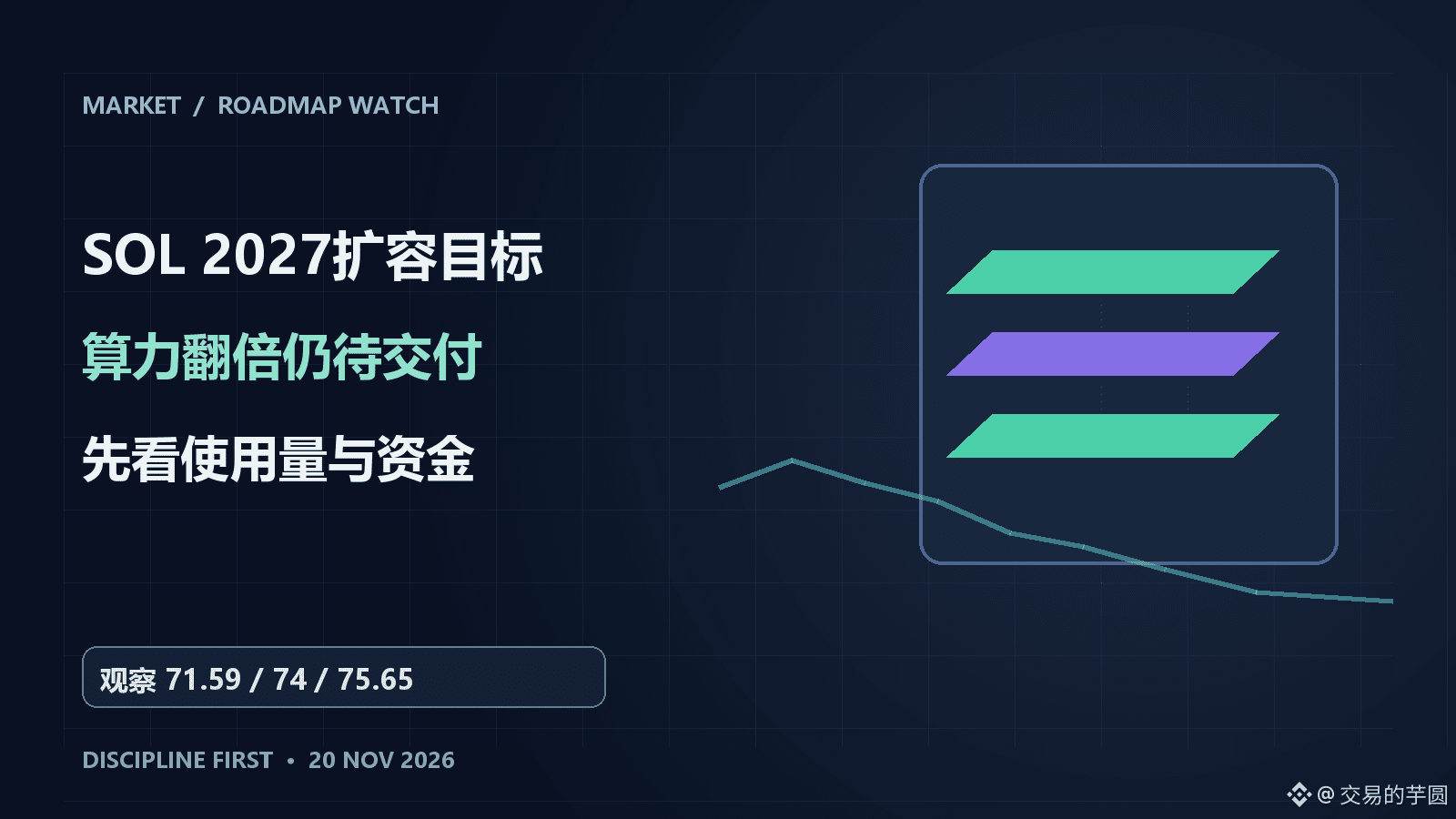
Solana scaling in focus|Doubling compute capacity remains a 2027 target|For SOL, watch usage and fund flows first
I’m leaning defensive. The trending topic #Solana2027RoadmapTargetsDoubleComputeCapacity is still being discussed on Binance Square. The 2027 plans Solana outlined during Breakpoint include increasing the network’s compute capacity and reducing the compute costs of token-account operations. These are engineering goals and roadmap items, not evidence that the mainnet has already been scaled up today. The foundation’s earlier announcement that it would retire the “mainnet-beta” label was merely an update to how the protocol version is described; it should not be conflated with a future performance target as if it were an upgrade already delivered. Describing a “target to double capacity” as “current throughput has doubled” would mislead people about the network’s ability to handle activity.
The mechanism I’m watching is this: greater capacity could allow more applications to compete for block space and could also make individual transactions cheaper. But growth in network usage can become a more durable source of support for SOL demand only if real transactions, stablecoin settlements, developer retention, and validator economics all improve at the same time. If fees per transaction fall faster than actual usage grows, total fees may not increase. Staking demand also doesn’t mean risk-free returns; validator operations, unstaking, and price volatility all need to be factored into net returns. The roadmap may shape expectations, but those expectations need to be validated by on-chain data and real products going live.
The market’s feedback so far is not strong. At the time of observation, SOL/USDT on Binance was around $72.42, down about 3.21% over 24 hours, with a low of $71.59 and a high of $75.65. Farside’s November 19 U.S. SOL fund table showed total net outflows of about $1.1 million. That amount is limited relative to the overall market, and the automatically updated table may still be revised, but at the very least, it cannot be described as a large institutional net-buying wave. The $74 recovery condition I was watching earlier has still not been met, so I won’t chase a rebound in today’s decline just because of a 2027 target. If the price reclaims and holds above $74, then breaks through $75.65, the short-term bearish view would ease. If $71.59 gives way, my previous support assumption is invalidated.
If I were trading it myself: I’d stay out for now and keep only a spot-long plan, with a position cap of 5% of total capital and no leverage. I’d need to see SOL move above $74, hold that level on a retest, and fund flows stop deteriorating before entering in two tranches. The first target is $75.65 and the second is $78. I’d sell half at the first target and move the protective stop up on the rest of the position. I’d stop out if the price falls back below $72; if it breaks below $71.59 before entry, I’d cancel the plan outright. If official development progress later stalls, actual on-chain usage fails to follow through, or the price falls back below $74 after entry and loses support, I’d close the position and reassess. A plan that has not been triggered does not mean I have bought or made a profit.
#Solana2027RoadmapTargetsDoubleComputeCapacity #SOL
The above is solely my personal market observation and does not constitute investment advice.