The liquidation data is out. How much did the bulls lose on CPI night? I’ll give you the numbers first, then the verdict.
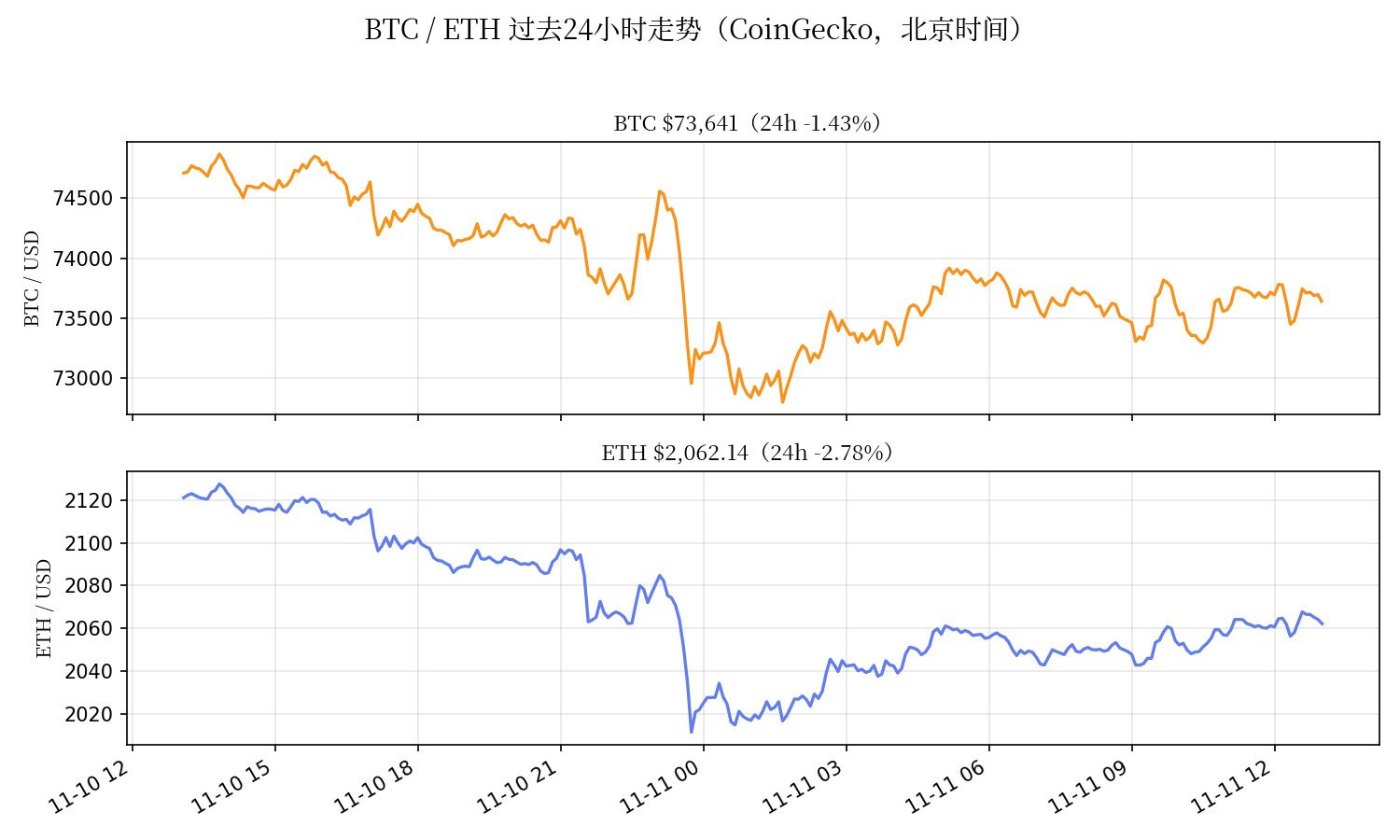
13:00: $BTC was about $73,615, down 1.5% over 24 hours; $ETH was about $2,062, down 2.7% over 24 hours (actual figures from CoinGecko). Prices have mostly stayed around $73,600, and the 4-hour candle closing at 12:00 ended at about $73,695—the 14th consecutive close below $75,000. The breakdown is looking more and more real.
First, liquidations (CoinGlass data, reported by crypto.news): In the 24 hours after the CPI release, total crypto liquidations were about $723 million, including roughly $570 million in longs—nearly 80% of the total. Around 116,000 traders were liquidated; BTC alone accounted for $203 million, of which $175 million was in longs. About $178 million in longs were liquidated within the first hour after the data came out (Coin360). In plain English: last night’s sharp move wasn’t retail traders running for the exits; it was forced liquidations of leveraged longs driving the price down.
Next, funding rates (Swolecharts’ snapshot from this morning): BTC perpetual funding was about 0.0093% per 8 hours, or roughly 10% annualized, meaning longs are still paying shorts. But $ETH funding has turned negative, to around -0.0034% per 8 hours—shorts are paying longs, and ETH shorts are starting to get crowded. BTC open interest on Hyperliquid fell 6.4% over 24 hours to $2.96 billion, with a long-to-short ratio of 3 to 97 (Faro.io data)—extremely bearish. The takeaway: one round of leverage has already been flushed out. Longs are less crowded, but nobody dares to go heavily long either.
Short position tracker #28: Shorts opened on November 7 at 13:00 between $75,800 and $76,100, with a midpoint entry of $75,950. At the current price of $73,615, the price is down 3.07%; on 100x leverage, the remaining half has an unrealized gain of about +307% (it was +309% at 11:00, essentially unchanged). The added short position ($74,700–$75,000, midpoint entry $74,850) is up about +165% (it was +167% at 11:00). The half already closed has locked in gains: +362% on the original position and +220% on the added short. To be honest, this trade is still in profit. The $77,500 stop-loss and the invalidation level of a 4-hour close above $76,250 have both stayed untouched.
The plan hasn’t changed: keep holding the remaining half, with a second target at $68,000. The next stop on the way to $68,000 is still the 200-day moving average around $71,500–$72,500; the overnight low of $72,840 wasn’t far off. A rebound to $75,300–$75,500 is still my zone to add to the short. If price breaks below $71,500 and can’t reclaim it on a 4-hour close, I won’t chase the short; I’ll hold and wait for $68,000. I’ll only consider flipping long if price gets back above $78,000 and holds there. I’m allocating only a very small portion of my total capital to 100x leverage.
One more thing to note: this is the third consecutive month that CPI has come in above expectations. The probability of a 25-basis-point rate hike in December is 88.3%, and the probability of a 50-basis-point hike is 11.7% (CME FedWatch). On Friday, November 13, we also have PPI and the expiry of 33,902 BTC options (max pain at $77,000).
Among the trending coins, ZEC is still falling, down 11.1% in a day, while INIT is up 45% in a day (with a market cap of just $70 million). Small-cap coins are only a sentiment gauge; I’m staying away.
The bulls got washed out to the tune of $700 million. Do you think shorts are too crowded now, or is the next wave of liquidations still to come? Let’s discuss in the comments. (Prices: actual CoinGecko figures at 13:00 Beijing time on November 11; chart shows the past 24 hours.)