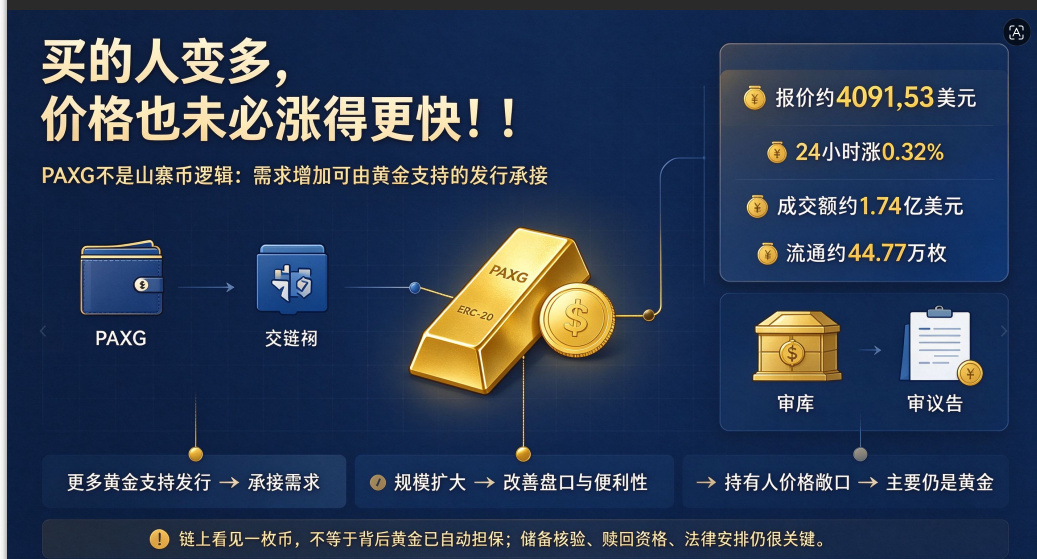
More buyers don’t necessarily mean prices will rise faster!!😀😀
When looking at gold on-chain, the easiest mistake is to apply the logic of altcoins: more users, more money flowing in, so the coin should go up. PAXG doesn’t quite work that way. Its goal is for the token to stay close to the value of the gold it represents. A large premium over the long term could instead signal friction in trading or redemption.
Its original purpose was practical: physical gold is hard to divide and transport, so why not split the gold in a vault into small, transferable portions in a wallet? Under Paxos’s design, each PAXG represents one troy ounce of allocated gold. The token serves as proof of rights to gold; it is neither stock in the issuing company nor a governance token that pays dividends through voting.
The technology handles record-keeping, division, and transfer. ERC-20 lets gold-backed rights connect to Ethereum wallets and apps, but it doesn’t move the vault onto the blockchain. Custody, reserve verification, redemption eligibility, and legal arrangements still depend on real-world institutions. Seeing a token on-chain can’t replace checking the gold behind it.
The page currently lists a price of about $4,091.53, up 0.32% over 24 hours, with trading volume of about $174 million and a circulating supply of roughly 447,700 tokens. Trading volume isn’t newly invested money, and circulating supply isn’t the number of holders, but these figures at least give a sense of actual issuance and trading activity. The more meaningful form of “community support” here is sustained trading, holding, and demand for access—not the number of people calling for a buy in a group chat.
Paxos has published a reserve attestation report for the end of September, issued on October 23. The report verifies reserves at a specific point in time; it can’t be taken as a blanket guarantee for every part of the system today.
That’s the key point: additional demand can be met by issuing more tokens backed by gold, rather than all of it being squeezed into a price increase for each token. Growth in scale may first improve order-book liquidity and ease of use. Holders’ primary price exposure remains to gold.
Over the next three to six months, if reserve reports continue to be updated, trading depth improves, and the premium or discount to gold remains stable, PAXG is more likely to become a useful on-chain gold tool. If its scale grows but bid-ask spreads and redemption friction don’t improve, that growth deserves a discount.
When researching RWA, don’t just ask whether an asset is on-chain. Ask what additional rights holders actually gain once it’s on-chain—and what risks they take on.
#PAXG #RWA
When looking at gold on-chain, the easiest mistake is to apply the logic of altcoins: more users, more money flowing in, so the coin should go up. PAXG doesn’t quite work that way. Its goal is for the token to stay close to the value of the gold it represents. A large premium over the long term could instead signal friction in trading or redemption.
Its original purpose was practical: physical gold is hard to divide and transport, so why not split the gold in a vault into small, transferable portions in a wallet? Under Paxos’s design, each PAXG represents one troy ounce of allocated gold. The token serves as proof of rights to gold; it is neither stock in the issuing company nor a governance token that pays dividends through voting.
The technology handles record-keeping, division, and transfer. ERC-20 lets gold-backed rights connect to Ethereum wallets and apps, but it doesn’t move the vault onto the blockchain. Custody, reserve verification, redemption eligibility, and legal arrangements still depend on real-world institutions. Seeing a token on-chain can’t replace checking the gold behind it.
The page currently lists a price of about $4,091.53, up 0.32% over 24 hours, with trading volume of about $174 million and a circulating supply of roughly 447,700 tokens. Trading volume isn’t newly invested money, and circulating supply isn’t the number of holders, but these figures at least give a sense of actual issuance and trading activity. The more meaningful form of “community support” here is sustained trading, holding, and demand for access—not the number of people calling for a buy in a group chat.
Paxos has published a reserve attestation report for the end of September, issued on October 23. The report verifies reserves at a specific point in time; it can’t be taken as a blanket guarantee for every part of the system today.
That’s the key point: additional demand can be met by issuing more tokens backed by gold, rather than all of it being squeezed into a price increase for each token. Growth in scale may first improve order-book liquidity and ease of use. Holders’ primary price exposure remains to gold.
Over the next three to six months, if reserve reports continue to be updated, trading depth improves, and the premium or discount to gold remains stable, PAXG is more likely to become a useful on-chain gold tool. If its scale grows but bid-ask spreads and redemption friction don’t improve, that growth deserves a discount.
When researching RWA, don’t just ask whether an asset is on-chain. Ask what additional rights holders actually gain once it’s on-chain—and what risks they take on.
#PAXG #RWA