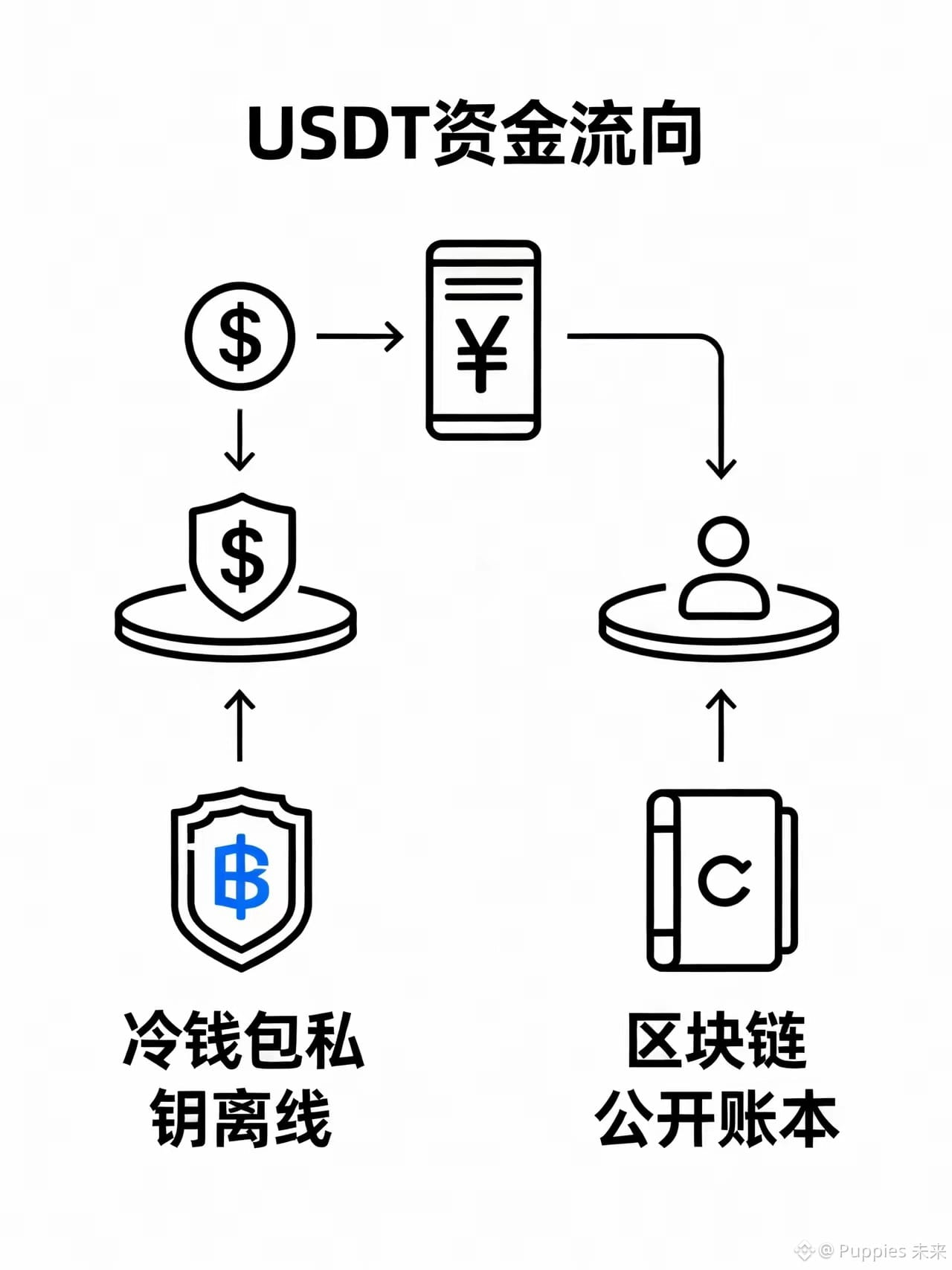
$PEPE $牛来 $币安人生 Can funds stored in a cold wallet really not be traced?
If you convert hundreds of millions in funds into USDT, put it in a cold wallet, and entrust someone else to keep it, can it really not be traced?
A case report involving political and business connections placed two officials, a publicly listed company, and a lawyer in the same trail of funds.
Company executive E transferred USDT: one transaction of about 30 million USDT went to an account linked to official A, and another of about 15 million USDT went to an account linked to official B.
USDT, or Tether, is a stablecoin pegged 1:1 to the US dollar. After investigators began looking into the matter, they took control of a wallet linked to A. A wallet linked to B was later found by investigators in the possession of a third party.
In March, authorities publicly announced an investigation into A. Investigators subsequently took control of A’s cold wallet. Their investigation also expanded to six other wallets held by E and the movement of funds through them.
In April, investigators took B in for questioning. They searched B’s residence but found no leads to the wallet. In late April, investigators took lawyer C in for questioning. The parties concerned claimed that some of the funds were legal fees.
A and B are officials, D is the company’s actual controller, E is an executive, and C is a lawyer. Whether the financial dealings in this case involved an exchange of money for power, or whether other financial arrangements were concealed under the guise of legal services, is for investigators to determine based on the evidence.
Investigators advanced the case by cross-checking technical records against statements from individuals.
A cold wallet sounds like a “safe,” but the key issue is how the private key is kept. The blockchain stores asset balances and transaction records; this information is not stored in the hardware wallet.
In other words, a cold wallet simply keeps the private key offline and disconnected from the internet, but transaction records remain on the public ledger. Anyone who knows the relevant address can look up transfers and receipts; no private key is needed.
If someone else has the private key, they effectively control the assets. “Cold” only reduces the risk of the private key being exposed online; it does not automatically hide on-chain activity.
Also, exchanges between fiat currency and virtual currency are often linked to real-world accounts and on-chain addresses. When funds enter or leave a legitimate platform, traceable information may still be left behind.
So entrusting large amounts of virtual currency to someone else for safekeeping does not mean you have an untraceable safe. Once the private key is no longer under the holder’s control, the risk shifts as well.#股票财报季