

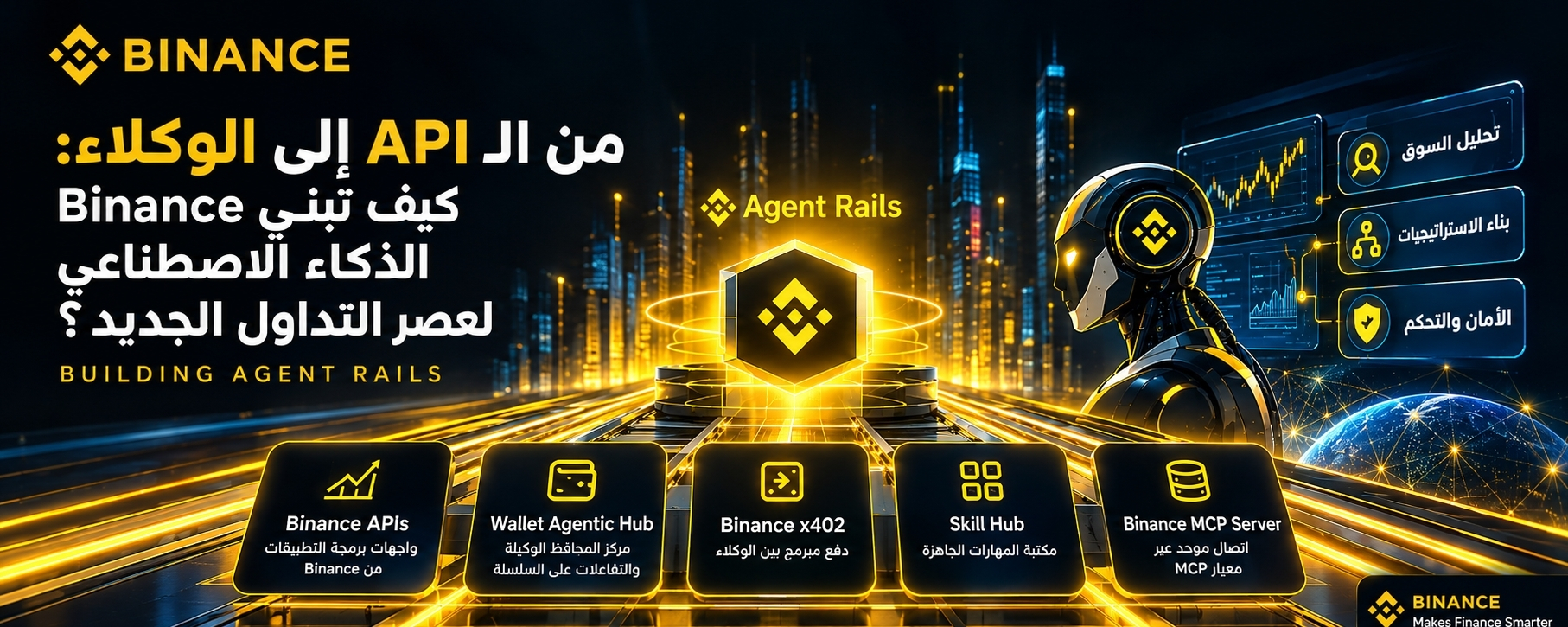

This week, Binance chose “Building Agent Rails” as the theme for its Word of the Day (WOTD) competition.
The phrase may sound technical, but behind it lies an important shift in how we interact with money.
If the API era allowed programs to connect to platforms, Agent Rails aims to build the infrastructure that enables AI agents to understand data, use tools, and carry out tasks within boundaries set by humans.
And this is where Binance Agent OS comes in.
What are Agent Rails?
Imagine AI becoming a digital employee that can read the market, analyze data, and carry out a task.
The problem isn’t its ability to work, but the more important question:
What is it allowed to do? Where do its permissions end?
That’s where the “rails” come in.
Rails are a set of permissions, limits, separate accounts, and control mechanisms that prevent an agent from straying beyond the path you’ve set for it.
Binance Agent OS: The infrastructure
Binance launched Agent OS on August 20, 2026, as a platform for developers to build applications and AI agents capable of interacting with Binance services.
The ecosystem brings together several components, including:
• Binance APIs for accessing market data and supported functions.
• Binance MCP Server as a unified connectivity layer that uses the Model Context Protocol standard, allowing compatible tools such as ChatGPT, Claude, Codex, Cursor, and VS Code to connect to Binance services once authorized.
• Wallet Agentic Hub for wallet-related interactions and on-chain operations.
• Binance x402 for programmable payments between agents.
• Skill Hub, which provides skills and capabilities developers can use to build their agents.
This means developers don’t need to build a separate connection for every function; instead, they get a more unified environment for building agent-based financial applications.
But why does this matter to traders?
It’s not simply that AI can now trade.
The more important change is the shift from:
Ask AI → Get an answer → Execute it yourself
To:
Request → Analyze → Use tools → Execute within authorized permissions.
That’s a big difference.
Three guardrails Binance is trying to put in place
1️⃣ Isolated sub-account
The agent is designed to operate within a separate Agentic Sub-account, isolated from the main account.
Funding is controlled by the user; the agent can’t simply withdraw money from your main account into its designated account.
The idea is simple:
If you want to give an agent $500, you don’t automatically give it access to your entire portfolio.
2️⃣ No external withdrawals through MCP
This is one of the most important security limits.
According to Binance’s documentation, Binance MCP Server does not provide permission to withdraw to an external address.
Depending on its permissions and eligibility, the agent can access market and account data, execute supported trades, and make transfers within the sub-account. But withdrawing funds to an external wallet is not within MCP’s permissions.
3️⃣ Permissions are set by the user
You can define the scope of what the agent can access, such as market data, account information, trading functions, and internal transfers.
Binance also provides tools for managing and stopping agents, including Emergency Stop, which can be used to halt agent activity and cancel open orders according to the account’s operating rules.
And here we see an important principle:
The agent can operate, but the human sets the limits of its activity.
Notably, current usage still leans toward reading
It may be easy to imagine millions of agents trading independently.
But the current data tells a different story.
According to Binance Research, 98% of the most-used Agent OS calls are related to reading, not trading.
Agent OS has also surpassed 280,000 requests per day, with activity rising significantly since its launch.
And that makes sense.
First, users need an agent that can:
Monitor → Gather data → Analyze → Alert
Before giving it permission to:
Trade on their behalf.
Is Binance alone in this race?
No.
The crypto sector is seeing a broader trend toward enabling agents to access financial services and carry out tasks.
But what sets Agent OS apart is Binance’s effort to bring access to market, account, and trading data together with wallet and payment tools and other capabilities in one ecosystem.
This means that future competition may not be just about:
Who has the best AI model?
But perhaps instead:
Who has the best infrastructure for enabling AI to operate safely within the financial system?
But there’s one thing we must not forget
Agent OS can give an agent tools.
But it can’t give it the ability to predict the future.
An agent can read market data faster than a human and execute a strategy precisely, but it can also execute a bad strategy quickly and without hesitation.
That’s why “rails” don’t mean trading has become safe.
They mean risk limits can be designed before the agent starts operating.
In summary
Building Agent Rails isn’t a story about a new trading bot.
It’s a story about building the infrastructure for an era in which AI may become a new interface for interacting with financial services.
In the past:
Human → Platform → Trade order
The new direction may be:
Human → Intelligent agent → Financial tools → Execution governed by permissions
If this model succeeds, the biggest change may not be that AI has become more intelligent.
It may instead be that money has become accessible through software agents operating according to rules set by humans.
And that is the essence of Building Agent Rails.
Before giving any agent permission to handle your money, understand exactly what it can access, test it with limited amounts, review its strategy and results, and don’t grant it more permissions than it needs.
As always, information can help you make a decision, but it can’t make the decision for you. Do your own research (DYOR) and assess the risks yourself before taking any financial action.
#BuildingAgentRails #BinanceIntelligence #AgentOS #AI #WOTD