



1) Executive summary
What Aave is. Aave $AAVE is an onchain lending network where users deposit assets to earn yield and borrow against their collateral, and the largest lending project onchain by active loans. It runs Aave V3 on more than a dozen networks, with Horizon as a dedicated V3 market for tokenized real-world assets; Aave V4 on five networks, including a dedicated instance that powers Ether.fi Cash; and the GHO stablecoin. Aave Labs leads development, and the Aave DAO, governed by AAVE holders, directs the markets and treasury.
Why onchain lending. Credit is the core business of traditional finance, and most of it runs through intermediaries whose balance sheets are opaque to the people funding them. Aave replaces that with programmatic markets in which collateral, outstanding loans, rates, and liquidations can be checked onchain at any time. Depositors earn what borrowers pay, minus a share kept by the Aave DAO as revenue.
The market and opportunity. Onchain lending is still a small fraction of conventional credit markets, but the collateral it accepts is widening from crypto assets to tokenized funds, gold, and stocks. The lending projects Token Terminal tracks held $26.9 B of active loans on average in September. Aave, the largest, accounted for 47.0% of that total, close to the rest of the sector combined.
The month. September extended the recovery that began in July: TVL, active loans, fees, revenue, and the AAVE market cap all rose, and monthly active users reached their highest level since February. Aave V4 set new all-time highs in the first full month of the Ether.fi Cash instance on OP Mainnet. Aave V4 also went live on Arc on September 16, and Coinbase Tokenized Stocks went live on Aave V4 on Base on September 25. Aave Labs launched the Aave MCP Server, and the Aave Savings Rate was raised.
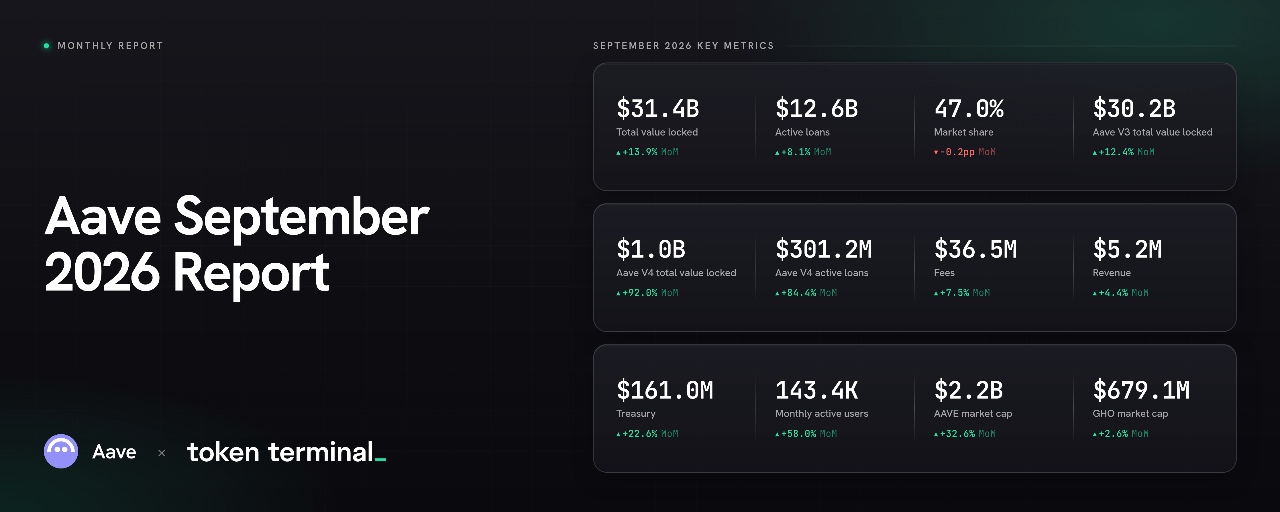
🔑 Key metrics (September 2026)
Total value locked: $31.4 B (+13.9% MoM, -55.2% YoY)
Active loans: $12.6 B (+8.1% MoM, -56.5% YoY)
Market share: 47.0% (-0.2 pp MoM, -17.4 pp YoY)
Aave V3 total value locked: $30.2 B (+12.4% MoM, -56.6% YoY)
Aave V4 total value locked: $1.0 B (+92.0% MoM)
Aave V4 active loans: $301.2 M (+84.4% MoM)
Fees: $36.5 M (+7.5% MoM, -65.7% YoY)
Revenue: $5.2 M (+4.4% MoM, -66.6% YoY)
Treasury: $161.0 M (+22.6% MoM, -45.2% YoY)
Monthly active users: 143.4 K (+58.0% MoM, +19.3% YoY)
AAVE market cap: $2.2 B (+32.6% MoM, -53.7% YoY)
GHO market cap: $679.1 M (+2.6% MoM, +127.4% YoY)
Metrics exclude Aave deployments not yet tracked by Token Terminal, including Mantle, Ink, X Layer and MegaETH.
👥 Aave Labs team commentary
"September was the biggest month yet for Aave V4. Deposits crossed $1 billion in mid-September, a new all-time high, and active loans passed $400 million by the end of the month. Aave V4 went live on Arc, the Layer 1 built by Circle for USDC, and PAXG went live on the Global Dollar Hub on Ethereum. The EtherFi Cash instance on OP Mainnet also completed its first full month.
Coinbase Tokenized Stocks went live on Aave V4 on Base in late September. Through the new Equities Hub, eligible users outside the U.S. can borrow USDC against seven tokenized stocks, including AAPLc, NVDAc, and TSLAc. We also published an ARFC for Custodied Collateral Lending, which would let institutions borrow stablecoins on Aave against assets held in custody at Anchorage, and announced that Aave V4's first RWA Hub is coming to Avalanche.
Aave V3 grew alongside V4, with TVL and active loans across Aave at their highest levels since April. The Aave V3 interface was fully redesigned to provide a better user experience. We also launched an Aave MCP, letting AI tools and agents read Aave data and prepare transactions on Aave V3 and V4. Lastly, Aave App early access expanded through September as we launched multi-chain deposits and onboarded users across several countries around the world."
2) TVL & active loans
Total value locked measures the total USD value of assets supplied to Aave's markets: for Aave V3, idle liquidity plus outstanding loans; for Aave V4, supply-side deposits. It is the broadest measure of how much capital the project's markets hold.
TVL averaged $31.4 B in September, up 13.9% MoM and down 55.2% YoY. It was a third consecutive monthly increase and the highest level since April. TVL across all projects tracked by Token Terminal rose roughly 6%, so Aave grew more than twice as fast as the wider market.
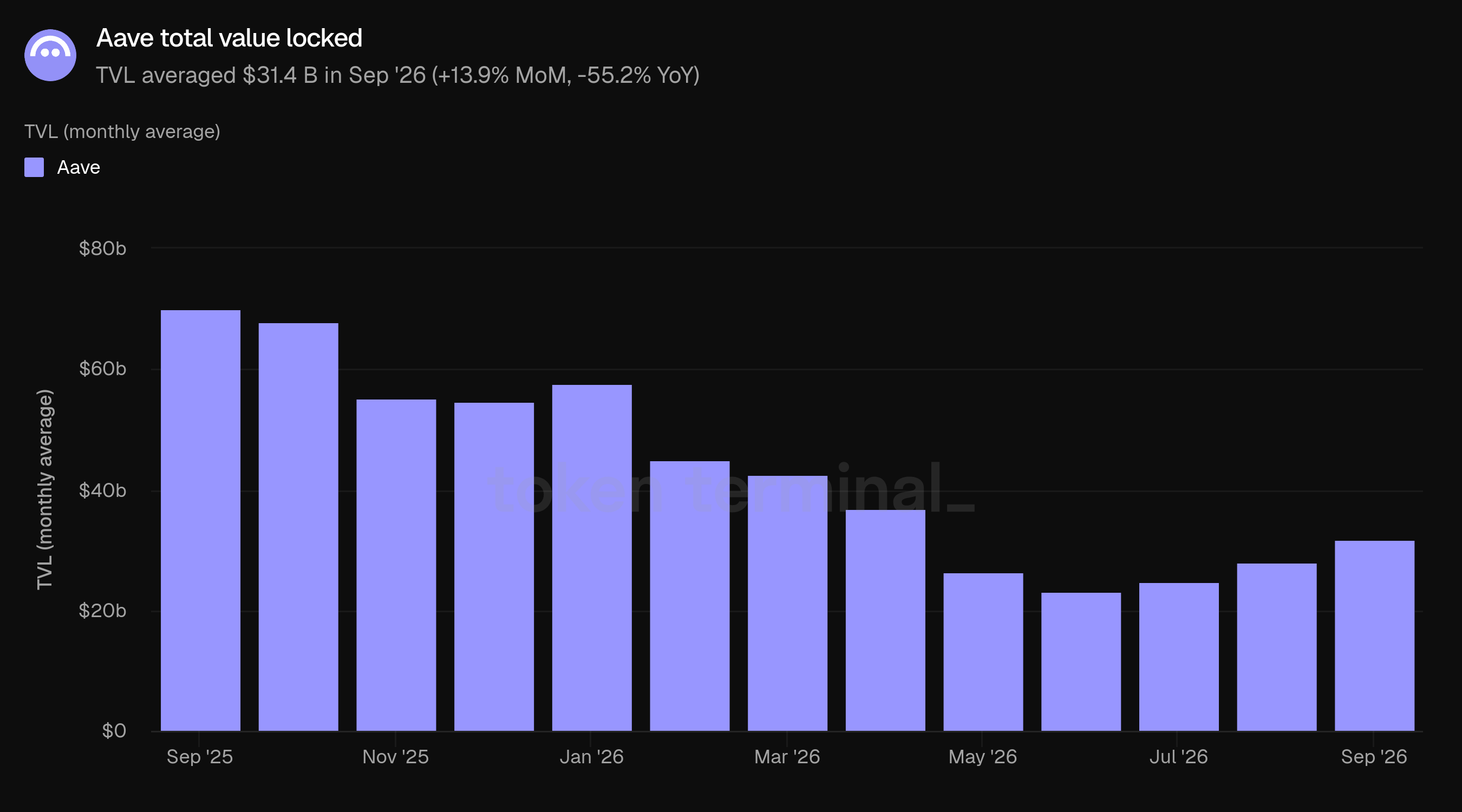
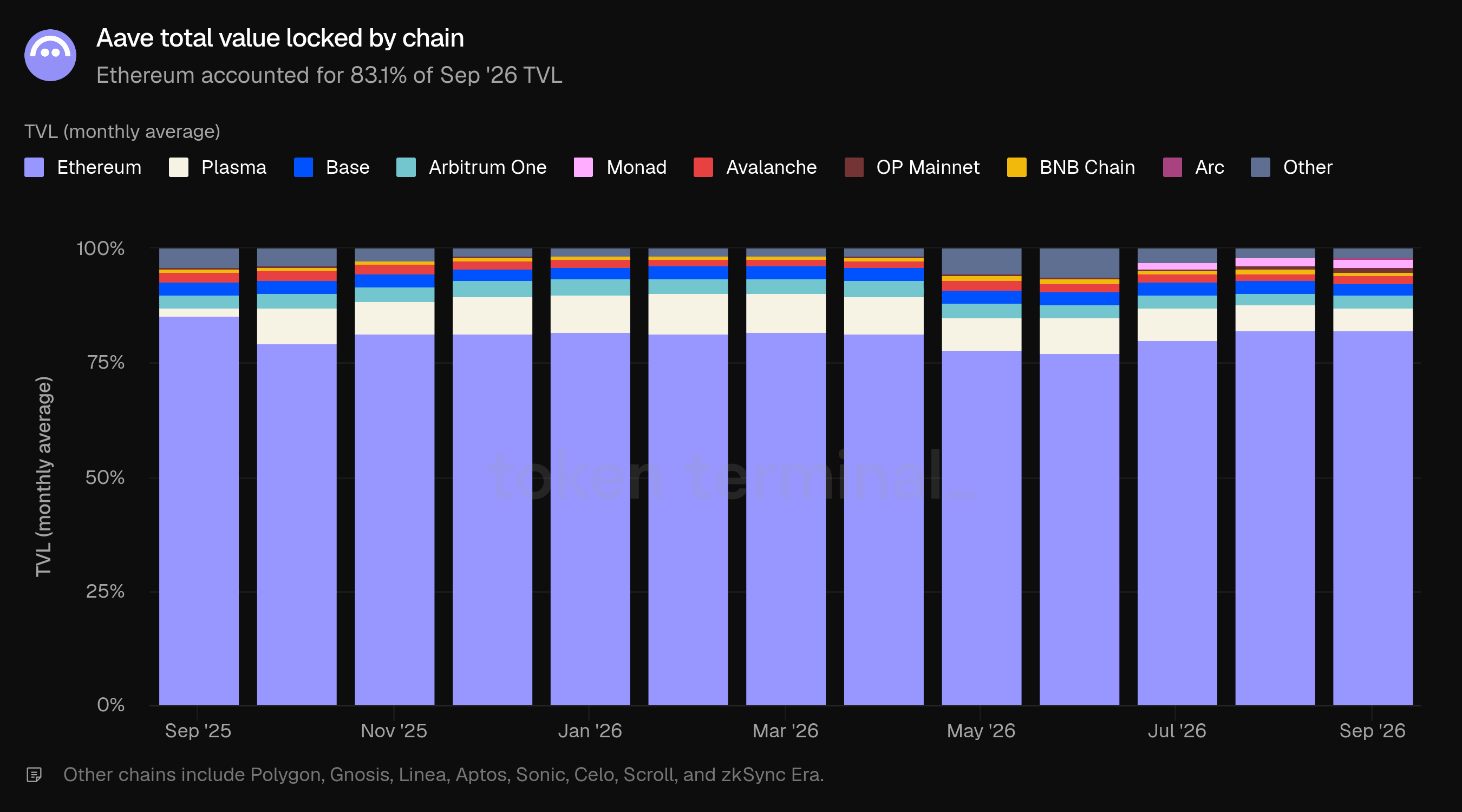
Ethereum accounted for 83.1% of September TVL ($26.1 B) and added about $3.2 B of the month's $3.8 B increase. The fastest growth came from the newer deployments: OP Mainnet roughly doubled to $361.8 M in the Ether.fi Cash instance's first full month, and Arc averaged $91.1 M after Aave V4 went live there on September 16.
Active loans measure the total USD value of outstanding borrows across Aave's markets, the part of deposits on which borrowers pay interest. TVL shows how much capital Aave holds; active loans show how much of it is put to work.
Active loans averaged $12.6 B in September, up 8.1% MoM and down 56.5% YoY, also a third consecutive increase and the highest level since April. Active loans across the lending sector rose about 9%, so Aave's loan book grew roughly in line with the sector.
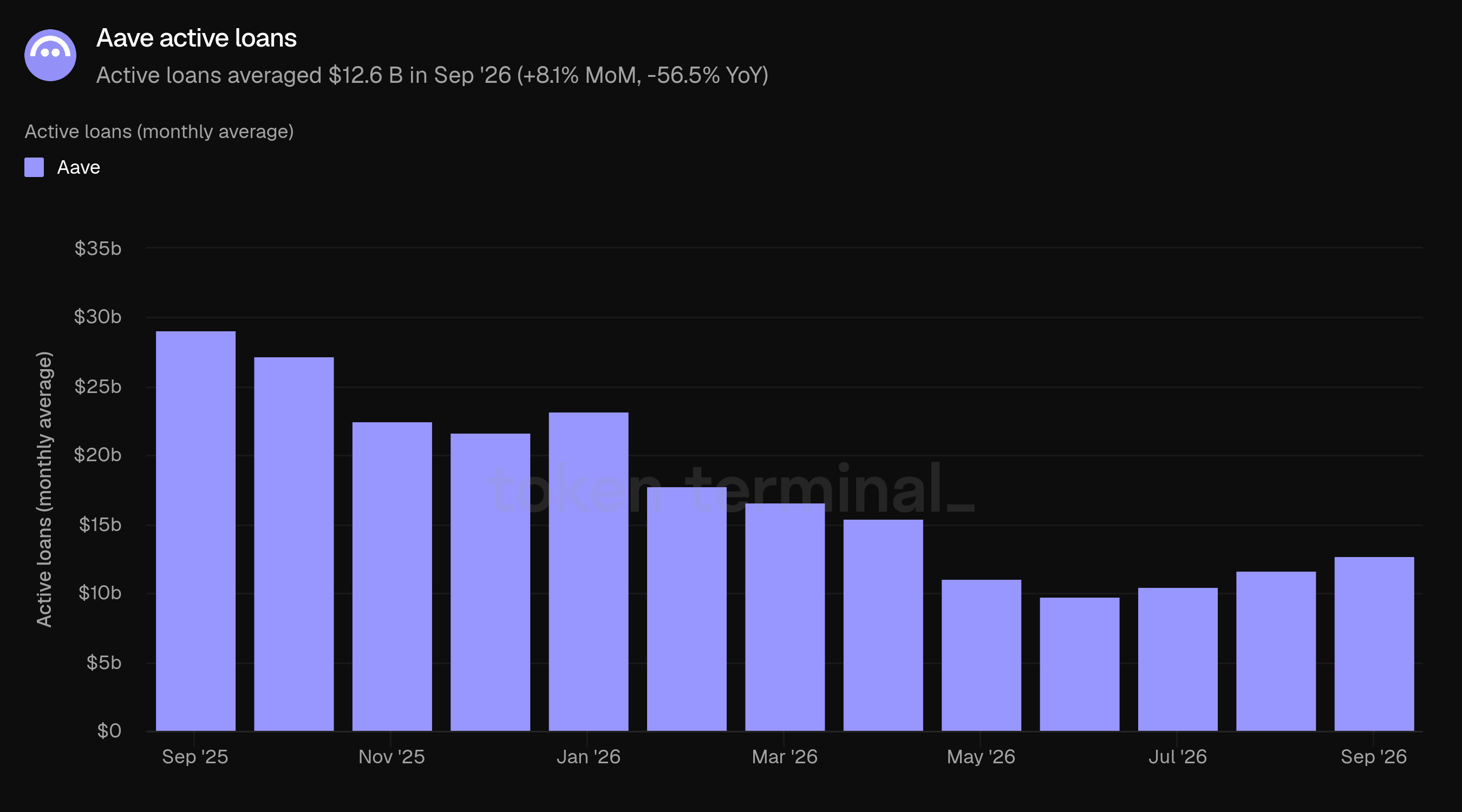
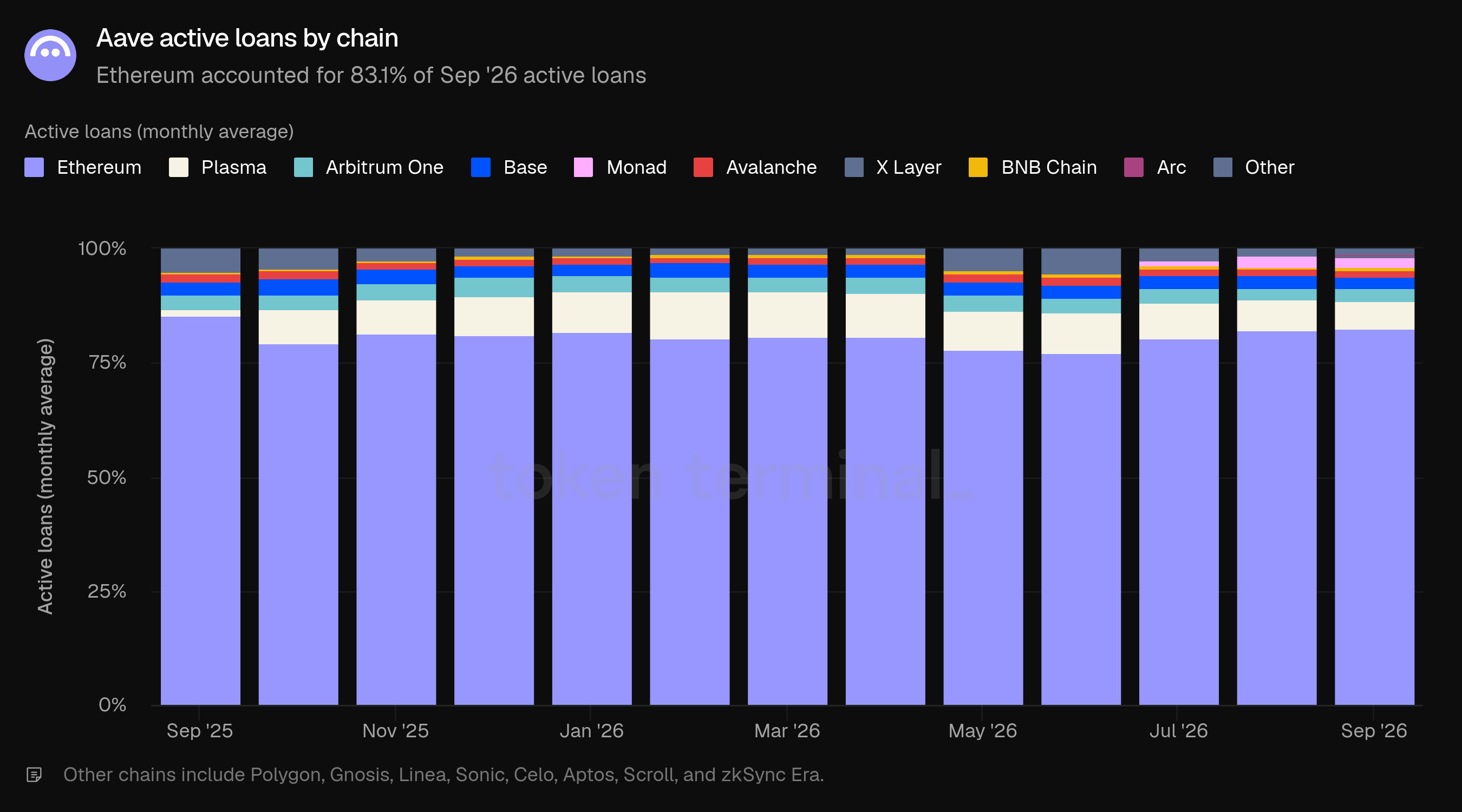
Ethereum accounted for 83.1% of September active loans ($10.5 B) and added about $880 M of the month's roughly $950 M increase. Active loans on OP Mainnet rose about 58% as borrowing on the Ether.fi Cash instance grew.
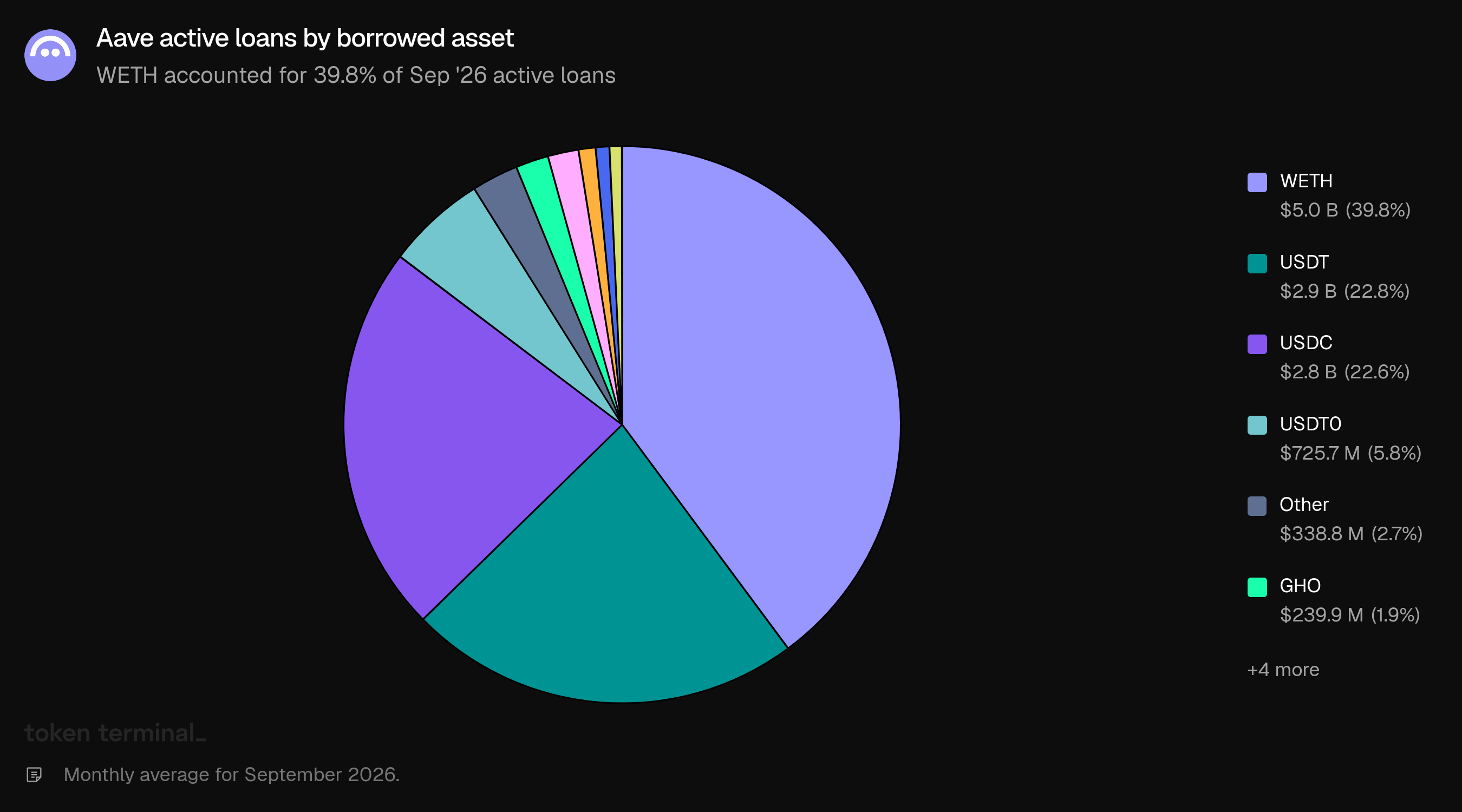
WETH was the largest borrowed asset, at 39.8% of September active loans ($5.0 B). USDT (22.8%) and USDC (22.6%) followed, and stablecoins together made up more than half of the loan book.
Market share measures Aave's share of active loans across the lending projects tracked by Token Terminal. Aave remained the largest lending project onchain in September, with 47.0% of lending-sector active loans, close to the rest of the sector combined. Its share was essentially unchanged from August (-0.2 pp MoM, -17.4 pp YoY), as Aave's loan book grew alongside the sector's.
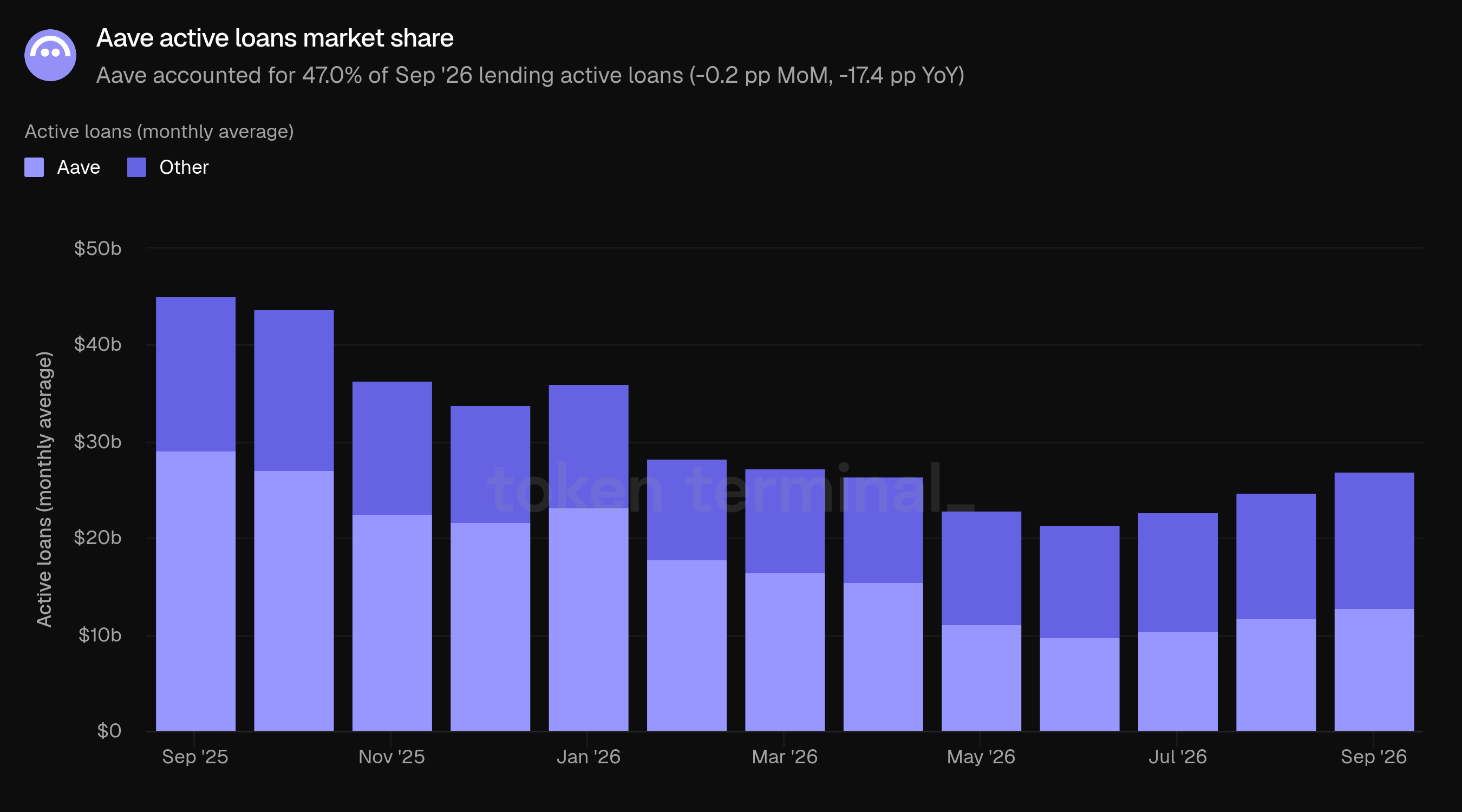
Aave's active loans were more than twice those of the next-largest lending project, and Aave has been the largest by active loans in every month of the past year. It also ranked first among lending projects by TVL.
Aave's lending runs mainly on two versions: Aave V3, the established markets, and Aave V4, the newer architecture where Aave is adding its latest markets.
3) Aave V3
Aave V3 is Aave's established set of markets, live on more than a dozen networks. Its markets fall into five groups: the Core market on Ethereum, the Prime market, Horizon for tokenized real-world assets, and markets on other L1 networks and on L2 networks.
Aave V3 TVL averaged $30.2 B in September, up 12.4% MoM and down 56.6% YoY, and every market group grew. Core, the largest group, accounted for most of the increase.
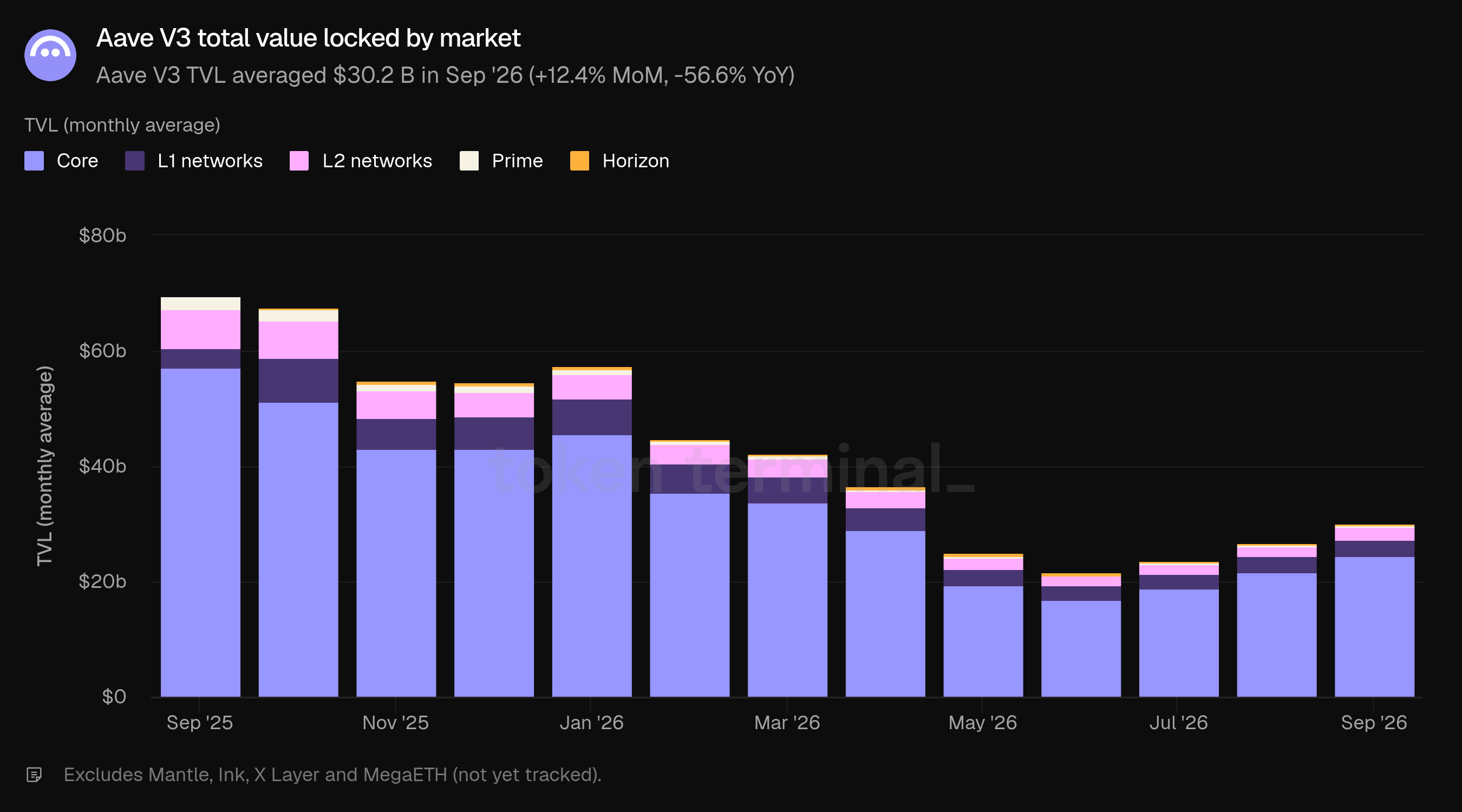
Horizon, where institutions borrow stablecoins against tokenized funds and treasuries, averaged $396.0 M of TVL, up 6.5% MoM and 216.9% YoY, roughly three times its level a year earlier.
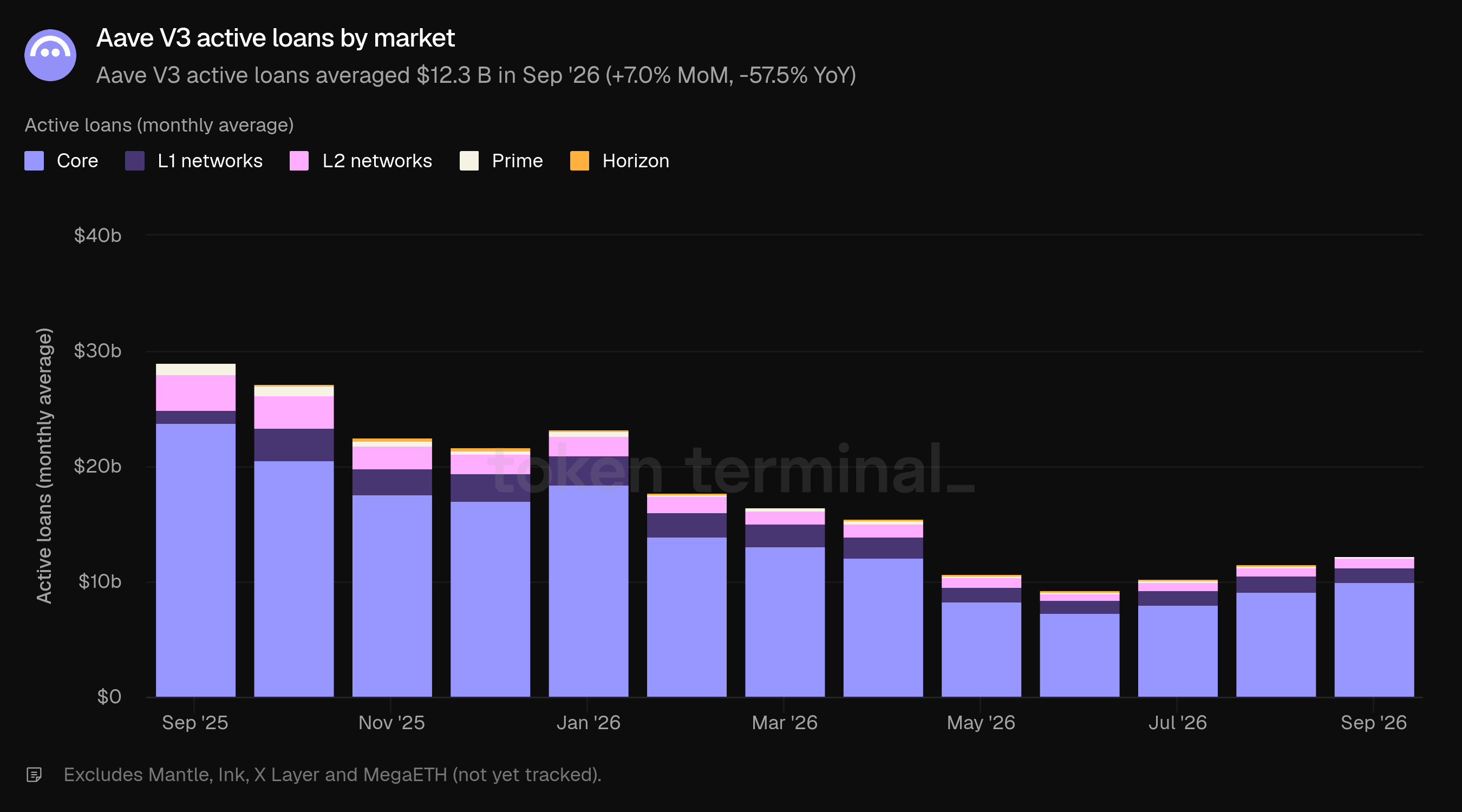
Aave V3 active loans averaged $12.3 B, up 7.0% MoM and down 57.5% YoY. Horizon's active loans grew faster than its TVL, up 17.2% MoM and 384.7% YoY to $135.0 M, so a larger share of the market's capital was borrowed.
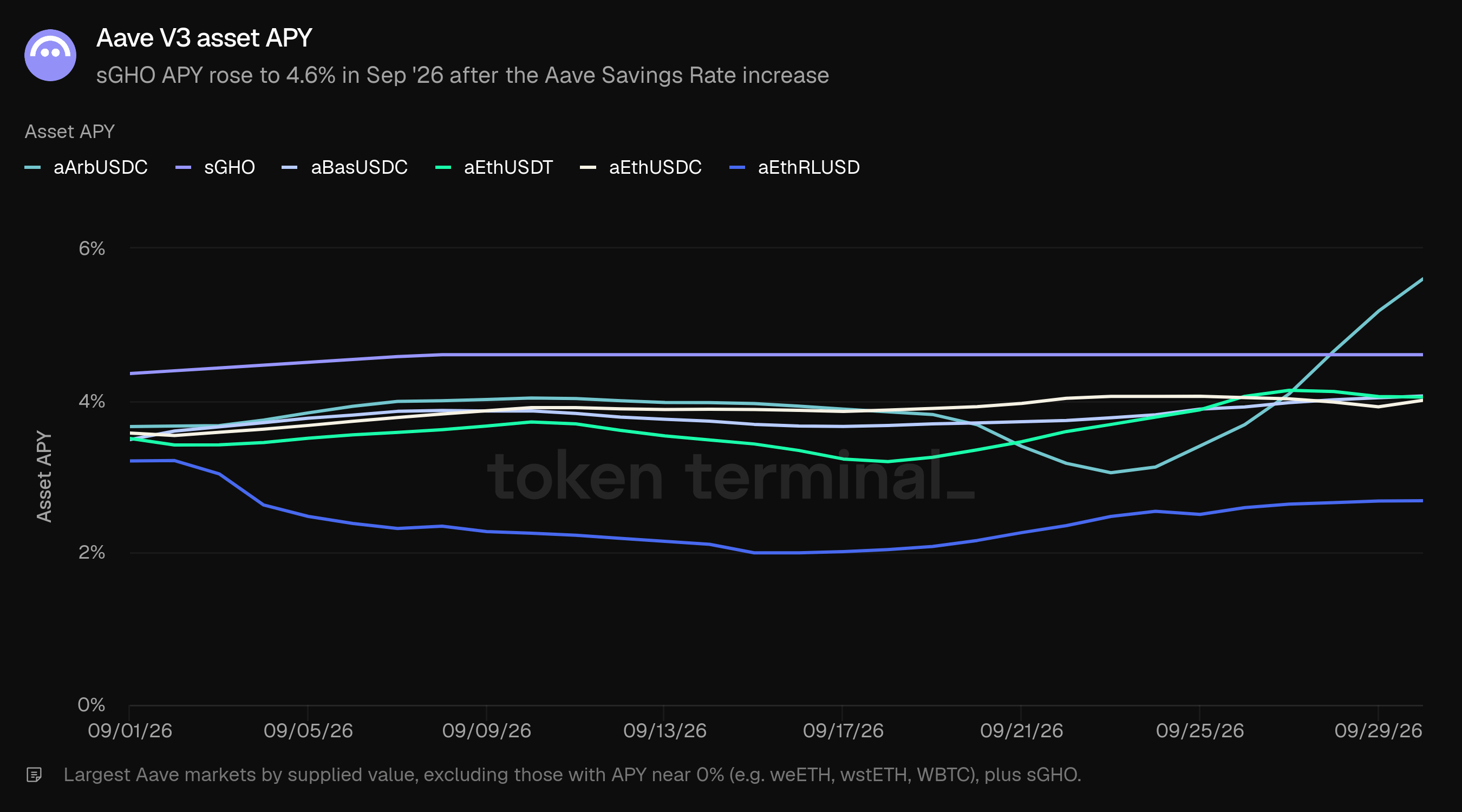
Asset APY measures the annualized yield earned by holding a yield-bearing token, from a standardized onchain yield index over a 7-day trailing window; for Aave it applies to aTokens and sGHO and is supply-side yield, not a borrow rate.
sGHO's APY moved up to 4.6% early in the month and held there. Unlike the other assets, whose yields move with borrowing demand, sGHO earns the Aave Savings Rate, which is set through governance and was raised from 4.25% to 4.50% APR under the GHO Stewards' August update (4.6% APY once compounded).
4) Aave V4
Aave V4 introduces a Hub and Spoke architecture in which shared Liquidity Hubs supply modular, risk-isolated Spokes, and it can be deployed as a dedicated instance for a single partner. It launched on Ethereum in late March 2026 and on Avalanche in July. September added Aave V4 on Arc, the Layer 1 blockchain built by Circle, on September 16, and an Equities Hub on Base for Coinbase Tokenized Stocks on September 25.
Ether.fi Cash is a payment card whose Borrow Mode funds purchases by borrowing a stablecoin against crypto the holder already owns. Since mid-August that borrowing has run on a dedicated Aave V4 instance operated by Ether.fi on OP Mainnet.
Aave V4 TVL averaged $1.0 B in September, up 92.0% MoM, and ended the month at $1.3 B, an all-time high.
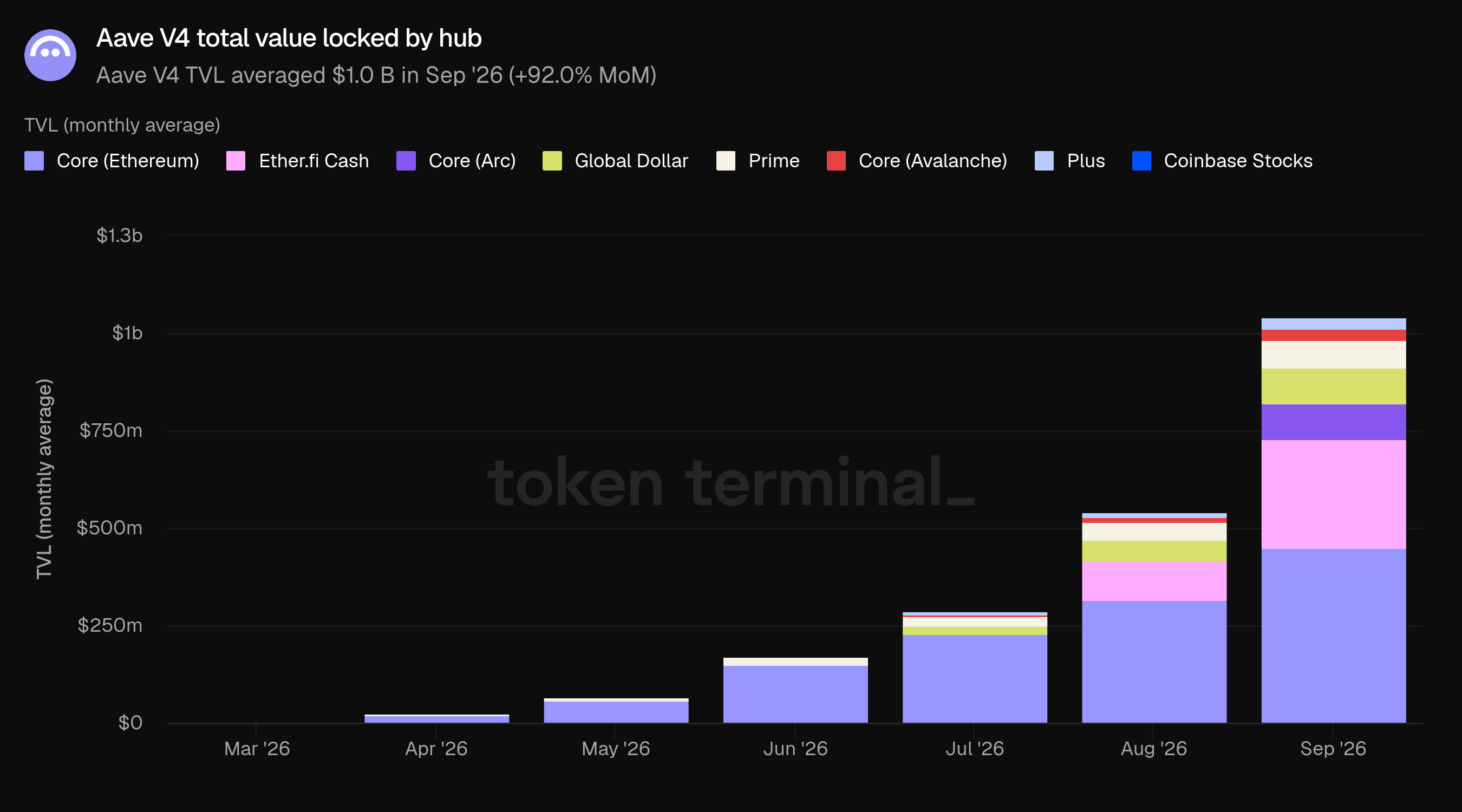
Core (Ethereum) remained the largest hub at $448.6 M, but Ether.fi Cash added the most, nearly tripling to $279.1 M in its first full month. Core (Arc) averaged $91.1 M over its first two weeks and held nearly a fifth of Aave V4 TVL by the end of September. Coinbase Stocks went live on September 25, six days before month-end.
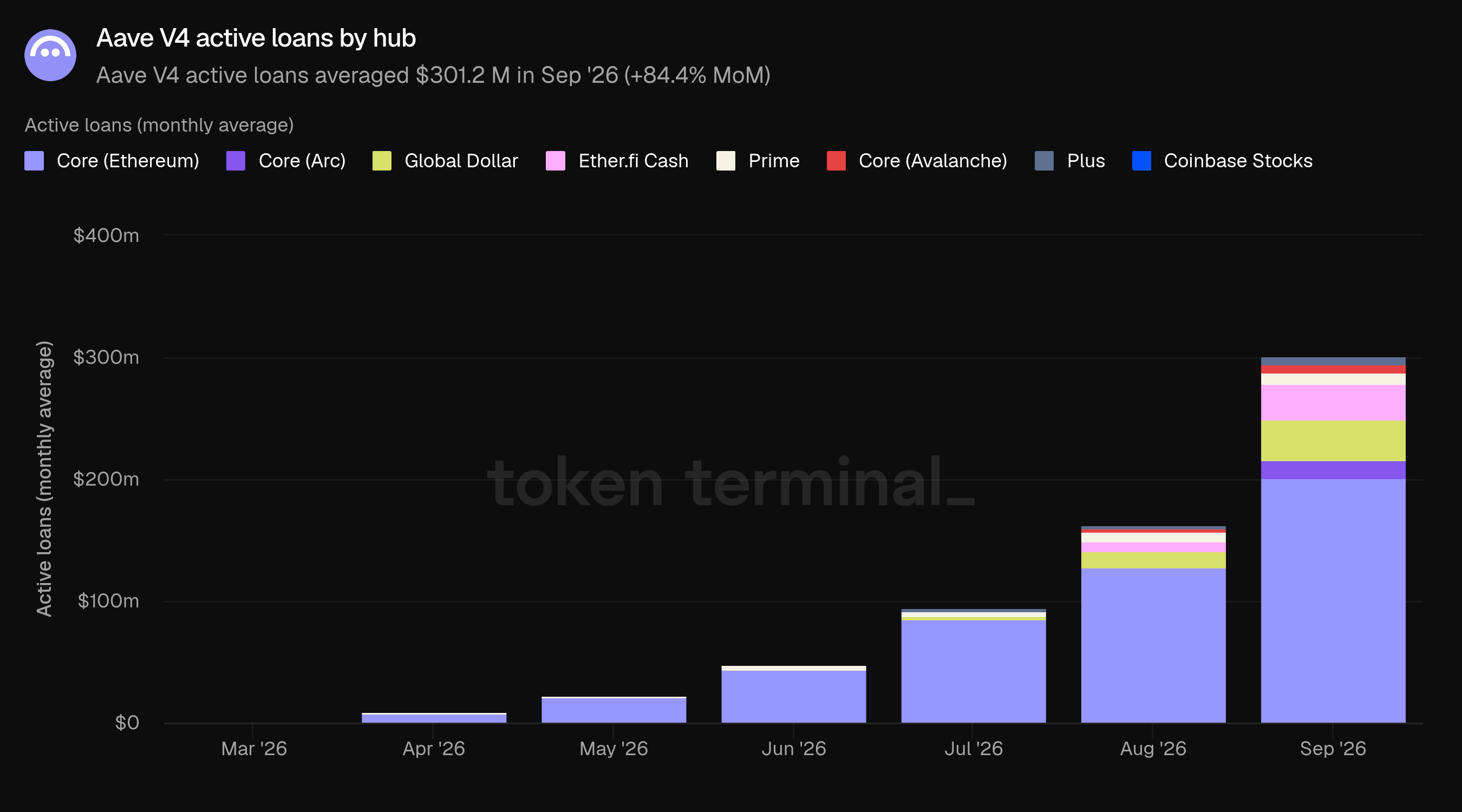
Aave V4 active loans averaged $301.2 M in September, up 84.4% MoM, and ended the month at $402.7 M, also an all-time high. Core (Ethereum) accounted for two-thirds of the total.
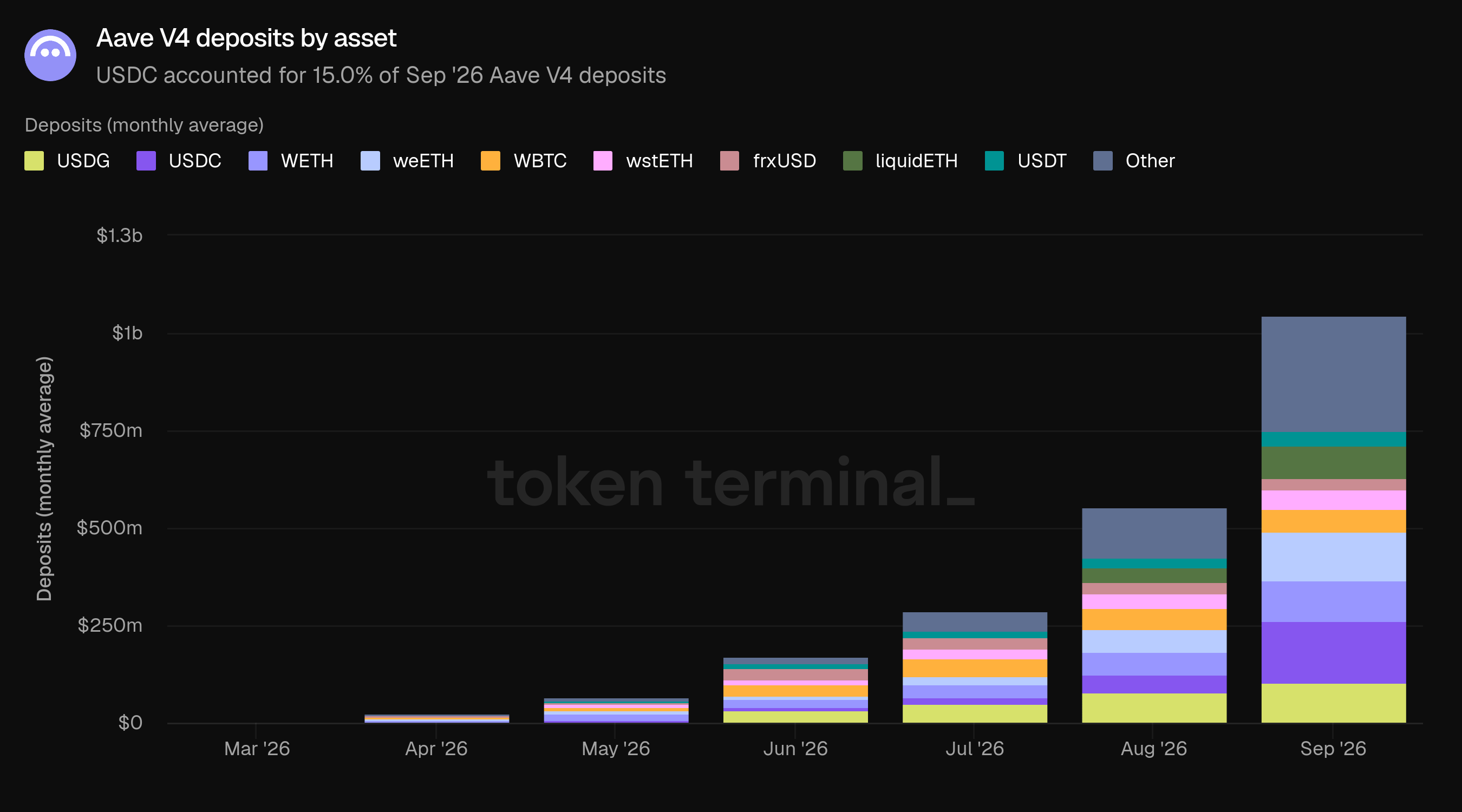
Deposits measure the total USD value of assets supplied to Aave's markets; for Aave V4 they equal TVL, broken down by asset. USDC was the largest Aave V4 deposit asset in September, at 15.0% ($156.8 M), up from fifth place in August after roughly tripling.
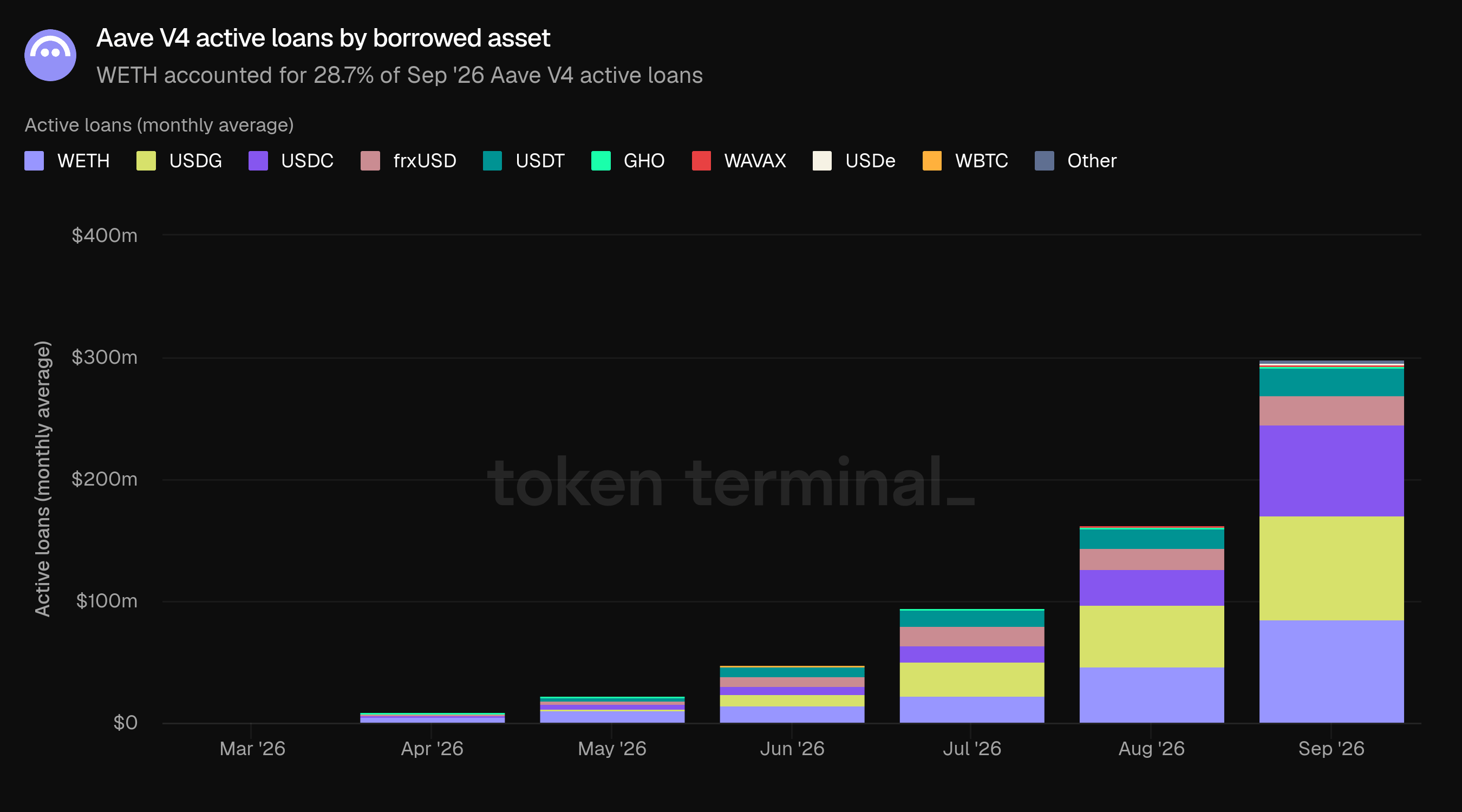
WETH and USDG were the largest borrowed assets on Aave V4, at 28.7% and 28.4% of September active loans, with USDC close behind at 25.4%. USDC borrowing more than doubled over the month.
Borrowing on Aave V4 is spread more evenly than on Aave as a whole, where WETH alone accounts for 39.8% of active loans.
5) Economics
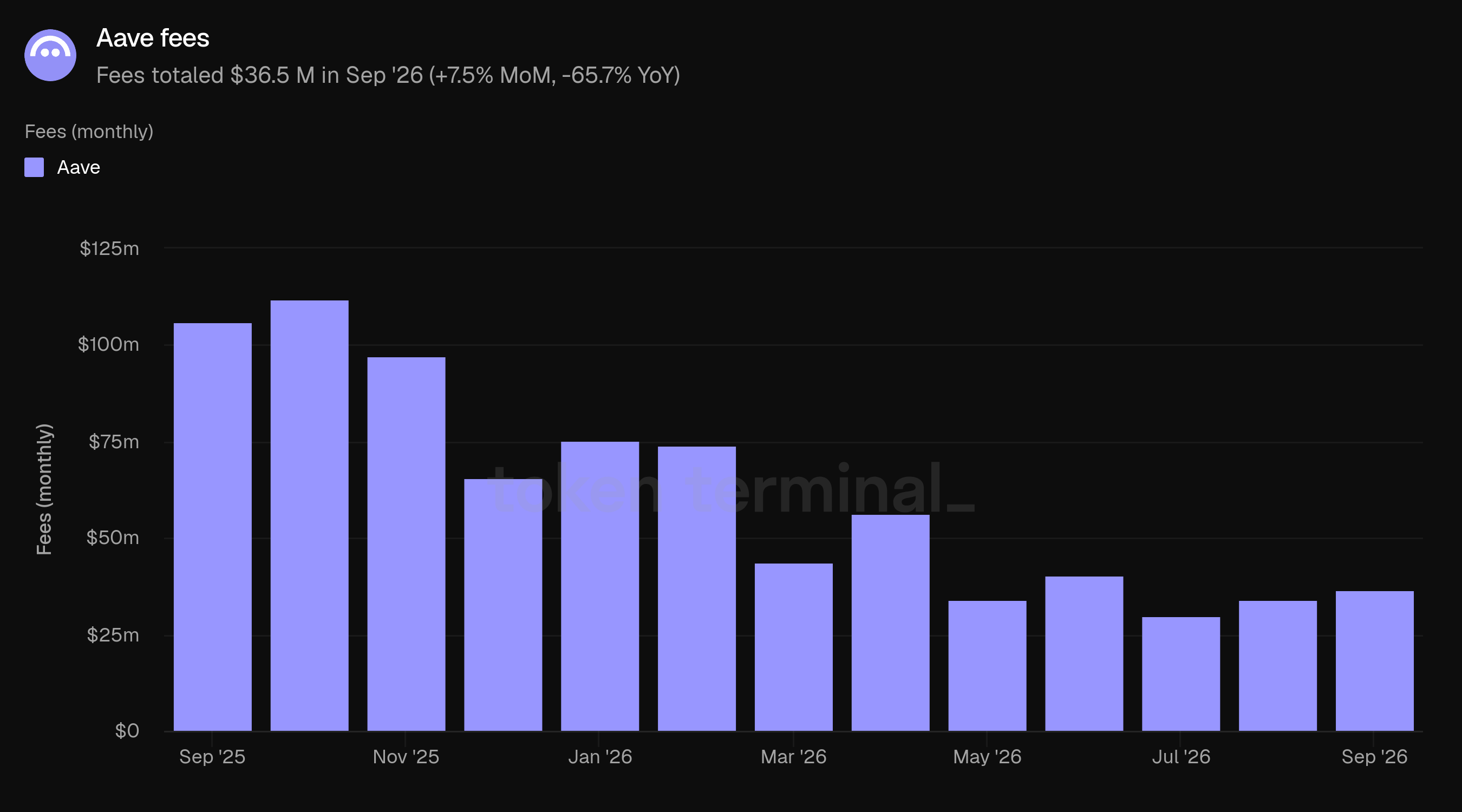
Fees measure the total USD value paid by users of Aave's markets, mostly interest paid by borrowers. Fees totaled $36.5 M in September, up 7.5% MoM and down 65.7% YoY, a second consecutive increase and the highest total since June.
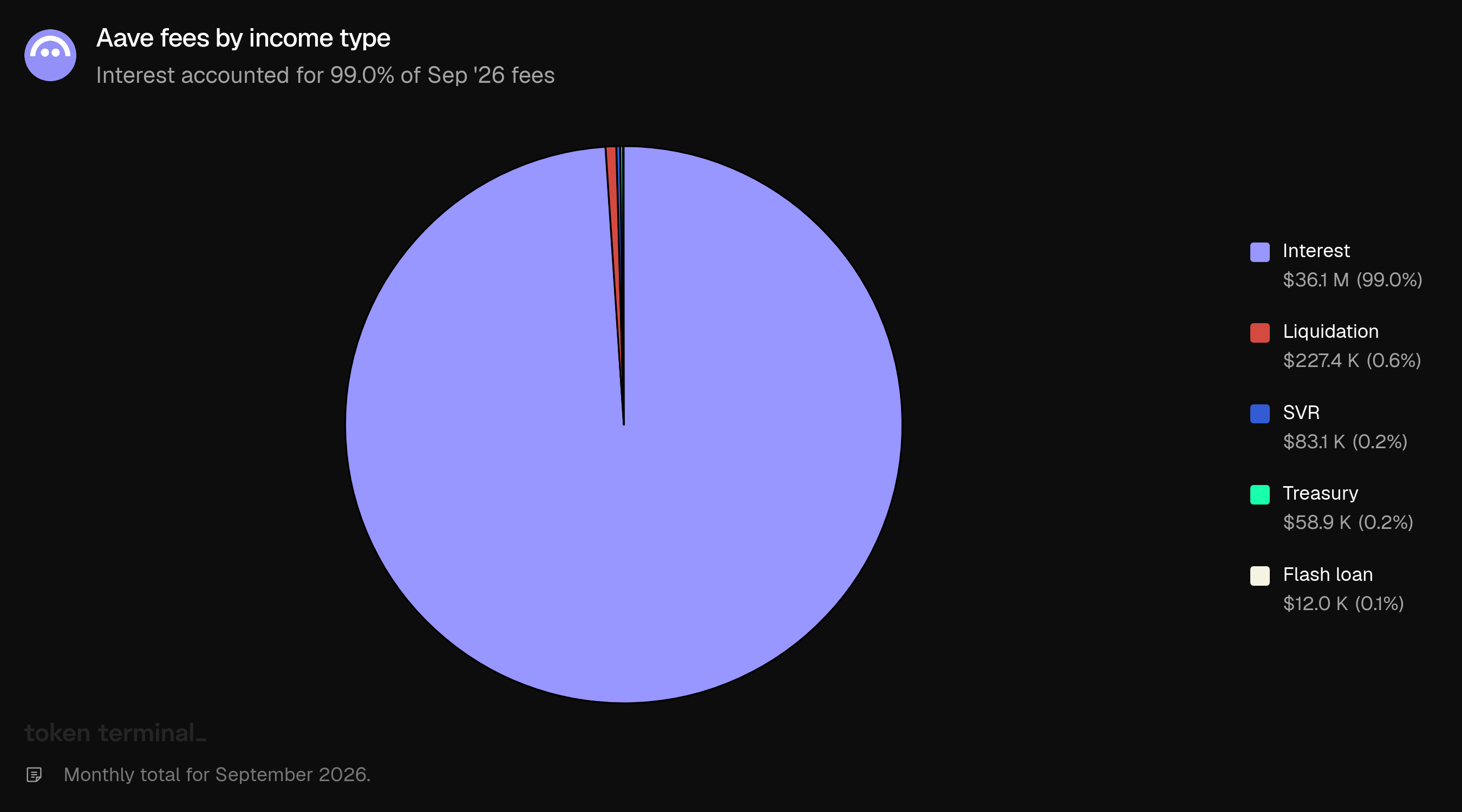
Interest accounted for 99.0% of September fees ($36.1 M). Aave earns almost entirely from borrowers paying interest, so its fees move with the size of its loan book: fees rose 7.5% in September and active loans 8.1%.
Revenue measures the portion of fees retained by the Aave DAO; the rest goes to depositors. Revenue totaled $5.2 M in September, up 4.4% MoM and down 66.6% YoY, also a second consecutive increase and the highest total since June.
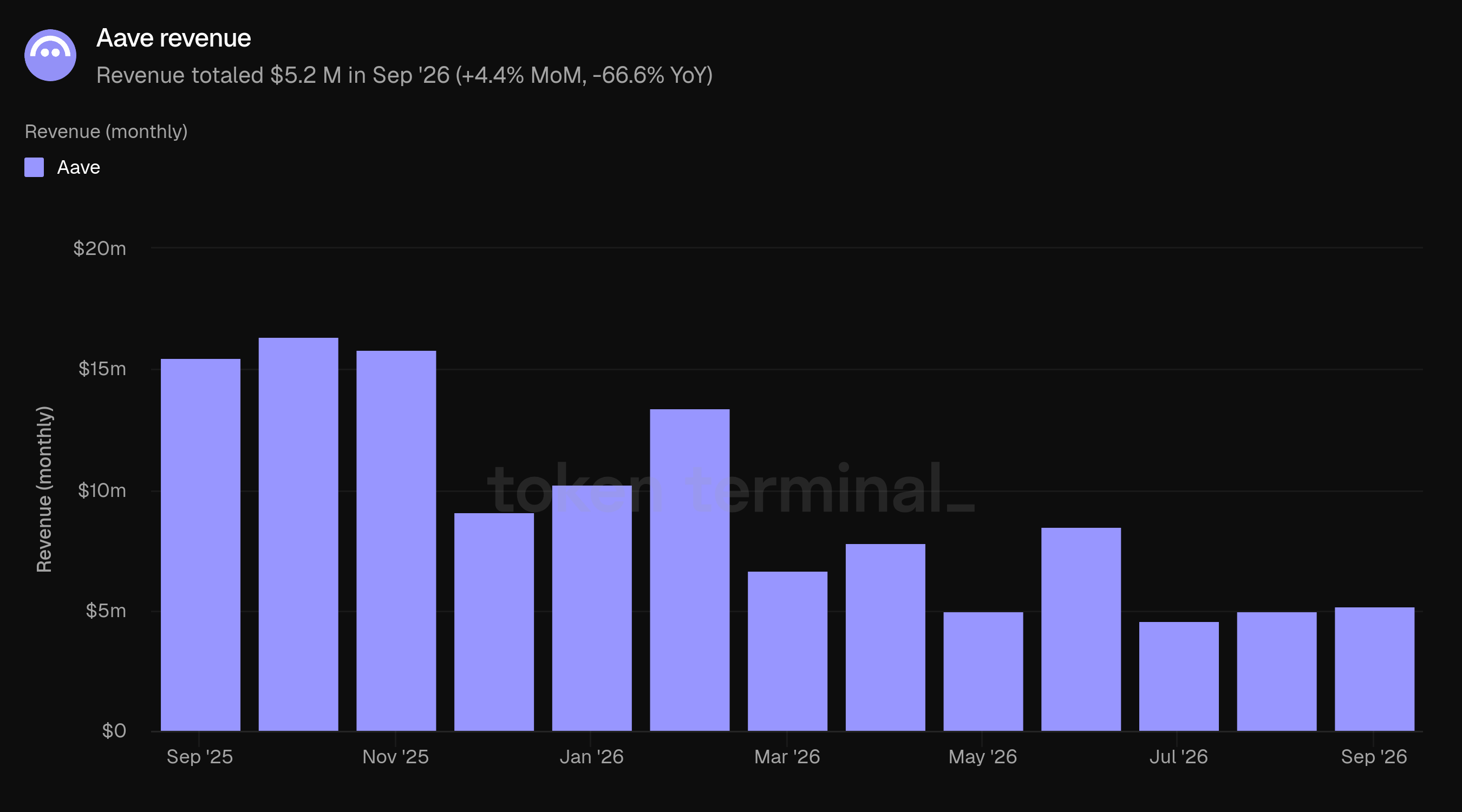
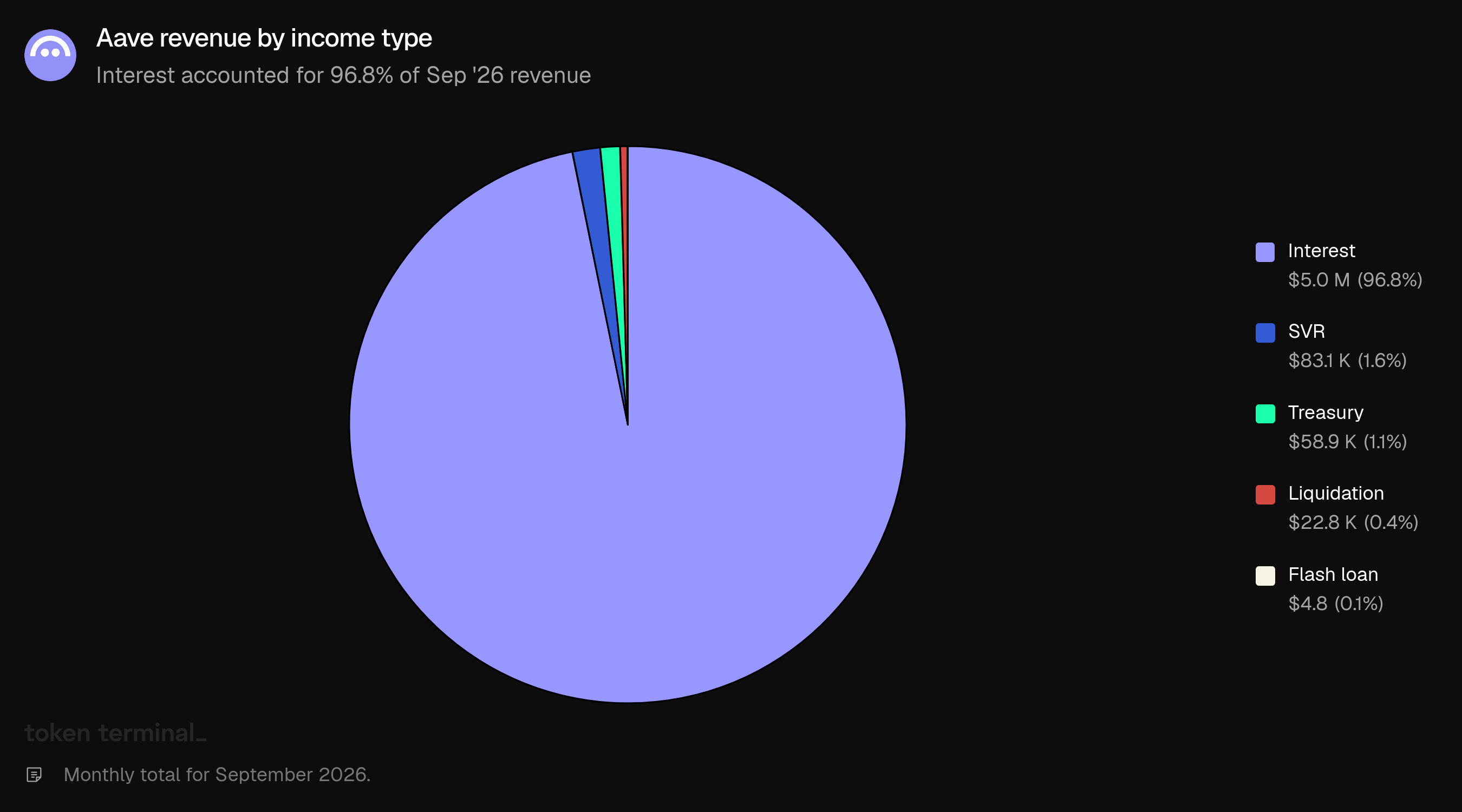
Interest accounted for 96.8% of September revenue ($5.0 M). The DAO's revenue is mainly its share of the spread between what borrowers pay and what depositors earn, and it accrues to the Aave DAO's treasury.
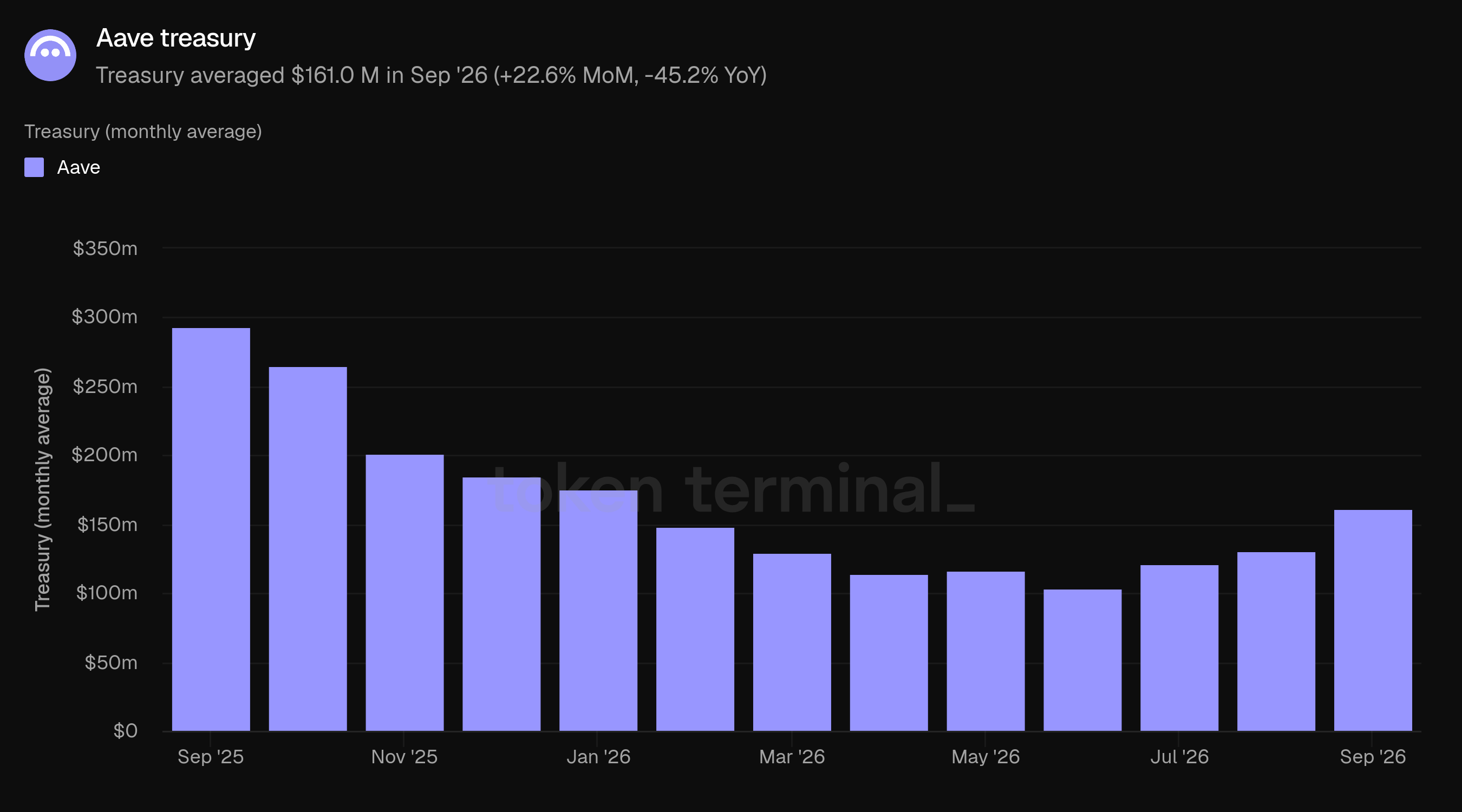
Treasury measures the total value of the Aave DAO's onchain treasury, including its holdings of AAVE. The treasury averaged $161.0 M in September, up 22.6% MoM and down 45.2% YoY, a third consecutive increase and the highest level since January.
6) Monthly active users
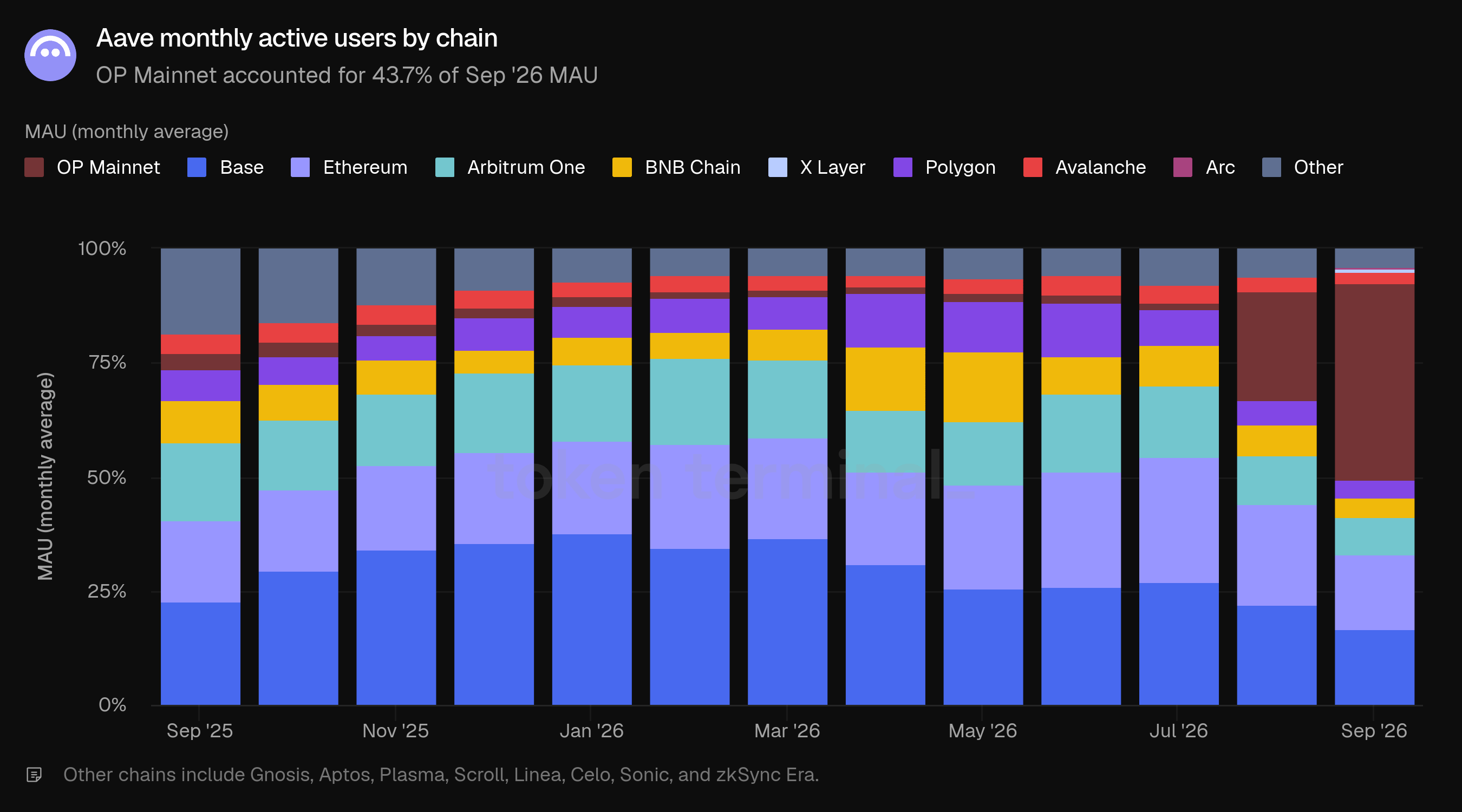
Monthly active users measure the number of unique addresses that supply, borrow, repay, withdraw, take a flash loan, or liquidate on Aave over a rolling 30-day window. MAU averaged 143.4 K in September, up 58.0% MoM and 19.3% YoY. That was the highest level since February and the largest monthly increase in the past year.
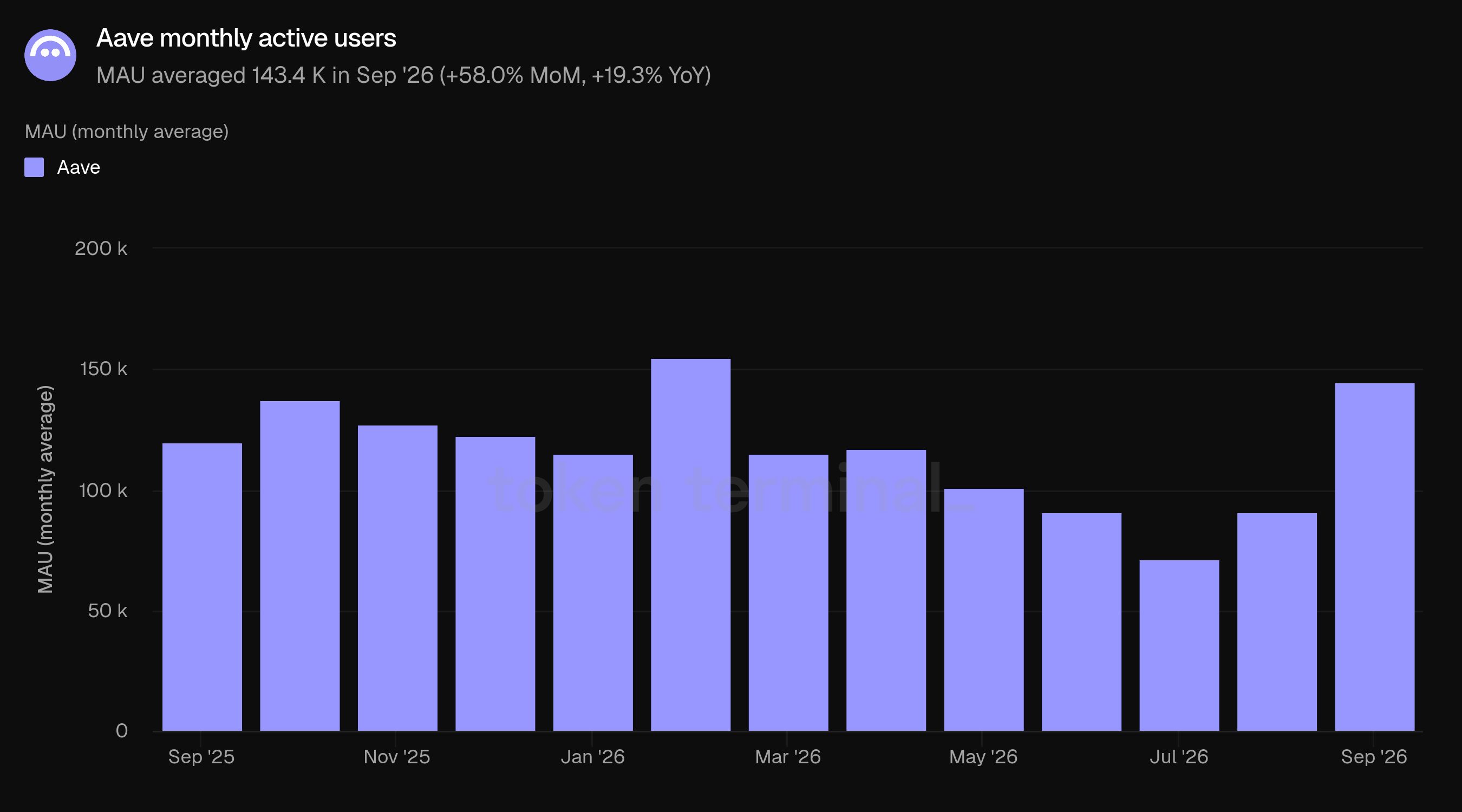
OP Mainnet accounted for 43.7% of September MAU (65.8 K), from about a thousand at the end of July. Nearly all of that activity comes from the Ether.fi Cash instance, where each Borrow Mode purchase is a borrow on Aave V4. MAU on other chains also rose, with Base and Ethereum each up by close to a fifth.
Aave V4's dedicated instances let a partner bring its own users to Aave: through the Ether.fi Cash instance, OP Mainnet now accounts for more than four in ten of Aave's active users.
7) AAVE & GHO
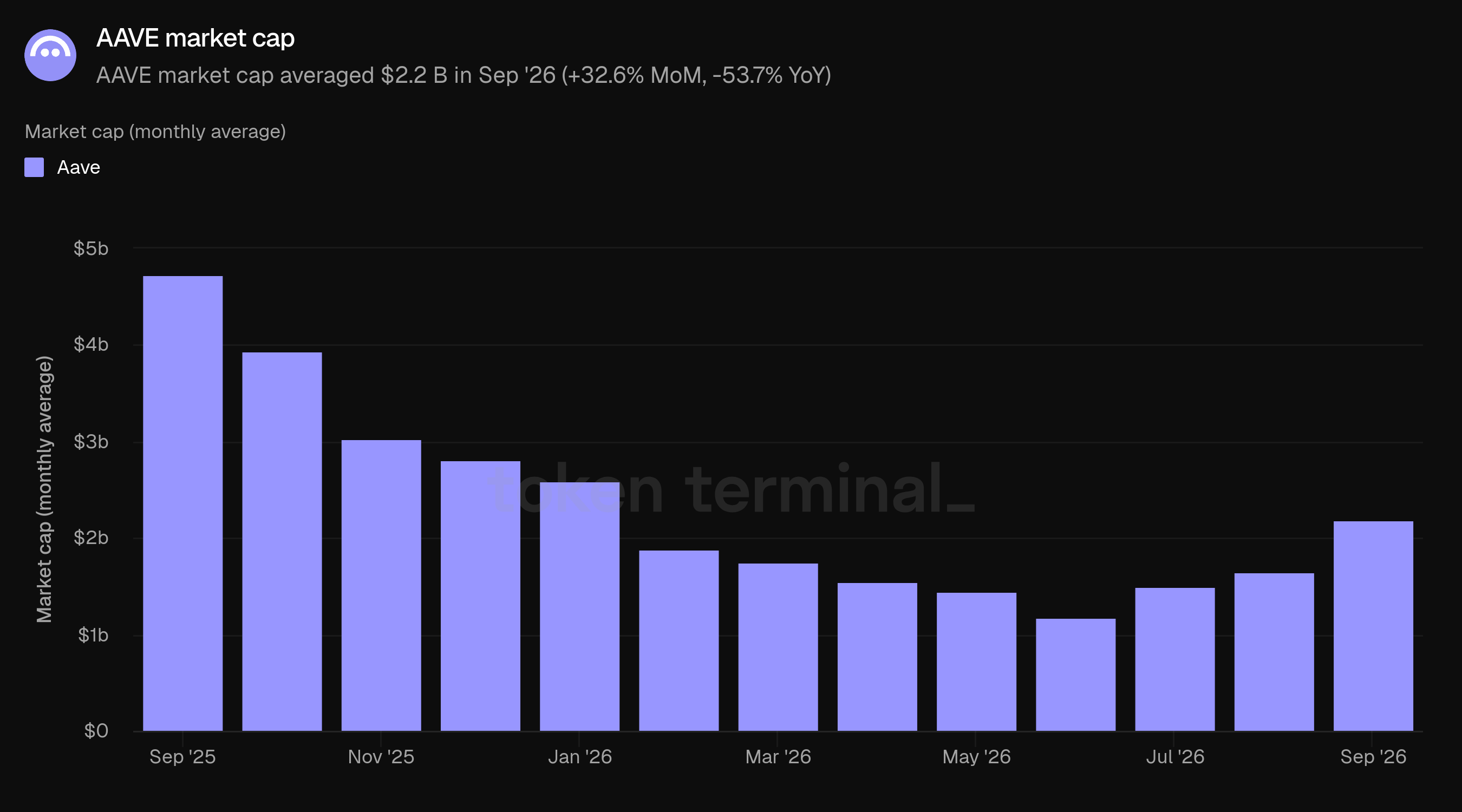
AAVE market cap measures the fully diluted valuation of the AAVE token: price times total supply. AAVE market cap averaged $2.2 B in September, up 32.6% MoM and down 53.7% YoY, a third consecutive increase and the highest level since January. It was also the largest monthly increase in the past year.
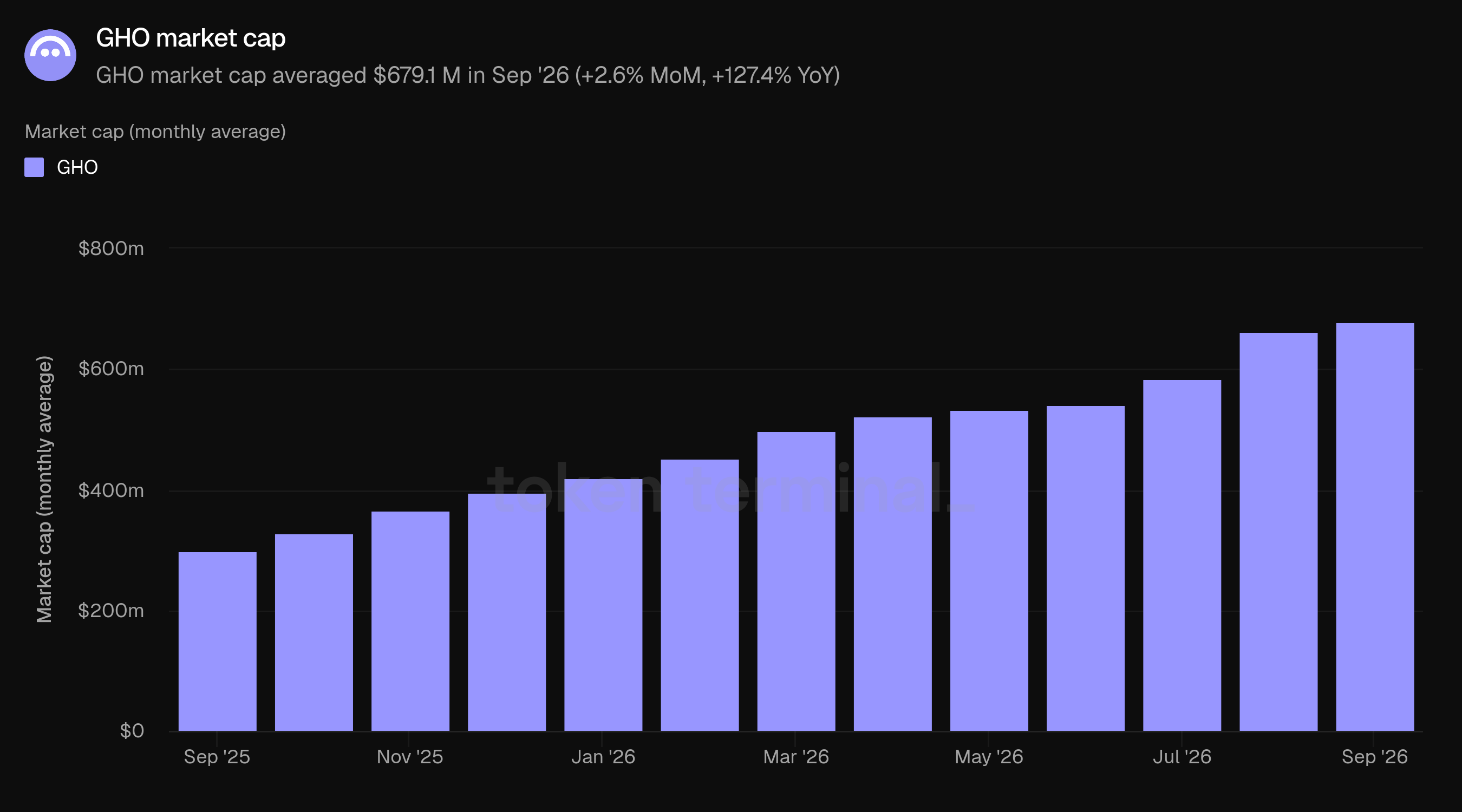
GHO market cap measures the outstanding supply of GHO in circulation, valued at its market price. GHO market cap averaged $679.1 M in September, up 2.6% MoM and 127.4% YoY, an all-time high and a fifteenth consecutive monthly increase.
8) Outlook
September was a third month of recovery for Aave's core markets and the month Aave V4 passed $1 B. TVL and active loans reached their highest levels since April, Aave V4 nearly doubled as new deployments and the Ether.fi Cash instance added deposits, and monthly active users rose to their highest level since February. Aave V4 TVL ended September above $1.3 B.
Three developments to watch going into October:
Tokenized stocks. Coinbase Tokenized Stocks went live on Aave V4 on Base on September 25, so October will be the Equities Hub's first full month.
Institutional credit. In September, Aave Labs proposed a separate Aave V4 hub where institutions could borrow stablecoins while their collateral stays with a regulated custodian, without moving it onchain. The proposal was still in governance discussion in early October.
Savings rate. The Aave Savings Rate paid to sGHO was raised from 4.25% to 4.50% APR under the GHO Stewards' August update and left unchanged in their October 2 update.
As of early October, the Equities Hub is live, the custody proposal is in discussion, and the Aave Savings Rate stands at 4.50% APR.
9) Definitions
Products:
Aave V3: the version carrying the bulk of Aave's deposits and loans, launched in March 2022, enabling multichain deployment and features such as e-mode for improved capital efficiency. Its markets fall into five groups: Core (Ethereum), Prime, Horizon, L1 networks, and L2 networks.
Aave V4: launched on Ethereum in late March 2026, on Avalanche in July 2026, and on Arc and Base in September 2026. Introduces a hub-and-spoke architecture where shared liquidity pools (hubs) connect to modular borrowing strategies (spokes). Can also be deployed as a dedicated instance for a single partner, such as the Ether.fi Cash instance on OP Mainnet.
Aave Horizon: a specialized lending market for tokenized real-world assets, launched in August 2025. Stablecoin supply is permissionless; collateral onboarding is managed by tokenization issuers and approved through Aave DAO governance.
Aave App: Aave's mobile app for retail users to access savings powered by Aave markets, in early access on iOS since August 2026.
AAVE: the project's native governance token. AAVE holders govern the Aave DAO, and the token can be staked in the Safety Module, which backstops the project against shortfall events.
GHO: Aave's native decentralized stablecoin, launched in 2023. Borrowers mint GHO using their Aave collateral.
sGHO: Savings GHO, which earns the Aave Savings Rate set through the GHO Stewards.
Metrics:
Total value locked: measures the total USD value of assets supplied to Aave's markets: for Aave V3, idle liquidity plus outstanding loans; for Aave V4, supply-side deposits.
Active loans: measures the total USD value of outstanding borrows across Aave's markets, the part of deposits on which borrowers pay interest.
Market share: measures Aave's share of active loans across the lending projects tracked by Token Terminal.
Asset APY: measures the annualized yield earned by holding a yield-bearing token, from a standardized onchain yield index over a 7-day trailing window; for Aave it applies to aTokens and sGHO and is supply-side yield, not a borrow rate.
Deposits: measures the total USD value of assets supplied to Aave's markets; for Aave V4 they equal TVL, broken down by asset.
Fees: measures the total USD value paid by users of Aave's markets, mostly interest paid by borrowers.
Revenue: measures the portion of fees retained by the Aave DAO; the rest goes to depositors.
Treasury: measures the total value of the Aave DAO's onchain treasury, including its holdings of AAVE.
Monthly active users: measures the number of unique addresses that supply, borrow, repay, withdraw, take a flash loan, or liquidate on Aave over a rolling 30-day window.
AAVE market cap: measures the fully diluted valuation of the AAVE token: price times total supply.
GHO market cap: measures the outstanding supply of GHO in circulation, valued at its market price.
Income types:
Interest: fees paid by borrowers on outstanding loans. A share of interest flows to the DAO treasury as revenue.
Liquidation: fees collected when undercollateralized positions are liquidated.
SVR: revenue recaptured from oracle-related MEV during liquidations via Chainlink SVR.
Flash loan: fees charged on uncollateralized loans that are borrowed and repaid within a single transaction.
Treasury: fees from Aave DAO treasury management activities.
10) About this report
This report is published monthly and produced leveraging Token Terminal's end-to-end onchain data infrastructure. All metrics are sourced directly from blockchain data. Charts and datasets referenced in this report can be viewed on the corresponding Aave September 2026 Report dashboard on Token Terminal.