

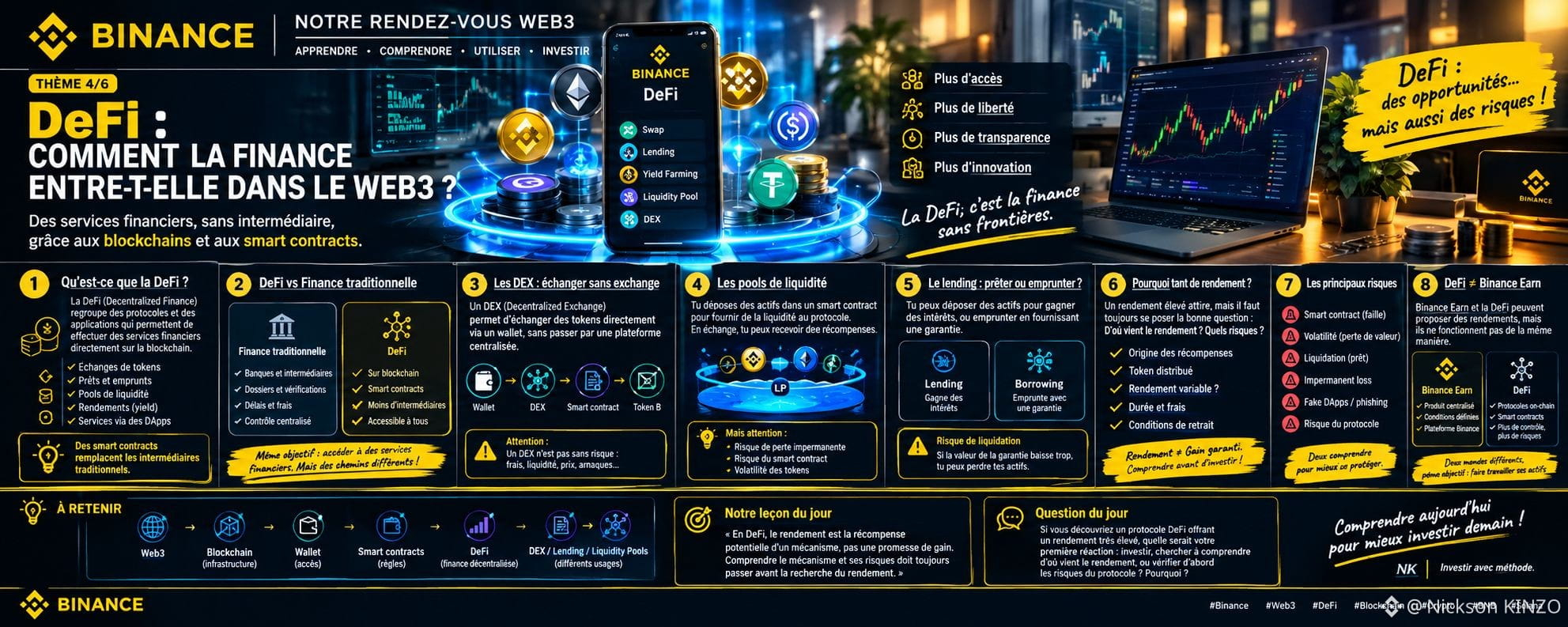

The traditional financial system generally relies on intermediaries: banks, brokers, payment platforms, etc.
DeFi — Decentralized Finance, or decentralized finance — aims to offer certain financial services directly through blockchains and smart contracts.
The idea is simple:
Use blockchain programs to enable certain financial operations without necessarily having to rely on a traditional centralized intermediary.
But be careful: DeFi does not mean easy money or guaranteed yield.
1-What is DeFi?
DeFi brings together a range of protocols and applications that allow people to carry out certain financial activities on the blockchain.
These can include:
token swaps;
lending and borrowing;
liquidity pools;
some yield-generating products;
financial services accessible through DApps.
What’s distinctive is that the protocol’s rules are generally executed by smart contracts.
To simplify:
Wallet → DApp → Smart contract → Blockchain → Transaction
2-DeFi vs. traditional finance
Let’s look at an example.
Traditional finance
You want to borrow money.
You may need an institution that:
reviews your application;
sets the terms;
holds the funds;
monitors repayment.
DeFi
Depending on the protocol, you can connect your wallet to a DApp and interact directly with a smart contract.
The protocol then automatically applies the programmed rules.
The human intermediary may be reduced, but that doesn’t mean there are no rules: the rules are encoded in the protocol.
3-DEXs: trading without using a centralized exchange
A DEX — Decentralized Exchange — is a decentralized trading platform.
Instead of necessarily depositing your assets on a centralized platform to make a trade, you can connect your wallet to a compatible DEX and carry out certain transactions directly on-chain.
Simplified example:
You own Token A.
You want to get Token B.
Wallet → DEX → Smart contract → Token B
The transaction is recorded on the blockchain.
But be careful
A DEX does not automatically mean:
❌ zero fees
❌ zero risk
❌ guaranteed best price
❌ no scams
You should take into account network fees, liquidity, and risks related to the protocol.
4-What is a liquidity pool?
This is one of the fundamental concepts of DeFi.
A liquidity pool is generally made up of crypto assets deposited in a smart contract to provide liquidity for certain protocol operations.
Users can contribute to this liquidity.
In return, they may receive rewards according to the protocol’s rules.
But here’s the catch:
Potential yield ≠ guaranteed yield.
The value of deposited assets can fluctuate significantly.
There are also various risks, including:
impermanent loss;
smart contract risk;
protocol-related risk;
liquidity risk;
token volatility.
5-Lending: lending and borrowing in DeFi
DeFi also makes it possible to create lending mechanisms.
Lending
You deposit certain assets into a protocol and may receive a return depending on market and protocol conditions.
Borrowing
A user can borrow certain assets, usually by providing collateral.
This can make it possible to operate without going through the traditional bank loan process.
But the mechanisms can be complex.
Significant risk
If the value of the collateral falls sharply, liquidation may occur according to the protocol’s rules.
6-Why is yield such a big topic in DeFi?
This is where we need to stick to our philosophy:
Understand before seeking yield.
A platform may display a very high yield.
The first question shouldn’t be:
“How much will I earn?”
Instead:
“Where does this yield come from, and what risks do I need to take to earn it?”
In particular, you should try to understand:
where the rewards come from;
which token is distributed;
whether the yield is variable;
what the duration is;
what the fees are;
what risks the protocol involves;
what conditions apply to withdrawing funds.
7-The main risks of DeFi
This is probably the most important part of our session.
Smart contract
A vulnerability in the code can lead to losses.
Volatility
Deposited assets can lose a lot of value.
Liquidation
In some lending systems, a drop in the value of the collateral can trigger liquidation.
Impermanent loss
Liquidity providers may experience a difference in performance between holding assets and depositing them in a pool.
Fake DApps / phishing
A fake website may try to get you to connect your wallet or sign a dangerous transaction.
Protocol risk
Even a well-known project is not automatically risk-free.
8-DeFi ≠ Binance Earn
This distinction is important for our Binance community.
Binance Earn and DeFi can both offer opportunities to earn yield, but they don’t work in the same way.
With a centralized service like Binance Earn, you use the products offered by a centralized platform under its terms and conditions.
In DeFi, you can interact directly with protocols and smart contracts on the blockchain.
The level of control, mechanisms, and risks can therefore vary considerably.
9-The right approach before entering a DeFi protocol
Before connecting your wallet, ask yourself at least 7 questions:
1. What is the protocol?
2. How exactly does it work?
3. Which smart contract will I use?
4. Which asset will I deposit?
5. Where does the advertised yield come from?
6. What are the main risks?
7. How can I withdraw my funds?
And most importantly:
Never connect your wallet to a DApp just because it promises a high yield.
REMEMBER
Our architecture now becomes:
🌐 Web3
↓
🔗 Blockchain — infrastructure
↓
👛 Wallet — access
↓
📜 Smart contracts — automated rules
↓
💰 DeFi — financial applications
↓
💱 DEXs / Lending / Liquidity Pools — different uses
Today’s lesson
“In DeFi, yield is the potential reward from a mechanism, not a promise of profit. Understanding the mechanism and its risks should always come before seeking yield.” NK
Our key takeaway
UNDERSTAND THE YIELD BEFORE SEEKING IT.
Question of the day
If you discovered a DeFi protocol offering a very high yield, what would your first reaction be: invest, try to understand where the yield comes from, or check the protocol’s risks first? Why?
NK | Invest methodically.
#Binance #Web3 #DeFi #Blockchain #Crypto #BNB #Solana