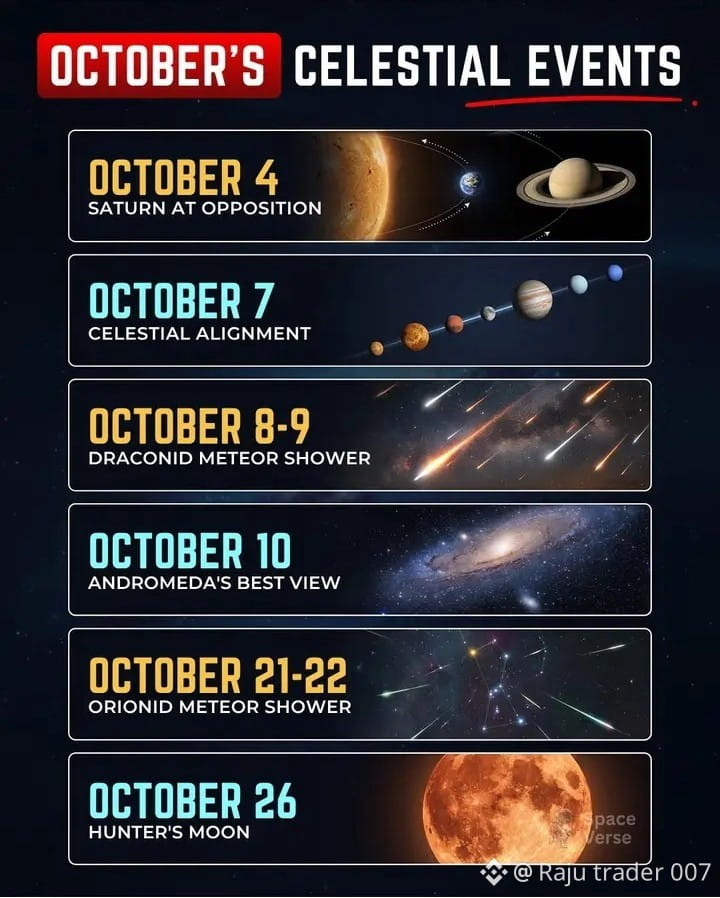
October is packed with some of the biggest space events.
From Saturn shining at its best to meteor showers and the full Hunter’s Moon, the night sky has something happening throughout the month.
🪐 OCTOBER 4 — SATURN AT OPPOSITION
Saturn reaches opposition, placing Earth between Saturn and the Sun. It will be especially bright and visible for much of the night.
OCTOBER 7 — MERCURY & VENUS CLOSE APPROACH
Mercury and Venus appear close together low in the evening sky. The exact visibility depends on your location and horizon conditions.
☄️ OCTOBER 8–9 — DRACONID METEOR SHOWER
The Draconids reach their peak during these dates. Unlike many meteor showers, they are best viewed during the evening after nightfall. This year’s timing is favorable because the Moon is close to its new phase.
OCTOBER 10 — ANDROMEDA GALAXY
October is an excellent month to look for the Andromeda Galaxy, especially from dark-sky locations. It can be visible to the naked eye under good conditions and becomes an excellent target for binoculars and telescopes.
☄️ OCTOBER 21–22 — ORIONID METEOR SHOWER
The Orionids, produced by debris from Halley’s Comet, reach their annual peak. Under dark skies, observers can see fast meteors streaking across the sky, although moonlight may hide some of the fainter ones this year.
OCTOBER 26 — HUNTER’S MOON
October’s Full Moon is traditionally known as the Hunter’s Moon. The Moon reaches full phase on October 26 at about 04:11 UTC
From Saturn shining at its best to meteor showers and the full Hunter’s Moon, the night sky has something happening throughout the month.
🪐 OCTOBER 4 — SATURN AT OPPOSITION
Saturn reaches opposition, placing Earth between Saturn and the Sun. It will be especially bright and visible for much of the night.
OCTOBER 7 — MERCURY & VENUS CLOSE APPROACH
Mercury and Venus appear close together low in the evening sky. The exact visibility depends on your location and horizon conditions.
☄️ OCTOBER 8–9 — DRACONID METEOR SHOWER
The Draconids reach their peak during these dates. Unlike many meteor showers, they are best viewed during the evening after nightfall. This year’s timing is favorable because the Moon is close to its new phase.
OCTOBER 10 — ANDROMEDA GALAXY
October is an excellent month to look for the Andromeda Galaxy, especially from dark-sky locations. It can be visible to the naked eye under good conditions and becomes an excellent target for binoculars and telescopes.
☄️ OCTOBER 21–22 — ORIONID METEOR SHOWER
The Orionids, produced by debris from Halley’s Comet, reach their annual peak. Under dark skies, observers can see fast meteors streaking across the sky, although moonlight may hide some of the fainter ones this year.
OCTOBER 26 — HUNTER’S MOON
October’s Full Moon is traditionally known as the Hunter’s Moon. The Moon reaches full phase on October 26 at about 04:11 UTC