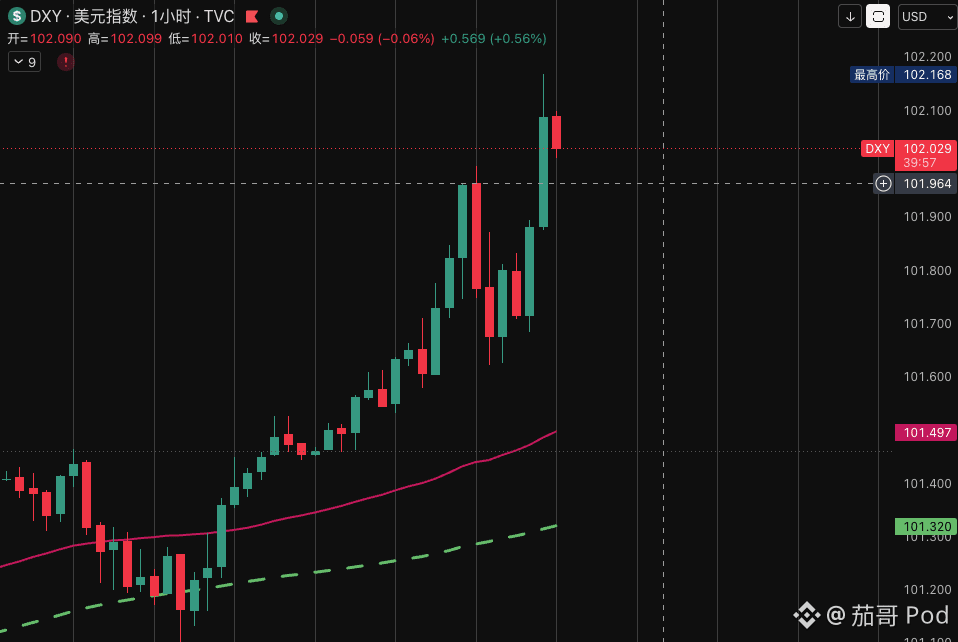

The US Dollar Index rises to about 101.8–102, hitting a new high since May 2025, reflecting the market’s repricing of a scenario of “higher-for-longer US interest rates.” The main drivers behind the dollar’s strength include cooling expectations for Federal Reserve rate cuts, persistent resilience in US inflation and economic data, and the widening interest-rate advantage of the US versus Europe and Japan; at the same time, geopolitical risks and concerns about global growth also drive safe-haven capital back into dollar-denominated assets.
The dollar’s strength does not necessarily contradict a potential intraday retreat in short-term US Treasury yields. In the FX market, the focus is on relative interest-rate spreads and risk appetite between the US and other major economies: even if 2-year US Treasury yields fall briefly, the dollar may still rise as long as US rates remain significantly higher than those of Europe and Japan, market expectations point to a more accommodative stance in Europe and Japan, or risk-aversion sentiment intensifies.
For markets, a strong dollar typically weighs on US-dollar-priced commodities such as gold, copper, and uranium, and puts pressure on emerging-market currencies, high-valuation tech stocks, and SMR nuclear power concept stocks that rely on long-term financing. The impact on the broader US equity market is more mixed: companies with stable domestic demand and dependable cash flows tend to be more resilient, while growth stocks with a higher share of overseas revenue and valuations that depend on forward profits face dual pressure from both exchange-rate moves and discount-rate effects. If the US Dollar Index can hold effectively above 102, and long-end US Treasury yields resume rising, markets should remain alert to the possibility of financial conditions tightening further.
#美元指数创2025年5月来新高
The dollar’s strength does not necessarily contradict a potential intraday retreat in short-term US Treasury yields. In the FX market, the focus is on relative interest-rate spreads and risk appetite between the US and other major economies: even if 2-year US Treasury yields fall briefly, the dollar may still rise as long as US rates remain significantly higher than those of Europe and Japan, market expectations point to a more accommodative stance in Europe and Japan, or risk-aversion sentiment intensifies.
For markets, a strong dollar typically weighs on US-dollar-priced commodities such as gold, copper, and uranium, and puts pressure on emerging-market currencies, high-valuation tech stocks, and SMR nuclear power concept stocks that rely on long-term financing. The impact on the broader US equity market is more mixed: companies with stable domestic demand and dependable cash flows tend to be more resilient, while growth stocks with a higher share of overseas revenue and valuations that depend on forward profits face dual pressure from both exchange-rate moves and discount-rate effects. If the US Dollar Index can hold effectively above 102, and long-end US Treasury yields resume rising, markets should remain alert to the possibility of financial conditions tightening further.
#美元指数创2025年5月来新高