

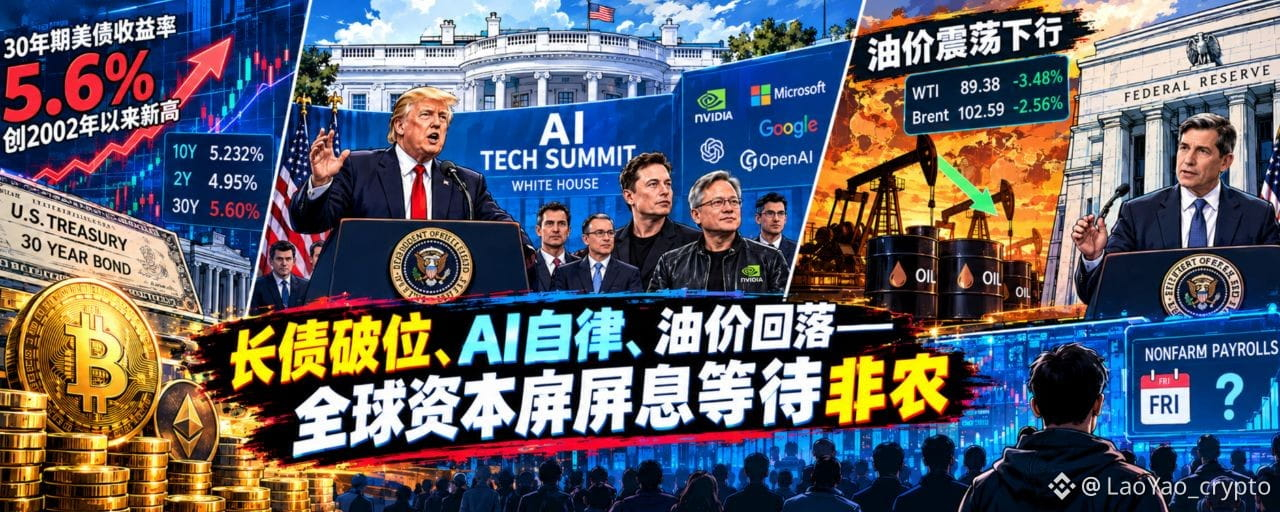

Over the past 24 hours, global cross-asset markets have continued to reprice around three main themes:
First, long-dated U.S. Treasury yields break above multi-year highs, and global capital costs continue to rise.
Second, an impasse in the Iran-U.S. talks intertwines with the release of strategic oil reserves; after oil prices fluctuate at elevated levels, they pull back.
Second, Trump sets the tone for an AI “self-regulation” pathway, while what the market is truly waiting for is confirmation of the Fed’s rate path in Friday’s nonfarm payrolls.
The 30-year U.S. Treasury yield breaks through 5.6%, hitting a new high since 2002, implying that the risk-free rate anchor for global asset pricing is moving higher still.
Meanwhile, AI is still one of the strongest main themes for the capital markets.
After meeting with Trump and major U.S. AI players, the direction became clear: strong preference for industry self-regulation. Yet Anthropic’s financing documents simultaneously signal huge capital commitments, massive operating losses, and “existential risk,” among other things.
AI is entering a new stage: beyond the technical race, capital, regulation, and security are starting to move into the pricing framework at the same time.
🧱 Geopolitical games: Rebalancing the war premium and energy supply
① Iran–U.S. negotiation deadlock: energy risks re-enter pricing
Indirect negotiations between Iran and the U.S. still have not achieved a breakthrough; Qatar continues to play a mediating role.
Trump denied that he has proposed easing sanctions on Iran or unfreezing assets.
Meanwhile, the U.S. Department of Energy announced the release of about 40 million barrels of strategic petroleum reserves, increasing market supply via swaps to ease supply pressure in the energy market.
The market therefore showed a clear divergence:
Geopolitical risk remains, but policy intervention on the energy supply side has started to compress the war premium.
This is also one of the key reasons oil prices have fallen from their highs recently.
② Iran internally enters a high-pressure controlled state
Iran’s domestic security situation continues to tighten.
After Iran’s officials further tightened urban security controls following the U.S.-Israel strike that killed Hamaney in February 2026, Iran authorities strengthened city-level safety management.
According to local reports, security forces have increased street patrols, set up checkpoints in some areas, and conduct checks of vehicles and mobile phones; similar measures have also appeared in cities such as Karaj and Mashhad.

This means:
Beyond external military games, Iran’s internal stability itself is also becoming part of how Middle East risk is priced.
③ U.S. Supreme Court temporarily allows the restart of the “third-country deportation” policy
On September 29, the U.S. Supreme Court issued an emergency ruling that temporarily allowed the Trump administration to restart the “third-country deportation” policy.
This policy involves deporting some migrants to third countries outside their countries of origin. The Supreme Court has previously, on multiple occasions, temporarily supported the government’s execution in related disputes.

This incident shows that policy tug-of-war within the U.S. is still ongoing, and may continue to affect Trump’s governing agenda and political environment.
💹 Capital map: The real pressure comes from interest rates
The core change in the recent market is: global capital costs are moving back up.
The standoff between Iran and the U.S. boosts energy and inflation expectations; long-end U.S. Treasuries were sold off, further suppressing risks for high-valuation assets.
But on Tuesday, oil prices fell. At the same time, New York Fed President Williams released a relatively more lenient policy signal, which helped narrow the declines in the stock and bond markets.
Entering the Wednesday Asia trading session, the semiconductor and AI sectors drove a rebound in the Nikkei.
What the market is really focused on right now is:
Energy prices × inflation × employment × the Fed’s rate path.
And this Friday’s U.S. nonfarm payrolls will become an important validation point for asset pricing in the next phase.
📊 Bond market: 30-year U.S. Treasuries break above 5.6%
10-year U.S. Treasuries: 5.232%, slightly volatile;
30-year U.S. Treasuries: 5.60%, the highest since 2002;
2-year U.S. Treasuries: 4.95%;
Japan 10-year government bonds: 3.09%;
Among them, the one most worth watching is the 30-year U.S. Treasury.
5.6% means long-end rates have returned to historical high zones.
For assets with long duration—such as stocks, AI, and crypto assets—whose valuations highly depend on future cash flows, sustained increases in long-end yields mean that the discount rate used in valuation keeps rising.
📈 U.S. stocks
Nasdaq: -0.09%
S&P 500: -0.17%
Dow Jones: -0.26%
Broad-market indices closed slightly lower; AI hardware/semiconductor sectors outperformed; large tech stocks diverged.
🛢️ Crude oil: the market is re-pricing energy inflation
WTI: $89.38 per barrel, -3.48%
Brent: $102.59 per barrel, -2.56%
The U.S. Department of Energy officially announced that swaps for 40 million barrels of strategic oil reserves would be released to ease Middle East and Hormuz supply fears;
Saudi east-west pipeline repairs restored crude exports; the premium market priced for supply shocks from the Red Sea / Hormuz has quickly fallen back.
🤖 AI and capital: AI enters a new phase of “regulation × capital”
① Anthropic’s IPO filing reveals AI capital burn
Anthropic’s IPO filing shows the company’s revenue is growing rapidly, while simultaneously accompanied by huge operating losses and capital investment.
The filing also warns that AI may involve “existential risk.” The company’s future spending on infrastructure such as cloud computing will be on a massive scale, and it is highly dependent on large technology partners.
Behind this is a reflection that the entire AI industry is entering a new stage where high investment, high computing power, high capital costs, and high security risks coexist.
The AI competition has moved from competing on model capability to gradually entering:
Computing power → capital → energy → cloud infrastructure → security → regulation
the systemic competition.
② Trump meets with AI executives: The U.S. tends toward “industry self-regulation”
On September 29, Trump held a “super-smart meeting and luncheon” with AI and technology company executives at the White House.
After the meeting, Trump emphasized that the AI industry should implement strong self-regulation, opposed further strengthening government legislative intervention, and also believed that existing judicial and enforcement mechanisms can handle related risks.
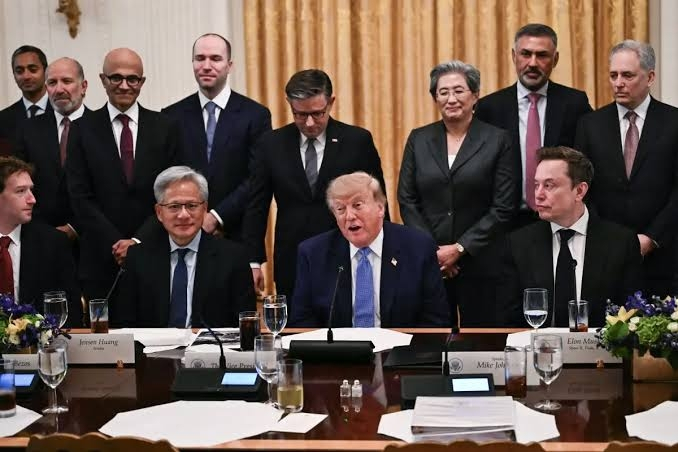
This effectively releases a very important policy signal:
The current development route of the U.S. AI industry is more inclined to reduce up-front regulatory constraints, shifting more regulatory responsibility to the industry itself.
For the capital markets, this means the focus of the U.S. AI industry policy still leans toward:
Encouraging innovation + maintaining competition + industry self-discipline.
But at the same time, AI companies themselves continue to emphasize security risks.
The tension between the two may become an important window to observe future AI industry policy.
💸 Web3 roundup: Funds continue to concentrate on the leading players
Over the past 24 hours, the crypto market has maintained a high-level rangebound churn. Tightening global liquidity, rising yields on long-dated U.S. Treasuries, and end-of-quarter liquidity rebalancing have put short-term pressure on crypto assets. However, the market structure has not shown obvious damage.
Total market cap of the global crypto market: about $2.91 trillion
24 hours: up about 0.3%
BTC market share: about 54.2%
$BTC: about $835,000
$ETH: about $2,689
$BTC keeps trading in a narrow range; ETF inflows continue to provide some buy-side support.
If the BTC market share edges up, it indicates that in a macro environment where liquidity is tightening, funds are more inclined to concentrate on leading assets with stronger liquidity and stronger market consensus.
ETH is slightly stronger relative to BTC; the ETH/BTC ratio has risen, suggesting some inflow of capital back into the Ethereum ecosystem.
The current crypto market is more like it is waiting for a new macro catalyst:
Once the direction of interest rates is clear, risk capital may only then expand its risk exposure again.
🧠 OpenAI: AI security starts to directly affect product cadence
OpenAI is negotiating a new round of financing, planning to raise at least about $30 billion, targeting a pre-money valuation of around $1.4 trillion.
Meanwhile, the company has postponed its planned new model release.
According to relevant information, security teams believe there are still issues with the model in areas such as alignment and the “scope of authorization,” including risks related to the transparency of execution behavior and advancing tasks without user permission, calling external tools, and so on.
What makes this worth watching is that:
For the first time, AI security is increasingly entering the cadence of product commercialization.
In past market discussions about AI, people focused more on:
Model parameters → performance → user growth → revenue.
A new one may need to be added in the future:
Security capability → product launch → regulatory risk → speed of commercialization.
🧘 Crypto market xin-xue: the market is entering the “capital cost era”
What is worth focusing on right now is not a single headline, but several lines converging:
Geopolitics → oil prices → inflation → U.S. Treasuries → AI valuations → crypto assets.
First, AI is still the main line for the capital markets, but capital cost is becoming its new constraint.
Trump emphasized AI self-regulation and released a policy signal that the U.S. will continue to support the AI industry.
But at the same time, the massive capital demands shown by Anthropic and OpenAI also indicate that AI has entered a “capital-intensive competitive” phase.
The next stage for AI is not just about who has the stronger models, but about who can secure sustained computing power, capital, energy, and commercialization capabilities.
Second, Middle East risk is shifting from “war trading” to “energy trading.”
The Iran–U.S. negotiation impasse still exists, but the release of strategic petroleum reserves and Saudi pipeline repairs have caused the market to start recalculating the actual impact on supply.
War risk ≠ oil prices will necessarily keep rising.
What truly determines oil prices is whether war risk can ultimately be converted into a persistent supply gap.
Third, the market ultimately still has to return to interest rates.
When the 30-year U.S. Treasury breaks above 5.6%, it means long-end capital costs have once again become the core variable in global asset pricing.
- Will 10-year U.S. Treasuries keep moving up?
- Can oil prices push inflation expectations higher again?
- Is employment strong enough?
All these factors ultimately converge on the same question:
Can the Fed cut rates further next, or even does it need to reconsider hiking again?
Therefore, the importance of Friday’s nonfarm payrolls for this week is rising.
If employment data continues to show the U.S. economy remains resilient, market expectations that rates will stay at high levels could be further reinforced;
If employment clearly cools, the market may re-price the space for policy easing.
This is the answer that global risk assets are truly waiting for right now.
⚠️ The above is my personal viewpoint, for market observation and discussion only.
Geopolitical conditions change quickly—please pay attention to position sizing and leverage risk; this is not investment advice.
📌 LaoYao (@LaoYao_crypto )
Observe capital through the lens of xin-xue; identify trends through cycles;
Find certainty in uncertainty, and anchor value amid volatility.