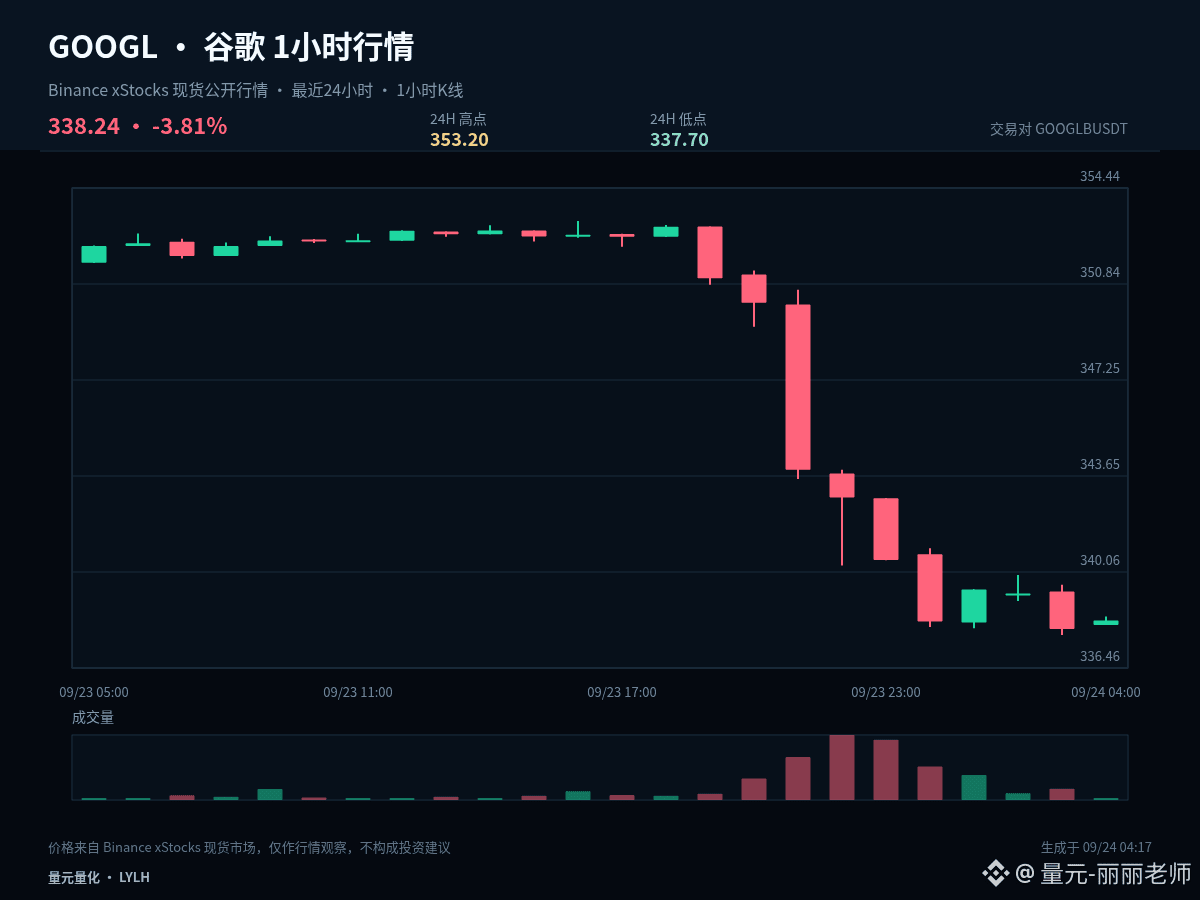
$GOOGLB #GOOGL In strong trends, pullbacks often reveal real buying support more clearly than rapid rallies. The current 1-hour move is +0.09%, and the 24-hour move is -3.77%, so the key is to determine whether this is a normal cooldown or a weakening structure.
The current price is close to the lower end of the recent 24-hour range, with the 1-hour at +0.09% and the 24-hour at -3.77%. The core of low-level analysis is not to buy the dip in advance, but to observe whether price can quickly reclaim after breaking down; a quick reclaim means selling pressure is being absorbed, while staying below the lower boundary suggests weakness has not ended.
Short-term control has not been clearly damaged yet, and 345.45 is the primary standard for judging pullback quality. Holding above it and then retesting 353.2 would indicate relatively strong consolidation; if price breaks below the midpoint and remains there, the focus should shift down to 337.7.
My scenario analysis is not a one-sided bet. If price breaks above 353.2 and can hold, it means upside room has reopened; if it breaks below 337.7 and fails to rebound, it means the structure is weakening further; if it trades between the two, continue watching the closing behavior around 345.45.
Existing positions can be managed in stages according to key levels to avoid making a full judgment all at once; those without positions should wait for either breakout confirmation or a successful hold on a retest. For U.S. stock instruments, also pay attention to volatility from trading session transitions. The plan should be based on price conditions, not emotions.
A trading plan must include an invalidation condition. If the judgment is correct, profits can be taken in stages; if it is wrong, you must allow yourself to exit, and not use adding to the position to cover up that the original logic has already changed. The market will update, and views should also adjust based on price evidence.
#DollarIndexReclaims101
The current price is close to the lower end of the recent 24-hour range, with the 1-hour at +0.09% and the 24-hour at -3.77%. The core of low-level analysis is not to buy the dip in advance, but to observe whether price can quickly reclaim after breaking down; a quick reclaim means selling pressure is being absorbed, while staying below the lower boundary suggests weakness has not ended.
Short-term control has not been clearly damaged yet, and 345.45 is the primary standard for judging pullback quality. Holding above it and then retesting 353.2 would indicate relatively strong consolidation; if price breaks below the midpoint and remains there, the focus should shift down to 337.7.
My scenario analysis is not a one-sided bet. If price breaks above 353.2 and can hold, it means upside room has reopened; if it breaks below 337.7 and fails to rebound, it means the structure is weakening further; if it trades between the two, continue watching the closing behavior around 345.45.
Existing positions can be managed in stages according to key levels to avoid making a full judgment all at once; those without positions should wait for either breakout confirmation or a successful hold on a retest. For U.S. stock instruments, also pay attention to volatility from trading session transitions. The plan should be based on price conditions, not emotions.
A trading plan must include an invalidation condition. If the judgment is correct, profits can be taken in stages; if it is wrong, you must allow yourself to exit, and not use adding to the position to cover up that the original logic has already changed. The market will update, and views should also adjust based on price evidence.
#DollarIndexReclaims101