


Tesla in September—so tightly scheduled it’s not normal.
On September 3, at Austin, Texas, the Cybercab with no steering wheel and no pedals was officially unveiled—and it wasn’t just put on display. That same day, it was connected to the Robotaxi network, starting commercial passenger pickup and charging. On September 17, the car appeared at Tesla’s experience store in Beijing Huamao, kicking off a nationwide tour across more than a dozen cities. The tour ran until September 27.
One car is for imagining the future; another is for cash flow. This article discusses why this time is different.

1. This time it’s not a PPT—it’s a fleet
Anyone familiar with Tesla knows this company’s “slip schedule” is a family craft: the Roadster first appeared in 2017, with delivery slated for 2027; the Semi truck was talked about from 2017 and only moved into production in 2025.
But Cybercab’s timeline is the exact opposite: the concept vehicle debuted in October 2024, the first production vehicle rolled off the line in February 2026, production scaled up in April, driverless road testing without safety operators happened in June, and after the September 3 press conference, it immediately began charging fares for passenger rides. Nevada has already approved Tesla to deploy up to 5,000 vehicles in Clark County within the next 12 months, replacing the previous test permits that were limited to just 10 vehicles.
II. The essence of this battle is a math problem
In the end, the Robotaxi race isn’t a technology race—it’s a cost race. Here’s a comparison:
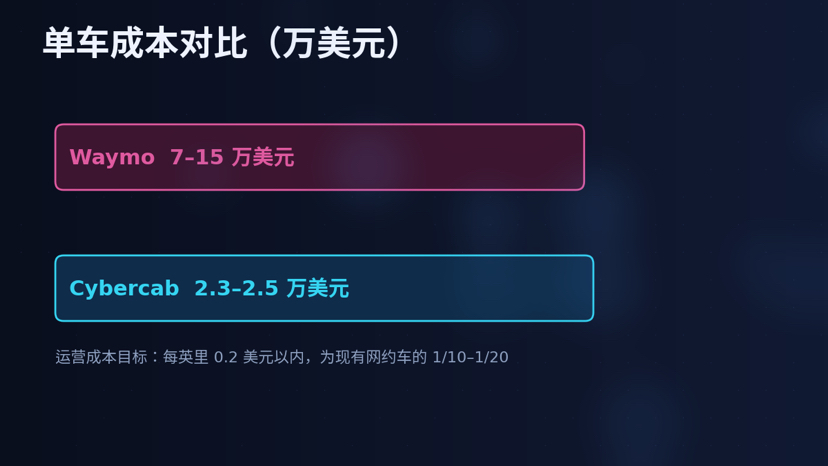
Cybercab’s per-vehicle cost is about $23,000–$25,000, roughly one-third of Waymo’s mainstream vehicles. The target operating cost per mile is pushed to within $0.20; passenger fares are expected to drop to one-third of current ride-hailing services.
What does a lower break-even point mean? With the same number of trips, the competitor hasn’t started making money yet, while Tesla has already begun recovering the cost of its fleet. In Morgan Stanley’s $400 target price for Tesla, the Robotaxi business alone accounts for $120. This valuation logic used to be called “storytelling”; after September 3rd, the story gained a fleet, license plates, and a fare meter.
III. Don’t ignore the core base: Model Y L
Cybercab is tasked with imagining the future, but the financial report is propped up by another set of numbers: the Model Y L six-seat version will begin deliveries on September 2, starting at 339,000 yuan, directly pushing Tesla China’s September sales to 71,000 units—an intra-year high. The official website’s delivery schedule is already booked out to November.
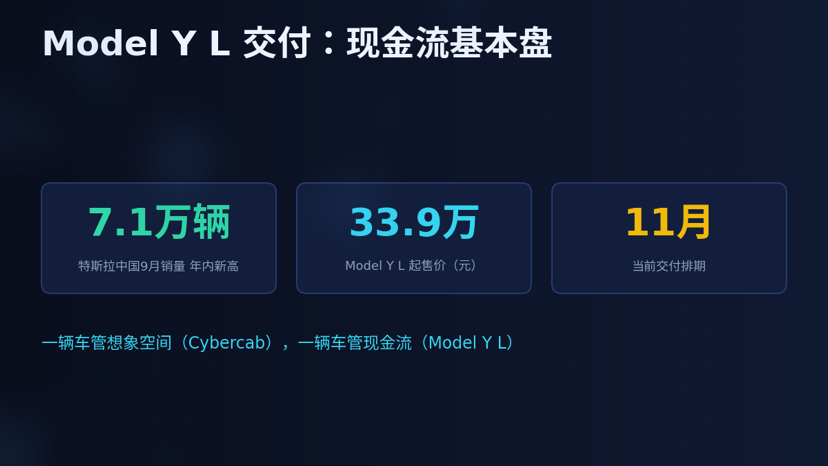
Adding the rumored entry-level model and the new product event on October 7, the 200,000 to 600,000 yuan range is being filled in. Robotaxi looks to the future; Model Y L handles the present.
IV. Two real question marks
Talking only about the good news is like playing a hustle. There are two things you must watch:
Regulators are still chasing while it drives. The NHTSA has asked Cybercab to explain the compliance basis for its “self-certification” requirements. FSD in China has not yet been approved; this exhibition is only a static display, and the timeline for entry into China cannot be moved up by even a single word.
The competitor isn’t standing still. Waymo is already offering fully driverless rides in 14 cities; Tesla is currently in 6. In the early phase of operations in Austin, there was even an experience-incident where a 10-minute trip turned into a 70-minute route.
But note the nature: one is a process issue and the other is a ramp-up issue—neither changes the structural advantages of “dedicated vehicles + low cost + self-developed FSD.”
Conclusion
Tesla’s narrative over the past decade has kept changing: first it was an electric vehicle company, then an energy company, and then an AI company. On the day Cybercab charges fares and carries passengers, the words “AI company” finally had a cash-flow entry point for the first time.
If the Cybercab tour comes to your city, would you go watch? Chat in the comments.
Note: The information in this article comes from publicly available reports. The verification date is 2026-09-23. This does not constitute any investment advice.
