Why do I actually recommend that beginners start with quantitative trading?
Because when most people first start out, it’s not the market that trips them up—it’s their own emotions.
Does this sound familiar? You stay up late watching the charts, staring at a single candlestick for ages. After a few winning trades, you start to think you’ve figured out the pattern. But then extreme market conditions hit, your earlier gains start to disappear, and you panic.
You can’t accept a loss, so you place another trade to make up for it. That one goes wrong too, so you keep increasing your position. Before long, you’re no longer analyzing the market—you’re battling yourself: “There’s no way I can’t make it back today.”
More often than not, you spend days painstakingly making a profit, only to lose it all in a single night and end up back where you started.
I’ve been trading event contracts for over a year, and I’ve seen so many people start out hoping to make money, then end up saying, “I’ll quit once I break even.” Eventually, they don’t even dare to hope they’ll break even, and quietly leave. Then another batch of newcomers comes along and repeats the same cycle.
Event contracts also come with a 20% fee, which means you’re carrying a cost from the very start. The people who manage to stick around long term often aren’t the ones who are best at predicting the market, but the ones who can control themselves and avoid making bad trades.
And the biggest benefit of quantitative trading is that it puts a lock on the moments when people are most likely to lose control.
It won’t place a trade unless the conditions are met. It won’t add to a position just because the previous trade lost, or suddenly increase position size after a streak of wins. It follows the rules and executes automatically 24 hours a day, helping keep emotional, impulsive, and revenge trades to a minimum.
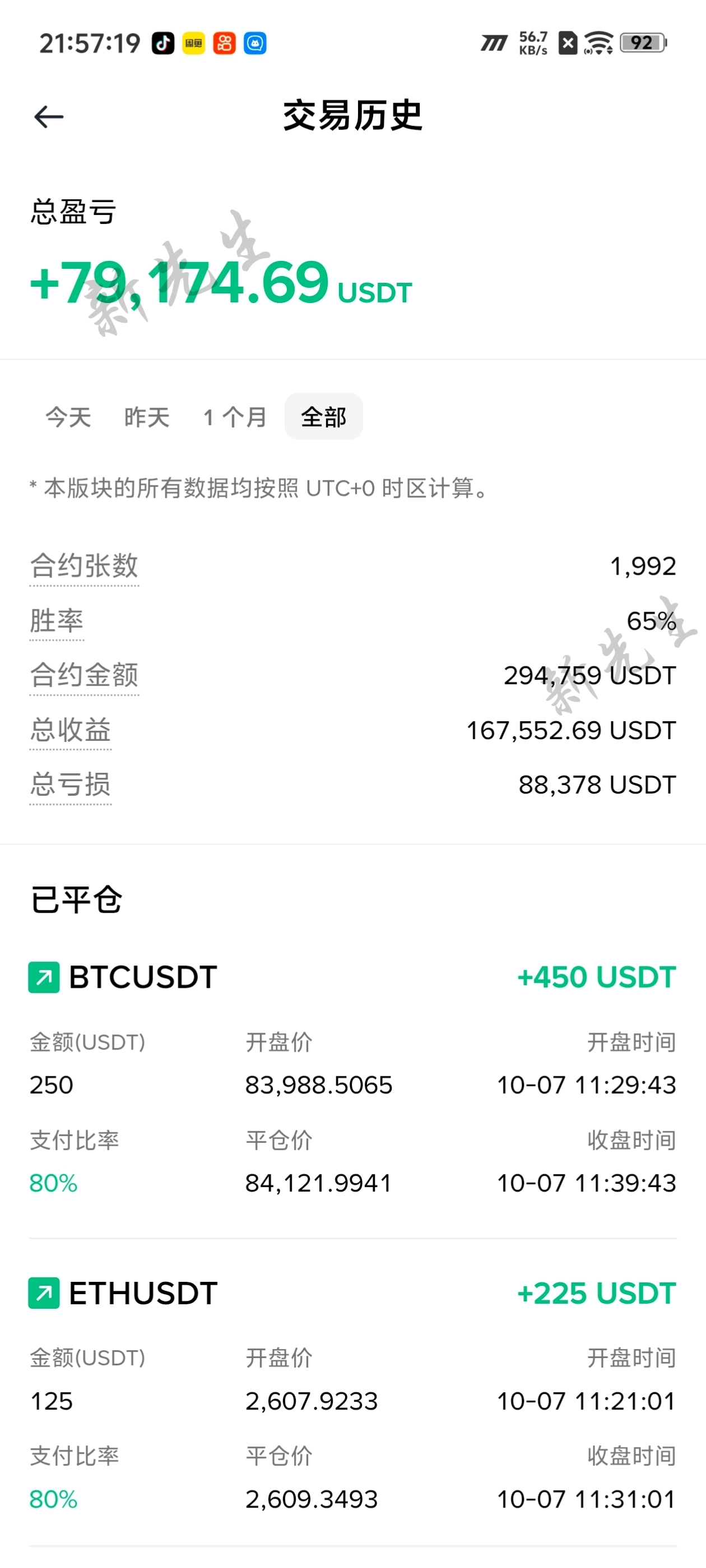
If a strategy has been validated against a large sample of data over a long period and across different market conditions, and can maintain an overall win rate of around 70%, then the focus shouldn’t be on how much you make today or tomorrow. What matters is whether your account is still growing after the strategy has been tested in extreme, sideways, and trending markets.
This account is currently up 50,000 U in unrealized profits after two months. But what I’ve always cared more about isn’t how much it made in those two months—it’s whether this system can keep running over the long term.
That’s the real significance of #量化 . #事件合约
Because when most people first start out, it’s not the market that trips them up—it’s their own emotions.
Does this sound familiar? You stay up late watching the charts, staring at a single candlestick for ages. After a few winning trades, you start to think you’ve figured out the pattern. But then extreme market conditions hit, your earlier gains start to disappear, and you panic.
You can’t accept a loss, so you place another trade to make up for it. That one goes wrong too, so you keep increasing your position. Before long, you’re no longer analyzing the market—you’re battling yourself: “There’s no way I can’t make it back today.”
More often than not, you spend days painstakingly making a profit, only to lose it all in a single night and end up back where you started.
I’ve been trading event contracts for over a year, and I’ve seen so many people start out hoping to make money, then end up saying, “I’ll quit once I break even.” Eventually, they don’t even dare to hope they’ll break even, and quietly leave. Then another batch of newcomers comes along and repeats the same cycle.
Event contracts also come with a 20% fee, which means you’re carrying a cost from the very start. The people who manage to stick around long term often aren’t the ones who are best at predicting the market, but the ones who can control themselves and avoid making bad trades.
And the biggest benefit of quantitative trading is that it puts a lock on the moments when people are most likely to lose control.
It won’t place a trade unless the conditions are met. It won’t add to a position just because the previous trade lost, or suddenly increase position size after a streak of wins. It follows the rules and executes automatically 24 hours a day, helping keep emotional, impulsive, and revenge trades to a minimum.
If a strategy has been validated against a large sample of data over a long period and across different market conditions, and can maintain an overall win rate of around 70%, then the focus shouldn’t be on how much you make today or tomorrow. What matters is whether your account is still growing after the strategy has been tested in extreme, sideways, and trending markets.
This account is currently up 50,000 U in unrealized profits after two months. But what I’ve always cared more about isn’t how much it made in those two months—it’s whether this system can keep running over the long term.
That’s the real significance of #量化 . #事件合约