

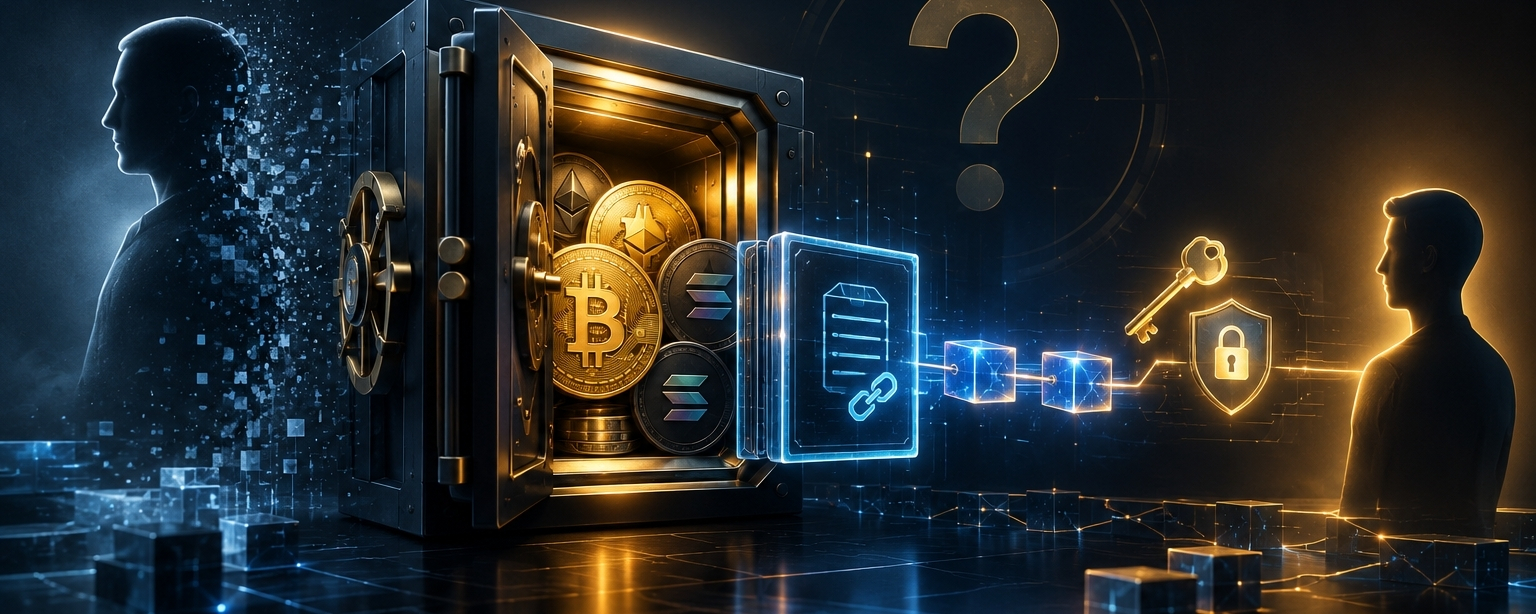

What happens to your digital coins if you disappear tomorrow? The forgotten side of digital wealth
$
In the world of cryptocurrencies, almost everyone talks about price, liquidity, market cycles, the ETF, and DeFi.
But there’s a much less discussed question:
What will happen to your digital coins if they no longer exist tomorrow?
The question may seem philosophical, but in fact it’s simultaneously a financial, technical, and legal one.
Owning Bitcoin or Ethereum or any other digital asset does not necessarily mean your family or heirs will be able to access it automatically. In some cases, the wealth may exist on the blockchain forever, but accessing it becomes impossible.
And here is one of the strangest paradoxes of the digital economy:
The assets can remain in place, while the owner of the only key disappears.
The blockchain doesn’t know who the heir is
In the traditional financial system, there are institutions that—according to the legal procedures in effect—can handle death cases, freeze accounts, and transfer assets to heirs.
Whereas in a non-custodial wallet, the equation is different.
The blockchain knows the address and the key that allows signing the transaction, but it doesn’t know that the address owner has died, nor does it automatically know who the legal heir is.
If someone owns a wallet that contains digital assets, and access to them depends on a private key or recovery phrase that nobody else knows, those assets may become practically inaccessible after their death.
And this doesn’t mean the coins disappeared.
Not at all—the opposite.
The coins may remain at the same address, and anyone on the network can see the balance, but nobody can move it without the correct signing method.
The problem isn’t only with Bitcoin
This problem isn’t only about Bitcoin.
This can apply to:
Digital currencies in non-custodial wallets.
DeFi symbols.
NFTs.
Assets on multiple networks.
Some assets associated with smart contracts.
Hardware Wallets device wallets.
And even accounts with centralized platforms, even if the access mechanism is different.
That’s why having a “copy of the Seed Phrase” is not a complete inheritance plan.
Because the next question becomes:
Who can access it? How? And when? And what prevents someone else from using it before that?
Paradox: the easy solution may be more dangerous than the problem
Some might think about writing the recovery phrase on paper and putting it in a drawer at home.
But this method creates another problem.
If the recovery phrase becomes available to anyone, the inheritance plan could turn into a theft plan.
So the recovery phrase is not like an ordinary password that can be changed easily.
In many wallets, whoever has the recovery method effectively has control over the assets.
So good planning is not only about:
“How do I give my heir the key?”
It’s also about:
“How do I give him access at the right time without giving anyone the ability to steal my assets today?”
The real solution: design a “inheritance system,” not just store a key
You can think of digital wealth as a system made up of several layers.
1. Inventory the assets
The first step isn’t giving anyone the keys.
But also knowing what you actually own.
A person may have Bitcoin in one wallet, Ethereum in another wallet, assets on a centralized platform, NFTs, and perhaps assets on different networks.
Without a clear list, heirs may not even know that some of these assets exist.
2. Document where the assets are
The document itself doesn’t necessarily have to include the private keys.
It can contain information such as:
Number of wallets.
Type of each wallet.
Networks used.
The platforms where the accounts are located.
Having hardware wallets.
Where the backups are located.
The legal documents related to the assets.
The idea is to create a map of digital wealth without creating a single easy-to-breach point.
3. Separate information from access keys
These are some of the most important ideas.
Instead of putting everything in one place, you can separate:
Information that the asset exists
About
Information on how to access it
Than
The information that actually allows signing and transferring.
The more carefully these layers are separated, the harder it becomes for a single person to access the entire wealth without the owner’s knowledge.
Multi-signature wallets may change the equation
In some cases, multiple signature wallets (Multi-Signature Wallets) can be used.
The core idea is that executing a transaction requires more than one key instead of a single key.
For example, a structure can be designed that requires a certain number of signatures to execute a transfer.
This opens the door to designing more complex inheritance scenarios:
The heir doesn’t need to have a single magical key, and the asset owner doesn’t need to hand over full control during their lifetime.
But this type of solution requires a good technical understanding, because the complexity itself can become a risk if backups and keys are not managed correctly.
What about centralized platforms?
Here the picture changes.
When assets are held on a centralized platform, the user doesn’t necessarily control the private key directly.
This means that death and account access procedures may depend on platform requirements, local laws, and required documents.
So you shouldn’t assume that:
“The platform will automatically know who the heir is”
Nor should you assume the opposite that:
“The assets will inevitably be lost.”
The reality depends on who holds the assets, their terms, jurisdiction, and the documents available.
And this is where the importance of having a clear record of accounts and related documents becomes apparent.
The biggest mistake: having the plan in only one person’s head
It may be the most dangerous point in the whole matter.
Someone could own millions of dollars in digital currencies, and use the best hardware wallet, strongest passwords, and the latest protection methods.
But if he’s the only person who knows:
Where the assets are,
and how to access them,
and which networks are used,
and where the backups are,
So the entire system becomes dependent on a single person.
And this is not only a cybersecurity issue.
It’s a continuity problem.
Digital wealth needs a “death plan” just like it needs a protection plan
A common mistake is thinking about security only from the angle of:
“How do I prevent others from accessing my money?”
But there’s a second question that’s no less important:
“How do I ensure that the people I choose will be able to access it when I’m no longer able to?”
These two issues seem contradictory, but they are actually two sides of the same problem.
Overprotection can lead to loss of assets.
And excessive ease of access may lead to it being stolen.
The goal is to find a balance between the two.
A simple test every investor can do
Instead of waiting for a real problem to happen, a practical test can be done.
Imagine you won’t be available for 30 days.
Can someone you trust be sure to know:
What assets do you own?
Where are they located?
Which wallets or platforms are used?
Where are the important documents?
Who should be contacted?
What information does he need for legal or technical access?
And what information should not be available except under specific circumstances?
If the answer is “I don’t know,” there may be a gap in your digital wealth plan.
The future may make this problem bigger
As digital assets become a larger part of the financial system, the question will no longer be:
“Do we need inheritance planning for digital currencies?”
But:
“What should financial planning look like when assets are programmable, transferable globally, and don’t require a bank to stay in existence?”
This is not a problem only for individual investors.
It can also become an important matter for companies, investment funds, and families that hold large digital assets.
So the blockchain may be excellent at keeping a record of ownership, but by itself it doesn’t solve the problem of who has the right to access that ownership once the owner’s personal circumstances change.
Summary
One of the biggest misconceptions in the world of digital currencies is that owning an asset necessarily means you can necessarily pass it on.
But the truth is more complex.
The digital asset can exist forever, while the ability to access it may disappear in a single moment.
That’s why a smart investor doesn’t only think about:
When should I buy?
Nor in:
When should I sell?
It also makes you think about a third question that doesn’t get enough attention:
If I can’t access my assets tomorrow, will the people I choose be able to access them in a safe and legal way?
In the world of cryptocurrencies, this might be one of the most important deals you’ll never execute on the blockchain:
To pre-plan what will happen to your digital wealth when you’re not the one pressing the “send” button.
Notice: This article is for general education, not legal, financial, or tax advice. Inheritance laws and access to digital assets vary by country and by the party that holds the assets. You should consult a qualified legal and financial professional when preparing an actual plan.