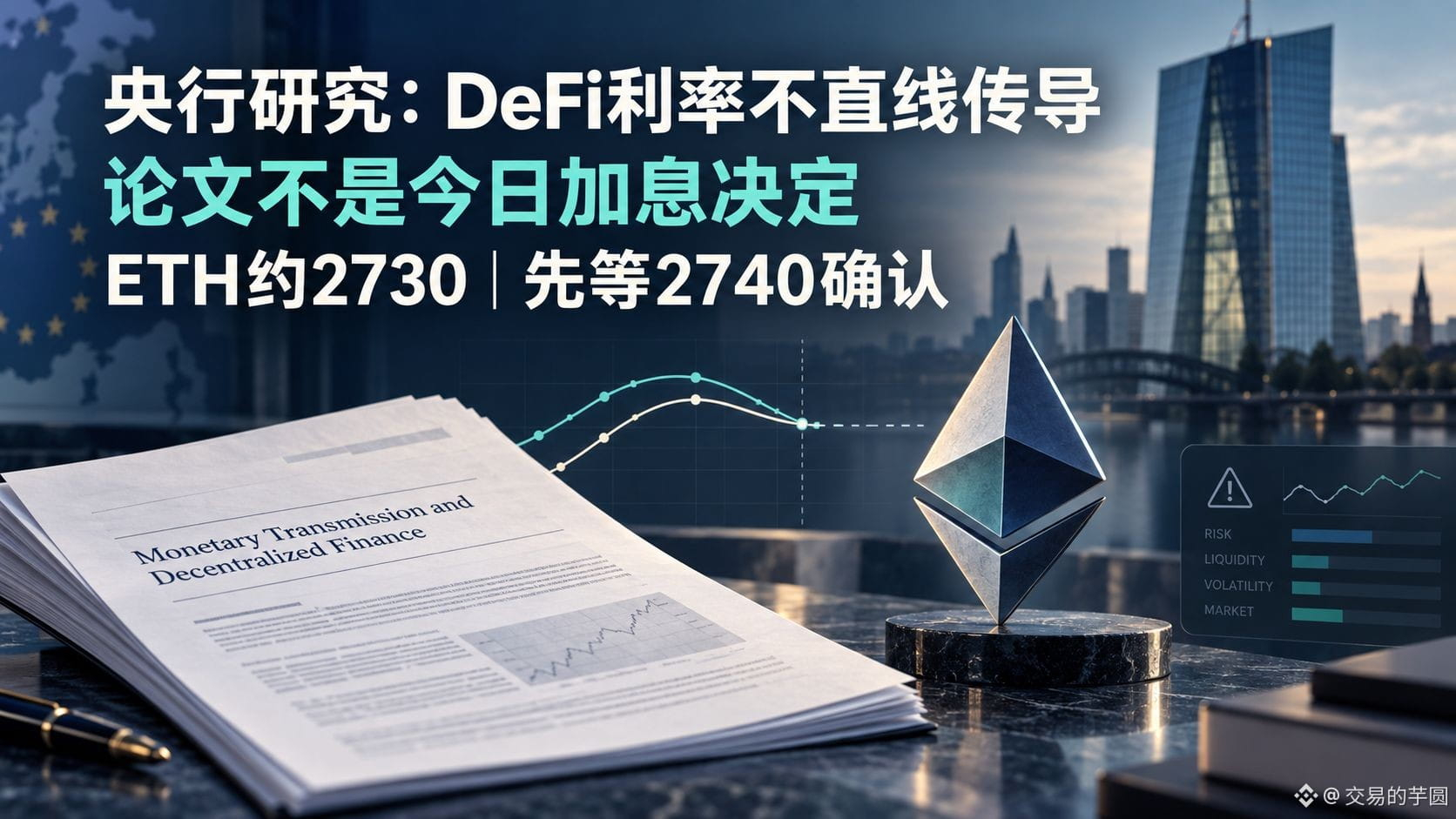
A central bank research report says DeFi interest rate transmission is not linear: it’s not today’s rate hike that decided it: ETH at 2730—I’ll wait for confirmation.
My stance remains cautious: an “interest-rate story” cannot replace entry conditions. Re-check the ECB’s Working Paper No. 3280 released on September 14. The authors studied how deposit interest rates on Ethereum’s Aave lending market for dollar stablecoins are influenced by Federal Reserve monetary policy. Using historical on-chain samples of USDT, USDC, DAI, etc., the paper finds: traditional short-term rates and DeFi deposit rates have a persistent spread; short-term transmission of policy shocks is weak and unstable—sometimes DeFi rates even move in the opposite direction; only in the medium term are they more likely to gradually converge. The paper’s front page clearly states the views are the authors’ own and do not represent the ECB’s policy position. This is not a new rate hike decision today, nor is it the central bank endorsing ETH or any particular DeFi protocol.
My understanding is that two forces are tugging in opposite directions: when traditional market interest rates rise, people who can do cross-market arbitrage may move stablecoin liquidity away, tightening on-chain supply; the same shock, if it also dampens crypto risk appetite, can reduce the demand to borrow and lever up—thereby lowering DeFi interest rates instead. Which one is stronger depends on the speed of deleveraging, cross-market funding frictions, and on-chain utilization; you can’t simply derive ETH’s intraday rise or fall from one benchmark interest rate. Ethereum is the chain where the paper observes these lending data; it does not mean the research results automatically translate into net spot buying for ETH. You also need to include in your risk budget liquidation events, contract vulnerabilities, and trading fees.
After scanning the current Binance Square trend topic and the six-hour hot-search list, there were no accurate popular tags that directly match this paper and ETH, so I’ll only discuss the coin itself. How has the market reacted? As of around 15:00 Beijing time, OKX publicly shows ETH perpetuals at $2729, with a 24-hour range of $2645–$2807. From 14:00 to the complete 15-minute candle, it fell from 2732 to close at 2728.53, with a low of 2723.5. At 14:15 it closed at 2728.74; at 14:30 it briefly tested up to 2735.2 and closed 2733.05; at 14:45 it closed again at 2729.15. After the bounce, it hasn’t continuously held above 2735, so you can’t attribute it to this paper as the reason for these few K-lines. The long entry conditions I wrote at 2725–2732—catching support, taking volume to close at 2745, then holding 2738—were not fulfilled. I won’t claim I already got filled or made money.
If I were trading myself: I wouldn’t participate right now. I’ll keep a zero position and only prepare conditional spot longs. I’ll buy using at most 1% of principal only after 2723–2730 prints at least two complete 15-minute candles without making new lows, then a high-volume close above 2740, and the next candle holds above 2735. First, I’d look at 2748–2756; if reached, I’d cut the position by half. Then I’d look at 2768–2780, and gradually close the remaining position. If after entering price returns below 2728, I’ll cut the position by half first; if a complete 15-minute candle closes below 2720, I’ll stop out and fully close. If it breaks below 2723 first and the retest to 2730 fails, then my bullish thesis is invalidated—cancel the buy order; I won’t treat the lending-rate paper as a reason to build a heavy position or use high leverage. #ETH
The above is only my personal market observation and does not constitute investment advice.
My stance remains cautious: an “interest-rate story” cannot replace entry conditions. Re-check the ECB’s Working Paper No. 3280 released on September 14. The authors studied how deposit interest rates on Ethereum’s Aave lending market for dollar stablecoins are influenced by Federal Reserve monetary policy. Using historical on-chain samples of USDT, USDC, DAI, etc., the paper finds: traditional short-term rates and DeFi deposit rates have a persistent spread; short-term transmission of policy shocks is weak and unstable—sometimes DeFi rates even move in the opposite direction; only in the medium term are they more likely to gradually converge. The paper’s front page clearly states the views are the authors’ own and do not represent the ECB’s policy position. This is not a new rate hike decision today, nor is it the central bank endorsing ETH or any particular DeFi protocol.
My understanding is that two forces are tugging in opposite directions: when traditional market interest rates rise, people who can do cross-market arbitrage may move stablecoin liquidity away, tightening on-chain supply; the same shock, if it also dampens crypto risk appetite, can reduce the demand to borrow and lever up—thereby lowering DeFi interest rates instead. Which one is stronger depends on the speed of deleveraging, cross-market funding frictions, and on-chain utilization; you can’t simply derive ETH’s intraday rise or fall from one benchmark interest rate. Ethereum is the chain where the paper observes these lending data; it does not mean the research results automatically translate into net spot buying for ETH. You also need to include in your risk budget liquidation events, contract vulnerabilities, and trading fees.
After scanning the current Binance Square trend topic and the six-hour hot-search list, there were no accurate popular tags that directly match this paper and ETH, so I’ll only discuss the coin itself. How has the market reacted? As of around 15:00 Beijing time, OKX publicly shows ETH perpetuals at $2729, with a 24-hour range of $2645–$2807. From 14:00 to the complete 15-minute candle, it fell from 2732 to close at 2728.53, with a low of 2723.5. At 14:15 it closed at 2728.74; at 14:30 it briefly tested up to 2735.2 and closed 2733.05; at 14:45 it closed again at 2729.15. After the bounce, it hasn’t continuously held above 2735, so you can’t attribute it to this paper as the reason for these few K-lines. The long entry conditions I wrote at 2725–2732—catching support, taking volume to close at 2745, then holding 2738—were not fulfilled. I won’t claim I already got filled or made money.
If I were trading myself: I wouldn’t participate right now. I’ll keep a zero position and only prepare conditional spot longs. I’ll buy using at most 1% of principal only after 2723–2730 prints at least two complete 15-minute candles without making new lows, then a high-volume close above 2740, and the next candle holds above 2735. First, I’d look at 2748–2756; if reached, I’d cut the position by half. Then I’d look at 2768–2780, and gradually close the remaining position. If after entering price returns below 2728, I’ll cut the position by half first; if a complete 15-minute candle closes below 2720, I’ll stop out and fully close. If it breaks below 2723 first and the retest to 2730 fails, then my bullish thesis is invalidated—cancel the buy order; I won’t treat the lending-rate paper as a reason to build a heavy position or use high leverage. #ETH
The above is only my personal market observation and does not constitute investment advice.