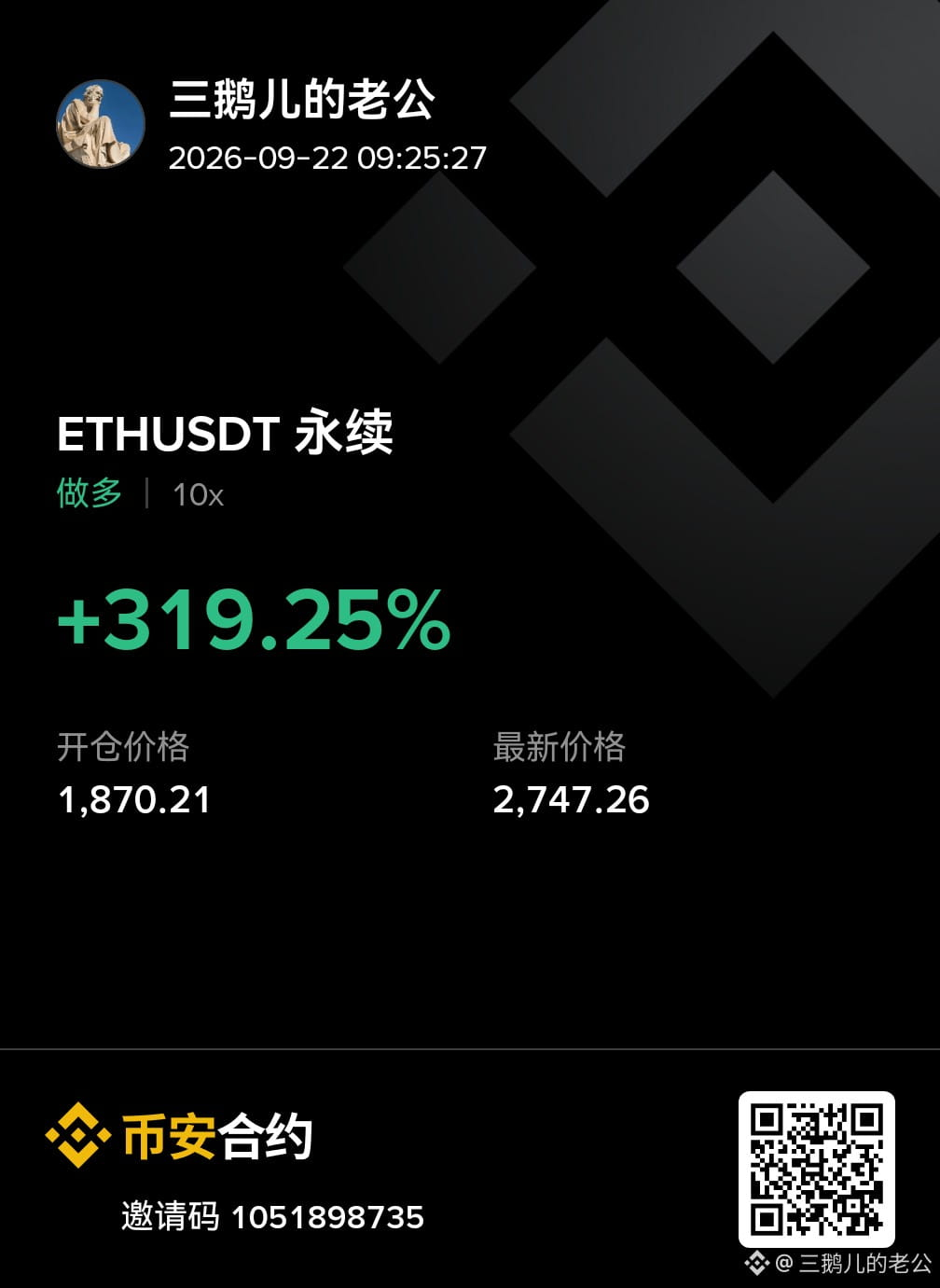
$ETH In the past three months, I believe I’m a very accurate blogger in this square for revisiting BTC and ETH. I told everyone very early on a trading logic for BTC and ETH: in the first half of the year, look for rallies to short; in the second half, start expecting pullbacks to enter and build long positions. Whether it’s futures or spot, in order to catch the bull market—even during the rate-hike period—I firmly told everyone that “when bad news is fully priced in, it becomes good news.” Their only trading mindset is to buy the dip to go long. Old friends all know this, and my records are all there. Today a friend asked me about the logic behind this leg of上涨 (rally), so I’ll explain it in detail. I think this surge in BTC and ETH strength isn’t driven by a single piece of good news, but rather the overlap of four things: “bad news is priced in + macro pressure eases + ETF capital flows back + shorts are forced to cover.” BTC has broken back above the $85,000 area, and ETH has also returned to around $2,750.
First, the biggest negative—rate hikes—has been fully realized, and the market already knew it would happen. On September 16, the Fed raised rates by 25bp to 3.75%–4.00%. But before the hike, the probability of a 25bp increase had already exceeded 90%. So after it truly happened, there wasn’t any new major information gap. BTC was consolidating around $75,000 at the time, and then instead it quickly regained $80,000. In other words: the market didn’t suddenly start liking rate hikes; it’s that the worst-case scenario already occurred, and it wasn’t worse than expected.
Second, oil prices pull back, and pressure on Treasury yields eases. This point is extremely important. After oil prices kept falling, worries that inflation was getting out of control and that there would be continuous rate hikes declined as well. Treasury yields also softened. For long-duration risk assets like BTC and ETH, this is clearly a signal of improved liquidity. Also, I’ve said before an important logic: rate hikes are not easy to trigger a heavy sell-off; they only tend to “poke in needles.” It’s rate cuts that more easily become bullish, and the market is more likely to sell when liquidity is good and emotions are in FOMO mode.
First, the biggest negative—rate hikes—has been fully realized, and the market already knew it would happen. On September 16, the Fed raised rates by 25bp to 3.75%–4.00%. But before the hike, the probability of a 25bp increase had already exceeded 90%. So after it truly happened, there wasn’t any new major information gap. BTC was consolidating around $75,000 at the time, and then instead it quickly regained $80,000. In other words: the market didn’t suddenly start liking rate hikes; it’s that the worst-case scenario already occurred, and it wasn’t worse than expected.
Second, oil prices pull back, and pressure on Treasury yields eases. This point is extremely important. After oil prices kept falling, worries that inflation was getting out of control and that there would be continuous rate hikes declined as well. Treasury yields also softened. For long-duration risk assets like BTC and ETH, this is clearly a signal of improved liquidity. Also, I’ve said before an important logic: rate hikes are not easy to trigger a heavy sell-off; they only tend to “poke in needles.” It’s rate cuts that more easily become bullish, and the market is more likely to sell when liquidity is good and emotions are in FOMO mode.