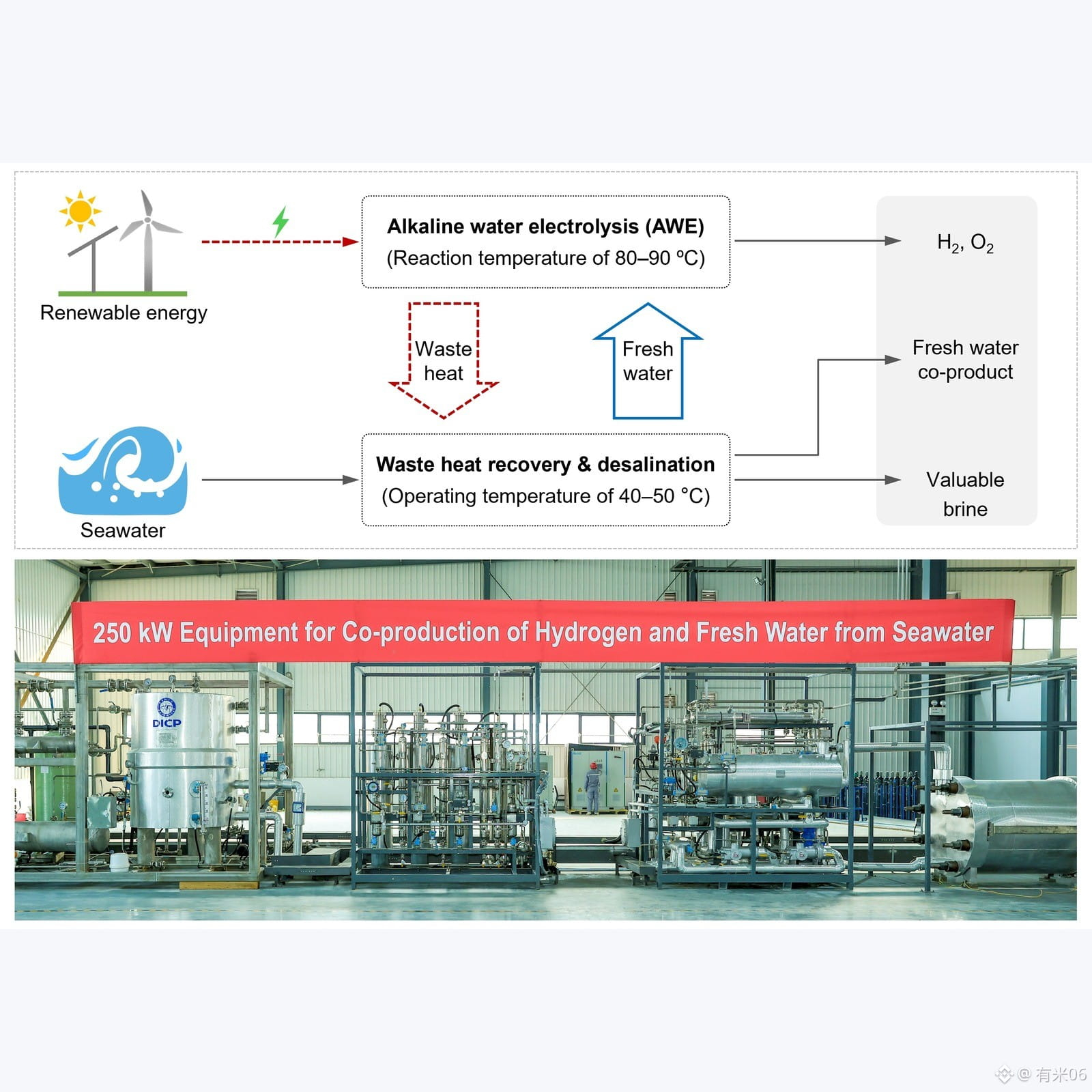
At a glance: Researchers at Dalian Institute of Chemical Physics, Chinese Academy of Sciences (DICP) repurpose waste heat from alkaline electrolysis of water for low-temperature distillation of seawater, creating “Seawater-to-Hydrogen Cogeneration with Freshwater Production” (STHW). In a 250 kW-class system, it produces about 48 Nm³ of high-purity hydrogen per hour and about 31.6 kg of freshwater per hour. Its electricity utilization efficiency is about 14.4% higher than that of conventional freshwater alkaline water electrolysis.
According to DICP’s press release (2026-09-16) and Nature Energy (2026-09-15, DOI 10.1038/s41560-026-02130-6): the Deng Dehui / Liu Yanting team recovers roughly 80–90°C low-grade waste heat to drive vacuum low-temperature desalination. The resulting freshwater can be fed back to the electrolysis system, and surplus can also be supplied externally. In a 20 kW pilot test, the system reportedly ran stably for about 100 days (about 3.8 Nm³/h hydrogen and 1.2 kg/h freshwater). This represents engineering validation and publication in a journal; it does not mean that green hydrogen production using coastal renewable electricity has been fully deployed everywhere. TechXplore’s coverage follows the same framing.
Figure: Original equipment image from DICP’s press release (process schematic + 250 kW setup, not AI)
Data as of: Nature Energy 2026-09-15; DICP press release 2026-09-16; TechXplore cross-check
#绿氢 #research
According to DICP’s press release (2026-09-16) and Nature Energy (2026-09-15, DOI 10.1038/s41560-026-02130-6): the Deng Dehui / Liu Yanting team recovers roughly 80–90°C low-grade waste heat to drive vacuum low-temperature desalination. The resulting freshwater can be fed back to the electrolysis system, and surplus can also be supplied externally. In a 20 kW pilot test, the system reportedly ran stably for about 100 days (about 3.8 Nm³/h hydrogen and 1.2 kg/h freshwater). This represents engineering validation and publication in a journal; it does not mean that green hydrogen production using coastal renewable electricity has been fully deployed everywhere. TechXplore’s coverage follows the same framing.
Figure: Original equipment image from DICP’s press release (process schematic + 250 kW setup, not AI)
Data as of: Nature Energy 2026-09-15; DICP press release 2026-09-16; TechXplore cross-check
#绿氢 #research