
Gerald Votta from Quantum Economics has a theory about the true identity of Bitcoin creator Satoshi Nakamoto: the author who first responded to the white paper itself.

Ever since Satoshi Nakamoto, the anonymous inventor of Bitcoin, disappeared in 2011, there has been no shortage of theories about their identity.
Hal Finney, Dorian Satoshi Nakamoto, Nick Szabo, and Craig Wright have all been mentioned as possible contenders (even if Wright is the main figure pushing the last theory).
Now, after months of research, Gerald Votta, head of GameFi research at Quantum Economics, thinks he has found the answer to the true identity of Satoshi Nakamoto: Canadian cryptographer James A. Donald. In a new research article published on Wednesday, Votta outlines what he believes is intriguing circumstantial evidence that proves the connection.
Donald was the first person to comment on the Bitcoin white paper in 2008, which piqued Votta’s interest. Votta wrote that the “almost instantaneous” timing was “highly suspicious” and prompted him to “take a closer look at his (Donald’s) life.”
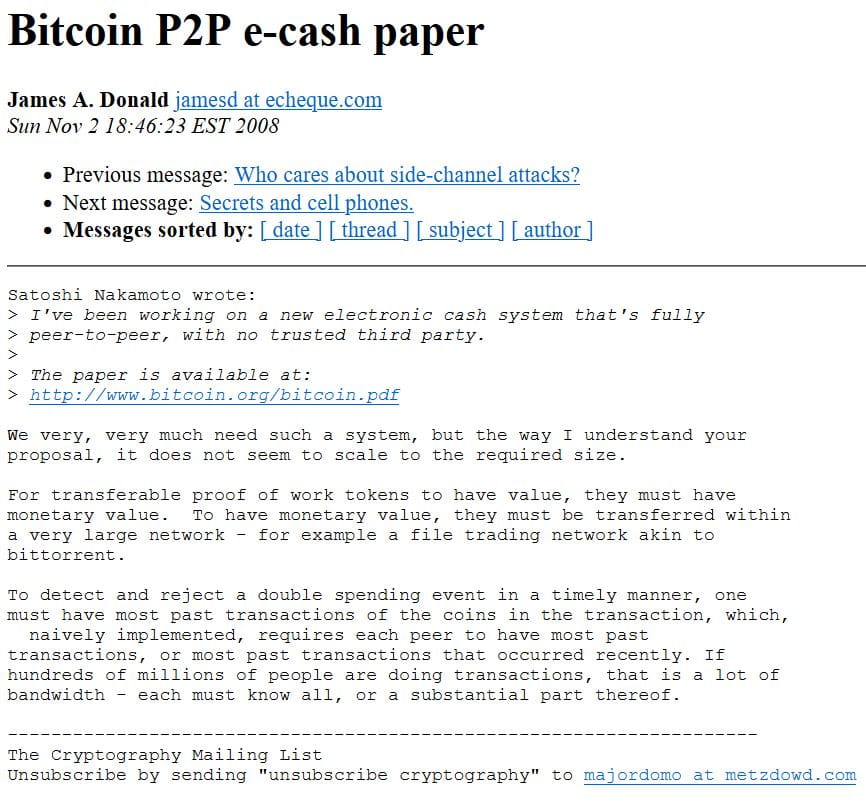
“If you look at the timing, Donald made his comment minutes after the Bitcoin white paper came out and asked Satoshi this specific question — how could you read the white paper, analyze it, and come up with this amazing scaling problem in, like, three minutes? It’s almost impossible.”
Donald also qualified, Vota wrote: "Donald not only has a deep understanding of computers, programming, and cryptography, but is also well-versed in economics, history, and law. However, it was his own words that helped me connect him to Satoshi."
This isn’t the first time this theory has been proposed. Back in 2014, a post by user Bruno Kucinskas on the online forum Bitcointalk also pointed out the same evidence of rapid replies, sparking a debate. One user argued that the timestamps on the different archives were different, while another said the time zones were different than suggested, which would call into question the length of time between the post and the reply.
It’s also possible that Satoshi and Donald spoke privately before publicly releasing the questions and responses. Votta told Cointelegraph that he had read all of these counter-arguments, but his evidence “speaks for itself.” He noted that the website for Donald’s project, Crypto Kong, “is literally Bitcoin incarnate.”
Votta’s research delves into Crypto Kong, a software program that uses elliptic curve cryptography to electronically sign documents. “This particular program is very familiar with the foundations of Bitcoin,” he wrote, with Votta’s blog post delving into the similarities between the information on the website and the white paper.
The Echeque website contains details of Crypto Kong, and "echeque.com" is the domain of Donald's email "james@echeque.com." Votta said Donald emailed Satoshi Nakamoto from this address at least once.
As evidence, on the main Crypto Kong page on the Echeque website, there is a minimized Kong example on the right side of the screen, whose digital signature matches the one sent to Satoshi Nakamoto up to the 34th bit.
So if they were actually Donald, why would Satoshi be talking to them from two different addresses? In Votta’s view, this strategy is a ploy to “remain anonymous and provoke a contrarian view on Bitcoin.”
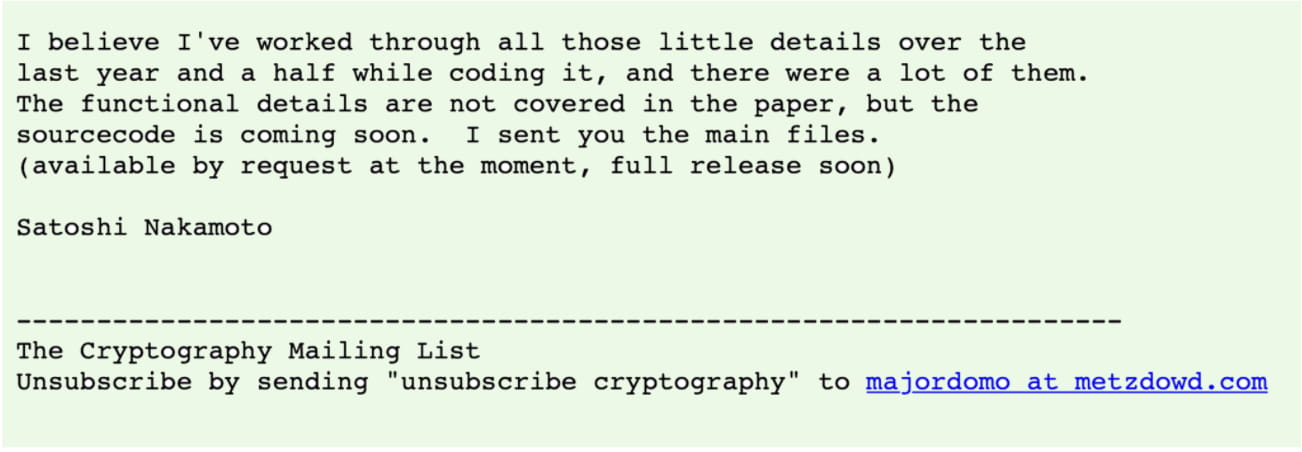
He also backed up his claim with evidence gathered through analysis of written language used by Satoshi Nakamoto. “[Donald’s] communications contain language that reminds me of Satoshi Nakamoto,” he wrote.
He claimed that Nakamoto was "not only fluent in English, but fluent in North American English," meaning he was likely born, raised, or studied in the United States, the United Kingdom, or a former British colony.
For example, Satoshi used the word “Chancellor” and the British spelling of the word “favour”.
Likewise, he was able to connect Satoshi and Donald through the specific usage of the word “ Chaumian ”, which Donald used in an email response on August 3, 2003, and which Satoshi also used in an email response on February 11, 2009.
"At this point, the mystery is solved. The likelihood of two people having these same credentials, a clear grasp of the North American language and culture, and sharing nearly identical white papers is extremely low," Votta said.
Mati Greenspan, founder of Quantum Economics, said Gerard conducted months of research alongside vice president of content Charles Bovaird, who “ensured appropriate research practices and information sourcing.”
He said the response to the post was "very good".
“This has been one of our most popular research pieces to date and we continue to get incredible feedback from industry experts.”