
SignalX 🇻🇳
896 Posts

SignalX 🇻🇳
 Square Verified
Personal analysis and market views only not financial or investment advice.
🤖 This channel is sponsored, built, and powered by SignalX AutoBot.
High-Frequency Trader
5.4 Years
150 Following
17.9K+ Followers
10.1K+ Liked
Posts
All
Quotes
Videos
Live
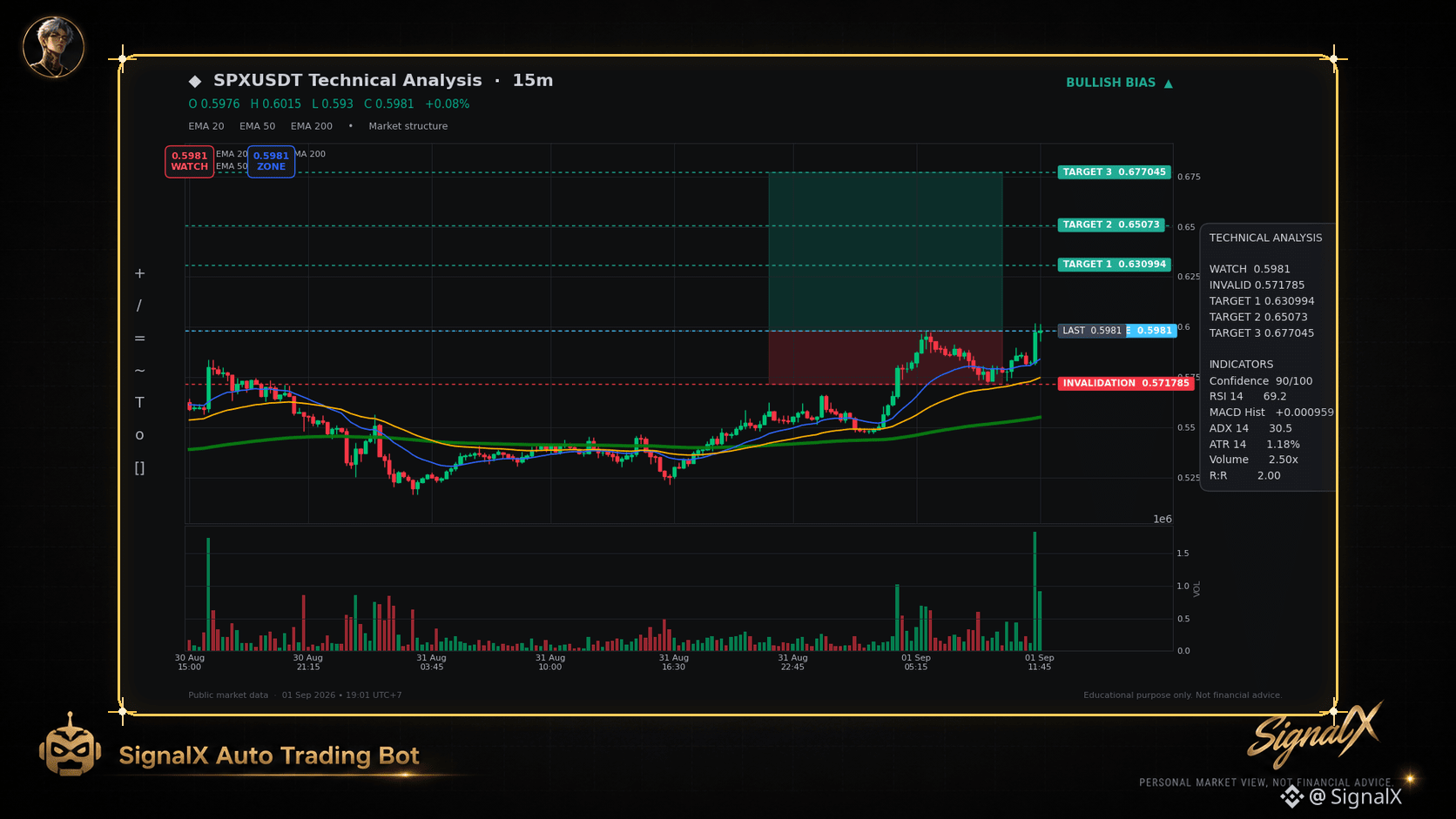
TECHNICAL ANALYSIS — SPX (15m)
🧭 Market bias: BULLISH BIAS 🟢
🎯 Setup: trend pullback/continuation
⭐ Confidence: 90/100
📍 Price zones to watch: 0.5981
🛑 Scenario invalidation level: 0.571785 (4.40% distance)
🎯 Technical target 1: 0.630994 (1.25R)
🎯 Technical target 2: 0.65073 (2R)
🎯 Technical target 3: 0.677045 (3R)
📊 TECHNICAL INDICATORS
📈 EMA20/50/200: aligned long
💪 ADX14: 30.5
⚡ RSI14: 69.2
🌊 MACD histogram: +0.000959145
🌡️ ATR14: 1.18% of price
🔊 Volume: 2.50x average (above 20-candle mean)
⚠️ A 15m close beyond the invalidation level weakens this scenario.
Disclaimer: Educational technical analysis only—not financial advice. Leveraged markets involve substantial risk.
🧭 Market bias: BULLISH BIAS 🟢
🎯 Setup: trend pullback/continuation
⭐ Confidence: 90/100
📍 Price zones to watch: 0.5981
🛑 Scenario invalidation level: 0.571785 (4.40% distance)
🎯 Technical target 1: 0.630994 (1.25R)
🎯 Technical target 2: 0.65073 (2R)
🎯 Technical target 3: 0.677045 (3R)
📊 TECHNICAL INDICATORS
📈 EMA20/50/200: aligned long
💪 ADX14: 30.5
⚡ RSI14: 69.2
🌊 MACD histogram: +0.000959145
🌡️ ATR14: 1.18% of price
🔊 Volume: 2.50x average (above 20-candle mean)
⚠️ A 15m close beyond the invalidation level weakens this scenario.
Disclaimer: Educational technical analysis only—not financial advice. Leveraged markets involve substantial risk.
🌍 CRYPTO MARKET UPDATE
Zoomex Deepens TradFi Push With 50+ Stock Perpetuals and Zero-Fee TradFi
Zoomex, a global cryptocurrency trading platform focused on derivatives trading, today confirmed that its Stock Perpetuals lineup has grown past 50 contracts. The milestone consolidates Zoomex’s position as a platform built for traders who want round-the-clock access to the world’s most closely watched equities, without ever leaving the derivatives infrastructure they already trust, and it The post Zoomex Deepens TradFi Push With 50+ Stock Perpetuals and Zero-Fee TradFi appeared first on . and global equities, all margined and settled in USDT: established mega-cap anchors including AAPL, MSFT, GOOGL, AMZN, META, TSLA, and NVDA; a fast-growing AI and semiconductor cluster covering AMD, INTC, AVGO, ASML, ARM, MRVL, QCOM, and TXN; crypto-adjacent equities such as COIN, MSTR, MARA, RIOT, CIFR, and HOOD; and a broader healthcare, finance, and consumer segment featuring UNH, GE, JPM, GILD, REGN, AMGN, WMT, KO, PEP, MA, PYPL, and BRK.B. Each contract trades 24/7 with leverage of up to 25x on most pairs, giving traders continuous exposure to names that traditional brokerages close off for two-thirds of every week. Rather than requiring a separate account, a different interface, or a new onboarding flow, every new Stock Perpetual contract runs on the same infrastructure as Zoomex’s existing USDT Perpetuals. Traders simply search the ticker under the Stock category in Perpetual Trading and open a position the same way they would on any crypto pair, with no currency conversion, no international wire transfer, and no waiting for a market to reopen. Built on Transparency and Rule-Based Execution Transparent by Design underpins the structure of each contract. Seychelles time or closing one on JPM during a U.S.
🕒 Updated: 01 Sep 2026 11:19 UTC
#CryptoNews #MarketUpdate #BinanceSquare
Zoomex Deepens TradFi Push With 50+ Stock Perpetuals and Zero-Fee TradFi
Zoomex, a global cryptocurrency trading platform focused on derivatives trading, today confirmed that its Stock Perpetuals lineup has grown past 50 contracts. The milestone consolidates Zoomex’s position as a platform built for traders who want round-the-clock access to the world’s most closely watched equities, without ever leaving the derivatives infrastructure they already trust, and it The post Zoomex Deepens TradFi Push With 50+ Stock Perpetuals and Zero-Fee TradFi appeared first on . and global equities, all margined and settled in USDT: established mega-cap anchors including AAPL, MSFT, GOOGL, AMZN, META, TSLA, and NVDA; a fast-growing AI and semiconductor cluster covering AMD, INTC, AVGO, ASML, ARM, MRVL, QCOM, and TXN; crypto-adjacent equities such as COIN, MSTR, MARA, RIOT, CIFR, and HOOD; and a broader healthcare, finance, and consumer segment featuring UNH, GE, JPM, GILD, REGN, AMGN, WMT, KO, PEP, MA, PYPL, and BRK.B. Each contract trades 24/7 with leverage of up to 25x on most pairs, giving traders continuous exposure to names that traditional brokerages close off for two-thirds of every week. Rather than requiring a separate account, a different interface, or a new onboarding flow, every new Stock Perpetual contract runs on the same infrastructure as Zoomex’s existing USDT Perpetuals. Traders simply search the ticker under the Stock category in Perpetual Trading and open a position the same way they would on any crypto pair, with no currency conversion, no international wire transfer, and no waiting for a market to reopen. Built on Transparency and Rule-Based Execution Transparent by Design underpins the structure of each contract. Seychelles time or closing one on JPM during a U.S.
🕒 Updated: 01 Sep 2026 11:19 UTC
#CryptoNews #MarketUpdate #BinanceSquare
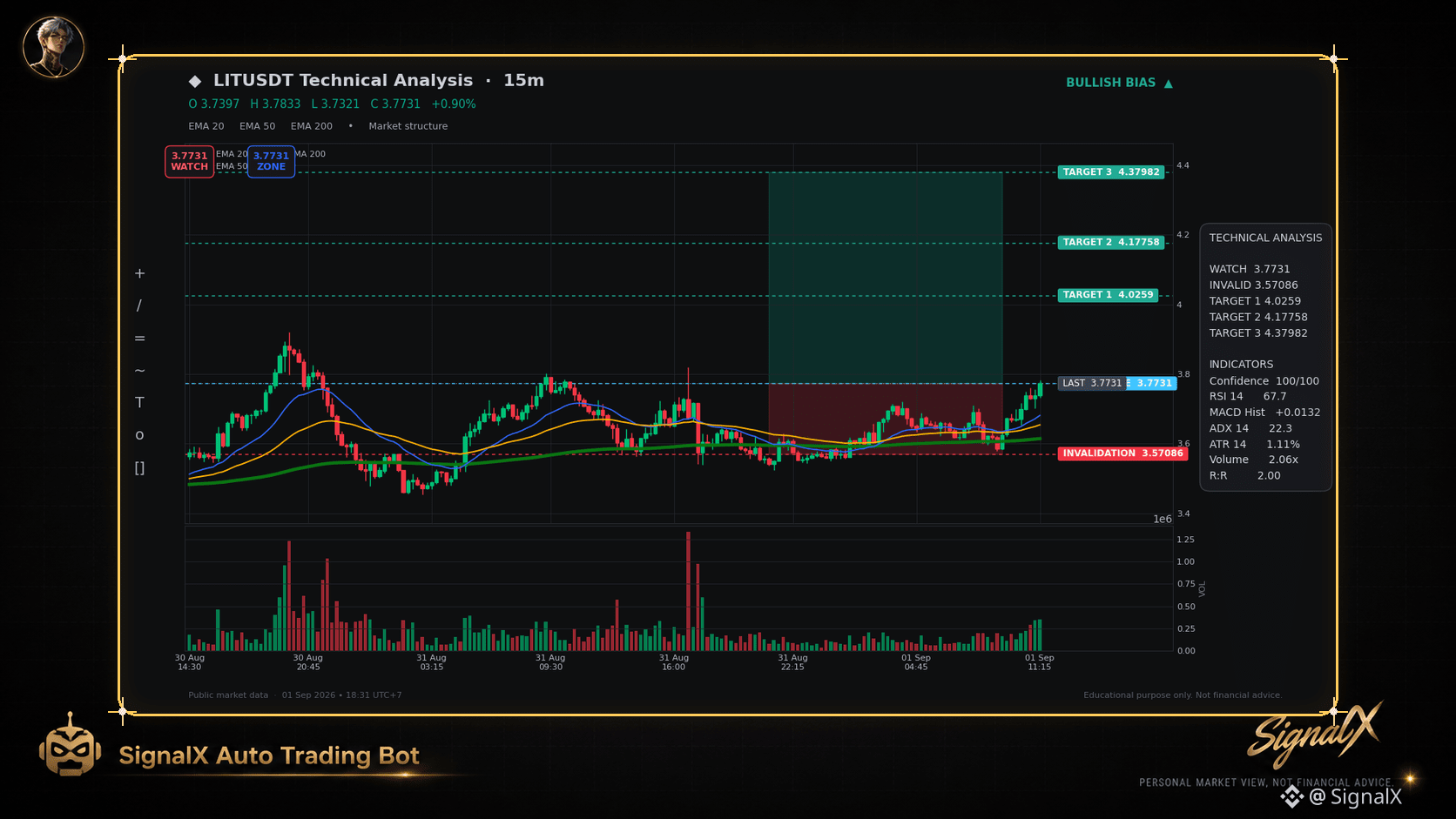
TECHNICAL ANALYSIS — LIT (15m)
🧭 Market bias: BULLISH BIAS 🟢
🎯 Setup: 20-candle breakout
⭐ Confidence: 100/100
📍 Price zones to watch: 3.7731
🛑 Scenario invalidation level: 3.57086 (5.36% distance)
🎯 Technical target 1: 4.0259 (1.25R)
🎯 Technical target 2: 4.17758 (2R)
🎯 Technical target 3: 4.37982 (3R)
📊 TECHNICAL INDICATORS
📈 EMA20/50/200: aligned long
💪 ADX14: 22.3
⚡ RSI14: 67.7
🌊 MACD histogram: +0.0131553
🌡️ ATR14: 1.11% of price
🔊 Volume: 2.06x average (above 20-candle mean)
⚠️ A 15m close beyond the invalidation level weakens this scenario.
Disclaimer: Educational technical analysis only—not financial advice. Leveraged markets involve substantial risk.
🧭 Market bias: BULLISH BIAS 🟢
🎯 Setup: 20-candle breakout
⭐ Confidence: 100/100
📍 Price zones to watch: 3.7731
🛑 Scenario invalidation level: 3.57086 (5.36% distance)
🎯 Technical target 1: 4.0259 (1.25R)
🎯 Technical target 2: 4.17758 (2R)
🎯 Technical target 3: 4.37982 (3R)
📊 TECHNICAL INDICATORS
📈 EMA20/50/200: aligned long
💪 ADX14: 22.3
⚡ RSI14: 67.7
🌊 MACD histogram: +0.0131553
🌡️ ATR14: 1.11% of price
🔊 Volume: 2.06x average (above 20-candle mean)
⚠️ A 15m close beyond the invalidation level weakens this scenario.
Disclaimer: Educational technical analysis only—not financial advice. Leveraged markets involve substantial risk.
🌍 CRYPTO MARKET UPDATE
Richer Than Anyone Thinks? Why Justin Sun Will Never Cash Out His Crypto
Justin Sun says Forbes and Bloomberg cut 70-80% off his net worth. Why Justin Sun Will Never Cash Out His Crypto appeared first on . TRON founder Justin Sun says Forbes and Bloomberg strip 70% to 80% off his crypto holdings when they calculate his net worth. Traditional trackers value him in the mid single-digit billions. Sun says the number they cut is the number that actually matters. Why Forbes and Bloomberg Discount His Net Worth TRON (TRX) currently trades near $0.33 , which ranks it eighth by market value at roughly $31.4 billion. That single price moves most of his balance sheet. Consequently, they treat most digital assets as uncertain rather than bankable. Forbes puts Sun at $8.5 billion and ranks him 444th globally. Sun accepts that logic yet rejects its conclusion. He framed the discounted slice as the place where his judgment sits. His finances drew fresh attention during his World Liberty lawsuit . “When Bloomberg and Forbes calculate my net worth, they discount my crypto assets by 70-80%. I understand their logic: concentration, high volatility, and by their standards, it doesn’t count as “certain.” That’s their methodology, and it has nothing to do with me.” Justin Sun, TRON founder, wrote in a post on X. Sun sued Bloomberg in 2025 to stop it from publishing his holdings. He cited personal security risks at the time. Scrutiny has grown across his businesses this year. He answered questions about Binance’s HTX restrictions in August. Meanwhile, his exchange moved closer to a settlement with the FCA , the UK financial regulator. Sun Rejects Diversifying Out of Crypto For 14 years, Sun has held most of his personal assets in crypto. However, he dismisses those as second-best assets.
🕒 Updated: 01 Sep 2026 11:08 UTC
#CryptoNews #MarketUpdate #BinanceSquare
Richer Than Anyone Thinks? Why Justin Sun Will Never Cash Out His Crypto
Justin Sun says Forbes and Bloomberg cut 70-80% off his net worth. Why Justin Sun Will Never Cash Out His Crypto appeared first on . TRON founder Justin Sun says Forbes and Bloomberg strip 70% to 80% off his crypto holdings when they calculate his net worth. Traditional trackers value him in the mid single-digit billions. Sun says the number they cut is the number that actually matters. Why Forbes and Bloomberg Discount His Net Worth TRON (TRX) currently trades near $0.33 , which ranks it eighth by market value at roughly $31.4 billion. That single price moves most of his balance sheet. Consequently, they treat most digital assets as uncertain rather than bankable. Forbes puts Sun at $8.5 billion and ranks him 444th globally. Sun accepts that logic yet rejects its conclusion. He framed the discounted slice as the place where his judgment sits. His finances drew fresh attention during his World Liberty lawsuit . “When Bloomberg and Forbes calculate my net worth, they discount my crypto assets by 70-80%. I understand their logic: concentration, high volatility, and by their standards, it doesn’t count as “certain.” That’s their methodology, and it has nothing to do with me.” Justin Sun, TRON founder, wrote in a post on X. Sun sued Bloomberg in 2025 to stop it from publishing his holdings. He cited personal security risks at the time. Scrutiny has grown across his businesses this year. He answered questions about Binance’s HTX restrictions in August. Meanwhile, his exchange moved closer to a settlement with the FCA , the UK financial regulator. Sun Rejects Diversifying Out of Crypto For 14 years, Sun has held most of his personal assets in crypto. However, he dismisses those as second-best assets.
🕒 Updated: 01 Sep 2026 11:08 UTC
#CryptoNews #MarketUpdate #BinanceSquare

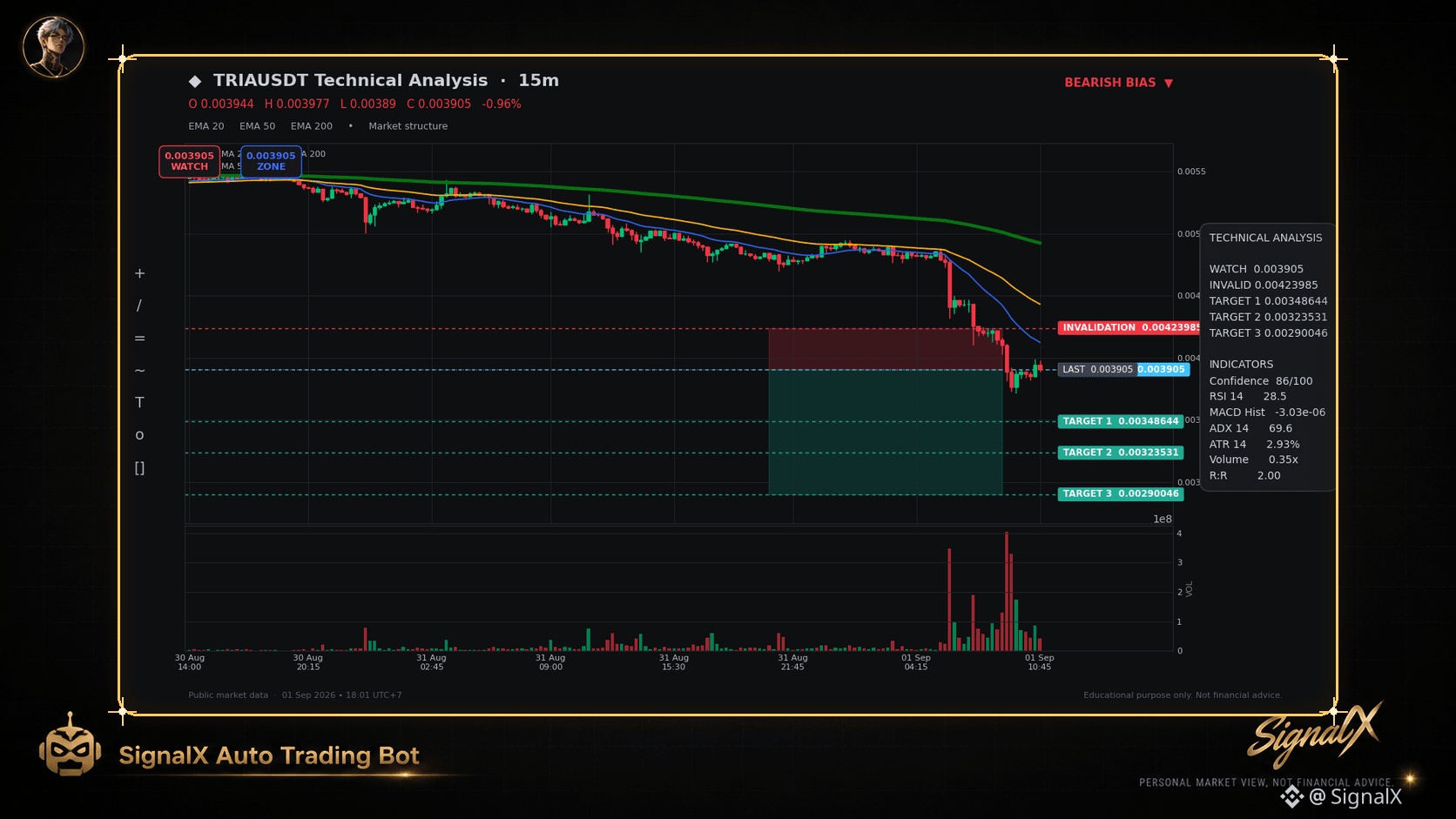
TECHNICAL ANALYSIS — TRIA (15m)
🧭 Market bias: BEARISH BIAS 🔴
🎯 Setup: trend pullback/continuation
⭐ Confidence: 86/100
📍 Price zones to watch: 0.003905
🛑 Scenario invalidation level: 0.00423985 (8.57% distance)
🎯 Technical target 1: 0.00348644 (1.25R)
🎯 Technical target 2: 0.00323531 (2R)
🎯 Technical target 3: 0.00290046 (3R)
📊 TECHNICAL INDICATORS
📈 EMA20/50/200: aligned short
💪 ADX14: 69.6
⚡ RSI14: 28.5
🌊 MACD histogram: -3.03352e-06
🌡️ ATR14: 2.93% of price
🔊 Volume: 0.35x average (below 20-candle mean)
⚠️ A 15m close beyond the invalidation level weakens this scenario.
Disclaimer: Educational technical analysis only—not financial advice. Leveraged markets involve substantial risk.
🧭 Market bias: BEARISH BIAS 🔴
🎯 Setup: trend pullback/continuation
⭐ Confidence: 86/100
📍 Price zones to watch: 0.003905
🛑 Scenario invalidation level: 0.00423985 (8.57% distance)
🎯 Technical target 1: 0.00348644 (1.25R)
🎯 Technical target 2: 0.00323531 (2R)
🎯 Technical target 3: 0.00290046 (3R)
📊 TECHNICAL INDICATORS
📈 EMA20/50/200: aligned short
💪 ADX14: 69.6
⚡ RSI14: 28.5
🌊 MACD histogram: -3.03352e-06
🌡️ ATR14: 2.93% of price
🔊 Volume: 0.35x average (below 20-candle mean)
⚠️ A 15m close beyond the invalidation level weakens this scenario.
Disclaimer: Educational technical analysis only—not financial advice. Leveraged markets involve substantial risk.
🌍 CRYPTO MARKET UPDATE
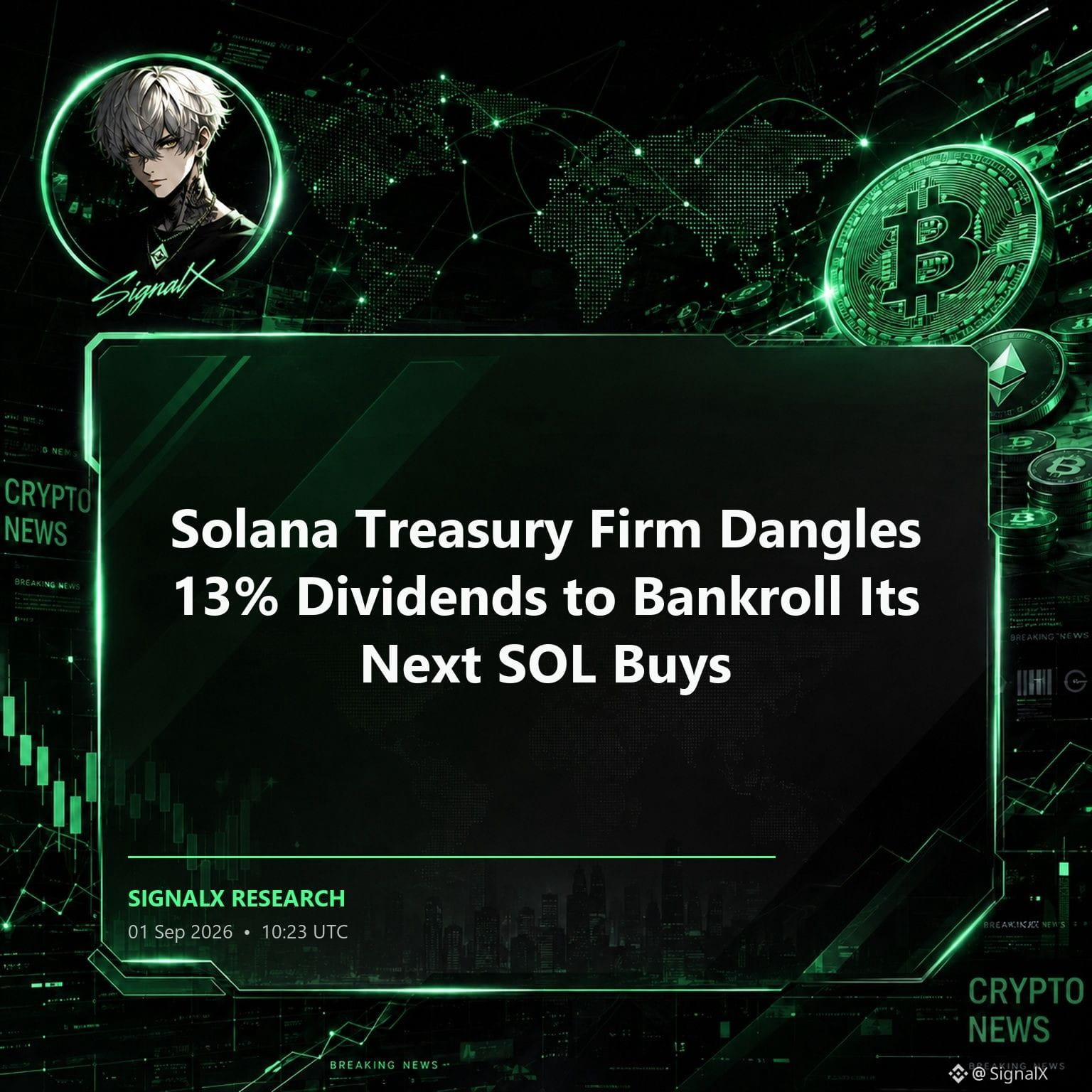
Solana Treasury Firm Dangles 13% Dividends to Bankroll Its Next SOL Buys
plans to raise up to $20 million through a preferred stock offering. It carries an initial annual dividend rate of 13%. The Solana (SOL) treasury company intends to use part of the proceeds to buy more SOL. It resumed accumulation last week as market conditions turned more favorable. What the Preferred Stock The post Solana Treasury Firm Dangles 13% Dividends to Bankroll Its Next SOL Buys appeared first on . What the Preferred Stock Offers DFDV announced that it plans to conduct an IPO of its Variable Rate Series C Perpetual Preferred Stock, known as CHAD Stock. Dividends will accrue on a stated amount of $10 per share. Payments will be made each business day of each calendar month, beginning October 1, 2026. The initial annual dividend rate is 13%, subject to adjustment under the stock’s terms. DFDV also intends to deposit $1.30 per share into a separate account at closing. The reserve would cover 12 months of dividend payments at the initial 13% rate. The company can fund it with existing cash, financial instruments, and/or digital assets. “The Company intends to use the net proceeds from the offering for general corporate purposes, including for working capital, the acquisition of SOL and other digital asset-related investments, strategic transactions and growth initiatives,” the firm said . Last week, it added 19,000 SOL at an average price of $98.14. That purchase lifted its treasury to about 2.33 million SOL and SOL equivalents. The company partly funded the acquisition by divesting its ZeroStack position, citing improving market conditions. Chief Executive Joseph Onorati described DFDV as a leveraged way for investors to gain exposure to SOL.
🕒 Updated: 01 Sep 2026 10:23 UTC
#CryptoNews #MarketUpdate #BinanceSquare
Solana Treasury Firm Dangles 13% Dividends to Bankroll Its Next SOL Buys
plans to raise up to $20 million through a preferred stock offering. It carries an initial annual dividend rate of 13%. The Solana (SOL) treasury company intends to use part of the proceeds to buy more SOL. It resumed accumulation last week as market conditions turned more favorable. What the Preferred Stock The post Solana Treasury Firm Dangles 13% Dividends to Bankroll Its Next SOL Buys appeared first on . What the Preferred Stock Offers DFDV announced that it plans to conduct an IPO of its Variable Rate Series C Perpetual Preferred Stock, known as CHAD Stock. Dividends will accrue on a stated amount of $10 per share. Payments will be made each business day of each calendar month, beginning October 1, 2026. The initial annual dividend rate is 13%, subject to adjustment under the stock’s terms. DFDV also intends to deposit $1.30 per share into a separate account at closing. The reserve would cover 12 months of dividend payments at the initial 13% rate. The company can fund it with existing cash, financial instruments, and/or digital assets. “The Company intends to use the net proceeds from the offering for general corporate purposes, including for working capital, the acquisition of SOL and other digital asset-related investments, strategic transactions and growth initiatives,” the firm said . Last week, it added 19,000 SOL at an average price of $98.14. That purchase lifted its treasury to about 2.33 million SOL and SOL equivalents. The company partly funded the acquisition by divesting its ZeroStack position, citing improving market conditions. Chief Executive Joseph Onorati described DFDV as a leveraged way for investors to gain exposure to SOL.
🕒 Updated: 01 Sep 2026 10:23 UTC
#CryptoNews #MarketUpdate #BinanceSquare
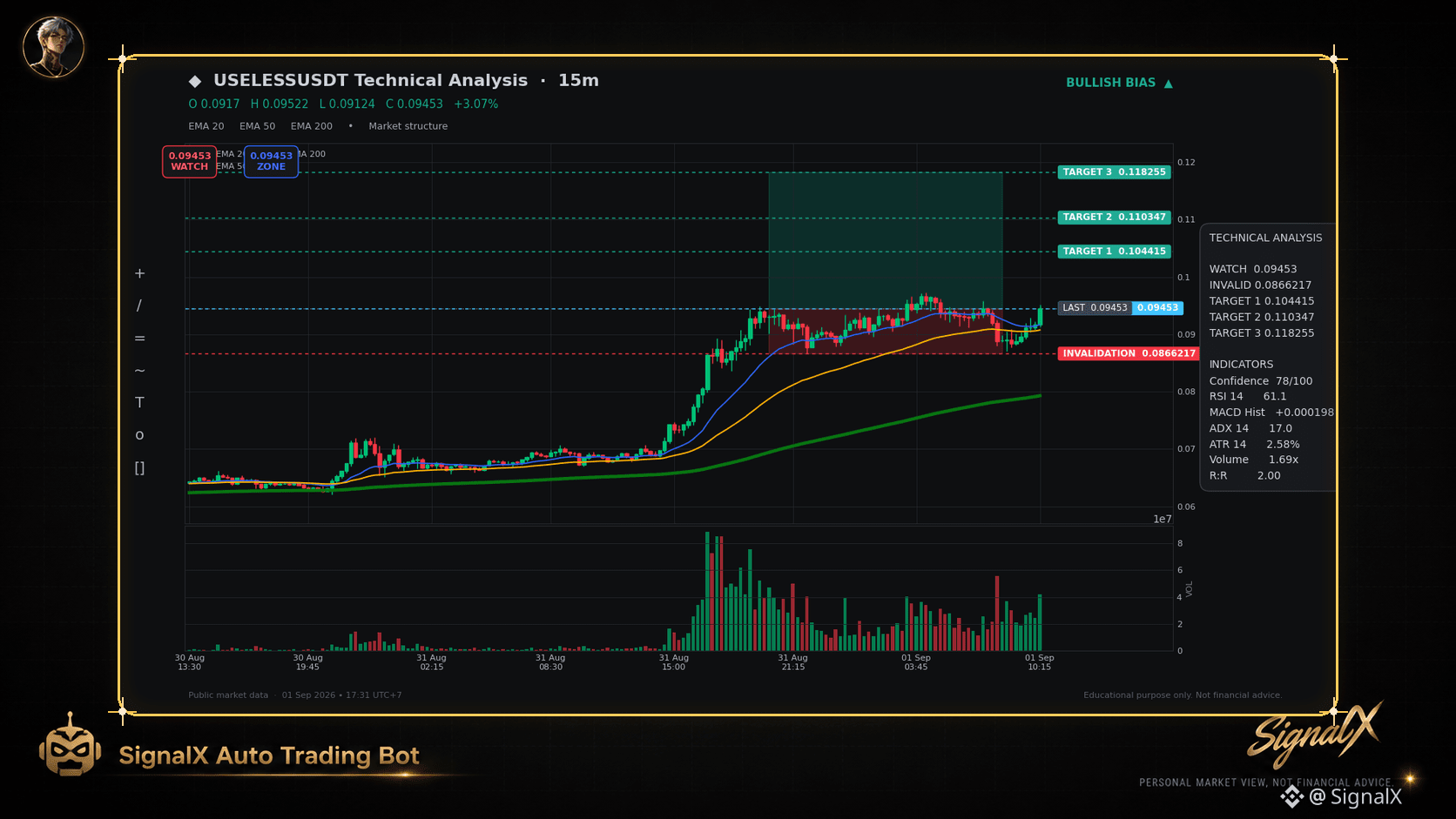
TECHNICAL ANALYSIS — USELESS (15m)
🧭 Market bias: BULLISH BIAS 🟢
🎯 Setup: trend pullback/continuation
⭐ Confidence: 78/100
📍 Price zones to watch: 0.09453
🛑 Scenario invalidation level: 0.0866217 (8.37% distance)
🎯 Technical target 1: 0.104415 (1.25R)
🎯 Technical target 2: 0.110347 (2R)
🎯 Technical target 3: 0.118255 (3R)
📊 TECHNICAL INDICATORS
📈 EMA20/50/200: aligned long
💪 ADX14: 17.0
⚡ RSI14: 61.1
🌊 MACD histogram: +0.000198339
🌡️ ATR14: 2.58% of price
🔊 Volume: 1.69x average (above 20-candle mean)
⚠️ A 15m close beyond the invalidation level weakens this scenario.
Disclaimer: Educational technical analysis only—not financial advice. Leveraged markets involve substantial risk.
🧭 Market bias: BULLISH BIAS 🟢
🎯 Setup: trend pullback/continuation
⭐ Confidence: 78/100
📍 Price zones to watch: 0.09453
🛑 Scenario invalidation level: 0.0866217 (8.37% distance)
🎯 Technical target 1: 0.104415 (1.25R)
🎯 Technical target 2: 0.110347 (2R)
🎯 Technical target 3: 0.118255 (3R)
📊 TECHNICAL INDICATORS
📈 EMA20/50/200: aligned long
💪 ADX14: 17.0
⚡ RSI14: 61.1
🌊 MACD histogram: +0.000198339
🌡️ ATR14: 2.58% of price
🔊 Volume: 1.69x average (above 20-candle mean)
⚠️ A 15m close beyond the invalidation level weakens this scenario.
Disclaimer: Educational technical analysis only—not financial advice. Leveraged markets involve substantial risk.
🌍 CRYPTO MARKET UPDATE
Bitfinex Securities lists tokenized notes tied to Strategy, Metaplanet
Five equity-backed notes issued through Luxembourg’s ORO II fund will trade against dollars, USDT and Bitcoin for eligible non-US investors. Bitfinex Securities, the tokenized investment platform associated with crypto exchange Bitfinex, has listed five tokenized notes giving eligible investors exposure to Strategy, Metaplanet and other publicly traded Bitcoin treasury companies. The trading platform announced that the products track the economic performance of shares in Strategy, Metaplanet, Sweden’s H100 Group and France’s Capital B. Bitfinex Securities also listed Strategy’s variable-rate perpetual preferred stock, STRC. Bitfinex Securities described the launch as the first time such products have been made available for secondary trading on a regulated tokenized securities exchange. The notes were issued through ORO (II), a Luxembourg umbrella securitization fund managed by SICOS Securities. According to Bitfinex Securities, they are backed by the underlying securities, which are held with regulated financial institutions, but do not give investors direct ownership of the corresponding company shares. Bitfinex Securities said fractional exposure is available from about $1, with the products trading against the US dollar, Tether’s USDt (USDT) and Bitcoin (BTC). However, availability is limited to eligible investors and excludes US persons. The listings follow Bitfinex Securities’ record $50 million tokenized capital raise for metals company Alkemya in August. The platform said its listed assets now exceed $500 million. All news, reviews, and analyses are produced with full journalistic independence and integrity. For more details on our standards and processes, please
🕒 Updated: 01 Sep 2026 10:00 UTC
#CryptoNews #MarketUpdate #BinanceSquare
Bitfinex Securities lists tokenized notes tied to Strategy, Metaplanet
Five equity-backed notes issued through Luxembourg’s ORO II fund will trade against dollars, USDT and Bitcoin for eligible non-US investors. Bitfinex Securities, the tokenized investment platform associated with crypto exchange Bitfinex, has listed five tokenized notes giving eligible investors exposure to Strategy, Metaplanet and other publicly traded Bitcoin treasury companies. The trading platform announced that the products track the economic performance of shares in Strategy, Metaplanet, Sweden’s H100 Group and France’s Capital B. Bitfinex Securities also listed Strategy’s variable-rate perpetual preferred stock, STRC. Bitfinex Securities described the launch as the first time such products have been made available for secondary trading on a regulated tokenized securities exchange. The notes were issued through ORO (II), a Luxembourg umbrella securitization fund managed by SICOS Securities. According to Bitfinex Securities, they are backed by the underlying securities, which are held with regulated financial institutions, but do not give investors direct ownership of the corresponding company shares. Bitfinex Securities said fractional exposure is available from about $1, with the products trading against the US dollar, Tether’s USDt (USDT) and Bitcoin (BTC). However, availability is limited to eligible investors and excludes US persons. The listings follow Bitfinex Securities’ record $50 million tokenized capital raise for metals company Alkemya in August. The platform said its listed assets now exceed $500 million. All news, reviews, and analyses are produced with full journalistic independence and integrity. For more details on our standards and processes, please
🕒 Updated: 01 Sep 2026 10:00 UTC
#CryptoNews #MarketUpdate #BinanceSquare
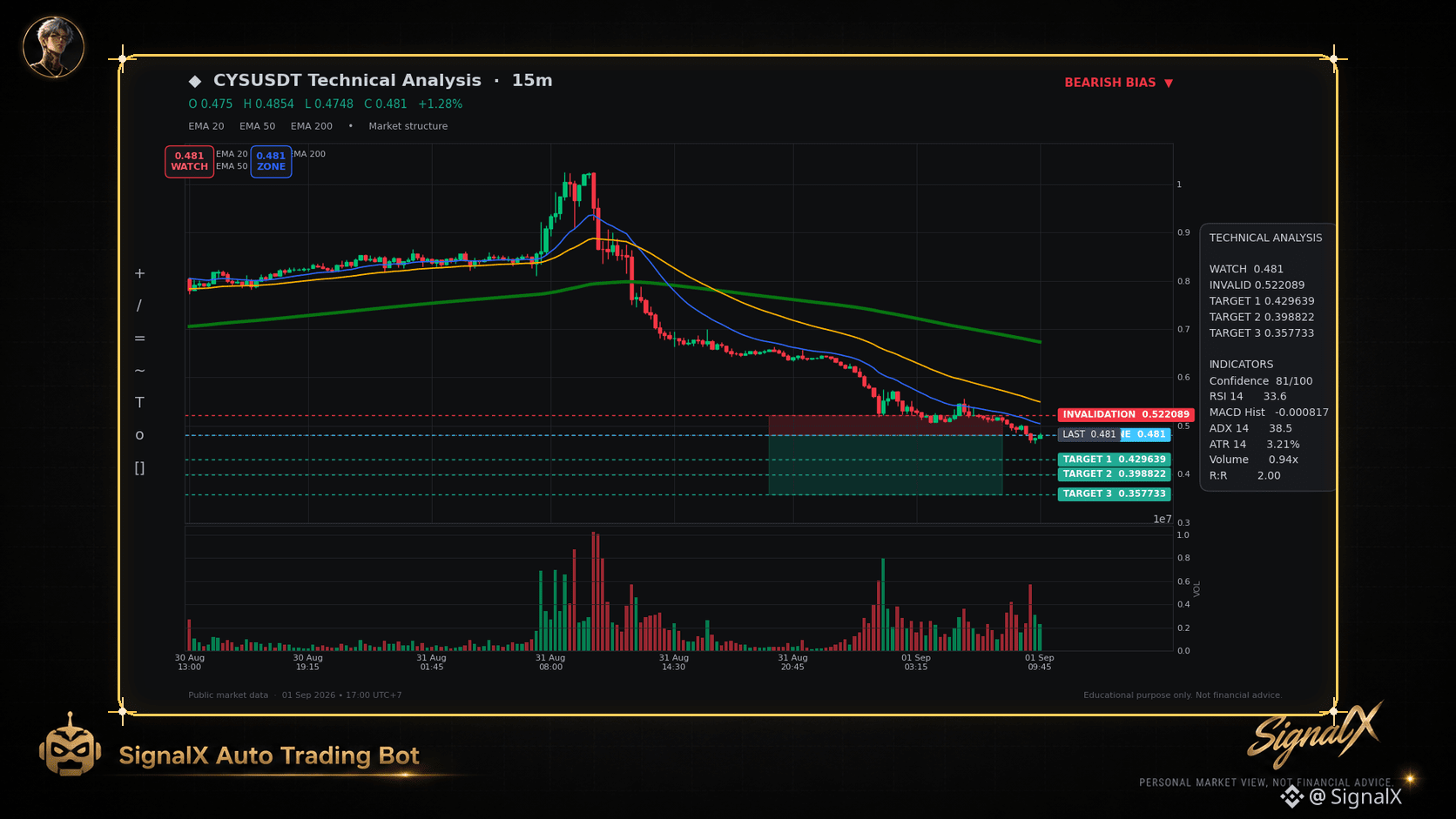
TECHNICAL ANALYSIS — CYS (15m)
🧭 Market bias: BEARISH BIAS 🔴
🎯 Setup: trend pullback/continuation
⭐ Confidence: 81/100
📍 Price zones to watch: 0.481
🛑 Scenario invalidation level: 0.522089 (8.54% distance)
🎯 Technical target 1: 0.429639 (1.25R)
🎯 Technical target 2: 0.398822 (2R)
🎯 Technical target 3: 0.357733 (3R)
📊 TECHNICAL INDICATORS
📈 EMA20/50/200: aligned short
💪 ADX14: 38.5
⚡ RSI14: 33.6
🌊 MACD histogram: -0.000816502
🌡️ ATR14: 3.21% of price
🔊 Volume: 0.94x average (below 20-candle mean)
⚠️ A 15m close beyond the invalidation level weakens this scenario.
Disclaimer: Educational technical analysis only—not financial advice. Leveraged markets involve substantial risk.
🧭 Market bias: BEARISH BIAS 🔴
🎯 Setup: trend pullback/continuation
⭐ Confidence: 81/100
📍 Price zones to watch: 0.481
🛑 Scenario invalidation level: 0.522089 (8.54% distance)
🎯 Technical target 1: 0.429639 (1.25R)
🎯 Technical target 2: 0.398822 (2R)
🎯 Technical target 3: 0.357733 (3R)
📊 TECHNICAL INDICATORS
📈 EMA20/50/200: aligned short
💪 ADX14: 38.5
⚡ RSI14: 33.6
🌊 MACD histogram: -0.000816502
🌡️ ATR14: 3.21% of price
🔊 Volume: 0.94x average (below 20-candle mean)
⚠️ A 15m close beyond the invalidation level weakens this scenario.
Disclaimer: Educational technical analysis only—not financial advice. Leveraged markets involve substantial risk.
🌍 CRYPTO MARKET UPDATE
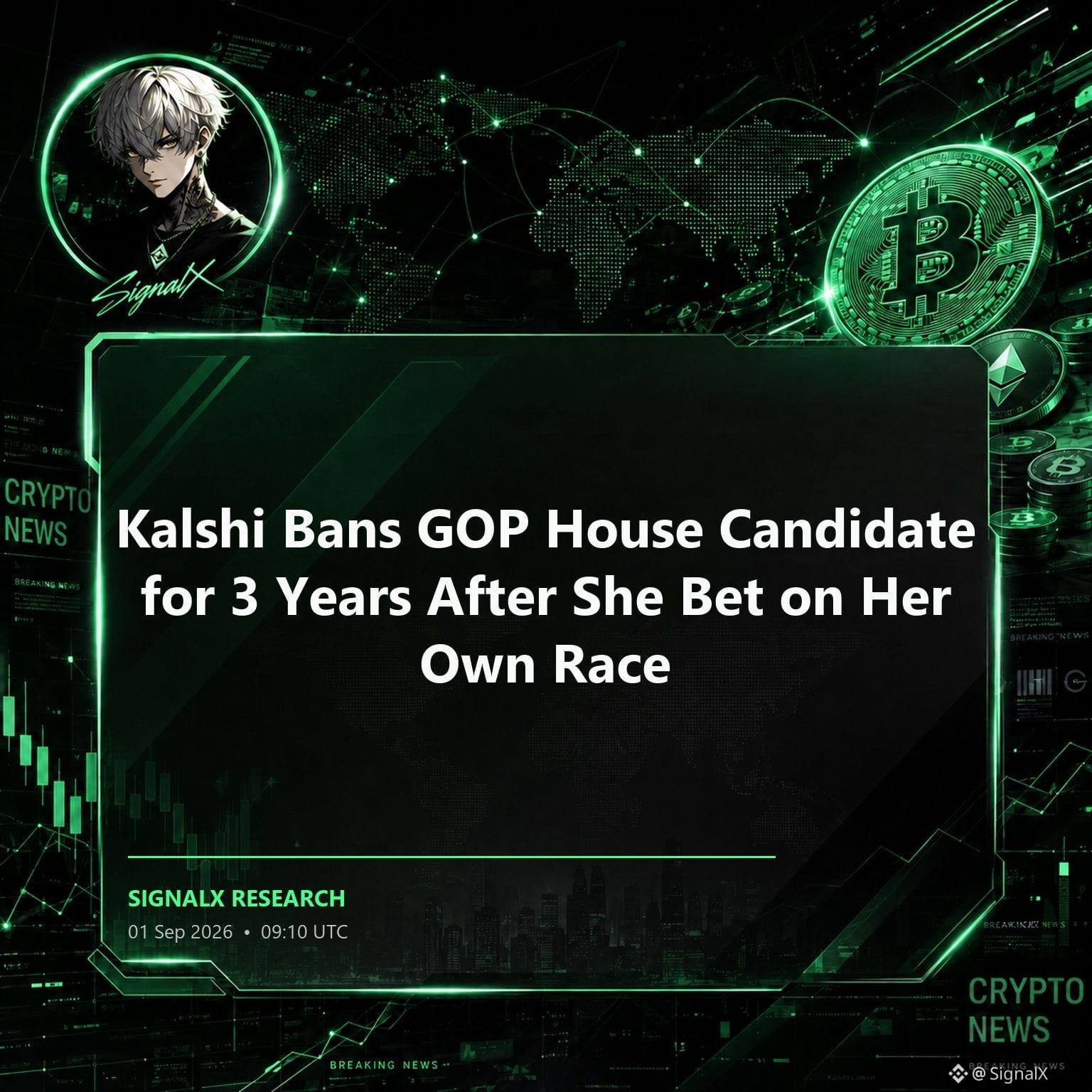
Kalshi Bans GOP House Candidate for 3 Years After She Bet on Her Own Race
Prediction market Kalshi suspended Republican House candidate Laurie Buckhout for 3 years after finding that she had placed bets on her own race. Buckhout is challenging Democratic Representative Don Davis in North Carolina’s 1st Congressional District. The Fine Costs More Than the Wager Buckhout bought less than $1,000 in contracts related to her own candidacy, The post Kalshi Bans GOP House Candidate for 3 Years After She Bet on Her Own Race appeared first on . The Fine Costs More Than the Wager Buckhout bought less than $1,000 in contracts related to her own candidacy, according to the disciplinary notice Kalshi published. She agreed to pay a penalty of $2,589.96, more than the bet itself. Kalshi rule 5.17(z) bars any trader with direct or indirect influence over an event from trading that contract. The prediction market said Buckhout cooperated with its inquiry. She accepted the findings and also agreed to the ban and the penalty. It was a dumb mistake, and as soon as I learned there was an issue, I worked to make it right. Safe to say my career as a Kalshi trader was short-lived,” Laurie Buckhout said. It imposed a lifetime ban and a fine of over $70,000 on former congressman George Santos on Monday after he refused to cooperate with investigators. Days earlier, the Commodity Futures Trading Commission (CFTC) and Kalshi acted against a White House teleprompter operator over bets on Trump’s speech text. Kalshi has been working to curb insider trading on its platform. The exchange introduced three market integrity measures in June. Representative Bryan Steil filed a bill in June that would ban lawmakers from betting on political outcomes, with fines and forfeited gains attached.
🕒 Updated: 01 Sep 2026 09:10 UTC
#CryptoNews #MarketUpdate #BinanceSquare
Kalshi Bans GOP House Candidate for 3 Years After She Bet on Her Own Race
Prediction market Kalshi suspended Republican House candidate Laurie Buckhout for 3 years after finding that she had placed bets on her own race. Buckhout is challenging Democratic Representative Don Davis in North Carolina’s 1st Congressional District. The Fine Costs More Than the Wager Buckhout bought less than $1,000 in contracts related to her own candidacy, The post Kalshi Bans GOP House Candidate for 3 Years After She Bet on Her Own Race appeared first on . The Fine Costs More Than the Wager Buckhout bought less than $1,000 in contracts related to her own candidacy, according to the disciplinary notice Kalshi published. She agreed to pay a penalty of $2,589.96, more than the bet itself. Kalshi rule 5.17(z) bars any trader with direct or indirect influence over an event from trading that contract. The prediction market said Buckhout cooperated with its inquiry. She accepted the findings and also agreed to the ban and the penalty. It was a dumb mistake, and as soon as I learned there was an issue, I worked to make it right. Safe to say my career as a Kalshi trader was short-lived,” Laurie Buckhout said. It imposed a lifetime ban and a fine of over $70,000 on former congressman George Santos on Monday after he refused to cooperate with investigators. Days earlier, the Commodity Futures Trading Commission (CFTC) and Kalshi acted against a White House teleprompter operator over bets on Trump’s speech text. Kalshi has been working to curb insider trading on its platform. The exchange introduced three market integrity measures in June. Representative Bryan Steil filed a bill in June that would ban lawmakers from betting on political outcomes, with fines and forfeited gains attached.
🕒 Updated: 01 Sep 2026 09:10 UTC
#CryptoNews #MarketUpdate #BinanceSquare
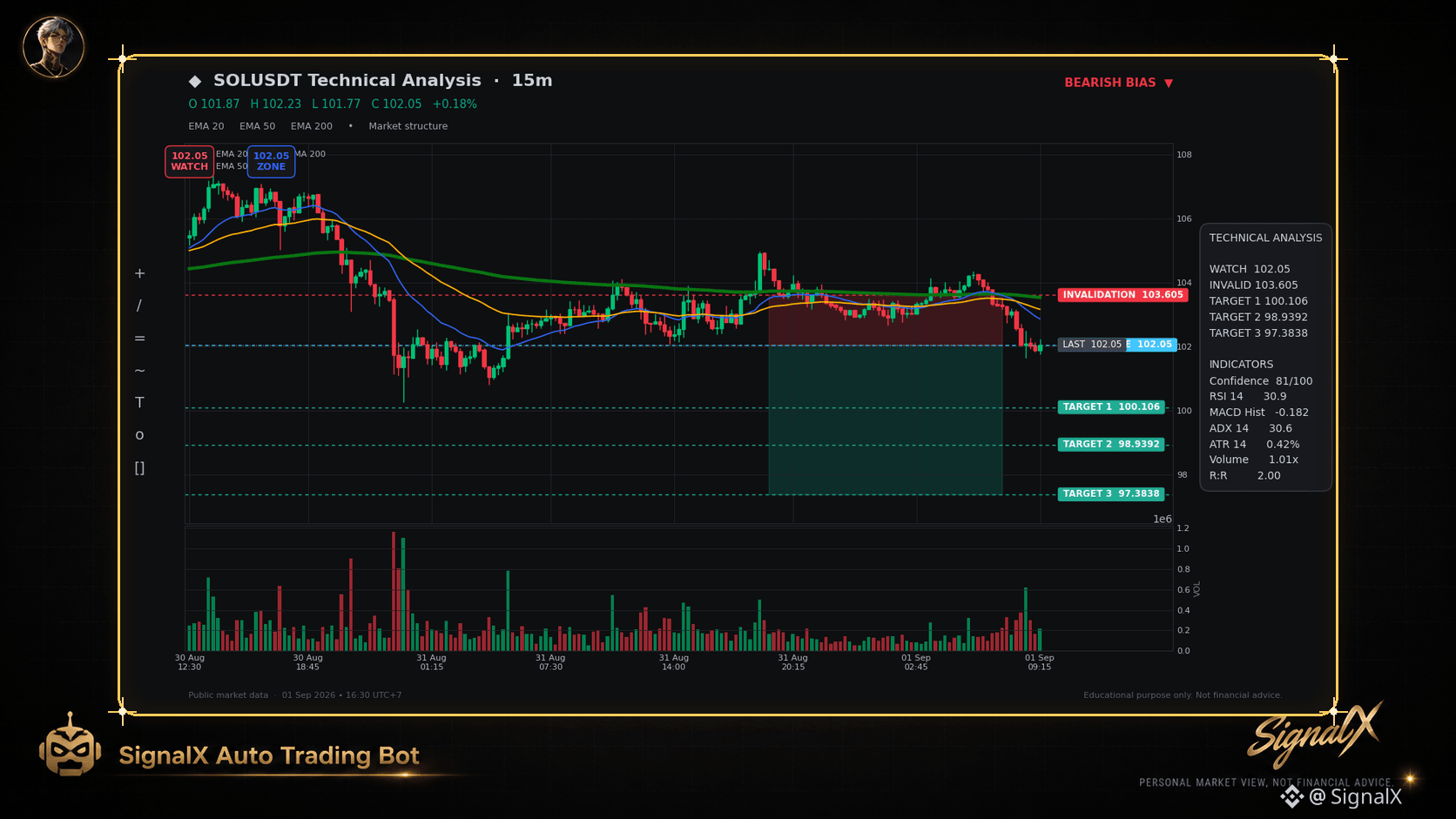
TECHNICAL ANALYSIS — SOL (15m)
🧭 Market bias: BEARISH BIAS 🔴
🎯 Setup: trend pullback/continuation
⭐ Confidence: 81/100
📍 Price zones to watch: 102.05
🛑 Scenario invalidation level: 103.605 (1.52% distance)
🎯 Technical target 1: 100.106 (1.25R)
🎯 Technical target 2: 98.9392 (2R)
🎯 Technical target 3: 97.3838 (3R)
📊 TECHNICAL INDICATORS
📈 EMA20/50/200: aligned short
💪 ADX14: 30.6
⚡ RSI14: 30.9
🌊 MACD histogram: -0.182254
🌡️ ATR14: 0.42% of price
🔊 Volume: 1.01x average (above 20-candle mean)
⚠️ A 15m close beyond the invalidation level weakens this scenario.
Disclaimer: Educational technical analysis only—not financial advice. Leveraged markets involve substantial risk.
🧭 Market bias: BEARISH BIAS 🔴
🎯 Setup: trend pullback/continuation
⭐ Confidence: 81/100
📍 Price zones to watch: 102.05
🛑 Scenario invalidation level: 103.605 (1.52% distance)
🎯 Technical target 1: 100.106 (1.25R)
🎯 Technical target 2: 98.9392 (2R)
🎯 Technical target 3: 97.3838 (3R)
📊 TECHNICAL INDICATORS
📈 EMA20/50/200: aligned short
💪 ADX14: 30.6
⚡ RSI14: 30.9
🌊 MACD histogram: -0.182254
🌡️ ATR14: 0.42% of price
🔊 Volume: 1.01x average (above 20-candle mean)
⚠️ A 15m close beyond the invalidation level weakens this scenario.
Disclaimer: Educational technical analysis only—not financial advice. Leveraged markets involve substantial risk.
🌍 CRYPTO MARKET UPDATE
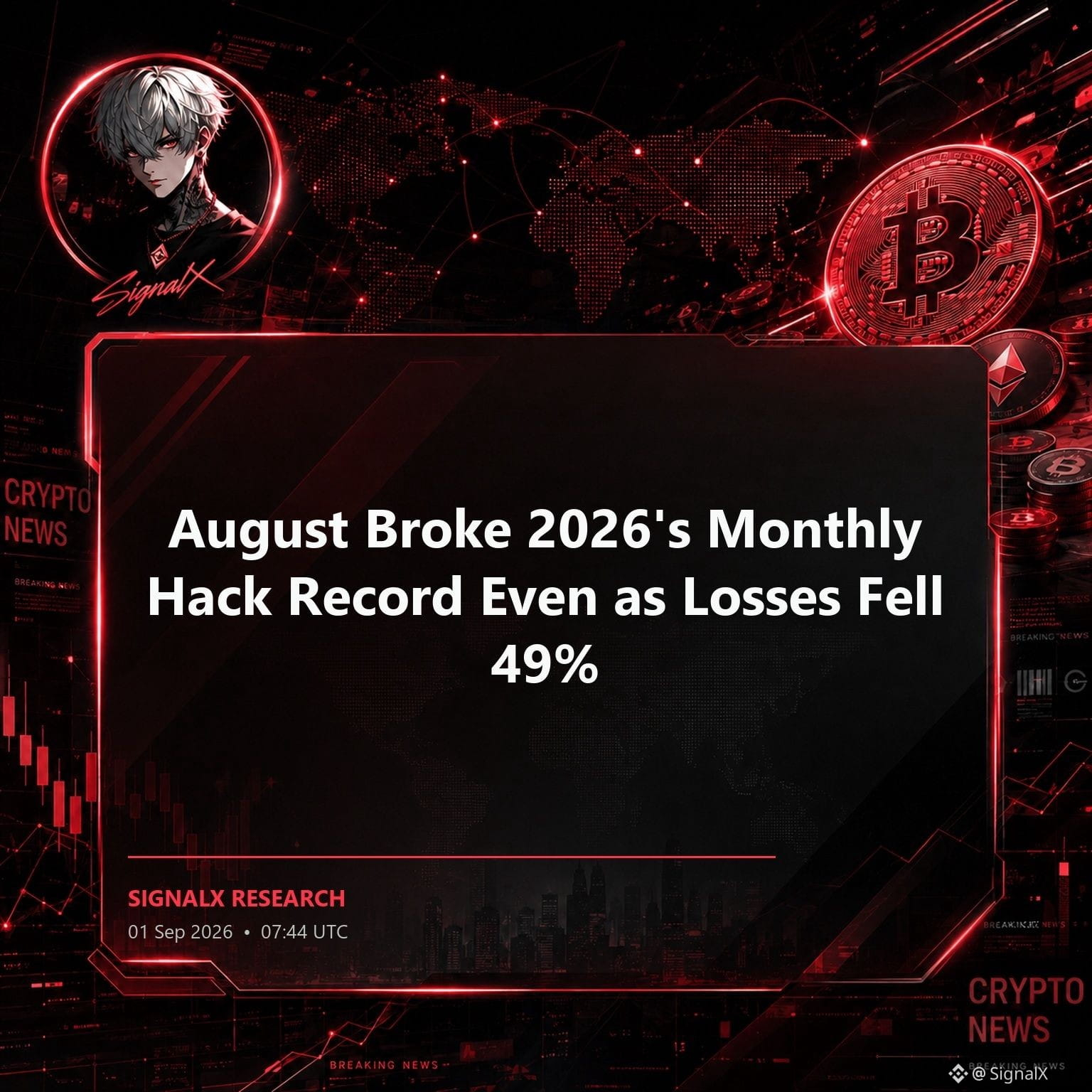
August Broke 2026's Monthly Hack Record Even as Losses Fell 49%
Crypto recorded 50 major hacks in August, the highest monthly count of 2026. Total losses fell to $136.3 million, down 49.5% from July. Blockchain security firm PeckShield published the tally on Tuesday. The figures show attackers striking far more often while extracting less from each incident. Cronos Halt Blunted the Month’s Largest Exploit A single The post August Broke 2026's Monthly Hack Record Even as Losses Fell 49% appeared first on . Cronos Halt Blunted the Month’s Largest Exploit A single incident dominated the month . Tectonic is the largest lending protocol on Cronos (CRO). It reportedly lost roughly $74 million, the fourth-largest crypto theft of 2026 to date. The attacker moved only about $6 million to Ethereum (ETH) before validators froze the network. “The exploiter has since started laundering the stolen funds, bridging them to #BTC (~200K so far),” PeckShield said. Cronos then restored the chain state to a point before the attack and resumed block production. 3M – a 49.5% month-over-month decrease from July's $270M. The Tectonic.cro incident, which resulted in ~$74M in losses, was the… pic.twitter.com/QtQUy8czdZ — PeckShieldAlert (@PeckShieldAlert) September 1, 2026 Attack Volume Rose as Individual Hauls Shrank August’s 50 incidents topped the 40 recorded in April, May, and June. PeckShield counted 16, 15, and 20 hacks in January, February, and March, respectively. .7 million, down from roughly $9 million in July. PeckShield’s top ten incidents accounted for $123.34 million of August’s total, leaving around $12.9 million across the other 40 hacks, per calculations. April remains the year’s costliest month at $646.89 million, driven by the Drift and KelpDAO exploits.
🕒 Updated: 01 Sep 2026 07:44 UTC
#CryptoNews #MarketUpdate #BinanceSquare
August Broke 2026's Monthly Hack Record Even as Losses Fell 49%
Crypto recorded 50 major hacks in August, the highest monthly count of 2026. Total losses fell to $136.3 million, down 49.5% from July. Blockchain security firm PeckShield published the tally on Tuesday. The figures show attackers striking far more often while extracting less from each incident. Cronos Halt Blunted the Month’s Largest Exploit A single The post August Broke 2026's Monthly Hack Record Even as Losses Fell 49% appeared first on . Cronos Halt Blunted the Month’s Largest Exploit A single incident dominated the month . Tectonic is the largest lending protocol on Cronos (CRO). It reportedly lost roughly $74 million, the fourth-largest crypto theft of 2026 to date. The attacker moved only about $6 million to Ethereum (ETH) before validators froze the network. “The exploiter has since started laundering the stolen funds, bridging them to #BTC (~200K so far),” PeckShield said. Cronos then restored the chain state to a point before the attack and resumed block production. 3M – a 49.5% month-over-month decrease from July's $270M. The Tectonic.cro incident, which resulted in ~$74M in losses, was the… pic.twitter.com/QtQUy8czdZ — PeckShieldAlert (@PeckShieldAlert) September 1, 2026 Attack Volume Rose as Individual Hauls Shrank August’s 50 incidents topped the 40 recorded in April, May, and June. PeckShield counted 16, 15, and 20 hacks in January, February, and March, respectively. .7 million, down from roughly $9 million in July. PeckShield’s top ten incidents accounted for $123.34 million of August’s total, leaving around $12.9 million across the other 40 hacks, per calculations. April remains the year’s costliest month at $646.89 million, driven by the Drift and KelpDAO exploits.
🕒 Updated: 01 Sep 2026 07:44 UTC
#CryptoNews #MarketUpdate #BinanceSquare
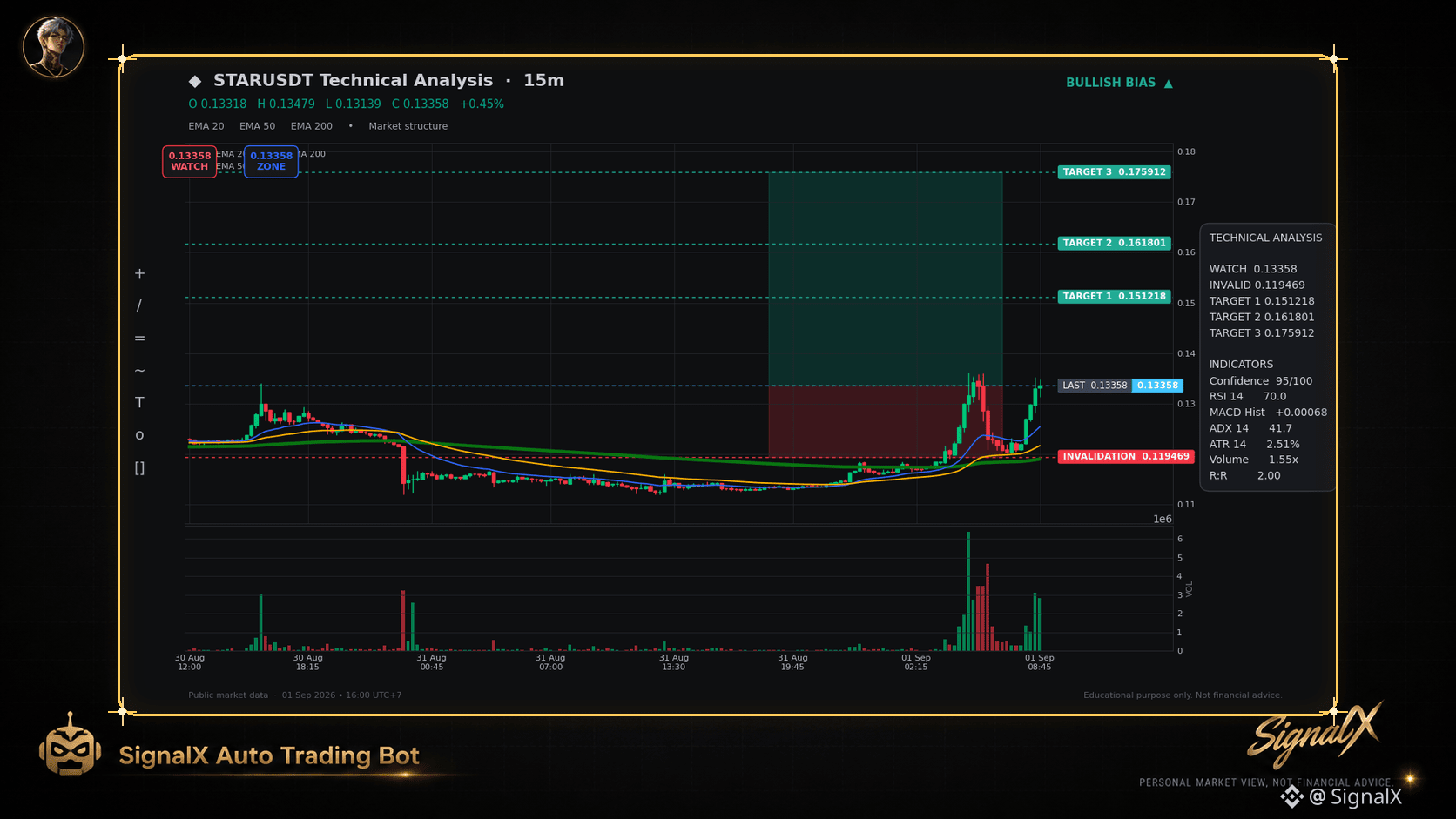
TECHNICAL ANALYSIS — STAR (15m)
🧭 Market bias: BULLISH BIAS 🟢
🎯 Setup: trend pullback/continuation
⭐ Confidence: 95/100
📍 Price zones to watch: 0.13358
🛑 Scenario invalidation level: 0.119469 (10.56% distance)
🎯 Technical target 1: 0.151218 (1.25R)
🎯 Technical target 2: 0.161801 (2R)
🎯 Technical target 3: 0.175912 (3R)
📊 TECHNICAL INDICATORS
📈 EMA20/50/200: aligned long
💪 ADX14: 41.7
⚡ RSI14: 70.0
🌊 MACD histogram: +0.000680428
🌡️ ATR14: 2.51% of price
🔊 Volume: 1.55x average (above 20-candle mean)
⚠️ A 15m close beyond the invalidation level weakens this scenario.
Disclaimer: Educational technical analysis only—not financial advice. Leveraged markets involve substantial risk.
🧭 Market bias: BULLISH BIAS 🟢
🎯 Setup: trend pullback/continuation
⭐ Confidence: 95/100
📍 Price zones to watch: 0.13358
🛑 Scenario invalidation level: 0.119469 (10.56% distance)
🎯 Technical target 1: 0.151218 (1.25R)
🎯 Technical target 2: 0.161801 (2R)
🎯 Technical target 3: 0.175912 (3R)
📊 TECHNICAL INDICATORS
📈 EMA20/50/200: aligned long
💪 ADX14: 41.7
⚡ RSI14: 70.0
🌊 MACD histogram: +0.000680428
🌡️ ATR14: 2.51% of price
🔊 Volume: 1.55x average (above 20-candle mean)
⚠️ A 15m close beyond the invalidation level weakens this scenario.
Disclaimer: Educational technical analysis only—not financial advice. Leveraged markets involve substantial risk.
🌍 CRYPTO MARKET UPDATE
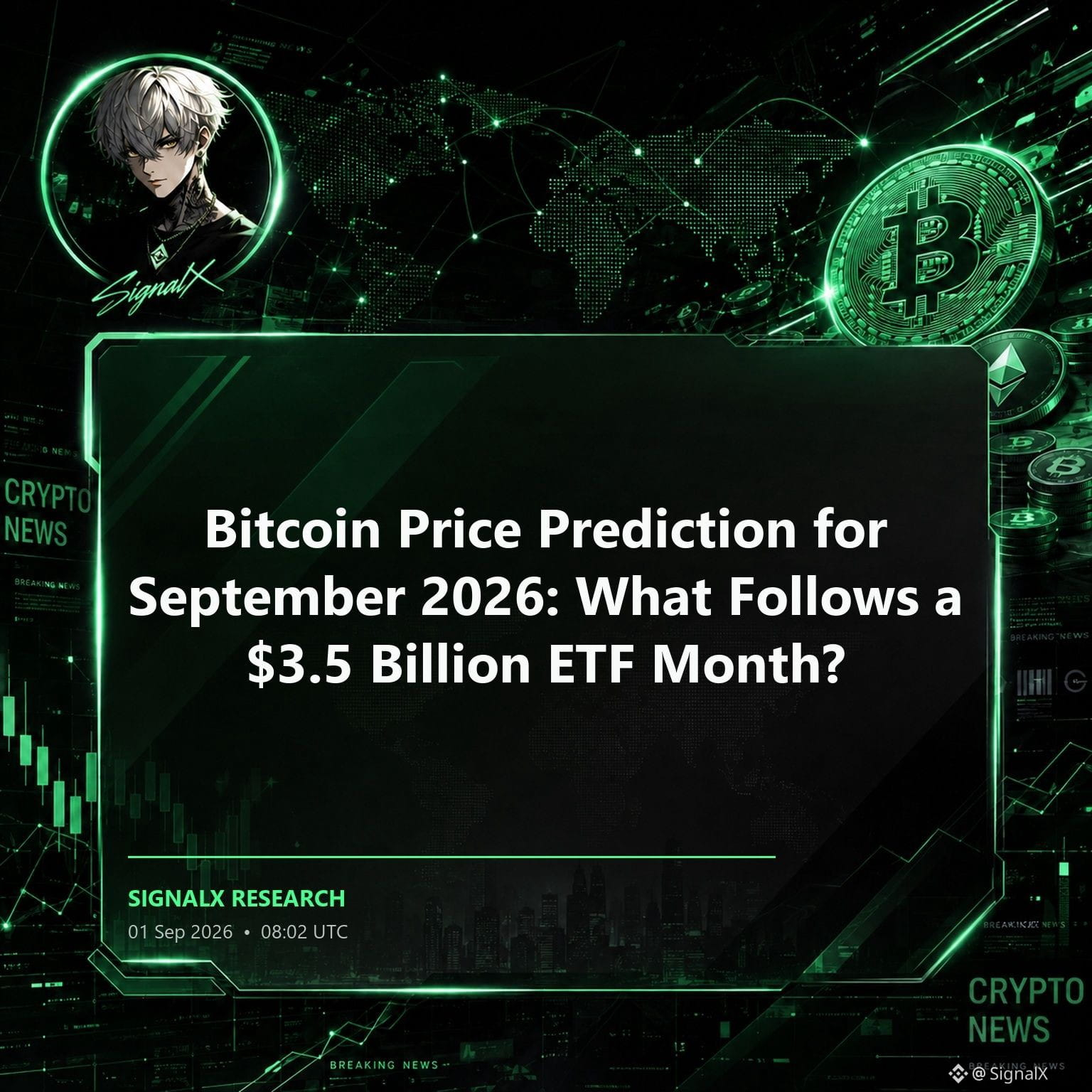
Bitcoin Price Prediction for September 2026: What Follows a $3.5 Billion ETF Month?
Bitcoin price rose 24.95% in August, and still trades 9.62% below where it started the year. The month was bought almost entirely by funds. US spot Bitcoin ETFs took in $3.52 billion during August, per SoSoValue data. Only five of 21 The post Bitcoin Price Prediction for September 2026: What Follows a $3.5 Billion ETF Month? That single month outweighs everything before it. Across January to July, the same funds lost a net $5.30 billion. August did not just beat the year, it reversed it. Bitcoin ETF Month Aftermath: The problem is what months like this have preceded. Twelve months since these funds launched have drawn $3 billion or more. Bitcoin fell in the month straight after seven of them. The average return in those following months is 0.13%, against 2.93% for an average month. Bitcoin has closed August green only two times since 2020 (before this year), and on both the occasions, September fell 7.30% and 7.96%. BTC Price History: CryptoRank One thing argues back. The last three Septembers all finished higher, so September’s reputation as Bitcoin’s worst month is out of date. Hodler Net Position Change, which measures whether long-term holders are adding coins or releasing them, stayed negative for the whole rally. It turned red on August 2 and stayed there for four weeks. Bitcoin Hodler Net Position Change: Glassnode Then it flipped. August 31 printed the first green bar since July, at 2,044 BTC. Large wallets did the same thing and have not reversed it. Addresses holding more than BTC fell from 1,963 on July 31 to 1,908, a loss of 55 wallets during a 25% rally. Bitcoin Whale Address Count: Glassnode So the rally was funds buying what holders and whales were handing over.
🕒 Updated: 01 Sep 2026 08:02 UTC
#CryptoNews #MarketUpdate #BinanceSquare
Bitcoin Price Prediction for September 2026: What Follows a $3.5 Billion ETF Month?
Bitcoin price rose 24.95% in August, and still trades 9.62% below where it started the year. The month was bought almost entirely by funds. US spot Bitcoin ETFs took in $3.52 billion during August, per SoSoValue data. Only five of 21 The post Bitcoin Price Prediction for September 2026: What Follows a $3.5 Billion ETF Month? That single month outweighs everything before it. Across January to July, the same funds lost a net $5.30 billion. August did not just beat the year, it reversed it. Bitcoin ETF Month Aftermath: The problem is what months like this have preceded. Twelve months since these funds launched have drawn $3 billion or more. Bitcoin fell in the month straight after seven of them. The average return in those following months is 0.13%, against 2.93% for an average month. Bitcoin has closed August green only two times since 2020 (before this year), and on both the occasions, September fell 7.30% and 7.96%. BTC Price History: CryptoRank One thing argues back. The last three Septembers all finished higher, so September’s reputation as Bitcoin’s worst month is out of date. Hodler Net Position Change, which measures whether long-term holders are adding coins or releasing them, stayed negative for the whole rally. It turned red on August 2 and stayed there for four weeks. Bitcoin Hodler Net Position Change: Glassnode Then it flipped. August 31 printed the first green bar since July, at 2,044 BTC. Large wallets did the same thing and have not reversed it. Addresses holding more than BTC fell from 1,963 on July 31 to 1,908, a loss of 55 wallets during a 25% rally. Bitcoin Whale Address Count: Glassnode So the rally was funds buying what holders and whales were handing over.
🕒 Updated: 01 Sep 2026 08:02 UTC
#CryptoNews #MarketUpdate #BinanceSquare
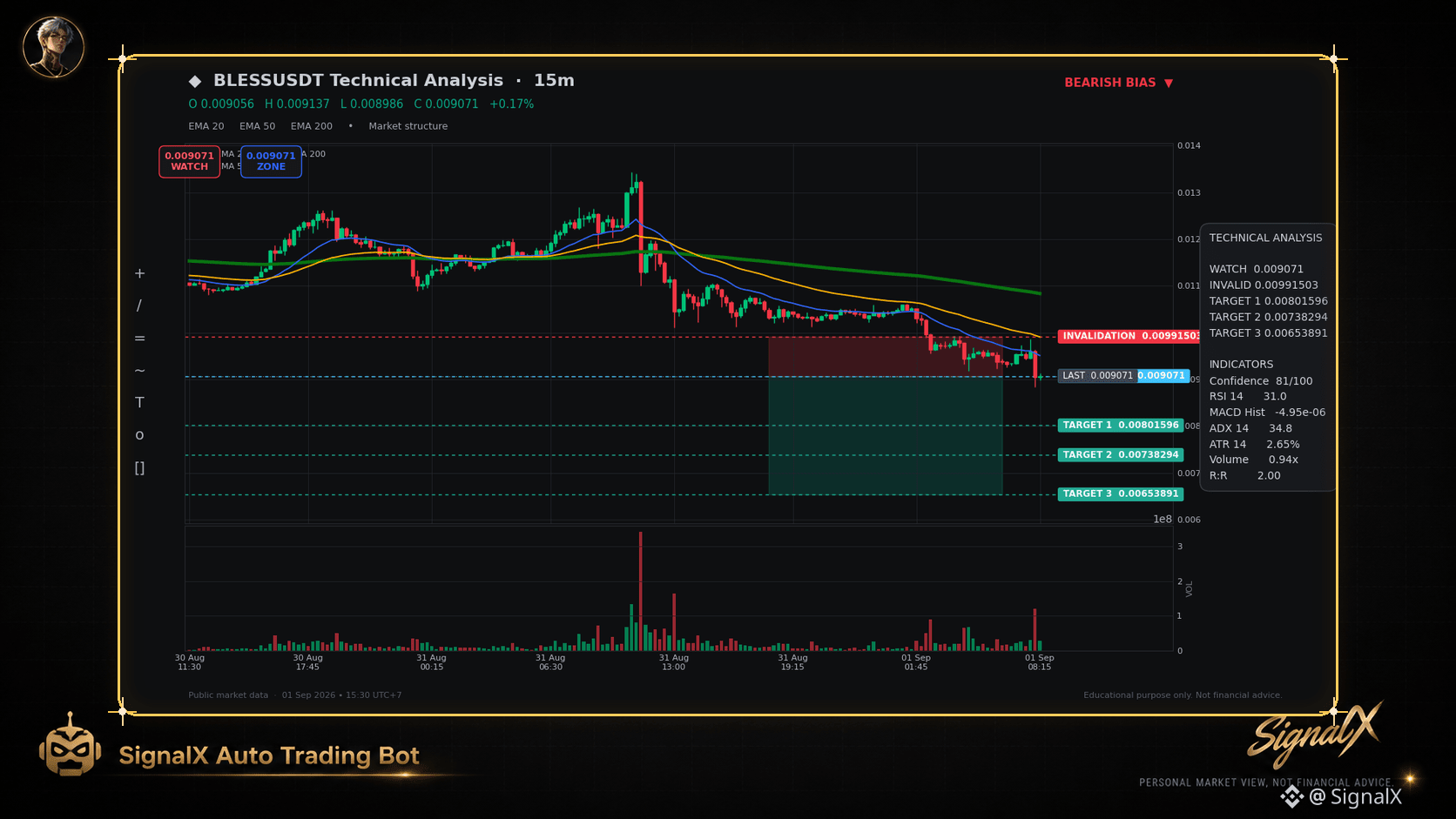
TECHNICAL ANALYSIS — BLESS (15m)
🧭 Market bias: BEARISH BIAS 🔴
🎯 Setup: trend pullback/continuation
⭐ Confidence: 81/100
📍 Price zones to watch: 0.009071
🛑 Scenario invalidation level: 0.00991503 (9.30% distance)
🎯 Technical target 1: 0.00801596 (1.25R)
🎯 Technical target 2: 0.00738294 (2R)
🎯 Technical target 3: 0.00653891 (3R)
📊 TECHNICAL INDICATORS
📈 EMA20/50/200: aligned short
💪 ADX14: 34.8
⚡ RSI14: 31.0
🌊 MACD histogram: -4.94785e-06
🌡️ ATR14: 2.65% of price
🔊 Volume: 0.94x average (below 20-candle mean)
⚠️ A 15m close beyond the invalidation level weakens this scenario.
Disclaimer: Educational technical analysis only—not financial advice. Leveraged markets involve substantial risk.
🧭 Market bias: BEARISH BIAS 🔴
🎯 Setup: trend pullback/continuation
⭐ Confidence: 81/100
📍 Price zones to watch: 0.009071
🛑 Scenario invalidation level: 0.00991503 (9.30% distance)
🎯 Technical target 1: 0.00801596 (1.25R)
🎯 Technical target 2: 0.00738294 (2R)
🎯 Technical target 3: 0.00653891 (3R)
📊 TECHNICAL INDICATORS
📈 EMA20/50/200: aligned short
💪 ADX14: 34.8
⚡ RSI14: 31.0
🌊 MACD histogram: -4.94785e-06
🌡️ ATR14: 2.65% of price
🔊 Volume: 0.94x average (below 20-candle mean)
⚠️ A 15m close beyond the invalidation level weakens this scenario.
Disclaimer: Educational technical analysis only—not financial advice. Leveraged markets involve substantial risk.
Verified
🌍 CRYPTO MARKET UPDATE
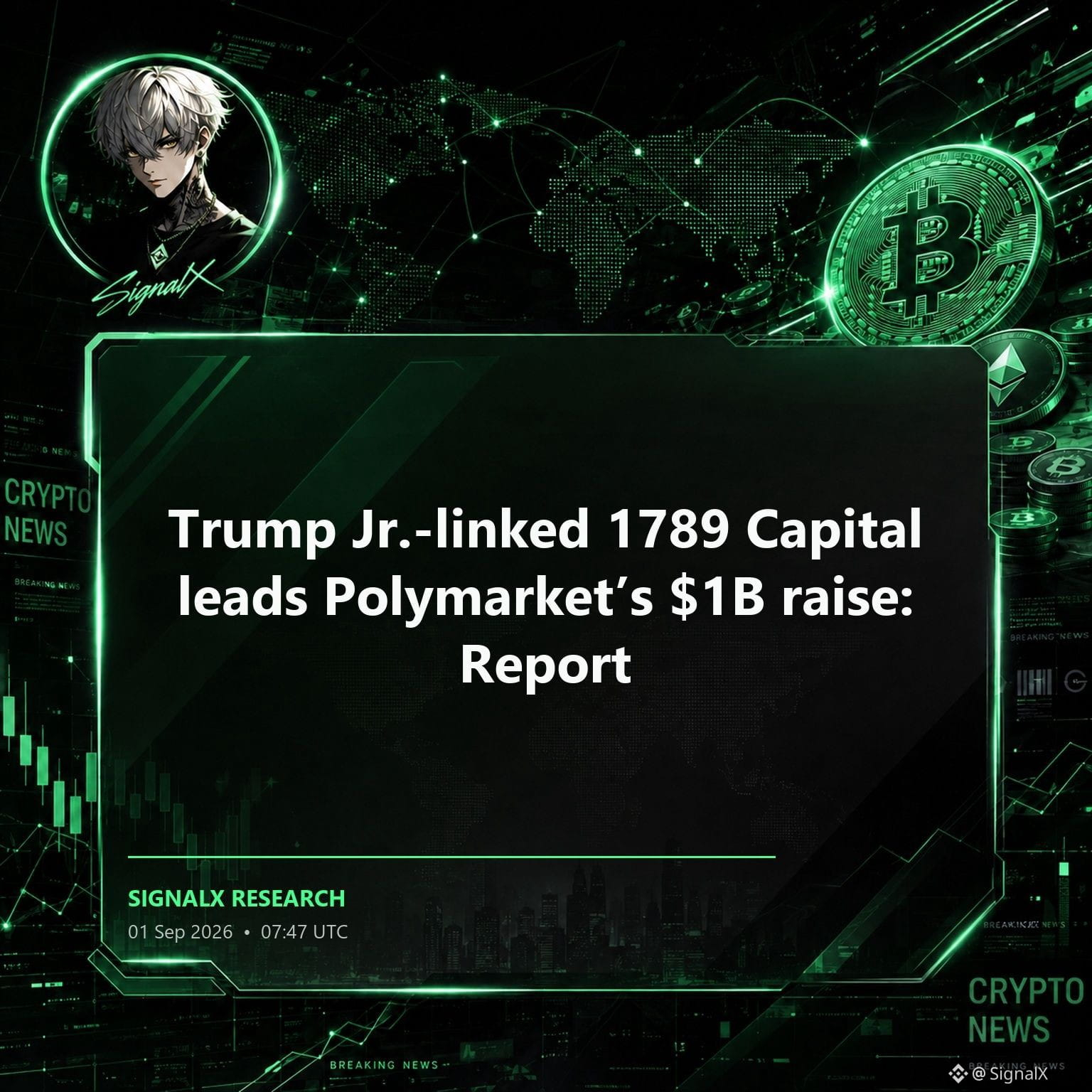
Trump Jr.-linked 1789 Capital leads Polymarket’s $1B raise: Report
Donald Trump Jr.-linked 1789 Capital will reportedly lead a $1 billion investment round into Polymarket, which would value the platform at $21 billion, just below Kalshi’s $22 billion valuation. Donald Trump Jr.-linked investment firm 1789 Capital is reportedly investing about $300 million in Polymarket, a blockchain-based prediction market. is a partner, will make the $300 million investment as part of a $1 billion round that would value Polymarket at $21 billion, people familiar with the matter told the Wall Street Journal on Monday. The investment would bring 1789 Capital’s total investment in Polymarket to about $500 million and make it one of the platform’s largest backers. Cointelegraph has approached 1789 Capital and Polymarket for comment. ICE remains Polymarket’s largest disclosed investor. In a July 30 10-Q filing, ICE said it had invested a combined $1.6 billion in Polymarket preferred shares. The holdings had a carrying value of approximately $2 billion as of June 30 and represented about 22% of outstanding shares, or 14% on a fully diluted basis. Polymarket reportedly started talks to raise $400 million in fresh capital in April, when it was seeking to raise the funds at a potential $15 billion valuation, below the $22 billion valuation of its main competitor, Kalshi. Prediction markets are facing increasing regulatory scrutiny in the US and worldwide. 14, JPMorgan Chase reportedly ended a banking relationship with Polymarket over regulatory concerns but said it remains keen on a potential underwriting role should Polymarket attempt to go public. All news, reviews, and analyses are produced with full journalistic independence and integrity.
🕒 Updated: 01 Sep 2026 07:47 UTC
#CryptoNews #MarketUpdate #BinanceSquare
Trump Jr.-linked 1789 Capital leads Polymarket’s $1B raise: Report
Donald Trump Jr.-linked 1789 Capital will reportedly lead a $1 billion investment round into Polymarket, which would value the platform at $21 billion, just below Kalshi’s $22 billion valuation. Donald Trump Jr.-linked investment firm 1789 Capital is reportedly investing about $300 million in Polymarket, a blockchain-based prediction market. is a partner, will make the $300 million investment as part of a $1 billion round that would value Polymarket at $21 billion, people familiar with the matter told the Wall Street Journal on Monday. The investment would bring 1789 Capital’s total investment in Polymarket to about $500 million and make it one of the platform’s largest backers. Cointelegraph has approached 1789 Capital and Polymarket for comment. ICE remains Polymarket’s largest disclosed investor. In a July 30 10-Q filing, ICE said it had invested a combined $1.6 billion in Polymarket preferred shares. The holdings had a carrying value of approximately $2 billion as of June 30 and represented about 22% of outstanding shares, or 14% on a fully diluted basis. Polymarket reportedly started talks to raise $400 million in fresh capital in April, when it was seeking to raise the funds at a potential $15 billion valuation, below the $22 billion valuation of its main competitor, Kalshi. Prediction markets are facing increasing regulatory scrutiny in the US and worldwide. 14, JPMorgan Chase reportedly ended a banking relationship with Polymarket over regulatory concerns but said it remains keen on a potential underwriting role should Polymarket attempt to go public. All news, reviews, and analyses are produced with full journalistic independence and integrity.
🕒 Updated: 01 Sep 2026 07:47 UTC
#CryptoNews #MarketUpdate #BinanceSquare
Macro View of Bitcoin $BTC
This chart shows Bitcoin moving within a long-term ascending logarithmic channel since 2012.
* 📈 Cycle Tops: 2013, 2017, 2021, and a projected top in 2025 near the upper channel.
* 📉 Cycle Bottoms: 2015, 2018, 2022, with a potential bottom projected for 2026 near the lower channel.
* 🎯 The idea is that Bitcoin continues following its historical four-year cycle, suggesting the current correction could extend before the next major accumulation phase.
It is only one possible outcome not confirmation of future price action.
#btc
This chart shows Bitcoin moving within a long-term ascending logarithmic channel since 2012.
* 📈 Cycle Tops: 2013, 2017, 2021, and a projected top in 2025 near the upper channel.
* 📉 Cycle Bottoms: 2015, 2018, 2022, with a potential bottom projected for 2026 near the lower channel.
* 🎯 The idea is that Bitcoin continues following its historical four-year cycle, suggesting the current correction could extend before the next major accumulation phase.
It is only one possible outcome not confirmation of future price action.
#btc

In crypto, knowledge helps you spot opportunities, but discipline is what keeps the profits rolling in. The market is always full of temptations from FOMO, high leverage, and emotional decisions. Only those with enough discipline to stick to their plans, manage risks, and be patient with long-term goals can gradually work their way to financial freedom.
#45NgayTuDoTaiChinh
#45NgayTuDoTaiChinh
Log in to explore more content