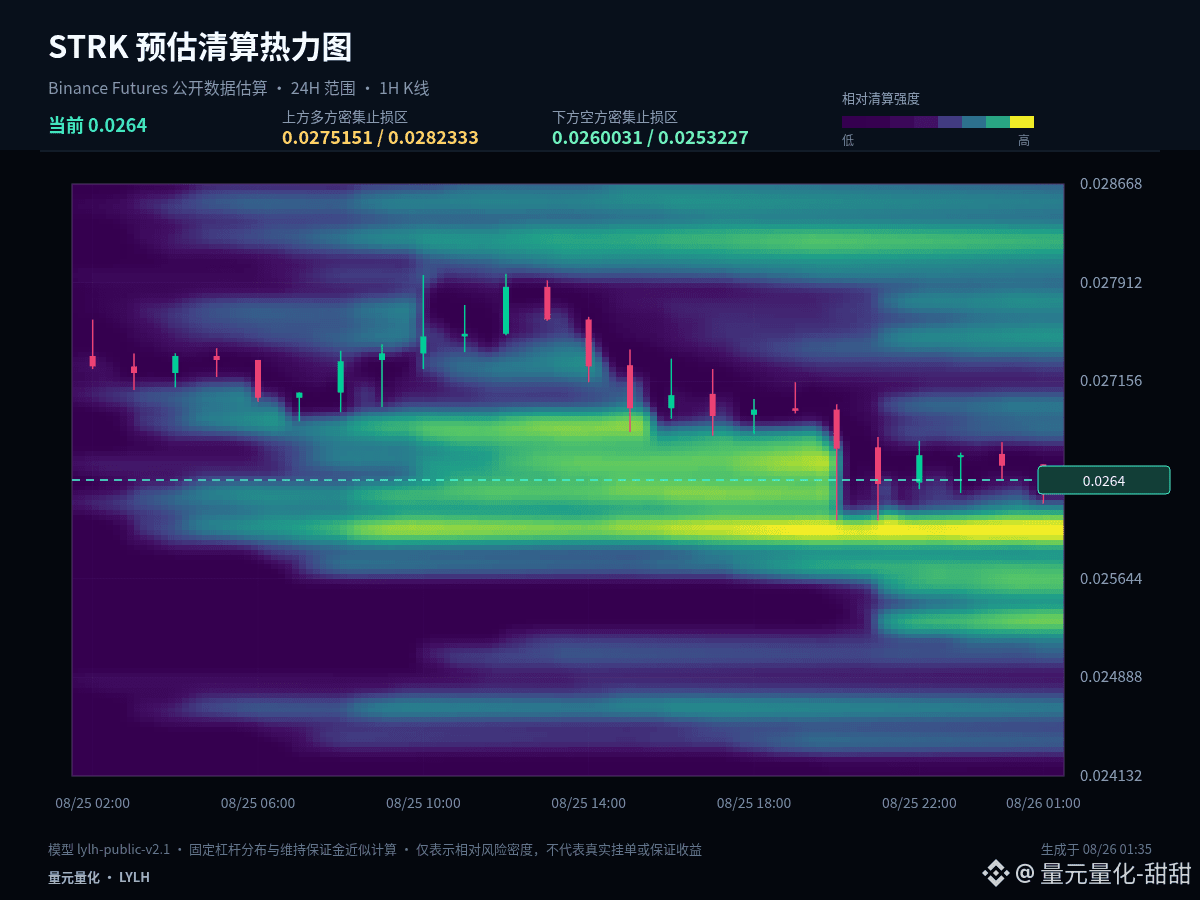
$STRK #STRK It currently looks more like interval-style trading and churn; there’s no need to explain every 1-hour candlestick as a brand-new trend. Current price 0.02638, 1 hour -0.42%, 24 hours -2.76%.
The current price is close to the lower bound of the last 24-hour range: 1 hour -0.42%, 24 hours -2.76%. The core of low-area analysis isn’t trying to call the bottom early—it’s to watch whether, after a breakdown, price can quickly reclaim. If it reclaims, that indicates selling pressure has been absorbed; if it continues to linger below the lower bound, it means the weakness hasn’t ended.
The upper band is 0.02795, the lower band is 0.0261, and the midline is 0.027025. Near the upper band, watch the breakout quality; near the lower band, watch for follow-through/support. Around the midline, reduce frequent trading—because price isn’t far enough from either side, and both direction and risk-reward are unclear.
The signals worth acting on are: after a break of the boundary, price is willing to stay in the new range; or after probing below the boundary, it quickly reclaims. Without such confirmation, keep treating it as range-bound, and don’t change the overall plan due to brief intraday fluctuations.
For position sizing, you need to differentiate spot holdings from derivatives. Existing spot can be managed in segments around key levels, without switching direction frequently based on a single 1-hour candlestick. If you’re currently flat, wait for confirmation and then scale in more calmly. Derivatives place more emphasis on entry location and invalidation conditions; when volatility increases, actively reduce position size to avoid turning short-term judgments into passive holding.
Risk control still comes before the conclusion: execute only when conditions appear, and reassess promptly if the price invalidates. The higher the volatility, the more restrained the per-trade position should be. The above is a scenario projection based on current 1-hour and 24-hour data, and does not constitute a promise of returns.
#KazakhstanCutsOilOutputForecastTo96MTons
The current price is close to the lower bound of the last 24-hour range: 1 hour -0.42%, 24 hours -2.76%. The core of low-area analysis isn’t trying to call the bottom early—it’s to watch whether, after a breakdown, price can quickly reclaim. If it reclaims, that indicates selling pressure has been absorbed; if it continues to linger below the lower bound, it means the weakness hasn’t ended.
The upper band is 0.02795, the lower band is 0.0261, and the midline is 0.027025. Near the upper band, watch the breakout quality; near the lower band, watch for follow-through/support. Around the midline, reduce frequent trading—because price isn’t far enough from either side, and both direction and risk-reward are unclear.
The signals worth acting on are: after a break of the boundary, price is willing to stay in the new range; or after probing below the boundary, it quickly reclaims. Without such confirmation, keep treating it as range-bound, and don’t change the overall plan due to brief intraday fluctuations.
For position sizing, you need to differentiate spot holdings from derivatives. Existing spot can be managed in segments around key levels, without switching direction frequently based on a single 1-hour candlestick. If you’re currently flat, wait for confirmation and then scale in more calmly. Derivatives place more emphasis on entry location and invalidation conditions; when volatility increases, actively reduce position size to avoid turning short-term judgments into passive holding.
Risk control still comes before the conclusion: execute only when conditions appear, and reassess promptly if the price invalidates. The higher the volatility, the more restrained the per-trade position should be. The above is a scenario projection based on current 1-hour and 24-hour data, and does not constitute a promise of returns.
#KazakhstanCutsOilOutputForecastTo96MTons