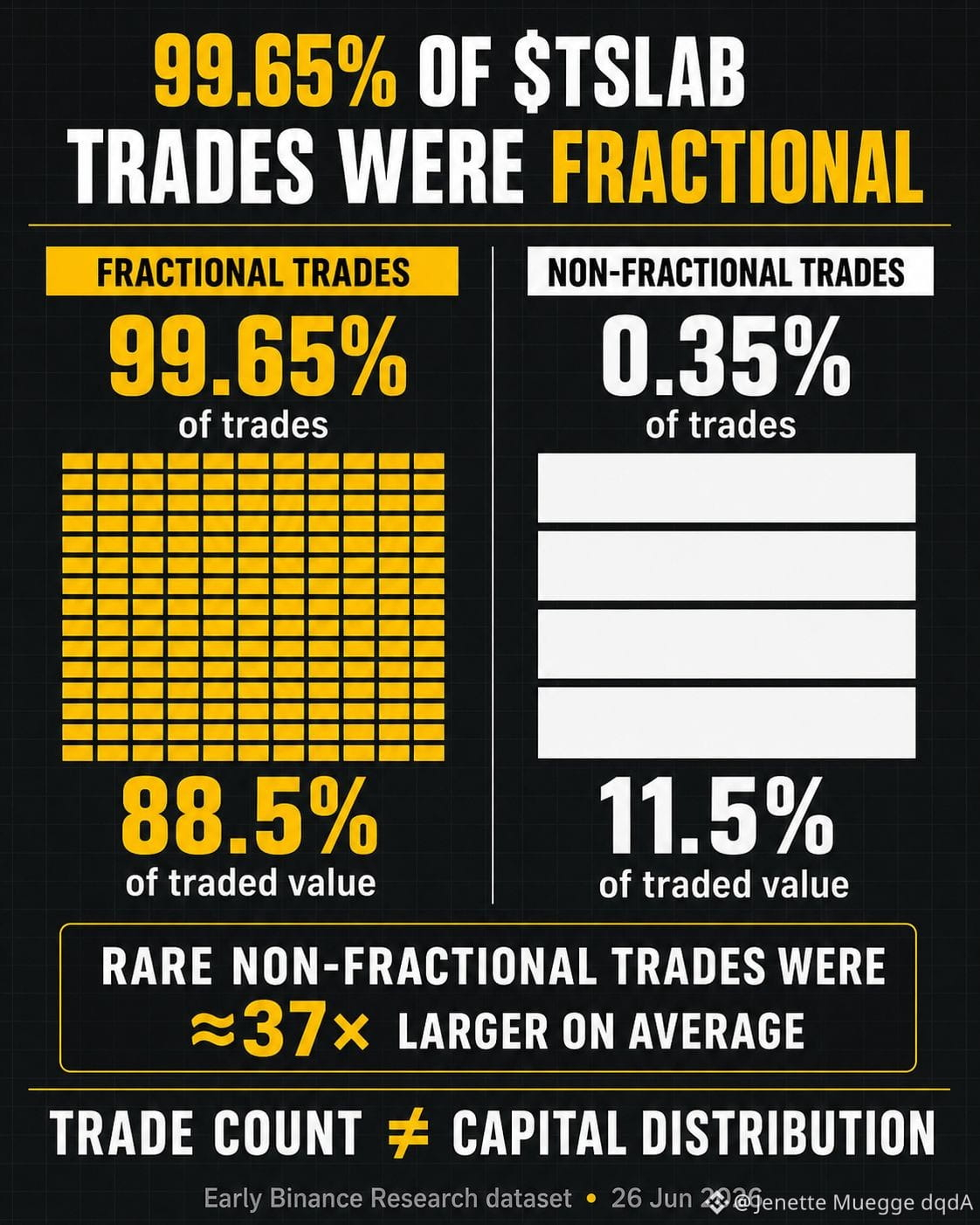
99.65% of early $TSLAB trades were fractional.
That sounds like retail noise until you look at the second number:
Those fractional trades still represented 88.5% of TSLAB’s total traded value.
But the two percentages reveal something else.
Normalize the dataset to 10,000 trades and $100 of total value:
• 9,965 fractional trades account for $88.50
• 35 non-fractional trades account for $11.50
Now compare their average sizes.
The rare non-fractional trade was approximately 37 times larger than the average fractional trade.
So the same dataset tells two stories:
Fractional orders dominated participation
A tiny 0.35% of trades still contained disproportionately large individual positions
This is more informative than simply saying that fractional trading makes Tesla accessible from $5.
The lower entry threshold changes the structure of participation: many users can enter through small fractions, while substantially larger orders can still coexist in the same market.
But 88.5% of value coming from fractional trades also shows that this was not just dust activity.
Most of the early $TSLAB capital in the dataset moved through sub-share positions.
That is why I would never judge bStocks adoption from trade count alone:
Trade count shows how people participate.
Traded value shows where capital actually moves.
Reading only one can produce the wrong conclusion.
Source: Binance Research early bStocks trading data, 26 June 2026; Binance CIS CreatorPad suggested talking points.
Which metric would you check first?
@BinanceCIS #bStocksCIS $TSLAB
That sounds like retail noise until you look at the second number:
Those fractional trades still represented 88.5% of TSLAB’s total traded value.
But the two percentages reveal something else.
Normalize the dataset to 10,000 trades and $100 of total value:
• 9,965 fractional trades account for $88.50
• 35 non-fractional trades account for $11.50
Now compare their average sizes.
The rare non-fractional trade was approximately 37 times larger than the average fractional trade.
So the same dataset tells two stories:
Fractional orders dominated participation
A tiny 0.35% of trades still contained disproportionately large individual positions
This is more informative than simply saying that fractional trading makes Tesla accessible from $5.
The lower entry threshold changes the structure of participation: many users can enter through small fractions, while substantially larger orders can still coexist in the same market.
But 88.5% of value coming from fractional trades also shows that this was not just dust activity.
Most of the early $TSLAB capital in the dataset moved through sub-share positions.
That is why I would never judge bStocks adoption from trade count alone:
Trade count shows how people participate.
Traded value shows where capital actually moves.
Reading only one can produce the wrong conclusion.
Source: Binance Research early bStocks trading data, 26 June 2026; Binance CIS CreatorPad suggested talking points.
Which metric would you check first?
@BinanceCIS #bStocksCIS $TSLAB