#dusk $DUSK I went looking at why Dusk bothers running two separate transaction models on its native layer at all, since Phoenix, the shielded one, already sounded like it covered privacy. Turns out Phoenix used to be the whole story, and that was a problem.
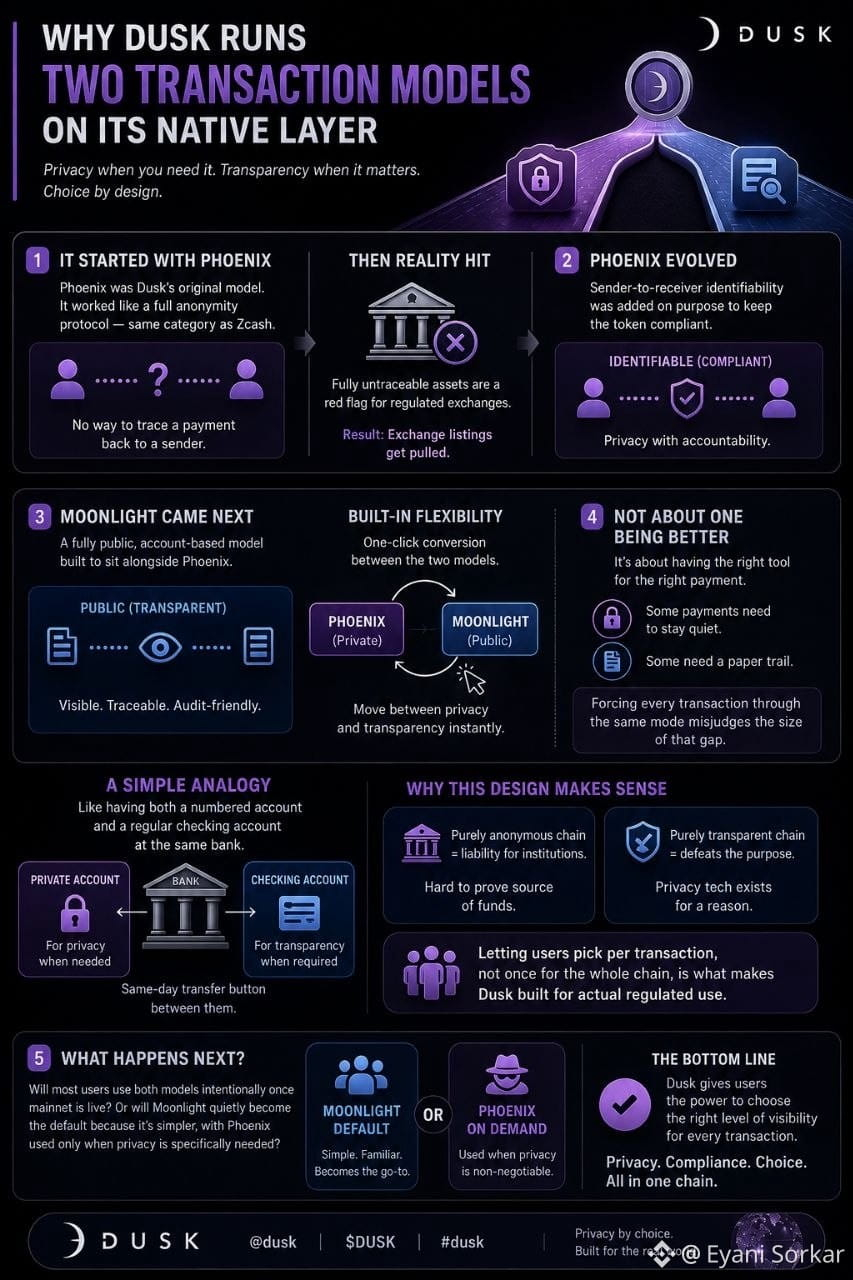
Phoenix originally worked like a full anonymity protocol, the same category as Zcash — no way to trace a payment to a sender at all. That got walked back on purpose. Sender-to-receiver identifiability got added to keep the token compliant, after realizing a fully untraceable asset is exactly the kind of thing that gets an exchange listing pulled. Moonlight came right after — a fully public, account-based model sitting next to Phoenix, with a one-click conversion between the two.
I'd assumed a privacy-focused chain would just keep tightening its privacy. Dusk went the other way on purpose — built the fully anonymous version first, ran into the reality that no regulated exchange wants to list something they can't monitor, and added a transparent second model so users could opt into visibility whenever the moment called for it.
Feels like having both a numbered account and a regular checking account at the same bank, with a same-day transfer button between them. Not because one account is broken. Because some payments need to stay quiet and some need a paper trail, and forcing every transaction through the same mode misjudges the size of that gap.
Makes sense once I sat with who this is actually built for. A purely anonymous chain is a liability the moment an institution has to prove where funds came from. A purely transparent one defeats the reason privacy tech exists in the first place. Letting the user pick per transaction, instead of picking once for the whole chain, is the part that feels built for actual regulated use rather than theoretical privacy.
Still turning over whether most users end up using both intentionally once mainnet's live, or whether Moonlight quietly becomes default because it's simpler, and Phoenix only gets reached for when someone specifically needs it. @Dusk
Phoenix originally worked like a full anonymity protocol, the same category as Zcash — no way to trace a payment to a sender at all. That got walked back on purpose. Sender-to-receiver identifiability got added to keep the token compliant, after realizing a fully untraceable asset is exactly the kind of thing that gets an exchange listing pulled. Moonlight came right after — a fully public, account-based model sitting next to Phoenix, with a one-click conversion between the two.
I'd assumed a privacy-focused chain would just keep tightening its privacy. Dusk went the other way on purpose — built the fully anonymous version first, ran into the reality that no regulated exchange wants to list something they can't monitor, and added a transparent second model so users could opt into visibility whenever the moment called for it.
Feels like having both a numbered account and a regular checking account at the same bank, with a same-day transfer button between them. Not because one account is broken. Because some payments need to stay quiet and some need a paper trail, and forcing every transaction through the same mode misjudges the size of that gap.
Makes sense once I sat with who this is actually built for. A purely anonymous chain is a liability the moment an institution has to prove where funds came from. A purely transparent one defeats the reason privacy tech exists in the first place. Letting the user pick per transaction, instead of picking once for the whole chain, is the part that feels built for actual regulated use rather than theoretical privacy.
Still turning over whether most users end up using both intentionally once mainnet's live, or whether Moonlight quietly becomes default because it's simpler, and Phoenix only gets reached for when someone specifically needs it. @Dusk