

If speed is the promise, architecture is the proof.
In the previous article, we discussed the structural problems in current blockchain infrastructure: latency, congestion, and execution uncertainty. Today, the important question is simple. How does Fogo actually attempt to solve these issues at the architectural level?
Most Layer-1 blockchains separate two major responsibilities: consensus and execution. Consensus decides which transactions are valid and in what order. Execution processes those transactions and updates the network state. In many early networks, these systems were designed for security and decentralization first, and performance optimization later.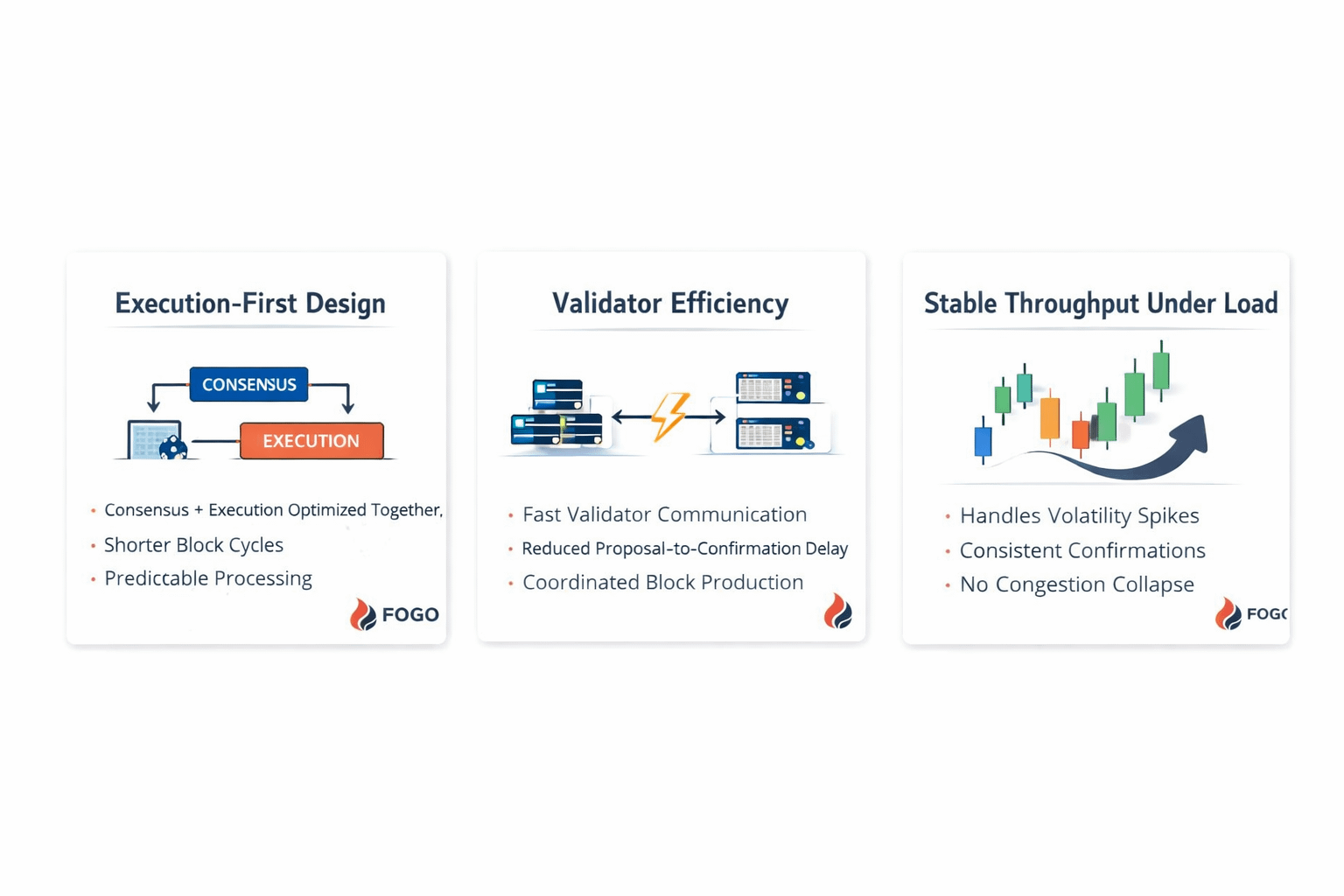
Fogo approaches this differently.
Instead of treating execution performance as a secondary outcome, it treats it as a design priority. The architecture is optimized to reduce confirmation delay and improve throughput consistency. That means block production cycles are shorter, transaction processing is more predictable, and validator coordination is streamlined.
One of the most important aspects of performance-focused chains is validator efficiency. Validators are not just passive nodes; they are the engines of the network. If validator communication is slow or poorly optimized, the entire chain feels sluggish. Fogo’s model emphasizes efficient validator communication and reduced latency between block proposal and confirmation.
Another key factor is execution reliability under load. A network may appear fast during normal activity, but the real test comes during volatility spikes. For example, imagine a sudden market drop where thousands of users attempt to close positions at the same time. In many networks, this creates congestion, delayed confirmations, and unpredictable fees. A performance-oriented architecture attempts to keep throughput stable even during high demand.
Fogo’s technical positioning suggests that it is being designed specifically for these stress scenarios. The idea is not just higher peak speed, but consistent execution quality when it matters most.
There is also a broader industry shift happening. Blockchain infrastructure is moving from experimentation phase to optimization phase. The early years were about launching smart contracts and proving decentralization. The next stage is about refining base layers so that decentralized finance can operate with institutional-level reliability. Architecture decisions are now being evaluated based on financial suitability, not just innovation.
This is where Fogo’s specialization becomes its main thesis. Instead of marketing itself as a universal platform for every possible use case, it frames itself as infrastructure tailored for on-chain financial systems.
Of course, architecture alone does not guarantee success. Adoption depends on developers building applications that take advantage of this performance design. Liquidity must follow. Ecosystem tools must mature. But from a structural perspective, Fogo is aligning its design with a clear economic direction: speed as infrastructure.
