


It’s hard to make up for the past, and it’s hard to make new things. Kujira has also crossed the ruins of Terra and made a name for himself in the Cosmos.
Written by Frank, Foresight News
Cosmos seems to be gradually emerging from the Mercury retrograde period recently. Star projects such as RUNE, INJ, and TIA have performed well in the secondary market, attracting a lot of attention. At the same time, another Cosmos ecological project that few people have heard of has also "convinced people with its growth" and quietly surfaced.
DeFillama data shows that the TVL of the Kujira ecosystem has increased more than five times since September, soaring from around US$16 million to around US$88 million in just over two months. The speed is astonishing, and its token KUJI has also increased by nearly 400% in three months, making it a dark horse.
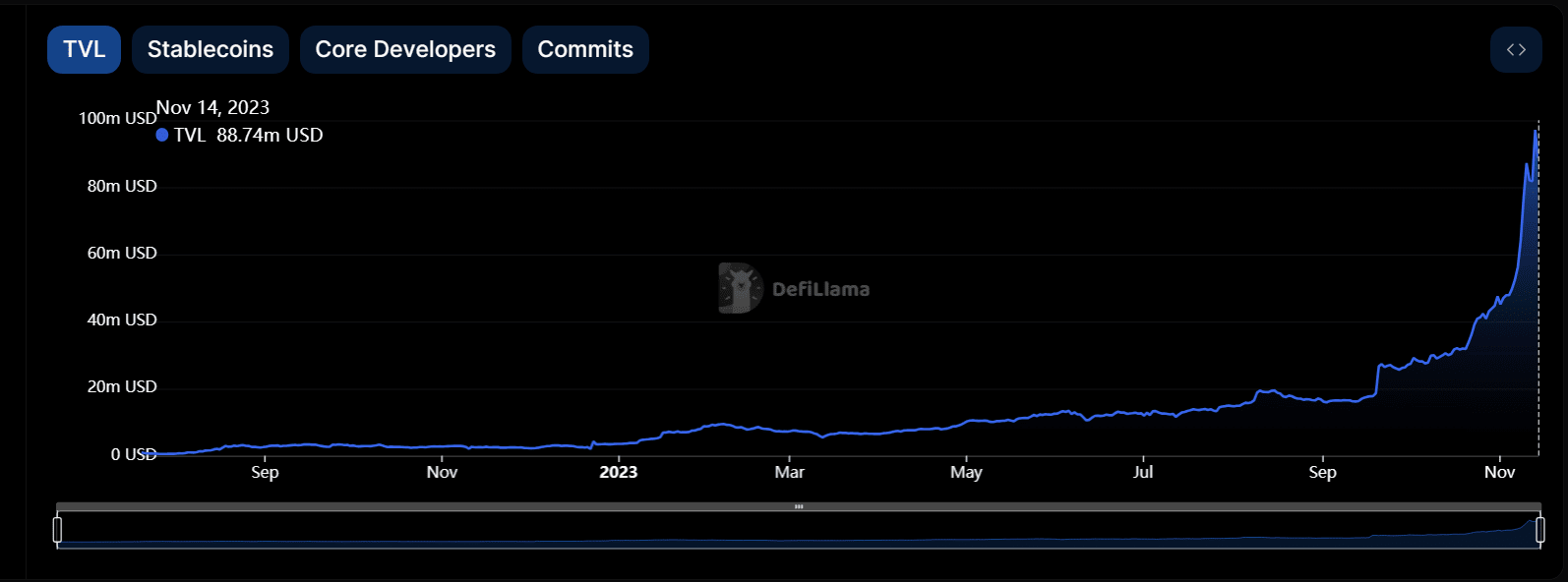
In fact, if you look closely at Kujira’s “past and present”, you will find that in just a year and a half, it has crossed the ruins of Terra’s collapse and grown into a dark horse rookie in the Cosmos ecosystem. It can be called a “rebirth article model” in the crypto world.
From Anchor Clearing Protocol to Layer1 Financial Public Chain
It is necessary for us to briefly review the development history of Kujira, among which May 11, 2022 is a key turning point that it cannot avoid.
Before the Terra crash in May 2022, Kujira was positioned as a collateral liquidation protocol on Terra, essentially providing limit orders below the liquidation price for Anchor lending:
Any user who wants to buy LUNA can bid on any form of collateral through Kujira during the liquidation period to buy discounted LUNA. This allows users to obtain discounted LUNA while also improving liquidation efficiency and avoiding extreme situations of chain declines.
However, the sudden collapse of Terra changed Kujira's original development plan, forcing it to shift on May 11, 2022, planning to build a Layer1 chain with the help of the Cosmos ecosystem and Cosmos SDK to quickly restart and run.
The chain was also launched on July 4, 2022, when the team distributed snapshots of addresses that still held KUJI on Terra. After turning to the Cosmos universe, according to the official description, Kujira is positioned as a "blockchain that realizes real benefits":
Providing a decentralized ecosystem for protocols, developers, and Web3 users seeking sustainable fintech.
Kujira's Ecosystem Matrix
According to official statistics, as of November 14, Kujira's ecological matrix currently includes 22 protocols/products, covering collateral liquidation, DEX (margin trading, limit orders, etc.), liquidity yield farming, lending market, Launchpad, wallet, strategy trading, OTC trading, P2P trading, NFT trading market, LST, on-chain ETF and other tracks (only the main protocol products are introduced below).
However, the core of Kujira is still the L1 financial public chain centered around "transactions and profits". In addition to key protocols such as Blue, FIN and Orca launched by the project team, other protocols/products within the ecosystem can use Kujira's multi-chain decentralized trading liquidity as infrastructure to launch their own services, thereby achieving composability.
In fact, if you compare, you will find that this product architecture and ecological development approach have many similarities with Injective, which is also developed based on Cosmos, and even the former Terra ecosystem. This also indirectly confirms Cosmos' consistent advantages in application chain ecological development.
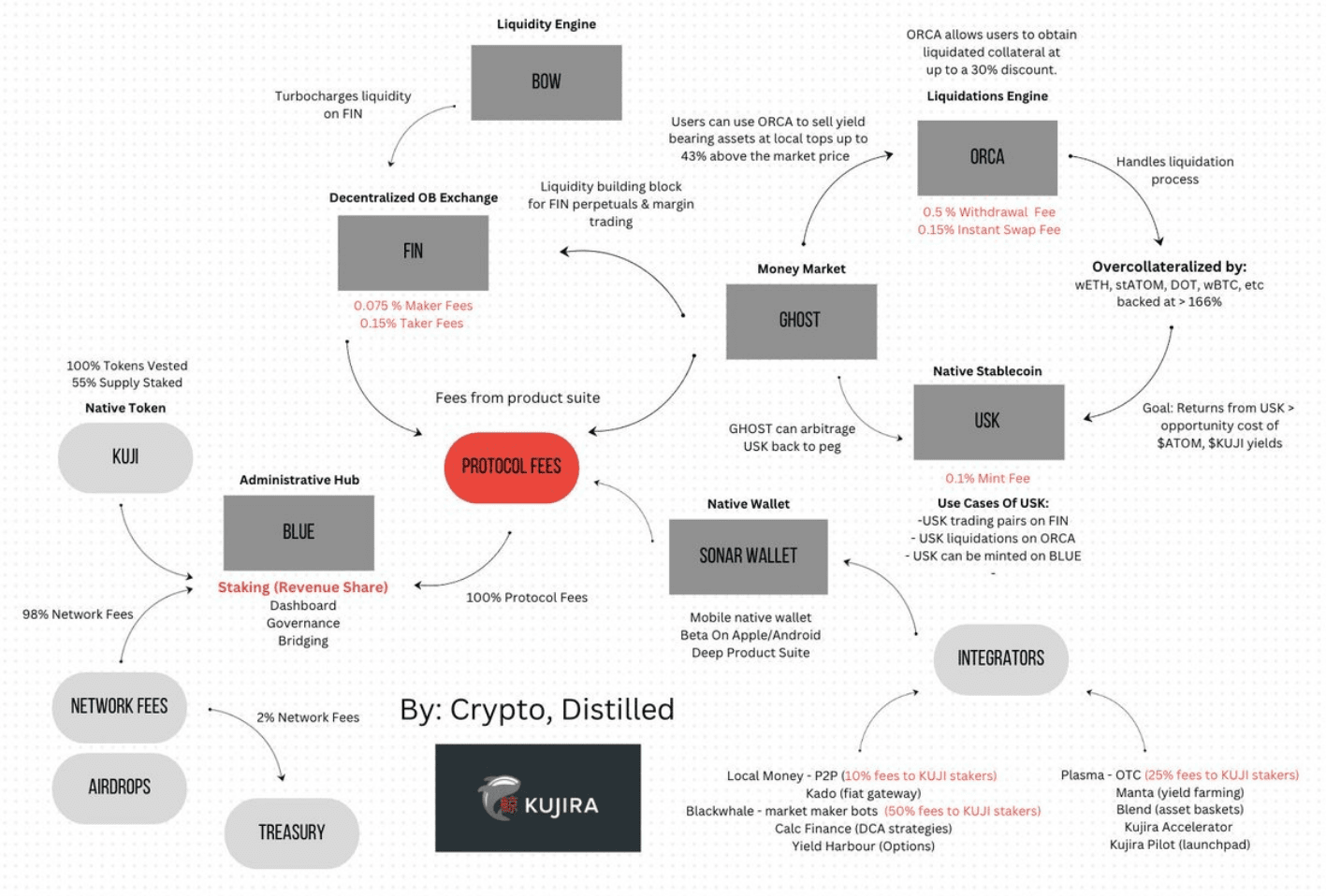
Source: Crypto, Distilled
Blue
Blue is one of the core infrastructures of the Kujira ecosystem. It can be used to manage tokens, pledge, vote, and redeem. At the same time, Blue's IBC function is also a key bridge for the flow of assets across the Cosmos ecosystem.
KUJI holders can stake tokens on Blue, claim rewards, delegate to validators, vote on governance, and transfer tokens across IBC chains.
In addition, Blue can also be used to pledge USK, the over-collateralized stablecoin of the Kujira ecosystem (see below for details).
Orca
Orca is in line with Kujiira's concept before May 2022. It is a public auction market for liquidating collateral, allowing anyone to bid for collateral to be liquidated.
END
FIN is a decentralized exchange in the Kujira ecosystem that provides order books, swaps, and margin trading.
BOW
BOW is an automated market maker that allows users to profit by providing liquidity, while FIN provides access to deeper liquidity.
Liquidity providers earn part of the fees from transactions and can receive additional rewards from third parties when staking their LP tokens.
GHOST
GHOST is a fully functional money market where users can borrow and lend using a variety of financial instruments, earn interest at competitive rates, and gain access to short-term loan funds.
SONAR
SONAR is the mobile wallet application of the Kujira ecosystem, allowing users to pay, trade, stake and vote directly through their mobile phones.
PILOT
PILOT is a Launchpad platform built in collaboration between Kujira and Fuzion that uses a sales approach based on the Orca bidding process to allow everyone to participate equally, providing a fair opportunity for all users.
From this perspective, Blue, Orca, and FIN are indeed the infrastructure of the Kujira ecosystem, enabling cross-chain flows of (liquidation) asset transactions and liquidity at the bottom of the entire ecosystem:
Blue provides users with cross-chain and token management services, allowing users to exchange assets obtained through bidding on Orca for stablecoins or other Cosmos assets through trading functions such as the FIN limit order book, thus realizing the liquidity closed loop between Kujira and the Cosmos universe.
BOW, GHOST, etc. further provide better liquidity or transaction combination functions for the process, thereby forming a complete and closed-loop liquidity processing chain, connecting the entire Cosmos universe and IBC assets through IBC, and converging the revenue streams of all products/protocols into Kujira.
What are the positives to look out for?
For this part, we follow the clues. Since KUJI's performance is so outstanding, are there any positive factors worth paying attention to in Kujira recently?
USK adoption accelerates
USK is the Kujira ecosystem's over-collateralized USD stablecoin (similar to DAI). Currently supported collateral includes ATOM, stATOM, wBTC, wETH, wstETH, wAVAX, wBNB, INJ, DOT, LUNA and other crypto assets.
Since mid-September of this year, the circulating supply of USK has been rising, nearly doubling from $1.72 million to approximately $3.25 million as of November 14.
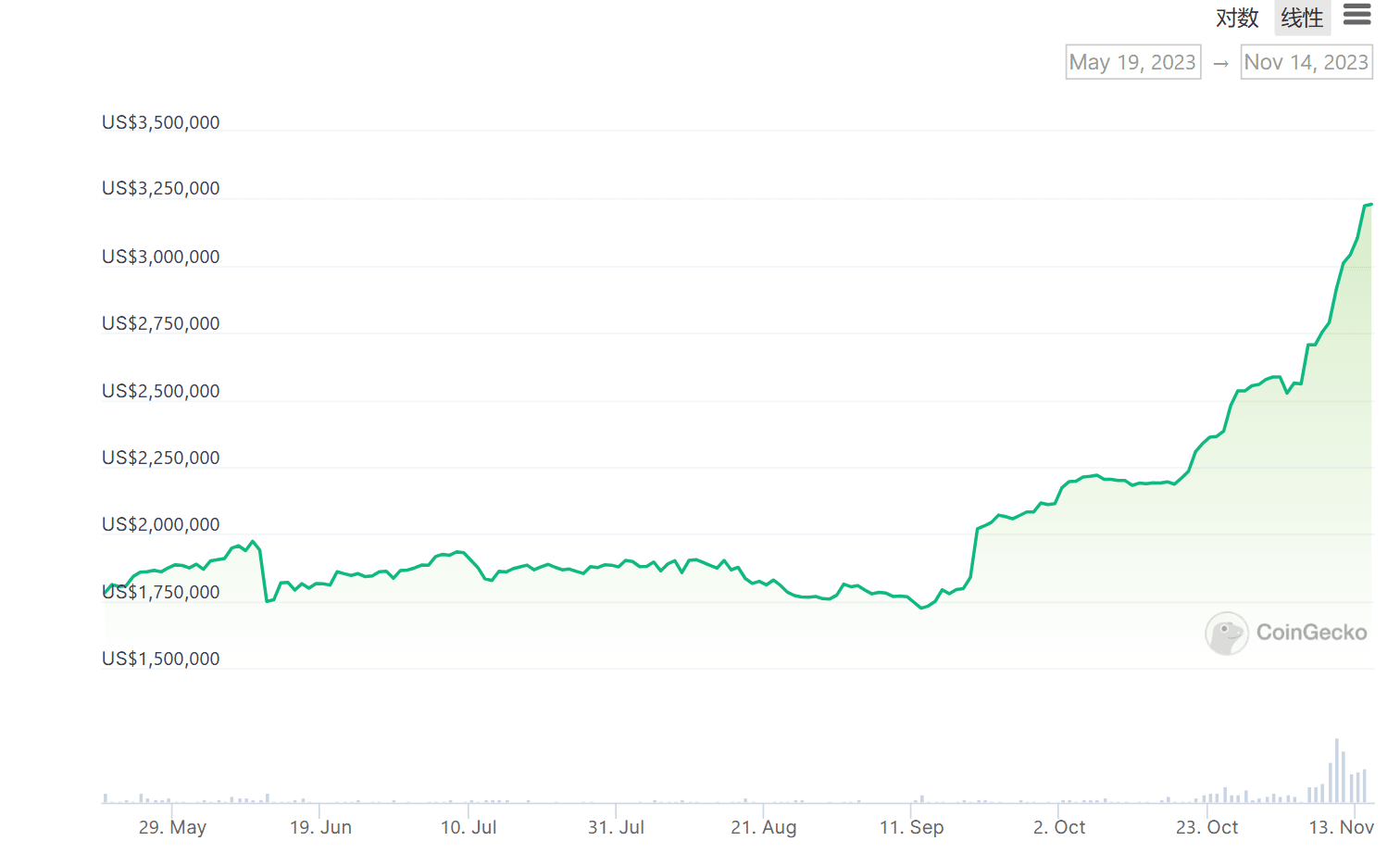
But to be honest, the current total circulating supply of USK is only about 3.25 million, which is still very small and can be almost ignored in the entire stablecoin track.
Perhaps because of this, according to CoinGecko statistics, the anchoring situation of USK is not very stable, and it has fluctuated widely in the range of US$0.98-1.04 in the past three months.
In addition, among the collateral, in addition to the packaged assets of BTC and ETH (about 1 million), the minting ratio of ATOM and other IBC assets undoubtedly accounts for the majority (about 800,000). From the perspective of empowerment, this will also help ATOM to capture the expansion value of the Cosmos ecosystem DeFi protocol.
Of course, this requires USK to not only become the core of the Kujira ecosystem, but also to become one of the universal currencies of the Cosmos universe:
For example, users can first mint USK and bid for liquidation collateral on ORCA, and then exchange the assets obtained from the bid for liquidity on FIN, thereby supporting cross-chain to other IBC networks, or crossing from other IBC networks for liquidation arbitrage.
In this way, multiple combinations with other trading and liquidity products/protocols can also use trading scenarios such as stablecoins to produce a siphon effect and make Kujira one of Cosmos' trading and liquidity nodes.
Full circulation of tokens and high pledge rate
In addition, in terms of token economics, on November 9, 2023, Kujira unlocked the last batch of vested KUJI tokens, which also means that approximately 122 million KUJI tokens in total are now fully circulated.
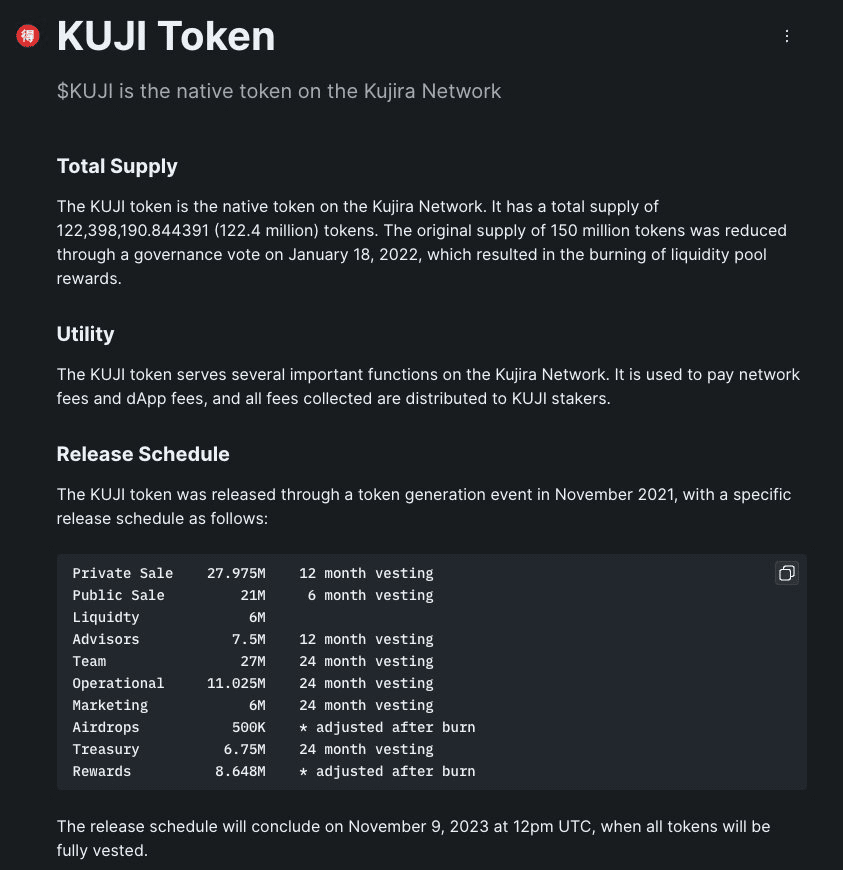
This is also a rare situation in the Cosmos ecosystem where high inflation is rampant. Therefore, from the perspective of supply and demand in the secondary market, it does eliminate the potential subsequent selling pressure of KUJI tokens.
At the same time, since KUJI's token economics allows KUJI stakers to receive 100% of the protocol fees, the KUJI staking rate has been rising, and currently more than 50% of KUJI is staked (about 64.3 million).
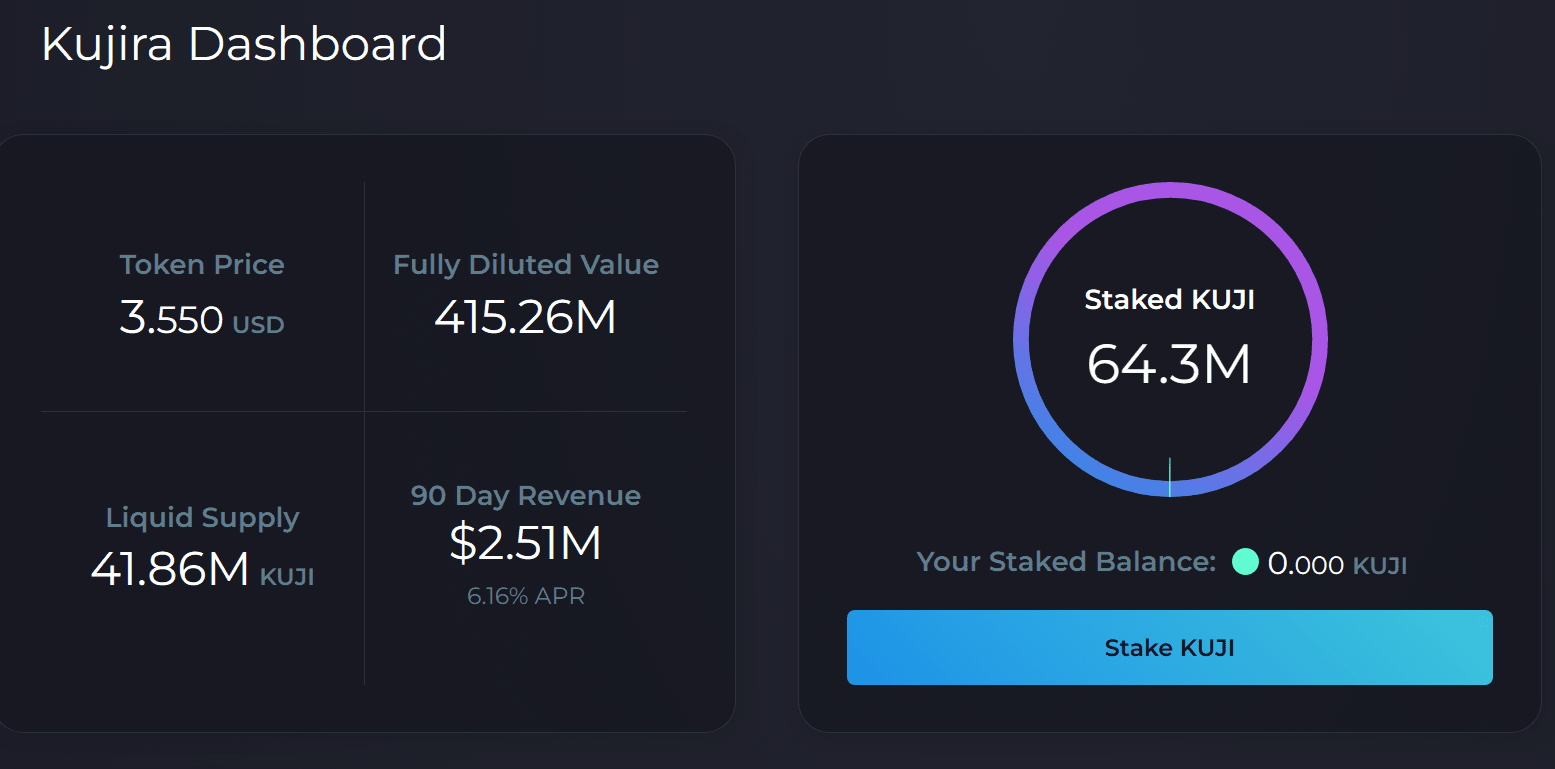
However, it should be noted that KUJI currently has almost no exchange trading pairs - it has not yet been listed on any top or second-tier exchanges, and liquidity is mainly concentrated on the chain and within the ecosystem, so be aware of the risks.
summary
Looking back now, the secondary disasters caused by the collapse of Terra in May 2022 have not yet dissipated for developers who originally wanted to build financial protocols based on UST in Terra. Many projects have fallen into difficulties or even suspended development.
In addition to the projects that subsequently chose to stay with Terra 2.0, there are also many projects like Stader, Mars, Kujira, etc. that have begun to actively save themselves. For many projects, Cosmos, which is close to the water and has the first chance to get the moon, naturally became the best migration option.
But it is difficult to make new profits, and now, a year and a half later, only Kujira has temporarily made a way for himself in Cosmos.
In general, Kujira now has its own over-collateralized stablecoin (USK), a relatively mature trading and liquidity infrastructure, and is working hard to become the main liquidity node in the Cosmos universe. It can be said that it has walked out of the quagmire of Terra, which is really not easy.
As long as you don’t fall down, you can stand up again. Kujira has set a good example. We also hope that more original Terra ecological projects can get out of the quagmire and usher in a new stage of development.