


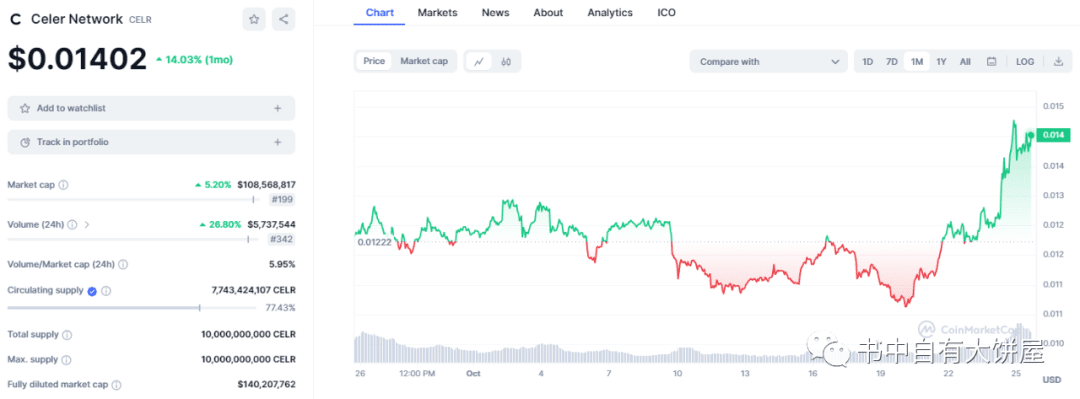
Today we are going to talk about an awesome project, which is the ultimate solution for off-chain expansion. Once it achieves hundreds of millions of TPS, it will not be a problem. Therefore, the current Rollup and ZK are just younger brothers, but it is extremely difficult to implement. It is the Celer network, which currently has a market value of 100 million US dollars and ranks 199th.
Introduction
Celer Network is a high-performance Layer 2 scalability platform that aims to realize the grand vision of bringing the scale of the Internet into the blockchain and helping the commercialization of the blockchain through the above technological innovations.
It is not an independent blockchain, but a general network system that runs on existing and future blockchains. It provides unprecedented performance and flexibility through innovative chain scaling technology and implicit economics of incentive alignment.
To put it bluntly, it is committed to building a blockchain application entrance platform matching the scale of the Internet based on off-chain expansion technology, so that everyone can quickly and easily develop, run and use high-performance distributed blockchains on the platform. application.
Project Highlights
Off-chain scaling technology allows smart contract interactions between mutually distrustful entities off-chain instead of on-chain. Participants jointly maintain and each copy a multi-signature off-chain state machine that cannot be tampered with, and only resort to on-chain consensus when absolutely necessary (such as when multiple parties cannot reach an agreement). Off-chain scaling is the only way to achieve distributed applications (dApps) that can scale horizontally and protect privacy while ensuring the trustless and decentralized nature of the blockchain. It is a turning point for the large-scale popularization of blockchain technology and will become the engine and cornerstone of all scalable dApps.
Technical Overview
As a comprehensive platform that can be built on existing or future blockchains, Celer Network contains a clear layered architecture that separates complex off-chain platforms into various levels of modules. This architecture greatly reduces the complexity of system design, development, and maintenance so that each component can easily iterate and adapt to changes.
A well-designed layered architecture should have open interfaces, and different implementations are encouraged on each layer as long as they support the same cross-layer interface. Each layer only needs to focus on implementing its own functionality. Inspired by the successful layered design of the Internet, Celer Network adopts an off-chain technology stack that can be built on different blockchains, named cStack, which consists of the following layers, arranged in bottom-up order:
cChannel: Generalized State Channel and Sidechain Suite
cRoute: Best Value Delivery Route
cOS: Development framework and operating environment for off-chain applications
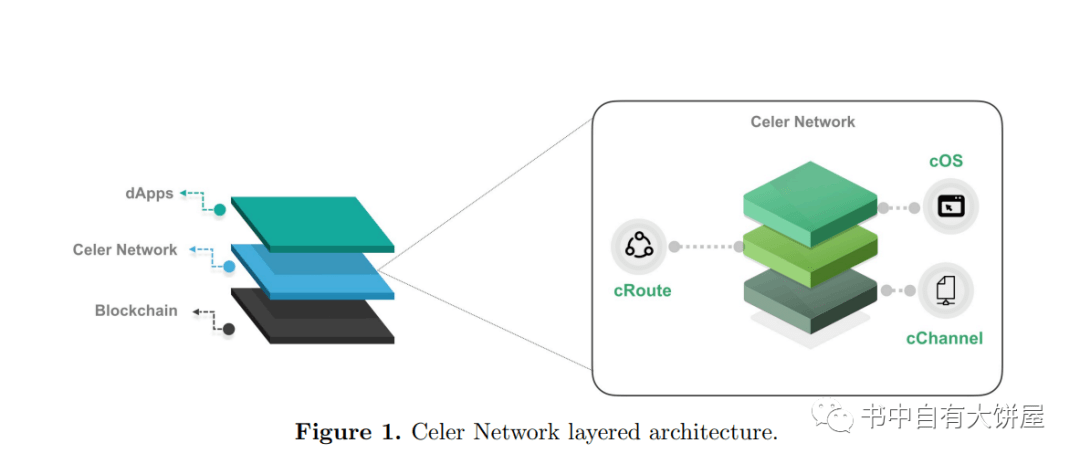
The Celer architecture provides innovative solutions for all layers. Below we detail the technical challenges and key features of cChannel, cRoute, and cOS.
cChannel
This layer is the layer closest to the underlying blockchain, interacts directly with the basic public chain, and provides real-time status updates to the upper layer with a common abstract structure within a limited time. cChannel uses state channel and sidechain technology, which are the cornerstones of the off-chain scaling platform.
State channels allow mutually untrusting parties to quickly agree on the latest agreed state in an off-chain program, and guarantee its immutable security through on-chain debt contracts. This concept was originally introduced by the Lightning Network to support high throughput of small transactions of Bitcoin off-chain. Since the idea of the Lightning Network was proposed, there have been some research works that solve different problems in the context of payment channel networks, such as routing algorithms and time lock optimization. However, off-chain networks are still in their early stages of development and face some major challenges in their modularity, flexibility, and cost-effectiveness. cChannel addresses current challenges by creating a series of new features.
Generalized off-chain state transfer. Off-chain transfer can be any state transfer that relies on DAG. This enables Celer Network to support complex, high-performance off-chain dApps such as games, online auctions, insurance, market predictions, and decentralized transactions.
Flexible and efficient value transfer. Provides a variety of state channels and sidechain structures, and various efficiency and immutability trade-off strategies to support fast value transfer with universal conditions, minimized on-chain interactions, and minimized capital lock-up.
Pure off-chain contracts. Any contract that is not directly related to on-chain deposits does not require any on-chain operations or initialization unless it causes disputes. Each purely off-chain contract or object has a uniquely identifiable off-chain address, is deployed on the blockchain only when needed, and is assigned an on-chain address by a built-in off-chain address converter.
crust
Celer Network is a highly scalable dApps platform, and providing support for high-throughput value transfer on the platform is one of its most important commitments. Off-chain value transfer is a basic requirement for many off-chain applications. While Celer Network has a bigger vision than just payment solutions, it is a groundbreaking improvement in off-chain payment routing as it directly determines how much value can be transferred within the ecosystem and how fast it can be transferred.
All existing off-chain payment routing can be attributed to traditional "shortest path routing" algorithms, which may result in poor performance for off-chain payment networks due to fundamental differences in link models. The link capacity of a computer network is stable and stateless (not affected by past transmissions). However, the link capacity of the off-chain payment network is stateful (i.e. determined by on-chain deposits and past payments), which results in the topology and link status constantly changing in a highly dynamic network, which makes the traditional shortest path algorithm It is difficult to converge, resulting in low throughput, high latency, and even outages.
Celer Network’s payment routing module recognizes this fundamental challenge and introduces a distributed routing balancing algorithm (DBR) that uses distributed congestion gradients.
Provably Optimal Throughput We prove that for any payment transaction request rate, if there exists a routing algorithm that can support that rate, then DBR can compute that algorithm. Our evaluation shows that DBR achieves 15x higher throughput and 20x better channel utilization than state-of-the-art solutions.
Transparent Channel Balancing "Keeping channels balanced" has been an intuitive thing to do since the Lightning Network. However, existing attempts are exploratory and involve a large number of on-chain or off-chain coordination to achieve a low-guaranteed balance. DBR combines the channel balancing process with routing and keeps the network balanced without any additional coordination.
The fully decentralized DBR algorithm is a fully decentralized algorithm in which each node only needs to communicate with its neighboring nodes in the state channel network topology. DBR's message passing cost in the protocol is also very low.
Failure Resilience The DBR algorithm is highly resilient to failures: it quickly detects and adapts to unresponsive nodes, supporting the maximum possible throughput on the remaining available nodes.
Privacy Protection Due to its multi-path nature, the DBR algorithm naturally preserves privacy about the transmitted values without using any additional privacy protection techniques (such as ZKSNARK). What’s more, the DBR algorithm can be seamlessly integrated with onion routing to protect source and destination anonymity.
cOS
An on-chain dApp is just a simple front-end that connects to the blockchain. Although off-chain dApps have great potential for high scalability, it is not easy to build them on traditional public chains. Celer Network introduces cOS, a development framework that allows everyone to easily develop, operate, and interact with scalable off-chain dApps, thereby reducing the additional complexity caused by off-chain expansion. Celer Network allows developers to focus more on the development of application logic and create the best user experience, while cOS handles the heavy work, including the following tasks:
Find the dependencies between any off-chain state and on-chain state.
Handles tracking, storage, and disputes of off-chain state.
Intermediate node failures are fault tolerant and transparent.
Supports multiple concurrent off-chain dApps.
Unified implementation to different on-chain and off-chain modules.
Off-chain incentive mechanism
Celer Network’s off-chain scaling solution is based on the following key concepts:
State Channels: Celer Network uses state channel technology to achieve off-chain expansion. A state channel is a private communication channel between two or more parties opened on the blockchain. In these channels, participants can perform a large number of transactions, and only the final settlement results will be submitted to the blockchain. This can greatly reduce the burden of on-chain transactions and improve efficiency.
Pipeline Computation (Off-chain Computation): Celer Network allows off-chain participants to perform complex computing tasks without waiting for confirmation from the blockchain network. These calculations can include smart contract execution, game logic, data processing, etc. Only the final results are submitted to the blockchain to ensure security and transparency.
Conditional Payment Network: Celer Network introduces a conditional payment network, allowing users to perform conditional payment operations within a state channel. This means payments can be tied to specific conditions, such as timestamps, event triggers, etc. This opens up more possibilities for more complex off-chain applications.
Network Interoperability: Celer Network’s scaling solutions are designed to interoperate with different blockchain networks, such as Ethereum, Bitcoin and other blockchains. This means assets and data can be transferred between different blockchains, enabling wider ecosystem interconnection.
The implementation layer of CELER relies entirely on the economic design model, maintaining and operating the entire CELER network through liquidity commitment proof POLC, liquidity support auction LIBA and state guard network SGN.
1 Proof of Liquidity Commitment (POLC):
The prerequisite for off-chain payment is that there is an open channel and a certain amount of tokens must be pledged. The real problem is that those with money may not necessarily have technology, and those with technology may not necessarily have money. Therefore, CELER has designed a liquidity commitment certificate, that is, by locking assets for mining, the locked assets will be provided to off-chain services. business, which can ensure a good liquidity of off-chain assets. The longer the locking period, the more CELER tokens you will receive.
Mining reward mechanism, for a limited time, Celer Network plans to give 20% more CELR as an incentive to NLBs (liquidity supporters) who lock CCC (guarantee commitment contract) to support the system compared to pre-mining. The incentive is proportional to the PoLC computing power of each NLB (liquidity supporter). If R i represents the incentive of i, then it has:
2Liquidity Auction (LIBA):
In addition to solving liquidity problems through locked mining, CELER has also designed an auction method to solve liquidity problems. By contacting service providers, you can obtain working capital through "private lending".
3 State Guard Network (SGN):
When the user goes offline, the State Guardian Network is a special compact sidechain to protect the off-chain state. CELER token holders can autonomously convert CELER into SGN, and then become state guardians. Before a user goes offline, she can submit her state to SGN by paying some fees, and let the guardian protect her state for her for a certain period of time. Then some guardians are randomly selected to be responsible for this state based on the state hash and "responsibility score".
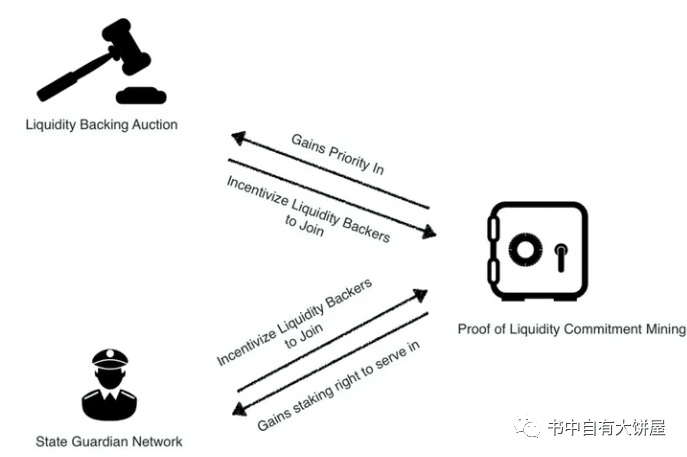
The basic process of the auction mechanism is:
OSP (borrower) submits information such as the required amount of borrowed funds and borrowing time on the Celer network to create a standard LiBA smart contract and initiate the Liquidity Support Auction (LiBA) process. The auction process is an anonymous auction, and the bidding information includes the loan interest rate expected by the lender, the amount of liquidity that can be mortgaged (the mortgage duration is the time required by the auction initiator OSP), the number of CELR Tokens, etc. In order to facilitate PoLC miners (NLB) to participate in the auction, the auction mechanism allows miners to provide liquidity funds through the CCC contract to participate in the auction.
The auction process adopts the VCG auction mechanism (this auction mechanism can ensure that bidders bid according to the real valuation, but the mechanism is relatively complex and is omitted here). During the auction, a "happiness index" is calculated based on the bidders' bidding information, and the final auction winner is selected according to certain rules. It is particularly important to point out that if the bidders have similar scores, the one holding the larger number of CELR Tokens wins.
After the auction ends, OSP (borrower) needs to pay interest in advance to the LiBA auction contract, and after receiving the prepaid interest, the auction contract will generate IOU Token at a ratio of 1:1 and send it to the state channel contract (cCurrency) where OSP is located, with the mortgage amount as ETH for example, generate cETH). The IOU Token will be used as the value transfer medium in the off-chain state channel. Generally speaking, before the auction contract expires, OSP will send all borrowed cETH back to the auction contract for liability liquidation, and the auction contract will expire. Since there is a 1:1 relationship between cETH and ETH, users can terminate off-chain transactions and withdraw funds at any time without risk.
(3) SGN network
(Through the SGN network, users can perform off-chain state hosting when offline to prevent transaction failures or interruptions and improve the availability of the Celer network)
The SGN network is the off-chain state guard network, a side chain that guards the off-chain state for offline customers. CELR Token holders can become off-chain state guardians by staking Tokens. The guardians of submitted off-chain state tasks will be randomly selected based on the state hash and "responsibility score". However, the more tokens are mortgaged, the greater the probability of being assigned the task of guarding the off-chain state and obtaining more handling fee income. By paying a certain fee, Celer network users can submit off-chain status to the SGN network for hosting for a period of time before going offline (such as to prevent the other party from canceling unfavorable transactions without authorization, etc.).
In summary, LiBA and PoLC focus on how to introduce the intermediate links of the state interaction process into the off-chain in an easier way, while SGN focuses on protecting the off-chain state transition process, aiming to bring the off-chain state back when necessary. On-chain (such as when the other party attempts fraud).
In the entire economic system, CELR Token can be used as collateral for anti-fraud bonds for liquidity lending, as a payment medium for payment channel registration fees, as transaction fees, and as other possible service fees. In addition, in the first 5 years of the system's operation, new CELR Tokens will be generated through PoLC mining, and LiBA only needs to pledge the Tokens. After the pledge period, CELR still belongs to the lender. When the 5-year PoLC mining period ends, LiBA will begin to consume CELR, and the consumed CELR will no longer be returned to the lender, but will be injected into the system as a continuous PoLC mining reward.
In terms of security, Celer has the following designs:
1. NLP tends to choose to lend to OSPs that do not have any default records.
2. Newly minted cETH is only allowed to be transferred to state channel contracts on the whitelist.
3. cETH can only be spent gradually at a rate below an upper limit.
4. OSP can do many things to maintain a secure infrastructure, such as partitioned multi-node deployment, formal verification of network infrastructure security access rules, etc.
team
The above actually also explains the architecture of the entire Celer network and the incentive design under the chain. In fact, the overall idea is relatively clear, but it requires strong implementation capabilities, so team configuration is very important. Of course, Celer's team is still very strong and all are real-name:
Founder, Dong Mo:
Graduated from Shanghai Jiao Tong University and received a PhD in CS from UIUC in 2017. He was a founding member of Veriflow, a network formal verification security company, where he served as engineering team leader and product manager. Dr. Dong is an early participant, developer and pioneer in distributed technology and blockchain circles. The distributed system and network protocol formal verification software developed earlier has been deployed in the world's top 50 companies. In 2017, it began to teach blockchain smart contract development courses, cultivating a large number of developers for the community.
1. Core members
Liu Junda:
Graduated from Tsinghua University, obtained a PhD in CS from UC Berkeley in 2011. Worked at Google for 7 years. The first person to propose the use of DAG for routing, achieving a network repair capability that is 1,000 times ahead of the industry.
Li Xiaozhou:
Graduated from Tsinghua University and received a PhD in CS from Princeton. 2 years of working experience in Barefoot network.
Liang Qingkai:
Graduated from Shanghai Jiao Tong University and obtained a Ph.D. in CS from MIT.
2. Operation team (weight 45%, score 42.75)
Wang Pengying:
Graduated from Boston University. Vice Chairman of MIT-CHIEF (MIT-China Innovation and Entrepreneurship Forum).
Li Sirong:
Master of Business Analytics from the University of Rochester. Work experience in Fortune 500 companies, with multiple successful marketing cases.
Comment: The team has rich experience working in famous companies. It is reported that the total number of team members is 12, including 9 technical developers.
3. Investment Consultant
Christos Kozyrakis:
Professor of Electrical Engineering and Computer Science at Stanford University.
Alan Mishchenko:
Glushkov Institute of Ukraine
PhD in Computer Science from Cybernetics.
Full-time researcher and engineer at UC Berkeley.
Zhang Shousheng:
Professor of Physics at Stanford University. Founder and Chairman of Danhua Capital.
Token Economy
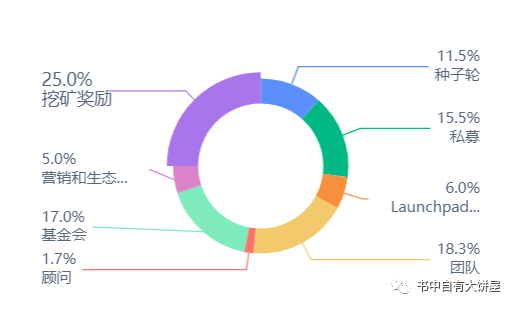
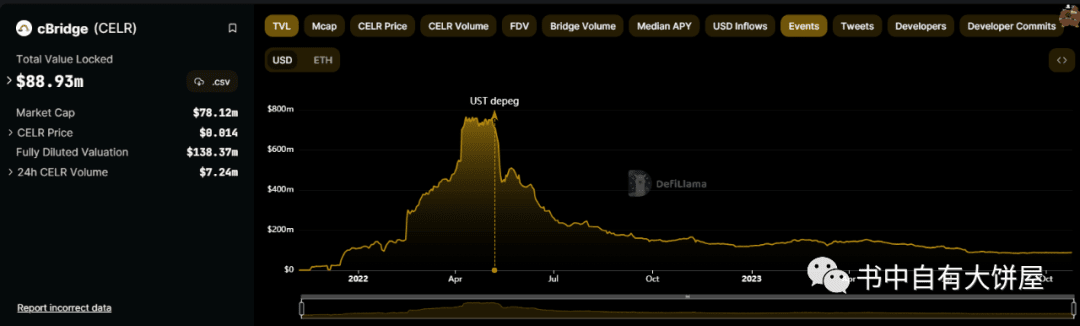
The project was launched in 2019, with a maximum supply of 10,000,000,000 CELR. Currently, 7,743,424,107 CELR are in circulation, with a circulation rate of 77.4%. The current price is $0.013, and the highest point is $0.1984 (2021-09-26). It has also fallen by more than 90%. In terms of token distribution, the team took 18.3%, and the foundation took 17%, that is, they took 35%, which is still a relatively high proportion. Then I looked at the TVL on cbridge, which is 88 million US dollars. Because its main network has not yet been launched, it is still good to have this size.
Finally, we conclude that this project is still very thoughtful and is positioned as an off-chain scalability solution. It proposes new technical solutions and economic models based on traditional off-chain solutions, and experimental simulation results of this solution show an order of magnitude performance improvement. The project development team is very strong, and has well-known researchers from famous universities and famous development engineers as consultants. It is expected to make breakthrough progress in off-chain scalability. However, state channels also have natural limitations. For example, they are more suitable for high-frequency interactions between multiple users, but are not suitable for low-frequency interactions where users change frequently. Even so, off-chain state channels, as a scalability enhancement suite for public chains, will help promote the practical use of blockchains once they are successfully broken through. However, it is very difficult to implement the project. In fact, the higher the TPS, the better. The current visa is only 24,000, which is enough. Moreover, the current high-speed public chains including L2 can actually meet the current demand. There is no need to chase a lot. High, but this project is a very promising solution at present. The current market value is also relatively low. At least compared with other L2s of the same level, it is currently in the low valuation range because it has not been completed yet. Once the main network is launched, If it can go online, there will definitely be a surge and it can be added to our watch list.