

#strategy
strategy
3.2M views
9,514 Discussing
Hot
Latest

·
--
🚨 **Corporate #bitcoin #strategy : Strategy & Strive Lock Daily Dividend Balancing Acts!** 🚨
📊 **The Reality Check:**
Corporate intelligence as of October 25, 2026, confirms that Bitcoin treasury titans Strategy (#MSTR ) and Strive (#ASST ) are executing highly sophisticated liquidity framework maneuvers. Both firms are expanding their massive #BTC reserves while managing intensive dollar-denominated preferred stock dividend obligations (12% for STRC and 15% for SATS).
⚠️ **How It Works:**
To achieve pure capital preservation and protect their combined treasury of nearly 900,000 BTC, both entities have established dedicated cash reserves. Strategy holds over $3.7B in fiat liquidity, while Strive locked a $157.5M initial dividend reserve, ensuring up to 2 years of uninterrupted daily payouts without selling a single Satoshi.
💡 **Smart Money Verdict:** This institutional-grade debt and equity engineering completely mitigates forced liquidation risks during market pullbacks. By isolating fiat liabilities from non-yielding digital assets, these mega-holders create an ironclad structural floor for corporate Bitcoin accumulation.
🎯 **Related Assets:** $BTC
{spot}(BTCUSDT)
| $MSTRB
{spot}(MSTRBUSDT)
| $ASST.US
{stock_us}(ASST.US)
🚨 **Corporate #bitcoin #strategy : Strategy & Strive Lock Daily Dividend Balancing Acts!** 🚨
📊 **The Reality Check:**
Corporate intelligence as of October 25, 2026, confirms that Bitcoin treasury titans Strategy (#MSTR ) and Strive (#ASST ) are executing highly sophisticated liquidity framework maneuvers. Both firms are expanding their massive #BTC reserves while managing intensive dollar-denominated preferred stock dividend obligations (12% for STRC and 15% for SATS).
⚠️ **How It Works:**
To achieve pure capital preservation and protect their combined treasury of nearly 900,000 BTC, both entities have established dedicated cash reserves. Strategy holds over $3.7B in fiat liquidity, while Strive locked a $157.5M initial dividend reserve, ensuring up to 2 years of uninterrupted daily payouts without selling a single Satoshi.
💡 **Smart Money Verdict:** This institutional-grade debt and equity engineering completely mitigates forced liquidation risks during market pullbacks. By isolating fiat liabilities from non-yielding digital assets, these mega-holders create an ironclad structural floor for corporate Bitcoin accumulation.
🎯 **Related Assets:** $BTC
| $MSTRB
| $ASST.US
📊 **The Reality Check:**
Corporate intelligence as of October 25, 2026, confirms that Bitcoin treasury titans Strategy (#MSTR ) and Strive (#ASST ) are executing highly sophisticated liquidity framework maneuvers. Both firms are expanding their massive #BTC reserves while managing intensive dollar-denominated preferred stock dividend obligations (12% for STRC and 15% for SATS).
⚠️ **How It Works:**
To achieve pure capital preservation and protect their combined treasury of nearly 900,000 BTC, both entities have established dedicated cash reserves. Strategy holds over $3.7B in fiat liquidity, while Strive locked a $157.5M initial dividend reserve, ensuring up to 2 years of uninterrupted daily payouts without selling a single Satoshi.
💡 **Smart Money Verdict:** This institutional-grade debt and equity engineering completely mitigates forced liquidation risks during market pullbacks. By isolating fiat liabilities from non-yielding digital assets, these mega-holders create an ironclad structural floor for corporate Bitcoin accumulation.
🎯 **Related Assets:** $BTC
| $MSTRB
| $ASST.US


Good luck 🍀
From OnionSam
Osama Al-Muntasir:
tanks
2
5
137

Do you understand what Strategy is doing? In the week of October 12–18, it spent just $22.1 million to buy 267 $BTC at an average price of $82,900, bringing its holdings to 848,517 coins at a total cost of $64 billion. Yet in the same week, it spent $193.1 million buying back STRC preferred stock—nearly nine times as much as it spent on Bitcoin. The board directly raised the preferred stock buyback cap from $2 billion to $3 billion, with $1.16 billion of capacity still remaining. Put simply, dividends and buybacks on the preferred stock are draining cash from the treasury company, and the pace of Bitcoin purchases has visibly slowed. Shareholders are also due to vote on October 28 on whether STRC should switch to daily dividends. In this Bitcoin treasury saga, the lead character is shifting from “buy, buy, buy” to “make sure the creditors are taken care of first.” #Strategy #Bitcoin
Do you understand what Strategy is doing? In the week of October 12–18, it spent just $22.1 million to buy 267 $BTC at an average price of $82,900, bringing its holdings to 848,517 coins at a total cost of $64 billion. Yet in the same week, it spent $193.1 million buying back STRC preferred stock—nearly nine times as much as it spent on Bitcoin. The board directly raised the preferred stock buyback cap from $2 billion to $3 billion, with $1.16 billion of capacity still remaining. Put simply, dividends and buybacks on the preferred stock are draining cash from the treasury company, and the pace of Bitcoin purchases has visibly slowed. Shareholders are also due to vote on October 28 on whether STRC should switch to daily dividends. In this Bitcoin treasury saga, the lead character is shifting from “buy, buy, buy” to “make sure the creditors are taken care of first.” #Strategy #Bitcoin

139

·
--
🚨 Strategy spends $193 million buying back preferred shares! Running short of money to buy Bitcoin?
Group: [点击加入短线策略群](https://app.binance.com/uni-qr/SC8V8G2r)
💰 Strategy and Strive are facing a real challenge: to keep accumulating BTC, they first need to balance financing with dividend payments!
📊 Strategy’s STRC preferred shares offer a floating dividend of around 12%. While this can attract investors seeking regular income and provide funding for Bitcoin purchases, dividends aren’t free. The larger the issuance, the greater the payment obligations the company will face in the future.
⚠️ The latest development deserves attention: Strategy set aside around $193 million to buy back STRC preferred shares, but purchased only 267 BTC. It also increased its preferred share repurchase authorization to $3 billion.
This means the company has to consider not only how much Bitcoin to buy, but also how to balance share buybacks, dividend payments, and cash reserves.
🔥 Why does this matter?
If preferred shares trade below par, issuing new shares to raise funds may become less attractive. Buying back existing preferred shares could help reduce future dividend obligations, but it would also use funds that could otherwise go toward buying BTC.
By comparison, U.S. spot Bitcoin ETFs remain an important source of market demand. Data shows their cumulative net inflows are around $57 billion, with assets totaling nearly $106 billion.
💡 Jiujiu’s view: The logic behind public companies accumulating crypto isn’t just about who buys the most. It’s also about who can keep raising funds, cover the costs, and maintain cash flow. If financing costs rise or market demand cools, companies may slow their pace of Bitcoin purchases.
But this doesn’t mean Strategy will stop buying Bitcoin anytime soon. What’s really worth watching next is the scale of its financing, preferred share prices, dividend payments, and the company’s weekly BTC accumulation data.
Do you think companies continually issuing shares to accumulate Bitcoin will drive BTC higher, or create potential financial pressure down the road? 👇
Follow me for daily market analysis and short-term trading strategies 🚀
#BTC #strategy
🚨 Strategy spends $193 million buying back preferred shares! Running short of money to buy Bitcoin?
Group: 点击加入短线策略群
💰 Strategy and Strive are facing a real challenge: to keep accumulating BTC, they first need to balance financing with dividend payments!
📊 Strategy’s STRC preferred shares offer a floating dividend of around 12%. While this can attract investors seeking regular income and provide funding for Bitcoin purchases, dividends aren’t free. The larger the issuance, the greater the payment obligations the company will face in the future.
⚠️ The latest development deserves attention: Strategy set aside around $193 million to buy back STRC preferred shares, but purchased only 267 BTC. It also increased its preferred share repurchase authorization to $3 billion.
This means the company has to consider not only how much Bitcoin to buy, but also how to balance share buybacks, dividend payments, and cash reserves.
🔥 Why does this matter?
If preferred shares trade below par, issuing new shares to raise funds may become less attractive. Buying back existing preferred shares could help reduce future dividend obligations, but it would also use funds that could otherwise go toward buying BTC.
By comparison, U.S. spot Bitcoin ETFs remain an important source of market demand. Data shows their cumulative net inflows are around $57 billion, with assets totaling nearly $106 billion.
💡 Jiujiu’s view: The logic behind public companies accumulating crypto isn’t just about who buys the most. It’s also about who can keep raising funds, cover the costs, and maintain cash flow. If financing costs rise or market demand cools, companies may slow their pace of Bitcoin purchases.
But this doesn’t mean Strategy will stop buying Bitcoin anytime soon. What’s really worth watching next is the scale of its financing, preferred share prices, dividend payments, and the company’s weekly BTC accumulation data.
Do you think companies continually issuing shares to accumulate Bitcoin will drive BTC higher, or create potential financial pressure down the road? 👇
Follow me for daily market analysis and short-term trading strategies 🚀
#BTC #strategy
Group: 点击加入短线策略群
💰 Strategy and Strive are facing a real challenge: to keep accumulating BTC, they first need to balance financing with dividend payments!
📊 Strategy’s STRC preferred shares offer a floating dividend of around 12%. While this can attract investors seeking regular income and provide funding for Bitcoin purchases, dividends aren’t free. The larger the issuance, the greater the payment obligations the company will face in the future.
⚠️ The latest development deserves attention: Strategy set aside around $193 million to buy back STRC preferred shares, but purchased only 267 BTC. It also increased its preferred share repurchase authorization to $3 billion.
This means the company has to consider not only how much Bitcoin to buy, but also how to balance share buybacks, dividend payments, and cash reserves.
🔥 Why does this matter?
If preferred shares trade below par, issuing new shares to raise funds may become less attractive. Buying back existing preferred shares could help reduce future dividend obligations, but it would also use funds that could otherwise go toward buying BTC.
By comparison, U.S. spot Bitcoin ETFs remain an important source of market demand. Data shows their cumulative net inflows are around $57 billion, with assets totaling nearly $106 billion.
💡 Jiujiu’s view: The logic behind public companies accumulating crypto isn’t just about who buys the most. It’s also about who can keep raising funds, cover the costs, and maintain cash flow. If financing costs rise or market demand cools, companies may slow their pace of Bitcoin purchases.
But this doesn’t mean Strategy will stop buying Bitcoin anytime soon. What’s really worth watching next is the scale of its financing, preferred share prices, dividend payments, and the company’s weekly BTC accumulation data.
Do you think companies continually issuing shares to accumulate Bitcoin will drive BTC higher, or create potential financial pressure down the road? 👇
Follow me for daily market analysis and short-term trading strategies 🚀
#BTC #strategy

172

·
--
Strategy preferred stocks vote this week on switching to “daily dividends”: Will STRC start paying out every day in November?
According to Strategy’s website and its SEC proxy statement (DEF 14A), the company plans to switch its four U.S.-listed preferred stocks—STRF/STRC/STRK/STRD—to daily dividend payments. Voting closes at 11:59 p.m. ET on 10/27, and the special shareholders’ meeting will be held at 14:00 UTC on 10/28 (22:00 Beijing time).
Proposal 1 requires more than half of the voting power of all outstanding common shares to vote in favor. Failure to vote counts as a vote against.
An 8-K filed on 10/15 shows that, if approved, STRC will have an annualized dividend rate of 12% starting in November, paying about $0.03–$0.04 per share per day, or $1 in total for the month. The other three will take effect on January 1, 2027.
Investing.com, citing data, reports that Strategy recently spent $193 million buying back preferred stock, while purchasing only 267 BTC over the same period.
【View】
Daily dividends essentially turn preferred stock into a “money market fund-like” product, attracting retail investors chasing yield and paving the way for further stock issuance to finance bitcoin purchases. But the 12% yield, combined with preferred-stock buybacks, is diverting funds from bitcoin purchases, suggesting that financing pressure is already substantial. This is also one reason why “corporate buying” weakened when BTC fell below $80,000 this time around.
【Opportunities/Risks】
1. If approved and STRC holds near $100, the preferred-stock financing channel could reopen, providing more firepower for future BTC purchases and boosting sentiment;
2. If the proposal fails or STRC continues to trade at a discount, the market may become concerned about the dividend burden and the company’s ability to buy bitcoin, and MSTR’s premium may continue to narrow;
3. The FOMC meeting is also scheduled for the early hours of 10/29 Beijing time, and Strategy’s Q3 earnings report is due after the U.S. market closes on Thursday, adding to volatility;
4. For BTC, watch whether it holds $80,000. Support below is around $78,400/$77,900 (Investing.com).
Do you think “daily dividends” can draw funds back to Strategy, or do they signal that its financing is getting increasingly expensive?
#Strategy #比特币 #美联储 #CryptoMarket
$BTC
For informational purposes only. This does not constitute investment advice
Strategy preferred stocks vote this week on switching to “daily dividends”: Will STRC start paying out every day in November?
According to Strategy’s website and its SEC proxy statement (DEF 14A), the company plans to switch its four U.S.-listed preferred stocks—STRF/STRC/STRK/STRD—to daily dividend payments. Voting closes at 11:59 p.m. ET on 10/27, and the special shareholders’ meeting will be held at 14:00 UTC on 10/28 (22:00 Beijing time).
Proposal 1 requires more than half of the voting power of all outstanding common shares to vote in favor. Failure to vote counts as a vote against.
An 8-K filed on 10/15 shows that, if approved, STRC will have an annualized dividend rate of 12% starting in November, paying about $0.03–$0.04 per share per day, or $1 in total for the month. The other three will take effect on January 1, 2027.
Investing.com, citing data, reports that Strategy recently spent $193 million buying back preferred stock, while purchasing only 267 BTC over the same period.
【View】
Daily dividends essentially turn preferred stock into a “money market fund-like” product, attracting retail investors chasing yield and paving the way for further stock issuance to finance bitcoin purchases. But the 12% yield, combined with preferred-stock buybacks, is diverting funds from bitcoin purchases, suggesting that financing pressure is already substantial. This is also one reason why “corporate buying” weakened when BTC fell below $80,000 this time around.
【Opportunities/Risks】
1. If approved and STRC holds near $100, the preferred-stock financing channel could reopen, providing more firepower for future BTC purchases and boosting sentiment;
2. If the proposal fails or STRC continues to trade at a discount, the market may become concerned about the dividend burden and the company’s ability to buy bitcoin, and MSTR’s premium may continue to narrow;
3. The FOMC meeting is also scheduled for the early hours of 10/29 Beijing time, and Strategy’s Q3 earnings report is due after the U.S. market closes on Thursday, adding to volatility;
4. For BTC, watch whether it holds $80,000. Support below is around $78,400/$77,900 (Investing.com).
Do you think “daily dividends” can draw funds back to Strategy, or do they signal that its financing is getting increasingly expensive?
#Strategy #比特币 #美联储 #CryptoMarket
$BTC
For informational purposes only. This does not constitute investment advice
According to Strategy’s website and its SEC proxy statement (DEF 14A), the company plans to switch its four U.S.-listed preferred stocks—STRF/STRC/STRK/STRD—to daily dividend payments. Voting closes at 11:59 p.m. ET on 10/27, and the special shareholders’ meeting will be held at 14:00 UTC on 10/28 (22:00 Beijing time).
Proposal 1 requires more than half of the voting power of all outstanding common shares to vote in favor. Failure to vote counts as a vote against.
An 8-K filed on 10/15 shows that, if approved, STRC will have an annualized dividend rate of 12% starting in November, paying about $0.03–$0.04 per share per day, or $1 in total for the month. The other three will take effect on January 1, 2027.
Investing.com, citing data, reports that Strategy recently spent $193 million buying back preferred stock, while purchasing only 267 BTC over the same period.
【View】
Daily dividends essentially turn preferred stock into a “money market fund-like” product, attracting retail investors chasing yield and paving the way for further stock issuance to finance bitcoin purchases. But the 12% yield, combined with preferred-stock buybacks, is diverting funds from bitcoin purchases, suggesting that financing pressure is already substantial. This is also one reason why “corporate buying” weakened when BTC fell below $80,000 this time around.
【Opportunities/Risks】
1. If approved and STRC holds near $100, the preferred-stock financing channel could reopen, providing more firepower for future BTC purchases and boosting sentiment;
2. If the proposal fails or STRC continues to trade at a discount, the market may become concerned about the dividend burden and the company’s ability to buy bitcoin, and MSTR’s premium may continue to narrow;
3. The FOMC meeting is also scheduled for the early hours of 10/29 Beijing time, and Strategy’s Q3 earnings report is due after the U.S. market closes on Thursday, adding to volatility;
4. For BTC, watch whether it holds $80,000. Support below is around $78,400/$77,900 (Investing.com).
Do you think “daily dividends” can draw funds back to Strategy, or do they signal that its financing is getting increasingly expensive?
#Strategy #比特币 #美联储 #CryptoMarket
$BTC
For informational purposes only. This does not constitute investment advice

212
·
--
Is Bitcoin’s “preferred stock buying” slowing down? Strategy repurchased $193 million of STRC in one week, but bought just 267 BTC
📌 Fidelity Digital Assets’ 10/20 report: Bitcoin-focused perpetual preferred stocks have funded purchases totaling approximately 135,979 BTC since 2025 (as of 10/5), more than 0.5% of the total BTC supply. More than 95,000 BTC were purchased and over $7 billion raised from March to May alone.
📌 Strategy 8-K (10/12–10/18): Repurchased $193.1 million of STRC preferred stock, while using only about $22.1 million to buy 267 BTC over the same period; increased the preferred stock buyback authorization from $2 billion to $3 billion; holdings stand at 848,517 BTC, at an average price of $75,446; used $45.5 million from its reserve to pay preferred stock dividends that week.
📌 CoinDesk 10/24: Analysts noted that preferred stock demand is “reflexive”: when prices fall below par, new issuance becomes less attractive, and companies are more inclined to buy back shares. Strategy has previously sold some BTC to pay dividends.
📌 Investing.com: BTC hit a low of $79,146 on Saturday and recovered to around $80,900 on Sunday; the 50-day moving average is around $81,700.
【View】
Corporate treasuries were an important source of marginal buying in this market rally, but capital is now shifting from “buying coins” to “supporting preferred stock prices and paying dividends.” Buybacks can reduce future dividend costs, but for now they compete with coin purchases for funds. With BTC near $80,000, it has only about a 7% cushion above Strategy’s average cost of $75,446. Combined with ETF net outflows this week, incremental buying demand is clearly thinning in the short term.
【Opportunities/Risks】
1️⃣ Watch whether preferred stocks such as STRC can return to around par: a return to par could mean new issuance resumes and buying demand returns; a persistent discount means buybacks will continue to crowd out coin purchases.
2️⃣ Check Strategy’s 8-K every Monday: the ratio of BTC purchases to buyback amounts is the clearest signal.
3️⃣ Key levels: $78,400/$77,876 below; the 50-day moving average around $81,700 above. The 10/28 FOMC decision could affect risk appetite.
4️⃣ Risk: If BTC approaches the $75K average cost, concerns about “treasury companies selling coins to pay dividends” could amplify volatility.
Do you think corporate treasuries can still provide a floor for this rally, or will it mainly depend on ETF inflows returning?
#比特币 #Strategy #美联储 #CryptoMarket
$BTC
For reference only; not investment advice
Is Bitcoin’s “preferred stock buying” slowing down? Strategy repurchased $193 million of STRC in one week, but bought just 267 BTC
📌 Fidelity Digital Assets’ 10/20 report: Bitcoin-focused perpetual preferred stocks have funded purchases totaling approximately 135,979 BTC since 2025 (as of 10/5), more than 0.5% of the total BTC supply. More than 95,000 BTC were purchased and over $7 billion raised from March to May alone.
📌 Strategy 8-K (10/12–10/18): Repurchased $193.1 million of STRC preferred stock, while using only about $22.1 million to buy 267 BTC over the same period; increased the preferred stock buyback authorization from $2 billion to $3 billion; holdings stand at 848,517 BTC, at an average price of $75,446; used $45.5 million from its reserve to pay preferred stock dividends that week.
📌 CoinDesk 10/24: Analysts noted that preferred stock demand is “reflexive”: when prices fall below par, new issuance becomes less attractive, and companies are more inclined to buy back shares. Strategy has previously sold some BTC to pay dividends.
📌 Investing.com: BTC hit a low of $79,146 on Saturday and recovered to around $80,900 on Sunday; the 50-day moving average is around $81,700.
【View】
Corporate treasuries were an important source of marginal buying in this market rally, but capital is now shifting from “buying coins” to “supporting preferred stock prices and paying dividends.” Buybacks can reduce future dividend costs, but for now they compete with coin purchases for funds. With BTC near $80,000, it has only about a 7% cushion above Strategy’s average cost of $75,446. Combined with ETF net outflows this week, incremental buying demand is clearly thinning in the short term.
【Opportunities/Risks】
1️⃣ Watch whether preferred stocks such as STRC can return to around par: a return to par could mean new issuance resumes and buying demand returns; a persistent discount means buybacks will continue to crowd out coin purchases.
2️⃣ Check Strategy’s 8-K every Monday: the ratio of BTC purchases to buyback amounts is the clearest signal.
3️⃣ Key levels: $78,400/$77,876 below; the 50-day moving average around $81,700 above. The 10/28 FOMC decision could affect risk appetite.
4️⃣ Risk: If BTC approaches the $75K average cost, concerns about “treasury companies selling coins to pay dividends” could amplify volatility.
Do you think corporate treasuries can still provide a floor for this rally, or will it mainly depend on ETF inflows returning?
#比特币 #Strategy #美联储 #CryptoMarket
$BTC
For reference only; not investment advice
📌 Fidelity Digital Assets’ 10/20 report: Bitcoin-focused perpetual preferred stocks have funded purchases totaling approximately 135,979 BTC since 2025 (as of 10/5), more than 0.5% of the total BTC supply. More than 95,000 BTC were purchased and over $7 billion raised from March to May alone.
📌 Strategy 8-K (10/12–10/18): Repurchased $193.1 million of STRC preferred stock, while using only about $22.1 million to buy 267 BTC over the same period; increased the preferred stock buyback authorization from $2 billion to $3 billion; holdings stand at 848,517 BTC, at an average price of $75,446; used $45.5 million from its reserve to pay preferred stock dividends that week.
📌 CoinDesk 10/24: Analysts noted that preferred stock demand is “reflexive”: when prices fall below par, new issuance becomes less attractive, and companies are more inclined to buy back shares. Strategy has previously sold some BTC to pay dividends.
📌 Investing.com: BTC hit a low of $79,146 on Saturday and recovered to around $80,900 on Sunday; the 50-day moving average is around $81,700.
【View】
Corporate treasuries were an important source of marginal buying in this market rally, but capital is now shifting from “buying coins” to “supporting preferred stock prices and paying dividends.” Buybacks can reduce future dividend costs, but for now they compete with coin purchases for funds. With BTC near $80,000, it has only about a 7% cushion above Strategy’s average cost of $75,446. Combined with ETF net outflows this week, incremental buying demand is clearly thinning in the short term.
【Opportunities/Risks】
1️⃣ Watch whether preferred stocks such as STRC can return to around par: a return to par could mean new issuance resumes and buying demand returns; a persistent discount means buybacks will continue to crowd out coin purchases.
2️⃣ Check Strategy’s 8-K every Monday: the ratio of BTC purchases to buyback amounts is the clearest signal.
3️⃣ Key levels: $78,400/$77,876 below; the 50-day moving average around $81,700 above. The 10/28 FOMC decision could affect risk appetite.
4️⃣ Risk: If BTC approaches the $75K average cost, concerns about “treasury companies selling coins to pay dividends” could amplify volatility.
Do you think corporate treasuries can still provide a floor for this rally, or will it mainly depend on ETF inflows returning?
#比特币 #Strategy #美联储 #CryptoMarket
$BTC
For reference only; not investment advice


·
--
Strategy and Strive are balancing Bitcoin accumulation with preferred stock dividends: preferred shares provide a financing channel for buying Bitcoin, but dividends and buybacks may constrain future purchases. Outlook: more diverse financing tools, entry of income-oriented investors, and ETFs remain the main source of demand. #比特币 #Strategy #Preferred Stock
Strategy and Strive are balancing Bitcoin accumulation with preferred stock dividends: preferred shares provide a financing channel for buying Bitcoin, but dividends and buybacks may constrain future purchases. Outlook: more diverse financing tools, entry of income-oriented investors, and ETFs remain the main source of demand. #比特币 #Strategy #Preferred Stock
157

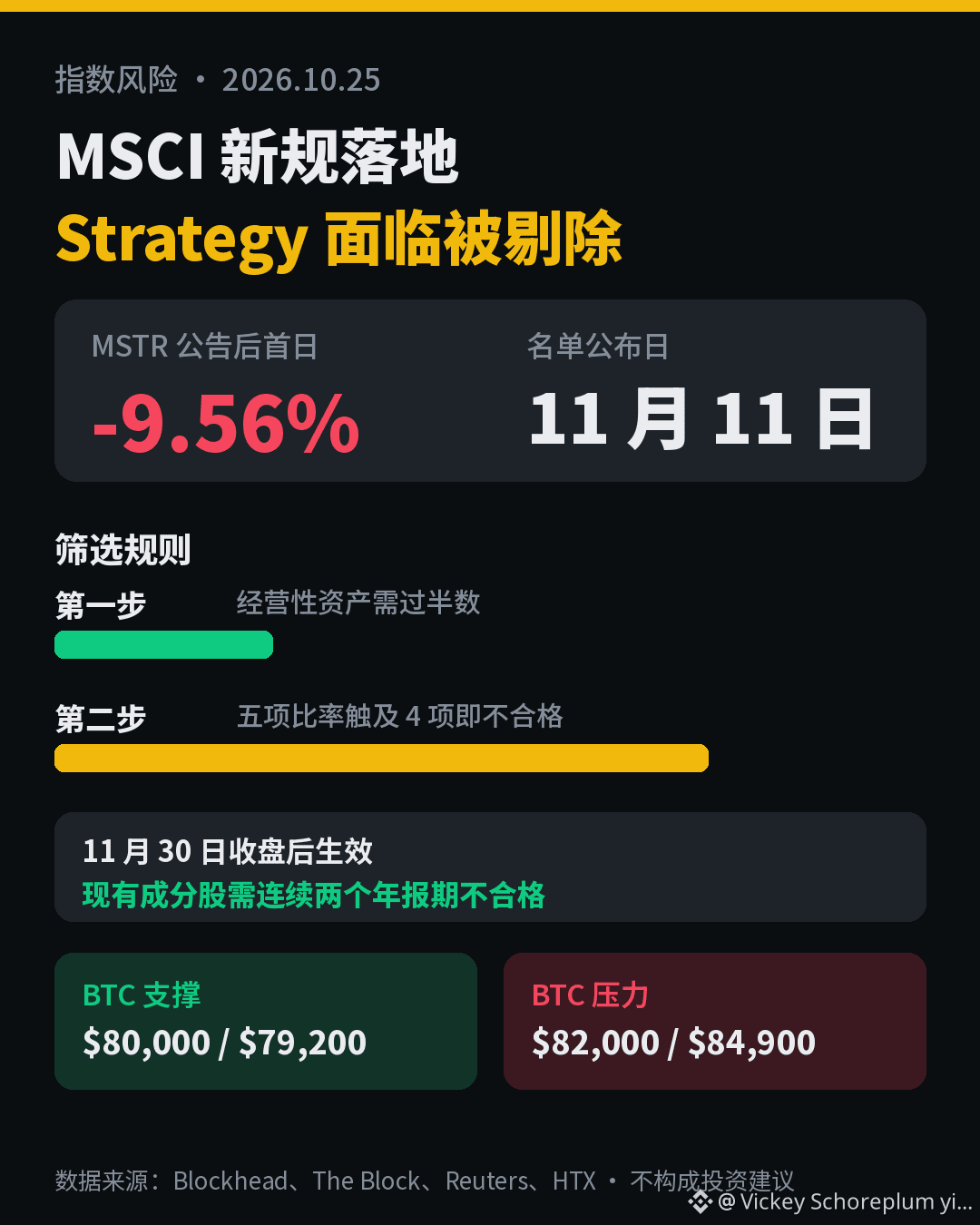
🏛️ New MSCI Rule Takes Effect: Could Strategy Be Removed from Global Indexes?
MSCI has officially adopted a new rule for “non-operating companies”: these companies will no longer qualify for its Global Investable Market Indexes. The rule takes effect after the market close on November 30, and the list of affected companies will be announced on November 11. On the first trading day after the announcement, Strategy shares closed down 9.56% at $136.83 (reported by Blockhead).
📌 Key details
• The screening process has two steps: first, it checks whether operating assets account for more than half of total assets. If not, the company is assessed against five financial ratios; failing four or more means it is ineligible.
• Existing index constituents will be removed only if they fail to qualify in both of the two most recent annual reporting periods; removal is not automatic across the board.
• The rule does not directly name crypto assets. Strategy, Metaplanet, and others were identified as potential candidates in earlier simulations, but whether they will ultimately be removed has not been confirmed.
• Analysts estimate that removal could trigger potential passive fund outflows of up to approximately $2.8 billion (cited by HTX).
💡 Market impact
For BTC, this is more of a risk to sentiment and fund flows. Strategy is the largest corporate holder of BTC, and pressure on its share price could affect expectations around buying by “treasury companies.” But passive fund rebalancing does not mean the company will sell its coins. The list on November 11 is the key date.
📊 BTC reference levels (daily chart over the past two weeks; current price around $80,850)
• Support: $80,000 / $79,200
• Resistance: $82,000 / $84,900
🤔 Do you think Strategy will ultimately be removed? Would this be a short-term negative for BTC, or has the market already priced it in? Join the discussion in the comments 👇
👉 Trade BTC: https://www.binance.com/zh-CN/trade/BTC_USDT
#MSCI敲定新规Strategy面临被剔除风险 #BTC #Strategy #MSCI
⚠️ This is not investment advice. Please be aware of the risks.
🏛️ New MSCI Rule Takes Effect: Could Strategy Be Removed from Global Indexes?
MSCI has officially adopted a new rule for “non-operating companies”: these companies will no longer qualify for its Global Investable Market Indexes. The rule takes effect after the market close on November 30, and the list of affected companies will be announced on November 11. On the first trading day after the announcement, Strategy shares closed down 9.56% at $136.83 (reported by Blockhead).
📌 Key details
• The screening process has two steps: first, it checks whether operating assets account for more than half of total assets. If not, the company is assessed against five financial ratios; failing four or more means it is ineligible.
• Existing index constituents will be removed only if they fail to qualify in both of the two most recent annual reporting periods; removal is not automatic across the board.
• The rule does not directly name crypto assets. Strategy, Metaplanet, and others were identified as potential candidates in earlier simulations, but whether they will ultimately be removed has not been confirmed.
• Analysts estimate that removal could trigger potential passive fund outflows of up to approximately $2.8 billion (cited by HTX).
💡 Market impact
For BTC, this is more of a risk to sentiment and fund flows. Strategy is the largest corporate holder of BTC, and pressure on its share price could affect expectations around buying by “treasury companies.” But passive fund rebalancing does not mean the company will sell its coins. The list on November 11 is the key date.
📊 BTC reference levels (daily chart over the past two weeks; current price around $80,850)
• Support: $80,000 / $79,200
• Resistance: $82,000 / $84,900
🤔 Do you think Strategy will ultimately be removed? Would this be a short-term negative for BTC, or has the market already priced it in? Join the discussion in the comments 👇
👉 Trade BTC: https://www.binance.com/zh-CN/trade/BTC_USDT
#MSCI敲定新规Strategy面临被剔除风险 #BTC #Strategy #MSCI
⚠️ This is not investment advice. Please be aware of the risks.
MSCI has officially adopted a new rule for “non-operating companies”: these companies will no longer qualify for its Global Investable Market Indexes. The rule takes effect after the market close on November 30, and the list of affected companies will be announced on November 11. On the first trading day after the announcement, Strategy shares closed down 9.56% at $136.83 (reported by Blockhead).
📌 Key details
• The screening process has two steps: first, it checks whether operating assets account for more than half of total assets. If not, the company is assessed against five financial ratios; failing four or more means it is ineligible.
• Existing index constituents will be removed only if they fail to qualify in both of the two most recent annual reporting periods; removal is not automatic across the board.
• The rule does not directly name crypto assets. Strategy, Metaplanet, and others were identified as potential candidates in earlier simulations, but whether they will ultimately be removed has not been confirmed.
• Analysts estimate that removal could trigger potential passive fund outflows of up to approximately $2.8 billion (cited by HTX).
💡 Market impact
For BTC, this is more of a risk to sentiment and fund flows. Strategy is the largest corporate holder of BTC, and pressure on its share price could affect expectations around buying by “treasury companies.” But passive fund rebalancing does not mean the company will sell its coins. The list on November 11 is the key date.
📊 BTC reference levels (daily chart over the past two weeks; current price around $80,850)
• Support: $80,000 / $79,200
• Resistance: $82,000 / $84,900
🤔 Do you think Strategy will ultimately be removed? Would this be a short-term negative for BTC, or has the market already priced it in? Join the discussion in the comments 👇
👉 Trade BTC: https://www.binance.com/zh-CN/trade/BTC_USDT
#MSCI敲定新规Strategy面临被剔除风险 #BTC #Strategy #MSCI
⚠️ This is not investment advice. Please be aware of the risks.
144

·
--
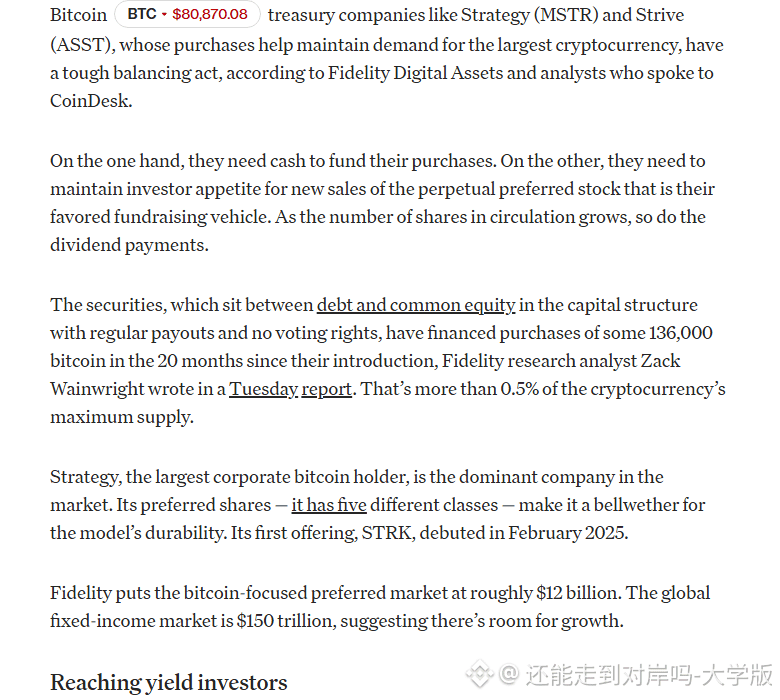
From the start of 2025 through October 5, companies such as Strategy and Strive purchased a total of 136,000 BTC through preferred stock financing, worth a total of $12 billion.
• Strategy repurchased $193 million of STRC and purchased 267 BTC, increasing its preferred stock repurchase authorization to $3 billion.
• Bitwise noted that ETFs remain the main source of demand, while perpetual preferred stock can meet the needs of investors seeking different types of yield.
• CoinShares said that favorable preferred stock financing conditions can support Bitcoin purchases, but that support may weaken when market sentiment deteriorates.
#Bitcoin #BTC #Strategy
From the start of 2025 through October 5, companies such as Strategy and Strive purchased a total of 136,000 BTC through preferred stock financing, worth a total of $12 billion.
• Strategy repurchased $193 million of STRC and purchased 267 BTC, increasing its preferred stock repurchase authorization to $3 billion.
• Bitwise noted that ETFs remain the main source of demand, while perpetual preferred stock can meet the needs of investors seeking different types of yield.
• CoinShares said that favorable preferred stock financing conditions can support Bitcoin purchases, but that support may weaken when market sentiment deteriorates.
#Bitcoin #BTC #Strategy
• Strategy repurchased $193 million of STRC and purchased 267 BTC, increasing its preferred stock repurchase authorization to $3 billion.
• Bitwise noted that ETFs remain the main source of demand, while perpetual preferred stock can meet the needs of investors seeking different types of yield.
• CoinShares said that favorable preferred stock financing conditions can support Bitcoin purchases, but that support may weaken when market sentiment deteriorates.
#Bitcoin #BTC #Strategy
469

·
--
From the start of 2025 through October 5, companies including Strategy and Strive financed purchases of 136,000 BTC through preferred stock, totaling $12 billion.
• Strategy repurchased $193 million of STRC and bought 267 BTC, raising its preferred stock repurchase authorization to $3 billion.
• Bitwise: ETFs remain the larger source of demand, while perpetual preferred stock caters to investors seeking different yields.
• CoinShares: Favorable preferred stock financing terms support BTC purchases, but that support may weaken as market sentiment turns negative.
#Bitcoin #BTC #Strategy
From the start of 2025 through October 5, companies including Strategy and Strive financed purchases of 136,000 BTC through preferred stock, totaling $12 billion.
• Strategy repurchased $193 million of STRC and bought 267 BTC, raising its preferred stock repurchase authorization to $3 billion.
• Bitwise: ETFs remain the larger source of demand, while perpetual preferred stock caters to investors seeking different yields.
• CoinShares: Favorable preferred stock financing terms support BTC purchases, but that support may weaken as market sentiment turns negative.
#Bitcoin #BTC #Strategy
• Strategy repurchased $193 million of STRC and bought 267 BTC, raising its preferred stock repurchase authorization to $3 billion.
• Bitwise: ETFs remain the larger source of demand, while perpetual preferred stock caters to investors seeking different yields.
• CoinShares: Favorable preferred stock financing terms support BTC purchases, but that support may weaken as market sentiment turns negative.
#Bitcoin #BTC #Strategy
332

·
--
Verified
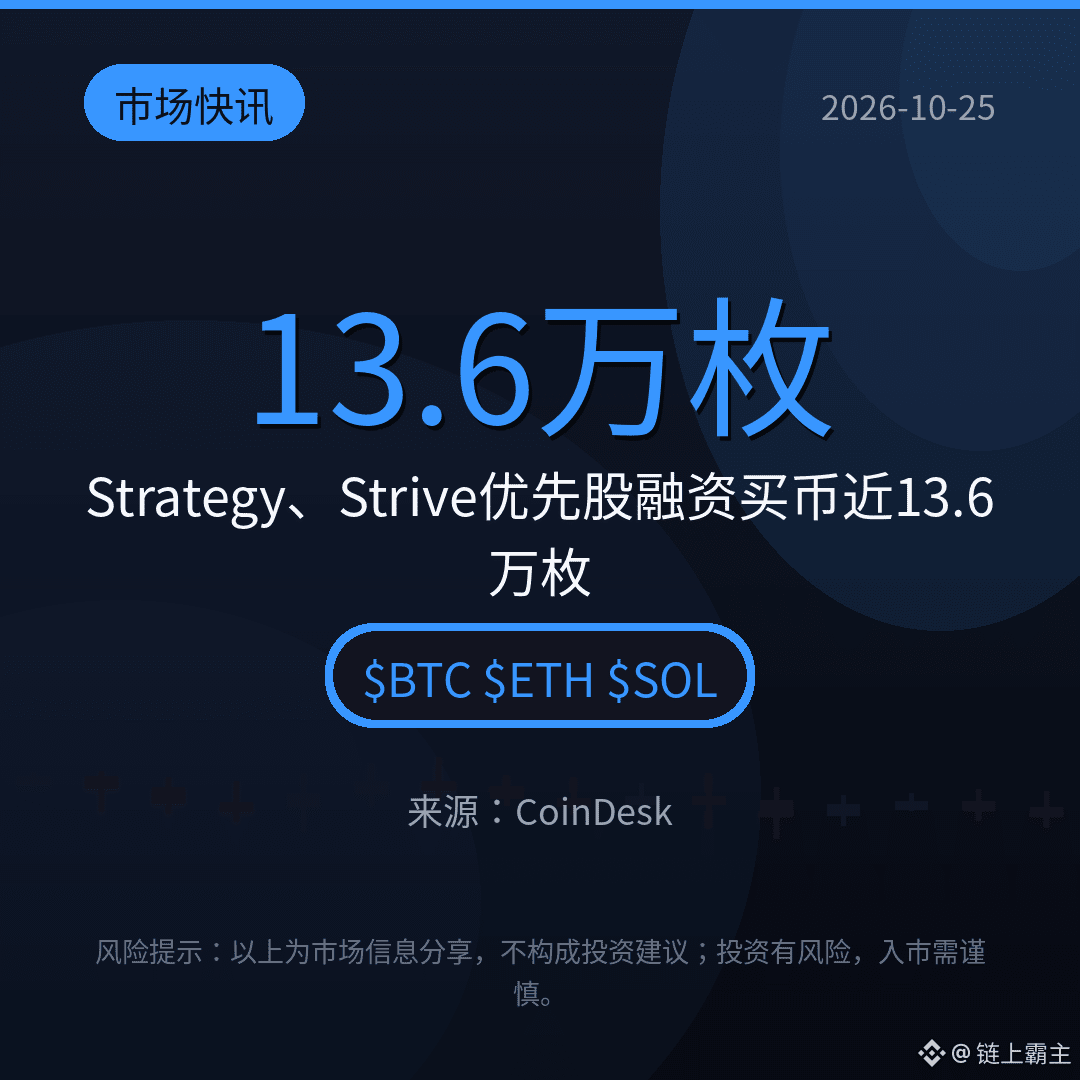
【Market Flash】Preferred stock securities have funded the purchase of nearly 136,000 bitcoins. Strategy and Strive must walk a tightrope: keep buying bitcoin while also paying preferred stock dividends.
Analysts believe this type of financing could complement the broader ETF market. Buying bitcoin too quickly increases dividend-payment pressure, while prioritizing dividends slows accumulation. The trade-off will determine how far this approach can go.
Is this good news or a potential risk for bitcoin treasury stocks? Share your thoughts in the comments.
$BTC $ETH $SOL
#比特币 #Strategy #PreferredStock
(Source: CoinDesk)
⚠️Risk warning: The above is for sharing market information only and does not constitute investment advice. Investing involves risks; please proceed with caution.
【Market Flash】Preferred stock securities have funded the purchase of nearly 136,000 bitcoins. Strategy and Strive must walk a tightrope: keep buying bitcoin while also paying preferred stock dividends.
Analysts believe this type of financing could complement the broader ETF market. Buying bitcoin too quickly increases dividend-payment pressure, while prioritizing dividends slows accumulation. The trade-off will determine how far this approach can go.
Is this good news or a potential risk for bitcoin treasury stocks? Share your thoughts in the comments.
$BTC $ETH $SOL
#比特币 #Strategy #PreferredStock
(Source: CoinDesk)
⚠️Risk warning: The above is for sharing market information only and does not constitute investment advice. Investing involves risks; please proceed with caution.
Analysts believe this type of financing could complement the broader ETF market. Buying bitcoin too quickly increases dividend-payment pressure, while prioritizing dividends slows accumulation. The trade-off will determine how far this approach can go.
Is this good news or a potential risk for bitcoin treasury stocks? Share your thoughts in the comments.
$BTC $ETH $SOL
#比特币 #Strategy #PreferredStock
(Source: CoinDesk)
⚠️Risk warning: The above is for sharing market information only and does not constitute investment advice. Investing involves risks; please proceed with caution.
776

·
--
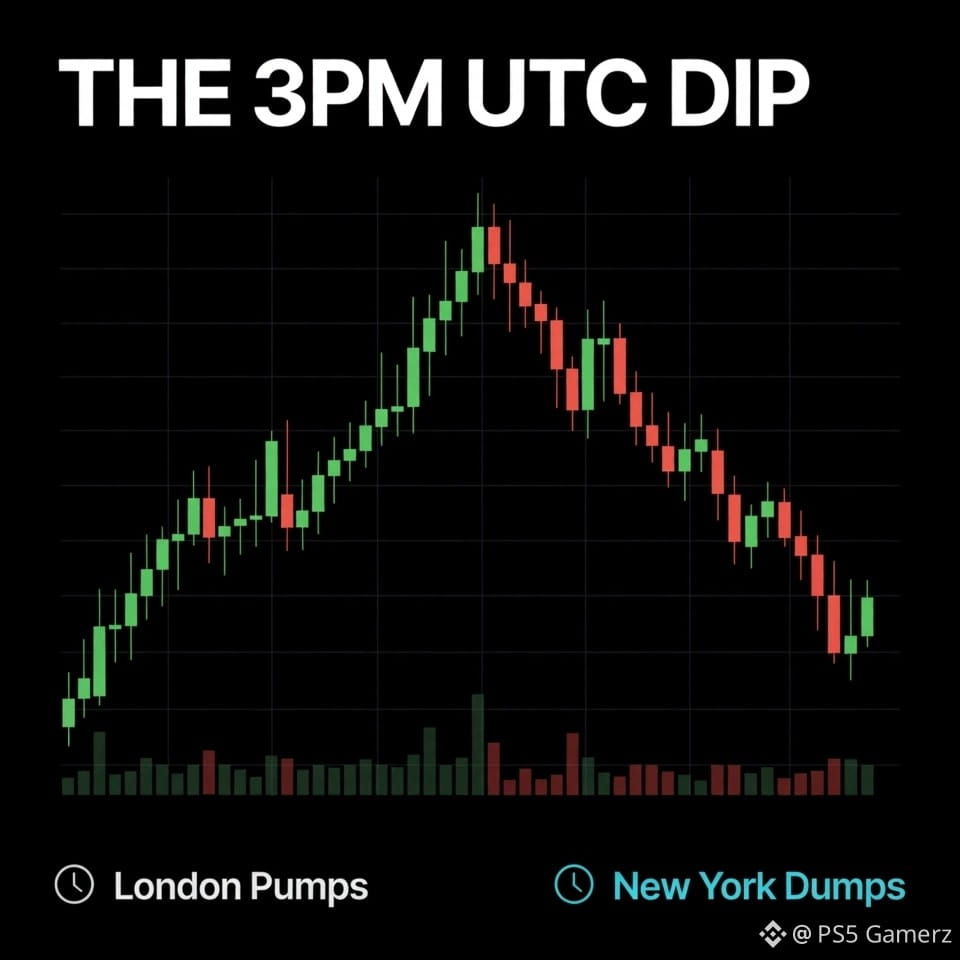
Everyone trades $BTC price without seeing perfect time..
The 3PM UTC Dip.
I backtested last 7 days. 5 out of 7 days, $BTC dipped at 3PM UTC.
Why?
8AM UTC - London opens, market pumps
1PM UTC - New York opens
3PM UTC - Overlap. London books profit + US dumps = DIP
Avg move: 0.7% - 1.2%
Perfect for short scalp.
Check your 1H chart. Today 3PM UTC - will it repeat?
I trade TIME, not price.
{future}(BTCUSDT)
#bitcoin #strategy
Everyone trades $BTC price without seeing perfect time..
The 3PM UTC Dip.
I backtested last 7 days. 5 out of 7 days, $BTC dipped at 3PM UTC.
Why?
8AM UTC - London opens, market pumps
1PM UTC - New York opens
3PM UTC - Overlap. London books profit + US dumps = DIP
Avg move: 0.7% - 1.2%
Perfect for short scalp.
Check your 1H chart. Today 3PM UTC - will it repeat?
I trade TIME, not price.
#bitcoin #strategy
The 3PM UTC Dip.
I backtested last 7 days. 5 out of 7 days, $BTC dipped at 3PM UTC.
Why?
8AM UTC - London opens, market pumps
1PM UTC - New York opens
3PM UTC - Overlap. London books profit + US dumps = DIP
Avg move: 0.7% - 1.2%
Perfect for short scalp.
Check your 1H chart. Today 3PM UTC - will it repeat?
I trade TIME, not price.
#bitcoin #strategy
54
·
--
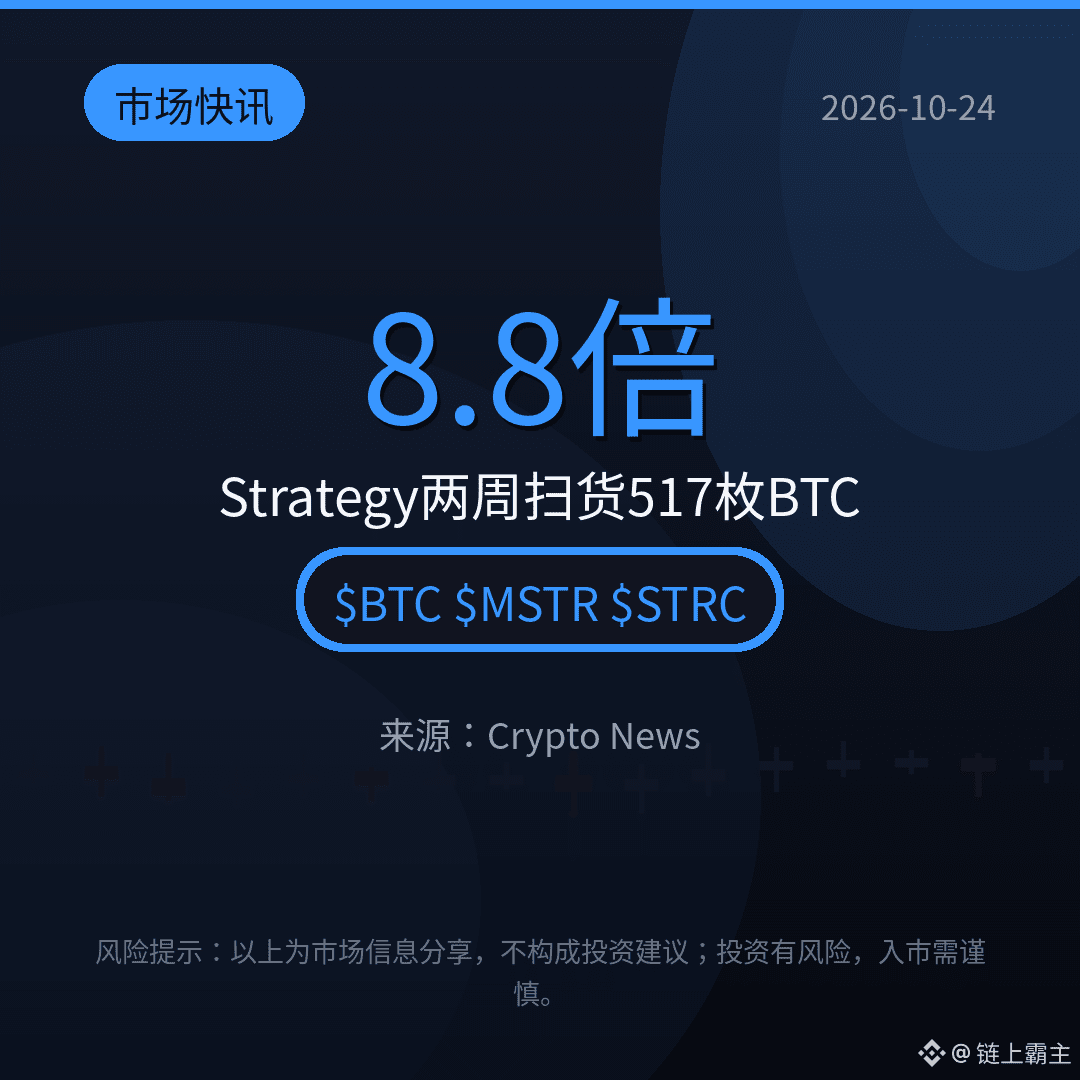
【Market Update】Strategy bought $43.6 million worth of Bitcoin over two weeks and repurchased $385.5 million in STRC—8.8 times the amount spent on Bitcoin.
8-K: Added 267 BTC, bringing holdings to 848,517 BTC; bought 517 BTC over two weeks, with 98.6% financed through stock issuance.
Saylor posted, “Working behind closed doors to resolve a few Bitcoin matters.” The last time he dropped a cryptic hint, the next day he disclosed an additional purchase of 250 BTC. Will there be an official announcement? Share your thoughts in the comments.
$BTC $MSTR $STRC
#BTC #Strategy #Bitcoin
(Source: Crypto News)
⚠️Risk disclaimer: The above is shared for market information purposes only and does not constitute investment advice. Investing involves risk; please exercise caution.
【Market Update】Strategy bought $43.6 million worth of Bitcoin over two weeks and repurchased $385.5 million in STRC—8.8 times the amount spent on Bitcoin.
8-K: Added 267 BTC, bringing holdings to 848,517 BTC; bought 517 BTC over two weeks, with 98.6% financed through stock issuance.
Saylor posted, “Working behind closed doors to resolve a few Bitcoin matters.” The last time he dropped a cryptic hint, the next day he disclosed an additional purchase of 250 BTC. Will there be an official announcement? Share your thoughts in the comments.
$BTC $MSTR $STRC
#BTC #Strategy #Bitcoin
(Source: Crypto News)
⚠️Risk disclaimer: The above is shared for market information purposes only and does not constitute investment advice. Investing involves risk; please exercise caution.
8-K: Added 267 BTC, bringing holdings to 848,517 BTC; bought 517 BTC over two weeks, with 98.6% financed through stock issuance.
Saylor posted, “Working behind closed doors to resolve a few Bitcoin matters.” The last time he dropped a cryptic hint, the next day he disclosed an additional purchase of 250 BTC. Will there be an official announcement? Share your thoughts in the comments.
$BTC $MSTR $STRC
#BTC #Strategy #Bitcoin
(Source: Crypto News)
⚠️Risk disclaimer: The above is shared for market information purposes only and does not constitute investment advice. Investing involves risk; please exercise caution.
256

·
--
🐳 MICHAEL SAYLOR: BETTING AGAINST STRATEGY COULD BE A BIG MISTAKE
Michael Saylor is making his confidence in Strategy crystal clear.
Speaking to Schwab Network, the Strategy chairman called his company the “800-pound gorilla in the space” and warned that “anybody that’s trading against us is probably making a mistake.”
Strategy has built its Bitcoin strategy around aggressive accumulation, making it one of the most closely watched corporate Bitcoin holders.
But confidence doesn't eliminate risk. Strategy remains exposed to Bitcoin's volatility, and a sharp BTC decline could put pressure on its stock.
Is Strategy too powerful to bet against, or is Saylor taking a bigger risk than the market realizes? 👇
#MichaelSaylor #Strategy #Bitcoin #BTC走势分析 #CryptoNews $BTC $DOOD $ZEC
{spot}(ZECUSDT)
🐳 MICHAEL SAYLOR: BETTING AGAINST STRATEGY COULD BE A BIG MISTAKE
Michael Saylor is making his confidence in Strategy crystal clear.
Speaking to Schwab Network, the Strategy chairman called his company the “800-pound gorilla in the space” and warned that “anybody that’s trading against us is probably making a mistake.”
Strategy has built its Bitcoin strategy around aggressive accumulation, making it one of the most closely watched corporate Bitcoin holders.
But confidence doesn't eliminate risk. Strategy remains exposed to Bitcoin's volatility, and a sharp BTC decline could put pressure on its stock.
Is Strategy too powerful to bet against, or is Saylor taking a bigger risk than the market realizes? 👇
#MichaelSaylor #Strategy #Bitcoin #BTC走势分析 #CryptoNews $BTC $DOOD $ZEC
Michael Saylor is making his confidence in Strategy crystal clear.
Speaking to Schwab Network, the Strategy chairman called his company the “800-pound gorilla in the space” and warned that “anybody that’s trading against us is probably making a mistake.”
Strategy has built its Bitcoin strategy around aggressive accumulation, making it one of the most closely watched corporate Bitcoin holders.
But confidence doesn't eliminate risk. Strategy remains exposed to Bitcoin's volatility, and a sharp BTC decline could put pressure on its stock.
Is Strategy too powerful to bet against, or is Saylor taking a bigger risk than the market realizes? 👇
#MichaelSaylor #Strategy #Bitcoin #BTC走势分析 #CryptoNews $BTC $DOOD $ZEC

215
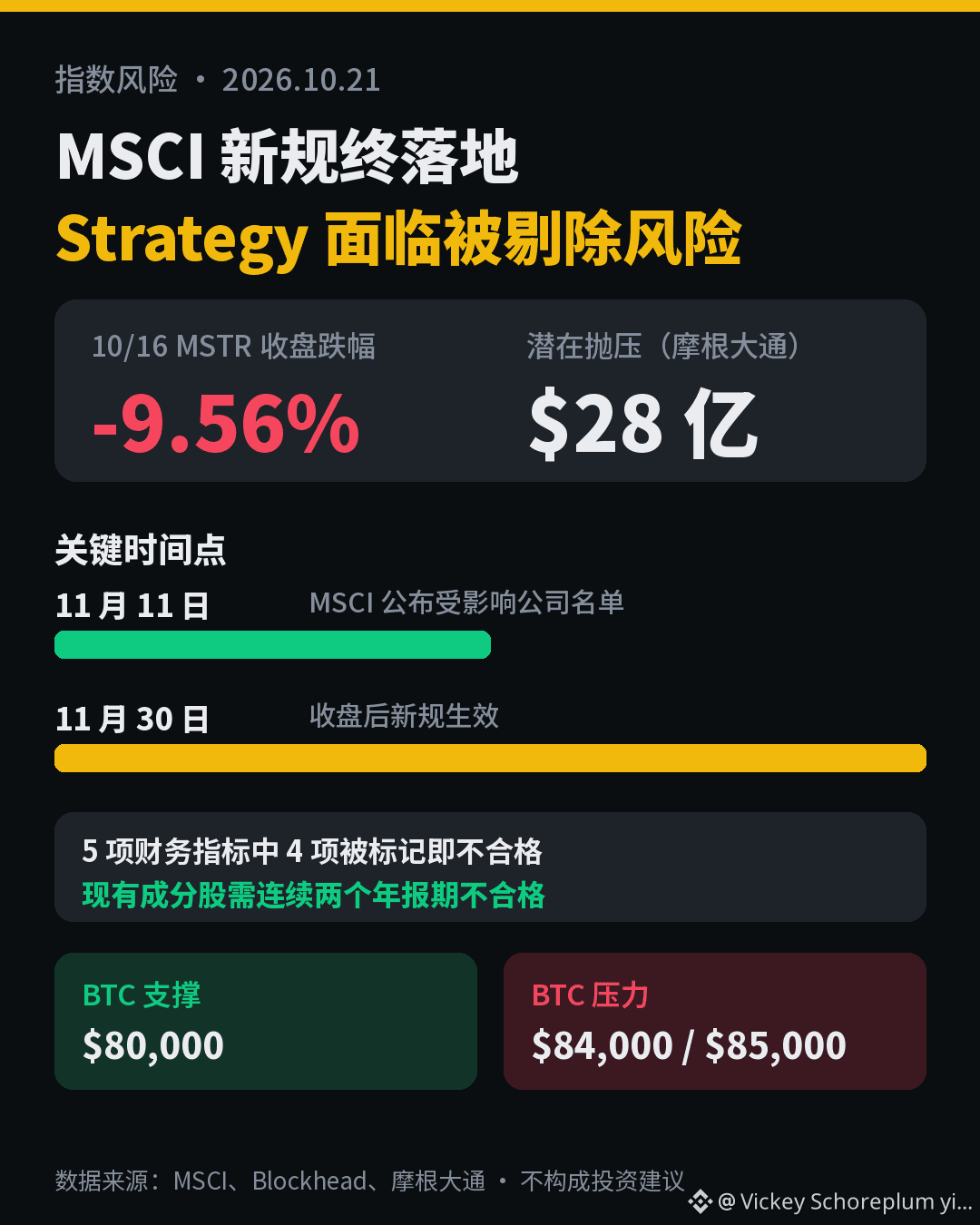
🏛 MSCI rules take effect: Will Strategy be dropped from global indexes?
On October 15, MSCI announced that “non-operating companies” will no longer be eligible for inclusion in its global investable market indexes. The new rules take effect after market close on November 30, and the list of affected companies will be announced on November 11.
📋 How will the rules be applied?
• Step 1: Operating assets must account for more than half of a company’s total assets
• Step 2: Companies that fail this test will be assessed against five financial metrics (operating assets as a share of total assets, expense ratio, operating cash flow, share of fair-value gains, and reliance on financing)
• A company is deemed ineligible if it is flagged on at least four of the five metrics
• Current index constituents must fail in two consecutive annual reporting periods before being removed, providing some buffer
💰 What is the market worried about?
• Strategy’s shares fell 9.56% at the close on October 16, to $136.83
• JPMorgan previously estimated that exclusion from MSCI could trigger around $2.8 billion in selling pressure; if other index providers follow suit, that figure could reach about $8.8 billion
• MSCI’s earlier simulations singled out Strategy, Metaplanet, and Yellow Cake
• Strategy currently holds 848,250 BTC and argues that its Bitcoin business is an operating segment under GAAP
🤔 What would this mean for BTC?
Adjustments by passive index funds do not mean Strategy has to sell its coins—these are fund flows at the stock level, not a forced Bitcoin sale by the company. But sentiment may fluctuate ahead of the list announcement on November 11. BTC is currently around $83,000, having traded roughly between $79,800 and $84,400 over the past two weeks. The $80,000 lower bound is a key psychological support level, while $84,000–$85,000 is resistance.
Do you think Strategy can stay in the indexes by making the case that it has an “operating segment”? Share your thoughts in the comments 👇
👉 Trade BTC: https://www.binance.com/zh-CN/trade/BTC_USDT
#MSCI敲定新规Strategy面临被剔除风险 #Strategy #比特币 #BTC
⚠️ The above does not constitute investment advice. Please be aware of the risks.
🏛 MSCI rules take effect: Will Strategy be dropped from global indexes?
On October 15, MSCI announced that “non-operating companies” will no longer be eligible for inclusion in its global investable market indexes. The new rules take effect after market close on November 30, and the list of affected companies will be announced on November 11.
📋 How will the rules be applied?
• Step 1: Operating assets must account for more than half of a company’s total assets
• Step 2: Companies that fail this test will be assessed against five financial metrics (operating assets as a share of total assets, expense ratio, operating cash flow, share of fair-value gains, and reliance on financing)
• A company is deemed ineligible if it is flagged on at least four of the five metrics
• Current index constituents must fail in two consecutive annual reporting periods before being removed, providing some buffer
💰 What is the market worried about?
• Strategy’s shares fell 9.56% at the close on October 16, to $136.83
• JPMorgan previously estimated that exclusion from MSCI could trigger around $2.8 billion in selling pressure; if other index providers follow suit, that figure could reach about $8.8 billion
• MSCI’s earlier simulations singled out Strategy, Metaplanet, and Yellow Cake
• Strategy currently holds 848,250 BTC and argues that its Bitcoin business is an operating segment under GAAP
🤔 What would this mean for BTC?
Adjustments by passive index funds do not mean Strategy has to sell its coins—these are fund flows at the stock level, not a forced Bitcoin sale by the company. But sentiment may fluctuate ahead of the list announcement on November 11. BTC is currently around $83,000, having traded roughly between $79,800 and $84,400 over the past two weeks. The $80,000 lower bound is a key psychological support level, while $84,000–$85,000 is resistance.
Do you think Strategy can stay in the indexes by making the case that it has an “operating segment”? Share your thoughts in the comments 👇
👉 Trade BTC: https://www.binance.com/zh-CN/trade/BTC_USDT
#MSCI敲定新规Strategy面临被剔除风险 #Strategy #比特币 #BTC
⚠️ The above does not constitute investment advice. Please be aware of the risks.
On October 15, MSCI announced that “non-operating companies” will no longer be eligible for inclusion in its global investable market indexes. The new rules take effect after market close on November 30, and the list of affected companies will be announced on November 11.
📋 How will the rules be applied?
• Step 1: Operating assets must account for more than half of a company’s total assets
• Step 2: Companies that fail this test will be assessed against five financial metrics (operating assets as a share of total assets, expense ratio, operating cash flow, share of fair-value gains, and reliance on financing)
• A company is deemed ineligible if it is flagged on at least four of the five metrics
• Current index constituents must fail in two consecutive annual reporting periods before being removed, providing some buffer
💰 What is the market worried about?
• Strategy’s shares fell 9.56% at the close on October 16, to $136.83
• JPMorgan previously estimated that exclusion from MSCI could trigger around $2.8 billion in selling pressure; if other index providers follow suit, that figure could reach about $8.8 billion
• MSCI’s earlier simulations singled out Strategy, Metaplanet, and Yellow Cake
• Strategy currently holds 848,250 BTC and argues that its Bitcoin business is an operating segment under GAAP
🤔 What would this mean for BTC?
Adjustments by passive index funds do not mean Strategy has to sell its coins—these are fund flows at the stock level, not a forced Bitcoin sale by the company. But sentiment may fluctuate ahead of the list announcement on November 11. BTC is currently around $83,000, having traded roughly between $79,800 and $84,400 over the past two weeks. The $80,000 lower bound is a key psychological support level, while $84,000–$85,000 is resistance.
Do you think Strategy can stay in the indexes by making the case that it has an “operating segment”? Share your thoughts in the comments 👇
👉 Trade BTC: https://www.binance.com/zh-CN/trade/BTC_USDT
#MSCI敲定新规Strategy面临被剔除风险 #Strategy #比特币 #BTC
⚠️ The above does not constitute investment advice. Please be aware of the risks.
121
·
--
Some background first: STRC was originally Strategy’s fundraising machine—a perpetual preferred stock yielding about 12% annually. As long as its share price stayed above its $100 par value, the company could issue new shares and use the proceeds to buy BTC. After it fell below par on May 15, new share issuance ground to a halt, and the price briefly hit a low of $74.57 in late June. From late July, the company instead started buying back shares to support the price, spending about $1.6 billion in total. Much of the funding came from selling MSTR, and the company even sold BTC over the summer. A fundraising tool has become something that needs money spent to maintain it—how long do you think this cycle can continue? Share your thoughts in the comments.
$BTC $MSTR $STRC
#比特币 #Strategy #PreferredStock
(Source: Protos, Unchained)
⚠️Risk warning: The above is shared for informational purposes only and does not constitute investment advice. Investing involves risk; please exercise caution.
Some background first: STRC was originally Strategy’s fundraising machine—a perpetual preferred stock yielding about 12% annually. As long as its share price stayed above its $100 par value, the company could issue new shares and use the proceeds to buy BTC. After it fell below par on May 15, new share issuance ground to a halt, and the price briefly hit a low of $74.57 in late June. From late July, the company instead started buying back shares to support the price, spending about $1.6 billion in total. Much of the funding came from selling MSTR, and the company even sold BTC over the summer. A fundraising tool has become something that needs money spent to maintain it—how long do you think this cycle can continue? Share your thoughts in the comments.
$BTC $MSTR $STRC
#比特币 #Strategy #PreferredStock
(Source: Protos, Unchained)
⚠️Risk warning: The above is shared for informational purposes only and does not constitute investment advice. Investing involves risk; please exercise caution.
$BTC $MSTR $STRC
#比特币 #Strategy #PreferredStock
(Source: Protos, Unchained)
⚠️Risk warning: The above is shared for informational purposes only and does not constitute investment advice. Investing involves risk; please exercise caution.

161


·
--
Verified
🔥🔥🔥🔥🔥🔥🔥
Strategy has increased its Bitcoin holdings.
Between October 12 and October 18, 2026, Strategy purchased 267 BTC for $22.1 million.
📊 The company spent $193.1 million on the redemption of STRC preferred shares.
Strategy remains the largest publicly traded holder of Bitcoin, with 848,517 BTC.#StrategyBuys267BTC #ETFvsBTC
#strategy
$BTC
{spot}(BTCUSDT)
🔥🔥🔥🔥🔥🔥🔥
Strategy has increased its Bitcoin holdings.
Between October 12 and October 18, 2026, Strategy purchased 267 BTC for $22.1 million.
📊 The company spent $193.1 million on the redemption of STRC preferred shares.
Strategy remains the largest publicly traded holder of Bitcoin, with 848,517 BTC.#StrategyBuys267BTC #ETFvsBTC
#strategy
$BTC
Strategy has increased its Bitcoin holdings.
Between October 12 and October 18, 2026, Strategy purchased 267 BTC for $22.1 million.
📊 The company spent $193.1 million on the redemption of STRC preferred shares.
Strategy remains the largest publicly traded holder of Bitcoin, with 848,517 BTC.#StrategyBuys267BTC #ETFvsBTC
#strategy
$BTC
ABO3ZAM:
خبر ممتاز يوضح قوة المؤسسات، لكن لا تنسون تأمين أرباحكم والالتزام بإدارة المحفظة، السوق يحتاج حذر عند مناطق المقاومة عشان ما تضيع المكاسب في تذبذب لحظي. 🤝
2
11
2k




·
--
Strategy buys another 267 BTC, bringing its holdings to over 848,000!
The steadfast Bitcoin accumulator has made another move!
Strategy recently added 267 BTC at a cost of approximately $22.1 million, paying an average price of about $82,900 per coin.
After the purchase, the company’s total Bitcoin holdings reached 848,517 BTC. Its total investment now stands at approximately $64.02 billion, with an average cost of about $75,446 per coin.
Notably, despite ongoing market volatility, Strategy continues to accumulate BTC.
What signal does this send?
On one hand, the institutional strategy of holding for the long term is still going strong. On the other, continued buying doesn’t guarantee that prices will rise—financing costs, stock performance, and market risks are also worth watching.
While others are still sitting on the sidelines, institutions keep stacking coins. Do you see this as a long-term conviction—or a high-risk bet?
#strategy #strategy增持267枚比特币
Strategy buys another 267 BTC, bringing its holdings to over 848,000!
The steadfast Bitcoin accumulator has made another move!
Strategy recently added 267 BTC at a cost of approximately $22.1 million, paying an average price of about $82,900 per coin.
After the purchase, the company’s total Bitcoin holdings reached 848,517 BTC. Its total investment now stands at approximately $64.02 billion, with an average cost of about $75,446 per coin.
Notably, despite ongoing market volatility, Strategy continues to accumulate BTC.
What signal does this send?
On one hand, the institutional strategy of holding for the long term is still going strong. On the other, continued buying doesn’t guarantee that prices will rise—financing costs, stock performance, and market risks are also worth watching.
While others are still sitting on the sidelines, institutions keep stacking coins. Do you see this as a long-term conviction—or a high-risk bet?
#strategy #strategy增持267枚比特币
The steadfast Bitcoin accumulator has made another move!
Strategy recently added 267 BTC at a cost of approximately $22.1 million, paying an average price of about $82,900 per coin.
After the purchase, the company’s total Bitcoin holdings reached 848,517 BTC. Its total investment now stands at approximately $64.02 billion, with an average cost of about $75,446 per coin.
Notably, despite ongoing market volatility, Strategy continues to accumulate BTC.
What signal does this send?
On one hand, the institutional strategy of holding for the long term is still going strong. On the other, continued buying doesn’t guarantee that prices will rise—financing costs, stock performance, and market risks are also worth watching.
While others are still sitting on the sidelines, institutions keep stacking coins. Do you see this as a long-term conviction—or a high-risk bet?
#strategy #strategy增持267枚比特币
1
457

·
--
$BTC bought $22.1 million worth of Bitcoin and repurchased $193 million in preferred stock: Where exactly is Saylor's money going? 📉
Strategy filed an 8-K on Monday. Let's start with three figures.
The most striking thing is how the money was spent. From October 12 to 18, it bought 267 $BTC at an average price of $82,900, spending $22.1 million. Overnight, $BTC fell to $81,300, putting that purchase 2% underwater already. It's true that this was the fifth consecutive week of buying, but with only a couple hundred coins per week, the purchases are starting to look like token buys.
Then there's the preferred stock buyback: $193.1 million—more than eight times what it spent on Bitcoin. The board also raised the buyback cap from $2 billion to $3 billion. The message is clear: high-dividend preferred stock is now the biggest drain on cash, while buying Bitcoin is increasingly starting to look like a gesture for the market.
Finally, the cost basis. Strategy's average purchase price is $75,446, while $BTC is currently at $81,300, leaving a cushion of just 7.7%. MSTR shares are at $136, down by half from their year-to-date high of $306. The MSCI delisting list will be announced on November 11, and JPMorgan estimates $2.8 billion in passive outflows.
Look at the details, and Saylor hasn't walked away—but the days of copying his playbook are definitely over. He now has to contend with both the cost basis and the delisting countdown. The conclusion is simple: $80,000 is the line in the sand. Before the FOMC meeting on October 27–28, this isn't a level worth buying at.
Today's highlights: U.S. housing starts and building permits at 20:30 tonight; Netflix's after-hours earnings will set the tone for tech sentiment.
Just my personal opinion, for reference only. Would you still dare to copy Saylor's playbook?
#Bitcoin #Strategy #BTC #美联储 #ETF
$BTC bought $22.1 million worth of Bitcoin and repurchased $193 million in preferred stock: Where exactly is Saylor's money going? 📉
Strategy filed an 8-K on Monday. Let's start with three figures.
The most striking thing is how the money was spent. From October 12 to 18, it bought 267 $BTC at an average price of $82,900, spending $22.1 million. Overnight, $BTC fell to $81,300, putting that purchase 2% underwater already. It's true that this was the fifth consecutive week of buying, but with only a couple hundred coins per week, the purchases are starting to look like token buys.
Then there's the preferred stock buyback: $193.1 million—more than eight times what it spent on Bitcoin. The board also raised the buyback cap from $2 billion to $3 billion. The message is clear: high-dividend preferred stock is now the biggest drain on cash, while buying Bitcoin is increasingly starting to look like a gesture for the market.
Finally, the cost basis. Strategy's average purchase price is $75,446, while $BTC is currently at $81,300, leaving a cushion of just 7.7%. MSTR shares are at $136, down by half from their year-to-date high of $306. The MSCI delisting list will be announced on November 11, and JPMorgan estimates $2.8 billion in passive outflows.
Look at the details, and Saylor hasn't walked away—but the days of copying his playbook are definitely over. He now has to contend with both the cost basis and the delisting countdown. The conclusion is simple: $80,000 is the line in the sand. Before the FOMC meeting on October 27–28, this isn't a level worth buying at.
Today's highlights: U.S. housing starts and building permits at 20:30 tonight; Netflix's after-hours earnings will set the tone for tech sentiment.
Just my personal opinion, for reference only. Would you still dare to copy Saylor's playbook?
#Bitcoin #Strategy #BTC #美联储 #ETF
Strategy filed an 8-K on Monday. Let's start with three figures.
The most striking thing is how the money was spent. From October 12 to 18, it bought 267 $BTC at an average price of $82,900, spending $22.1 million. Overnight, $BTC fell to $81,300, putting that purchase 2% underwater already. It's true that this was the fifth consecutive week of buying, but with only a couple hundred coins per week, the purchases are starting to look like token buys.
Then there's the preferred stock buyback: $193.1 million—more than eight times what it spent on Bitcoin. The board also raised the buyback cap from $2 billion to $3 billion. The message is clear: high-dividend preferred stock is now the biggest drain on cash, while buying Bitcoin is increasingly starting to look like a gesture for the market.
Finally, the cost basis. Strategy's average purchase price is $75,446, while $BTC is currently at $81,300, leaving a cushion of just 7.7%. MSTR shares are at $136, down by half from their year-to-date high of $306. The MSCI delisting list will be announced on November 11, and JPMorgan estimates $2.8 billion in passive outflows.
Look at the details, and Saylor hasn't walked away—but the days of copying his playbook are definitely over. He now has to contend with both the cost basis and the delisting countdown. The conclusion is simple: $80,000 is the line in the sand. Before the FOMC meeting on October 27–28, this isn't a level worth buying at.
Today's highlights: U.S. housing starts and building permits at 20:30 tonight; Netflix's after-hours earnings will set the tone for tech sentiment.
Just my personal opinion, for reference only. Would you still dare to copy Saylor's playbook?
#Bitcoin #Strategy #BTC #美联储 #ETF

174

·
--
Bullish
Verified
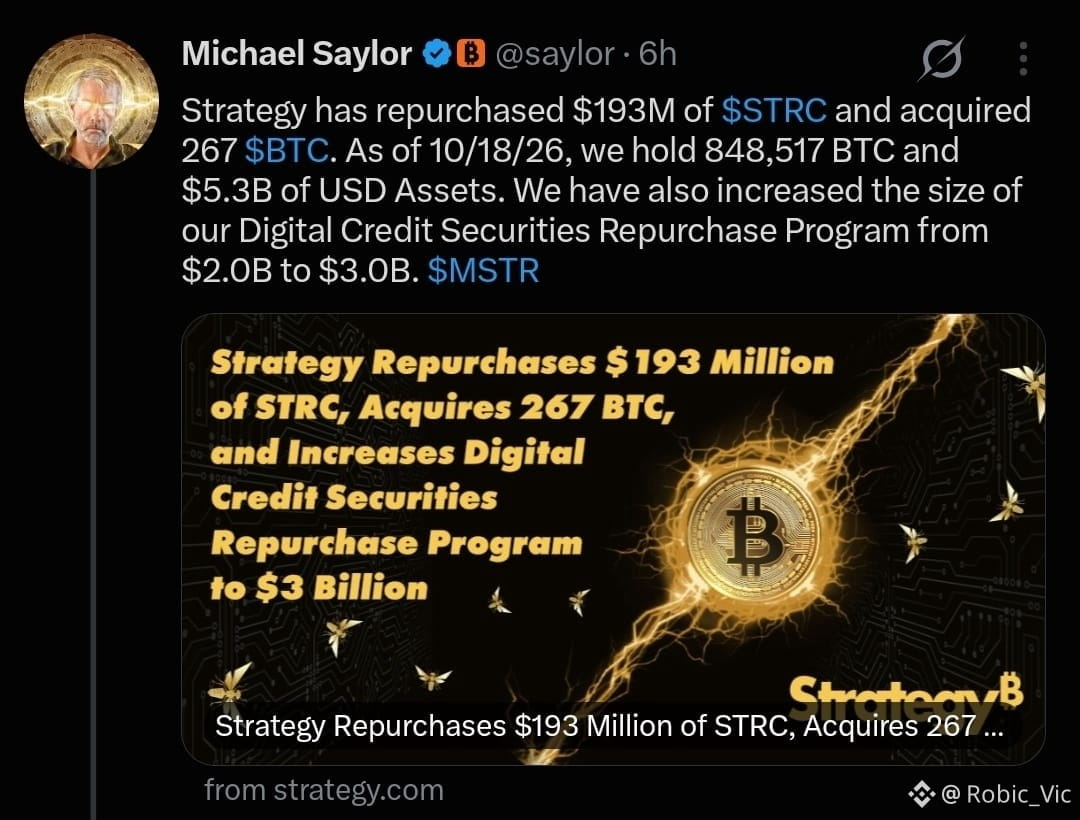
Strategy just added 267 BTC, bringing it's Bitcoin holdings to 848, 517 BTC as of Oct. 18, while holding $5.3B in USD assets.
This reinforces the corporate treasury adoption narrative. The BTC purchases itself is relatively small for the broader market, but the message is clear: Strategy is still treating Bitcoin as a core reserve asset while actively managing the securities used to finance that strategy.
#bitcoin #CryptoMarkets #strategy $BTC
Strategy just added 267 BTC, bringing it's Bitcoin holdings to 848, 517 BTC as of Oct. 18, while holding $5.3B in USD assets.
This reinforces the corporate treasury adoption narrative. The BTC purchases itself is relatively small for the broader market, but the message is clear: Strategy is still treating Bitcoin as a core reserve asset while actively managing the securities used to finance that strategy.
#bitcoin #CryptoMarkets #strategy $BTC
This reinforces the corporate treasury adoption narrative. The BTC purchases itself is relatively small for the broader market, but the message is clear: Strategy is still treating Bitcoin as a core reserve asset while actively managing the securities used to finance that strategy.
#bitcoin #CryptoMarkets #strategy $BTC
2
175
Log in to explore more content
Join global crypto users on Binance Square
⚡️ Get latest and useful information about crypto.
💬 Trusted by the world’s largest crypto exchange.
👍 Discover real insights from verified creators.
Email / Phone number
Trending Topics
1
#BinancePick
2.7M views
142,841 Discussing
2
#EarningsSeason
5M views
24,509 Discussing
3
#SouthKoreaReportedlyWeighsFourthCryptoTaxDelay
2 views
13 Discussing
4
#FranklinTempletonFilesForTwoDividendToBitcoinETFs
4,146 views
163 Discussing
5
#StrategyMSTRSurpassesNasdaqInMarketCap
4,675 views
136 Discussing
6
#CanadaProposesStablecoinRedemptionWithin3BusinessDays
141 views
14 Discussing
7
#ElectrumWalletBugLetRogueServersStealFunds
10,595 views
271 Discussing
8
#ArgentineCourtDismissesLIBRACaseAgainstMilei
21,072 views
344 Discussing
9
#SKHynixReportedlyPlansSpecialDividendFromKioxiaStakeSale
3,347 views
48 Discussing
10
#KeystoneWebsiteBreachExposesBuyersShippingAddresses
1,759 views
41 Discussing