

#scan
scan
37,216 views
196 Discussing
Hot
Latest
Article
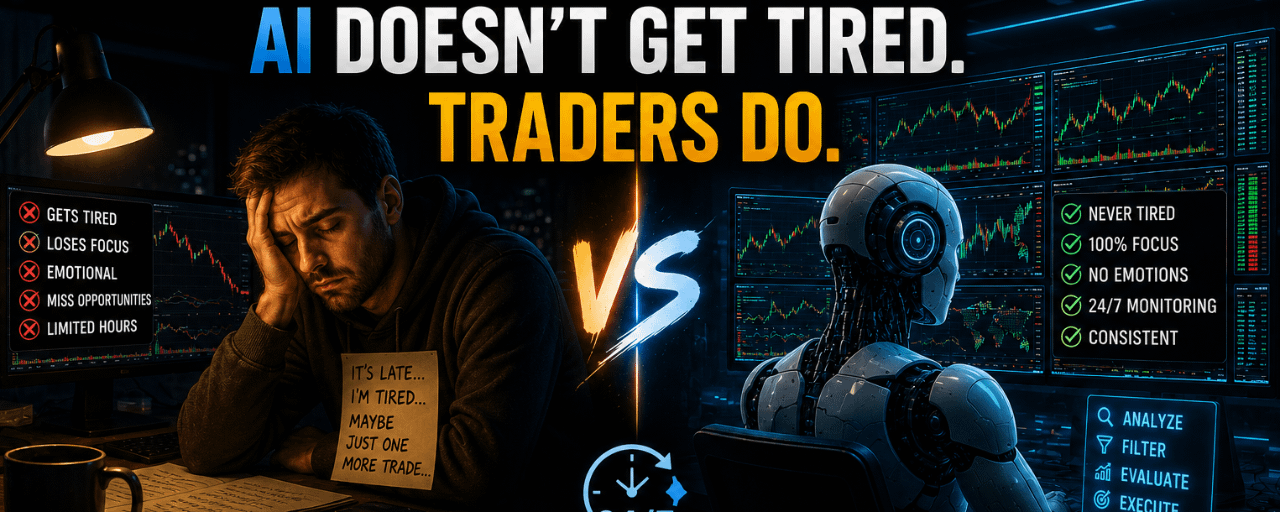
AI Doesn't Get Tired. Traders Do.Crypto never sleeps.
Not at night.
Not on weekends.
Not when you're tired.
And definitely not when you've been staring at charts for six hours and telling yourself:
“Just one more trade.”
That's the problem.
The market can operate 24/7.
Humans can't.
🧠 At 9 AM, you're a different trader than at 3 AM
Let's be honest.
After a good night's sleep, you can analyze a chart, follow your rules and make a rational decision.
Six hours later?
After watching $BTC move sideways all day?
After missing one breakout?
After taking two losing trades?
Your decision-making may not be exactly the same.
And that's not a lack of skill.
It's biology.
Humans get tired.
Attention decreases.
Patience disappears.
And the longer we stare at the market, the easier it becomes to see opportunities that may not actually exist.
😴 The market has an unfair advantage
Imagine this:
You decide to stop trading for the day.
You close your laptop.
You go to sleep.
Three hours later, the market changes.
$BTC breaks a major level.
Liquidity enters the market.
Several altcoins suddenly show strong momentum.
A new setup appears.
And you're asleep.
Nothing wrong with that.
You can't trade every hour of every day.
But here's the important question:
What if the market could still be monitored while you weren't watching?
🤖 AI doesn't have a “bad day”
An AI system doesn't wake up tired.
It doesn't lose concentration after six hours.
It doesn't say:
“I've had enough charts for today.”
It can apply the same analytical process:
at 9 AM
↓
at 3 PM
↓
at 2 AM
↓
on Sunday
The conditions may change.
The market may change.
The analysis may produce different results.
But the system doesn't suddenly become emotionally exhausted.
That's one of the most underestimated advantages of automation:
Consistency.
But consistency doesn't mean intelligence
This distinction matters.
A system can consistently make bad decisions too.
If the logic is poor, running it 24/7 simply means making poor decisions faster.
That's why automation alone isn't the answer.
The goal isn't:
“Make more trades because the AI is always awake.”
That would be a terrible KPI.
The goal is:
Monitor continuously. Filter aggressively. Act selectively.
Because the market being open 24/7 doesn't mean you need to trade 24/7.
🔍 More hours shouldn't mean more signals
This is where many trading systems get it wrong.
They see 24 hours of market activity and think:
More scanning = more signals.
But that's not necessarily an advantage.
More scanning can also find:
more noisemore false breakoutsmore weak setupsmore conflicting signalsmore reasons to overtrade
So the real value of a system that never sleeps isn't simply finding everything.
It's learning what deserves attention.
And what doesn't.
🧠 Human attention is expensive
A trader has a limited amount of focus every day.
Every chart consumes attention.
Every position consumes mental energy.
Every loss can influence the next decision.
This creates an interesting problem.
The more markets you try to watch manually...
...the harder it becomes to watch each one properly.
AI changes the workflow.
Instead of:
Human watches everything → Human finds everything → Human analyzes everything
the model can become:
🤖 System monitors the market
↓
🤖 System filters potential opportunities
↓
🤖 System evaluates predefined conditions
↓
🧠 Human reviews what matters
This isn't necessarily Human vs AI.
It may be a better version of:
Human + #AI .
🧪 This is part of what we're building
With Crypto AI Pro, the objective isn't to create a machine that mindlessly generates signals all day.
Our system is designed to continuously monitor a large universe of crypto markets and evaluate potential setups through multiple layers of analysis.
But a potential opportunity still has to earn its place.
The process is closer to:
#scan
↓
FILTER
↓
ANALYZE
↓
SCORE
↓
REJECT OR APPROVE
And sometimes, after scanning the market for hours, the answer can still be:
NO #trade .
That's not failure.
That's filtering.
⚔️ HUMAN vs AI — ROUND 2
In Round 1, we looked at scale.
Who can watch more of the crypto market?
🤖 AI wins on scale.
But this round is different.
Who can stay focused longer?
🧠 Humans need rest.
🤖 AI systems don't experience fatigue.
So on pure availability and consistency?
ROUND 2: AI
But again, the game isn't over.
Because watching the market constantly is one thing.
Reacting to it correctly is another.
🧪 THE AI TRADING EXPERIMENT — DAY 6
So far, we've explored:
DAY 1
Would You Trust AI With $10,000?
DAY 2
Bitcoin Doesn't Care About Your Trading Plan
DAY 3
The Biggest Lie in Crypto Trading
DAY 4
Your Brain Is Probably Your Worst Trading Indicator
DAY 5
Trader vs AI: Who Can See More of the Crypto Market?
And now:
DAY 6
AI Doesn't Get Tired. Traders Do.
AI is ahead on:
⚡ Scale
⏱️ Availability
🔄 Consistency
But the harder rounds are still ahead.
Can AI react faster?
Can it handle losses better?
And most importantly:
Can it actually learn?
We're not declaring the winner yet.
We're testing the idea one round at a time.
👇 Your turn
Be honest:
How long can you actively watch crypto charts before your decisions get worse?
A) 1–2 hours
B) 3–5 hours
C) 6+ hours
D) I check charts all day and probably shouldn't 😅
And the bigger question:
Would you trust an AI to monitor the market while you sleep?
YES or NO — and why?
Follow the AI Trading Experiment. Round 3 is coming. 🤖⚔️
This content is for educational purposes only and is not financial advice. Crypto trading involves substantial risk. AI does not guarantee profits or eliminate trading risk.
{spot}(BCHUSDT)
{spot}(BNBUSDT)
{spot}(MSFTBUSDT)
AI Doesn't Get Tired. Traders Do.
Crypto never sleeps.
Not at night.
Not on weekends.
Not when you're tired.
And definitely not when you've been staring at charts for six hours and telling yourself:
“Just one more trade.”
That's the problem.
The market can operate 24/7.
Humans can't.
🧠 At 9 AM, you're a different trader than at 3 AM
Let's be honest.
After a good night's sleep, you can analyze a chart, follow your rules and make a rational decision.
Six hours later?
After watching $BTC move sideways all day?
After missing one breakout?
After taking two losing trades?
Your decision-making may not be exactly the same.
And that's not a lack of skill.
It's biology.
Humans get tired.
Attention decreases.
Patience disappears.
And the longer we stare at the market, the easier it becomes to see opportunities that may not actually exist.
😴 The market has an unfair advantage
Imagine this:
You decide to stop trading for the day.
You close your laptop.
You go to sleep.
Three hours later, the market changes.
$BTC breaks a major level.
Liquidity enters the market.
Several altcoins suddenly show strong momentum.
A new setup appears.
And you're asleep.
Nothing wrong with that.
You can't trade every hour of every day.
But here's the important question:
What if the market could still be monitored while you weren't watching?
🤖 AI doesn't have a “bad day”
An AI system doesn't wake up tired.
It doesn't lose concentration after six hours.
It doesn't say:
“I've had enough charts for today.”
It can apply the same analytical process:
at 9 AM
↓
at 3 PM
↓
at 2 AM
↓
on Sunday
The conditions may change.
The market may change.
The analysis may produce different results.
But the system doesn't suddenly become emotionally exhausted.
That's one of the most underestimated advantages of automation:
Consistency.
But consistency doesn't mean intelligence
This distinction matters.
A system can consistently make bad decisions too.
If the logic is poor, running it 24/7 simply means making poor decisions faster.
That's why automation alone isn't the answer.
The goal isn't:
“Make more trades because the AI is always awake.”
That would be a terrible KPI.
The goal is:
Monitor continuously. Filter aggressively. Act selectively.
Because the market being open 24/7 doesn't mean you need to trade 24/7.
🔍 More hours shouldn't mean more signals
This is where many trading systems get it wrong.
They see 24 hours of market activity and think:
More scanning = more signals.
But that's not necessarily an advantage.
More scanning can also find:
more noisemore false breakoutsmore weak setupsmore conflicting signalsmore reasons to overtrade
So the real value of a system that never sleeps isn't simply finding everything.
It's learning what deserves attention.
And what doesn't.
🧠 Human attention is expensive
A trader has a limited amount of focus every day.
Every chart consumes attention.
Every position consumes mental energy.
Every loss can influence the next decision.
This creates an interesting problem.
The more markets you try to watch manually...
...the harder it becomes to watch each one properly.
AI changes the workflow.
Instead of:
Human watches everything → Human finds everything → Human analyzes everything
the model can become:
🤖 System monitors the market
↓
🤖 System filters potential opportunities
↓
🤖 System evaluates predefined conditions
↓
🧠 Human reviews what matters
This isn't necessarily Human vs AI.
It may be a better version of:
Human + #AI .
🧪 This is part of what we're building
With Crypto AI Pro, the objective isn't to create a machine that mindlessly generates signals all day.
Our system is designed to continuously monitor a large universe of crypto markets and evaluate potential setups through multiple layers of analysis.
But a potential opportunity still has to earn its place.
The process is closer to:
#scan
↓
FILTER
↓
ANALYZE
↓
SCORE
↓
REJECT OR APPROVE
And sometimes, after scanning the market for hours, the answer can still be:
NO #trade .
That's not failure.
That's filtering.
⚔️ HUMAN vs AI — ROUND 2
In Round 1, we looked at scale.
Who can watch more of the crypto market?
🤖 AI wins on scale.
But this round is different.
Who can stay focused longer?
🧠 Humans need rest.
🤖 AI systems don't experience fatigue.
So on pure availability and consistency?
ROUND 2: AI
But again, the game isn't over.
Because watching the market constantly is one thing.
Reacting to it correctly is another.
🧪 THE AI TRADING EXPERIMENT — DAY 6
So far, we've explored:
DAY 1
Would You Trust AI With $10,000?
DAY 2
Bitcoin Doesn't Care About Your Trading Plan
DAY 3
The Biggest Lie in Crypto Trading
DAY 4
Your Brain Is Probably Your Worst Trading Indicator
DAY 5
Trader vs AI: Who Can See More of the Crypto Market?
And now:
DAY 6
AI Doesn't Get Tired. Traders Do.
AI is ahead on:
⚡ Scale
⏱️ Availability
🔄 Consistency
But the harder rounds are still ahead.
Can AI react faster?
Can it handle losses better?
And most importantly:
Can it actually learn?
We're not declaring the winner yet.
We're testing the idea one round at a time.
👇 Your turn
Be honest:
How long can you actively watch crypto charts before your decisions get worse?
A) 1–2 hours
B) 3–5 hours
C) 6+ hours
D) I check charts all day and probably shouldn't 😅
And the bigger question:
Would you trust an AI to monitor the market while you sleep?
YES or NO — and why?
Follow the AI Trading Experiment. Round 3 is coming. 🤖⚔️
This content is for educational purposes only and is not financial advice. Crypto trading involves substantial risk. AI does not guarantee profits or eliminate trading risk.
Not at night.
Not on weekends.
Not when you're tired.
And definitely not when you've been staring at charts for six hours and telling yourself:
“Just one more trade.”
That's the problem.
The market can operate 24/7.
Humans can't.
🧠 At 9 AM, you're a different trader than at 3 AM
Let's be honest.
After a good night's sleep, you can analyze a chart, follow your rules and make a rational decision.
Six hours later?
After watching $BTC move sideways all day?
After missing one breakout?
After taking two losing trades?
Your decision-making may not be exactly the same.
And that's not a lack of skill.
It's biology.
Humans get tired.
Attention decreases.
Patience disappears.
And the longer we stare at the market, the easier it becomes to see opportunities that may not actually exist.
😴 The market has an unfair advantage
Imagine this:
You decide to stop trading for the day.
You close your laptop.
You go to sleep.
Three hours later, the market changes.
$BTC breaks a major level.
Liquidity enters the market.
Several altcoins suddenly show strong momentum.
A new setup appears.
And you're asleep.
Nothing wrong with that.
You can't trade every hour of every day.
But here's the important question:
What if the market could still be monitored while you weren't watching?
🤖 AI doesn't have a “bad day”
An AI system doesn't wake up tired.
It doesn't lose concentration after six hours.
It doesn't say:
“I've had enough charts for today.”
It can apply the same analytical process:
at 9 AM
↓
at 3 PM
↓
at 2 AM
↓
on Sunday
The conditions may change.
The market may change.
The analysis may produce different results.
But the system doesn't suddenly become emotionally exhausted.
That's one of the most underestimated advantages of automation:
Consistency.
But consistency doesn't mean intelligence
This distinction matters.
A system can consistently make bad decisions too.
If the logic is poor, running it 24/7 simply means making poor decisions faster.
That's why automation alone isn't the answer.
The goal isn't:
“Make more trades because the AI is always awake.”
That would be a terrible KPI.
The goal is:
Monitor continuously. Filter aggressively. Act selectively.
Because the market being open 24/7 doesn't mean you need to trade 24/7.
🔍 More hours shouldn't mean more signals
This is where many trading systems get it wrong.
They see 24 hours of market activity and think:
More scanning = more signals.
But that's not necessarily an advantage.
More scanning can also find:
more noisemore false breakoutsmore weak setupsmore conflicting signalsmore reasons to overtrade
So the real value of a system that never sleeps isn't simply finding everything.
It's learning what deserves attention.
And what doesn't.
🧠 Human attention is expensive
A trader has a limited amount of focus every day.
Every chart consumes attention.
Every position consumes mental energy.
Every loss can influence the next decision.
This creates an interesting problem.
The more markets you try to watch manually...
...the harder it becomes to watch each one properly.
AI changes the workflow.
Instead of:
Human watches everything → Human finds everything → Human analyzes everything
the model can become:
🤖 System monitors the market
↓
🤖 System filters potential opportunities
↓
🤖 System evaluates predefined conditions
↓
🧠 Human reviews what matters
This isn't necessarily Human vs AI.
It may be a better version of:
Human + #AI .
🧪 This is part of what we're building
With Crypto AI Pro, the objective isn't to create a machine that mindlessly generates signals all day.
Our system is designed to continuously monitor a large universe of crypto markets and evaluate potential setups through multiple layers of analysis.
But a potential opportunity still has to earn its place.
The process is closer to:
#scan
↓
FILTER
↓
ANALYZE
↓
SCORE
↓
REJECT OR APPROVE
And sometimes, after scanning the market for hours, the answer can still be:
NO #trade .
That's not failure.
That's filtering.
⚔️ HUMAN vs AI — ROUND 2
In Round 1, we looked at scale.
Who can watch more of the crypto market?
🤖 AI wins on scale.
But this round is different.
Who can stay focused longer?
🧠 Humans need rest.
🤖 AI systems don't experience fatigue.
So on pure availability and consistency?
ROUND 2: AI
But again, the game isn't over.
Because watching the market constantly is one thing.
Reacting to it correctly is another.
🧪 THE AI TRADING EXPERIMENT — DAY 6
So far, we've explored:
DAY 1
Would You Trust AI With $10,000?
DAY 2
Bitcoin Doesn't Care About Your Trading Plan
DAY 3
The Biggest Lie in Crypto Trading
DAY 4
Your Brain Is Probably Your Worst Trading Indicator
DAY 5
Trader vs AI: Who Can See More of the Crypto Market?
And now:
DAY 6
AI Doesn't Get Tired. Traders Do.
AI is ahead on:
⚡ Scale
⏱️ Availability
🔄 Consistency
But the harder rounds are still ahead.
Can AI react faster?
Can it handle losses better?
And most importantly:
Can it actually learn?
We're not declaring the winner yet.
We're testing the idea one round at a time.
👇 Your turn
Be honest:
How long can you actively watch crypto charts before your decisions get worse?
A) 1–2 hours
B) 3–5 hours
C) 6+ hours
D) I check charts all day and probably shouldn't 😅
And the bigger question:
Would you trust an AI to monitor the market while you sleep?
YES or NO — and why?
Follow the AI Trading Experiment. Round 3 is coming. 🤖⚔️
This content is for educational purposes only and is not financial advice. Crypto trading involves substantial risk. AI does not guarantee profits or eliminate trading risk.
82

·
--
My thoughts on Arkm upgrading from a free version to a paid version#Arkm From being virtually unknown to becoming the most famous, after a race lasting more than four years, it once surpassed #Scan to become the leading blockchain explorer. It became a legend in the crypto world and the go-to tracking tool for crypto traders. People across the crypto community contributed over 90% of its reliable, verified labels. By the laws of the universe, there’s never really such a thing as “one person making another”—after all, everyone has profited from #Arkm over the past few years.
So, now that it’s switching to the upgraded version, with the lowest tier costing 1,500 U per month, is that really reasonable? Who ultimately benefits from this change? And who will be affected the most?
My thoughts on Arkm upgrading from a free version to a paid version
#Arkm From being virtually unknown to becoming the most famous, after a race lasting more than four years, it once surpassed #Scan to become the leading blockchain explorer. It became a legend in the crypto world and the go-to tracking tool for crypto traders. People across the crypto community contributed over 90% of its reliable, verified labels. By the laws of the universe, there’s never really such a thing as “one person making another”—after all, everyone has profited from #Arkm over the past few years.
So, now that it’s switching to the upgraded version, with the lowest tier costing 1,500 U per month, is that really reasonable? Who ultimately benefits from this change? And who will be affected the most?
So, now that it’s switching to the upgraded version, with the lowest tier costing 1,500 U per month, is that really reasonable? Who ultimately benefits from this change? And who will be affected the most?
美股大涨:
丙哥,用区块链浏览器平替不行吗,实在不行用笨方法。区块链浏览器不认识的地址放到 ark 上去看。因为现在 ark 过于强大导致老鼠仓暴增,影响庄家操盘。据我所知这几个月有好几个项目因为散户抢跑没拉起来了。我觉得信息不透明对于你这种资深链上玩家反而是好事?
2
4
2.4k



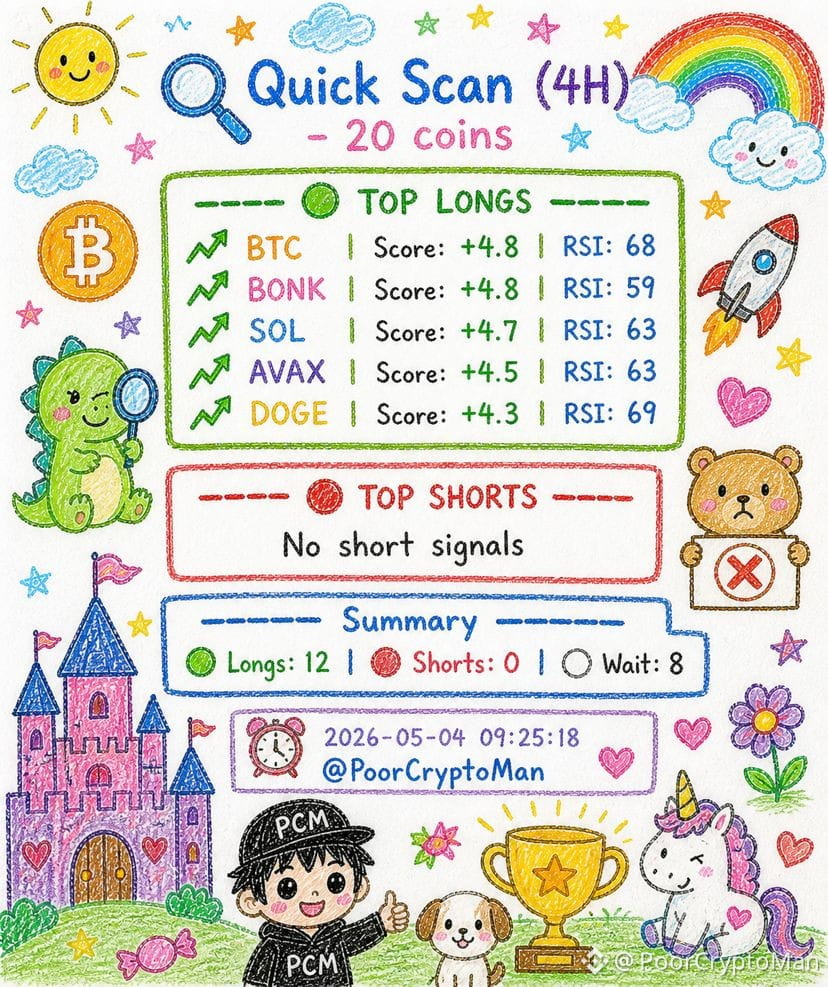
🔍 Quick Scan (4H) - 20 coins
━━━ 🟢 TOP LONGS ━━━
📈 BTC | Score: +4.8 | RSI: 68
📈 BONK | Score: +4.8 | RSI: 59
📈 SOL | Score: +4.7 | RSI: 63
📈 AVAX | Score: +4.5 | RSI: 63
📈 DOGE | Score: +4.3 | RSI: 69
━━━ 🔴 TOP SHORTS ━━━
No short signals
━━━ Summary ━━━
🟢 Longs: 12 | 🔴 Shorts: 0 | ⚪ Wait: 8
⏰ 2026-05-04 09:25:18
@PoorCryptoMan #BTCSurpasses$80K #scan #quickscan
🔍 Quick Scan (4H) - 20 coins
━━━ 🟢 TOP LONGS ━━━
📈 BTC | Score: +4.8 | RSI: 68
📈 BONK | Score: +4.8 | RSI: 59
📈 SOL | Score: +4.7 | RSI: 63
📈 AVAX | Score: +4.5 | RSI: 63
📈 DOGE | Score: +4.3 | RSI: 69
━━━ 🔴 TOP SHORTS ━━━
No short signals
━━━ Summary ━━━
🟢 Longs: 12 | 🔴 Shorts: 0 | ⚪ Wait: 8
⏰ 2026-05-04 09:25:18
@PoorCryptoMan #BTCSurpasses$80K #scan #quickscan
━━━ 🟢 TOP LONGS ━━━
📈 BTC | Score: +4.8 | RSI: 68
📈 BONK | Score: +4.8 | RSI: 59
📈 SOL | Score: +4.7 | RSI: 63
📈 AVAX | Score: +4.5 | RSI: 63
📈 DOGE | Score: +4.3 | RSI: 69
━━━ 🔴 TOP SHORTS ━━━
No short signals
━━━ Summary ━━━
🟢 Longs: 12 | 🔴 Shorts: 0 | ⚪ Wait: 8
⏰ 2026-05-04 09:25:18
@PoorCryptoMan #BTCSurpasses$80K #scan #quickscan
1
116
·
--
Bullish
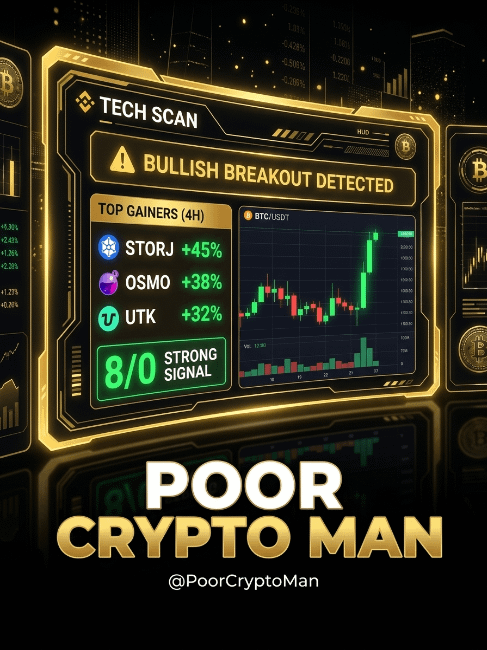
#Tech #scan (4H) 🔍
Looking at Top Gainers:
🟢 $STORJ : LONG (12/15)
🟢 $OSMO : LONG (12/15)
🟢 $UTK: LONG (12/15)
🟢 $ZBT : LONG (12/15)
🟢 $ORCA: LONG (12/15)
🟢 $PSG: LONG (11/15)
🟢 $QNT: LONG (8/15)
🟢 $D: LONG (7/15)
#Strong #signals : 8 | Weak: 0
📱 Follow @PoorCryptoMan
{future}(STORJUSDT)
{spot}(OSMOUSDT)
{future}(ZBTUSDT)
#Tech #scan (4H) 🔍
Looking at Top Gainers:
🟢 $STORJ : LONG (12/15)
🟢 $OSMO : LONG (12/15)
🟢 $UTK: LONG (12/15)
🟢 $ZBT : LONG (12/15)
🟢 $ORCA: LONG (12/15)
🟢 $PSG: LONG (11/15)
🟢 $QNT: LONG (8/15)
🟢 $D: LONG (7/15)
#Strong #signals : 8 | Weak: 0
📱 Follow @PoorCryptoMan
Looking at Top Gainers:
🟢 $STORJ : LONG (12/15)
🟢 $OSMO : LONG (12/15)
🟢 $UTK: LONG (12/15)
🟢 $ZBT : LONG (12/15)
🟢 $ORCA: LONG (12/15)
🟢 $PSG: LONG (11/15)
🟢 $QNT: LONG (8/15)
🟢 $D: LONG (7/15)
#Strong #signals : 8 | Weak: 0
📱 Follow @PoorCryptoMan
2
214
·
--
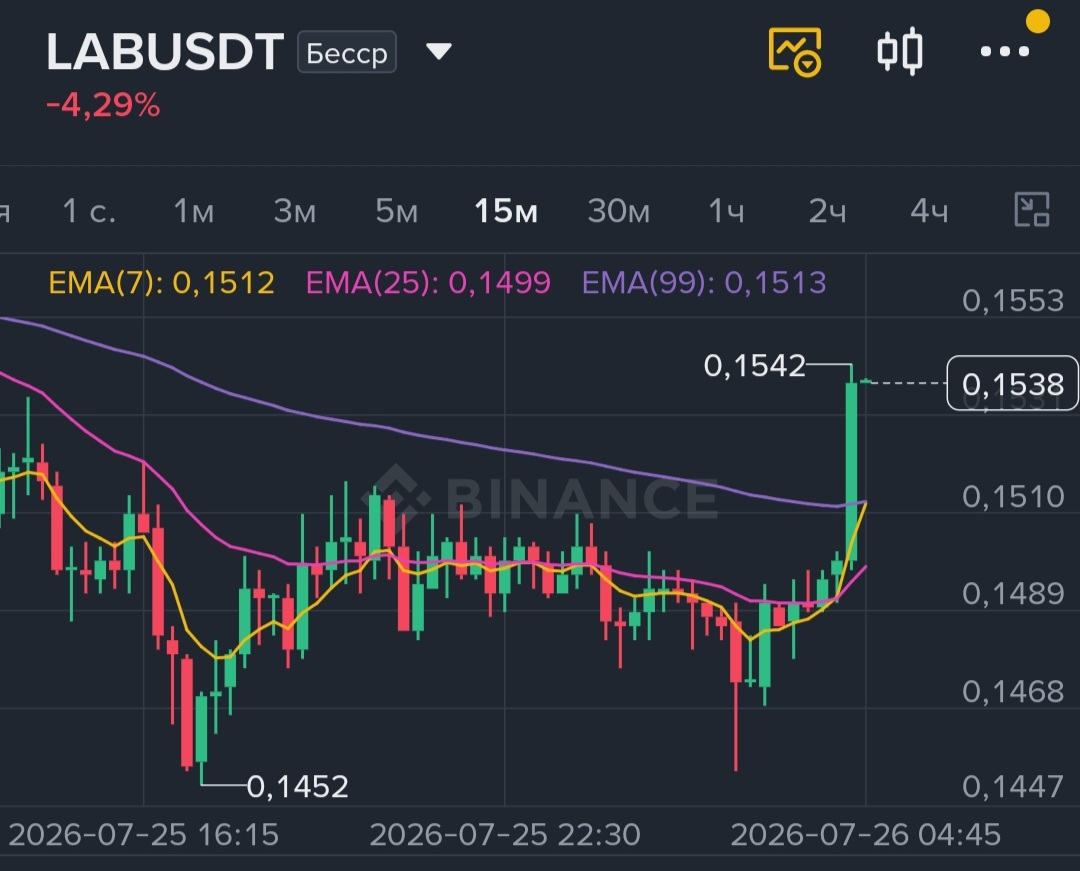
$LAB is gaining momentum and attracting more and more attention from the crypto community. While most are watching from the sidelines, others are already starting to build a position.
If the current interest in the project holds, a strong push may be ahead. Many promising moves begin precisely when the market is still doubtful.
Don’t miss your chance—maybe now is the perfect time to take a closer look at #LAB and conduct your own analysis while the price remains attractive.
$EUL $SOL
#Binance #trader #scan #ALPHA🔥
$LAB is gaining momentum and attracting more and more attention from the crypto community. While most are watching from the sidelines, others are already starting to build a position.
If the current interest in the project holds, a strong push may be ahead. Many promising moves begin precisely when the market is still doubtful.
Don’t miss your chance—maybe now is the perfect time to take a closer look at #LAB and conduct your own analysis while the price remains attractive.
$EUL $SOL
#Binance #trader #scan #ALPHA🔥
If the current interest in the project holds, a strong push may be ahead. Many promising moves begin precisely when the market is still doubtful.
Don’t miss your chance—maybe now is the perfect time to take a closer look at #LAB and conduct your own analysis while the price remains attractive.
$EUL $SOL
#Binance #trader #scan #ALPHA🔥
2
157
·
--
Bullish
🔎 HOW I FIND TRADING OPPORTUNITIES WITH SCREENERS
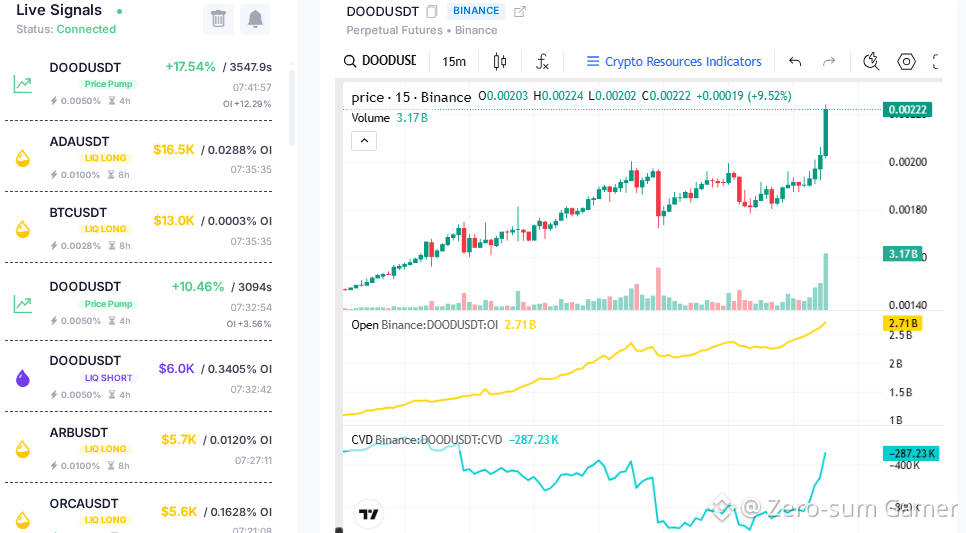
I don’t scroll through hundreds of charts. I start with coins where something is already happening: price expansion, unusual volume, liquidations, or a sharp change in OI.
📊 Pump/Dump Screener shows where price and volume are starting to accelerate.
💥 Liquidation Screener shows where positions are already getting wiped. I’m not interested in the liquidation number alone. I want to see what happens next: continuation, a sharp rebound, or a break in structure.
📈 Open Interest helps me read positioning. Price and OI rising together means new positions are entering the move. OI expanding while price barely moves is a different setup — someone may be getting trapped.
⚡ Funding and Premium Index show how crowded derivatives positioning has become. The more one-sided the market gets, the more interesting the opposite setup becomes once structure confirms it.
After the #scan , I open the chart and check structure, local range, volume, liquidations, and the reaction after the #IMPULSE .
A screener doesn’t give me an entry. It removes hundreds of dead charts and leaves the few where there is actually something worth trading.
My workflow:
anomaly → structure → confirmation → entry → risk contro
l
🚀 Crypto Resources screeners are free: #pump /#dump , #Liquidations , OI and other tools for finding active setups faster.
$CFG $UAI $CATI
🔎 HOW I FIND TRADING OPPORTUNITIES WITH SCREENERS
I don’t scroll through hundreds of charts. I start with coins where something is already happening: price expansion, unusual volume, liquidations, or a sharp change in OI.
📊 Pump/Dump Screener shows where price and volume are starting to accelerate.
💥 Liquidation Screener shows where positions are already getting wiped. I’m not interested in the liquidation number alone. I want to see what happens next: continuation, a sharp rebound, or a break in structure.
📈 Open Interest helps me read positioning. Price and OI rising together means new positions are entering the move. OI expanding while price barely moves is a different setup — someone may be getting trapped.
⚡ Funding and Premium Index show how crowded derivatives positioning has become. The more one-sided the market gets, the more interesting the opposite setup becomes once structure confirms it.
After the #scan , I open the chart and check structure, local range, volume, liquidations, and the reaction after the #IMPULSE .
A screener doesn’t give me an entry. It removes hundreds of dead charts and leaves the few where there is actually something worth trading.
My workflow:
anomaly → structure → confirmation → entry → risk contro
l
🚀 Crypto Resources screeners are free: #pump /#dump , #Liquidations , OI and other tools for finding active setups faster.
$CFG $UAI $CATI
I don’t scroll through hundreds of charts. I start with coins where something is already happening: price expansion, unusual volume, liquidations, or a sharp change in OI.
📊 Pump/Dump Screener shows where price and volume are starting to accelerate.
💥 Liquidation Screener shows where positions are already getting wiped. I’m not interested in the liquidation number alone. I want to see what happens next: continuation, a sharp rebound, or a break in structure.
📈 Open Interest helps me read positioning. Price and OI rising together means new positions are entering the move. OI expanding while price barely moves is a different setup — someone may be getting trapped.
⚡ Funding and Premium Index show how crowded derivatives positioning has become. The more one-sided the market gets, the more interesting the opposite setup becomes once structure confirms it.
After the #scan , I open the chart and check structure, local range, volume, liquidations, and the reaction after the #IMPULSE .
A screener doesn’t give me an entry. It removes hundreds of dead charts and leaves the few where there is actually something worth trading.
My workflow:
anomaly → structure → confirmation → entry → risk contro
l
🚀 Crypto Resources screeners are free: #pump /#dump , #Liquidations , OI and other tools for finding active setups faster.
$CFG $UAI $CATI
2
332
Article
Crypto Is Stuck?The crypto market is sending a mixed signal.
#Bitcoin❗ is hovering around $63K, while the broader market remains under pressure. $BTC has struggled to sustain a breakout above the $64K area, and recent $ETH outflows and regulatory uncertainty are keeping traders cautious.
At the same time, some capital is starting to rotate selectively into altcoins. #Solana , for example, recently saw its strongest weekly ETH inflows since May.
So what are we looking at?
Not a clean bull market.
Not a clear bear market either.
A market where selectivity matters more than ever.
And this is exactly the environment where we decided to release the biggest update to our trading system yet.
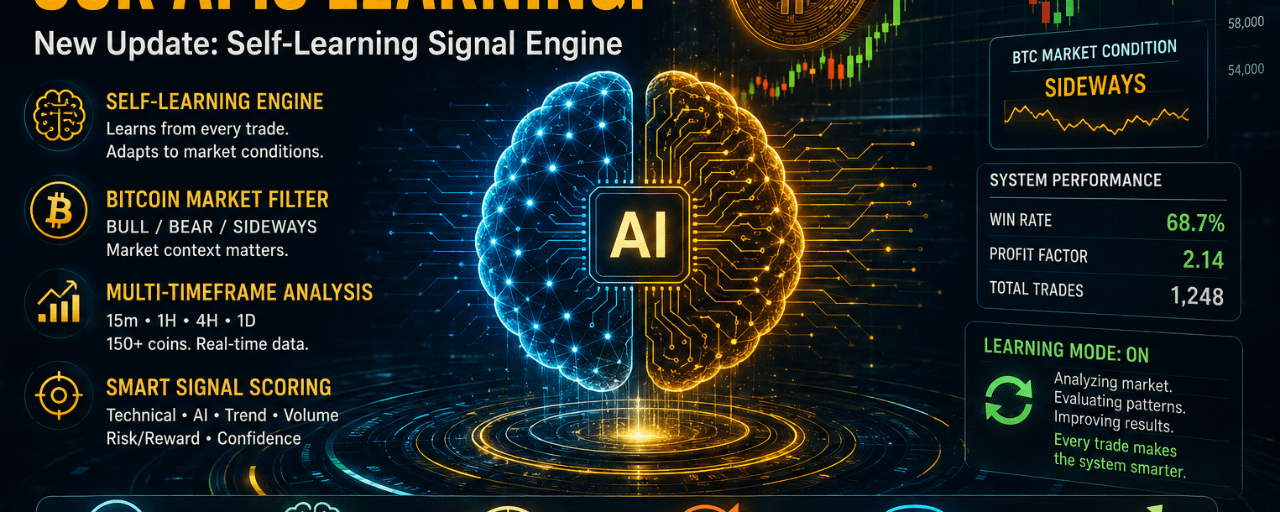
From AI Signals to Self-#learning
Our project started with a simple idea:
Let AI #scan the crypto market and identify potential trading opportunities.
But there was an obvious limitation.
An AI can analyze thousands of data points.
It can recognize technical patterns.
It can generate LONG and SHORT setups.
But what happens after the trade closes?
Does the system remember what worked?
Does it know which factors were actually useful?
Does it understand that a setup can behave completely differently in a bullish, bearish or sideways Bitcoin market?
Previously, our system could use recent winning and losing trades as context.
Now we have taken this significantly further.
The New Self-Learning Engine
The latest update introduces a new Self-Learning layer that works with the complete history of closed trades.
Instead of looking at only a few recent examples, the system aggregates historical results across the entire learning database.
It analyzes:
which AI factors correlate with winning trades;LONG vs SHORT performance;performance under different BTC market regimes;historical P&L;recent winning and losing examples.
The system then feeds this information back into the AI analysis when evaluating new opportunities.
In simple terms:
The system doesn't just generate a signal.
It studies what happened after previous signals.
And that creates a feedback loop:
Analyze → Signal → Trade → Result → Learn → Recalibrate → Signal
That is the direction we're taking.
Bitcoin Is Now Part of the Decision
Another important part of the architecture is the BTC market filter.
The system classifies the broader market into three regimes:
BULL / BEAR / SIDEWAYS
This classification is based on Bitcoin's 4H and 1D structure, including EMA alignment, the daily 200 EMA, MACD and ADX.
Why does this matter?
Because a LONG setup during a strong BTC bullish regime is fundamentally different from the same setup while Bitcoin is trending down.
The system therefore adjusts the market-trend component of the signal score depending on BTC's regime.
A LONG fighting a BEAR market gets penalized.
A SHORT aligned with a BEAR market gets stronger confirmation.
And in a SIDEWAYS environment, the system becomes more neutral.
This sounds obvious.
Yet many automated signal systems still treat every coin as an isolated chart.
We don't.
Bitcoin is the market context.
150 Coins. Four Timeframes. Multiple Layers of Analysis.
The scanner continuously works with a controlled pool of liquid Binance Futures pairs.
The pool is rebuilt every six hours and filtered by liquidity, spread and listing age before coins enter the analysis pipeline.
Market data is then evaluated across:
15m → 1H → 4H → 1D
The system calculates indicators including:
RSIMACDADXATREMA 10/20/50/200Bollinger BandsVWAPSupport & Resistance
The goal isn't to throw every coin at AI.
First, the system filters the market.
Then it identifies candidates.
Then AI analyzes the shortlisted setups.
Finally, a separate Signal Score evaluates the opportunity using technical confluence, AI confidence, BTC trend, volume and risk/reward. Only setups above the required threshold are eligible for publication.
That's an important distinction.
AI does not automatically mean #buy .
AI generates an opinion.
The scoring and risk-management layers decide whether that opinion is strong enough to become a signal.
And Now the Score Can Learn Too
This is probably the most interesting part of the update.
Our Signal Score combines several components:
Technical + AI + Market Trend + Volume + Risk/Reward
The new system can now periodically evaluate how strongly each component correlated with the actual result of completed trades.
Then it can gradually adjust the weights.
Not overnight.
Not aggressively.
And not based on one lucky trade.
The system uses a limited adjustment step and requires a minimum number of closed trades before recalibration begins.
This is important because we don't want the algorithm chasing noise.
A good trading system shouldn't completely change its personality because of five successful trades.
Adaptation needs guardrails.
That's why our implementation is deliberately conservative.
And to be precise:
This is not a claim that we have built a magical autonomous neural network that perfectly retrains itself.
The current implementation combines AI/ML analysis with statistical learning and automated calibration of the Signal Score.
That's much more useful than pretending otherwise.
Every Trade Becomes Data
When a signal is generated, the system stores the market context behind it.
That includes the technical snapshot, BTC regime, volume, spread, AI confidence, factors, entry, leverage and Signal Score.
When the trade eventually closes, the outcome becomes part of the learning history.
Wins.Losses.P&L.Market conditions.AI factors.Direction.BTC regime.
Everything goes into the dataset.
That means the system can eventually answer questions that a static indicator cannot.
For example:
Which factors actually work best for LONG trades?
Which factors work better during a BTC bull market?
Does the system perform better in trending or sideways conditions?
Which combinations repeatedly appear in successful setups?
These are the questions that matter.
The Market Is Changing. Our System Has to Change Too.
The crypto market of 2026 is not the crypto market of 2021.
Liquidity changes.
Volatility changes.
Narratives change.
Correlation changes.
The behavior of traders changes.
And strategies that worked six months ago can become mediocre today.
A static strategy assumes the market stays relatively similar.
A learning system assumes the opposite:
The market will change.
So the system must continuously measure what is happening and adjust accordingly.
That's the philosophy behind this update.
We are not trying to build a machine that predicts every Bitcoin candle.
Nobody can.
We're building a system designed to find statistical advantages, measure the outcomes and gradually improve its decision process.
The Next Generation of Crypto Signals
The future of crypto trading signals probably isn't another RSI bot.
It isn't another Telegram channel shouting:
LONG 🚀
SHORT 🔥
100% WIN RATE 🤖
That model is getting old.
The more interesting direction is:
Market Data → AI → Risk Management → Real Trade → Learning → Adaptation
And that's exactly where we're taking our project.
Our latest update is another step toward that architecture.
The system doesn't just ask:
"Is there a signal?"
It is increasingly asking:
"Why did this type of signal work before — and does the current market look similar?"
That's a much harder question.
But potentially a much more valuable one.
The future of crypto signals may not be about predicting the market.
It may be about learning from it.
This article is for informational and educational purposes only and does not constitute financial or investment advice. Cryptocurrency trading, especially futures and leveraged trading, involves substantial risk. Past performance does not guarantee future results.
{spot}(BTCUSDT)
{spot}(AAPLBUSDT)
{spot}(GOOGLBUSDT)
Crypto Is Stuck?
The crypto market is sending a mixed signal.
#Bitcoin❗ is hovering around $63K, while the broader market remains under pressure. $BTC has struggled to sustain a breakout above the $64K area, and recent $ETH outflows and regulatory uncertainty are keeping traders cautious.
At the same time, some capital is starting to rotate selectively into altcoins. #Solana , for example, recently saw its strongest weekly ETH inflows since May.
So what are we looking at?
Not a clean bull market.
Not a clear bear market either.
A market where selectivity matters more than ever.
And this is exactly the environment where we decided to release the biggest update to our trading system yet.
From AI Signals to Self-#learning
Our project started with a simple idea:
Let AI #scan the crypto market and identify potential trading opportunities.
But there was an obvious limitation.
An AI can analyze thousands of data points.
It can recognize technical patterns.
It can generate LONG and SHORT setups.
But what happens after the trade closes?
Does the system remember what worked?
Does it know which factors were actually useful?
Does it understand that a setup can behave completely differently in a bullish, bearish or sideways Bitcoin market?
Previously, our system could use recent winning and losing trades as context.
Now we have taken this significantly further.
The New Self-Learning Engine
The latest update introduces a new Self-Learning layer that works with the complete history of closed trades.
Instead of looking at only a few recent examples, the system aggregates historical results across the entire learning database.
It analyzes:
which AI factors correlate with winning trades;LONG vs SHORT performance;performance under different BTC market regimes;historical P&L;recent winning and losing examples.
The system then feeds this information back into the AI analysis when evaluating new opportunities.
In simple terms:
The system doesn't just generate a signal.
It studies what happened after previous signals.
And that creates a feedback loop:
Analyze → Signal → Trade → Result → Learn → Recalibrate → Signal
That is the direction we're taking.
Bitcoin Is Now Part of the Decision
Another important part of the architecture is the BTC market filter.
The system classifies the broader market into three regimes:
BULL / BEAR / SIDEWAYS
This classification is based on Bitcoin's 4H and 1D structure, including EMA alignment, the daily 200 EMA, MACD and ADX.
Why does this matter?
Because a LONG setup during a strong BTC bullish regime is fundamentally different from the same setup while Bitcoin is trending down.
The system therefore adjusts the market-trend component of the signal score depending on BTC's regime.
A LONG fighting a BEAR market gets penalized.
A SHORT aligned with a BEAR market gets stronger confirmation.
And in a SIDEWAYS environment, the system becomes more neutral.
This sounds obvious.
Yet many automated signal systems still treat every coin as an isolated chart.
We don't.
Bitcoin is the market context.
150 Coins. Four Timeframes. Multiple Layers of Analysis.
The scanner continuously works with a controlled pool of liquid Binance Futures pairs.
The pool is rebuilt every six hours and filtered by liquidity, spread and listing age before coins enter the analysis pipeline.
Market data is then evaluated across:
15m → 1H → 4H → 1D
The system calculates indicators including:
RSIMACDADXATREMA 10/20/50/200Bollinger BandsVWAPSupport & Resistance
The goal isn't to throw every coin at AI.
First, the system filters the market.
Then it identifies candidates.
Then AI analyzes the shortlisted setups.
Finally, a separate Signal Score evaluates the opportunity using technical confluence, AI confidence, BTC trend, volume and risk/reward. Only setups above the required threshold are eligible for publication.
That's an important distinction.
AI does not automatically mean #buy .
AI generates an opinion.
The scoring and risk-management layers decide whether that opinion is strong enough to become a signal.
And Now the Score Can Learn Too
This is probably the most interesting part of the update.
Our Signal Score combines several components:
Technical + AI + Market Trend + Volume + Risk/Reward
The new system can now periodically evaluate how strongly each component correlated with the actual result of completed trades.
Then it can gradually adjust the weights.
Not overnight.
Not aggressively.
And not based on one lucky trade.
The system uses a limited adjustment step and requires a minimum number of closed trades before recalibration begins.
This is important because we don't want the algorithm chasing noise.
A good trading system shouldn't completely change its personality because of five successful trades.
Adaptation needs guardrails.
That's why our implementation is deliberately conservative.
And to be precise:
This is not a claim that we have built a magical autonomous neural network that perfectly retrains itself.
The current implementation combines AI/ML analysis with statistical learning and automated calibration of the Signal Score.
That's much more useful than pretending otherwise.
Every Trade Becomes Data
When a signal is generated, the system stores the market context behind it.
That includes the technical snapshot, BTC regime, volume, spread, AI confidence, factors, entry, leverage and Signal Score.
When the trade eventually closes, the outcome becomes part of the learning history.
Wins.Losses.P&L.Market conditions.AI factors.Direction.BTC regime.
Everything goes into the dataset.
That means the system can eventually answer questions that a static indicator cannot.
For example:
Which factors actually work best for LONG trades?
Which factors work better during a BTC bull market?
Does the system perform better in trending or sideways conditions?
Which combinations repeatedly appear in successful setups?
These are the questions that matter.
The Market Is Changing. Our System Has to Change Too.
The crypto market of 2026 is not the crypto market of 2021.
Liquidity changes.
Volatility changes.
Narratives change.
Correlation changes.
The behavior of traders changes.
And strategies that worked six months ago can become mediocre today.
A static strategy assumes the market stays relatively similar.
A learning system assumes the opposite:
The market will change.
So the system must continuously measure what is happening and adjust accordingly.
That's the philosophy behind this update.
We are not trying to build a machine that predicts every Bitcoin candle.
Nobody can.
We're building a system designed to find statistical advantages, measure the outcomes and gradually improve its decision process.
The Next Generation of Crypto Signals
The future of crypto trading signals probably isn't another RSI bot.
It isn't another Telegram channel shouting:
LONG 🚀
SHORT 🔥
100% WIN RATE 🤖
That model is getting old.
The more interesting direction is:
Market Data → AI → Risk Management → Real Trade → Learning → Adaptation
And that's exactly where we're taking our project.
Our latest update is another step toward that architecture.
The system doesn't just ask:
"Is there a signal?"
It is increasingly asking:
"Why did this type of signal work before — and does the current market look similar?"
That's a much harder question.
But potentially a much more valuable one.
The future of crypto signals may not be about predicting the market.
It may be about learning from it.
This article is for informational and educational purposes only and does not constitute financial or investment advice. Cryptocurrency trading, especially futures and leveraged trading, involves substantial risk. Past performance does not guarantee future results.
#Bitcoin❗ is hovering around $63K, while the broader market remains under pressure. $BTC has struggled to sustain a breakout above the $64K area, and recent $ETH outflows and regulatory uncertainty are keeping traders cautious.
At the same time, some capital is starting to rotate selectively into altcoins. #Solana , for example, recently saw its strongest weekly ETH inflows since May.
So what are we looking at?
Not a clean bull market.
Not a clear bear market either.
A market where selectivity matters more than ever.
And this is exactly the environment where we decided to release the biggest update to our trading system yet.
From AI Signals to Self-#learning
Our project started with a simple idea:
Let AI #scan the crypto market and identify potential trading opportunities.
But there was an obvious limitation.
An AI can analyze thousands of data points.
It can recognize technical patterns.
It can generate LONG and SHORT setups.
But what happens after the trade closes?
Does the system remember what worked?
Does it know which factors were actually useful?
Does it understand that a setup can behave completely differently in a bullish, bearish or sideways Bitcoin market?
Previously, our system could use recent winning and losing trades as context.
Now we have taken this significantly further.
The New Self-Learning Engine
The latest update introduces a new Self-Learning layer that works with the complete history of closed trades.
Instead of looking at only a few recent examples, the system aggregates historical results across the entire learning database.
It analyzes:
which AI factors correlate with winning trades;LONG vs SHORT performance;performance under different BTC market regimes;historical P&L;recent winning and losing examples.
The system then feeds this information back into the AI analysis when evaluating new opportunities.
In simple terms:
The system doesn't just generate a signal.
It studies what happened after previous signals.
And that creates a feedback loop:
Analyze → Signal → Trade → Result → Learn → Recalibrate → Signal
That is the direction we're taking.
Bitcoin Is Now Part of the Decision
Another important part of the architecture is the BTC market filter.
The system classifies the broader market into three regimes:
BULL / BEAR / SIDEWAYS
This classification is based on Bitcoin's 4H and 1D structure, including EMA alignment, the daily 200 EMA, MACD and ADX.
Why does this matter?
Because a LONG setup during a strong BTC bullish regime is fundamentally different from the same setup while Bitcoin is trending down.
The system therefore adjusts the market-trend component of the signal score depending on BTC's regime.
A LONG fighting a BEAR market gets penalized.
A SHORT aligned with a BEAR market gets stronger confirmation.
And in a SIDEWAYS environment, the system becomes more neutral.
This sounds obvious.
Yet many automated signal systems still treat every coin as an isolated chart.
We don't.
Bitcoin is the market context.
150 Coins. Four Timeframes. Multiple Layers of Analysis.
The scanner continuously works with a controlled pool of liquid Binance Futures pairs.
The pool is rebuilt every six hours and filtered by liquidity, spread and listing age before coins enter the analysis pipeline.
Market data is then evaluated across:
15m → 1H → 4H → 1D
The system calculates indicators including:
RSIMACDADXATREMA 10/20/50/200Bollinger BandsVWAPSupport & Resistance
The goal isn't to throw every coin at AI.
First, the system filters the market.
Then it identifies candidates.
Then AI analyzes the shortlisted setups.
Finally, a separate Signal Score evaluates the opportunity using technical confluence, AI confidence, BTC trend, volume and risk/reward. Only setups above the required threshold are eligible for publication.
That's an important distinction.
AI does not automatically mean #buy .
AI generates an opinion.
The scoring and risk-management layers decide whether that opinion is strong enough to become a signal.
And Now the Score Can Learn Too
This is probably the most interesting part of the update.
Our Signal Score combines several components:
Technical + AI + Market Trend + Volume + Risk/Reward
The new system can now periodically evaluate how strongly each component correlated with the actual result of completed trades.
Then it can gradually adjust the weights.
Not overnight.
Not aggressively.
And not based on one lucky trade.
The system uses a limited adjustment step and requires a minimum number of closed trades before recalibration begins.
This is important because we don't want the algorithm chasing noise.
A good trading system shouldn't completely change its personality because of five successful trades.
Adaptation needs guardrails.
That's why our implementation is deliberately conservative.
And to be precise:
This is not a claim that we have built a magical autonomous neural network that perfectly retrains itself.
The current implementation combines AI/ML analysis with statistical learning and automated calibration of the Signal Score.
That's much more useful than pretending otherwise.
Every Trade Becomes Data
When a signal is generated, the system stores the market context behind it.
That includes the technical snapshot, BTC regime, volume, spread, AI confidence, factors, entry, leverage and Signal Score.
When the trade eventually closes, the outcome becomes part of the learning history.
Wins.Losses.P&L.Market conditions.AI factors.Direction.BTC regime.
Everything goes into the dataset.
That means the system can eventually answer questions that a static indicator cannot.
For example:
Which factors actually work best for LONG trades?
Which factors work better during a BTC bull market?
Does the system perform better in trending or sideways conditions?
Which combinations repeatedly appear in successful setups?
These are the questions that matter.
The Market Is Changing. Our System Has to Change Too.
The crypto market of 2026 is not the crypto market of 2021.
Liquidity changes.
Volatility changes.
Narratives change.
Correlation changes.
The behavior of traders changes.
And strategies that worked six months ago can become mediocre today.
A static strategy assumes the market stays relatively similar.
A learning system assumes the opposite:
The market will change.
So the system must continuously measure what is happening and adjust accordingly.
That's the philosophy behind this update.
We are not trying to build a machine that predicts every Bitcoin candle.
Nobody can.
We're building a system designed to find statistical advantages, measure the outcomes and gradually improve its decision process.
The Next Generation of Crypto Signals
The future of crypto trading signals probably isn't another RSI bot.
It isn't another Telegram channel shouting:
LONG 🚀
SHORT 🔥
100% WIN RATE 🤖
That model is getting old.
The more interesting direction is:
Market Data → AI → Risk Management → Real Trade → Learning → Adaptation
And that's exactly where we're taking our project.
Our latest update is another step toward that architecture.
The system doesn't just ask:
"Is there a signal?"
It is increasingly asking:
"Why did this type of signal work before — and does the current market look similar?"
That's a much harder question.
But potentially a much more valuable one.
The future of crypto signals may not be about predicting the market.
It may be about learning from it.
This article is for informational and educational purposes only and does not constitute financial or investment advice. Cryptocurrency trading, especially futures and leveraged trading, involves substantial risk. Past performance does not guarantee future results.
45
·
--
Bullish
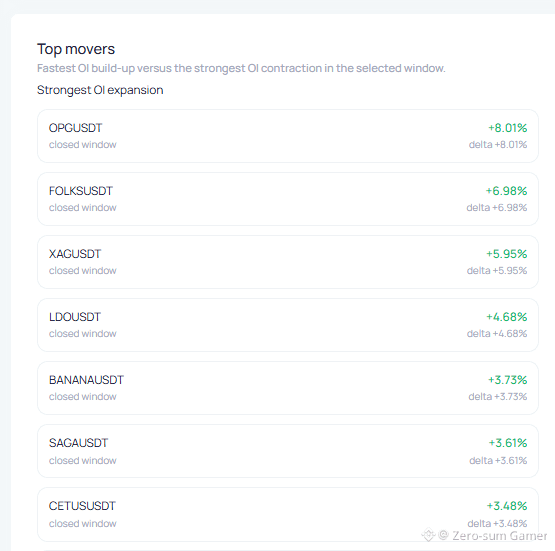
📈 Why I Track Coins With Rising Open Interest
Rising open interest shows where fresh risk is entering the market: new positions, new leverage, new pressure.
I track these coins first because price can look calm while positioning is already changing under the surface.
🔎 How I read it
When OI rises with price, I look for continuation after a clean pullback.
When OI rises while price stays flat, I watch the compression. This is where the next impulse often starts loading.
When OI spikes on a thin coin, I slow down and check funding, liquidations, volume, premium index and basic structure.
⚙️ How I trade it
A coin at the top of the OI list only gets attention. The trade needs a level, a pullback, a reaction, and clear invalidation.
For longs, I prefer strength after a pullback.
For shorts, I need overheated OI, weak continuation, fading momentum and the first signs of structure breaking.
🧰 Crypto Resources workflow
Inside Crypto Resources I use the OI screener as an attention filter. Then I check funding, liquidations, premium index and the Market Median.
The screener shows where the market is building pressure. The rest of the stack helps decide whether that pressure is continuation, trap, squeeze fuel or late leverage.
OI is where I start watching. The trade only comes after structure confirms.
#Openinterest #scan $LDO $BANANA $SAGA
{future}(SAGAUSDT)
{future}(BANANAUSDT)
{future}(LDOUSDT)
📈 Why I Track Coins With Rising Open Interest
Rising open interest shows where fresh risk is entering the market: new positions, new leverage, new pressure.
I track these coins first because price can look calm while positioning is already changing under the surface.
🔎 How I read it
When OI rises with price, I look for continuation after a clean pullback.
When OI rises while price stays flat, I watch the compression. This is where the next impulse often starts loading.
When OI spikes on a thin coin, I slow down and check funding, liquidations, volume, premium index and basic structure.
⚙️ How I trade it
A coin at the top of the OI list only gets attention. The trade needs a level, a pullback, a reaction, and clear invalidation.
For longs, I prefer strength after a pullback.
For shorts, I need overheated OI, weak continuation, fading momentum and the first signs of structure breaking.
🧰 Crypto Resources workflow
Inside Crypto Resources I use the OI screener as an attention filter. Then I check funding, liquidations, premium index and the Market Median.
The screener shows where the market is building pressure. The rest of the stack helps decide whether that pressure is continuation, trap, squeeze fuel or late leverage.
OI is where I start watching. The trade only comes after structure confirms.
#Openinterest #scan $LDO $BANANA $SAGA
Rising open interest shows where fresh risk is entering the market: new positions, new leverage, new pressure.
I track these coins first because price can look calm while positioning is already changing under the surface.
🔎 How I read it
When OI rises with price, I look for continuation after a clean pullback.
When OI rises while price stays flat, I watch the compression. This is where the next impulse often starts loading.
When OI spikes on a thin coin, I slow down and check funding, liquidations, volume, premium index and basic structure.
⚙️ How I trade it
A coin at the top of the OI list only gets attention. The trade needs a level, a pullback, a reaction, and clear invalidation.
For longs, I prefer strength after a pullback.
For shorts, I need overheated OI, weak continuation, fading momentum and the first signs of structure breaking.
🧰 Crypto Resources workflow
Inside Crypto Resources I use the OI screener as an attention filter. Then I check funding, liquidations, premium index and the Market Median.
The screener shows where the market is building pressure. The rest of the stack helps decide whether that pressure is continuation, trap, squeeze fuel or late leverage.
OI is where I start watching. The trade only comes after structure confirms.
#Openinterest #scan $LDO $BANANA $SAGA
3
564
·
--
$STO For those who hit $1.80 and even after 4 months we will only have this " Chicken flight 🐔" ?? Is that really it #STO?
#scan #Fraud_alert #golpe
$STO For those who hit $1.80 and even after 4 months we will only have this " Chicken flight 🐔" ?? Is that really it #STO?
#scan #Fraud_alert #golpe
#scan #Fraud_alert #golpe
1
322
Log in to explore more content
Join global crypto users on Binance Square
⚡️ Get latest and useful information about crypto.
💬 Trusted by the world’s largest crypto exchange.
👍 Discover real insights from verified creators.
Email / Phone number
Trending Topics
1
#BinancePick
3M views
152,141 Discussing
2
#EarningsSeason
5.3M views
25,852 Discussing
3
#AnthropicTTMRevenueGrewAbout1200%
23,672 views
356 Discussing
4
#AnthropicS1ExpectedToday
23,186 views
305 Discussing
5
#SouthKoreaReportedlyWeighsFourthCryptoTaxDelay
27,833 views
429 Discussing
6
#FranklinTempletonFilesForTwoDividendToBitcoinETFs
36,472 views
518 Discussing
7
#StrategyMSTRSurpassesNasdaqInMarketCap
27,548 views
375 Discussing
8
#CanadaProposesStablecoinRedemptionWithin3BusinessDays
1,241 views
36 Discussing
9
#ElectrumWalletBugLetRogueServersStealFunds
29,007 views
452 Discussing
10
#ArgentineCourtDismissesLIBRACaseAgainstMilei
43,886 views
559 Discussing