
#signdigitalsovereigninfra
signdigitalsovereigninfra
12.2M views
97,302 Discussing
Hot
Latest

·
--
#openledger $OPEN Focus on Sovereign Infrastructure
Empowering regions with robust decentralized architecture is the next massive frontier for Web3. By building foundational digital sovereign infrastructure, @SignOfficial is positioning itself perfectly to drive real-world economic growth and scale utility. Looking forward to seeing the long-term impact of $SIGN across emerging markets. #SignDigitalSovereignInfra
Empowering regions with robust decentralized architecture is the next massive frontier for Web3. By building foundational digital sovereign infrastructure, @SignOfficial is positioning itself perfectly to drive real-world economic growth and scale utility. Looking forward to seeing the long-term impact of $SIGN across emerging markets. #SignDigitalSovereignInfra
320



·
--
Bearish
#signdigitalsovereigninfra $SIGN SIGN Protocol: The Workshop of Digital Truth
In Web3, trust is not given, it is built. With SIGN Protocol, we move from abstraction to the "workshop" where verification is tangible. By connecting hardware and real data with the blockchain, we create a layer of irrefutable evidence.
Each attestation functions as a decentralized seal of approval: transparent, sovereign, and free from intermediaries. No more blind faith; now the user has control over their own certainty. Remember: in a market that punishes emotions, the discipline of verification is your greatest asset.@SignOfficial
1
9
86

·
--
Bullish
I am very happy to gain profit this coin is a ama my portfolio is double .if you want to gain profit trade this coin#signdigitalsovereigninfra $SIGN
I am very happy to gain profit this coin is a ama my portfolio is double .if you want to gain profit trade this coin#signdigitalsovereigninfra $SIGN
1
6

·
--
#signdigitalsovereigninfra $SIGN
There is no such thing as too late to start
improving yourself🥀
And there is no specific age to reach the best
As long as your heart is still beating, you have a chance every day ♥️
🌸May you all be well and succeed, O people of ambition💐
🌹
The most important rule in the world of money:
Do not spend a fortune to appear wealthy, but build your wealth to become wealthy.
Do not buy a bag for $500 to keep it empty,
Buy a bag for $70… and put the rest in it.
Do not go bankrupt to impress people,
But save to impress yourself.
#تحفيز #حكمة
#signaladvisor #signalsfutures
$BTC
1
90

What makes Sign more interesting to me is that it’s not really just a registry.
That sounds too passive.
The bigger thing is that it lets trust travel. A proof gets signed once, then other apps or chains can use it without making everyone go through the same verification ritual again. That makes the whole system feel less repetitive and a lot less dumb.
That’s the good part.
The uncomfortable part is where the risk moves next.
Because once trust becomes portable, issuers matter a lot more. A weak issuer doesn’t just make one bad attestation. It can poison a whole chain of downstream decisions. And then there’s the time problem. Something can be valid once and still look trustworthy long after it should’ve expired.
That’s the tension I keep coming back to.
Sign can make cross-chain trust cleaner and more reusable.
But reusable trust only works if the issuer stays credible and the proof doesn’t outlive the truth it was supposed to prove.
@SignOfficial #SignDigitalSovereignInfra $SIGN
#DriftProtocolExploited #ADPJobsSurge #GoogleStudyOnCryptoSecurityChallenges
$SIREN
91

From Airdrop to Staking: A Whole New Wealth Game Rule
In the world of digital assets
From Airdrop to Staking: A Whole New Wealth Game Rule
In the world of digital assets, the SIGN token is redefining community governance and incentives for long-term holders in an unprecedented way. It’s no longer just a trading chip; it’s a creative and interactive experiment where every holder can become a participant in the ecosystem’s development.
Initially, SIGN attracted users through airdrops, which is not only a quick user acquisition strategy but also a creative way to stimulate community engagement. Airdrops give ordinary folks a chance to get involved with the project, breaking the traditional finance monopoly on resources and allowing more people to ride the digital economy wave. However, the airdrop is just the beginning; the real value lies in how to continuously engage users and encourage them to hold long-term.
Thus, SIGN introduced a staking mechanism, which is not only a technical innovation but also a deep incentive for user behavior. Through staking, users can earn stable yields while participating in community decision-making, truly embodying the idea of "holding tokens equals power." This design makes holders not just investors but core drivers of the project’s development.
Throughout this process, SIGN has shown unique creative thinking by cleverly combining economic incentives with community governance, creating a sustainable ecosystem. For shoppers, this is not just an investment opportunity but a new consumption experience—they can earn additional yields by holding tokens and even influence the project’s future direction.
Such a design undoubtedly brings new vitality to the market and allows SIGN to stand out among many projects. It proves that when technology, creativity, and user demand perfectly blend, surprising results can be achieved. Whether for long-term holders or ordinary users, SIGN offers a whole new value proposition worth diving into and paying attention to.
From Airdrop to Staking: A Whole New Wealth Game Rule In the world of digital assets
From Airdrop to Staking: A Whole New Wealth Game Rule
In the world of digital assets, the SIGN token is redefining community governance and incentives for long-term holders in an unprecedented way. It’s no longer just a trading chip; it’s a creative and interactive experiment where every holder can become a participant in the ecosystem’s development.
Initially, SIGN attracted users through airdrops, which is not only a quick user acquisition strategy but also a creative way to stimulate community engagement. Airdrops give ordinary folks a chance to get involved with the project, breaking the traditional finance monopoly on resources and allowing more people to ride the digital economy wave. However, the airdrop is just the beginning; the real value lies in how to continuously engage users and encourage them to hold long-term.
Thus, SIGN introduced a staking mechanism, which is not only a technical innovation but also a deep incentive for user behavior. Through staking, users can earn stable yields while participating in community decision-making, truly embodying the idea of "holding tokens equals power." This design makes holders not just investors but core drivers of the project’s development.
Throughout this process, SIGN has shown unique creative thinking by cleverly combining economic incentives with community governance, creating a sustainable ecosystem. For shoppers, this is not just an investment opportunity but a new consumption experience—they can earn additional yields by holding tokens and even influence the project’s future direction.
Such a design undoubtedly brings new vitality to the market and allows SIGN to stand out among many projects. It proves that when technology, creativity, and user demand perfectly blend, surprising results can be achieved. Whether for long-term holders or ordinary users, SIGN offers a whole new value proposition worth diving into and paying attention to.
230

·
--

Article
🚨 Breaking: Shooting at the Correspondents' Dinner. How is the market reacting?The world is shaken by the weekend events in Washington. The attack on the Washington Hilton hotel during the annual White House Correspondents' Association dinner has become the major geopolitical trigger of these days.
What's known at this moment? 🛡️
Incident:
Shots were fired during the event. President Donald Trump and the First Lady were urgently evacuated by the Secret Service.
🚨 Breaking: Shooting at the Correspondents' Dinner. How is the market reacting?
The world is shaken by the weekend events in Washington. The attack on the Washington Hilton hotel during the annual White House Correspondents' Association dinner has become the major geopolitical trigger of these days.
What's known at this moment? 🛡️
Incident:
Shots were fired during the event. President Donald Trump and the First Lady were urgently evacuated by the Secret Service.
What's known at this moment? 🛡️
Incident:
Shots were fired during the event. President Donald Trump and the First Lady were urgently evacuated by the Secret Service.
1
186

·
--
Article
Shock‑Resistant by Design Infrastructure That Holds When Everything BreaksI have heard enough big crypto claims to know the pattern everything Sounds airtight until markets peak then it vanishes. So fail‑safe infrastructure doesn’t make me excited; it makes me cautious. I dug in because SIGN Protocol looked different for a straightforward reason: it isn’t stuck in theory, it’s already in use.
The idea’s simple enough to respect build systems that don’t crumble under pressure, not just for me trading at night but for entire countries. That’s a heavy claim. Governments don’t want experiments; they need things that keep working when everything else breaks. What grabs me is the focus on shock resistance. It’s real: markets crash, banks freeze, systems fail. I’ve watched it happen too many times. If infra can’t take stress it’s useless when it matters.
@SignOfficial SIGN seems aimed right at that gap. Instead of launching another token or chasing the same hype loop, it works on the base layer how trust and data are handled. Quiet work but important. From what I can tell it’s already deployed in real situations, and that outweighs any roadmap slide.
Still I’m not blindly recommending it or throwing myself wholly in. Sovereign‑grade infrastructure is serious governments move slowly for good reason. Security, control, accountability can’t be half‑baked. One weak point and the whole system gets questioned; tech ends up trash. I respect the direction, though. If blockchain has long‑term value, this is where it needs to go: not memes, not speculation, but ecosystems that stay standing when things go sideways.
I’m doubtful, but I’m watching closely. If something like this actually works at scale, it changes how countries think about digital infrastructure. I don’t get carried away by big claims, but I don’t ignore quiet progress either. Watch what gets used, learn, teach others that’s how real adoption moves forward. It’s not as far off as people think.#SignDigitalSovereignInfra $SIGN
Shock‑Resistant by Design Infrastructure That Holds When Everything Breaks
I have heard enough big crypto claims to know the pattern everything Sounds airtight until markets peak then it vanishes. So fail‑safe infrastructure doesn’t make me excited; it makes me cautious. I dug in because SIGN Protocol looked different for a straightforward reason: it isn’t stuck in theory, it’s already in use.
The idea’s simple enough to respect build systems that don’t crumble under pressure, not just for me trading at night but for entire countries. That’s a heavy claim. Governments don’t want experiments; they need things that keep working when everything else breaks. What grabs me is the focus on shock resistance. It’s real: markets crash, banks freeze, systems fail. I’ve watched it happen too many times. If infra can’t take stress it’s useless when it matters.
@SignOfficial SIGN seems aimed right at that gap. Instead of launching another token or chasing the same hype loop, it works on the base layer how trust and data are handled. Quiet work but important. From what I can tell it’s already deployed in real situations, and that outweighs any roadmap slide.
Still I’m not blindly recommending it or throwing myself wholly in. Sovereign‑grade infrastructure is serious governments move slowly for good reason. Security, control, accountability can’t be half‑baked. One weak point and the whole system gets questioned; tech ends up trash. I respect the direction, though. If blockchain has long‑term value, this is where it needs to go: not memes, not speculation, but ecosystems that stay standing when things go sideways.
I’m doubtful, but I’m watching closely. If something like this actually works at scale, it changes how countries think about digital infrastructure. I don’t get carried away by big claims, but I don’t ignore quiet progress either. Watch what gets used, learn, teach others that’s how real adoption moves forward. It’s not as far off as people think.#SignDigitalSovereignInfra $SIGN
22
20
481

#signdigitalsovereigninfra $SIGN Market looking choppy today, but smart money knows this is where patience pays. Accumulating solid projects during uncertainty has always been the winning strategy. Are you buying fear or waiting for confirmation?
#signdigitalsovereigninfra $SIGN Market looking choppy today, but smart money knows this is where patience pays. Accumulating solid projects during uncertainty has always been the winning strategy. Are you buying fear or waiting for confirmation?
1
35

·
--
Article
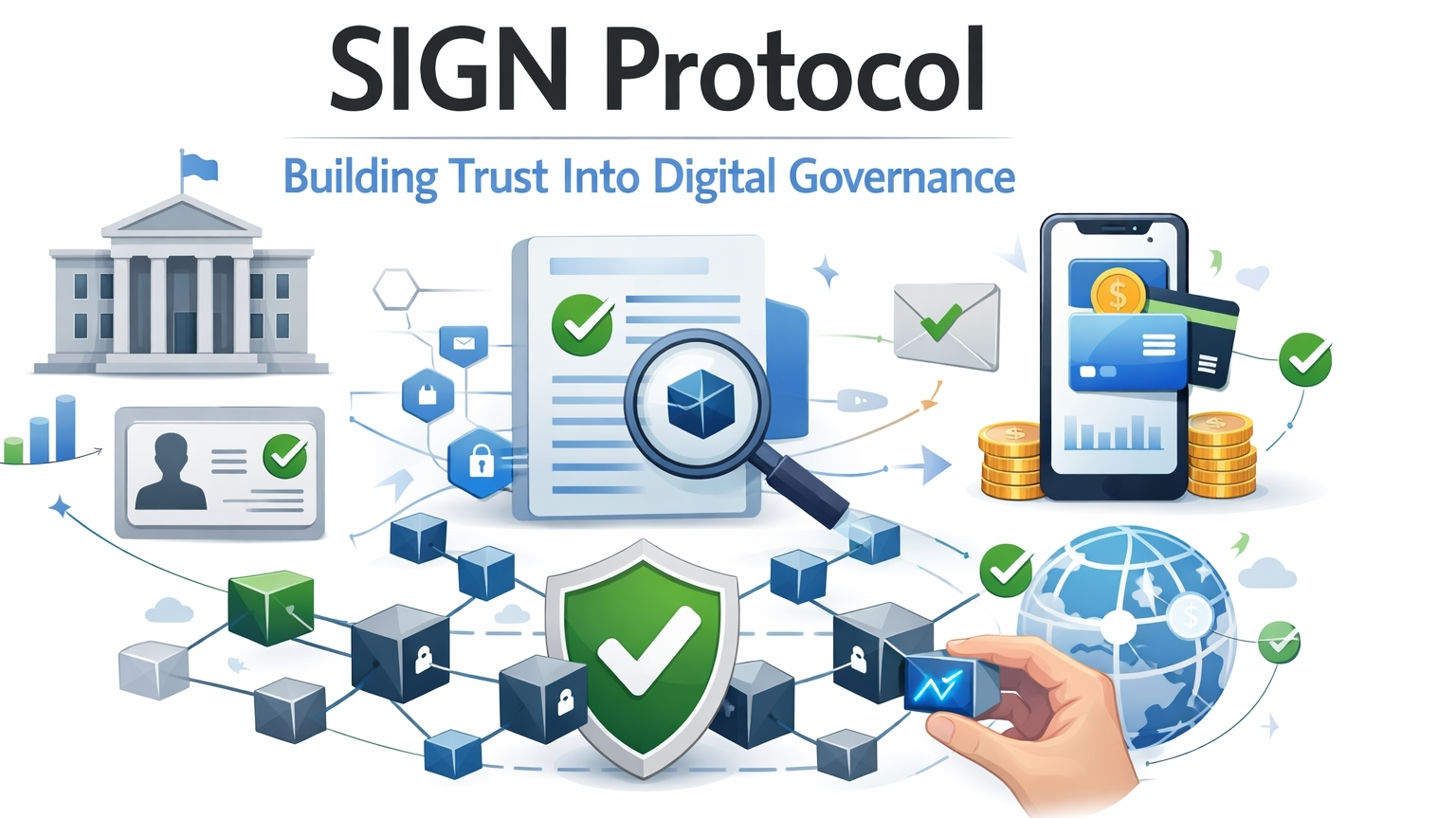
SIGN Protocol: Building Trust Into Digital GovernanceSIGN Protocol feels different because it is not trying to impress people with noise first and meaning later. A lot of projects in this space come in loud. Big promises, big words, polished branding, but once you look under the surface, there is not much there besides another token narrative. SIGN does not really hit like that. The more you look at it, the more it feels like a project built around a real problem.
That problem is simple to understand. The digital world keeps expanding, but trust inside digital systems is still weak. Records are scattered. Verification is fragmented. One system says one thing, another says something else, and nobody is fully sure where the final truth sits. A document can be approved, a credential can be issued, a payment can be processed, but proving the full story behind it later is often harder than it should be. That is where SIGN starts to matter.
At the center of the project is the idea of attestations. That sounds technical at first, but the meaning is actually very human. It is about turning a claim into something that can be verified instead of just believed. A person, an institution, or a system says something is true, and that truth is structured, signed, and made usable across different environments. That changes the whole feeling of digital interaction. Instead of depending on closed databases and disconnected approvals, there is a clearer way to carry proof.
What makes SIGN stand out is that it is not only solving this for one app or one isolated use case. The project feels like it is thinking at a much larger level. Identity, credentials, payments, compliance, access, public records, digital capital — all of these things depend on trusted data. If the trust layer is weak, every other layer becomes shaky too. SIGN seems to understand that better than most. It is not just building tools. It is building the base logic that lets digital systems rely on each other without falling into chaos.
That is why the project feels more serious the longer you sit with it. It is not trying to decorate governance and make it look trendy. It is trying to make digital governance actually work. And that matters, because governance in the digital era is not just about elections or policy language. It is about how systems decide what is valid, who is eligible, what is approved, what can be checked, and what can be trusted later when questions come up. That is a hard layer to build. It is not flashy work. But it is the kind of work that lasts.
There is also something mature about the way SIGN approaches structure. It does not pretend the world is simple. Real systems need roles, accountability, revocation, audits, permissions, upgrades, boundaries. In other words, they need discipline. A lot of crypto projects try to skip that part and act like pure openness solves everything. It does not. In real life, systems break when nobody knows who is responsible or when proof cannot survive stress. SIGN seems built with that reality in mind. That alone gives the project more weight.
The identity side of SIGN is especially important. Digital identity has been talked about for years, but most approaches still feel shallow. They treat identity like a login feature instead of what it really is — the base layer for access, services, credentials, benefits, compliance, and participation. Once that layer is weak, everything built on top of it starts to wobble. SIGN gives the impression that identity should not just exist, it should be provable, reusable, and portable. That is a much stronger vision than the usual disconnected database model.
The payment and distribution angle makes the project even more interesting. In the real world, identity and money are deeply connected. Who gets paid, who qualifies, who has authority, who can receive benefits, who can prove ownership — none of that works smoothly if trust is broken at the record level. SIGN is valuable because it sits close to that pressure point. It is trying to make trusted coordination possible between systems that normally struggle to speak the same language. That is not a small ambition. It is actually one of the biggest infrastructure problems out there.
What I like most is that the project does not feel like it is chasing hype first. It feels like it is building something that institutions, governments, businesses, and digital ecosystems could actually use when things become more complex. And that is usually where real value lives. Not in whatever sounds exciting for one week, but in whatever keeps making sense when the attention cools down. SIGN has that kind of shape. The kind that becomes more relevant as the digital world grows more serious.
Of course, no project is automatically great just because the idea is strong. Execution still matters. Adoption matters. Integration matters. A framework can look smart on paper and still struggle in practice. That part is real, and it should never be ignored. But even with that in mind, SIGN still feels like one of the more thoughtful projects in this lane because it is trying to fix something fundamental. It is asking how digital systems can create proof that survives doubt, not just activity that looks impressive on a dashboard.
That is why the project leaves a stronger impression than a lot of louder names. It is not forcing a revolution story. It is working on trust infrastructure. And trust infrastructure is one of those things people ignore until they realize everything depends on it. Once identity, governance, credentials, and value all move deeper into digital rails, the systems underneath will need more than speed. They will need structure. They will need proof. They will need something that can be checked, reused, and trusted across environments.
That is the lane SIGN is moving in, and honestly, that is what gives the project real depth. It is not just building another crypto product. It is trying to build a foundation for how digital systems can function with more clarity, more accountability, and less blind trust. That makes it feel less like a trend and more like a serious long-term project.
#SignDigitalSovereignInfra @SignOfficial $SIGN
SIGN Protocol: Building Trust Into Digital Governance
SIGN Protocol feels different because it is not trying to impress people with noise first and meaning later. A lot of projects in this space come in loud. Big promises, big words, polished branding, but once you look under the surface, there is not much there besides another token narrative. SIGN does not really hit like that. The more you look at it, the more it feels like a project built around a real problem.
That problem is simple to understand. The digital world keeps expanding, but trust inside digital systems is still weak. Records are scattered. Verification is fragmented. One system says one thing, another says something else, and nobody is fully sure where the final truth sits. A document can be approved, a credential can be issued, a payment can be processed, but proving the full story behind it later is often harder than it should be. That is where SIGN starts to matter.
At the center of the project is the idea of attestations. That sounds technical at first, but the meaning is actually very human. It is about turning a claim into something that can be verified instead of just believed. A person, an institution, or a system says something is true, and that truth is structured, signed, and made usable across different environments. That changes the whole feeling of digital interaction. Instead of depending on closed databases and disconnected approvals, there is a clearer way to carry proof.
What makes SIGN stand out is that it is not only solving this for one app or one isolated use case. The project feels like it is thinking at a much larger level. Identity, credentials, payments, compliance, access, public records, digital capital — all of these things depend on trusted data. If the trust layer is weak, every other layer becomes shaky too. SIGN seems to understand that better than most. It is not just building tools. It is building the base logic that lets digital systems rely on each other without falling into chaos.
That is why the project feels more serious the longer you sit with it. It is not trying to decorate governance and make it look trendy. It is trying to make digital governance actually work. And that matters, because governance in the digital era is not just about elections or policy language. It is about how systems decide what is valid, who is eligible, what is approved, what can be checked, and what can be trusted later when questions come up. That is a hard layer to build. It is not flashy work. But it is the kind of work that lasts.
There is also something mature about the way SIGN approaches structure. It does not pretend the world is simple. Real systems need roles, accountability, revocation, audits, permissions, upgrades, boundaries. In other words, they need discipline. A lot of crypto projects try to skip that part and act like pure openness solves everything. It does not. In real life, systems break when nobody knows who is responsible or when proof cannot survive stress. SIGN seems built with that reality in mind. That alone gives the project more weight.
The identity side of SIGN is especially important. Digital identity has been talked about for years, but most approaches still feel shallow. They treat identity like a login feature instead of what it really is — the base layer for access, services, credentials, benefits, compliance, and participation. Once that layer is weak, everything built on top of it starts to wobble. SIGN gives the impression that identity should not just exist, it should be provable, reusable, and portable. That is a much stronger vision than the usual disconnected database model.
The payment and distribution angle makes the project even more interesting. In the real world, identity and money are deeply connected. Who gets paid, who qualifies, who has authority, who can receive benefits, who can prove ownership — none of that works smoothly if trust is broken at the record level. SIGN is valuable because it sits close to that pressure point. It is trying to make trusted coordination possible between systems that normally struggle to speak the same language. That is not a small ambition. It is actually one of the biggest infrastructure problems out there.
What I like most is that the project does not feel like it is chasing hype first. It feels like it is building something that institutions, governments, businesses, and digital ecosystems could actually use when things become more complex. And that is usually where real value lives. Not in whatever sounds exciting for one week, but in whatever keeps making sense when the attention cools down. SIGN has that kind of shape. The kind that becomes more relevant as the digital world grows more serious.
Of course, no project is automatically great just because the idea is strong. Execution still matters. Adoption matters. Integration matters. A framework can look smart on paper and still struggle in practice. That part is real, and it should never be ignored. But even with that in mind, SIGN still feels like one of the more thoughtful projects in this lane because it is trying to fix something fundamental. It is asking how digital systems can create proof that survives doubt, not just activity that looks impressive on a dashboard.
That is why the project leaves a stronger impression than a lot of louder names. It is not forcing a revolution story. It is working on trust infrastructure. And trust infrastructure is one of those things people ignore until they realize everything depends on it. Once identity, governance, credentials, and value all move deeper into digital rails, the systems underneath will need more than speed. They will need structure. They will need proof. They will need something that can be checked, reused, and trusted across environments.
That is the lane SIGN is moving in, and honestly, that is what gives the project real depth. It is not just building another crypto product. It is trying to build a foundation for how digital systems can function with more clarity, more accountability, and less blind trust. That makes it feel less like a trend and more like a serious long-term project.
#SignDigitalSovereignInfra @SignOfficial $SIGN
9
13
633

·
--
#signdigitalsovereigninfra $SIGN
From 0.128 to 0.032: A Redefinition of Value
In the cryptocurrency market, price fluctuations are as unpredictable as tides. The SIGN coin once plummeted from $0.128 to $0.032 in a short period, a drop of as much as 75%. Behind this number lies not only a plunge in value but also a violent shake-up of market sentiment. For investors, this may be a frustrating moment, but it is also an opportunity to reassess the essence and future potential of the project.
When prices fall sharply, it often signifies a severe erosion of market confidence in the project. However, projects with true long-term value are often able to gather strength in the lows, waiting for the right moment to rise again. The recent crash of the SIGN coin, while unexpected, has provided an entry opportunity for those visionary investors. The market is always correcting its mistakes, and true value will ultimately manifest over time.
From a technical perspective, the underlying logic and application scenarios of the SIGN coin have not changed due to the price drop. Its decentralized architecture, smart contract functionality, and ecosystem development remain the core elements supporting its long-term value. The short-term panic in the market may keep prices depressed, but these factors will not hinder the project's progress and development.
Moreover, this price adjustment has injected new vitality into the market. Some investors who were hesitant due to high valuations may now find more reasonable entry points. At the same time, project teams may seize this opportunity to optimize operations and strengthen community building, further solidifying their position in the industry.
Whether newbies or veterans, facing the extreme fluctuations of the market requires maintaining calm and rationality. The essence of cryptocurrency is technological innovation and value transmission, rather than a tool for short-term speculation. The recent drop of the SIGN coin may be a reminder from the market: returning to the essence is the right path to the future.
After experiencing such dramatic fluctuations, the return of the SIGN coin's value is not out of reach. What it needs is time, patience, and confidence in the project itself. For those willing to wait and believe in its potential, the future may bring unexpected rewards.
@SignOfficial $SIGN #Sign地缘政治基建
10
309

·
--
#signdigitalsovereigninfra $SIGN
The innovative value and application prospects of the SIGN token. In the field of Web3 identity verification, the SIGN token is initiating a profound transformation with its unique full-chain proof protocol technology. Unlike traditional centralized identity authentication methods, SIGN achieves a decentralized, transparent, and tamper-proof identity verification mechanism through blockchain technology, providing users with greater data sovereignty and privacy protection.
The full-chain proof protocol is the core technical highlight of SIGN, allowing users to generate and verify identity credentials across different chains, ensuring consistency and credibility of information throughout the ecosystem. This cross-chain compatibility not only enhances user experience but also provides robust support for developers to build diverse application scenarios. Whether it's digital identity management, financial transactions, or enterprise-level authentication, SIGN can offer efficient and reliable solutions.
As the Web3 ecosystem continues to expand, the demand for identity verification is growing. The SIGN token is not just a financial asset but also an infrastructure that drives progress in the entire industry. Its value is reflected not only in technical aspects but also in its high regard for user privacy and data security. By decentralizing, SIGN effectively reduces reliance on third-party institutions, lowers fraud risks, and improves overall system security.
For ordinary users, the SIGN token represents a whole new way of managing digital identities, putting personal data truly in their own hands. For developers and enterprises, SIGN provides rich API interfaces and development tools, facilitating quick integration into existing systems for seamless connectivity.
In the future, the SIGN token is expected to be applied in more vertical fields and become an important participant in the Web3 identity verification track. With its innovative technical architecture and clear business logic, SIGN is redefining the future direction of digital identity and injecting new vitality into the entire industry.
@SignOfficial $SIGN #Sign地缘政治基建
136



·
--
@SignOfficial I’ll be honest I used to hate proving anything online. Same forms, same screenshots, same “trust me bro” loop. Then I started digging into how things run on Ethereum and honestly… it clicked a bit.
From what I’ve seen, Sign Protocol isn’t trying to be flashy. It’s just fixing something painfully basic. Turning proofs into reusable on-chain credentials. You verify once, and it sticks. That alone feels like real utility, not hype.
Still, I wonder how far this scales outside crypto-native users. Regular people don’t care about wallets. They care about convenience.
But yeah… this feels closer to real-world infrastructure than most “next big things” I’ve come across.
I’ll be honest, I’ve become skeptical of anything mixing tokens with “infrastructure.” Usually it’s forced. But this case feels… different.
Sign Protocol leans more into verification than speculation. It’s like giving blockchain a job beyond trading. Credentials, attestations, distribution… stuff that actually matters off-chain too.
I think that’s where Web3 slowly redeems itself. When it stops shouting and just works quietly in the background.
Only concern? If adoption doesn’t reach institutions, it stays a niche tool. And we’ve seen that story before.
There’s always been this gap in Web3. We talk about ownership, identity, reputation… but the proof layer felt messy.
After spending time exploring on-chain systems, I kinda see Sign Protocol as that missing layer. Not exciting on the surface, but foundational.
It’s like plumbing. You don’t notice it until it’s broken.
And yeah, it’s not perfect. Gas fees, UX friction, and fragmented standards still exist. But direction-wise? This makes more sense than another DeFi fork or NFT trend.
Feels like quiet progress. The kind that doesn’t trend, but actually lasts.
#SignDigitalSovereignInfra $SIGN
3
1
168


·
--
Article
SIGN: The Quiet Infrastructure Behind Trust, Proof, and Digital CoordinationWhen I first looked at SIGN, I did not see a flashy consumer product or a token built around hype. I saw something more practical and, in a way, more serious: an attempt to turn verification into infrastructure. That matters because crypto has already given us many ways to move value, but it has not yet solved the harder problem of how to prove things cleanly, consistently, and across different systems. Who approved what. Who is eligible. Which record is valid. Which claim can be trusted later. These are not glamorous questions, but they are the questions that decide whether digital systems can scale beyond speculation and into real coordination.
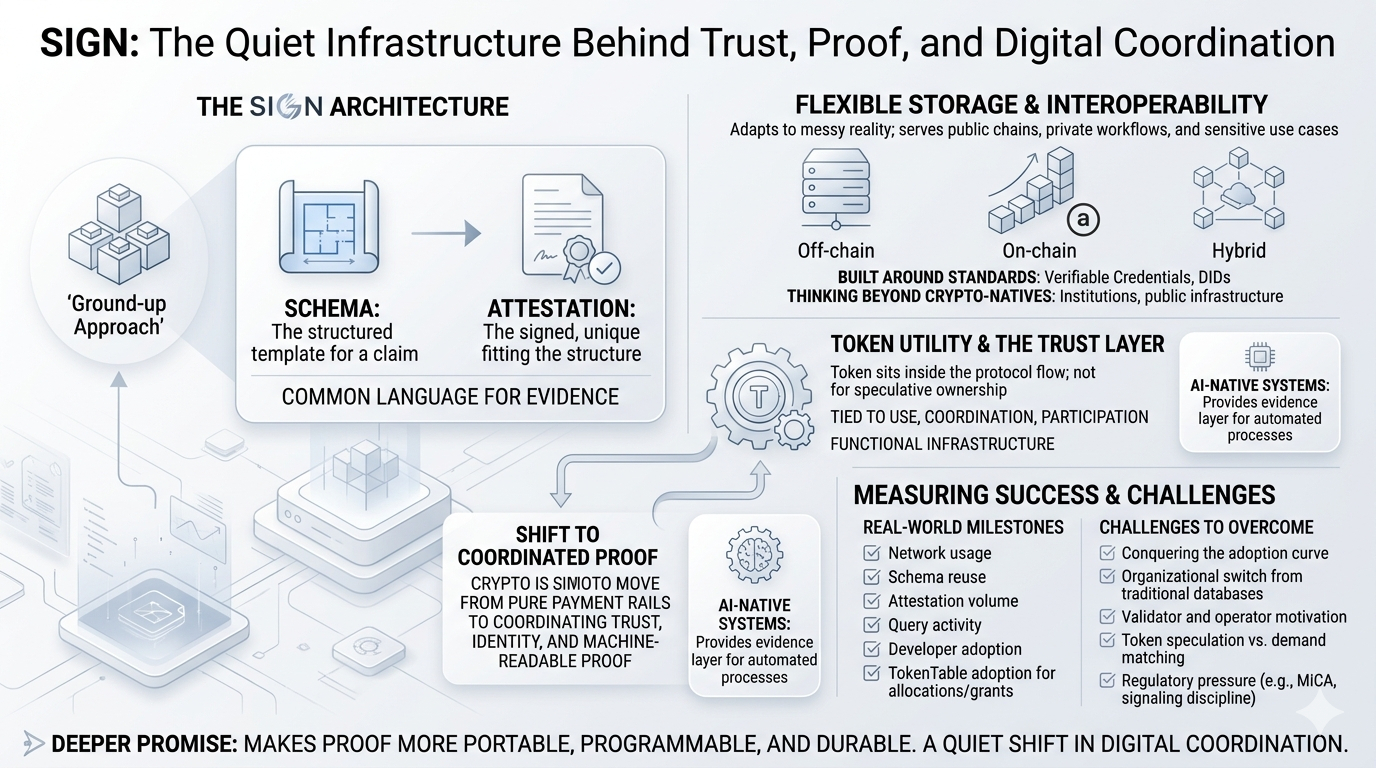
I noticed that SIGN is trying to answer this problem from the ground up. The core idea is simple enough to explain: a schema is used as the structure for a claim, and an attestation is the signed record that fits that structure. That means the protocol is not just storing data for the sake of storing data. It is creating a common language for evidence. This becomes important when you think about how many systems today still rely on scattered databases, manual checks, screenshots, PDFs, and trust assumptions that are hard to verify later. SIGN is trying to replace that mess with a more stable way to write down proof so it can be checked, queried, and reused.
I started thinking about why this matters so much in crypto specifically. The industry has spent years building financial rails, but those rails still depend on identity, eligibility, authorization, and auditability. A token can move, but it does not by itself prove who is allowed to receive it, whether a rule was followed, or whether a decision can be defended later. That is where SIGN starts to feel relevant. It is not just another protocol competing for attention. It is trying to become a trust layer underneath many different kinds of digital activity, from institutional workflows to public programs to on-chain distribution systems.
The architecture makes more sense once you look at the problem it is solving. I wondered why the builders did not choose a single rigid design, and the answer seems to be that reality is too messy for that. The docs describe support for fully on-chain, fully off-chain, and hybrid setups. Evidence can live on-chain, in Arweave, or in a mixed model where the important reference stays verifiable while the heavier data stays elsewhere. That is a practical design choice. It lets the protocol serve public chains, private workflows, and sensitive use cases without forcing every application into the same storage pattern. It also suggests that the team understands a basic truth of infrastructure: flexibility often matters more than elegance.
Another thing that stood out to me is the emphasis on standards and interoperability. SIGN is built around ideas that fit naturally with broader identity and verification systems, including verifiable credentials and decentralized identifiers. That tells me the builders are not only thinking about crypto-native users. They are thinking about institutions, public infrastructure, and systems where proof has to survive long after the original transaction has passed. The indexing layer, SignScan, adds another important piece. It gives developers a way to query and search across attestations and schemas, which means the protocol is not only creating records but also making them useful. In practice, that is what turns a protocol into infrastructure rather than a niche archive.
The token side is where the project becomes more delicate, because tokens often carry too many hopes at once. In SIGN’s case, the token is meant to sit inside the protocol rather than float above it as a separate speculative object. The whitepaper describes it as part of the protocol’s utility and ecosystem flow, not as an ownership claim in the classic corporate sense. That matters because it changes how you understand the asset. The token is not just there to be traded. It is tied to use, coordination, and participation. It may support services, access, distribution logic, and parts of the protocol’s operating structure. In that sense, the token is trying to be functional infrastructure rather than a decorative layer on top.
That also helps explain the wider market narrative around SIGN. We are seeing a shift in crypto away from pure payment rails and toward systems that coordinate trust, identity, and machine-readable proof. SIGN fits into that shift naturally. It sits close to Web3 infrastructure, but it also touches ideas that are becoming more important in the age of automation and artificial intelligence. If machines are going to participate in commerce, compliance, grants, subsidies, or resource allocation, they need records they can verify without human interpretation every time. SIGN looks like an attempt to provide that kind of evidence layer. It is not being positioned as an AI project in the loud, promotional sense, but it may still end up serving AI-native systems if those systems need structured proof to operate.
The longer I sat with it, the more I realized that the hardest part is not the technology itself. The hard part is adoption. A protocol like this has to convince developers to use its schemas instead of inventing their own. It has to convince organizations that an on-chain or hybrid attestation is worth the switch from familiar databases and custom workflows. It has to convince validators and operators that the network is worth maintaining honestly over time. And it has to do all of that while surviving the usual forces that shape crypto: token speculation, changing market cycles, uneven user interest, and the constant pressure to justify why a blockchain should be involved at all.
Regulation adds another layer of pressure. The project’s MiCA whitepaper shows that it is already moving in a more formal direction than many crypto experiments. That can be a strength because it signals a willingness to operate in a more structured environment, but it also raises expectations. Once a project begins speaking in the language of regulated markets, it has to live up to that language. Documentation needs to be clearer. Claims need to be more careful. Governance needs to be more defensible. I think that is part of the point here, though. A verification protocol cannot really afford to be vague. If anything, it has to be more disciplined than the systems it is trying to improve.
Success for SIGN, realistically, should not be measured only by token enthusiasm. The more meaningful signs of progress would be network usage, schema reuse, attestation volume, query activity, and whether developers treat it as a default evidence layer instead of a one-off experiment. I would also watch whether TokenTable and the broader Sign stack become normal tools for allocations, vesting, grants, or regulated distribution workflows. If that happens, then the project is not just storing proof. It is helping coordinate economic activity in a way that is transparent, reusable, and easier to audit. That would be a real milestone because it would mean the protocol has moved from promise to habit.
Of course, there are limits. Not every verification problem belongs on a blockchain. Not every organization wants public evidence, even if the evidence is structured. Not every user will care about a cleaner proof layer if the existing system is already “good enough.” And even a well-designed token model can struggle if demand does not match the incentives built into it. These are not small issues. They are the reasons many infrastructure projects look obvious in theory but slow down in practice. SIGN will have to prove that it can deliver something better, not just something different.
Still, I keep coming back to the same thought: maybe the most important infrastructure in crypto is not the loudest one. Maybe it is the layer that helps systems remember what happened, who approved it, and whether the record can be trusted later. That is the deeper promise I see in SIGN. It is trying to make proof more portable, more programmable, and more durable. If it succeeds, the result will not just be a stronger protocol. It will be a quieter but more meaningful shift in how digital systems coordinate. And that kind of shift is often the one that lasts longest.
@SignOfficial #SignDigitalSovereignInfra $SIGN
{future}(SIGNUSDT)
SIGN: The Quiet Infrastructure Behind Trust, Proof, and Digital Coordination
When I first looked at SIGN, I did not see a flashy consumer product or a token built around hype. I saw something more practical and, in a way, more serious: an attempt to turn verification into infrastructure. That matters because crypto has already given us many ways to move value, but it has not yet solved the harder problem of how to prove things cleanly, consistently, and across different systems. Who approved what. Who is eligible. Which record is valid. Which claim can be trusted later. These are not glamorous questions, but they are the questions that decide whether digital systems can scale beyond speculation and into real coordination.
I noticed that SIGN is trying to answer this problem from the ground up. The core idea is simple enough to explain: a schema is used as the structure for a claim, and an attestation is the signed record that fits that structure. That means the protocol is not just storing data for the sake of storing data. It is creating a common language for evidence. This becomes important when you think about how many systems today still rely on scattered databases, manual checks, screenshots, PDFs, and trust assumptions that are hard to verify later. SIGN is trying to replace that mess with a more stable way to write down proof so it can be checked, queried, and reused.
I started thinking about why this matters so much in crypto specifically. The industry has spent years building financial rails, but those rails still depend on identity, eligibility, authorization, and auditability. A token can move, but it does not by itself prove who is allowed to receive it, whether a rule was followed, or whether a decision can be defended later. That is where SIGN starts to feel relevant. It is not just another protocol competing for attention. It is trying to become a trust layer underneath many different kinds of digital activity, from institutional workflows to public programs to on-chain distribution systems.
The architecture makes more sense once you look at the problem it is solving. I wondered why the builders did not choose a single rigid design, and the answer seems to be that reality is too messy for that. The docs describe support for fully on-chain, fully off-chain, and hybrid setups. Evidence can live on-chain, in Arweave, or in a mixed model where the important reference stays verifiable while the heavier data stays elsewhere. That is a practical design choice. It lets the protocol serve public chains, private workflows, and sensitive use cases without forcing every application into the same storage pattern. It also suggests that the team understands a basic truth of infrastructure: flexibility often matters more than elegance.
Another thing that stood out to me is the emphasis on standards and interoperability. SIGN is built around ideas that fit naturally with broader identity and verification systems, including verifiable credentials and decentralized identifiers. That tells me the builders are not only thinking about crypto-native users. They are thinking about institutions, public infrastructure, and systems where proof has to survive long after the original transaction has passed. The indexing layer, SignScan, adds another important piece. It gives developers a way to query and search across attestations and schemas, which means the protocol is not only creating records but also making them useful. In practice, that is what turns a protocol into infrastructure rather than a niche archive.
The token side is where the project becomes more delicate, because tokens often carry too many hopes at once. In SIGN’s case, the token is meant to sit inside the protocol rather than float above it as a separate speculative object. The whitepaper describes it as part of the protocol’s utility and ecosystem flow, not as an ownership claim in the classic corporate sense. That matters because it changes how you understand the asset. The token is not just there to be traded. It is tied to use, coordination, and participation. It may support services, access, distribution logic, and parts of the protocol’s operating structure. In that sense, the token is trying to be functional infrastructure rather than a decorative layer on top.
That also helps explain the wider market narrative around SIGN. We are seeing a shift in crypto away from pure payment rails and toward systems that coordinate trust, identity, and machine-readable proof. SIGN fits into that shift naturally. It sits close to Web3 infrastructure, but it also touches ideas that are becoming more important in the age of automation and artificial intelligence. If machines are going to participate in commerce, compliance, grants, subsidies, or resource allocation, they need records they can verify without human interpretation every time. SIGN looks like an attempt to provide that kind of evidence layer. It is not being positioned as an AI project in the loud, promotional sense, but it may still end up serving AI-native systems if those systems need structured proof to operate.
The longer I sat with it, the more I realized that the hardest part is not the technology itself. The hard part is adoption. A protocol like this has to convince developers to use its schemas instead of inventing their own. It has to convince organizations that an on-chain or hybrid attestation is worth the switch from familiar databases and custom workflows. It has to convince validators and operators that the network is worth maintaining honestly over time. And it has to do all of that while surviving the usual forces that shape crypto: token speculation, changing market cycles, uneven user interest, and the constant pressure to justify why a blockchain should be involved at all.
Regulation adds another layer of pressure. The project’s MiCA whitepaper shows that it is already moving in a more formal direction than many crypto experiments. That can be a strength because it signals a willingness to operate in a more structured environment, but it also raises expectations. Once a project begins speaking in the language of regulated markets, it has to live up to that language. Documentation needs to be clearer. Claims need to be more careful. Governance needs to be more defensible. I think that is part of the point here, though. A verification protocol cannot really afford to be vague. If anything, it has to be more disciplined than the systems it is trying to improve.
Success for SIGN, realistically, should not be measured only by token enthusiasm. The more meaningful signs of progress would be network usage, schema reuse, attestation volume, query activity, and whether developers treat it as a default evidence layer instead of a one-off experiment. I would also watch whether TokenTable and the broader Sign stack become normal tools for allocations, vesting, grants, or regulated distribution workflows. If that happens, then the project is not just storing proof. It is helping coordinate economic activity in a way that is transparent, reusable, and easier to audit. That would be a real milestone because it would mean the protocol has moved from promise to habit.
Of course, there are limits. Not every verification problem belongs on a blockchain. Not every organization wants public evidence, even if the evidence is structured. Not every user will care about a cleaner proof layer if the existing system is already “good enough.” And even a well-designed token model can struggle if demand does not match the incentives built into it. These are not small issues. They are the reasons many infrastructure projects look obvious in theory but slow down in practice. SIGN will have to prove that it can deliver something better, not just something different.
Still, I keep coming back to the same thought: maybe the most important infrastructure in crypto is not the loudest one. Maybe it is the layer that helps systems remember what happened, who approved it, and whether the record can be trusted later. That is the deeper promise I see in SIGN. It is trying to make proof more portable, more programmable, and more durable. If it succeeds, the result will not just be a stronger protocol. It will be a quieter but more meaningful shift in how digital systems coordinate. And that kind of shift is often the one that lasts longest.
@SignOfficial #SignDigitalSovereignInfra $SIGN
59
53
1.4k

·
--
Article
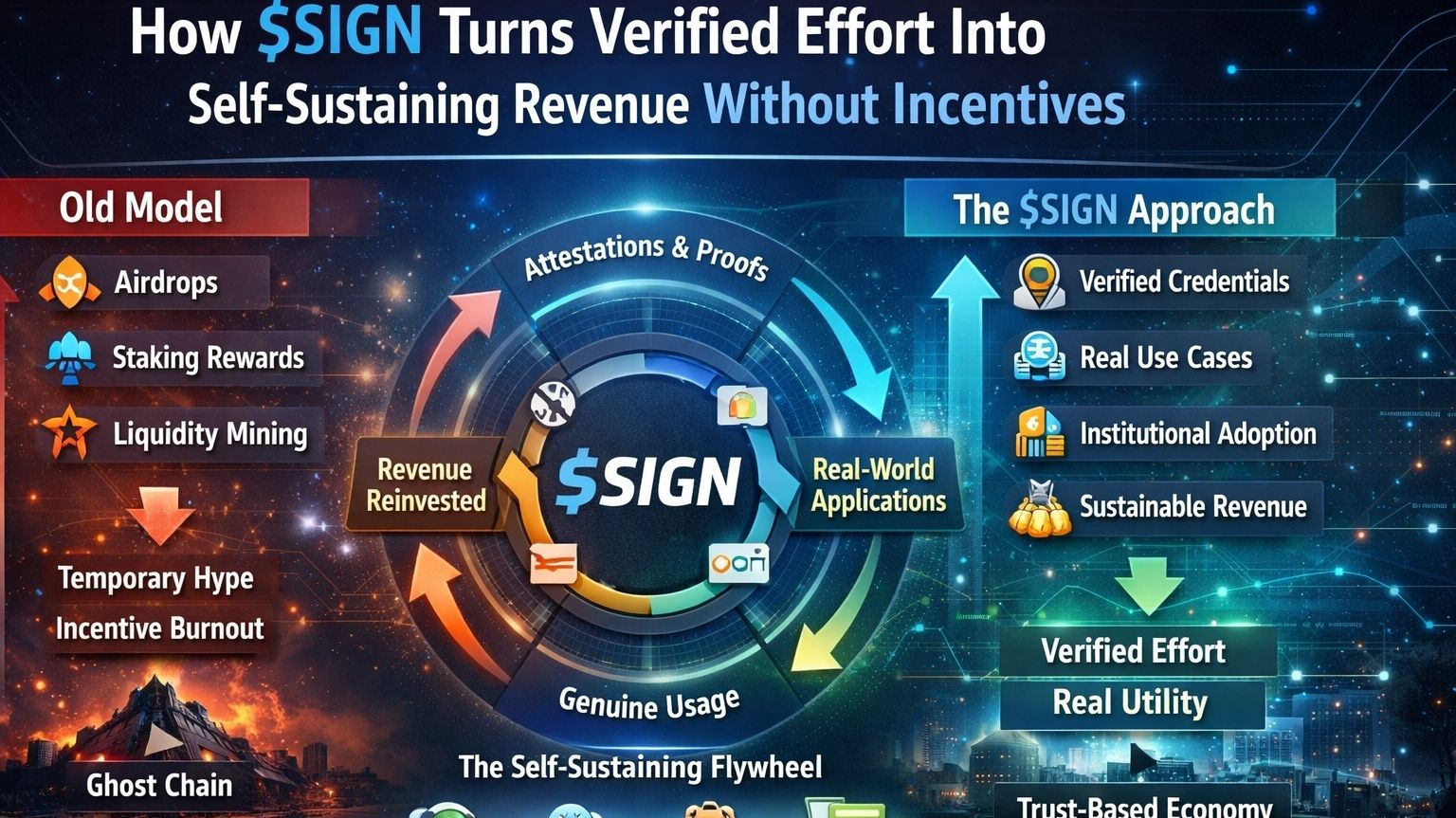
How $SIGN Turns Verified Effort Into Self-Sustaining Revenue Without IncentivesIf I’m being honest, this is one of the biggest things that has always bothered me about crypto.
We call a lot of projects “infrastructure,” but when you look closely, many of them are not really being sustained by utility. They are being sustained by incentives. First there is an airdrop, then staking rewards, then liquidity mining, then some new emissions program to keep people active. For a while, everything looks alive. The dashboards look strong. The community looks engaged. Activity is everywhere.
But eventually the rewards start slowing down.
And that is when the truth usually shows up.
Volume fades. Users disappear. Builders lose interest. The energy that once looked like adoption suddenly feels shallow. You realize a lot of that momentum was never organic in the first place. It was rented. People were not always there because the product had become essential. They were there because the token was paying them to care.
That is why $SIGN feels different to me.
What makes Sign interesting is not just that it is building infrastructure. A lot of projects say that. What stands out is the possibility that it is building a system where verified effort itself becomes economically useful. That is a very different foundation from the usual crypto playbook.
Because real infrastructure should not need to constantly bribe people into using it. Real infrastructure becomes valuable when it solves something painful enough, clearly enough, and at enough scale that people end up using it because they need it.
That is what I think makes the Sign model worth paying attention to.
At the center of it is a simple idea, but a powerful one: when a credential gets attested — whether it represents a real contribution, a verified identity, a completed task, or some institution-issued status — it stops being just a static record. It becomes usable proof. Something machine-readable. Something portable. Something other systems can actually work with.
And that is where the economic logic starts to change.
Because once effort can be turned into proof, and proof can be used across applications, effort stops being invisible. It becomes structured. It becomes programmable. It becomes something that can move through products, systems, and institutions in a way that creates real utility.
That matters a lot.
Developers do not need to integrate a system like that because they were offered rewards. They integrate it because it gives them trusted inputs for products that already need trust. Institutions do not need a token incentive to care about reliable verification. They care because fraud is expensive, distribution is messy, compliance is difficult, and proving who did what is still a major problem across digital systems.
So the real value here is not hype. It is usefulness.
A lending system could use verified claims instead of relying on outdated paperwork. An airdrop could target actual contributors instead of sybil wallets. A national program could distribute benefits with fewer leakages and less fraud. An enterprise workflow could execute based on verified credentials rather than manual review.
Different environments, same basic idea:
trust is being turned into structured infrastructure.
And once trust becomes structured, it starts becoming economic.
That is the part I think a lot of people miss.
Crypto is still full of projects trying to manufacture demand through incentives. And to be fair, incentives do work for a while. They can attract attention, bootstrap activity, and create early momentum. But too often, that momentum disappears the moment the payments stop. Which means the product never really crossed the line from “rewarded usage” to “needed usage.”
That is the line that matters.
What makes the Sign model compelling is that it seems much closer to utility compounding than attention farming. If credentials and attestations are genuinely useful, then every new integration makes the network more valuable. More credentials mean more usable trust signals. More trust signals mean more applications can plug in. More applications create more daily usage. More daily usage creates real revenue. And real revenue can be reinvested back into the infrastructure itself.
That is the flywheel.
Not the usual kind built on emissions and token rewards, but one built on actual usage.
The more the infrastructure is used, the stronger it gets.
The stronger it gets, the more developers and institutions are willing to rely on it.
The more they rely on it, the more credentials get issued and consumed.
And the more that happens, the less the system needs to manufacture demand from the outside.
That is a much healthier model than what we usually see.
Because in the end, sustainable infrastructure is rarely loud. It is rarely glamorous. It usually does not produce the kind of short-term excitement the market loves. It does not always come with explosive narratives or the kind of storytelling that gets people posting rocket emojis for three days straight.
It tends to look slower than that.
Quieter than that.
Maybe even a little boring from the outside.
But that is often what real infrastructure looks like while it is becoming indispensable.
Governments do not need airdrops to adopt digital identity rails. Enterprises do not need staking rewards to verify suppliers or credentials. Systems that handle real-world coordination do not care about temporary token incentives. They care about whether something works, whether it scales, whether it stays neutral, and whether it can be trusted under pressure.
That is why I think the deeper idea behind $SIGN matters.
It is not just about building another protocol and hoping the market notices. It is about building a trust layer where human effort, identity, participation, and contribution can be turned into verifiable, portable, and economically useful proof. If that works at scale, then revenue stops being something the protocol chases through incentives. It becomes a natural byproduct of the system doing its job.
And to me, that is the real difference.
A lot of projects are still paying for attention.
Sign seems to be trying to earn permanence.
That does not make it flashy. It does not make it loud. But it does make it important.
Because the projects that are still standing years from now probably will not be the ones that spent the most on keeping users temporarily excited. They will be the ones that found a way to make themselves genuinely necessary.
And that is why I think SIGN turning verified effort into self-sustaining economics without relying on incentives is more than just an interesting narrative.
It might be the kind of model crypto has needed for a long time.
@SignOfficial #SignDigitalSovereignInfra $SIGN
{spot}(SIGNUSDT)
How $SIGN Turns Verified Effort Into Self-Sustaining Revenue Without Incentives
If I’m being honest, this is one of the biggest things that has always bothered me about crypto.
We call a lot of projects “infrastructure,” but when you look closely, many of them are not really being sustained by utility. They are being sustained by incentives. First there is an airdrop, then staking rewards, then liquidity mining, then some new emissions program to keep people active. For a while, everything looks alive. The dashboards look strong. The community looks engaged. Activity is everywhere.
But eventually the rewards start slowing down.
And that is when the truth usually shows up.
Volume fades. Users disappear. Builders lose interest. The energy that once looked like adoption suddenly feels shallow. You realize a lot of that momentum was never organic in the first place. It was rented. People were not always there because the product had become essential. They were there because the token was paying them to care.
That is why $SIGN feels different to me.
What makes Sign interesting is not just that it is building infrastructure. A lot of projects say that. What stands out is the possibility that it is building a system where verified effort itself becomes economically useful. That is a very different foundation from the usual crypto playbook.
Because real infrastructure should not need to constantly bribe people into using it. Real infrastructure becomes valuable when it solves something painful enough, clearly enough, and at enough scale that people end up using it because they need it.
That is what I think makes the Sign model worth paying attention to.
At the center of it is a simple idea, but a powerful one: when a credential gets attested — whether it represents a real contribution, a verified identity, a completed task, or some institution-issued status — it stops being just a static record. It becomes usable proof. Something machine-readable. Something portable. Something other systems can actually work with.
And that is where the economic logic starts to change.
Because once effort can be turned into proof, and proof can be used across applications, effort stops being invisible. It becomes structured. It becomes programmable. It becomes something that can move through products, systems, and institutions in a way that creates real utility.
That matters a lot.
Developers do not need to integrate a system like that because they were offered rewards. They integrate it because it gives them trusted inputs for products that already need trust. Institutions do not need a token incentive to care about reliable verification. They care because fraud is expensive, distribution is messy, compliance is difficult, and proving who did what is still a major problem across digital systems.
So the real value here is not hype. It is usefulness.
A lending system could use verified claims instead of relying on outdated paperwork. An airdrop could target actual contributors instead of sybil wallets. A national program could distribute benefits with fewer leakages and less fraud. An enterprise workflow could execute based on verified credentials rather than manual review.
Different environments, same basic idea:
trust is being turned into structured infrastructure.
And once trust becomes structured, it starts becoming economic.
That is the part I think a lot of people miss.
Crypto is still full of projects trying to manufacture demand through incentives. And to be fair, incentives do work for a while. They can attract attention, bootstrap activity, and create early momentum. But too often, that momentum disappears the moment the payments stop. Which means the product never really crossed the line from “rewarded usage” to “needed usage.”
That is the line that matters.
What makes the Sign model compelling is that it seems much closer to utility compounding than attention farming. If credentials and attestations are genuinely useful, then every new integration makes the network more valuable. More credentials mean more usable trust signals. More trust signals mean more applications can plug in. More applications create more daily usage. More daily usage creates real revenue. And real revenue can be reinvested back into the infrastructure itself.
That is the flywheel.
Not the usual kind built on emissions and token rewards, but one built on actual usage.
The more the infrastructure is used, the stronger it gets.
The stronger it gets, the more developers and institutions are willing to rely on it.
The more they rely on it, the more credentials get issued and consumed.
And the more that happens, the less the system needs to manufacture demand from the outside.
That is a much healthier model than what we usually see.
Because in the end, sustainable infrastructure is rarely loud. It is rarely glamorous. It usually does not produce the kind of short-term excitement the market loves. It does not always come with explosive narratives or the kind of storytelling that gets people posting rocket emojis for three days straight.
It tends to look slower than that.
Quieter than that.
Maybe even a little boring from the outside.
But that is often what real infrastructure looks like while it is becoming indispensable.
Governments do not need airdrops to adopt digital identity rails. Enterprises do not need staking rewards to verify suppliers or credentials. Systems that handle real-world coordination do not care about temporary token incentives. They care about whether something works, whether it scales, whether it stays neutral, and whether it can be trusted under pressure.
That is why I think the deeper idea behind $SIGN matters.
It is not just about building another protocol and hoping the market notices. It is about building a trust layer where human effort, identity, participation, and contribution can be turned into verifiable, portable, and economically useful proof. If that works at scale, then revenue stops being something the protocol chases through incentives. It becomes a natural byproduct of the system doing its job.
And to me, that is the real difference.
A lot of projects are still paying for attention.
Sign seems to be trying to earn permanence.
That does not make it flashy. It does not make it loud. But it does make it important.
Because the projects that are still standing years from now probably will not be the ones that spent the most on keeping users temporarily excited. They will be the ones that found a way to make themselves genuinely necessary.
And that is why I think SIGN turning verified effort into self-sustaining economics without relying on incentives is more than just an interesting narrative.
It might be the kind of model crypto has needed for a long time.
@SignOfficial #SignDigitalSovereignInfra $SIGN
42
41
393


·
--
Why the Future May Depend More on Proof Layers Like SIGNMost people still think the future of the internet will be decided by faster apps, smarter AI, or bigger blockchains. And yes, those things matter. But I think something even deeper is starting to matter more now: proof. Not proof in the old sense of paperwork, screenshots, and manual checks. I mean digital proof that can move quickly, stay reliable, and be trusted across different systems. That is exactly why projects like SIGN feel so important.
We are entering a world where more of life is happening online. Money moves digitally. Identity is being pushed into digital systems. Communities, work, access, rewards, governance, and even eligibility are all becoming part of the internet. But the more digital everything becomes, the more one question starts showing up everywhere: how do you prove something is true in a way that others can trust?
That is where SIGN stands out.
At its core, SIGN is not just another crypto project trying to attract attention with noise. It is trying to solve a very real structural problem. In digital systems, trust is often fragmented. One platform verifies you in one way, another asks for something else, and a third may not recognize either of them. This creates friction, repetition, and weak coordination. People keep proving the same things again and again, but the proof rarely becomes portable or reusable.
SIGN changes that conversation by focusing on attestations and proof infrastructure. In simple words, it helps turn claims into something verifiable. Instead of depending on loose trust, scattered databases, or endless back-and-forth verification, SIGN introduces a way for information to be structured, checked, and reused. That may sound technical at first, but the idea behind it is actually very human. It is about reducing confusion and creating a cleaner layer of trust.
And that matters more than many people realize.
Think about how the digital world works today. We have endless data, but not enough reliable coordination. We have visibility, but not always truth. We have systems talking constantly, but often failing to trust each other without extra steps. What SIGN is building feels important because it is not just focused on data itself. It is focused on evidence. It is asking a better question: not “what information exists?” but “what can be proven, and how can that proof travel?”
That shift is powerful.
A proof layer like SIGN can become valuable because it sits beneath so many different use cases. Identity, token distribution, community access, governance systems, on-chain credentials, institutional verification, and real-world integrations all need trust. But trust at scale cannot depend on manual work forever. It needs infrastructure. It needs systems that can verify without forcing people to start from zero every time. That is where SIGN starts looking less like a niche product and more like a foundational one.
What also makes SIGN interesting is timing. The market is maturing. People are slowly moving beyond hype-only thinking. They still care about narratives, of course, but there is also growing attention on what actually supports long-term digital coordination. In earlier cycles, visibility alone could create excitement. Now the conversation is changing. More people are asking what kind of infrastructure can survive once speculation cools down. Projects that help systems function better may quietly become more important than projects that simply trend louder.
That is why SIGN deserves attention.
Its value is not only in the token conversation, though the token naturally becomes part of the broader picture. The deeper value comes from what the network represents. If SIGN becomes a trusted proof layer, then the token is connected to something much more durable than temporary attention. It becomes tied to utility, coordination, and the growth of systems that depend on verifiable trust. That kind of foundation usually matters more over time than short bursts of excitement.
Of course, no project should be judged only by vision. Execution matters. Adoption matters. Real usage matters. But when I look at SIGN, I see a project that is pointed at a genuine future need. The internet is becoming more complex, more financialized, and more automated. In that kind of world, proof is not a side feature. It becomes part of the base layer of how things work.
And that is why I believe the future may depend more on proof layers like SIGN than many people expect. Not because they are flashy, but because they solve something fundamental. In the years ahead, the systems that matter most may not be the ones making the most noise. They may be the ones helping the digital world trust itself. SIGN is building in that direction, and that is exactly why it feels worth watching.
@SignOfficial
$SIGN
#SignDigitalSovereignInfra
{future}(SIGNUSDT)
Why the Future May Depend More on Proof Layers Like SIGN
Most people still think the future of the internet will be decided by faster apps, smarter AI, or bigger blockchains. And yes, those things matter. But I think something even deeper is starting to matter more now: proof. Not proof in the old sense of paperwork, screenshots, and manual checks. I mean digital proof that can move quickly, stay reliable, and be trusted across different systems. That is exactly why projects like SIGN feel so important.
We are entering a world where more of life is happening online. Money moves digitally. Identity is being pushed into digital systems. Communities, work, access, rewards, governance, and even eligibility are all becoming part of the internet. But the more digital everything becomes, the more one question starts showing up everywhere: how do you prove something is true in a way that others can trust?
That is where SIGN stands out.
At its core, SIGN is not just another crypto project trying to attract attention with noise. It is trying to solve a very real structural problem. In digital systems, trust is often fragmented. One platform verifies you in one way, another asks for something else, and a third may not recognize either of them. This creates friction, repetition, and weak coordination. People keep proving the same things again and again, but the proof rarely becomes portable or reusable.
SIGN changes that conversation by focusing on attestations and proof infrastructure. In simple words, it helps turn claims into something verifiable. Instead of depending on loose trust, scattered databases, or endless back-and-forth verification, SIGN introduces a way for information to be structured, checked, and reused. That may sound technical at first, but the idea behind it is actually very human. It is about reducing confusion and creating a cleaner layer of trust.
And that matters more than many people realize.
Think about how the digital world works today. We have endless data, but not enough reliable coordination. We have visibility, but not always truth. We have systems talking constantly, but often failing to trust each other without extra steps. What SIGN is building feels important because it is not just focused on data itself. It is focused on evidence. It is asking a better question: not “what information exists?” but “what can be proven, and how can that proof travel?”
That shift is powerful.
A proof layer like SIGN can become valuable because it sits beneath so many different use cases. Identity, token distribution, community access, governance systems, on-chain credentials, institutional verification, and real-world integrations all need trust. But trust at scale cannot depend on manual work forever. It needs infrastructure. It needs systems that can verify without forcing people to start from zero every time. That is where SIGN starts looking less like a niche product and more like a foundational one.
What also makes SIGN interesting is timing. The market is maturing. People are slowly moving beyond hype-only thinking. They still care about narratives, of course, but there is also growing attention on what actually supports long-term digital coordination. In earlier cycles, visibility alone could create excitement. Now the conversation is changing. More people are asking what kind of infrastructure can survive once speculation cools down. Projects that help systems function better may quietly become more important than projects that simply trend louder.
That is why SIGN deserves attention.
Its value is not only in the token conversation, though the token naturally becomes part of the broader picture. The deeper value comes from what the network represents. If SIGN becomes a trusted proof layer, then the token is connected to something much more durable than temporary attention. It becomes tied to utility, coordination, and the growth of systems that depend on verifiable trust. That kind of foundation usually matters more over time than short bursts of excitement.
Of course, no project should be judged only by vision. Execution matters. Adoption matters. Real usage matters. But when I look at SIGN, I see a project that is pointed at a genuine future need. The internet is becoming more complex, more financialized, and more automated. In that kind of world, proof is not a side feature. It becomes part of the base layer of how things work.
And that is why I believe the future may depend more on proof layers like SIGN than many people expect. Not because they are flashy, but because they solve something fundamental. In the years ahead, the systems that matter most may not be the ones making the most noise. They may be the ones helping the digital world trust itself. SIGN is building in that direction, and that is exactly why it feels worth watching.
@SignOfficial
$SIGN
#SignDigitalSovereignInfra
103
58
1.8k
Log in to explore more content
Join global crypto users on Binance Square
⚡️ Get latest and useful information about crypto.
💬 Trusted by the world’s largest crypto exchange.
👍 Discover real insights from verified creators.
Email / Phone number
Related Coins
Trending Topics
1
#A Packed Week of Earnings and Data Tests Markets
37,773 views
272 Discussing
2
#AnthropicIPOTestsInvestorAppetiteForAI
46,007 views
844 Discussing
3
#BitcoinExtendsLosingStreakToSixWeeks
7,273 views
209 Discussing
4
#XRPFallsTo$0.89LowestSinceNovember2024
2,811 views
25 Discussing
5
#HuangReportedlyConsidersReturnToNvidia
69,677 views
892 Discussing
6
#SP500AndNasdaqFuturesHitQuarterlyLows
1,551 views
63 Discussing
7
#CaliforniaVotersBackProp42BarringNewCryptoTaxes
2,032 views
79 Discussing
8
#HKPlansDigitalAssetRegulatoryBillByYearEnd
2,066 views
68 Discussing
9
#MUFGSMFGMizuhoPlanYenBackedStablecoin
12,006 views
170 Discussing
10
#HKMAAndSwiftExploreTokenizedDepositInteroperability
584 views
13 Discussing