
#openledger
openledger
17.3M views
202,831 Discussing
Hot
Latest

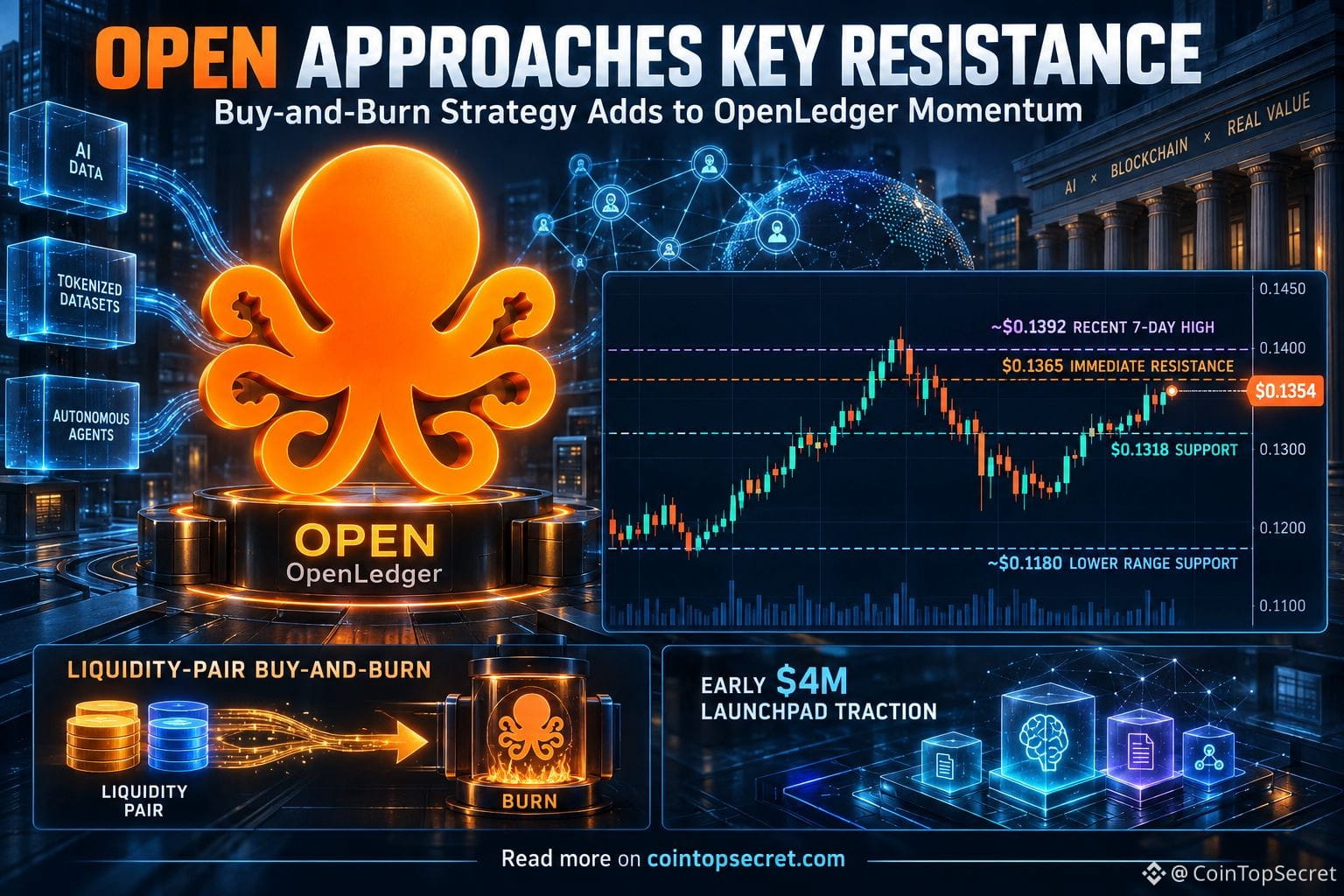
$OPEN Update 🔎 Can OPEN push through its recent high?
💰 Price now: $0.1354 | 24h: +0.6%
📊 Market cap: $29.18M | Rank: #675
📈 24h range: $0.1318 – $0.1365
📰 What's happening:
OPEN is holding above $0.13 after a stronger move from its September low. shows a 7-day gain of 5.3%, while 24h volume is about $4.29M.
🔥 Key catalyst:
OpenLedger recently outlined a liquidity-pair buy-and-burn strategy and reported early $4M launchpad traction.
👀 Next step to watch:
🔴 Bearish case: Below $0.1318 could expose the ~$0.1180 area.
🟢 Bullish case: Above $0.1365 could put ~$0.1392 into focus.
📝 My take: OPEN has improved short-term momentum, but the $0.1365–$0.1392 zone remains an important test.
Not financial advice, DYOR ⚠️
#OpenLedger #OPEN #CryptoAnalysis $OPEN
$OPEN Update 🔎 Can OPEN push through its recent high?
💰 Price now: $0.1354 | 24h: +0.6%
📊 Market cap: $29.18M | Rank: #675
📈 24h range: $0.1318 – $0.1365
📰 What's happening:
OPEN is holding above $0.13 after a stronger move from its September low. shows a 7-day gain of 5.3%, while 24h volume is about $4.29M.
🔥 Key catalyst:
OpenLedger recently outlined a liquidity-pair buy-and-burn strategy and reported early $4M launchpad traction.
👀 Next step to watch:
🔴 Bearish case: Below $0.1318 could expose the ~$0.1180 area.
🟢 Bullish case: Above $0.1365 could put ~$0.1392 into focus.
📝 My take: OPEN has improved short-term momentum, but the $0.1365–$0.1392 zone remains an important test.
Not financial advice, DYOR ⚠️
#OpenLedger #OPEN #CryptoAnalysis $OPEN
💰 Price now: $0.1354 | 24h: +0.6%
📊 Market cap: $29.18M | Rank: #675
📈 24h range: $0.1318 – $0.1365
📰 What's happening:
OPEN is holding above $0.13 after a stronger move from its September low. shows a 7-day gain of 5.3%, while 24h volume is about $4.29M.
🔥 Key catalyst:
OpenLedger recently outlined a liquidity-pair buy-and-burn strategy and reported early $4M launchpad traction.
👀 Next step to watch:
🔴 Bearish case: Below $0.1318 could expose the ~$0.1180 area.
🟢 Bullish case: Above $0.1365 could put ~$0.1392 into focus.
📝 My take: OPEN has improved short-term momentum, but the $0.1365–$0.1392 zone remains an important test.
Not financial advice, DYOR ⚠️
#OpenLedger #OPEN #CryptoAnalysis $OPEN
116

·
--
🎯 OpenLedger-Phase 1 and Reward Pool:
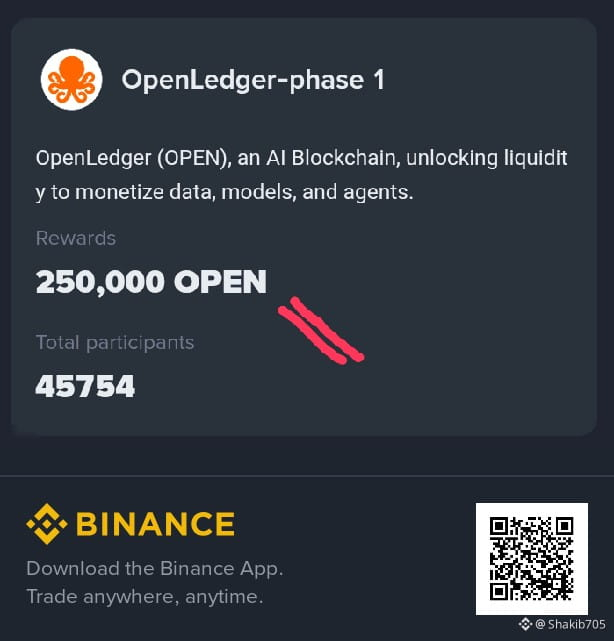
Currently its first step or the OpenLedger-phase 1 campaign is running, where a massive reward pool has been set up. Already, thousands of users (as shown in the image with 45,754+) are participating in this airdrop and booster program, earning FREE OPEN tokens!#OpenLedger #Phase1 $OPEN
{spot}(OPENUSDT)
🎯 OpenLedger-Phase 1 and Reward Pool:
Currently its first step or the OpenLedger-phase 1 campaign is running, where a massive reward pool has been set up. Already, thousands of users (as shown in the image with 45,754+) are participating in this airdrop and booster program, earning FREE OPEN tokens!#OpenLedger #Phase1 $OPEN
Currently its first step or the OpenLedger-phase 1 campaign is running, where a massive reward pool has been set up. Already, thousands of users (as shown in the image with 45,754+) are participating in this airdrop and booster program, earning FREE OPEN tokens!#OpenLedger #Phase1 $OPEN
255

$OPEN — First Target HIT ✅
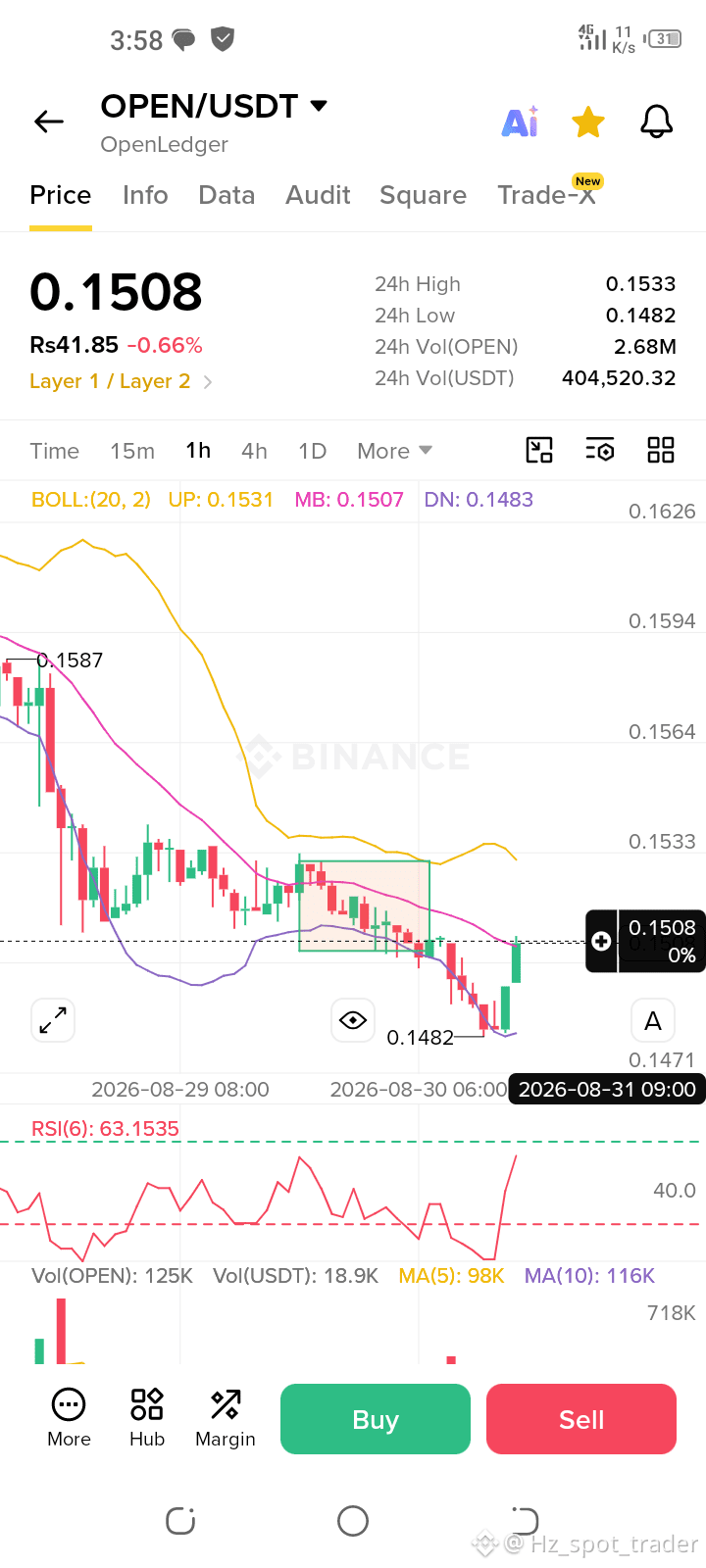
The first level I shared on open was around $0.1508.
Price reached it. 🎯
That was roughly +1.2% from the area I was watching.
I also shared a similar short-term setup on $HOME earlier, with the $0.00622 area as the level to watch.
I’m not claiming every target will work.
The important thing is to plan the level BEFORE the move and respect the risk.
Did anyone here take the open SPOT setup?
If you did, tell me your entry and result 👇
SPOT only. No futures. No leverage.
my first target / level to watch was $0.1508 — and price reached it
$OPEN
{spot}(OPENUSDT)
#OPEN #OpenLedger #SpotTrading
$OPEN — First Target HIT ✅
The first level I shared on open was around $0.1508.
Price reached it. 🎯
That was roughly +1.2% from the area I was watching.
I also shared a similar short-term setup on $HOME earlier, with the $0.00622 area as the level to watch.
I’m not claiming every target will work.
The important thing is to plan the level BEFORE the move and respect the risk.
Did anyone here take the open SPOT setup?
If you did, tell me your entry and result 👇
SPOT only. No futures. No leverage.
my first target / level to watch was $0.1508 — and price reached it
$OPEN
#OPEN #OpenLedger #SpotTrading
The first level I shared on open was around $0.1508.
Price reached it. 🎯
That was roughly +1.2% from the area I was watching.
I also shared a similar short-term setup on $HOME earlier, with the $0.00622 area as the level to watch.
I’m not claiming every target will work.
The important thing is to plan the level BEFORE the move and respect the risk.
Did anyone here take the open SPOT setup?
If you did, tell me your entry and result 👇
SPOT only. No futures. No leverage.
my first target / level to watch was $0.1508 — and price reached it
$OPEN
#OPEN #OpenLedger #SpotTrading
1
242
$OPEN — Bounce Setup or Just a Dead Cat Bounce? 👀
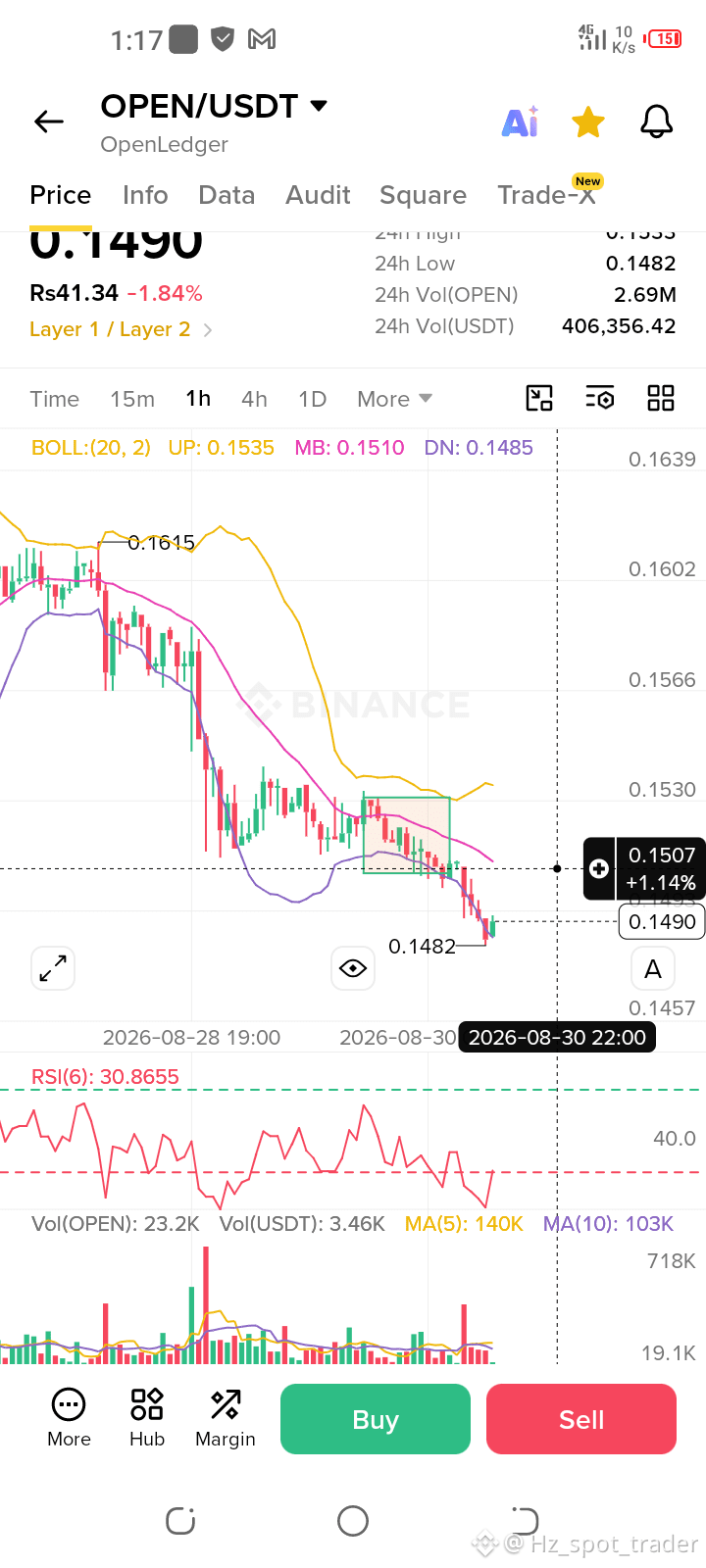
OPEN is trading around $0.1490 after the recent sell-off.
On the 1H chart:
• RSI(6) ≈ 30.9 — oversold area
• Lower Bollinger Band ≈ $0.1485
• Middle Band ≈ $0.1510
• My first level to watch: $0.1508
A move to $0.1508 would be around +1.2% from the current area.
If momentum returns, I’ll be watching the $0.1510–$0.1530 zone next.
But no guarantee — if $0.1482 breaks, the setup becomes weaker.
Would you take the SPOT bounce or wait for confirmation?
$OPEN
{spot}(OPENUSDT)
#OPEN #OpenLedger #SpotTrading
$OPEN — Bounce Setup or Just a Dead Cat Bounce? 👀
OPEN is trading around $0.1490 after the recent sell-off.
On the 1H chart:
• RSI(6) ≈ 30.9 — oversold area
• Lower Bollinger Band ≈ $0.1485
• Middle Band ≈ $0.1510
• My first level to watch: $0.1508
A move to $0.1508 would be around +1.2% from the current area.
If momentum returns, I’ll be watching the $0.1510–$0.1530 zone next.
But no guarantee — if $0.1482 breaks, the setup becomes weaker.
Would you take the SPOT bounce or wait for confirmation?
$OPEN
#OPEN #OpenLedger #SpotTrading
OPEN is trading around $0.1490 after the recent sell-off.
On the 1H chart:
• RSI(6) ≈ 30.9 — oversold area
• Lower Bollinger Band ≈ $0.1485
• Middle Band ≈ $0.1510
• My first level to watch: $0.1508
A move to $0.1508 would be around +1.2% from the current area.
If momentum returns, I’ll be watching the $0.1510–$0.1530 zone next.
But no guarantee — if $0.1482 breaks, the setup becomes weaker.
Would you take the SPOT bounce or wait for confirmation?
$OPEN
#OPEN #OpenLedger #SpotTrading
1
209

·
--

Article
OpenLedger: Decentralized Data for the AI Era$OPEN
For a long time, I felt like a passive ghost in the machine of the artificial intelligence boom. Every time I interact with a chatbot, write a review, or upload a creative snippet online, I know my data is being vacuumed into a massive, centralized black box.
Tech monopolies scrape our collective human intelligence, train their multi-billion-dollar models, and lock the profits behind corporate walls. We give them the clay, and they sell us back the sculpture.
But I’ve realized that the infrastructure of AI doesn't have to look like a digital feudal state. That is why I believe OpenLedger represents a fundamental paradigm shift: it is decentralized data purpose-built for the AI era.
### The Awakening: From Black Box to Clear Glass
When I first started looking into OpenLedger, I was driven by a deep sense of frustration with how opaque AI development has become.
Traditional LLMs operate on a "trust us" basis. You don't know whose data trained them, you don't know why they bias certain answers, and the actual creators of the underlying knowledge never see a dime.
OpenLedger flips this dynamic on its head by building an AI-first blockchain ecosystem. Instead of letting data sit in static, siloed corporate servers, it treats data, models, and autonomous agents as liquid, composable assets on an EVM-compatible Layer 2 network.
For the first time, the entire AI lifecycle—from data contribution and model refinement to final user inference—is pulled entirely on-chain. It turns what used to be a mysterious black box into a transparent, auditable ledger.
### The Magic of Proof of Attribution
What really captured my imagination as a creator is a mechanism OpenLedger calls Proof of Attribution (PoA).
In the old Web2 model, if an AI generates a piece of medical advice or an intricate piece of code based on a unique dataset you curated, your contribution is entirely erased. With Proof of Attribution, every single dataset upload, fine-tuning step, and algorithmic tweak is cryptographically tracked.
How it works in practice: When an end-user queries an AI model, the system executes a real-time audit. It traces the exact lineage of the data that shaped that specific output.
If my specialized input helped form the answer, the protocol recognizes it. Because the network runs natively on the $OPEN token economy, I am automatically and traceably rewarded for my intellectual property. It changes the narrative from "stolen data" to "payable AI," functioning much like a decentralized royalty system for human intelligence.
### Community Power: Datanets and the ModelFactory
I’ve always believed that the future of AI isn’t one massive, general-purpose god-model, but rather millions of highly specialized, hyper-optimized models tailored for finance, law, healthcare, and art. But to build specialized models, you need specialized data.
OpenLedger makes this possible through Datanets—which I like to think of as community-run data clubs. Anyone can join or launch a Datanet to co-create and curate niche datasets.
From there, developers use the ModelFactory, a no-code interface that lets anyone grab a base model (like LLaMA or DeepSeek), plug in permissioned data from these Datanets, and fine-tune it via frameworks like OpenLoRA. It levels the playing field, meaning a small team or an independent developer can deploy optimized, lightweight models on minimal GPU infrastructure without needing Silicon Valley venture capital.
### A Shared Digital Future
We are standing at a crucial crossroads in human history. We can either let artificial intelligence become the ultimate tool of corporate centralization, or we can build an open, permissionless network where data ownership is democratized.
For me, OpenLedger isn't just about blockchain technology or tokenomics; it’s about restoring digital dignity. It ensures that as AI evolves, the builders, the thinkers, and the everyday data contributors are the ones who own the future. It’s time we stop being the product and start being the shareholders.
#OpenLedger @Openledger
OpenLedger: Decentralized Data for the AI Era
$OPEN
For a long time, I felt like a passive ghost in the machine of the artificial intelligence boom. Every time I interact with a chatbot, write a review, or upload a creative snippet online, I know my data is being vacuumed into a massive, centralized black box.
Tech monopolies scrape our collective human intelligence, train their multi-billion-dollar models, and lock the profits behind corporate walls. We give them the clay, and they sell us back the sculpture.
But I’ve realized that the infrastructure of AI doesn't have to look like a digital feudal state. That is why I believe OpenLedger represents a fundamental paradigm shift: it is decentralized data purpose-built for the AI era.
### The Awakening: From Black Box to Clear Glass
When I first started looking into OpenLedger, I was driven by a deep sense of frustration with how opaque AI development has become.
Traditional LLMs operate on a "trust us" basis. You don't know whose data trained them, you don't know why they bias certain answers, and the actual creators of the underlying knowledge never see a dime.
OpenLedger flips this dynamic on its head by building an AI-first blockchain ecosystem. Instead of letting data sit in static, siloed corporate servers, it treats data, models, and autonomous agents as liquid, composable assets on an EVM-compatible Layer 2 network.
For the first time, the entire AI lifecycle—from data contribution and model refinement to final user inference—is pulled entirely on-chain. It turns what used to be a mysterious black box into a transparent, auditable ledger.
### The Magic of Proof of Attribution
What really captured my imagination as a creator is a mechanism OpenLedger calls Proof of Attribution (PoA).
In the old Web2 model, if an AI generates a piece of medical advice or an intricate piece of code based on a unique dataset you curated, your contribution is entirely erased. With Proof of Attribution, every single dataset upload, fine-tuning step, and algorithmic tweak is cryptographically tracked.
How it works in practice: When an end-user queries an AI model, the system executes a real-time audit. It traces the exact lineage of the data that shaped that specific output.
If my specialized input helped form the answer, the protocol recognizes it. Because the network runs natively on the $OPEN token economy, I am automatically and traceably rewarded for my intellectual property. It changes the narrative from "stolen data" to "payable AI," functioning much like a decentralized royalty system for human intelligence.
### Community Power: Datanets and the ModelFactory
I’ve always believed that the future of AI isn’t one massive, general-purpose god-model, but rather millions of highly specialized, hyper-optimized models tailored for finance, law, healthcare, and art. But to build specialized models, you need specialized data.
OpenLedger makes this possible through Datanets—which I like to think of as community-run data clubs. Anyone can join or launch a Datanet to co-create and curate niche datasets.
From there, developers use the ModelFactory, a no-code interface that lets anyone grab a base model (like LLaMA or DeepSeek), plug in permissioned data from these Datanets, and fine-tune it via frameworks like OpenLoRA. It levels the playing field, meaning a small team or an independent developer can deploy optimized, lightweight models on minimal GPU infrastructure without needing Silicon Valley venture capital.
### A Shared Digital Future
We are standing at a crucial crossroads in human history. We can either let artificial intelligence become the ultimate tool of corporate centralization, or we can build an open, permissionless network where data ownership is democratized.
For me, OpenLedger isn't just about blockchain technology or tokenomics; it’s about restoring digital dignity. It ensures that as AI evolves, the builders, the thinkers, and the everyday data contributors are the ones who own the future. It’s time we stop being the product and start being the shareholders.
#OpenLedger @OpenLedger
For a long time, I felt like a passive ghost in the machine of the artificial intelligence boom. Every time I interact with a chatbot, write a review, or upload a creative snippet online, I know my data is being vacuumed into a massive, centralized black box.
Tech monopolies scrape our collective human intelligence, train their multi-billion-dollar models, and lock the profits behind corporate walls. We give them the clay, and they sell us back the sculpture.
But I’ve realized that the infrastructure of AI doesn't have to look like a digital feudal state. That is why I believe OpenLedger represents a fundamental paradigm shift: it is decentralized data purpose-built for the AI era.
### The Awakening: From Black Box to Clear Glass
When I first started looking into OpenLedger, I was driven by a deep sense of frustration with how opaque AI development has become.
Traditional LLMs operate on a "trust us" basis. You don't know whose data trained them, you don't know why they bias certain answers, and the actual creators of the underlying knowledge never see a dime.
OpenLedger flips this dynamic on its head by building an AI-first blockchain ecosystem. Instead of letting data sit in static, siloed corporate servers, it treats data, models, and autonomous agents as liquid, composable assets on an EVM-compatible Layer 2 network.
For the first time, the entire AI lifecycle—from data contribution and model refinement to final user inference—is pulled entirely on-chain. It turns what used to be a mysterious black box into a transparent, auditable ledger.
### The Magic of Proof of Attribution
What really captured my imagination as a creator is a mechanism OpenLedger calls Proof of Attribution (PoA).
In the old Web2 model, if an AI generates a piece of medical advice or an intricate piece of code based on a unique dataset you curated, your contribution is entirely erased. With Proof of Attribution, every single dataset upload, fine-tuning step, and algorithmic tweak is cryptographically tracked.
How it works in practice: When an end-user queries an AI model, the system executes a real-time audit. It traces the exact lineage of the data that shaped that specific output.
If my specialized input helped form the answer, the protocol recognizes it. Because the network runs natively on the $OPEN token economy, I am automatically and traceably rewarded for my intellectual property. It changes the narrative from "stolen data" to "payable AI," functioning much like a decentralized royalty system for human intelligence.
### Community Power: Datanets and the ModelFactory
I’ve always believed that the future of AI isn’t one massive, general-purpose god-model, but rather millions of highly specialized, hyper-optimized models tailored for finance, law, healthcare, and art. But to build specialized models, you need specialized data.
OpenLedger makes this possible through Datanets—which I like to think of as community-run data clubs. Anyone can join or launch a Datanet to co-create and curate niche datasets.
From there, developers use the ModelFactory, a no-code interface that lets anyone grab a base model (like LLaMA or DeepSeek), plug in permissioned data from these Datanets, and fine-tune it via frameworks like OpenLoRA. It levels the playing field, meaning a small team or an independent developer can deploy optimized, lightweight models on minimal GPU infrastructure without needing Silicon Valley venture capital.
### A Shared Digital Future
We are standing at a crucial crossroads in human history. We can either let artificial intelligence become the ultimate tool of corporate centralization, or we can build an open, permissionless network where data ownership is democratized.
For me, OpenLedger isn't just about blockchain technology or tokenomics; it’s about restoring digital dignity. It ensures that as AI evolves, the builders, the thinkers, and the everyday data contributors are the ones who own the future. It’s time we stop being the product and start being the shareholders.
#OpenLedger @OpenLedger
211

·
--

Article
Spotlight on the economic ecosystem and utility of the $OPEN tokenTo truly grasp why @Openledger is grabbing so much attention right now on Binance Square, you need to dig deeper than just the AI hype and check out its solid economic model. OpenLedger acts as a purpose-built layer that unlocks liquidity for data, specialized models, and autonomous AI agents. Backed by heavyweights like Polychain Capital, the network is designed for real long-term sustainability rather than fleeting speculative cycles. At the core of this economic flow is the $OPEN token. It isn’t just a speculative asset; it serves as the essential fuel for paying network fees, securing the infrastructure through staking, driving decentralized governance, and granting direct access to advanced, specialized AI services. Thanks to its native attribution engine, anyone providing valuable insights or computation can effortlessly earn rewards as AI models monetize. By integrating cross-chain liquidity and supporting real developers to build verifiable AI agents, OpenLedger is tackling the actual bottlenecks of decentralized coordination. I’m super bullish on the long-term fundamentals of $OPEN and stoked to stack up points through this ecosystem booster initiative! #OpenLedger 🔥💎
Spotlight on the economic ecosystem and utility of the $OPEN token
To truly grasp why @OpenLedger is grabbing so much attention right now on Binance Square, you need to dig deeper than just the AI hype and check out its solid economic model. OpenLedger acts as a purpose-built layer that unlocks liquidity for data, specialized models, and autonomous AI agents. Backed by heavyweights like Polychain Capital, the network is designed for real long-term sustainability rather than fleeting speculative cycles. At the core of this economic flow is the $OPEN token. It isn’t just a speculative asset; it serves as the essential fuel for paying network fees, securing the infrastructure through staking, driving decentralized governance, and granting direct access to advanced, specialized AI services. Thanks to its native attribution engine, anyone providing valuable insights or computation can effortlessly earn rewards as AI models monetize. By integrating cross-chain liquidity and supporting real developers to build verifiable AI agents, OpenLedger is tackling the actual bottlenecks of decentralized coordination. I’m super bullish on the long-term fundamentals of $OPEN and stoked to stack up points through this ecosystem booster initiative! #OpenLedger 🔥💎
1
10
341

·
--
The Value Flywheel of OpenLedgerWhen assessing the long-term viability of a Decentralized Physical Infrastructure Network (DePIN), the tokenomics model must be robust enough to sustain physical hardware contributions. A project cannot rely on hype alone; it requires a self-sustaining loop. This is precisely why the economic blueprint of @Openledger is garnering significant developer interest.
The relationship between the network and its native asset, the $OPEN token, is built on hard utility. As decentralized applications and enterprises tap into the network for secure data storage and verifiable compute, they actively utilize $OPEN to settle transaction costs and secure operational bandwidth. This continuous demand rewards the node providers who keep the infrastructure secure, forming a healthy growth loop. As global data creation continues to grow exponentially, establishing a decentralized market for processing that data positions this protocol at the absolute forefront of Web3 innovation. #OpenLedger
The Value Flywheel of OpenLedger
When assessing the long-term viability of a Decentralized Physical Infrastructure Network (DePIN), the tokenomics model must be robust enough to sustain physical hardware contributions. A project cannot rely on hype alone; it requires a self-sustaining loop. This is precisely why the economic blueprint of @OpenLedger is garnering significant developer interest.
The relationship between the network and its native asset, the $OPEN token, is built on hard utility. As decentralized applications and enterprises tap into the network for secure data storage and verifiable compute, they actively utilize $OPEN to settle transaction costs and secure operational bandwidth. This continuous demand rewards the node providers who keep the infrastructure secure, forming a healthy growth loop. As global data creation continues to grow exponentially, establishing a decentralized market for processing that data positions this protocol at the absolute forefront of Web3 innovation. #OpenLedger
The relationship between the network and its native asset, the $OPEN token, is built on hard utility. As decentralized applications and enterprises tap into the network for secure data storage and verifiable compute, they actively utilize $OPEN to settle transaction costs and secure operational bandwidth. This continuous demand rewards the node providers who keep the infrastructure secure, forming a healthy growth loop. As global data creation continues to grow exponentially, establishing a decentralized market for processing that data positions this protocol at the absolute forefront of Web3 innovation. #OpenLedger
1
74

#openledger $OPEN @Openledger
Open ledger is AI block chain with a market value .
doing in market from decades.
Now they have launched a campaign on binance square what you have to do is to compkete tasks and get your rewards .
#50000usdc
#openledger $OPEN @OpenLedger
Open ledger is AI block chain with a market value .
doing in market from decades.
Now they have launched a campaign on binance square what you have to do is to compkete tasks and get your rewards .
#50000usdc
Open ledger is AI block chain with a market value .
doing in market from decades.
Now they have launched a campaign on binance square what you have to do is to compkete tasks and get your rewards .
#50000usdc
21

·
--
#openledger $OPEN Open data and decentralized AI can unlock new opportunities across the blockchain industry. @OpenLedger is building infrastructure that helps connect data providers and AI applications, creating real utility for the ecosystem. Looking forward to the future of $OPEN. #OpenLedger
#openledger $OPEN Open data and decentralized AI can unlock new opportunities across the blockchain industry. @OpenLedger is building infrastructure that helps connect data providers and AI applications, creating real utility for the ecosystem. Looking forward to the future of $OPEN . #OpenLedger
52

·
--
Bullish
A lot of people still approach the AI + crypto narrative like it’s just another trading cycle but what’s actually shifting is much deeper than short-term market moves.
I’ve seen cases where users split small amounts of BNB into multiple micro-activities just to “farm signals,” while quietly tracking fees, dashboards, and percentage changes like it’s a game.
But the real question isn’t the trade it’s the understanding behind it.
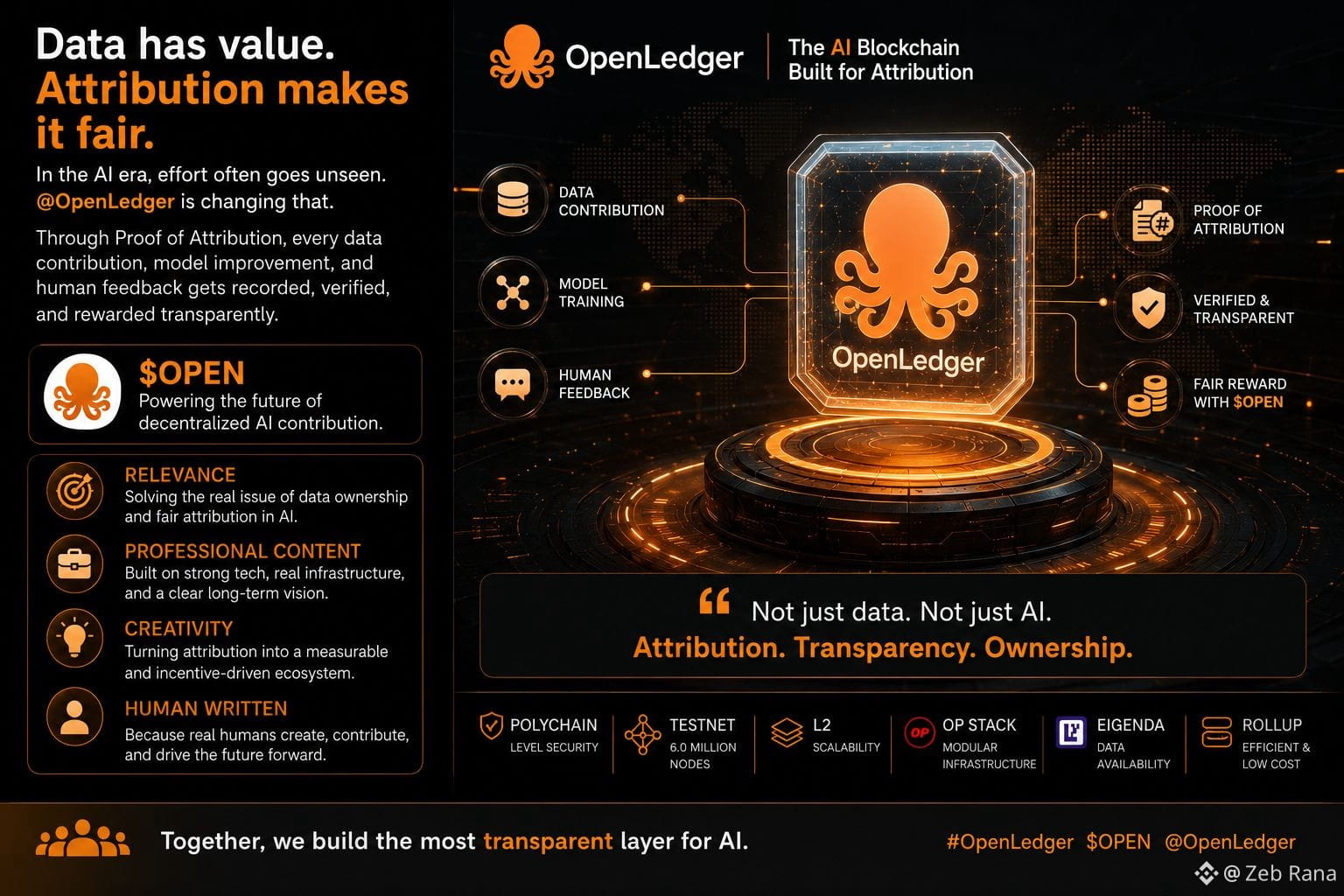
Projects like @Openledger (https://www.binance.com/en/square/profile/openledger) push a more uncomfortable idea: data isn’t just “owned,” it’s attributed, measured, and weighted.
And that changes everything.
Think of it like a precision scale in a market.
The scale is accurate, but what truly matters is who decides what gets placed on it.
That’s the core tension in Proof of Attribution not where knowledge feels like it comes from, but what can be verified, tracked, and converted into measurable contribution.
In that system, effort that cannot be quantified often risks being ignored.
A cleaner dataset vs. higher interaction volume the system naturally leans toward what is easier to verify, not always what is most meaningful.
That’s where $OPEN becomes interesting. It’s not just about incentives; it’s about how AI-era contribution is recorded, scored, and eventually rewarded.
But here’s the uncomfortable truth: when everything becomes a metric data cleaning, feedback loops, fine-tuning signals creativity starts getting filtered through what can be proven, not what can be imagined.
Still, this is what makes @Openledger stand out.
It doesn’t sell a fantasy. It builds an audit layer for intelligence itself.
And in Web3, an audit room can feel more powerful and more unsettling than a casino.
{spot}(OPENUSDT)
{alpha}(560x7ec43cf65f1663f820427c62a5780b8f2e25593a)
#OpenLedger $OPEN $LAB
A lot of people still approach the AI + crypto narrative like it’s just another trading cycle but what’s actually shifting is much deeper than short-term market moves.
I’ve seen cases where users split small amounts of BNB into multiple micro-activities just to “farm signals,” while quietly tracking fees, dashboards, and percentage changes like it’s a game.
But the real question isn’t the trade it’s the understanding behind it.
Projects like @OpenLedger (https://www.binance.com/en/square/profile/openledger) push a more uncomfortable idea: data isn’t just “owned,” it’s attributed, measured, and weighted.
And that changes everything.
Think of it like a precision scale in a market.
The scale is accurate, but what truly matters is who decides what gets placed on it.
That’s the core tension in Proof of Attribution not where knowledge feels like it comes from, but what can be verified, tracked, and converted into measurable contribution.
In that system, effort that cannot be quantified often risks being ignored.
A cleaner dataset vs. higher interaction volume the system naturally leans toward what is easier to verify, not always what is most meaningful.
That’s where $OPEN becomes interesting. It’s not just about incentives; it’s about how AI-era contribution is recorded, scored, and eventually rewarded.
But here’s the uncomfortable truth: when everything becomes a metric data cleaning, feedback loops, fine-tuning signals creativity starts getting filtered through what can be proven, not what can be imagined.
Still, this is what makes @OpenLedger stand out.
It doesn’t sell a fantasy. It builds an audit layer for intelligence itself.
And in Web3, an audit room can feel more powerful and more unsettling than a casino.
#OpenLedger $OPEN $LAB
I’ve seen cases where users split small amounts of BNB into multiple micro-activities just to “farm signals,” while quietly tracking fees, dashboards, and percentage changes like it’s a game.
But the real question isn’t the trade it’s the understanding behind it.
Projects like @OpenLedger (https://www.binance.com/en/square/profile/openledger) push a more uncomfortable idea: data isn’t just “owned,” it’s attributed, measured, and weighted.
And that changes everything.
Think of it like a precision scale in a market.
The scale is accurate, but what truly matters is who decides what gets placed on it.
That’s the core tension in Proof of Attribution not where knowledge feels like it comes from, but what can be verified, tracked, and converted into measurable contribution.
In that system, effort that cannot be quantified often risks being ignored.
A cleaner dataset vs. higher interaction volume the system naturally leans toward what is easier to verify, not always what is most meaningful.
That’s where $OPEN becomes interesting. It’s not just about incentives; it’s about how AI-era contribution is recorded, scored, and eventually rewarded.
But here’s the uncomfortable truth: when everything becomes a metric data cleaning, feedback loops, fine-tuning signals creativity starts getting filtered through what can be proven, not what can be imagined.
Still, this is what makes @OpenLedger stand out.
It doesn’t sell a fantasy. It builds an audit layer for intelligence itself.
And in Web3, an audit room can feel more powerful and more unsettling than a casino.
#OpenLedger $OPEN $LAB
331

·
--
@Openledger What gets me hyped the most about the growth isn't just how many active wallets it's gained, but how it's been anything but 'uniform.' $LAB
I ran through the call data for various Datanets this week, and the discrepancies were outrageous. The frequency of calls for financial data and on-chain data outpaces other sectors by miles, while many areas are as deserted as a ghost town, just sitting there ignored. #BTC
At first, I thought this was a problem, but then I realized—this extreme imbalance is actually a healthy signal. The market is voting with real money: whoever's data is in demand can attract contributors to flock in. This isn't some fake prosperity pushed by the project teams with resources; it's the result of natural selection—brutal, but real.
The Proof of Attribution profit-sharing logic forces contributors' attention away from 'data farming' and towards 'real utility,' driven by cold hard economic incentives, not just community slogans. If you dump a bunch of junk data that no one calls, your @Openledger rewards are basically zero; if your data gets high-frequency calls, the rewards keep rolling in. The efficiency of these two mechanisms is worlds apart, and most projects still don't get this.
But what worries me most right now is the thorn of data quality.
I haven't seen effective solutions for the mixed quality issues within Datanet. Low-quality data mixed in will slowly erode the entire platform's reputation. If callers hit a few snags continuously, they're likely to bail and never come back. That's my biggest concern—it's not the short-term coin price, but whether the average quality of data can hold up as they scale.
And there's a death spiral lurking here: the more niche a Datanet is, the fewer calls it gets, and the fewer calls, the less anyone wants to contribute quality data, leaving nothing but junk to rot. Hot sectors gobble up all the attention while long-tail sectors starve to death.
$OPEN What I'm aiming for is a free market for data, but a free market will naturally polarize.
In the next six months, Datanet's actual elimination rate will tell us more than any number of active wallets. Finding the balance between 'natural selection' and 'long-tail decay' is a hurdle it can't avoid.
#OpenLedger
{alpha}(560x7ec43cf65f1663f820427c62a5780b8f2e25593a)
{spot}(OPENUSDT)
@OpenLedger What gets me hyped the most about the growth isn't just how many active wallets it's gained, but how it's been anything but 'uniform.' $LAB
I ran through the call data for various Datanets this week, and the discrepancies were outrageous. The frequency of calls for financial data and on-chain data outpaces other sectors by miles, while many areas are as deserted as a ghost town, just sitting there ignored. #BTC
At first, I thought this was a problem, but then I realized—this extreme imbalance is actually a healthy signal. The market is voting with real money: whoever's data is in demand can attract contributors to flock in. This isn't some fake prosperity pushed by the project teams with resources; it's the result of natural selection—brutal, but real.
The Proof of Attribution profit-sharing logic forces contributors' attention away from 'data farming' and towards 'real utility,' driven by cold hard economic incentives, not just community slogans. If you dump a bunch of junk data that no one calls, your @OpenLedger rewards are basically zero; if your data gets high-frequency calls, the rewards keep rolling in. The efficiency of these two mechanisms is worlds apart, and most projects still don't get this.
But what worries me most right now is the thorn of data quality.
I haven't seen effective solutions for the mixed quality issues within Datanet. Low-quality data mixed in will slowly erode the entire platform's reputation. If callers hit a few snags continuously, they're likely to bail and never come back. That's my biggest concern—it's not the short-term coin price, but whether the average quality of data can hold up as they scale.
And there's a death spiral lurking here: the more niche a Datanet is, the fewer calls it gets, and the fewer calls, the less anyone wants to contribute quality data, leaving nothing but junk to rot. Hot sectors gobble up all the attention while long-tail sectors starve to death.
$OPEN What I'm aiming for is a free market for data, but a free market will naturally polarize.
In the next six months, Datanet's actual elimination rate will tell us more than any number of active wallets. Finding the balance between 'natural selection' and 'long-tail decay' is a hurdle it can't avoid.
#OpenLedger
I ran through the call data for various Datanets this week, and the discrepancies were outrageous. The frequency of calls for financial data and on-chain data outpaces other sectors by miles, while many areas are as deserted as a ghost town, just sitting there ignored. #BTC
At first, I thought this was a problem, but then I realized—this extreme imbalance is actually a healthy signal. The market is voting with real money: whoever's data is in demand can attract contributors to flock in. This isn't some fake prosperity pushed by the project teams with resources; it's the result of natural selection—brutal, but real.
The Proof of Attribution profit-sharing logic forces contributors' attention away from 'data farming' and towards 'real utility,' driven by cold hard economic incentives, not just community slogans. If you dump a bunch of junk data that no one calls, your @OpenLedger rewards are basically zero; if your data gets high-frequency calls, the rewards keep rolling in. The efficiency of these two mechanisms is worlds apart, and most projects still don't get this.
But what worries me most right now is the thorn of data quality.
I haven't seen effective solutions for the mixed quality issues within Datanet. Low-quality data mixed in will slowly erode the entire platform's reputation. If callers hit a few snags continuously, they're likely to bail and never come back. That's my biggest concern—it's not the short-term coin price, but whether the average quality of data can hold up as they scale.
And there's a death spiral lurking here: the more niche a Datanet is, the fewer calls it gets, and the fewer calls, the less anyone wants to contribute quality data, leaving nothing but junk to rot. Hot sectors gobble up all the attention while long-tail sectors starve to death.
$OPEN What I'm aiming for is a free market for data, but a free market will naturally polarize.
In the next six months, Datanet's actual elimination rate will tell us more than any number of active wallets. Finding the balance between 'natural selection' and 'long-tail decay' is a hurdle it can't avoid.
#OpenLedger
不均衡到底是好是坏
50%
数据质量这关怎么过
0%
冷门方向会被饿死吗
0%
我也想上传数据试试
50%
2 votes • Voting closed
2
1
223

·
--
#openledger $OPEN @Openledger
For most of human history, if you created something, you were attached to it. A craftsman made a chair and people knew whose hands shaped it. A writer published a book and their name stayed on the cover through every edition. The connection between creation and creator was so natural that separating them required deliberate legal effort.
AI changed that without anyone passing a law.
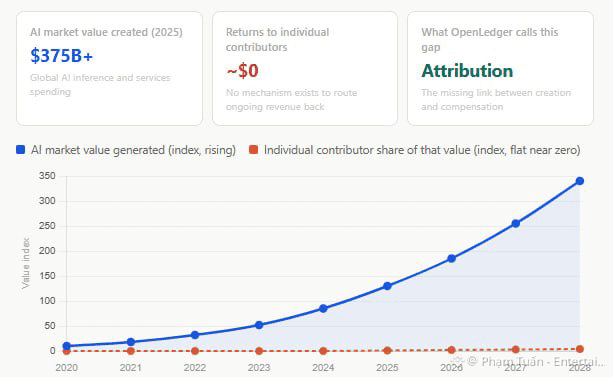
When a model generates text or image or analysis, the connection to the people whose knowledge trained it simply vanishes. Not stolen, exactly. Not credited either. Just quietly severed somewhere in the process of becoming useful to someone else. The output exists. The contributors do not.
What interests me about @Openledger is that it focuses on reattaching those two things. Not by slowing AI down or demanding it work differently. But by building a layer that remembers who contributed what, and makes sure that memory has economic consequences. The idea behind $OPEN is that authorship and ownership might eventually become the same thing again.
Whether that turns out to be possible is still an open question. But it strikes me as one of the more important problems anyone in this space is working on.
Do you think the separation between authorship and ownership in AI is a temporary gap that will eventually be addressed, or has it already become the permanent default that most of the industry is simply building on top of?
#openledger $OPEN @OpenLedger
For most of human history, if you created something, you were attached to it. A craftsman made a chair and people knew whose hands shaped it. A writer published a book and their name stayed on the cover through every edition. The connection between creation and creator was so natural that separating them required deliberate legal effort.
AI changed that without anyone passing a law.
When a model generates text or image or analysis, the connection to the people whose knowledge trained it simply vanishes. Not stolen, exactly. Not credited either. Just quietly severed somewhere in the process of becoming useful to someone else. The output exists. The contributors do not.
What interests me about @OpenLedger is that it focuses on reattaching those two things. Not by slowing AI down or demanding it work differently. But by building a layer that remembers who contributed what, and makes sure that memory has economic consequences. The idea behind $OPEN is that authorship and ownership might eventually become the same thing again.
Whether that turns out to be possible is still an open question. But it strikes me as one of the more important problems anyone in this space is working on.
Do you think the separation between authorship and ownership in AI is a temporary gap that will eventually be addressed, or has it already become the permanent default that most of the industry is simply building on top of?
For most of human history, if you created something, you were attached to it. A craftsman made a chair and people knew whose hands shaped it. A writer published a book and their name stayed on the cover through every edition. The connection between creation and creator was so natural that separating them required deliberate legal effort.
AI changed that without anyone passing a law.
When a model generates text or image or analysis, the connection to the people whose knowledge trained it simply vanishes. Not stolen, exactly. Not credited either. Just quietly severed somewhere in the process of becoming useful to someone else. The output exists. The contributors do not.
What interests me about @OpenLedger is that it focuses on reattaching those two things. Not by slowing AI down or demanding it work differently. But by building a layer that remembers who contributed what, and makes sure that memory has economic consequences. The idea behind $OPEN is that authorship and ownership might eventually become the same thing again.
Whether that turns out to be possible is still an open question. But it strikes me as one of the more important problems anyone in this space is working on.
Do you think the separation between authorship and ownership in AI is a temporary gap that will eventually be addressed, or has it already become the permanent default that most of the industry is simply building on top of?
56

·
--
#openledger $OPEN #OpenLedger (OPEN) has announced the launch of liquidity to monetize data, models, and intelligent agents on its blockchain specialized in AI.
This innovation opens new horizons for developers, companies, and creators:
🔹 Direct income generation: Users can now turn their data, models, and intelligent agents into tradable assets.
🔹 Accelerated innovation: The platform enables secure and efficient sharing of smart resources, supporting the development of advanced AI solutions.
🔹 Decentralization and transparency: All transactions and transfers are conducted on the OPEN blockchain, ensuring complete credibility and advanced security.
With OpenLedger, AI is no longer just a tool; it has become a self-sustaining economy that everyone can participate in and benefit from. 🌐💡
#openledger $OPEN #OpenLedger (OPEN) has announced the launch of liquidity to monetize data, models, and intelligent agents on its blockchain specialized in AI.
This innovation opens new horizons for developers, companies, and creators:
🔹 Direct income generation: Users can now turn their data, models, and intelligent agents into tradable assets.
🔹 Accelerated innovation: The platform enables secure and efficient sharing of smart resources, supporting the development of advanced AI solutions.
🔹 Decentralization and transparency: All transactions and transfers are conducted on the OPEN blockchain, ensuring complete credibility and advanced security.
With OpenLedger, AI is no longer just a tool; it has become a self-sustaining economy that everyone can participate in and benefit from. 🌐💡
This innovation opens new horizons for developers, companies, and creators:
🔹 Direct income generation: Users can now turn their data, models, and intelligent agents into tradable assets.
🔹 Accelerated innovation: The platform enables secure and efficient sharing of smart resources, supporting the development of advanced AI solutions.
🔹 Decentralization and transparency: All transactions and transfers are conducted on the OPEN blockchain, ensuring complete credibility and advanced security.
With OpenLedger, AI is no longer just a tool; it has become a self-sustaining economy that everyone can participate in and benefit from. 🌐💡
80

·
--
#openledger $OPEN decentralized physical infrastructure networks are transforming the ai landscape and @Openledger is at the forefront of this shift
Secure data layer protocols are essential for training ai models properly
Watching the open token carefully as the mainnet expands #OpenLedger #Binance #crypto $OPEN
{spot}(OPENUSDT)
$BNB
{spot}(BNBUSDT)
#openledger $OPEN decentralized physical infrastructure networks are transforming the ai landscape and @OpenLedger is at the forefront of this shift
Secure data layer protocols are essential for training ai models properly
Watching the open token carefully as the mainnet expands #OpenLedger #Binance #crypto $OPEN
$BNB
Secure data layer protocols are essential for training ai models properly
Watching the open token carefully as the mainnet expands #OpenLedger #Binance #crypto $OPEN
$BNB
56

·
--
Recently got the itch and dragged out a few old workstations I used to mine ETH, forcibly set up to run a node on OpenLedger for real trading. I want to clarify one simple thing: running this node, is it profitable or a loss? Here's the conclusion upfront—most people have calculated this wrong.
The new retail traders only focus on output, thinking that any tokens coming in daily means they're making money. But after running on-chain settlements for five days and breaking down the costs, I realized where the holes are. The costs of bandwidth, GPU depreciation, and electricity add up to fixed daily expenses that are non-negotiable. Meanwhile, the output is volatile; when AI usage spikes, the earnings can be substantial, but if the application cools off, profits can get slashed in half. If you take a high output and compare it to the annual fixed costs, it might seem like a win, but when you average it out over the cycle, most retail nodes end up with negative net earnings. $LAB
What's even more hidden is depreciation. GPUs, when pushed hard for long periods, experience a steep decline in lifespan. Many people don’t factor this into their earnings calculations, and by the time the cards wear out, they realize that token earnings aren't even enough to buy a new one. This is a classic case of sacrificing your equipment for some pocket change. $BTC
So, is it completely unplayable? Not really. From my observations, the only ones who can make it work fall into two categories: those who already have idle professional computing power with very low marginal costs, and those who don’t rely on nodes to earn tokens but instead profit from the high-tier identity that brings discounts on calls and ecosystem benefits. If you're just plugging in to chase mining profits, you're basically just donating computing power to the protocol.
My takeaway from analyzing this mechanism is that it indeed filters out the speculators with a brutal cost structure, keeping real resource players in the game. The logic is hardcore, but it's extremely unfriendly to retail traders. Before you jump in, make sure to honestly account for depreciation and electricity costs in your spreadsheet before making a decision—don't be fooled by the superficial output numbers. #OpenLedger $OPEN @Openledger
Recently got the itch and dragged out a few old workstations I used to mine ETH, forcibly set up to run a node on OpenLedger for real trading. I want to clarify one simple thing: running this node, is it profitable or a loss? Here's the conclusion upfront—most people have calculated this wrong.
The new retail traders only focus on output, thinking that any tokens coming in daily means they're making money. But after running on-chain settlements for five days and breaking down the costs, I realized where the holes are. The costs of bandwidth, GPU depreciation, and electricity add up to fixed daily expenses that are non-negotiable. Meanwhile, the output is volatile; when AI usage spikes, the earnings can be substantial, but if the application cools off, profits can get slashed in half. If you take a high output and compare it to the annual fixed costs, it might seem like a win, but when you average it out over the cycle, most retail nodes end up with negative net earnings. $LAB
What's even more hidden is depreciation. GPUs, when pushed hard for long periods, experience a steep decline in lifespan. Many people don’t factor this into their earnings calculations, and by the time the cards wear out, they realize that token earnings aren't even enough to buy a new one. This is a classic case of sacrificing your equipment for some pocket change. $BTC
So, is it completely unplayable? Not really. From my observations, the only ones who can make it work fall into two categories: those who already have idle professional computing power with very low marginal costs, and those who don’t rely on nodes to earn tokens but instead profit from the high-tier identity that brings discounts on calls and ecosystem benefits. If you're just plugging in to chase mining profits, you're basically just donating computing power to the protocol.
My takeaway from analyzing this mechanism is that it indeed filters out the speculators with a brutal cost structure, keeping real resource players in the game. The logic is hardcore, but it's extremely unfriendly to retail traders. Before you jump in, make sure to honestly account for depreciation and electricity costs in your spreadsheet before making a decision—don't be fooled by the superficial output numbers. #OpenLedger $OPEN @OpenLedger
The new retail traders only focus on output, thinking that any tokens coming in daily means they're making money. But after running on-chain settlements for five days and breaking down the costs, I realized where the holes are. The costs of bandwidth, GPU depreciation, and electricity add up to fixed daily expenses that are non-negotiable. Meanwhile, the output is volatile; when AI usage spikes, the earnings can be substantial, but if the application cools off, profits can get slashed in half. If you take a high output and compare it to the annual fixed costs, it might seem like a win, but when you average it out over the cycle, most retail nodes end up with negative net earnings. $LAB
What's even more hidden is depreciation. GPUs, when pushed hard for long periods, experience a steep decline in lifespan. Many people don’t factor this into their earnings calculations, and by the time the cards wear out, they realize that token earnings aren't even enough to buy a new one. This is a classic case of sacrificing your equipment for some pocket change. $BTC
So, is it completely unplayable? Not really. From my observations, the only ones who can make it work fall into two categories: those who already have idle professional computing power with very low marginal costs, and those who don’t rely on nodes to earn tokens but instead profit from the high-tier identity that brings discounts on calls and ecosystem benefits. If you're just plugging in to chase mining profits, you're basically just donating computing power to the protocol.
My takeaway from analyzing this mechanism is that it indeed filters out the speculators with a brutal cost structure, keeping real resource players in the game. The logic is hardcore, but it's extremely unfriendly to retail traders. Before you jump in, make sure to honestly account for depreciation and electricity costs in your spreadsheet before making a decision—don't be fooled by the superficial output numbers. #OpenLedger $OPEN @OpenLedger
跑节点到底是赚还是亏
0%
显卡折旧这笔隐藏账
25%
哪两类人才玩得起
75%
4 votes • Voting closed
2
1
699

·
--
I've been spending the last couple of days just hanging out in the governance section of OpenLedger, watching those big whales cast their votes. The more I see, the more I think this so-called decentralized governance is a polished joke. On the surface, everyone can propose and vote, sounds super democratic, but if you dig into the distribution of voting power, you'll realize that the small fry's votes are barely enough to tickle the big players. $LAB
I've followed a few rounds of proposals, and the patterns are crystal clear. The so-called dynamic weight adjustments, today they're suddenly skewing rewards towards text data to cozy up to a big model team; tomorrow, the wind shifts again, and they're subsidizing video rendering. They market these adjustments as optimizing the ecosystem and responding to demand, but the decision-makers are still those few early addresses holding massive chips. Retail investors in this system aren't co-builders; they're more like cheap voting tools manipulated by algorithms and capital, with proposals already predetermined, and voting is just a formality for show.
What’s even sneakier is the kind of traffic manipulation that feels like coercion. The tokens released each month are entirely determined by the real lockup amounts and call frequencies of various vertical networks, forcing subnet teams to use real operational data to fight for funds. It sounds fair, but if you break it down, once the early bonus phase is depleted, those whales holding massive chips will definitely form private alliances, creating a few shell networks to play hot potato, wildly extracting inflation rewards and draining the retail investors' profit pools. What’s left to balance this capital collusion is a deadlock that teams can't escape. $BTC
I’m not saying this project isn’t viable; they have the guts to write the distribution logic directly into the code and not rely on human governance, which is indeed rare in the space. But the centralization risks in governance are very real. Until the issue of whale alliances is resolved, retail investors better recognize their position at the table and not delude themselves into thinking they can change the rules as shareholders. #OpenLedger $OPEN @Openledger
I've been spending the last couple of days just hanging out in the governance section of OpenLedger, watching those big whales cast their votes. The more I see, the more I think this so-called decentralized governance is a polished joke. On the surface, everyone can propose and vote, sounds super democratic, but if you dig into the distribution of voting power, you'll realize that the small fry's votes are barely enough to tickle the big players. $LAB
I've followed a few rounds of proposals, and the patterns are crystal clear. The so-called dynamic weight adjustments, today they're suddenly skewing rewards towards text data to cozy up to a big model team; tomorrow, the wind shifts again, and they're subsidizing video rendering. They market these adjustments as optimizing the ecosystem and responding to demand, but the decision-makers are still those few early addresses holding massive chips. Retail investors in this system aren't co-builders; they're more like cheap voting tools manipulated by algorithms and capital, with proposals already predetermined, and voting is just a formality for show.
What’s even sneakier is the kind of traffic manipulation that feels like coercion. The tokens released each month are entirely determined by the real lockup amounts and call frequencies of various vertical networks, forcing subnet teams to use real operational data to fight for funds. It sounds fair, but if you break it down, once the early bonus phase is depleted, those whales holding massive chips will definitely form private alliances, creating a few shell networks to play hot potato, wildly extracting inflation rewards and draining the retail investors' profit pools. What’s left to balance this capital collusion is a deadlock that teams can't escape. $BTC
I’m not saying this project isn’t viable; they have the guts to write the distribution logic directly into the code and not rely on human governance, which is indeed rare in the space. But the centralization risks in governance are very real. Until the issue of whale alliances is resolved, retail investors better recognize their position at the table and not delude themselves into thinking they can change the rules as shareholders. #OpenLedger $OPEN @OpenLedger
I've followed a few rounds of proposals, and the patterns are crystal clear. The so-called dynamic weight adjustments, today they're suddenly skewing rewards towards text data to cozy up to a big model team; tomorrow, the wind shifts again, and they're subsidizing video rendering. They market these adjustments as optimizing the ecosystem and responding to demand, but the decision-makers are still those few early addresses holding massive chips. Retail investors in this system aren't co-builders; they're more like cheap voting tools manipulated by algorithms and capital, with proposals already predetermined, and voting is just a formality for show.
What’s even sneakier is the kind of traffic manipulation that feels like coercion. The tokens released each month are entirely determined by the real lockup amounts and call frequencies of various vertical networks, forcing subnet teams to use real operational data to fight for funds. It sounds fair, but if you break it down, once the early bonus phase is depleted, those whales holding massive chips will definitely form private alliances, creating a few shell networks to play hot potato, wildly extracting inflation rewards and draining the retail investors' profit pools. What’s left to balance this capital collusion is a deadlock that teams can't escape. $BTC
I’m not saying this project isn’t viable; they have the guts to write the distribution logic directly into the code and not rely on human governance, which is indeed rare in the space. But the centralization risks in governance are very real. Until the issue of whale alliances is resolved, retail investors better recognize their position at the table and not delude themselves into thinking they can change the rules as shareholders. #OpenLedger $OPEN @OpenLedger
散户投票权重有多惨
33%
动态权重调整谁说了算
67%
3 votes • Voting closed
2
1
533
·
--

Article
The Future Of AI dApps Secure Tamper Proof Datasets With OpenledgerTrust is the most valuable currency in both blockchain systems and big data fields
When ai algorithms ingest unverified information the results can be highly inaccurate and deeply flawed
@Openledger introduces an innovative verification layer that ensures only verified tamper proof datasets are utilized for computational purposes
By creating an open cryptographic history of data handling they are building a reliable framework for future ai dApps
The economy of the protocol is driven directly by the $OPEN token which secures the system against bad actors and fuels transaction flows
If you are tracking sustainable technologies that offer a true alternative to legacy silicon valley systems exploring their detailed documentation is a vital step
The community led governance and technological foundation look extremely solid here #OpenLedger #Binance #crypto $OPEN
{future}(OPENUSDT)
$BNB
{spot}(BNBUSDT)
The Future Of AI dApps Secure Tamper Proof Datasets With Openledger
Trust is the most valuable currency in both blockchain systems and big data fields
When ai algorithms ingest unverified information the results can be highly inaccurate and deeply flawed
@OpenLedger introduces an innovative verification layer that ensures only verified tamper proof datasets are utilized for computational purposes
By creating an open cryptographic history of data handling they are building a reliable framework for future ai dApps
The economy of the protocol is driven directly by the $OPEN token which secures the system against bad actors and fuels transaction flows
If you are tracking sustainable technologies that offer a true alternative to legacy silicon valley systems exploring their detailed documentation is a vital step
The community led governance and technological foundation look extremely solid here #OpenLedger #Binance #crypto $OPEN
$BNB
When ai algorithms ingest unverified information the results can be highly inaccurate and deeply flawed
@OpenLedger introduces an innovative verification layer that ensures only verified tamper proof datasets are utilized for computational purposes
By creating an open cryptographic history of data handling they are building a reliable framework for future ai dApps
The economy of the protocol is driven directly by the $OPEN token which secures the system against bad actors and fuels transaction flows
If you are tracking sustainable technologies that offer a true alternative to legacy silicon valley systems exploring their detailed documentation is a vital step
The community led governance and technological foundation look extremely solid here #OpenLedger #Binance #crypto $OPEN
$BNB
89

·
--
The Future of Decentralized AI with OpenLedgerThe future of blockchain is increasingly connected with artificial intelligence, and projects like @Openledger are positioning themselves at the center of this transformation. OpenLedger is building a decentralized infrastructure where data, AI models, and computing resources can be shared in a transparent and permissionless way. This approach helps solve one of the biggest problems in AI today—centralized control of data and lack of fair incentives for contributors.
With $OPEN , users are not just participants but active contributors in an ecosystem where value is distributed more fairly. The idea of combining Web3 principles with AI development opens the door for new use cases such as decentralized model training, data marketplaces, and AI-powered applications that are not controlled by a single entity.
As adoption of AI grows globally, platforms like OpenLedger may play a key role in shaping how intelligence is created, shared, and monetized in the future. #OpenLedger
The Future of Decentralized AI with OpenLedger
The future of blockchain is increasingly connected with artificial intelligence, and projects like @OpenLedger are positioning themselves at the center of this transformation. OpenLedger is building a decentralized infrastructure where data, AI models, and computing resources can be shared in a transparent and permissionless way. This approach helps solve one of the biggest problems in AI today—centralized control of data and lack of fair incentives for contributors.
With $OPEN , users are not just participants but active contributors in an ecosystem where value is distributed more fairly. The idea of combining Web3 principles with AI development opens the door for new use cases such as decentralized model training, data marketplaces, and AI-powered applications that are not controlled by a single entity.
As adoption of AI grows globally, platforms like OpenLedger may play a key role in shaping how intelligence is created, shared, and monetized in the future. #OpenLedger
With $OPEN , users are not just participants but active contributors in an ecosystem where value is distributed more fairly. The idea of combining Web3 principles with AI development opens the door for new use cases such as decentralized model training, data marketplaces, and AI-powered applications that are not controlled by a single entity.
As adoption of AI grows globally, platforms like OpenLedger may play a key role in shaping how intelligence is created, shared, and monetized in the future. #OpenLedger
29

·
--
Bullish
Most projects treat exchange listings like a milestone.
Price pops. Volume spikes. Twitter celebrates.
Then two weeks later everyone moves on.
I've been thinking about @Openledger BitMart listing back in February. At the time the $OPEN price dropped 6% on listing day, which is unusual. Most listings pump.
The drop didn't bother me as much as what it revealed.
Exchange listings matter differently for infrastructure projects than they do for consumer tokens. A meme coin needs liquidity and retail access to survive. An infrastructure layer needs developer adoption, enterprise integrations, and protocol usage liquidity is almost secondary.
$OPEN getting listed on BitMart, MEXC, and other venues is necessary. But it's not the signal worth watching.
The signal worth watching is whether anyone is actually paying $OPEN to use the network. AI credits, datanet creation fees, attribution transactions, these are the numbers that tell you if the infrastructure is being used.
Not the order book depth. The fee revenue.
One of these metrics is easy to find. The other takes five minutes of on-chain research.
Guess which one most people are looking at.
#OpenLedger
{future}(OPENUSDT)
Most projects treat exchange listings like a milestone.
Price pops. Volume spikes. Twitter celebrates.
Then two weeks later everyone moves on.
I've been thinking about @OpenLedger BitMart listing back in February. At the time the $OPEN price dropped 6% on listing day, which is unusual. Most listings pump.
The drop didn't bother me as much as what it revealed.
Exchange listings matter differently for infrastructure projects than they do for consumer tokens. A meme coin needs liquidity and retail access to survive. An infrastructure layer needs developer adoption, enterprise integrations, and protocol usage liquidity is almost secondary.
$OPEN getting listed on BitMart, MEXC, and other venues is necessary. But it's not the signal worth watching.
The signal worth watching is whether anyone is actually paying $OPEN to use the network. AI credits, datanet creation fees, attribution transactions, these are the numbers that tell you if the infrastructure is being used.
Not the order book depth. The fee revenue.
One of these metrics is easy to find. The other takes five minutes of on-chain research.
Guess which one most people are looking at.
#OpenLedger
Price pops. Volume spikes. Twitter celebrates.
Then two weeks later everyone moves on.
I've been thinking about @OpenLedger BitMart listing back in February. At the time the $OPEN price dropped 6% on listing day, which is unusual. Most listings pump.
The drop didn't bother me as much as what it revealed.
Exchange listings matter differently for infrastructure projects than they do for consumer tokens. A meme coin needs liquidity and retail access to survive. An infrastructure layer needs developer adoption, enterprise integrations, and protocol usage liquidity is almost secondary.
$OPEN getting listed on BitMart, MEXC, and other venues is necessary. But it's not the signal worth watching.
The signal worth watching is whether anyone is actually paying $OPEN to use the network. AI credits, datanet creation fees, attribution transactions, these are the numbers that tell you if the infrastructure is being used.
Not the order book depth. The fee revenue.
One of these metrics is easy to find. The other takes five minutes of on-chain research.
Guess which one most people are looking at.
#OpenLedger

1
256

·
--
Article
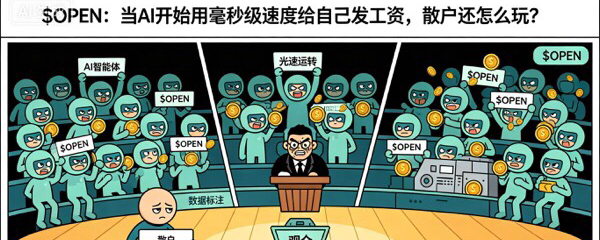
$OPEN: When AI starts paying itself in milliseconds, how can retail traders keep playing?To be honest, when I first stumbled upon OpenLedger, I almost swiped away. Another one of those "upload data, pay per use" old tricks? But after trying it out, it actually sends $OPEN automatically every time it's called, like a supplier who’s been ignored suddenly getting a paycheck. For those creators who’ve been getting ragged on by big companies for years, this really hits home.
But I calmed down and the more I thought about it, the more it didn’t sit right.
Proof of attribution sounds great, but in practice, it’s a total black box. With models having billions of parameters, how can you accurately determine what portion of my labeled data contributed? The white paper provides a solution for crypto economics but doesn’t address my biggest fear: what if someone repackages the same data repeatedly to farm weights, or the algorithm misattributes credit? How does this trust system hold up? I triple-check the address whenever I make a transfer; I can’t just ignore that kind of risk.
$OPEN: When AI starts paying itself in milliseconds, how can retail traders keep playing?
To be honest, when I first stumbled upon OpenLedger, I almost swiped away. Another one of those "upload data, pay per use" old tricks? But after trying it out, it actually sends $OPEN automatically every time it's called, like a supplier who’s been ignored suddenly getting a paycheck. For those creators who’ve been getting ragged on by big companies for years, this really hits home.
But I calmed down and the more I thought about it, the more it didn’t sit right.
Proof of attribution sounds great, but in practice, it’s a total black box. With models having billions of parameters, how can you accurately determine what portion of my labeled data contributed? The white paper provides a solution for crypto economics but doesn’t address my biggest fear: what if someone repackages the same data repeatedly to farm weights, or the algorithm misattributes credit? How does this trust system hold up? I triple-check the address whenever I make a transfer; I can’t just ignore that kind of risk.
But I calmed down and the more I thought about it, the more it didn’t sit right.
Proof of attribution sounds great, but in practice, it’s a total black box. With models having billions of parameters, how can you accurately determine what portion of my labeled data contributed? The white paper provides a solution for crypto economics but doesn’t address my biggest fear: what if someone repackages the same data repeatedly to farm weights, or the algorithm misattributes credit? How does this trust system hold up? I triple-check the address whenever I make a transfer; I can’t just ignore that kind of risk.
1
132
Log in to explore more content
Join global crypto users on Binance Square
⚡️ Get latest and useful information about crypto.
💬 Trusted by the world’s largest crypto exchange.
👍 Discover real insights from verified creators.
Email / Phone number
Trending Topics
1
#BitcoinSurpasses$77000
10,818 views
165 Discussing
2
#ParadigmDisclosesZECHolding
40,481 views
788 Discussing
3
#BitcoinETFsShed$450M
20,670 views
186 Discussing
4
#USWeeklyJoblessClaimsFallTo196K
21,217 views
465 Discussing
5
#ArkhamSaysBlackRockBuys$1.5BInETH
3,894 views
51 Discussing
6
#ElSalvadorBTCHoldingsRiseTo7777
48,194 views
773 Discussing
7
#MemeLaunchpads82%OfArcDayOneVolume
52,250 views
959 Discussing
8
#OstiumLoanDisputeHearingSetInNYFederalCourt
41,778 views
683 Discussing
9
#HyperliquidUSDCSupplyOvertakesSolana
18,471 views
336 Discussing
10
#SKPoliceRefer18PolymarketUsersToProsecutors
24,061 views
501 Discussing