

#meme
meme
17.5M views
31,163 Discussing
Hot
Latest

Pepe ($PEPE ) Market Update: Wolfe Wave Setup Points to $0.000005, But Whales Are Quietly Loading Up
$PEPE is trading near $0.00000453**, up roughly **5%** after breaking above the **$0.00000445 resistance level that capped price for days .
The Setup: Technical analyst Aditya Khatri identified a Wolfe Wave pattern forming on the 4-hour chart, projecting a move toward $0.000005** if buyers sustain the breakout . The path runs through **$0.00000461 and $0.00000477 as intermediate hurdles .
The Real Story: While price chops, whales are accumulating aggressively. PEPE saw a single-day exchange net outflow of 4.54 trillion tokens—the largest since November 2024 . Nansen data shows the top 100 holders increased positions by 6.07%, while Smart Money wallets exploded 307% . That's supply leaving exchanges and concentrating into stronger hands.
Key Levels: $0.00000415** is the first support below the breakout zone, then **$0.00000402 and $0.00000387** . A clean break above **$0.00000461 opens the $0.000005 target.
Binance Trade Setup: A cautious long if $PEPE holds above $0.00000445** with volume, targeting **$0.00000477–$0.00000500**, stop below **$0.00000415. DYOR—meme volatility is extreme.
#pepe #MEME #analises #BİNANCE
{spot}(PEPEUSDT)
Pepe ($PEPE ) Market Update: Wolfe Wave Setup Points to $0.000005, But Whales Are Quietly Loading Up
$PEPE is trading near $0.00000453**, up roughly **5%** after breaking above the **$0.00000445 resistance level that capped price for days .
The Setup: Technical analyst Aditya Khatri identified a Wolfe Wave pattern forming on the 4-hour chart, projecting a move toward $0.000005** if buyers sustain the breakout . The path runs through **$0.00000461 and $0.00000477 as intermediate hurdles .
The Real Story: While price chops, whales are accumulating aggressively. PEPE saw a single-day exchange net outflow of 4.54 trillion tokens—the largest since November 2024 . Nansen data shows the top 100 holders increased positions by 6.07%, while Smart Money wallets exploded 307% . That's supply leaving exchanges and concentrating into stronger hands.
Key Levels: $0.00000415** is the first support below the breakout zone, then **$0.00000402 and $0.00000387** . A clean break above **$0.00000461 opens the $0.000005 target.
Binance Trade Setup: A cautious long if $PEPE holds above $0.00000445** with volume, targeting **$0.00000477–$0.00000500**, stop below **$0.00000415. DYOR—meme volatility is extreme.
#pepe #MEME #analises #BİNANCE
$PEPE is trading near $0.00000453**, up roughly **5%** after breaking above the **$0.00000445 resistance level that capped price for days .
The Setup: Technical analyst Aditya Khatri identified a Wolfe Wave pattern forming on the 4-hour chart, projecting a move toward $0.000005** if buyers sustain the breakout . The path runs through **$0.00000461 and $0.00000477 as intermediate hurdles .
The Real Story: While price chops, whales are accumulating aggressively. PEPE saw a single-day exchange net outflow of 4.54 trillion tokens—the largest since November 2024 . Nansen data shows the top 100 holders increased positions by 6.07%, while Smart Money wallets exploded 307% . That's supply leaving exchanges and concentrating into stronger hands.
Key Levels: $0.00000415** is the first support below the breakout zone, then **$0.00000402 and $0.00000387** . A clean break above **$0.00000461 opens the $0.000005 target.
Binance Trade Setup: A cautious long if $PEPE holds above $0.00000445** with volume, targeting **$0.00000477–$0.00000500**, stop below **$0.00000415. DYOR—meme volatility is extreme.
#pepe #MEME #analises #BİNANCE
1
41


·
--
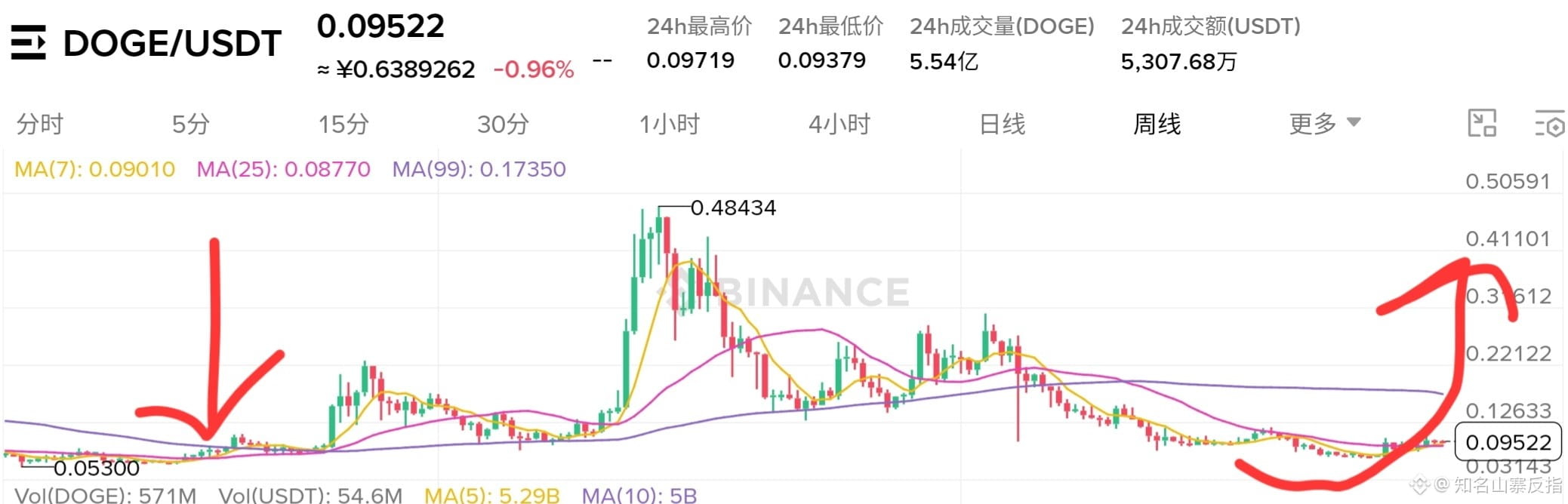
Many people still see $DOGE
as a MEME coin that “relies on Musk’s tweets.”
But something has changed recently.
DogeOS is rolling out a new testnet,
and starting to explore more use cases for DOGE,
such as trading,
lending, and stablecoins.
Now that’s interesting…
If the story of DOGE
slowly shifts from “hype + MEME”
to “MEME + ecosystem,”
how will the market view it in the next phase?
What do you think about $DOGE this time?
#DOGE #狗狗 #MEME
{future}(DOGEUSDT)
Many people still see $DOGE
as a MEME coin that “relies on Musk’s tweets.”
But something has changed recently.
DogeOS is rolling out a new testnet,
and starting to explore more use cases for DOGE,
such as trading,
lending, and stablecoins.
Now that’s interesting…
If the story of DOGE
slowly shifts from “hype + MEME”
to “MEME + ecosystem,”
how will the market view it in the next phase?
What do you think about $DOGE this time?
#DOGE #狗狗 #MEME
as a MEME coin that “relies on Musk’s tweets.”
But something has changed recently.
DogeOS is rolling out a new testnet,
and starting to explore more use cases for DOGE,
such as trading,
lending, and stablecoins.
Now that’s interesting…
If the story of DOGE
slowly shifts from “hype + MEME”
to “MEME + ecosystem,”
how will the market view it in the next phase?
What do you think about $DOGE this time?
#DOGE #狗狗 #MEME

梓阳纳福:
归零
1
1
452
·
--
PENGU Rebounds on Co-Branded Merch and Event CatalystsOver the past 24 hours (as of around 19:05 Beijing time on October 5), $PENGU was trading at about $0.009855, up approximately 5.5%. Binance spot trading volume was about $17.8 million, or around 0.99 times the seven-day average. Trading volume was broadly flat, while the price rebounded with market sentiment, making this an event-driven bounce rather than a broad-based surge in trading activity.
PENGU is the ecosystem token of Pudgy Penguins. The brand is known for its penguin IP and NFT community, and in recent years has continued to expand into consumer merchandise and offline experiences. Co-branded merchandise with LINE FRIENDS recently went on sale; from October 6 to 9, a series of “Huddle” community events will also be held in Singapore during Token2049, spanning social, brand, and ecosystem gatherings. The event window itself could easily boost short-term attention.
PENGU Rebounds on Co-Branded Merch and Event Catalysts
Over the past 24 hours (as of around 19:05 Beijing time on October 5), $PENGU was trading at about $0.009855, up approximately 5.5%. Binance spot trading volume was about $17.8 million, or around 0.99 times the seven-day average. Trading volume was broadly flat, while the price rebounded with market sentiment, making this an event-driven bounce rather than a broad-based surge in trading activity.
PENGU is the ecosystem token of Pudgy Penguins. The brand is known for its penguin IP and NFT community, and in recent years has continued to expand into consumer merchandise and offline experiences. Co-branded merchandise with LINE FRIENDS recently went on sale; from October 6 to 9, a series of “Huddle” community events will also be held in Singapore during Token2049, spanning social, brand, and ecosystem gatherings. The event window itself could easily boost short-term attention.
PENGU is the ecosystem token of Pudgy Penguins. The brand is known for its penguin IP and NFT community, and in recent years has continued to expand into consumer merchandise and offline experiences. Co-branded merchandise with LINE FRIENDS recently went on sale; from October 6 to 9, a series of “Huddle” community events will also be held in Singapore during Token2049, spanning social, brand, and ecosystem gatherings. The event window itself could easily boost short-term attention.
171

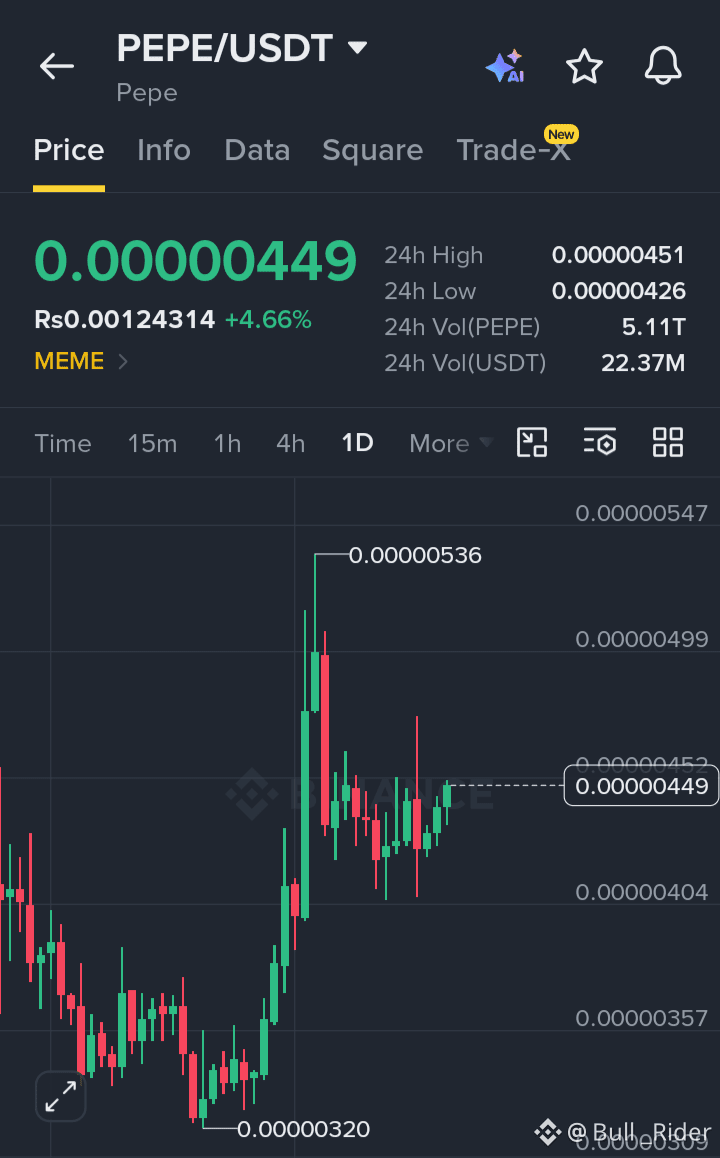
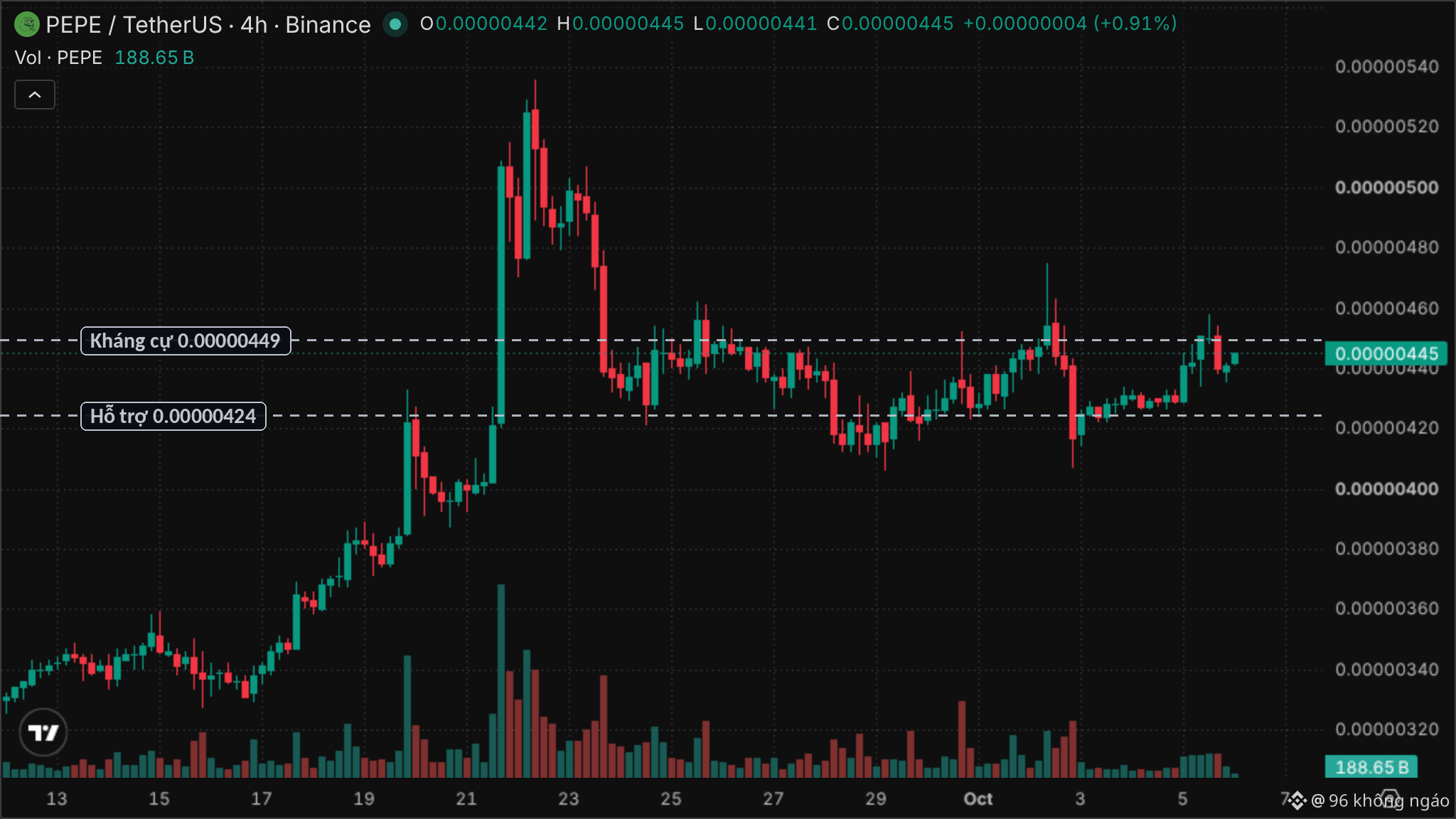
$PEPE testing the same price zone that capped gains three times in the past 10 days
On Sep 28, the price fell to $0.00000421, touching a support zone that had held several times before. It then gradually rebounded over successive sessions, recovering nearly all of the decline.
The price is now retesting $0.00000449 — a zone that has capped gains three times on the 4-hour chart. 24-hour volume has risen to $30.7 million, well above that of the previous few sessions.
The 4-hour and 1-hour charts are above the EMA20/50. The weekly and monthly charts remain below the long-term average zone, so this rebound is just a reaction within an old range, not a new trend.
Just my personal observation, not investment advice
#PEPE #Meme #Altcoin #CryptoTrading
Support me by placing a trade through this link 👇
$PEPE testing the same price zone that capped gains three times in the past 10 days
On Sep 28, the price fell to $0.00000421, touching a support zone that had held several times before. It then gradually rebounded over successive sessions, recovering nearly all of the decline.
The price is now retesting $0.00000449 — a zone that has capped gains three times on the 4-hour chart. 24-hour volume has risen to $30.7 million, well above that of the previous few sessions.
The 4-hour and 1-hour charts are above the EMA20/50. The weekly and monthly charts remain below the long-term average zone, so this rebound is just a reaction within an old range, not a new trend.
Just my personal observation, not investment advice
#PEPE #Meme #Altcoin #CryptoTrading
Support me by placing a trade through this link 👇
On Sep 28, the price fell to $0.00000421, touching a support zone that had held several times before. It then gradually rebounded over successive sessions, recovering nearly all of the decline.
The price is now retesting $0.00000449 — a zone that has capped gains three times on the 4-hour chart. 24-hour volume has risen to $30.7 million, well above that of the previous few sessions.
The 4-hour and 1-hour charts are above the EMA20/50. The weekly and monthly charts remain below the long-term average zone, so this rebound is just a reaction within an old range, not a new trend.
Just my personal observation, not investment advice
#PEPE #Meme #Altcoin #CryptoTrading
Support me by placing a trade through this link 👇
29

🔥 The noisiest Shiba Inu on the Robinhood chain got slammed again this morning: down 9.16% in 24 hours, with trading volume still hitting $9.4 million.
Current price: $0.1148. Intraday high: $0.1370; low: $0.1068. Market cap: around $114 million. Holders: 54,800. Liquidity: around $5.06 million. The chain is Robinhood, and the trading venue is clearly listed: available on Binance Alpha.
It’s still turning over, for an obvious reason. It’s a Shiba Inu meme with an added layer of “AI” narrative, and its trading pair is also linked to tokenized NVIDIA. The community doesn’t see it as a quiet pet; it’s more like an emotional switch on this chain: volume is there, people are there, and traders are watching the pullback too. Trading volume is just a step shy of $10 million, and a 9% drop hasn’t scared everyone out of the market.
The pullback itself isn’t news. Intraday, it has already slid from $0.1370 to around $0.1068—a sizeable swing. Meme markets have always been like this: the story keeps going while the price jolts people awake. In the short term, the question is whether volume sticks around, not whether a slogan can hold the line at a round number.
⚠️ Meme coins are extremely volatile. This is not investment advice.
Data source: Binance Alpha real-time market data (October 6, 09:40 UTC+8)
#meme #币安Alpha #On-chain Trending
$AI
🔥 The noisiest Shiba Inu on the Robinhood chain got slammed again this morning: down 9.16% in 24 hours, with trading volume still hitting $9.4 million.
Current price: $0.1148. Intraday high: $0.1370; low: $0.1068. Market cap: around $114 million. Holders: 54,800. Liquidity: around $5.06 million. The chain is Robinhood, and the trading venue is clearly listed: available on Binance Alpha.
It’s still turning over, for an obvious reason. It’s a Shiba Inu meme with an added layer of “AI” narrative, and its trading pair is also linked to tokenized NVIDIA. The community doesn’t see it as a quiet pet; it’s more like an emotional switch on this chain: volume is there, people are there, and traders are watching the pullback too. Trading volume is just a step shy of $10 million, and a 9% drop hasn’t scared everyone out of the market.
The pullback itself isn’t news. Intraday, it has already slid from $0.1370 to around $0.1068—a sizeable swing. Meme markets have always been like this: the story keeps going while the price jolts people awake. In the short term, the question is whether volume sticks around, not whether a slogan can hold the line at a round number.
⚠️ Meme coins are extremely volatile. This is not investment advice.
Data source: Binance Alpha real-time market data (October 6, 09:40 UTC+8)
#meme #币安Alpha #On-chain Trending
$AI
Current price: $0.1148. Intraday high: $0.1370; low: $0.1068. Market cap: around $114 million. Holders: 54,800. Liquidity: around $5.06 million. The chain is Robinhood, and the trading venue is clearly listed: available on Binance Alpha.
It’s still turning over, for an obvious reason. It’s a Shiba Inu meme with an added layer of “AI” narrative, and its trading pair is also linked to tokenized NVIDIA. The community doesn’t see it as a quiet pet; it’s more like an emotional switch on this chain: volume is there, people are there, and traders are watching the pullback too. Trading volume is just a step shy of $10 million, and a 9% drop hasn’t scared everyone out of the market.
The pullback itself isn’t news. Intraday, it has already slid from $0.1370 to around $0.1068—a sizeable swing. Meme markets have always been like this: the story keeps going while the price jolts people awake. In the short term, the question is whether volume sticks around, not whether a slogan can hold the line at a round number.
⚠️ Meme coins are extremely volatile. This is not investment advice.
Data source: Binance Alpha real-time market data (October 6, 09:40 UTC+8)
#meme #币安Alpha #On-chain Trending
$AI
37

·
--
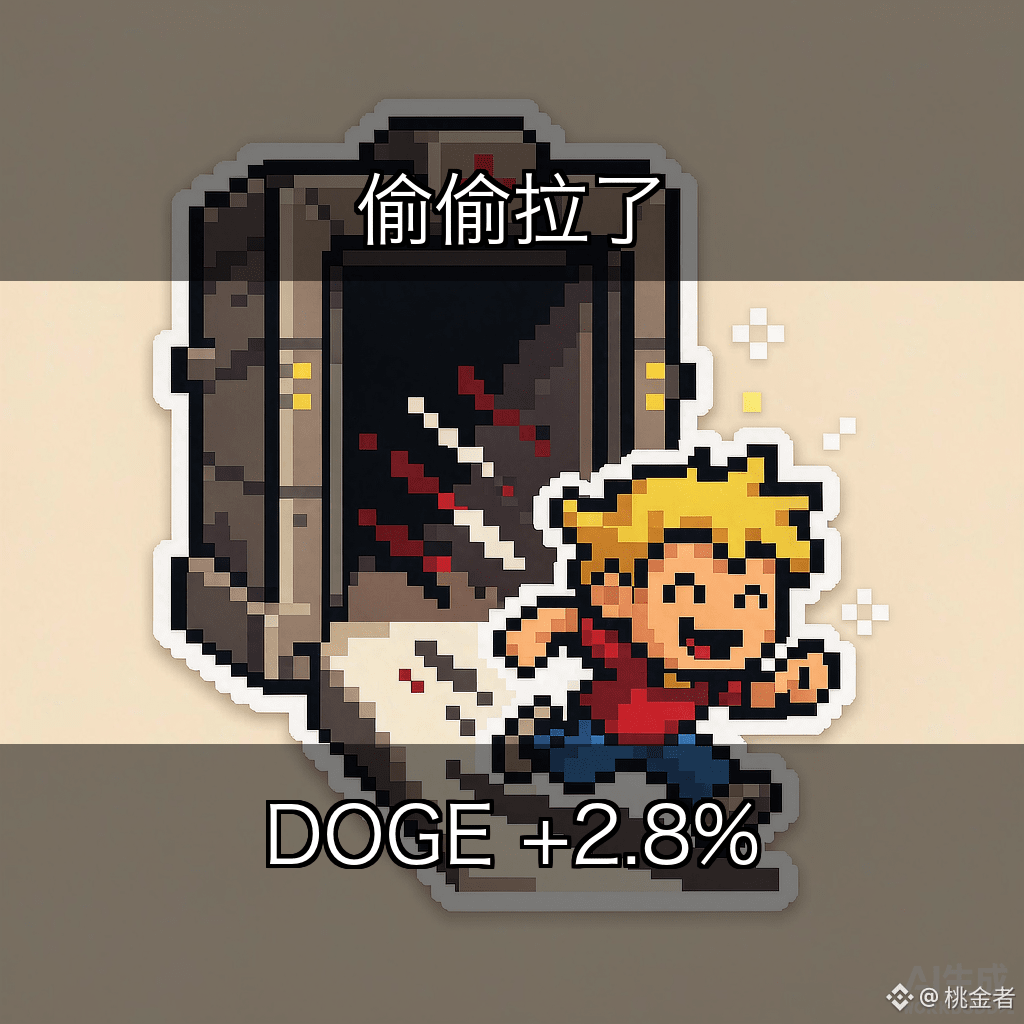
⚡ Today’s One Coin · DOGE
📈 DOGE is up 2.81%—and I actually started shaking
💵 In the past 24h: +2.81%, trading volume 56.7M U, current price 0.0956. Chasing in at this spot feels like catching a falling knife.
🗣️ One line: Volume and price are still in sync, but don’t chase at the top.
🎯 Only once it holds above 0.1004 can it be a relay—otherwise it’s just bait for a rally.
💬 If you’re holding DOGE, today—hold on or reduce?
🎉 Wishing everyone a full win on every order, riding the whole main uptrend from start to finish 🐋
$DOGE #Meme 🔥
Investing involves risk. All data in this article is collected from the internet and does not constitute investment advice. Please do your own research and study.
⚡ Today’s One Coin · DOGE
📈 DOGE is up 2.81%—and I actually started shaking
💵 In the past 24h: +2.81%, trading volume 56.7M U, current price 0.0956. Chasing in at this spot feels like catching a falling knife.
🗣️ One line: Volume and price are still in sync, but don’t chase at the top.
🎯 Only once it holds above 0.1004 can it be a relay—otherwise it’s just bait for a rally.
💬 If you’re holding DOGE, today—hold on or reduce?
🎉 Wishing everyone a full win on every order, riding the whole main uptrend from start to finish 🐋
$DOGE #Meme 🔥
Investing involves risk. All data in this article is collected from the internet and does not constitute investment advice. Please do your own research and study.
📈 DOGE is up 2.81%—and I actually started shaking
💵 In the past 24h: +2.81%, trading volume 56.7M U, current price 0.0956. Chasing in at this spot feels like catching a falling knife.
🗣️ One line: Volume and price are still in sync, but don’t chase at the top.
🎯 Only once it holds above 0.1004 can it be a relay—otherwise it’s just bait for a rally.
💬 If you’re holding DOGE, today—hold on or reduce?
🎉 Wishing everyone a full win on every order, riding the whole main uptrend from start to finish 🐋
$DOGE #Meme 🔥
Investing involves risk. All data in this article is collected from the internet and does not constitute investment advice. Please do your own research and study.
204


·
--
PEPE has moved first; the ETF is still going through the process
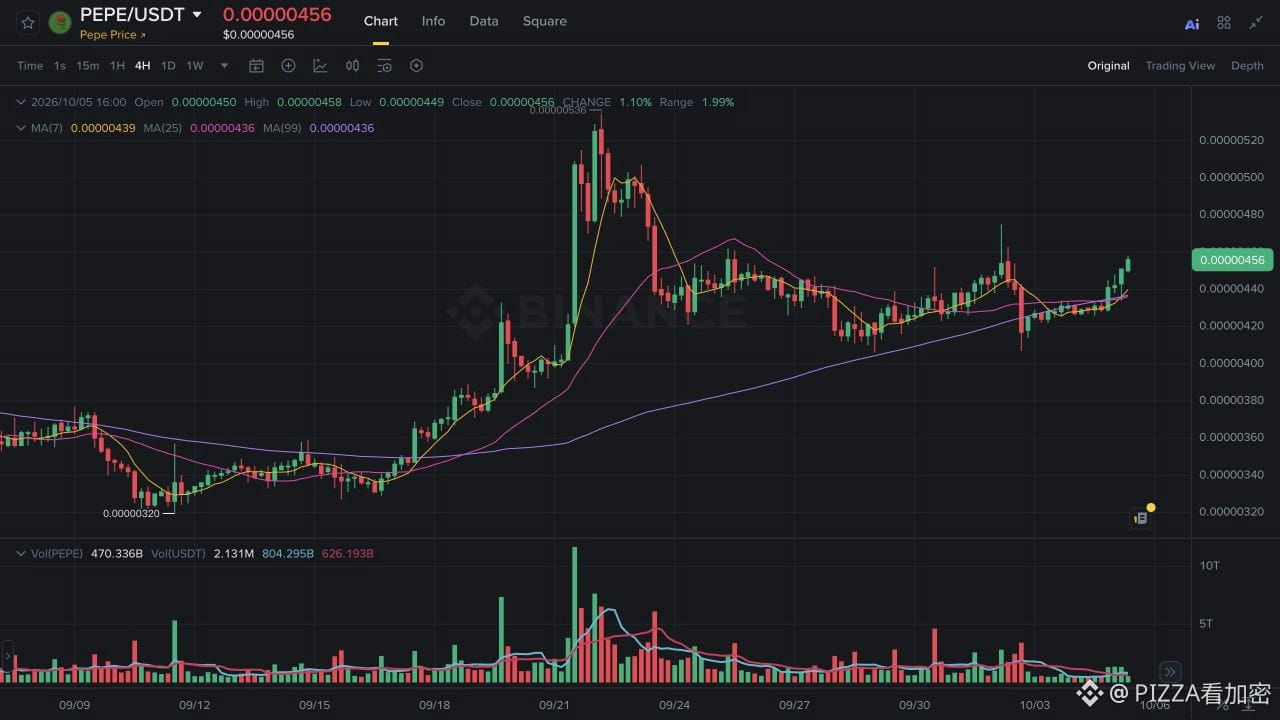
I think $PEPE could keep pushing higher over the next couple of days. The weekend lows have been rising, and today it moved above the weekend high. The rebound also has more momentum than yesterday. That said, my bullish view is based on price action over the past few days; ETF-related money shouldn’t be counted in advance.
At 16:30 Beijing time, PEPE/USDT on Binance was around 0.00000455, up about 6.1% over the rolling 24 hours. On the UTC daily chart, Saturday’s low was 0.00000422, Sunday’s was 0.00000426, and today’s low so far was 0.00000434. The lows have been moving higher on pullbacks, and today’s price has also moved above Sunday’s high of 0.00000445.
Friday’s high of 0.00000475 is still overhead. If buyers step in around 0.00000445 on the next pullback, I’d be more inclined to think the rebound can continue. If it drops back toward today’s low, that short-term edge will weaken. Today’s daily candle hasn’t closed yet, so it could still retreat after breaking above that level intraday.
Canary submitted an amended S-1/A on October 2; the initial S-1 was filed back on April 8. The amendment still says these shares cannot be sold before the registration statement becomes effective, and it doesn’t specify the quantity or amount of PEPE purchased by seed investors. This filing alone isn’t enough to work out how much PEPE the ETF has bought.
Once it launches and sees net inflows, the fund would need to receive PEPE or buy it with cash, which could add to demand. But the market can also price in expectations ahead of time; it doesn’t have to wait for every step of the process to be completed before rising. FET and ADA are also up today, and the candlestick chart alone can’t tell us how much of PEPE’s rebound is driven by ETF hopes.
As for whether the ETF will let more people buy PEPE through brokerage accounts, we’ll have to wait until the application reaches the actual launch stage.
#PEPE #ETF #Meme
PEPE has moved first; the ETF is still going through the process
I think $PEPE could keep pushing higher over the next couple of days. The weekend lows have been rising, and today it moved above the weekend high. The rebound also has more momentum than yesterday. That said, my bullish view is based on price action over the past few days; ETF-related money shouldn’t be counted in advance.
At 16:30 Beijing time, PEPE/USDT on Binance was around 0.00000455, up about 6.1% over the rolling 24 hours. On the UTC daily chart, Saturday’s low was 0.00000422, Sunday’s was 0.00000426, and today’s low so far was 0.00000434. The lows have been moving higher on pullbacks, and today’s price has also moved above Sunday’s high of 0.00000445.
Friday’s high of 0.00000475 is still overhead. If buyers step in around 0.00000445 on the next pullback, I’d be more inclined to think the rebound can continue. If it drops back toward today’s low, that short-term edge will weaken. Today’s daily candle hasn’t closed yet, so it could still retreat after breaking above that level intraday.
Canary submitted an amended S-1/A on October 2; the initial S-1 was filed back on April 8. The amendment still says these shares cannot be sold before the registration statement becomes effective, and it doesn’t specify the quantity or amount of PEPE purchased by seed investors. This filing alone isn’t enough to work out how much PEPE the ETF has bought.
Once it launches and sees net inflows, the fund would need to receive PEPE or buy it with cash, which could add to demand. But the market can also price in expectations ahead of time; it doesn’t have to wait for every step of the process to be completed before rising. FET and ADA are also up today, and the candlestick chart alone can’t tell us how much of PEPE’s rebound is driven by ETF hopes.
As for whether the ETF will let more people buy PEPE through brokerage accounts, we’ll have to wait until the application reaches the actual launch stage.
#PEPE #ETF #Meme
I think $PEPE could keep pushing higher over the next couple of days. The weekend lows have been rising, and today it moved above the weekend high. The rebound also has more momentum than yesterday. That said, my bullish view is based on price action over the past few days; ETF-related money shouldn’t be counted in advance.
At 16:30 Beijing time, PEPE/USDT on Binance was around 0.00000455, up about 6.1% over the rolling 24 hours. On the UTC daily chart, Saturday’s low was 0.00000422, Sunday’s was 0.00000426, and today’s low so far was 0.00000434. The lows have been moving higher on pullbacks, and today’s price has also moved above Sunday’s high of 0.00000445.
Friday’s high of 0.00000475 is still overhead. If buyers step in around 0.00000445 on the next pullback, I’d be more inclined to think the rebound can continue. If it drops back toward today’s low, that short-term edge will weaken. Today’s daily candle hasn’t closed yet, so it could still retreat after breaking above that level intraday.
Canary submitted an amended S-1/A on October 2; the initial S-1 was filed back on April 8. The amendment still says these shares cannot be sold before the registration statement becomes effective, and it doesn’t specify the quantity or amount of PEPE purchased by seed investors. This filing alone isn’t enough to work out how much PEPE the ETF has bought.
Once it launches and sees net inflows, the fund would need to receive PEPE or buy it with cash, which could add to demand. But the market can also price in expectations ahead of time; it doesn’t have to wait for every step of the process to be completed before rising. FET and ADA are also up today, and the candlestick chart alone can’t tell us how much of PEPE’s rebound is driven by ETF hopes.
As for whether the ETF will let more people buy PEPE through brokerage accounts, we’ll have to wait until the application reaches the actual launch stage.
#PEPE #ETF #Meme
416
🔥 The bull hasn’t arrived yet. 64,700 people are still holding on.
This Chinese meme coin on BSC was nearly flat tonight: current price $0.08172, down 1.23% over 24 hours, with $1.376 million in trading volume. Intraday high/low: $0.0843 / $0.0776; market cap around $81.72 million; 64,700 holders; on-chain liquidity around $2.38 million. Already listed on Binance Spot.
The name is the whole story: “Hang on and wait for the bull”—wait through the rises, wait through the dips, and wait even when it goes sideways. No explosive rally or crash tonight; volume is thinning as the price grinds along, but people haven’t left. What meme coins fear most isn’t a red day—it’s being ignored. This one is still on people’s radar. A flat price doesn’t mean the story is over; the catchphrase just hasn’t come true yet.
⚠️ Meme coins are extremely volatile. This is not investment advice.
Data source: Binance Alpha real-time market data (October 5, 19:41 UTC+8)
#meme #币安Alpha #OnchainHotTopics
🔥 The bull hasn’t arrived yet. 64,700 people are still holding on.
This Chinese meme coin on BSC was nearly flat tonight: current price $0.08172, down 1.23% over 24 hours, with $1.376 million in trading volume. Intraday high/low: $0.0843 / $0.0776; market cap around $81.72 million; 64,700 holders; on-chain liquidity around $2.38 million. Already listed on Binance Spot.
The name is the whole story: “Hang on and wait for the bull”—wait through the rises, wait through the dips, and wait even when it goes sideways. No explosive rally or crash tonight; volume is thinning as the price grinds along, but people haven’t left. What meme coins fear most isn’t a red day—it’s being ignored. This one is still on people’s radar. A flat price doesn’t mean the story is over; the catchphrase just hasn’t come true yet.
⚠️ Meme coins are extremely volatile. This is not investment advice.
Data source: Binance Alpha real-time market data (October 5, 19:41 UTC+8)
#meme #币安Alpha #OnchainHotTopics
This Chinese meme coin on BSC was nearly flat tonight: current price $0.08172, down 1.23% over 24 hours, with $1.376 million in trading volume. Intraday high/low: $0.0843 / $0.0776; market cap around $81.72 million; 64,700 holders; on-chain liquidity around $2.38 million. Already listed on Binance Spot.
The name is the whole story: “Hang on and wait for the bull”—wait through the rises, wait through the dips, and wait even when it goes sideways. No explosive rally or crash tonight; volume is thinning as the price grinds along, but people haven’t left. What meme coins fear most isn’t a red day—it’s being ignored. This one is still on people’s radar. A flat price doesn’t mean the story is over; the catchphrase just hasn’t come true yet.
⚠️ Meme coins are extremely volatile. This is not investment advice.
Data source: Binance Alpha real-time market data (October 5, 19:41 UTC+8)
#meme #币安Alpha #OnchainHotTopics
54
🔥 This cat in the afternoon clawed the chart until it turned red. Almost all the order-book levels worth over ten million are for project coins—the real meme being jumped to is this cat.
On BNB Chain, Mubarak is up 17.41% in 24 hours. Current price: $0.0767. Intraday low: $0.0649; high: $0.0794. It went from the bottom to the top in one continuous move. Trading volume: $1.037 million. Holders: 36,500. Liquidity: $3.31 million and still rising. Listed on Binance spot already, with a market cap of about $76.75 million.
So why is it still on fire? It’s that cat meme tied to a Binance founder expression. The community recognizes this face—whenever there’s emotion in the order book, it often moves first by a notch. Today there aren’t any verifiable new events you can confirm via search; it’s just an old meme being lifted again by capital. Short-term funds love this kind of familiar face: thin order books, and once pushed, it runs.
⚠️ Meme coins can fluctuate extremely wildly—seeing 17-point swings back and forth within a day is common. They can pump fast and dump just as fast, and this does not constitute investment advice.
Data source: Binance Alpha real-time market data (Oct 5, 14:40 UTC+8)
#meme #币安Alpha #On-chain highlights
$MUBARAK
🔥 This cat in the afternoon clawed the chart until it turned red. Almost all the order-book levels worth over ten million are for project coins—the real meme being jumped to is this cat.
On BNB Chain, Mubarak is up 17.41% in 24 hours. Current price: $0.0767. Intraday low: $0.0649; high: $0.0794. It went from the bottom to the top in one continuous move. Trading volume: $1.037 million. Holders: 36,500. Liquidity: $3.31 million and still rising. Listed on Binance spot already, with a market cap of about $76.75 million.
So why is it still on fire? It’s that cat meme tied to a Binance founder expression. The community recognizes this face—whenever there’s emotion in the order book, it often moves first by a notch. Today there aren’t any verifiable new events you can confirm via search; it’s just an old meme being lifted again by capital. Short-term funds love this kind of familiar face: thin order books, and once pushed, it runs.
⚠️ Meme coins can fluctuate extremely wildly—seeing 17-point swings back and forth within a day is common. They can pump fast and dump just as fast, and this does not constitute investment advice.
Data source: Binance Alpha real-time market data (Oct 5, 14:40 UTC+8)
#meme #币安Alpha #On-chain highlights
$MUBARAK
On BNB Chain, Mubarak is up 17.41% in 24 hours. Current price: $0.0767. Intraday low: $0.0649; high: $0.0794. It went from the bottom to the top in one continuous move. Trading volume: $1.037 million. Holders: 36,500. Liquidity: $3.31 million and still rising. Listed on Binance spot already, with a market cap of about $76.75 million.
So why is it still on fire? It’s that cat meme tied to a Binance founder expression. The community recognizes this face—whenever there’s emotion in the order book, it often moves first by a notch. Today there aren’t any verifiable new events you can confirm via search; it’s just an old meme being lifted again by capital. Short-term funds love this kind of familiar face: thin order books, and once pushed, it runs.
⚠️ Meme coins can fluctuate extremely wildly—seeing 17-point swings back and forth within a day is common. They can pump fast and dump just as fast, and this does not constitute investment advice.
Data source: Binance Alpha real-time market data (Oct 5, 14:40 UTC+8)
#meme #币安Alpha #On-chain highlights
$MUBARAK
207
·
--
⚡ Today One Coin · PEPE
📈 PEPE sees on-chain activity, up 3.74%
💵 24h +3.74%, trading volume 15.4M U, current price 4.44e-06. When big holders move, the whole market shakes
One line: volume and price are still coordinating, but don’t chase at the peak.
🎯 Holding steady above 0.0 is what counts as a relay, otherwise it’s just a bull trap.
💬 If you hold PEPE, do you hold on today or reduce?
🎉 Wishing everyone matches the rhythm and never misses a step 🥁
$PEPE #Meme 🔥
Investing involves risk. The data in this article is all collected from the internet and does not constitute investment advice—please do your own research and study.
⚡ Today One Coin · PEPE
📈 PEPE sees on-chain activity, up 3.74%
💵 24h +3.74%, trading volume 15.4M U, current price 4.44e-06. When big holders move, the whole market shakes
One line: volume and price are still coordinating, but don’t chase at the peak.
🎯 Holding steady above 0.0 is what counts as a relay, otherwise it’s just a bull trap.
💬 If you hold PEPE, do you hold on today or reduce?
🎉 Wishing everyone matches the rhythm and never misses a step 🥁
$PEPE #Meme 🔥
Investing involves risk. The data in this article is all collected from the internet and does not constitute investment advice—please do your own research and study.
📈 PEPE sees on-chain activity, up 3.74%
💵 24h +3.74%, trading volume 15.4M U, current price 4.44e-06. When big holders move, the whole market shakes
One line: volume and price are still coordinating, but don’t chase at the peak.
🎯 Holding steady above 0.0 is what counts as a relay, otherwise it’s just a bull trap.
💬 If you hold PEPE, do you hold on today or reduce?
🎉 Wishing everyone matches the rhythm and never misses a step 🥁
$PEPE #Meme 🔥
Investing involves risk. The data in this article is all collected from the internet and does not constitute investment advice—please do your own research and study.
128
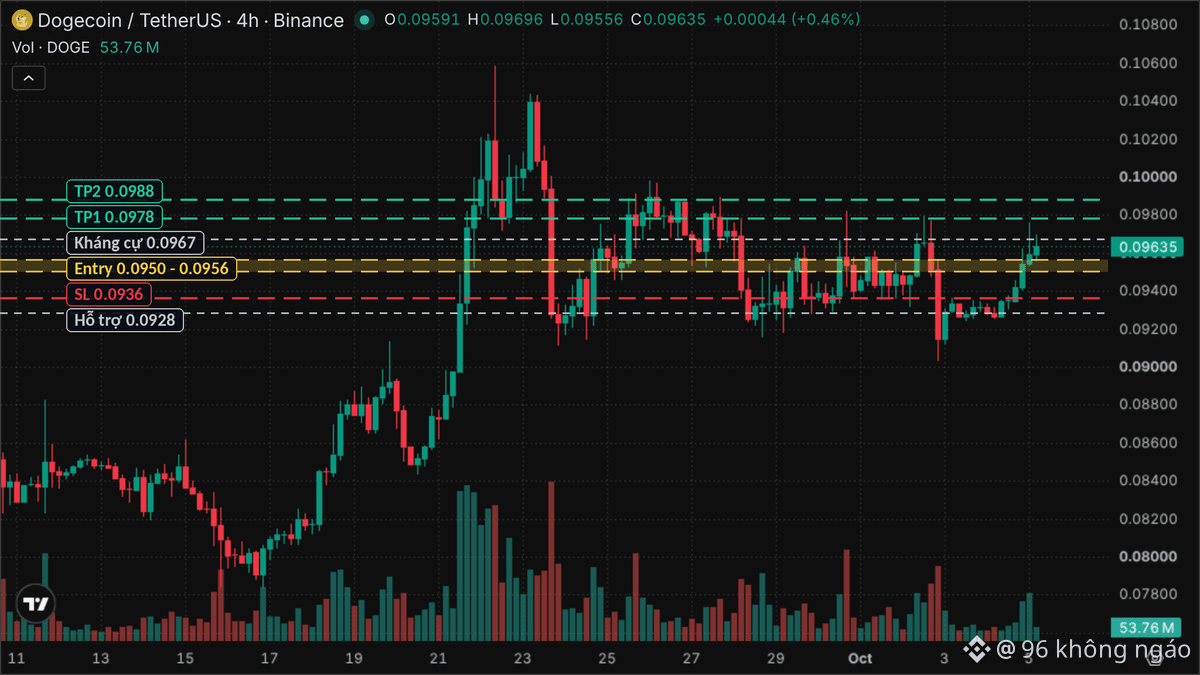
$DOGE — LONG
Entry 0.0950 – 0.0956
SL 0.0936
TP1 0.0978
TP2 0.0988
Seven consecutive red sessions pushed the price down to the bottom, followed by a bullish green reversal candle.
From 26/09 to 03/10, $DOGE fell for seven straight sessions, from 0.099 down to 0.0928 USD. On 04/10 it rebounded +3.33% with volume double that of the previous session; today it continues to hold above 0.096 — stronger than BTC (+2.1% over the same period).
On the 4-hour, 2-hour, and 1-hour charts, price is above the EMA20/50, confirming the short-term uptrend. I’m waiting for a pullback to 0.0950 – 0.0956 before entering; if the 4H candle closes below 0.0936, then I’ll cancel the order.
Personal observation only, not investment advice
#DOGE #Dogecoin #Meme #CryptoTrading
Support me by placing an order through here 👇
$DOGE — LONG
Entry 0.0950 – 0.0956
SL 0.0936
TP1 0.0978
TP2 0.0988
Seven consecutive red sessions pushed the price down to the bottom, followed by a bullish green reversal candle.
From 26/09 to 03/10, $DOGE fell for seven straight sessions, from 0.099 down to 0.0928 USD. On 04/10 it rebounded +3.33% with volume double that of the previous session; today it continues to hold above 0.096 — stronger than BTC (+2.1% over the same period).
On the 4-hour, 2-hour, and 1-hour charts, price is above the EMA20/50, confirming the short-term uptrend. I’m waiting for a pullback to 0.0950 – 0.0956 before entering; if the 4H candle closes below 0.0936, then I’ll cancel the order.
Personal observation only, not investment advice
#DOGE #Dogecoin #Meme #CryptoTrading
Support me by placing an order through here 👇
Entry 0.0950 – 0.0956
SL 0.0936
TP1 0.0978
TP2 0.0988
Seven consecutive red sessions pushed the price down to the bottom, followed by a bullish green reversal candle.
From 26/09 to 03/10, $DOGE fell for seven straight sessions, from 0.099 down to 0.0928 USD. On 04/10 it rebounded +3.33% with volume double that of the previous session; today it continues to hold above 0.096 — stronger than BTC (+2.1% over the same period).
On the 4-hour, 2-hour, and 1-hour charts, price is above the EMA20/50, confirming the short-term uptrend. I’m waiting for a pullback to 0.0950 – 0.0956 before entering; if the 4H candle closes below 0.0936, then I’ll cancel the order.
Personal observation only, not investment advice
#DOGE #Dogecoin #Meme #CryptoTrading
Support me by placing an order through here 👇
80
🔥 The meme coin on-chain that “the cinema is a decoy”—Robinhood’s own this morning shook it a bit: +7.21% in 24 hours.
Don’t be fooled by the name. On-chain numbers speak louder than slogans—current price is about $0.01618. It ranged from $0.01377 to $0.01782 during the day. Trading volume: $1.534M, holders: 29.7K, market cap: about $16.18M, liquidity: about $4.05M. It’s tradable on Binance Alpha.
Why is it still trending? This meme’s persona was never a serious cinema. The community catchphrase has long been “the cinema is a decoy.” The narrative is light, the order book stays active, and every couple of days it can be pulled back up for another look. This morning there were no new, verifiable catalysts—so the data is moving on its own.
⚠️ Meme coins are extremely volatile; gains can come fast and so can give-backs. This is not investment advice.
Data source: Binance Alpha real-time quotes (Oct 5, 09:41 UTC+8)
#meme #币安Alpha #On-chain Hotspot
$MEME
🔥 The meme coin on-chain that “the cinema is a decoy”—Robinhood’s own this morning shook it a bit: +7.21% in 24 hours.
Don’t be fooled by the name. On-chain numbers speak louder than slogans—current price is about $0.01618. It ranged from $0.01377 to $0.01782 during the day. Trading volume: $1.534M, holders: 29.7K, market cap: about $16.18M, liquidity: about $4.05M. It’s tradable on Binance Alpha.
Why is it still trending? This meme’s persona was never a serious cinema. The community catchphrase has long been “the cinema is a decoy.” The narrative is light, the order book stays active, and every couple of days it can be pulled back up for another look. This morning there were no new, verifiable catalysts—so the data is moving on its own.
⚠️ Meme coins are extremely volatile; gains can come fast and so can give-backs. This is not investment advice.
Data source: Binance Alpha real-time quotes (Oct 5, 09:41 UTC+8)
#meme #币安Alpha #On-chain Hotspot
$MEME
Don’t be fooled by the name. On-chain numbers speak louder than slogans—current price is about $0.01618. It ranged from $0.01377 to $0.01782 during the day. Trading volume: $1.534M, holders: 29.7K, market cap: about $16.18M, liquidity: about $4.05M. It’s tradable on Binance Alpha.
Why is it still trending? This meme’s persona was never a serious cinema. The community catchphrase has long been “the cinema is a decoy.” The narrative is light, the order book stays active, and every couple of days it can be pulled back up for another look. This morning there were no new, verifiable catalysts—so the data is moving on its own.
⚠️ Meme coins are extremely volatile; gains can come fast and so can give-backs. This is not investment advice.
Data source: Binance Alpha real-time quotes (Oct 5, 09:41 UTC+8)
#meme #币安Alpha #On-chain Hotspot
$MEME
91

·
--
meme short-term sentiment—how is it today?
If the leader doesn’t expand volume, I won’t listen to any small-cap stories.
Use price change and volume for sentiment; don’t rely on chat group hype.
SHIB 0.00000595(+4.20%),BONK 0.00000397(+3.93%),DOGE 0.0963(+3.71%),PEPE 0.00000442(+2.55%)
For comparison: BTC 86590(24h +2.14%)。
SHIB’s 24h +4.20% is clearly stronger than BTC’s +2.14%—there’s independent buying. But WIF is only +0.36%, and the sector isn’t resonating. Trade the leader only; don’t fantasize about laggard rotation.
If the spread between the leader and the weakest one narrows to within 2 percentage points, the independent buying disappears—then cut the position.
Data: Binance spot 24h / Binance U-margined / Yahoo daily (5-day up/down). Missing numbers aren’t filled in.
Are you currently in cash waiting for a pullback, or are you already on the train?
#meme #sentiment
Data card (same round as the main text; what’s missing is the dashes):
BTC 86,590 +2.14% Binance spot 24h
ETH 2,726 +1.23% ETH/BTC 0.03148
S&P 7,723 -0.27% Yahoo 5-day
Nasdaq 27,191 +0.45% Yahoo 5-day
US Dollar 102 +0.59% DXY 5-day
VIX 15.31 -4.73% Yahoo
Fee rate 0.0083% Open interest 8.50B(24h +3.32) Long/Short 0.9833 Binance U-margined
Personal take—numbers are from the sources in the main text. Not a trade instruction.
meme short-term sentiment—how is it today?
If the leader doesn’t expand volume, I won’t listen to any small-cap stories.
Use price change and volume for sentiment; don’t rely on chat group hype.
SHIB 0.00000595(+4.20%),BONK 0.00000397(+3.93%),DOGE 0.0963(+3.71%),PEPE 0.00000442(+2.55%)
For comparison: BTC 86590(24h +2.14%)。
SHIB’s 24h +4.20% is clearly stronger than BTC’s +2.14%—there’s independent buying. But WIF is only +0.36%, and the sector isn’t resonating. Trade the leader only; don’t fantasize about laggard rotation.
If the spread between the leader and the weakest one narrows to within 2 percentage points, the independent buying disappears—then cut the position.
Data: Binance spot 24h / Binance U-margined / Yahoo daily (5-day up/down). Missing numbers aren’t filled in.
Are you currently in cash waiting for a pullback, or are you already on the train?
#meme #sentiment
Data card (same round as the main text; what’s missing is the dashes):
BTC 86,590 +2.14% Binance spot 24h
ETH 2,726 +1.23% ETH/BTC 0.03148
S&P 7,723 -0.27% Yahoo 5-day
Nasdaq 27,191 +0.45% Yahoo 5-day
US Dollar 102 +0.59% DXY 5-day
VIX 15.31 -4.73% Yahoo
Fee rate 0.0083% Open interest 8.50B(24h +3.32) Long/Short 0.9833 Binance U-margined
Personal take—numbers are from the sources in the main text. Not a trade instruction.
If the leader doesn’t expand volume, I won’t listen to any small-cap stories.
Use price change and volume for sentiment; don’t rely on chat group hype.
SHIB 0.00000595(+4.20%),BONK 0.00000397(+3.93%),DOGE 0.0963(+3.71%),PEPE 0.00000442(+2.55%)
For comparison: BTC 86590(24h +2.14%)。
SHIB’s 24h +4.20% is clearly stronger than BTC’s +2.14%—there’s independent buying. But WIF is only +0.36%, and the sector isn’t resonating. Trade the leader only; don’t fantasize about laggard rotation.
If the spread between the leader and the weakest one narrows to within 2 percentage points, the independent buying disappears—then cut the position.
Data: Binance spot 24h / Binance U-margined / Yahoo daily (5-day up/down). Missing numbers aren’t filled in.
Are you currently in cash waiting for a pullback, or are you already on the train?
#meme #sentiment
Data card (same round as the main text; what’s missing is the dashes):
BTC 86,590 +2.14% Binance spot 24h
ETH 2,726 +1.23% ETH/BTC 0.03148
S&P 7,723 -0.27% Yahoo 5-day
Nasdaq 27,191 +0.45% Yahoo 5-day
US Dollar 102 +0.59% DXY 5-day
VIX 15.31 -4.73% Yahoo
Fee rate 0.0083% Open interest 8.50B(24h +3.32) Long/Short 0.9833 Binance U-margined
Personal take—numbers are from the sources in the main text. Not a trade instruction.
55

·
--
After the $1000PEPE spike-pin, it crawls back to the pressure level. I watched this bullish candle’s quality twice.
On October 2nd, that dump, a single 4H candle fell from 0.00454 to 0.00406—amplitude over 10%, volume reaching 92.5M. A textbook spike-pin washout: the bears wiped out the longs in one bite, and then price returned above 0.00425 in less than two K-lines. Panic selling was completely absorbed.
Market signals: current price 0.0043882, just 1.2% away from the 10-K line resistance level at 0.004443. 24h change +1.95%—not explosive, but the direction is clear. Support at 0.004217 has been tested three times with no break. The bottom is rising.
Market sentiment: funding rate +0.01%/8h—longs are paying, but not expensive. The market isn’t overly optimistic and there’s no panic. This funding-rate structure suggests most people are watching from the sidelines, and the longs who truly entered haven’t started adding leverage yet. Sentiment is neutral to slightly more bullish—this isn’t a FOMO phase.
Whale activity: the 4H candle at 16:00 on October 2nd had 92.5M in成交. Immediately at 20:00 volume shrank to 26.4M, indicating the main player completed a position/chip exchange within that spike-pin candle. After that, the trading volume stayed stable between 11M and 21M for four days, with no abnormal sell pressure. The latest 4H volume is 37.4M, the highest among the last four—so a breakout with increased volume likely aligns with the direction chosen by the longs.
Volume-price structure: 30-K-line volume ratio average is 1.04, and this candle is right around the mean. Not a blow-off volume—just a moderate increase. Blow-off volume often marks a top; moderate expansion is the signal that a trend is starting. Total trading in 24h is 113.6M, and given PEPE’s size, liquidity is sufficient.
K-line details: a string of one solid green candle, but the key is that the bullish candle body covers the drop of the previous two bearish candles. The one at 20:00 on October 4th opened at 0.004297 and closed at 0.004388. The upper wick is extremely short (the high at 0.004443 is almost the closing price), showing the bulls closed near the highs without hesitation. The center of gravity over the last ~10 K-lines has been slowly lifting: 0.00426 → 0.00428 → 0.00430 → 0.00439, a stair-step climb.
PEPE is an old hand in the Meme track—there’s no technical narrative, no ecosystem value-add, it lives purely on community consensus and liquidity. The move in this kind of coin depends entirely on capital flow and sentiment; fundamentals carry essentially zero weight. With the spike-pin not breaking the bottom and moderate volume pushing toward resistance, the structure is overall bullish.
Nini’s plan: current price 0.0043882, resistance 0.004443. After a breakout, look for the 0.0046–0.0047 range (around the October 2nd high). Stop loss below the support at 0.004217. Slightly bullish, but don’t chase—wait for a pullback near 0.0043 to enter. If it directly breaks 0.004443 with volume and doesn’t look back, then don’t chase—wait for the next structure.
If you need a customized strategy, you can find Nini.
#1000PEPE #Meme #MemeCoin
After the $1000PEPE spike-pin, it crawls back to the pressure level. I watched this bullish candle’s quality twice.
On October 2nd, that dump, a single 4H candle fell from 0.00454 to 0.00406—amplitude over 10%, volume reaching 92.5M. A textbook spike-pin washout: the bears wiped out the longs in one bite, and then price returned above 0.00425 in less than two K-lines. Panic selling was completely absorbed.
Market signals: current price 0.0043882, just 1.2% away from the 10-K line resistance level at 0.004443. 24h change +1.95%—not explosive, but the direction is clear. Support at 0.004217 has been tested three times with no break. The bottom is rising.
Market sentiment: funding rate +0.01%/8h—longs are paying, but not expensive. The market isn’t overly optimistic and there’s no panic. This funding-rate structure suggests most people are watching from the sidelines, and the longs who truly entered haven’t started adding leverage yet. Sentiment is neutral to slightly more bullish—this isn’t a FOMO phase.
Whale activity: the 4H candle at 16:00 on October 2nd had 92.5M in成交. Immediately at 20:00 volume shrank to 26.4M, indicating the main player completed a position/chip exchange within that spike-pin candle. After that, the trading volume stayed stable between 11M and 21M for four days, with no abnormal sell pressure. The latest 4H volume is 37.4M, the highest among the last four—so a breakout with increased volume likely aligns with the direction chosen by the longs.
Volume-price structure: 30-K-line volume ratio average is 1.04, and this candle is right around the mean. Not a blow-off volume—just a moderate increase. Blow-off volume often marks a top; moderate expansion is the signal that a trend is starting. Total trading in 24h is 113.6M, and given PEPE’s size, liquidity is sufficient.
K-line details: a string of one solid green candle, but the key is that the bullish candle body covers the drop of the previous two bearish candles. The one at 20:00 on October 4th opened at 0.004297 and closed at 0.004388. The upper wick is extremely short (the high at 0.004443 is almost the closing price), showing the bulls closed near the highs without hesitation. The center of gravity over the last ~10 K-lines has been slowly lifting: 0.00426 → 0.00428 → 0.00430 → 0.00439, a stair-step climb.
PEPE is an old hand in the Meme track—there’s no technical narrative, no ecosystem value-add, it lives purely on community consensus and liquidity. The move in this kind of coin depends entirely on capital flow and sentiment; fundamentals carry essentially zero weight. With the spike-pin not breaking the bottom and moderate volume pushing toward resistance, the structure is overall bullish.
Nini’s plan: current price 0.0043882, resistance 0.004443. After a breakout, look for the 0.0046–0.0047 range (around the October 2nd high). Stop loss below the support at 0.004217. Slightly bullish, but don’t chase—wait for a pullback near 0.0043 to enter. If it directly breaks 0.004443 with volume and doesn’t look back, then don’t chase—wait for the next structure.
If you need a customized strategy, you can find Nini.
#1000PEPE #Meme #MemeCoin
On October 2nd, that dump, a single 4H candle fell from 0.00454 to 0.00406—amplitude over 10%, volume reaching 92.5M. A textbook spike-pin washout: the bears wiped out the longs in one bite, and then price returned above 0.00425 in less than two K-lines. Panic selling was completely absorbed.
Market signals: current price 0.0043882, just 1.2% away from the 10-K line resistance level at 0.004443. 24h change +1.95%—not explosive, but the direction is clear. Support at 0.004217 has been tested three times with no break. The bottom is rising.
Market sentiment: funding rate +0.01%/8h—longs are paying, but not expensive. The market isn’t overly optimistic and there’s no panic. This funding-rate structure suggests most people are watching from the sidelines, and the longs who truly entered haven’t started adding leverage yet. Sentiment is neutral to slightly more bullish—this isn’t a FOMO phase.
Whale activity: the 4H candle at 16:00 on October 2nd had 92.5M in成交. Immediately at 20:00 volume shrank to 26.4M, indicating the main player completed a position/chip exchange within that spike-pin candle. After that, the trading volume stayed stable between 11M and 21M for four days, with no abnormal sell pressure. The latest 4H volume is 37.4M, the highest among the last four—so a breakout with increased volume likely aligns with the direction chosen by the longs.
Volume-price structure: 30-K-line volume ratio average is 1.04, and this candle is right around the mean. Not a blow-off volume—just a moderate increase. Blow-off volume often marks a top; moderate expansion is the signal that a trend is starting. Total trading in 24h is 113.6M, and given PEPE’s size, liquidity is sufficient.
K-line details: a string of one solid green candle, but the key is that the bullish candle body covers the drop of the previous two bearish candles. The one at 20:00 on October 4th opened at 0.004297 and closed at 0.004388. The upper wick is extremely short (the high at 0.004443 is almost the closing price), showing the bulls closed near the highs without hesitation. The center of gravity over the last ~10 K-lines has been slowly lifting: 0.00426 → 0.00428 → 0.00430 → 0.00439, a stair-step climb.
PEPE is an old hand in the Meme track—there’s no technical narrative, no ecosystem value-add, it lives purely on community consensus and liquidity. The move in this kind of coin depends entirely on capital flow and sentiment; fundamentals carry essentially zero weight. With the spike-pin not breaking the bottom and moderate volume pushing toward resistance, the structure is overall bullish.
Nini’s plan: current price 0.0043882, resistance 0.004443. After a breakout, look for the 0.0046–0.0047 range (around the October 2nd high). Stop loss below the support at 0.004217. Slightly bullish, but don’t chase—wait for a pullback near 0.0043 to enter. If it directly breaks 0.004443 with volume and doesn’t look back, then don’t chase—wait for the next structure.
If you need a customized strategy, you can find Nini.
#1000PEPE #Meme #MemeCoin
28
·
--
$Lobster fell from 0.11 to 0.043—over the course of four days, it dropped 60%. What I’m talking about isn’t a slow, creeping decline. It’s the 4-hour candlestick on October 2: open at 0.05237, the low smashed down to 0.02515. The single-candle range was over 50%, and volume hit $164 million. That day, the bulls were basically smashed out.
After that, it bounced for two days back to around 0.054, looking like it might stabilize. But today it’s back again. The current price is 0.04333, down 8.37% in the last 24 hours, just one step away from that day’s low of 0.04101.
The chart signals are very clear. From the last 30 4-hour candles, the high was 0.11396 and the low was 0.02515, for a maximum drawdown of 78%. Now the price is stuck in the middle—neither up nor down. Resistance above at 0.05448 is today’s high; support below at 0.03911 is the low from the Oct 3 pullback. As long as this range isn’t broken, it’s just a sideways grind for the base. If 0.039 breaks, there isn’t much in the way of meaningful support below.
Market sentiment is cautious. The funding rate is +0.0155%—positive, meaning longs are still paying shorts. But the rate isn’t that high, which suggests the longs aren’t being very aggressive. When the rally on Oct 1 happened, the funding rate must have been much higher. What happened then? It pumped and then immediately collapsed. At this funding level, it actually shows the market has learned—nobody dares to bet big on direction.
The actions of the big players are a bit interesting. On Oct 2—the crash day—there was $164 million in traded value in the 04:00–time slot, and another $152 million in the 12:00–time slot. This kind of magnitude isn’t something retail traders can smash through. Someone likely dumped heavily at that level, or a cascade of stop-loss orders got triggered. After that, the rebound volume visibly shrank: on Oct 3, the highest for the whole day was only $117 million; today is even worse—recent candles’ traded value has been below $10 million. The main force hasn’t come back.
The volume-price structure is what’s most worrying. The price bounced from 0.025 to 0.055 while volume steadily decreased—an obvious volume-shrinking rebound. The last four 4-hour candles’ traded value: 38.2M, 32.3M, 38.9M, 9.6M, 8.3M. The 9.6M and 8.3M are near-record low volume for this coin—basically no participation. The volume ratio is 0.00, and the latest candle nearly has no trades. Without real capital entering, this rebound won’t go far.
In terms of candle detail, the real bodies of the last 10 candles have been getting smaller and smaller. In the Oct 4 08:00 candle, it opened at 0.0473 and closed at 0.04626. The upper and lower wicks aren’t long—just a normal bearish drift. By the 12:00 and 16:00 candles, the body has shrunk to just 1–2 “厘” levels. The latest 20:00 candle opened at 0.04315 and closed at 0.04333, a tiny gain of 0.00018, with traded value of only $100,000. Neither bulls nor bears show any real desire.
For this “Lobster” coin, you can tell from the name it’s in the Meme track. There’s no technical whitepaper, no ecosystem applications—it's driven purely by community sentiment and money flow. When it pumps, it can triple within a week; when it dumps, it can hit zero within a week. For coins like this, discipline matters more than judgment.
Nini’s plan: bearish. With the current price at 0.04333, if it breaks below 0.04101 (today’s low), it may dip toward the 0.039 support. A rebound to around 0.054 is short-term resistance—if you can’t break through without expanding volume, it won’t get far. If you already have positions, cut into the rebound rather than holding through strength. If you’re on the sidelines, don’t rush to buy the bottom—wait for signs of expansion after a low-volume base is established. Meme coin bottoms aren’t guessed—they’re built by price action.
A strategy needs to be customized—find Nini if you need that.
#龙虾 #Meme #Contract
$Lobster fell from 0.11 to 0.043—over the course of four days, it dropped 60%. What I’m talking about isn’t a slow, creeping decline. It’s the 4-hour candlestick on October 2: open at 0.05237, the low smashed down to 0.02515. The single-candle range was over 50%, and volume hit $164 million. That day, the bulls were basically smashed out.
After that, it bounced for two days back to around 0.054, looking like it might stabilize. But today it’s back again. The current price is 0.04333, down 8.37% in the last 24 hours, just one step away from that day’s low of 0.04101.
The chart signals are very clear. From the last 30 4-hour candles, the high was 0.11396 and the low was 0.02515, for a maximum drawdown of 78%. Now the price is stuck in the middle—neither up nor down. Resistance above at 0.05448 is today’s high; support below at 0.03911 is the low from the Oct 3 pullback. As long as this range isn’t broken, it’s just a sideways grind for the base. If 0.039 breaks, there isn’t much in the way of meaningful support below.
Market sentiment is cautious. The funding rate is +0.0155%—positive, meaning longs are still paying shorts. But the rate isn’t that high, which suggests the longs aren’t being very aggressive. When the rally on Oct 1 happened, the funding rate must have been much higher. What happened then? It pumped and then immediately collapsed. At this funding level, it actually shows the market has learned—nobody dares to bet big on direction.
The actions of the big players are a bit interesting. On Oct 2—the crash day—there was $164 million in traded value in the 04:00–time slot, and another $152 million in the 12:00–time slot. This kind of magnitude isn’t something retail traders can smash through. Someone likely dumped heavily at that level, or a cascade of stop-loss orders got triggered. After that, the rebound volume visibly shrank: on Oct 3, the highest for the whole day was only $117 million; today is even worse—recent candles’ traded value has been below $10 million. The main force hasn’t come back.
The volume-price structure is what’s most worrying. The price bounced from 0.025 to 0.055 while volume steadily decreased—an obvious volume-shrinking rebound. The last four 4-hour candles’ traded value: 38.2M, 32.3M, 38.9M, 9.6M, 8.3M. The 9.6M and 8.3M are near-record low volume for this coin—basically no participation. The volume ratio is 0.00, and the latest candle nearly has no trades. Without real capital entering, this rebound won’t go far.
In terms of candle detail, the real bodies of the last 10 candles have been getting smaller and smaller. In the Oct 4 08:00 candle, it opened at 0.0473 and closed at 0.04626. The upper and lower wicks aren’t long—just a normal bearish drift. By the 12:00 and 16:00 candles, the body has shrunk to just 1–2 “厘” levels. The latest 20:00 candle opened at 0.04315 and closed at 0.04333, a tiny gain of 0.00018, with traded value of only $100,000. Neither bulls nor bears show any real desire.
For this “Lobster” coin, you can tell from the name it’s in the Meme track. There’s no technical whitepaper, no ecosystem applications—it's driven purely by community sentiment and money flow. When it pumps, it can triple within a week; when it dumps, it can hit zero within a week. For coins like this, discipline matters more than judgment.
Nini’s plan: bearish. With the current price at 0.04333, if it breaks below 0.04101 (today’s low), it may dip toward the 0.039 support. A rebound to around 0.054 is short-term resistance—if you can’t break through without expanding volume, it won’t get far. If you already have positions, cut into the rebound rather than holding through strength. If you’re on the sidelines, don’t rush to buy the bottom—wait for signs of expansion after a low-volume base is established. Meme coin bottoms aren’t guessed—they’re built by price action.
A strategy needs to be customized—find Nini if you need that.
#龙虾 #Meme #Contract
After that, it bounced for two days back to around 0.054, looking like it might stabilize. But today it’s back again. The current price is 0.04333, down 8.37% in the last 24 hours, just one step away from that day’s low of 0.04101.
The chart signals are very clear. From the last 30 4-hour candles, the high was 0.11396 and the low was 0.02515, for a maximum drawdown of 78%. Now the price is stuck in the middle—neither up nor down. Resistance above at 0.05448 is today’s high; support below at 0.03911 is the low from the Oct 3 pullback. As long as this range isn’t broken, it’s just a sideways grind for the base. If 0.039 breaks, there isn’t much in the way of meaningful support below.
Market sentiment is cautious. The funding rate is +0.0155%—positive, meaning longs are still paying shorts. But the rate isn’t that high, which suggests the longs aren’t being very aggressive. When the rally on Oct 1 happened, the funding rate must have been much higher. What happened then? It pumped and then immediately collapsed. At this funding level, it actually shows the market has learned—nobody dares to bet big on direction.
The actions of the big players are a bit interesting. On Oct 2—the crash day—there was $164 million in traded value in the 04:00–time slot, and another $152 million in the 12:00–time slot. This kind of magnitude isn’t something retail traders can smash through. Someone likely dumped heavily at that level, or a cascade of stop-loss orders got triggered. After that, the rebound volume visibly shrank: on Oct 3, the highest for the whole day was only $117 million; today is even worse—recent candles’ traded value has been below $10 million. The main force hasn’t come back.
The volume-price structure is what’s most worrying. The price bounced from 0.025 to 0.055 while volume steadily decreased—an obvious volume-shrinking rebound. The last four 4-hour candles’ traded value: 38.2M, 32.3M, 38.9M, 9.6M, 8.3M. The 9.6M and 8.3M are near-record low volume for this coin—basically no participation. The volume ratio is 0.00, and the latest candle nearly has no trades. Without real capital entering, this rebound won’t go far.
In terms of candle detail, the real bodies of the last 10 candles have been getting smaller and smaller. In the Oct 4 08:00 candle, it opened at 0.0473 and closed at 0.04626. The upper and lower wicks aren’t long—just a normal bearish drift. By the 12:00 and 16:00 candles, the body has shrunk to just 1–2 “厘” levels. The latest 20:00 candle opened at 0.04315 and closed at 0.04333, a tiny gain of 0.00018, with traded value of only $100,000. Neither bulls nor bears show any real desire.
For this “Lobster” coin, you can tell from the name it’s in the Meme track. There’s no technical whitepaper, no ecosystem applications—it's driven purely by community sentiment and money flow. When it pumps, it can triple within a week; when it dumps, it can hit zero within a week. For coins like this, discipline matters more than judgment.
Nini’s plan: bearish. With the current price at 0.04333, if it breaks below 0.04101 (today’s low), it may dip toward the 0.039 support. A rebound to around 0.054 is short-term resistance—if you can’t break through without expanding volume, it won’t get far. If you already have positions, cut into the rebound rather than holding through strength. If you’re on the sidelines, don’t rush to buy the bottom—wait for signs of expansion after a low-volume base is established. Meme coin bottoms aren’t guessed—they’re built by price action.
A strategy needs to be customized—find Nini if you need that.
#龙虾 #Meme #Contract
93

·
--
The MEME leaderboard was taken over by Chinese coins again today 😂 GM is firmly in first place with -49.71%, followed by a “sit back and win” with +27538.48%. The most outrageous one is SI at +18670.99%—can you believe it?? But it’s already in a pullback, so be cautious when chasing. The MEME sector changes every day—are you playing on-chain shitcoins? #土狗 #百倍币 #MEME
#GM -49.71%
The MEME leaderboard was taken over by Chinese coins again today 😂 GM is firmly in first place with -49.71%, followed by a “sit back and win” with +27538.48%. The most outrageous one is SI at +18670.99%—can you believe it?? But it’s already in a pullback, so be cautious when chasing. The MEME sector changes every day—are you playing on-chain shitcoins? #土狗 #百倍币 #MEME
#GM -49.71%
#GM -49.71%
30

·
--
Renaming genius: Musk—SpaceX AI became SpaceX SI overnight. The reason: Trump has just ordered federal agencies to standardize the name “Artificial Intelligence” as “Superintelligence.”
Now the term SI comes with a policy buff, and in the short term there will definitely be meme money rushing in to hitch a ride. But the administrative order meme won’t last more than two days—act fast and you’ll eat, act slow and you’ll stand guard. Try lightly for experiments, not a love affair with a long battle 🚀
$AI #SI #Meme #Musk
Renaming genius: Musk—SpaceX AI became SpaceX SI overnight. The reason: Trump has just ordered federal agencies to standardize the name “Artificial Intelligence” as “Superintelligence.”
Now the term SI comes with a policy buff, and in the short term there will definitely be meme money rushing in to hitch a ride. But the administrative order meme won’t last more than two days—act fast and you’ll eat, act slow and you’ll stand guard. Try lightly for experiments, not a love affair with a long battle 🚀
$AI #SI #Meme #Musk
Now the term SI comes with a policy buff, and in the short term there will definitely be meme money rushing in to hitch a ride. But the administrative order meme won’t last more than two days—act fast and you’ll eat, act slow and you’ll stand guard. Try lightly for experiments, not a love affair with a long battle 🚀
$AI #SI #Meme #Musk

185
·
--
⚡ Today’s one coin · DOGE
📈 DOGE is up 0.45% — and I’m actually shaking more
💵 24h +0.45%, trading volume 27.0M U, current price 0.09333. The more it surges, the more my hands shake
🗣️ One sentence: volume and price are still lining up, but don’t chase at the peak.
🎯 Only when it holds above 0.098 does it qualify as a relay—otherwise it’s just a bull trap.
💬 At this point for DOGE, are you brave enough to add, or will you run first?
🎉 Wishing everyone a mindset steadier than their position sizing, and vision sharper than the market 🔭
$DOGE #Meme 🔥
Investing involves risk. All data in this article is collected from the internet and does not constitute investment advice. Please do your own research and learn.
⚡ Today’s one coin · DOGE
📈 DOGE is up 0.45% — and I’m actually shaking more
💵 24h +0.45%, trading volume 27.0M U, current price 0.09333. The more it surges, the more my hands shake
🗣️ One sentence: volume and price are still lining up, but don’t chase at the peak.
🎯 Only when it holds above 0.098 does it qualify as a relay—otherwise it’s just a bull trap.
💬 At this point for DOGE, are you brave enough to add, or will you run first?
🎉 Wishing everyone a mindset steadier than their position sizing, and vision sharper than the market 🔭
$DOGE #Meme 🔥
Investing involves risk. All data in this article is collected from the internet and does not constitute investment advice. Please do your own research and learn.
📈 DOGE is up 0.45% — and I’m actually shaking more
💵 24h +0.45%, trading volume 27.0M U, current price 0.09333. The more it surges, the more my hands shake
🗣️ One sentence: volume and price are still lining up, but don’t chase at the peak.
🎯 Only when it holds above 0.098 does it qualify as a relay—otherwise it’s just a bull trap.
💬 At this point for DOGE, are you brave enough to add, or will you run first?
🎉 Wishing everyone a mindset steadier than their position sizing, and vision sharper than the market 🔭
$DOGE #Meme 🔥
Investing involves risk. All data in this article is collected from the internet and does not constitute investment advice. Please do your own research and learn.
92
Log in to explore more content
Join global crypto users on Binance Square
⚡️ Get latest and useful information about crypto.
💬 Trusted by the world’s largest crypto exchange.
👍 Discover real insights from verified creators.
Email / Phone number
Trending Topics
1
#BinanceLaunchesBinanceIntelligence
107 views
27 Discussing
2
#EvernorthXRPTreasuryCompletesSPACMerger
730 views
41 Discussing
3
#ADAGains10%Above$0.27
16,570 views
185 Discussing
4
#ETHUp70%InQ3ButLiquidityFalls
183,567 views
1,135 Discussing
5
#EthStakingExitQueueHits2026High
62,519 views
808 Discussing
6
#FedOctoberHoldOdds82.3%
65,501 views
764 Discussing
7
#Nikkei225Jumps2.5%ToThreeMonthHigh
85,355 views
1,131 Discussing
8
#CircleMints$2.75BUSDCOnSolanaIn7Days
2,362 views
52 Discussing
9
#DriftHackVictimsBeginClaims
183,258 views
1,774 Discussing
10
#SolanaTokenizedStockVolumeTops$4.4BInSeptember
14,011 views
135 Discussing