

#bouncebitprime
bouncebitprime
13.1M views
120,419 Discussing
Hot
Latest


·
--
$BB :For the first time, bring traditional trust logic into the crypto world
Why traditional finance has been able to carry massive wealth for the long term depends on a mature set of trust logic: asset custody, profit distribution, beneficiary structure, and transparent contractual relationships.
The crypto world has always had assets, but it has lacked a true “trust layer.”
Until the appearance of $BB and #BounceBitPrime , this missing piece of the puzzle began to be filled.
Within the system of @bounce_bit , holding $BB is not just holding a token—it’s more like becoming a beneficiary on-chain. The underlying custodial assets continue to generate yield, while smart contracts handle the distribution of that yield according to predefined rules, bringing the contractual mechanism of traditional trusts onto the blockchain.
This design not only preserves the core rule constraints of the trust system, but also leverages smart contracts to achieve higher transparency, lower execution costs, and automated operation without human intervention.
If, in the past, DeFi was mostly about reconstructing financial instruments, then #BounceBitPrime is trying to reconstruct financial infrastructure.
It gives crypto assets, for the first time, a running framework that closely resembles traditional finance trust systems—while also enabling @bounce_bit to open a brand-new possibility for on-chain asset management through $BB.
In the future, the real value may not be only about “putting assets on-chain,” but about putting trusts on-chain.
$BB :For the first time, bring traditional trust logic into the crypto world
Why traditional finance has been able to carry massive wealth for the long term depends on a mature set of trust logic: asset custody, profit distribution, beneficiary structure, and transparent contractual relationships.
The crypto world has always had assets, but it has lacked a true “trust layer.”
Until the appearance of $BB and #BounceBitPrime , this missing piece of the puzzle began to be filled.
Within the system of @BounceBit , holding $BB is not just holding a token—it’s more like becoming a beneficiary on-chain. The underlying custodial assets continue to generate yield, while smart contracts handle the distribution of that yield according to predefined rules, bringing the contractual mechanism of traditional trusts onto the blockchain.
This design not only preserves the core rule constraints of the trust system, but also leverages smart contracts to achieve higher transparency, lower execution costs, and automated operation without human intervention.
If, in the past, DeFi was mostly about reconstructing financial instruments, then #BounceBitPrime is trying to reconstruct financial infrastructure.
It gives crypto assets, for the first time, a running framework that closely resembles traditional finance trust systems—while also enabling @BounceBit to open a brand-new possibility for on-chain asset management through $BB .
In the future, the real value may not be only about “putting assets on-chain,” but about putting trusts on-chain.
Why traditional finance has been able to carry massive wealth for the long term depends on a mature set of trust logic: asset custody, profit distribution, beneficiary structure, and transparent contractual relationships.
The crypto world has always had assets, but it has lacked a true “trust layer.”
Until the appearance of $BB and #BounceBitPrime , this missing piece of the puzzle began to be filled.
Within the system of @BounceBit , holding $BB is not just holding a token—it’s more like becoming a beneficiary on-chain. The underlying custodial assets continue to generate yield, while smart contracts handle the distribution of that yield according to predefined rules, bringing the contractual mechanism of traditional trusts onto the blockchain.
This design not only preserves the core rule constraints of the trust system, but also leverages smart contracts to achieve higher transparency, lower execution costs, and automated operation without human intervention.
If, in the past, DeFi was mostly about reconstructing financial instruments, then #BounceBitPrime is trying to reconstruct financial infrastructure.
It gives crypto assets, for the first time, a running framework that closely resembles traditional finance trust systems—while also enabling @BounceBit to open a brand-new possibility for on-chain asset management through $BB .
In the future, the real value may not be only about “putting assets on-chain,” but about putting trusts on-chain.
2
445

BounceBit: The Moment Bitcoin Starts to Live AgainI still remember when I bought my first Bitcoin. It felt like owning a part of history, a digital version of gold that the world was only beginning to understand. Over time, though, something about it started to bother me. My Bitcoin just sat there. It didn’t move. It didn’t grow. It didn’t do anything except exist in my wallet.
It was valuable, yes. But it was silent.
That’s the strange paradox of Bitcoin. It is the strongest digital asset we have, yet most of it is asleep. Locked away. Waiting for price movements that may or may not come.
Then I found BounceBit, and for the first time, I felt like Bitcoin could finally breathe.
The Vision That Sparked BounceBit
The idea behind BounceBit is simple but powerful. Bitcoin doesn’t need to stay idle. It deserves to work. It deserves to move. It deserves to be alive.
BounceBit was created to unlock that potential. It is built as a restaking chain, designed to take Bitcoin out of its long sleep and give it a new purpose. Instead of holding BTC and waiting, you can now use it to secure a blockchain, participate in DeFi, and earn yield without giving up safety.
That’s the shift. It transforms Bitcoin from something you hold into something that works for you.
A Place Where Security Meets Opportunity
The hardest part of crypto has always been the trade-off between safety and growth. If you stay in centralized custody, your coins are safe but inactive. If you dive into full DeFi, you gain opportunity but expose yourself to risk.
BounceBit builds a bridge between those two worlds.
Your Bitcoin remains in regulated custody, handled by trusted partners, while you receive BBTC, a token that represents your BTC on-chain. That token is your ticket to DeFi — to stake, restake, lend, borrow, and explore — all while your original Bitcoin remains securely held.
It’s the first time I’ve seen a system that lets me keep peace of mind and still chase growth.
Two Tokens, One Strong Foundation
What makes BounceBit different from other chains is how it secures itself. It doesn’t rely on just one asset. The network is powered and protected by two: BB, the native token, and BBTC, which mirrors Bitcoin inside the system.
Validators use both to secure the network, tying its stability directly to the most trusted crypto on the planet. It’s like building a skyscraper on solid rock instead of sand. The strength of Bitcoin becomes the foundation of BounceBit itself.
Staking That Gives You Freedom
Traditional staking always felt restrictive to me. You lock your coins and wait. You can’t move them, can’t use them, can’t touch them. BounceBit changes that completely.
When you stake, you receive liquid staking tokens:
• Stake BB and receive stBB
• Stake BBTC and receive stBBTC
These tokens can move freely. You can trade them, use them in DeFi, or even restake them again for layered rewards. Your assets stay active instead of trapped. You keep earning, but you also keep flexibility.
It’s the kind of system that rewards both patience and participation.
How Bitcoin Enters the BounceBit World
Moving Bitcoin into BounceBit is simpler than you might think. The project has built specialized bridges like BTC Bridge, Portal, and MultiBit, allowing assets such as BTC, BTCB, and WBTC to move safely into the BounceBit network.
Once your Bitcoin crosses over, it becomes BBTC, a version that can interact with the on-chain world — from staking and yield farming to lending and liquidity pools.
This is where Bitcoin steps beyond its original limits. It’s still Bitcoin at its core, but now it can do more.
Safety Without Letting Go
In crypto, security is everything. BounceBit was designed with that truth in mind. It partners with Ceffu, a regulated custodian, and uses MirrorX to ensure transparency and verifiability.
Think of it like this: your Bitcoin is kept in a protected vault, but you hold a digital key that lets you explore freely. You can participate in DeFi without compromising custody.
It feels like having the reliability of traditional finance and the innovation of blockchain in one place.
Prime: The Heart of the Ecosystem
If BounceBit is the engine, Prime is its fuel system. Prime brings together multiple sources of yield so your Bitcoin can earn from more than one direction.
Inside Prime, yield doesn’t come from thin air. It’s generated through a blend of:
• Tokenized real-world assets like treasuries
• Balanced crypto-native strategies
• Staking and restaking rewards
It’s a structure that feels built for long-term sustainability rather than hype. One deposit of BTC can generate value from multiple layers — a smarter, more efficient way to grow your holdings.
Understanding the Risks
Every system, no matter how advanced, comes with risks. And BounceBit is transparent about that.
Custody still depends on third parties. Bridges always carry technical risks. Yields shift with market conditions. The BB token will have unlocks that may affect price dynamics.
These are real factors to consider. But being aware of them doesn’t make the vision smaller — it makes your decisions wiser.
Why This Feels Like a Turning Point for Bitcoin
For years, Bitcoin has been about holding, waiting, and hoping. BounceBit changes that rhythm. It gives Bitcoin a new heartbeat.
Now your BTC can secure networks, earn yields, and power communities — all without leaving the safety net that gives it strength.
It’s not just about higher returns or faster systems. It’s about evolution. It’s about taking the most trusted digital asset and giving it motion, purpose, and productivity.
I see BounceBit as more than another blockchain. It’s a bridge between what Bitcoin has been and what it can become.
It’s the moment when Bitcoin stops sleeping and starts living.
$BB #BounceBitPrime @bounce_bit
BounceBit: The Moment Bitcoin Starts to Live Again
I still remember when I bought my first Bitcoin. It felt like owning a part of history, a digital version of gold that the world was only beginning to understand. Over time, though, something about it started to bother me. My Bitcoin just sat there. It didn’t move. It didn’t grow. It didn’t do anything except exist in my wallet.
It was valuable, yes. But it was silent.
That’s the strange paradox of Bitcoin. It is the strongest digital asset we have, yet most of it is asleep. Locked away. Waiting for price movements that may or may not come.
Then I found BounceBit, and for the first time, I felt like Bitcoin could finally breathe.
The Vision That Sparked BounceBit
The idea behind BounceBit is simple but powerful. Bitcoin doesn’t need to stay idle. It deserves to work. It deserves to move. It deserves to be alive.
BounceBit was created to unlock that potential. It is built as a restaking chain, designed to take Bitcoin out of its long sleep and give it a new purpose. Instead of holding BTC and waiting, you can now use it to secure a blockchain, participate in DeFi, and earn yield without giving up safety.
That’s the shift. It transforms Bitcoin from something you hold into something that works for you.
A Place Where Security Meets Opportunity
The hardest part of crypto has always been the trade-off between safety and growth. If you stay in centralized custody, your coins are safe but inactive. If you dive into full DeFi, you gain opportunity but expose yourself to risk.
BounceBit builds a bridge between those two worlds.
Your Bitcoin remains in regulated custody, handled by trusted partners, while you receive BBTC, a token that represents your BTC on-chain. That token is your ticket to DeFi — to stake, restake, lend, borrow, and explore — all while your original Bitcoin remains securely held.
It’s the first time I’ve seen a system that lets me keep peace of mind and still chase growth.
Two Tokens, One Strong Foundation
What makes BounceBit different from other chains is how it secures itself. It doesn’t rely on just one asset. The network is powered and protected by two: BB, the native token, and BBTC, which mirrors Bitcoin inside the system.
Validators use both to secure the network, tying its stability directly to the most trusted crypto on the planet. It’s like building a skyscraper on solid rock instead of sand. The strength of Bitcoin becomes the foundation of BounceBit itself.
Staking That Gives You Freedom
Traditional staking always felt restrictive to me. You lock your coins and wait. You can’t move them, can’t use them, can’t touch them. BounceBit changes that completely.
When you stake, you receive liquid staking tokens:
• Stake BB and receive stBB
• Stake BBTC and receive stBBTC
These tokens can move freely. You can trade them, use them in DeFi, or even restake them again for layered rewards. Your assets stay active instead of trapped. You keep earning, but you also keep flexibility.
It’s the kind of system that rewards both patience and participation.
How Bitcoin Enters the BounceBit World
Moving Bitcoin into BounceBit is simpler than you might think. The project has built specialized bridges like BTC Bridge, Portal, and MultiBit, allowing assets such as BTC, BTCB, and WBTC to move safely into the BounceBit network.
Once your Bitcoin crosses over, it becomes BBTC, a version that can interact with the on-chain world — from staking and yield farming to lending and liquidity pools.
This is where Bitcoin steps beyond its original limits. It’s still Bitcoin at its core, but now it can do more.
Safety Without Letting Go
In crypto, security is everything. BounceBit was designed with that truth in mind. It partners with Ceffu, a regulated custodian, and uses MirrorX to ensure transparency and verifiability.
Think of it like this: your Bitcoin is kept in a protected vault, but you hold a digital key that lets you explore freely. You can participate in DeFi without compromising custody.
It feels like having the reliability of traditional finance and the innovation of blockchain in one place.
Prime: The Heart of the Ecosystem
If BounceBit is the engine, Prime is its fuel system. Prime brings together multiple sources of yield so your Bitcoin can earn from more than one direction.
Inside Prime, yield doesn’t come from thin air. It’s generated through a blend of:
• Tokenized real-world assets like treasuries
• Balanced crypto-native strategies
• Staking and restaking rewards
It’s a structure that feels built for long-term sustainability rather than hype. One deposit of BTC can generate value from multiple layers — a smarter, more efficient way to grow your holdings.
Understanding the Risks
Every system, no matter how advanced, comes with risks. And BounceBit is transparent about that.
Custody still depends on third parties. Bridges always carry technical risks. Yields shift with market conditions. The BB token will have unlocks that may affect price dynamics.
These are real factors to consider. But being aware of them doesn’t make the vision smaller — it makes your decisions wiser.
Why This Feels Like a Turning Point for Bitcoin
For years, Bitcoin has been about holding, waiting, and hoping. BounceBit changes that rhythm. It gives Bitcoin a new heartbeat.
Now your BTC can secure networks, earn yields, and power communities — all without leaving the safety net that gives it strength.
It’s not just about higher returns or faster systems. It’s about evolution. It’s about taking the most trusted digital asset and giving it motion, purpose, and productivity.
I see BounceBit as more than another blockchain. It’s a bridge between what Bitcoin has been and what it can become.
It’s the moment when Bitcoin stops sleeping and starts living.
$BB #BounceBitPrime @BounceBit
It was valuable, yes. But it was silent.
That’s the strange paradox of Bitcoin. It is the strongest digital asset we have, yet most of it is asleep. Locked away. Waiting for price movements that may or may not come.
Then I found BounceBit, and for the first time, I felt like Bitcoin could finally breathe.
The Vision That Sparked BounceBit
The idea behind BounceBit is simple but powerful. Bitcoin doesn’t need to stay idle. It deserves to work. It deserves to move. It deserves to be alive.
BounceBit was created to unlock that potential. It is built as a restaking chain, designed to take Bitcoin out of its long sleep and give it a new purpose. Instead of holding BTC and waiting, you can now use it to secure a blockchain, participate in DeFi, and earn yield without giving up safety.
That’s the shift. It transforms Bitcoin from something you hold into something that works for you.
A Place Where Security Meets Opportunity
The hardest part of crypto has always been the trade-off between safety and growth. If you stay in centralized custody, your coins are safe but inactive. If you dive into full DeFi, you gain opportunity but expose yourself to risk.
BounceBit builds a bridge between those two worlds.
Your Bitcoin remains in regulated custody, handled by trusted partners, while you receive BBTC, a token that represents your BTC on-chain. That token is your ticket to DeFi — to stake, restake, lend, borrow, and explore — all while your original Bitcoin remains securely held.
It’s the first time I’ve seen a system that lets me keep peace of mind and still chase growth.
Two Tokens, One Strong Foundation
What makes BounceBit different from other chains is how it secures itself. It doesn’t rely on just one asset. The network is powered and protected by two: BB, the native token, and BBTC, which mirrors Bitcoin inside the system.
Validators use both to secure the network, tying its stability directly to the most trusted crypto on the planet. It’s like building a skyscraper on solid rock instead of sand. The strength of Bitcoin becomes the foundation of BounceBit itself.
Staking That Gives You Freedom
Traditional staking always felt restrictive to me. You lock your coins and wait. You can’t move them, can’t use them, can’t touch them. BounceBit changes that completely.
When you stake, you receive liquid staking tokens:
• Stake BB and receive stBB
• Stake BBTC and receive stBBTC
These tokens can move freely. You can trade them, use them in DeFi, or even restake them again for layered rewards. Your assets stay active instead of trapped. You keep earning, but you also keep flexibility.
It’s the kind of system that rewards both patience and participation.
How Bitcoin Enters the BounceBit World
Moving Bitcoin into BounceBit is simpler than you might think. The project has built specialized bridges like BTC Bridge, Portal, and MultiBit, allowing assets such as BTC, BTCB, and WBTC to move safely into the BounceBit network.
Once your Bitcoin crosses over, it becomes BBTC, a version that can interact with the on-chain world — from staking and yield farming to lending and liquidity pools.
This is where Bitcoin steps beyond its original limits. It’s still Bitcoin at its core, but now it can do more.
Safety Without Letting Go
In crypto, security is everything. BounceBit was designed with that truth in mind. It partners with Ceffu, a regulated custodian, and uses MirrorX to ensure transparency and verifiability.
Think of it like this: your Bitcoin is kept in a protected vault, but you hold a digital key that lets you explore freely. You can participate in DeFi without compromising custody.
It feels like having the reliability of traditional finance and the innovation of blockchain in one place.
Prime: The Heart of the Ecosystem
If BounceBit is the engine, Prime is its fuel system. Prime brings together multiple sources of yield so your Bitcoin can earn from more than one direction.
Inside Prime, yield doesn’t come from thin air. It’s generated through a blend of:
• Tokenized real-world assets like treasuries
• Balanced crypto-native strategies
• Staking and restaking rewards
It’s a structure that feels built for long-term sustainability rather than hype. One deposit of BTC can generate value from multiple layers — a smarter, more efficient way to grow your holdings.
Understanding the Risks
Every system, no matter how advanced, comes with risks. And BounceBit is transparent about that.
Custody still depends on third parties. Bridges always carry technical risks. Yields shift with market conditions. The BB token will have unlocks that may affect price dynamics.
These are real factors to consider. But being aware of them doesn’t make the vision smaller — it makes your decisions wiser.
Why This Feels Like a Turning Point for Bitcoin
For years, Bitcoin has been about holding, waiting, and hoping. BounceBit changes that rhythm. It gives Bitcoin a new heartbeat.
Now your BTC can secure networks, earn yields, and power communities — all without leaving the safety net that gives it strength.
It’s not just about higher returns or faster systems. It’s about evolution. It’s about taking the most trusted digital asset and giving it motion, purpose, and productivity.
I see BounceBit as more than another blockchain. It’s a bridge between what Bitcoin has been and what it can become.
It’s the moment when Bitcoin stops sleeping and starts living.
$BB #BounceBitPrime @BounceBit
1
28
5.5k

·
--
🪙BounceBit AUM and Revenue
- AUM: $545.94M (+0.52%), which is in a solid $540–560M band even though the market is choppy.
- Total revenue: $12.79 million (as of September 3, 2025) — a steady, clean rise after the early ramp.
- Signal: Capital looks sticky; the yield engine keeps compounding even when AUM ranges, which makes things more efficient.
What do you think? 🗣️
Are we seeing base-building before the next leg up, or do we have a longer range?
Take a look at your view: Growth 🚀, Consolidation 🧱, or Reversal ⚠️.
@bounce_bit #BounceBitPrime $BB
🪙BounceBit AUM and Revenue
- AUM: $545.94M (+0.52%), which is in a solid $540–560M band even though the market is choppy.
- Total revenue: $12.79 million (as of September 3, 2025) — a steady, clean rise after the early ramp.
- Signal: Capital looks sticky; the yield engine keeps compounding even when AUM ranges, which makes things more efficient.
What do you think? 🗣️
Are we seeing base-building before the next leg up, or do we have a longer range?
Take a look at your view: Growth 🚀, Consolidation 🧱, or Reversal ⚠️.
@BounceBit #BounceBitPrime $BB
- AUM: $545.94M (+0.52%), which is in a solid $540–560M band even though the market is choppy.
- Total revenue: $12.79 million (as of September 3, 2025) — a steady, clean rise after the early ramp.
- Signal: Capital looks sticky; the yield engine keeps compounding even when AUM ranges, which makes things more efficient.
What do you think? 🗣️
Are we seeing base-building before the next leg up, or do we have a longer range?
Take a look at your view: Growth 🚀, Consolidation 🧱, or Reversal ⚠️.
@BounceBit #BounceBitPrime $BB

1
1
6
4k

·
--
From Dormant Bitcoin to Active Yield Engine: The Rise of BounceBitThere’s a quiet revolution underway in the crypto world. While Bitcoin sits in wallets as digital gold, much of its potential lies dormant unable to flow, earn, or transform. That’s the story BounceBit wants to rewrite.
In this article, I take you into the vision, architecture, challenges, and poetic promise of BounceBit. Think of it as Bitcoin with muscles a new layer that awakens what was once static.
Chapter 1: The Sleepy Giant
Bitcoin is king. It is the most trusted, most capitalized, most recognized crypto asset in the world. Yet despite its prominence, its utility in decentralized finance is surprisingly limited. Bitcoin’s core design Proof of Work, no smart contracts made it strong but isolated.
For years, Bitcoin has been a fortress rather than a workshop: safe, immutable, but unable to participate fully in the yield games, DeFi applications, or financial engineering that Ethereum and newer chains support. Meanwhile, trillions in value flow through DeFi protocols, NFTs, derivatives but Bitcoin mostly watches from the sidelines.
BounceBit sees that as both a tragedy and an opportunity.
Chapter 2: Awakening Bitcoin — The Core Idea of BounceBit
BounceBit is, at its heart, a restaking and CeDeFi (centralized + decentralized finance) infrastructure. Its mission: to let Bitcoin holders activate their assets, to turn them from passive stores into engines of yield, participation, and innovation.
Here’s how:
Dual-token PoS layer 1: On BounceBit’s chain, validators stake both Bitcoin (wrapped or mapped into a token form) and the chain’s native token, BB. This dual-token security model anchors the chain in Bitcoin’s gravitas while enabling flexibility.
CeDeFi bridging: Glowingly, BounceBit combines the regulated world custodians, compliance, custody with decentralized yield protocols. You don’t have to sacrifice security or formal oversight to earn via DeFi.
Restaking mechanics: When you “stake” Bitcoin into BounceBit, your staked position can also be deployed in DeFi strategies liquidity pools, arbitrage, yield farming without unwrapping or giving up custody. That means your capital is “working” in multiple ways, not just locked.
Real-World Assets (RWA) integration: BounceBit isn’t just about crypto yield. With its recent launch of BB Prime, it enables exposure to regulated instruments like tokenized U.S. Treasury funds (e.g. Franklin Templeton’s BENJI) bringing a bridge to real-world yield on-chain.
In short: BounceBit seeks to turn Bitcoin into a core engine of DeFi, rather than a spectator.
Chapter 3: The Human Side Founders, Backers & Milestones
Every ambitious project has its origin story. Here’s how BounceBit came alive:
The founder is Jack Lu, who previously co-founded Bounce Finance, and the project draws on experience spanning traditional finance and crypto.
In early 2024, BounceBit raised $6 million in seed funding, led by Blockchain Capital and Breyer Capital, along with participation from many others (OKX Ventures, NGC Ventures, Bankless, etc.).
Right after early access launched, BounceBit hit $100 million in total value locked (TVL), with over $70 million in BTC staked—an impressive stamp of early traction.
Its chain has evolved through versions version 1.6.1 introduced key optimizations such as better inter-component communication (using Unix sockets), reduced I/O overhead, and a revamped EVM request cache to reduce latency.
More recently, with BB Prime, the project is pushing into the regulated yield space, bringing tokenized real-world assets into the fold.
These steps reveal a project not just dreaming but iterating, proving, and bridging gaps between crypto ideals and financial reality.
Chapter 4: How BounceBit Tickles Latency & Efficiency
To turn Bitcoin useful, BounceBit must navigate technical challenges particularly around performance, cost, and responsiveness. Here are some strategies it uses, or must evolve, to remain competitive:
1. Modular architecture & process isolation
In version 1.6.1, BounceBit refactored internal components so that cross-module communication is done via Unix sockets rather than HTTP calls. That lowers inter-component latency.
2. Caching & EVM RPC pooling
They reengineered the EVM RPC request cache pool to raise cache hit rates and reduce redundant computations under heavy load. That means fewer delays in handling smart contract calls.
3. Storage & I/O optimization
BounceBit removed a heavyweight index database (evmindexer.db) to simplify the data access path. The result: fewer I/O bottlenecks, faster node sync, lighter overhead per transaction.
4. Parallel yield & restaking pathways
Because staking and restaking yield logic can run in parallel with consensus and block production, the chain can avoid bottlenecking on heavy yield logic when validating blocks.
5. Governance & tokenomics alignment
A well-designed token economy and governance setup can help reduce on-chain congestion by avoiding unnecessary transactions or chaotic upgrades.
6. Geographic nodes & validator diversity
Though data is still emerging, for low physical latency, BounceBit’s validator network must be sufficiently distributed. The project already supports a global node set.
While BounceBit's design is not primarily pitched as a “metaverse / avatar latency” chain (that’s more Somnia’s domain), many of the same principles apply: faster I/O, modular execution, intelligent caching, and optimized internal communications
Chapter 5: Use Cases that Spark Imagination
When we talk about infrastructure like BounceBit, the truly fun part is imagining what people will do with it. Here are some compelling scenarios.
🚀 Activating Bitcoin in DeFi
You hold BTC, and you’re tired of it just sitting there. With BounceBit:
You stake BTC to secure the chain.
Meanwhile, your staked BTC is represented by a liquid token that participates in yield strategies across DeFi liquidity provision, derivatives, arbitrage.
You earn multiple streams of yield without losing security or custody.
🏦 Institutional Yield via RWA Exposure
Thanks to BB Prime, institutions (and qualified individuals) can get access to regulated instruments like Treasury funds, while enjoying blockchain-native features:
Earn yield from traditional assets without leaving the cryptoverse.
On-chain transparency, auditable flows, and composability with DeFi.
An example: BounceBit has integrated with Franklin Templeton’s BENJI U.S. Treasury fund ( ~$700 million AUM). Through this route, BounceBit users can access ~4.5% yield on a regulated instrument but within a blockchain environment.
🌐 Cross-chain Leverage & Composability
Because BounceBit is EVM-compatible and supports bridges, its restaked BTC and yield-bearing tokens can travel across ecosystems linking to Ethereum, BNB Chain, etc. Developers can build DeFi stacks that borrow the security of Bitcoin while interacting with broader chain ecosystems.
🧩 Building Hybrid Finance Products
BounceBit’s CeDeFi model enables novel financial products:
Delta-neutral strategies that hedge risk.
Yield vaults combining regulated yield + DeFi alpha.
Structured tokenized products bundling BTC, stablecoins, and RWAs.
In-and-out mining: users can “mine” BB tokens by trading or providing liquidity on CEX/DEX.
In effect, BounceBit is not just about staking it’s about giving builders tools to craft financial experiences layered over Bitcoin.
Chapter 6: Strengths That Make Me Believe … and Worries That Keep Me Awake
✅ What’s Working in Its Favor
Strong anchor: Bitcoin BounceBit doesn’t start from zero; it uses Bitcoin’s trust, security, and widespread adoption as its base.
Traction & capital Hitting $100M TVL early, raising $6M, achieving momentum in staking shows real demand.
Layering traditional finance By bridging regulated instruments and crypto yield (via BB Prime), it appeals to institutions wary of pure crypto risks.
Technical evolution Its repeated updates (v1.6.1) show the team isn’t idle; they are improving performance, reducing latency, optimizing systems.
EVM compatibility & composability Builders accustomed to Ethereum tooling can adapt, lowering friction for adoption.
⚠️ What Keeps Me Skeptical
Complexity & newness risks Dual-token staking + restaking frameworks are relatively novel. Bugs, edge-case exploits, or unforeseen incentives could cause trouble.
Liquidity concentration Early stages may see a small number of actors controlling validators or yield flows, opening centralization risks.
Regulatory scrutiny The blending of CeFi and DeFi, and handling of real-world assets, will draw eyes from regulators.
Sustainability of yield As more capital flows in, yield strategies may compress, and returns may diminish
Performance under stress The real test is a big market crash, a yield strategy gone rogue, or mass withdrawal. Can the protocol handle it without lag or cascading failures?
User experience & liquidity migration Convincing Bitcoin holders to “entrust” their BTC into a tokenized restaking scheme is not trivial. Many prefer simplicity over yield complexity.
In other words: it’s exciting, but the path is narrow
Chapter 7: A Quiet Conversation Two Crypto Holders
Let me bring you into a moment in a café (virtual or real) in 2027.
Amina, a long-time Bitcoin hodler, sips tea. She stares at her cold wallet. She knows her BTC is safe, but doing nothing. Then she hears of BounceBit.
She contemplates:
> “What if I could stake this BTC, yet still use it in DeFi? What if I could earn yield without giving up custody? Could this be the bridge I’ve waited for?”
Her friend Rashid, a DeFi-savvy coder, sees the allure but warns:
> “Sure, the yield looks attractive. But what if the system fails under stress? What if custodians mismanage their rules, or regulators clamp down? The architecture is beautiful only if the underpinnings are rock solid.
They decide to test itAmina stakes a small amount of BTC via BounceBit, watches her restaked tokens flow, experiments with vaults and yield strategies. She watches whether her returns hold up, whether transactions feel smooth, whether fees bite.
Over weeks, if her yield is stable, she scales up. If she sees red flags slippage, delays, centralization she backs off.
Why this matters: in the next-generation crypto world, users (not just whales) will be judgment calls. Protocols like BounceBit succeed not only via code, but via trust built from experience and cautious experimentation
Chapter 8: What the Horizon Might Hold
What could BounceBit become if it succeeds?
Bitcoin Yield Layer: The standard place where BTC becomes live capital, feeding into DeFi, derivatives, liquidity pools, hybrids.
Institutional Bridge: A portal allowing banks, funds, and institutions to access regulated yield instruments in a blockchain-native way.
Composable Finance Stack: Other protocols build layers on top: lending, insurance, synthetic assets, cross-chain primitives—using restaked BTC as foundational collateral.
Private / Permissioned Module: For enterprises or consortia wanting hybrid models, BounceBit may support semi-permissioned modules or private chains tied into its restaking system.
Backstop for Volatility: As Bitcoin prices gyrate, BounceBit’s layered yield systems may act as liquidity cushions, mitigating shocks in the broader ecosystem.
@bounce_bit
#BounceBitPrime
$BB
From Dormant Bitcoin to Active Yield Engine: The Rise of BounceBit
There’s a quiet revolution underway in the crypto world. While Bitcoin sits in wallets as digital gold, much of its potential lies dormant unable to flow, earn, or transform. That’s the story BounceBit wants to rewrite.
In this article, I take you into the vision, architecture, challenges, and poetic promise of BounceBit. Think of it as Bitcoin with muscles a new layer that awakens what was once static.
Chapter 1: The Sleepy Giant
Bitcoin is king. It is the most trusted, most capitalized, most recognized crypto asset in the world. Yet despite its prominence, its utility in decentralized finance is surprisingly limited. Bitcoin’s core design Proof of Work, no smart contracts made it strong but isolated.
For years, Bitcoin has been a fortress rather than a workshop: safe, immutable, but unable to participate fully in the yield games, DeFi applications, or financial engineering that Ethereum and newer chains support. Meanwhile, trillions in value flow through DeFi protocols, NFTs, derivatives but Bitcoin mostly watches from the sidelines.
BounceBit sees that as both a tragedy and an opportunity.
Chapter 2: Awakening Bitcoin — The Core Idea of BounceBit
BounceBit is, at its heart, a restaking and CeDeFi (centralized + decentralized finance) infrastructure. Its mission: to let Bitcoin holders activate their assets, to turn them from passive stores into engines of yield, participation, and innovation.
Here’s how:
Dual-token PoS layer 1: On BounceBit’s chain, validators stake both Bitcoin (wrapped or mapped into a token form) and the chain’s native token, BB. This dual-token security model anchors the chain in Bitcoin’s gravitas while enabling flexibility.
CeDeFi bridging: Glowingly, BounceBit combines the regulated world custodians, compliance, custody with decentralized yield protocols. You don’t have to sacrifice security or formal oversight to earn via DeFi.
Restaking mechanics: When you “stake” Bitcoin into BounceBit, your staked position can also be deployed in DeFi strategies liquidity pools, arbitrage, yield farming without unwrapping or giving up custody. That means your capital is “working” in multiple ways, not just locked.
Real-World Assets (RWA) integration: BounceBit isn’t just about crypto yield. With its recent launch of BB Prime, it enables exposure to regulated instruments like tokenized U.S. Treasury funds (e.g. Franklin Templeton’s BENJI) bringing a bridge to real-world yield on-chain.
In short: BounceBit seeks to turn Bitcoin into a core engine of DeFi, rather than a spectator.
Chapter 3: The Human Side Founders, Backers & Milestones
Every ambitious project has its origin story. Here’s how BounceBit came alive:
The founder is Jack Lu, who previously co-founded Bounce Finance, and the project draws on experience spanning traditional finance and crypto.
In early 2024, BounceBit raised $6 million in seed funding, led by Blockchain Capital and Breyer Capital, along with participation from many others (OKX Ventures, NGC Ventures, Bankless, etc.).
Right after early access launched, BounceBit hit $100 million in total value locked (TVL), with over $70 million in BTC staked—an impressive stamp of early traction.
Its chain has evolved through versions version 1.6.1 introduced key optimizations such as better inter-component communication (using Unix sockets), reduced I/O overhead, and a revamped EVM request cache to reduce latency.
More recently, with BB Prime, the project is pushing into the regulated yield space, bringing tokenized real-world assets into the fold.
These steps reveal a project not just dreaming but iterating, proving, and bridging gaps between crypto ideals and financial reality.
Chapter 4: How BounceBit Tickles Latency & Efficiency
To turn Bitcoin useful, BounceBit must navigate technical challenges particularly around performance, cost, and responsiveness. Here are some strategies it uses, or must evolve, to remain competitive:
1. Modular architecture & process isolation
In version 1.6.1, BounceBit refactored internal components so that cross-module communication is done via Unix sockets rather than HTTP calls. That lowers inter-component latency.
2. Caching & EVM RPC pooling
They reengineered the EVM RPC request cache pool to raise cache hit rates and reduce redundant computations under heavy load. That means fewer delays in handling smart contract calls.
3. Storage & I/O optimization
BounceBit removed a heavyweight index database (evmindexer.db) to simplify the data access path. The result: fewer I/O bottlenecks, faster node sync, lighter overhead per transaction.
4. Parallel yield & restaking pathways
Because staking and restaking yield logic can run in parallel with consensus and block production, the chain can avoid bottlenecking on heavy yield logic when validating blocks.
5. Governance & tokenomics alignment
A well-designed token economy and governance setup can help reduce on-chain congestion by avoiding unnecessary transactions or chaotic upgrades.
6. Geographic nodes & validator diversity
Though data is still emerging, for low physical latency, BounceBit’s validator network must be sufficiently distributed. The project already supports a global node set.
While BounceBit's design is not primarily pitched as a “metaverse / avatar latency” chain (that’s more Somnia’s domain), many of the same principles apply: faster I/O, modular execution, intelligent caching, and optimized internal communications
Chapter 5: Use Cases that Spark Imagination
When we talk about infrastructure like BounceBit, the truly fun part is imagining what people will do with it. Here are some compelling scenarios.
🚀 Activating Bitcoin in DeFi
You hold BTC, and you’re tired of it just sitting there. With BounceBit:
You stake BTC to secure the chain.
Meanwhile, your staked BTC is represented by a liquid token that participates in yield strategies across DeFi liquidity provision, derivatives, arbitrage.
You earn multiple streams of yield without losing security or custody.
🏦 Institutional Yield via RWA Exposure
Thanks to BB Prime, institutions (and qualified individuals) can get access to regulated instruments like Treasury funds, while enjoying blockchain-native features:
Earn yield from traditional assets without leaving the cryptoverse.
On-chain transparency, auditable flows, and composability with DeFi.
An example: BounceBit has integrated with Franklin Templeton’s BENJI U.S. Treasury fund ( ~$700 million AUM). Through this route, BounceBit users can access ~4.5% yield on a regulated instrument but within a blockchain environment.
🌐 Cross-chain Leverage & Composability
Because BounceBit is EVM-compatible and supports bridges, its restaked BTC and yield-bearing tokens can travel across ecosystems linking to Ethereum, BNB Chain, etc. Developers can build DeFi stacks that borrow the security of Bitcoin while interacting with broader chain ecosystems.
🧩 Building Hybrid Finance Products
BounceBit’s CeDeFi model enables novel financial products:
Delta-neutral strategies that hedge risk.
Yield vaults combining regulated yield + DeFi alpha.
Structured tokenized products bundling BTC, stablecoins, and RWAs.
In-and-out mining: users can “mine” BB tokens by trading or providing liquidity on CEX/DEX.
In effect, BounceBit is not just about staking it’s about giving builders tools to craft financial experiences layered over Bitcoin.
Chapter 6: Strengths That Make Me Believe … and Worries That Keep Me Awake
✅ What’s Working in Its Favor
Strong anchor: Bitcoin BounceBit doesn’t start from zero; it uses Bitcoin’s trust, security, and widespread adoption as its base.
Traction & capital Hitting $100M TVL early, raising $6M, achieving momentum in staking shows real demand.
Layering traditional finance By bridging regulated instruments and crypto yield (via BB Prime), it appeals to institutions wary of pure crypto risks.
Technical evolution Its repeated updates (v1.6.1) show the team isn’t idle; they are improving performance, reducing latency, optimizing systems.
EVM compatibility & composability Builders accustomed to Ethereum tooling can adapt, lowering friction for adoption.
⚠️ What Keeps Me Skeptical
Complexity & newness risks Dual-token staking + restaking frameworks are relatively novel. Bugs, edge-case exploits, or unforeseen incentives could cause trouble.
Liquidity concentration Early stages may see a small number of actors controlling validators or yield flows, opening centralization risks.
Regulatory scrutiny The blending of CeFi and DeFi, and handling of real-world assets, will draw eyes from regulators.
Sustainability of yield As more capital flows in, yield strategies may compress, and returns may diminish
Performance under stress The real test is a big market crash, a yield strategy gone rogue, or mass withdrawal. Can the protocol handle it without lag or cascading failures?
User experience & liquidity migration Convincing Bitcoin holders to “entrust” their BTC into a tokenized restaking scheme is not trivial. Many prefer simplicity over yield complexity.
In other words: it’s exciting, but the path is narrow
Chapter 7: A Quiet Conversation Two Crypto Holders
Let me bring you into a moment in a café (virtual or real) in 2027.
Amina, a long-time Bitcoin hodler, sips tea. She stares at her cold wallet. She knows her BTC is safe, but doing nothing. Then she hears of BounceBit.
She contemplates:
> “What if I could stake this BTC, yet still use it in DeFi? What if I could earn yield without giving up custody? Could this be the bridge I’ve waited for?”
Her friend Rashid, a DeFi-savvy coder, sees the allure but warns:
> “Sure, the yield looks attractive. But what if the system fails under stress? What if custodians mismanage their rules, or regulators clamp down? The architecture is beautiful only if the underpinnings are rock solid.
They decide to test itAmina stakes a small amount of BTC via BounceBit, watches her restaked tokens flow, experiments with vaults and yield strategies. She watches whether her returns hold up, whether transactions feel smooth, whether fees bite.
Over weeks, if her yield is stable, she scales up. If she sees red flags slippage, delays, centralization she backs off.
Why this matters: in the next-generation crypto world, users (not just whales) will be judgment calls. Protocols like BounceBit succeed not only via code, but via trust built from experience and cautious experimentation
Chapter 8: What the Horizon Might Hold
What could BounceBit become if it succeeds?
Bitcoin Yield Layer: The standard place where BTC becomes live capital, feeding into DeFi, derivatives, liquidity pools, hybrids.
Institutional Bridge: A portal allowing banks, funds, and institutions to access regulated yield instruments in a blockchain-native way.
Composable Finance Stack: Other protocols build layers on top: lending, insurance, synthetic assets, cross-chain primitives—using restaked BTC as foundational collateral.
Private / Permissioned Module: For enterprises or consortia wanting hybrid models, BounceBit may support semi-permissioned modules or private chains tied into its restaking system.
Backstop for Volatility: As Bitcoin prices gyrate, BounceBit’s layered yield systems may act as liquidity cushions, mitigating shocks in the broader ecosystem.
@BounceBit
#BounceBitPrime
$BB
In this article, I take you into the vision, architecture, challenges, and poetic promise of BounceBit. Think of it as Bitcoin with muscles a new layer that awakens what was once static.
Chapter 1: The Sleepy Giant
Bitcoin is king. It is the most trusted, most capitalized, most recognized crypto asset in the world. Yet despite its prominence, its utility in decentralized finance is surprisingly limited. Bitcoin’s core design Proof of Work, no smart contracts made it strong but isolated.
For years, Bitcoin has been a fortress rather than a workshop: safe, immutable, but unable to participate fully in the yield games, DeFi applications, or financial engineering that Ethereum and newer chains support. Meanwhile, trillions in value flow through DeFi protocols, NFTs, derivatives but Bitcoin mostly watches from the sidelines.
BounceBit sees that as both a tragedy and an opportunity.
Chapter 2: Awakening Bitcoin — The Core Idea of BounceBit
BounceBit is, at its heart, a restaking and CeDeFi (centralized + decentralized finance) infrastructure. Its mission: to let Bitcoin holders activate their assets, to turn them from passive stores into engines of yield, participation, and innovation.
Here’s how:
Dual-token PoS layer 1: On BounceBit’s chain, validators stake both Bitcoin (wrapped or mapped into a token form) and the chain’s native token, BB. This dual-token security model anchors the chain in Bitcoin’s gravitas while enabling flexibility.
CeDeFi bridging: Glowingly, BounceBit combines the regulated world custodians, compliance, custody with decentralized yield protocols. You don’t have to sacrifice security or formal oversight to earn via DeFi.
Restaking mechanics: When you “stake” Bitcoin into BounceBit, your staked position can also be deployed in DeFi strategies liquidity pools, arbitrage, yield farming without unwrapping or giving up custody. That means your capital is “working” in multiple ways, not just locked.
Real-World Assets (RWA) integration: BounceBit isn’t just about crypto yield. With its recent launch of BB Prime, it enables exposure to regulated instruments like tokenized U.S. Treasury funds (e.g. Franklin Templeton’s BENJI) bringing a bridge to real-world yield on-chain.
In short: BounceBit seeks to turn Bitcoin into a core engine of DeFi, rather than a spectator.
Chapter 3: The Human Side Founders, Backers & Milestones
Every ambitious project has its origin story. Here’s how BounceBit came alive:
The founder is Jack Lu, who previously co-founded Bounce Finance, and the project draws on experience spanning traditional finance and crypto.
In early 2024, BounceBit raised $6 million in seed funding, led by Blockchain Capital and Breyer Capital, along with participation from many others (OKX Ventures, NGC Ventures, Bankless, etc.).
Right after early access launched, BounceBit hit $100 million in total value locked (TVL), with over $70 million in BTC staked—an impressive stamp of early traction.
Its chain has evolved through versions version 1.6.1 introduced key optimizations such as better inter-component communication (using Unix sockets), reduced I/O overhead, and a revamped EVM request cache to reduce latency.
More recently, with BB Prime, the project is pushing into the regulated yield space, bringing tokenized real-world assets into the fold.
These steps reveal a project not just dreaming but iterating, proving, and bridging gaps between crypto ideals and financial reality.
Chapter 4: How BounceBit Tickles Latency & Efficiency
To turn Bitcoin useful, BounceBit must navigate technical challenges particularly around performance, cost, and responsiveness. Here are some strategies it uses, or must evolve, to remain competitive:
1. Modular architecture & process isolation
In version 1.6.1, BounceBit refactored internal components so that cross-module communication is done via Unix sockets rather than HTTP calls. That lowers inter-component latency.
2. Caching & EVM RPC pooling
They reengineered the EVM RPC request cache pool to raise cache hit rates and reduce redundant computations under heavy load. That means fewer delays in handling smart contract calls.
3. Storage & I/O optimization
BounceBit removed a heavyweight index database (evmindexer.db) to simplify the data access path. The result: fewer I/O bottlenecks, faster node sync, lighter overhead per transaction.
4. Parallel yield & restaking pathways
Because staking and restaking yield logic can run in parallel with consensus and block production, the chain can avoid bottlenecking on heavy yield logic when validating blocks.
5. Governance & tokenomics alignment
A well-designed token economy and governance setup can help reduce on-chain congestion by avoiding unnecessary transactions or chaotic upgrades.
6. Geographic nodes & validator diversity
Though data is still emerging, for low physical latency, BounceBit’s validator network must be sufficiently distributed. The project already supports a global node set.
While BounceBit's design is not primarily pitched as a “metaverse / avatar latency” chain (that’s more Somnia’s domain), many of the same principles apply: faster I/O, modular execution, intelligent caching, and optimized internal communications
Chapter 5: Use Cases that Spark Imagination
When we talk about infrastructure like BounceBit, the truly fun part is imagining what people will do with it. Here are some compelling scenarios.
🚀 Activating Bitcoin in DeFi
You hold BTC, and you’re tired of it just sitting there. With BounceBit:
You stake BTC to secure the chain.
Meanwhile, your staked BTC is represented by a liquid token that participates in yield strategies across DeFi liquidity provision, derivatives, arbitrage.
You earn multiple streams of yield without losing security or custody.
🏦 Institutional Yield via RWA Exposure
Thanks to BB Prime, institutions (and qualified individuals) can get access to regulated instruments like Treasury funds, while enjoying blockchain-native features:
Earn yield from traditional assets without leaving the cryptoverse.
On-chain transparency, auditable flows, and composability with DeFi.
An example: BounceBit has integrated with Franklin Templeton’s BENJI U.S. Treasury fund ( ~$700 million AUM). Through this route, BounceBit users can access ~4.5% yield on a regulated instrument but within a blockchain environment.
🌐 Cross-chain Leverage & Composability
Because BounceBit is EVM-compatible and supports bridges, its restaked BTC and yield-bearing tokens can travel across ecosystems linking to Ethereum, BNB Chain, etc. Developers can build DeFi stacks that borrow the security of Bitcoin while interacting with broader chain ecosystems.
🧩 Building Hybrid Finance Products
BounceBit’s CeDeFi model enables novel financial products:
Delta-neutral strategies that hedge risk.
Yield vaults combining regulated yield + DeFi alpha.
Structured tokenized products bundling BTC, stablecoins, and RWAs.
In-and-out mining: users can “mine” BB tokens by trading or providing liquidity on CEX/DEX.
In effect, BounceBit is not just about staking it’s about giving builders tools to craft financial experiences layered over Bitcoin.
Chapter 6: Strengths That Make Me Believe … and Worries That Keep Me Awake
✅ What’s Working in Its Favor
Strong anchor: Bitcoin BounceBit doesn’t start from zero; it uses Bitcoin’s trust, security, and widespread adoption as its base.
Traction & capital Hitting $100M TVL early, raising $6M, achieving momentum in staking shows real demand.
Layering traditional finance By bridging regulated instruments and crypto yield (via BB Prime), it appeals to institutions wary of pure crypto risks.
Technical evolution Its repeated updates (v1.6.1) show the team isn’t idle; they are improving performance, reducing latency, optimizing systems.
EVM compatibility & composability Builders accustomed to Ethereum tooling can adapt, lowering friction for adoption.
⚠️ What Keeps Me Skeptical
Complexity & newness risks Dual-token staking + restaking frameworks are relatively novel. Bugs, edge-case exploits, or unforeseen incentives could cause trouble.
Liquidity concentration Early stages may see a small number of actors controlling validators or yield flows, opening centralization risks.
Regulatory scrutiny The blending of CeFi and DeFi, and handling of real-world assets, will draw eyes from regulators.
Sustainability of yield As more capital flows in, yield strategies may compress, and returns may diminish
Performance under stress The real test is a big market crash, a yield strategy gone rogue, or mass withdrawal. Can the protocol handle it without lag or cascading failures?
User experience & liquidity migration Convincing Bitcoin holders to “entrust” their BTC into a tokenized restaking scheme is not trivial. Many prefer simplicity over yield complexity.
In other words: it’s exciting, but the path is narrow
Chapter 7: A Quiet Conversation Two Crypto Holders
Let me bring you into a moment in a café (virtual or real) in 2027.
Amina, a long-time Bitcoin hodler, sips tea. She stares at her cold wallet. She knows her BTC is safe, but doing nothing. Then she hears of BounceBit.
She contemplates:
> “What if I could stake this BTC, yet still use it in DeFi? What if I could earn yield without giving up custody? Could this be the bridge I’ve waited for?”
Her friend Rashid, a DeFi-savvy coder, sees the allure but warns:
> “Sure, the yield looks attractive. But what if the system fails under stress? What if custodians mismanage their rules, or regulators clamp down? The architecture is beautiful only if the underpinnings are rock solid.
They decide to test itAmina stakes a small amount of BTC via BounceBit, watches her restaked tokens flow, experiments with vaults and yield strategies. She watches whether her returns hold up, whether transactions feel smooth, whether fees bite.
Over weeks, if her yield is stable, she scales up. If she sees red flags slippage, delays, centralization she backs off.
Why this matters: in the next-generation crypto world, users (not just whales) will be judgment calls. Protocols like BounceBit succeed not only via code, but via trust built from experience and cautious experimentation
Chapter 8: What the Horizon Might Hold
What could BounceBit become if it succeeds?
Bitcoin Yield Layer: The standard place where BTC becomes live capital, feeding into DeFi, derivatives, liquidity pools, hybrids.
Institutional Bridge: A portal allowing banks, funds, and institutions to access regulated yield instruments in a blockchain-native way.
Composable Finance Stack: Other protocols build layers on top: lending, insurance, synthetic assets, cross-chain primitives—using restaked BTC as foundational collateral.
Private / Permissioned Module: For enterprises or consortia wanting hybrid models, BounceBit may support semi-permissioned modules or private chains tied into its restaking system.
Backstop for Volatility: As Bitcoin prices gyrate, BounceBit’s layered yield systems may act as liquidity cushions, mitigating shocks in the broader ecosystem.
@BounceBit
#BounceBitPrime
$BB
1
282


Article
On-Ramp Institutional 2.0: The Bouncebit On-Chain Yield Bridge b/w Traditional Custody & On-ChainThe institutions desire exposure to crypto but they desire it to be safe, regulated, and real. Years ago there was no such a balance. DeFi was high returns and no compliance; TradFi was low risk and no innovation. BounceBit is the bridge that eventually brings both parties together - to form a new Institutional On-Ramp 2.0, where traditional custody is combined with on-chain yield via verifiable architecture, rather than marketing promises.
The trick lies in the two-custody system of BounceBit. Regulated custodians such as Mainnet Digital hold assets, and consensus, restaking and yield logic are handled by on-chain validators. This implies that all Bitcoin within BounceBit is still under institutional grade security but is on-chain as active capital. It is not wrapped or synthetic, but real BTC expressed in a transparent way by the use of proofs of custody and validator attestations. Holdings, transactions and performance can be checked in real time by institutions.
That framework opens the door to what DeFi has failed to achieve: compliance-native yield. BounceBit directs capital into lending pools, liquidity vaults, and RWA integrations all supported by verifiable proofs through its hybrid CeDeFi architecture. Blind faith is over, no more risks. Institutions will finally be able to produce DeFi-like returns under the framework of traditional finance. It is exposure-free, liquidity-free.
The outcome is a win-win system. Banks, custodians, and asset managers can put client capital to work in a way that is fully regulated, and DeFi users have the liquidity and credibility that institutional money provides. BounceBit makes Bitcoin a programmable yield infrastructure that connects the old world of finance to the open economy of Web3.
BounceBit is unique in a market where everyone has been experimenting with speculative ideas, in that it does something that appears to be simple on the surface, which is to make trust scalable. The on-ramp is open but this time it is two-way.
#BounceBitPrime $BB @bounce_bit
{spot}(BBUSDT)
On-Ramp Institutional 2.0: The Bouncebit On-Chain Yield Bridge b/w Traditional Custody & On-Chain
The institutions desire exposure to crypto but they desire it to be safe, regulated, and real. Years ago there was no such a balance. DeFi was high returns and no compliance; TradFi was low risk and no innovation. BounceBit is the bridge that eventually brings both parties together - to form a new Institutional On-Ramp 2.0, where traditional custody is combined with on-chain yield via verifiable architecture, rather than marketing promises.
The trick lies in the two-custody system of BounceBit. Regulated custodians such as Mainnet Digital hold assets, and consensus, restaking and yield logic are handled by on-chain validators. This implies that all Bitcoin within BounceBit is still under institutional grade security but is on-chain as active capital. It is not wrapped or synthetic, but real BTC expressed in a transparent way by the use of proofs of custody and validator attestations. Holdings, transactions and performance can be checked in real time by institutions.
That framework opens the door to what DeFi has failed to achieve: compliance-native yield. BounceBit directs capital into lending pools, liquidity vaults, and RWA integrations all supported by verifiable proofs through its hybrid CeDeFi architecture. Blind faith is over, no more risks. Institutions will finally be able to produce DeFi-like returns under the framework of traditional finance. It is exposure-free, liquidity-free.
The outcome is a win-win system. Banks, custodians, and asset managers can put client capital to work in a way that is fully regulated, and DeFi users have the liquidity and credibility that institutional money provides. BounceBit makes Bitcoin a programmable yield infrastructure that connects the old world of finance to the open economy of Web3.
BounceBit is unique in a market where everyone has been experimenting with speculative ideas, in that it does something that appears to be simple on the surface, which is to make trust scalable. The on-ramp is open but this time it is two-way.
#BounceBitPrime $BB @BounceBit
The trick lies in the two-custody system of BounceBit. Regulated custodians such as Mainnet Digital hold assets, and consensus, restaking and yield logic are handled by on-chain validators. This implies that all Bitcoin within BounceBit is still under institutional grade security but is on-chain as active capital. It is not wrapped or synthetic, but real BTC expressed in a transparent way by the use of proofs of custody and validator attestations. Holdings, transactions and performance can be checked in real time by institutions.
That framework opens the door to what DeFi has failed to achieve: compliance-native yield. BounceBit directs capital into lending pools, liquidity vaults, and RWA integrations all supported by verifiable proofs through its hybrid CeDeFi architecture. Blind faith is over, no more risks. Institutions will finally be able to produce DeFi-like returns under the framework of traditional finance. It is exposure-free, liquidity-free.
The outcome is a win-win system. Banks, custodians, and asset managers can put client capital to work in a way that is fully regulated, and DeFi users have the liquidity and credibility that institutional money provides. BounceBit makes Bitcoin a programmable yield infrastructure that connects the old world of finance to the open economy of Web3.
BounceBit is unique in a market where everyone has been experimenting with speculative ideas, in that it does something that appears to be simple on the surface, which is to make trust scalable. The on-ramp is open but this time it is two-way.
#BounceBitPrime $BB @BounceBit
1
18
14.6k

·
--
Article
BounceBit: The CeDeFi Revolution Turning Idle BTC into Institutional Yield@bounce_bit has fundamentally redefined the concept of Bitcoin utility. What began as an innovative idea to use BTC for restaking has now evolved into a cutting-edge CeDeFi framework that unlocks diversified, institutional-grade yield for BTC holders. At the core of this system is $BB, the gateway token and the groundbreaking BounceBit Prime. This is the future where Bitcoin is no longer a passive asset, but a powerhouse of decentralized finance.
How It Started:
BounceBit was founded to solve a critical problem: Bitcoin, despite being the most secure and valuable asset in crypto, was non-productive. While Ethereum gained utility through DeFi, BTC largely sat idle or relied on riskier centralized products.
What problem did it solve? The issue of maximizing secure yield for BTC holders. BounceBit solved this by pioneering the CeFi + DeFi framework, where BTC is held in regulated custody (CeFi security) while its on-chain representation (DeFi utility) is restaked to earn yield from multiple, lower-risk sources.
Why did people adopt it so quickly? The appeal of "earning yield on BTC without custody risk" resonated instantly. Users could finally make their Bitcoin work without trusting an unregulated exchange, blending the best of both worlds.
Accessibility: The Liquid Custody Token (LCT) model (e.g., BBTC) makes it accessible. Users simply deposit BTC/WBTC with a regulated custodian and immediately receive a tokenized LCT to use in DeFi, all within an intuitive, EVM-compatible environment.
BounceBit Prime: The Institutional Bridge
The launch of BounceBit Prime is the project's most significant contribution to the RWA narrative and a major mindshare driver.
Institutional Yield Strategies On-Chain: Prime directly tackles the gap between high-yield, compliant Traditional Finance (TradFi) and accessible DeFi. It brings institutional yield strategies on-chain, allowing users to tap into returns previously exclusive to accredited investors.
World-Class Collaboration: This is built in collaboration with major financial custodians and fund managers, including pioneers like BlackRock and Franklin Templeton. Their involvement is a massive vote of confidence, transforming BounceBit from a DeFi protocol into a legitimate financial infrastructure layer.
Tokenized RWA Yield Access: Prime gives users direct access to tokenized RWA yield specifically U.S. Treasury and money market funds within a compliant, secure environment. This democratizes access to stable, non-crypto-correlated returns.
Role in Ecosystem:
BounceBit is building the definitive BTC Restaking Chain, securing its network with the very asset it aims to make productive.
Dual-Token PoS Security: The network utilizes a unique Dual-Token Proof-of-Stake model, secured by staking both BB (the native governance token) and tokenized BTC (BBTC). This aligns the security of the chain directly with Bitcoin’s value and utility.
Multi-Source Yield Stack: BTC restakers earn a layered yield stack:
Native staking rewards from securing the BounceBit chain.
Premium yield from market-neutral strategies (e.g., funding rate arbitrage on CeFi).
Tokenized RWA yield exposure via BounceBit Prime.
Flagship Status: BounceBit is a flagship for the "BTC Fi 2.0" narrative, moving beyond simple wrappers to complex, high-utility financial infrastructure.
Why It Stands Out:
Compliant RWA Gateway: BounceBit Prime is a compliance benchmark for RWA, utilizing regulated custodians to ensure all tokenized assets correspond to real, auditable holdings.
True CeDeFi Innovation: It is one of the few platforms where the core design actively merges CeFi security (custody, compliance) with DeFi efficiency (restaking, smart contracts) to create a new, hybrid financial primitive.
BB Token Utility: BB has deep utility, required for:
Validator staking in the Dual-Token PoS.
Fee payments and governance across the ecosystem.
Fee discounts and revenue boosts within BounceBit Prime.
Focus on Diversified Yield: The protocol avoids single-source, highly volatile returns, instead focusing on a multi-layered yield strategy (staking + arbitrage + RWA) for sustainability.
Bigger Trend Connection:
BounceBit is leading the charge in the convergence of two major Web3 trends: BTC Utility and RWA Tokenization.
It reflects the larger macro trend where traditional finance is seeking transparent, compliant on-chain rails, and crypto is seeking stable, high-quality, real-world returns.
By making the $14 trillion BTC market productive and connecting it to the multi-trillion dollar RWA market via compliant infrastructure, BounceBit is not just part of the future; it's paving the highway for institutional capital into the blockchain ecosystem.
What’s Next:
The roadmap is focused on expanding the utility and compliance of the Prime platform. Future plans include:
New Prime Vaults: Introducing tokenized access to more complex, institutional-grade assets like corporate bonds and structured credit products.
Shared Security Clients (SSCs): Expanding the number of protocols and applications secured by restaked BTC, increasing the utility and demand for BBTC.
Final Thoughts:
BounceBit is the strategic asset that turns Bitcoin's perceived weakness, its lack of programmability into its greatest strength. By building a compliant, high-performance chain secured by BTC and powered by institutional RWA yields through BounceBit Prime, BB is not just a governance token; it is the financial instrument that underpins the productive Bitcoin economy. This protocol is the definitive answer to the question: How does Bitcoin truly become the world's reserve asset in the age of DeFi?
Do you believe the CeDeFi model, led by @bounce_bit, is the only sustainable way to onboard trillions in institutional capital? Share your bullish or bearish takes!
#BounceBitPrime $BB @bounce_bit
This post is for educational purpose only, not financial advise. Always DYOR and manage risk.
BounceBit: The CeDeFi Revolution Turning Idle BTC into Institutional Yield
@BounceBit has fundamentally redefined the concept of Bitcoin utility. What began as an innovative idea to use BTC for restaking has now evolved into a cutting-edge CeDeFi framework that unlocks diversified, institutional-grade yield for BTC holders. At the core of this system is $BB , the gateway token and the groundbreaking BounceBit Prime. This is the future where Bitcoin is no longer a passive asset, but a powerhouse of decentralized finance.
How It Started:
BounceBit was founded to solve a critical problem: Bitcoin, despite being the most secure and valuable asset in crypto, was non-productive. While Ethereum gained utility through DeFi, BTC largely sat idle or relied on riskier centralized products.
What problem did it solve? The issue of maximizing secure yield for BTC holders. BounceBit solved this by pioneering the CeFi + DeFi framework, where BTC is held in regulated custody (CeFi security) while its on-chain representation (DeFi utility) is restaked to earn yield from multiple, lower-risk sources.
Why did people adopt it so quickly? The appeal of "earning yield on BTC without custody risk" resonated instantly. Users could finally make their Bitcoin work without trusting an unregulated exchange, blending the best of both worlds.
Accessibility: The Liquid Custody Token (LCT) model (e.g., BBTC) makes it accessible. Users simply deposit BTC/WBTC with a regulated custodian and immediately receive a tokenized LCT to use in DeFi, all within an intuitive, EVM-compatible environment.
BounceBit Prime: The Institutional Bridge
The launch of BounceBit Prime is the project's most significant contribution to the RWA narrative and a major mindshare driver.
Institutional Yield Strategies On-Chain: Prime directly tackles the gap between high-yield, compliant Traditional Finance (TradFi) and accessible DeFi. It brings institutional yield strategies on-chain, allowing users to tap into returns previously exclusive to accredited investors.
World-Class Collaboration: This is built in collaboration with major financial custodians and fund managers, including pioneers like BlackRock and Franklin Templeton. Their involvement is a massive vote of confidence, transforming BounceBit from a DeFi protocol into a legitimate financial infrastructure layer.
Tokenized RWA Yield Access: Prime gives users direct access to tokenized RWA yield specifically U.S. Treasury and money market funds within a compliant, secure environment. This democratizes access to stable, non-crypto-correlated returns.
Role in Ecosystem:
BounceBit is building the definitive BTC Restaking Chain, securing its network with the very asset it aims to make productive.
Dual-Token PoS Security: The network utilizes a unique Dual-Token Proof-of-Stake model, secured by staking both BB (the native governance token) and tokenized BTC (BBTC). This aligns the security of the chain directly with Bitcoin’s value and utility.
Multi-Source Yield Stack: BTC restakers earn a layered yield stack:
Native staking rewards from securing the BounceBit chain.
Premium yield from market-neutral strategies (e.g., funding rate arbitrage on CeFi).
Tokenized RWA yield exposure via BounceBit Prime.
Flagship Status: BounceBit is a flagship for the "BTC Fi 2.0" narrative, moving beyond simple wrappers to complex, high-utility financial infrastructure.
Why It Stands Out:
Compliant RWA Gateway: BounceBit Prime is a compliance benchmark for RWA, utilizing regulated custodians to ensure all tokenized assets correspond to real, auditable holdings.
True CeDeFi Innovation: It is one of the few platforms where the core design actively merges CeFi security (custody, compliance) with DeFi efficiency (restaking, smart contracts) to create a new, hybrid financial primitive.
BB Token Utility: BB has deep utility, required for:
Validator staking in the Dual-Token PoS.
Fee payments and governance across the ecosystem.
Fee discounts and revenue boosts within BounceBit Prime.
Focus on Diversified Yield: The protocol avoids single-source, highly volatile returns, instead focusing on a multi-layered yield strategy (staking + arbitrage + RWA) for sustainability.
Bigger Trend Connection:
BounceBit is leading the charge in the convergence of two major Web3 trends: BTC Utility and RWA Tokenization.
It reflects the larger macro trend where traditional finance is seeking transparent, compliant on-chain rails, and crypto is seeking stable, high-quality, real-world returns.
By making the $14 trillion BTC market productive and connecting it to the multi-trillion dollar RWA market via compliant infrastructure, BounceBit is not just part of the future; it's paving the highway for institutional capital into the blockchain ecosystem.
What’s Next:
The roadmap is focused on expanding the utility and compliance of the Prime platform. Future plans include:
New Prime Vaults: Introducing tokenized access to more complex, institutional-grade assets like corporate bonds and structured credit products.
Shared Security Clients (SSCs): Expanding the number of protocols and applications secured by restaked BTC, increasing the utility and demand for BBTC.
Final Thoughts:
BounceBit is the strategic asset that turns Bitcoin's perceived weakness, its lack of programmability into its greatest strength. By building a compliant, high-performance chain secured by BTC and powered by institutional RWA yields through BounceBit Prime, BB is not just a governance token; it is the financial instrument that underpins the productive Bitcoin economy. This protocol is the definitive answer to the question: How does Bitcoin truly become the world's reserve asset in the age of DeFi?
Do you believe the CeDeFi model, led by @bounce_bit, is the only sustainable way to onboard trillions in institutional capital? Share your bullish or bearish takes!
#BounceBitPrime $BB @BounceBit
This post is for educational purpose only, not financial advise. Always DYOR and manage risk.
How It Started:
BounceBit was founded to solve a critical problem: Bitcoin, despite being the most secure and valuable asset in crypto, was non-productive. While Ethereum gained utility through DeFi, BTC largely sat idle or relied on riskier centralized products.
What problem did it solve? The issue of maximizing secure yield for BTC holders. BounceBit solved this by pioneering the CeFi + DeFi framework, where BTC is held in regulated custody (CeFi security) while its on-chain representation (DeFi utility) is restaked to earn yield from multiple, lower-risk sources.
Why did people adopt it so quickly? The appeal of "earning yield on BTC without custody risk" resonated instantly. Users could finally make their Bitcoin work without trusting an unregulated exchange, blending the best of both worlds.
Accessibility: The Liquid Custody Token (LCT) model (e.g., BBTC) makes it accessible. Users simply deposit BTC/WBTC with a regulated custodian and immediately receive a tokenized LCT to use in DeFi, all within an intuitive, EVM-compatible environment.
BounceBit Prime: The Institutional Bridge
The launch of BounceBit Prime is the project's most significant contribution to the RWA narrative and a major mindshare driver.
Institutional Yield Strategies On-Chain: Prime directly tackles the gap between high-yield, compliant Traditional Finance (TradFi) and accessible DeFi. It brings institutional yield strategies on-chain, allowing users to tap into returns previously exclusive to accredited investors.
World-Class Collaboration: This is built in collaboration with major financial custodians and fund managers, including pioneers like BlackRock and Franklin Templeton. Their involvement is a massive vote of confidence, transforming BounceBit from a DeFi protocol into a legitimate financial infrastructure layer.
Tokenized RWA Yield Access: Prime gives users direct access to tokenized RWA yield specifically U.S. Treasury and money market funds within a compliant, secure environment. This democratizes access to stable, non-crypto-correlated returns.
Role in Ecosystem:
BounceBit is building the definitive BTC Restaking Chain, securing its network with the very asset it aims to make productive.
Dual-Token PoS Security: The network utilizes a unique Dual-Token Proof-of-Stake model, secured by staking both BB (the native governance token) and tokenized BTC (BBTC). This aligns the security of the chain directly with Bitcoin’s value and utility.
Multi-Source Yield Stack: BTC restakers earn a layered yield stack:
Native staking rewards from securing the BounceBit chain.
Premium yield from market-neutral strategies (e.g., funding rate arbitrage on CeFi).
Tokenized RWA yield exposure via BounceBit Prime.
Flagship Status: BounceBit is a flagship for the "BTC Fi 2.0" narrative, moving beyond simple wrappers to complex, high-utility financial infrastructure.
Why It Stands Out:
Compliant RWA Gateway: BounceBit Prime is a compliance benchmark for RWA, utilizing regulated custodians to ensure all tokenized assets correspond to real, auditable holdings.
True CeDeFi Innovation: It is one of the few platforms where the core design actively merges CeFi security (custody, compliance) with DeFi efficiency (restaking, smart contracts) to create a new, hybrid financial primitive.
BB Token Utility: BB has deep utility, required for:
Validator staking in the Dual-Token PoS.
Fee payments and governance across the ecosystem.
Fee discounts and revenue boosts within BounceBit Prime.
Focus on Diversified Yield: The protocol avoids single-source, highly volatile returns, instead focusing on a multi-layered yield strategy (staking + arbitrage + RWA) for sustainability.
Bigger Trend Connection:
BounceBit is leading the charge in the convergence of two major Web3 trends: BTC Utility and RWA Tokenization.
It reflects the larger macro trend where traditional finance is seeking transparent, compliant on-chain rails, and crypto is seeking stable, high-quality, real-world returns.
By making the $14 trillion BTC market productive and connecting it to the multi-trillion dollar RWA market via compliant infrastructure, BounceBit is not just part of the future; it's paving the highway for institutional capital into the blockchain ecosystem.
What’s Next:
The roadmap is focused on expanding the utility and compliance of the Prime platform. Future plans include:
New Prime Vaults: Introducing tokenized access to more complex, institutional-grade assets like corporate bonds and structured credit products.
Shared Security Clients (SSCs): Expanding the number of protocols and applications secured by restaked BTC, increasing the utility and demand for BBTC.
Final Thoughts:
BounceBit is the strategic asset that turns Bitcoin's perceived weakness, its lack of programmability into its greatest strength. By building a compliant, high-performance chain secured by BTC and powered by institutional RWA yields through BounceBit Prime, BB is not just a governance token; it is the financial instrument that underpins the productive Bitcoin economy. This protocol is the definitive answer to the question: How does Bitcoin truly become the world's reserve asset in the age of DeFi?
Do you believe the CeDeFi model, led by @bounce_bit, is the only sustainable way to onboard trillions in institutional capital? Share your bullish or bearish takes!
#BounceBitPrime $BB @BounceBit
This post is for educational purpose only, not financial advise. Always DYOR and manage risk.
4
248

·
--

Article
BounceBit: The Chain Turning Bitcoin into an Earning Machine
You know how most people treat Bitcoin like digital gold, something you buy and hold and hope it goes up in price? For a long time, that was all you could really do. But BounceBit is changing that story. It is giving Bitcoin a new life, letting it actually work and earn instead of just sitting quietly in your wallet.
BounceBit is built around a simple but powerful idea. It combines the safety of traditional finance with the creativity of decentralized finance. The team calls it CeDeFi, and the goal is to make Bitcoin more productive without losing what makes it special. It is a place where your Bitcoin can finally do something, earn yield, restake, and take part in a real on chain economy.
What makes things even more exciting is how BounceBit is now stepping into real world finance. It recently teamed up with Franklin Templeton, one of the biggest asset managers in the world, to launch BB Prime. This new platform lets people earn from tokenized money market funds that are backed by United States Treasury bills. That means real assets, real yield, and real institutions entering the crypto space through BounceBit. It is a big step because it shows that traditional finance is beginning to see crypto not as a risk but as an opportunity.
The project also announced a BB token buyback plan. This means the team will use part of its earnings to buy BB tokens from the open market. That move reduces the token supply and shows the team is thinking long term, not just chasing short term hype. Recently, about forty two million new tokens were unlocked, which added some short term pressure, but the buyback could help keep things balanced. It is the kind of responsible approach that helps build trust with the community.
Traders and analysts have also started watching BounceBit more closely. Some noticed that the BB chart is showing a rounding bottom pattern, which often means the market could be preparing for a positive move. But beyond price, the real story is about usage, more capital is flowing into BB Prime, and more users are testing what BounceBit can actually do.
What I like most about BounceBit is its purpose. It is not trying to replace Bitcoin or change its core nature. It is trying to make it more useful. Think of it as a system that helps your Bitcoin grow instead of just wait. It is a yield reactor that gives Bitcoin a reason to move, build, and connect with the wider crypto world.
Developers are also paying attention because BounceBit is EVM compatible, which means it works with the same tools Ethereum developers already use. That makes it easier for builders to create apps and products, and that is how ecosystems truly grow. With real world assets like United States Treasury funds now being used on chain, BounceBit feels like it is building a bridge between the old world of finance and the new world of crypto.
Of course, it is still early. The team has a lot to prove and many milestones to reach. But so far, the vision is clear and the progress is steady. If BounceBit keeps moving this way, building carefully, keeping transparency, and focusing on real value, it could become one of the most important Bitcoin based ecosystems in the industry.
BounceBit is showing us that Bitcoin does not just have to sit there waiting for the next bull run. It can earn, it can move, and it can power a new kind of financial system. It is a glimpse of what happens when innovation meets purpose, and maybe this is the version of Bitcoin we have all been waiting to see.
#BounceBitPrime $BB
@bounce_bit
You know how most people treat Bitcoin like digital gold, something you buy and hold and hope it goes up in price? For a long time, that was all you could really do. But BounceBit is changing that story. It is giving Bitcoin a new life, letting it actually work and earn instead of just sitting quietly in your wallet.
BounceBit is built around a simple but powerful idea. It combines the safety of traditional finance with the creativity of decentralized finance. The team calls it CeDeFi, and the goal is to make Bitcoin more productive without losing what makes it special. It is a place where your Bitcoin can finally do something, earn yield, restake, and take part in a real on chain economy.
What makes things even more exciting is how BounceBit is now stepping into real world finance. It recently teamed up with Franklin Templeton, one of the biggest asset managers in the world, to launch BB Prime. This new platform lets people earn from tokenized money market funds that are backed by United States Treasury bills. That means real assets, real yield, and real institutions entering the crypto space through BounceBit. It is a big step because it shows that traditional finance is beginning to see crypto not as a risk but as an opportunity.
The project also announced a BB token buyback plan. This means the team will use part of its earnings to buy BB tokens from the open market. That move reduces the token supply and shows the team is thinking long term, not just chasing short term hype. Recently, about forty two million new tokens were unlocked, which added some short term pressure, but the buyback could help keep things balanced. It is the kind of responsible approach that helps build trust with the community.
Traders and analysts have also started watching BounceBit more closely. Some noticed that the BB chart is showing a rounding bottom pattern, which often means the market could be preparing for a positive move. But beyond price, the real story is about usage, more capital is flowing into BB Prime, and more users are testing what BounceBit can actually do.
What I like most about BounceBit is its purpose. It is not trying to replace Bitcoin or change its core nature. It is trying to make it more useful. Think of it as a system that helps your Bitcoin grow instead of just wait. It is a yield reactor that gives Bitcoin a reason to move, build, and connect with the wider crypto world.
Developers are also paying attention because BounceBit is EVM compatible, which means it works with the same tools Ethereum developers already use. That makes it easier for builders to create apps and products, and that is how ecosystems truly grow. With real world assets like United States Treasury funds now being used on chain, BounceBit feels like it is building a bridge between the old world of finance and the new world of crypto.
Of course, it is still early. The team has a lot to prove and many milestones to reach. But so far, the vision is clear and the progress is steady. If BounceBit keeps moving this way, building carefully, keeping transparency, and focusing on real value, it could become one of the most important Bitcoin based ecosystems in the industry.
BounceBit is showing us that Bitcoin does not just have to sit there waiting for the next bull run. It can earn, it can move, and it can power a new kind of financial system. It is a glimpse of what happens when innovation meets purpose, and maybe this is the version of Bitcoin we have all been waiting to see.
#BounceBitPrime $BB
@BounceBit
BounceBit: The Chain Turning Bitcoin into an Earning Machine
You know how most people treat Bitcoin like digital gold, something you buy and hold and hope it goes up in price? For a long time, that was all you could really do. But BounceBit is changing that story. It is giving Bitcoin a new life, letting it actually work and earn instead of just sitting quietly in your wallet.
BounceBit is built around a simple but powerful idea. It combines the safety of traditional finance with the creativity of decentralized finance. The team calls it CeDeFi, and the goal is to make Bitcoin more productive without losing what makes it special. It is a place where your Bitcoin can finally do something, earn yield, restake, and take part in a real on chain economy.
What makes things even more exciting is how BounceBit is now stepping into real world finance. It recently teamed up with Franklin Templeton, one of the biggest asset managers in the world, to launch BB Prime. This new platform lets people earn from tokenized money market funds that are backed by United States Treasury bills. That means real assets, real yield, and real institutions entering the crypto space through BounceBit. It is a big step because it shows that traditional finance is beginning to see crypto not as a risk but as an opportunity.
The project also announced a BB token buyback plan. This means the team will use part of its earnings to buy BB tokens from the open market. That move reduces the token supply and shows the team is thinking long term, not just chasing short term hype. Recently, about forty two million new tokens were unlocked, which added some short term pressure, but the buyback could help keep things balanced. It is the kind of responsible approach that helps build trust with the community.
Traders and analysts have also started watching BounceBit more closely. Some noticed that the BB chart is showing a rounding bottom pattern, which often means the market could be preparing for a positive move. But beyond price, the real story is about usage, more capital is flowing into BB Prime, and more users are testing what BounceBit can actually do.
What I like most about BounceBit is its purpose. It is not trying to replace Bitcoin or change its core nature. It is trying to make it more useful. Think of it as a system that helps your Bitcoin grow instead of just wait. It is a yield reactor that gives Bitcoin a reason to move, build, and connect with the wider crypto world.
Developers are also paying attention because BounceBit is EVM compatible, which means it works with the same tools Ethereum developers already use. That makes it easier for builders to create apps and products, and that is how ecosystems truly grow. With real world assets like United States Treasury funds now being used on chain, BounceBit feels like it is building a bridge between the old world of finance and the new world of crypto.
Of course, it is still early. The team has a lot to prove and many milestones to reach. But so far, the vision is clear and the progress is steady. If BounceBit keeps moving this way, building carefully, keeping transparency, and focusing on real value, it could become one of the most important Bitcoin based ecosystems in the industry.
BounceBit is showing us that Bitcoin does not just have to sit there waiting for the next bull run. It can earn, it can move, and it can power a new kind of financial system. It is a glimpse of what happens when innovation meets purpose, and maybe this is the version of Bitcoin we have all been waiting to see.
#BounceBitPrime $BB
@BounceBit
1
1
8
1.5k

BounceBit CeDeFi Breakthrough: Finance in 2025.
@bounce_bit
In 2025 Bounty is reinventing finance with their CeDeFi model, combining centralized efficiency and decentralized transparency. It is a new system that democratizes access to high-yield opportunities, which are now accessible to everyone, and are of an institutional quality. Liquidity Custody Tokens (LCTs) allow users to gain two yield types on-chain DeFi and off-chain custody with low fee and zero slippage to receive the best returns possible. BounceBit Chain is a safe PoS Layer 1 blockchain based on BB and BBTC that is highly secure, with compatibility with EVM and a rich ecosystem of applications. Smart Allocation will be automated diversified portfolios, and One-Click Fixed Yield will offer consistent income over assets such as BTC and USDT. Structured products such as Dual Investments are advanced products. Having a multi-layer custody, KYC/AML compliance, and BVI investment license, BounceBit values trust. It combines the traditional and digital finance sphere and offers high-yield and security solutions to its users by integrating RWAs such as Treasury Bill Yields.
#BounceBitPrime $BB
{spot}(BBUSDT)
BounceBit CeDeFi Breakthrough: Finance in 2025.
@BounceBit
In 2025 Bounty is reinventing finance with their CeDeFi model, combining centralized efficiency and decentralized transparency. It is a new system that democratizes access to high-yield opportunities, which are now accessible to everyone, and are of an institutional quality. Liquidity Custody Tokens (LCTs) allow users to gain two yield types on-chain DeFi and off-chain custody with low fee and zero slippage to receive the best returns possible. BounceBit Chain is a safe PoS Layer 1 blockchain based on BB and BBTC that is highly secure, with compatibility with EVM and a rich ecosystem of applications. Smart Allocation will be automated diversified portfolios, and One-Click Fixed Yield will offer consistent income over assets such as BTC and USDT. Structured products such as Dual Investments are advanced products. Having a multi-layer custody, KYC/AML compliance, and BVI investment license, BounceBit values trust. It combines the traditional and digital finance sphere and offers high-yield and security solutions to its users by integrating RWAs such as Treasury Bill Yields.
#BounceBitPrime $BB
@BounceBit
In 2025 Bounty is reinventing finance with their CeDeFi model, combining centralized efficiency and decentralized transparency. It is a new system that democratizes access to high-yield opportunities, which are now accessible to everyone, and are of an institutional quality. Liquidity Custody Tokens (LCTs) allow users to gain two yield types on-chain DeFi and off-chain custody with low fee and zero slippage to receive the best returns possible. BounceBit Chain is a safe PoS Layer 1 blockchain based on BB and BBTC that is highly secure, with compatibility with EVM and a rich ecosystem of applications. Smart Allocation will be automated diversified portfolios, and One-Click Fixed Yield will offer consistent income over assets such as BTC and USDT. Structured products such as Dual Investments are advanced products. Having a multi-layer custody, KYC/AML compliance, and BVI investment license, BounceBit values trust. It combines the traditional and digital finance sphere and offers high-yield and security solutions to its users by integrating RWAs such as Treasury Bill Yields.
#BounceBitPrime $BB

5
749

·
--
Community, Partnerships, and Growth Strategy ?
One of the greatest strengths of BounceBit lies in its community-driven growth and extensive partnerships around the globe. Since its launch, the project has strategically collaborated with multiple blockchain platforms, leading exchanges, and secure digital wallets to expand accessibility and create sustainable growth opportunities. Today, BounceBit enjoys the support of over 150,000 active community members who engage daily through online forums, social channels, and community events.
Marketing campaigns, promotional activities, and reward systems have further accelerated its adoption worldwide. Additionally, BounceBit has attracted attention from institutional investors, giving it a level of credibility that many new projects struggle to achieve. So far, more than $2 billion worth of digital assets have been staked through its ecosystem, highlighting the scale of trust it has earned. With upcoming product launches and more strategic partnerships planned, the project appears well-positioned to capture a larger share of the growing DeFi market.
@bounce_bit #BounceBitPrime $BB
{spot}(BBUSDT)
Community, Partnerships, and Growth Strategy ?
One of the greatest strengths of BounceBit lies in its community-driven growth and extensive partnerships around the globe. Since its launch, the project has strategically collaborated with multiple blockchain platforms, leading exchanges, and secure digital wallets to expand accessibility and create sustainable growth opportunities. Today, BounceBit enjoys the support of over 150,000 active community members who engage daily through online forums, social channels, and community events.
Marketing campaigns, promotional activities, and reward systems have further accelerated its adoption worldwide. Additionally, BounceBit has attracted attention from institutional investors, giving it a level of credibility that many new projects struggle to achieve. So far, more than $2 billion worth of digital assets have been staked through its ecosystem, highlighting the scale of trust it has earned. With upcoming product launches and more strategic partnerships planned, the project appears well-positioned to capture a larger share of the growing DeFi market.
@BounceBit #BounceBitPrime $BB
One of the greatest strengths of BounceBit lies in its community-driven growth and extensive partnerships around the globe. Since its launch, the project has strategically collaborated with multiple blockchain platforms, leading exchanges, and secure digital wallets to expand accessibility and create sustainable growth opportunities. Today, BounceBit enjoys the support of over 150,000 active community members who engage daily through online forums, social channels, and community events.
Marketing campaigns, promotional activities, and reward systems have further accelerated its adoption worldwide. Additionally, BounceBit has attracted attention from institutional investors, giving it a level of credibility that many new projects struggle to achieve. So far, more than $2 billion worth of digital assets have been staked through its ecosystem, highlighting the scale of trust it has earned. With upcoming product launches and more strategic partnerships planned, the project appears well-positioned to capture a larger share of the growing DeFi market.
@BounceBit #BounceBitPrime $BB
2.5k
1.2k
188
2.5k

Technology BounceBit is based on: Dual-Token PoS and EVM Scrutinizing the technical implementationTechnology BounceBit is based on: Dual-Token PoS and EVM Scrutinizing the technical implementation of BounceBit, one can find out an advanced architecture that combines the strengths of Bitcoin with the freedom of Ethereum. It is based on a dual-token PoS consensus mechanism, a new technology that provides security to the network both in terms of BTC and $BB.
The validators put BTC as primary security, i.e. indirectly with the hash power of Bitcoin via mirrored custody, and $BB as an incentive to operate. The hybrid model shares the risk: BTC offers undisputable collateral (and slashing is used in the case of downtime), whereas $BB takes care of gas and rewards, and is thus non-centralized. By mid-2025, there will be more than 800 BTC integrated and the validator set will be decentralized with a minimum number of 100 + nodes.The killer feature of BounceBit is the full EVM compatibility.
The chain can run Solidity smart contracts, which can be used in dApps such as DEXs, lending protocols, and yield farms, unlike Bitcoin which has a limited scripting system. Ethereum tools can be developed with ease and cross-chain liquidity between the BNB Chain and Ethereum is bridged. Restaking enables BounceBit Chain to achieve over 1,000 TPS with finality of sub-second, which is faster than most L1s, and is possible due to the best possible PoS parameters achieved through on-chain governance. The BTC variants (native BTC, BTCB, WBTC) are deposited by the users into vaults and mirrored by the positions on-chain using the MirrorX tech by Ceffu. Today there are three sources of yield, including: (1) DeFi- lending to integrated protocols such as Aave forks; (2) Infrastructure-validator rewards of 5-8% APY; (3) CeFi- arbitrage through regulated custodians at 10%+ on funding rates.
Rebasing Smart contracts are used to produce an automated form of rebasing: some tokens such as BBTC (BounceBit BTC) auto-compound yields, and can be composable for swaps or collateral, without going through an unstaking phase, with the adopted standards of BB-token being called BBTC, BBETH, BBSOL, BBNB and BBUSD, live as of October 17, 2025. They are yield-embedded ERC-20s, which rebase on daily basis, and have returns of the same directly embedded in the token balance. Vaults, swaps, perps and staking are all run within a single ledger. The current protocol fees finance $BB buybacks, which impose deflationary pressure -0.1 percent of each trade is repaid to holders. Migration is facilitated by gas subsidies through airdrops, which give 0.1 $BB to the holders.Security is the highest. Mainnet digital is the custodian of the funds, and they are audited routinely by PeckShield and on-chain traceable. Slashing rewards the malicious validators with a penalty that is up to 100 percent of stake, and CeDeFi rails assure that institutional users abide by the KYC/AML checks. Technically, the stack of BounceBit involves Cosmos SDK to do PoS, Reth to execute EVM, and Tendermint to provide consensus.
The App Store modular smart contracts reduce the risks of deployment. RWA integration through oracles such as Chainlink tie real-world yields (e.g. Treasuries) into smart contracts, represented as RWAs. Future upgrades ZK-rollups are privacy-preserving trades.Critics with CeFi dependencies would centralize which is offset by on-chain mirrors and community governance. Having a cumulative Prime volume of 1.5 billion and partnerships such as the Benji vault of Franklin Templeton (10M TVL), BounceBit does not just have a theorized tech, but one that is tested. As a dev, SDKs and Bounties via BounceClub help build faster, and an ecosystem that describes several Bitcoin-powered DeFi waves is being built.
@bounce_bit #BounceBitPrime $BB
Technology BounceBit is based on: Dual-Token PoS and EVM Scrutinizing the technical implementation
Technology BounceBit is based on: Dual-Token PoS and EVM Scrutinizing the technical implementation of BounceBit, one can find out an advanced architecture that combines the strengths of Bitcoin with the freedom of Ethereum. It is based on a dual-token PoS consensus mechanism, a new technology that provides security to the network both in terms of BTC and $BB .
The validators put BTC as primary security, i.e. indirectly with the hash power of Bitcoin via mirrored custody, and $BB as an incentive to operate. The hybrid model shares the risk: BTC offers undisputable collateral (and slashing is used in the case of downtime), whereas $BB takes care of gas and rewards, and is thus non-centralized. By mid-2025, there will be more than 800 BTC integrated and the validator set will be decentralized with a minimum number of 100 + nodes.The killer feature of BounceBit is the full EVM compatibility.
The chain can run Solidity smart contracts, which can be used in dApps such as DEXs, lending protocols, and yield farms, unlike Bitcoin which has a limited scripting system. Ethereum tools can be developed with ease and cross-chain liquidity between the BNB Chain and Ethereum is bridged. Restaking enables BounceBit Chain to achieve over 1,000 TPS with finality of sub-second, which is faster than most L1s, and is possible due to the best possible PoS parameters achieved through on-chain governance. The BTC variants (native BTC, BTCB, WBTC) are deposited by the users into vaults and mirrored by the positions on-chain using the MirrorX tech by Ceffu. Today there are three sources of yield, including: (1) DeFi- lending to integrated protocols such as Aave forks; (2) Infrastructure-validator rewards of 5-8% APY; (3) CeFi- arbitrage through regulated custodians at 10%+ on funding rates.
Rebasing Smart contracts are used to produce an automated form of rebasing: some tokens such as BBTC (BounceBit BTC) auto-compound yields, and can be composable for swaps or collateral, without going through an unstaking phase, with the adopted standards of BB-token being called BBTC, BBETH, BBSOL, BBNB and BBUSD, live as of October 17, 2025. They are yield-embedded ERC-20s, which rebase on daily basis, and have returns of the same directly embedded in the token balance. Vaults, swaps, perps and staking are all run within a single ledger. The current protocol fees finance $BB buybacks, which impose deflationary pressure -0.1 percent of each trade is repaid to holders. Migration is facilitated by gas subsidies through airdrops, which give 0.1 $BB to the holders.Security is the highest. Mainnet digital is the custodian of the funds, and they are audited routinely by PeckShield and on-chain traceable. Slashing rewards the malicious validators with a penalty that is up to 100 percent of stake, and CeDeFi rails assure that institutional users abide by the KYC/AML checks. Technically, the stack of BounceBit involves Cosmos SDK to do PoS, Reth to execute EVM, and Tendermint to provide consensus.
The App Store modular smart contracts reduce the risks of deployment. RWA integration through oracles such as Chainlink tie real-world yields (e.g. Treasuries) into smart contracts, represented as RWAs. Future upgrades ZK-rollups are privacy-preserving trades.Critics with CeFi dependencies would centralize which is offset by on-chain mirrors and community governance. Having a cumulative Prime volume of 1.5 billion and partnerships such as the Benji vault of Franklin Templeton (10M TVL), BounceBit does not just have a theorized tech, but one that is tested. As a dev, SDKs and Bounties via BounceClub help build faster, and an ecosystem that describes several Bitcoin-powered DeFi waves is being built.
@BounceBit #BounceBitPrime $BB
The validators put BTC as primary security, i.e. indirectly with the hash power of Bitcoin via mirrored custody, and $BB as an incentive to operate. The hybrid model shares the risk: BTC offers undisputable collateral (and slashing is used in the case of downtime), whereas $BB takes care of gas and rewards, and is thus non-centralized. By mid-2025, there will be more than 800 BTC integrated and the validator set will be decentralized with a minimum number of 100 + nodes.The killer feature of BounceBit is the full EVM compatibility.
The chain can run Solidity smart contracts, which can be used in dApps such as DEXs, lending protocols, and yield farms, unlike Bitcoin which has a limited scripting system. Ethereum tools can be developed with ease and cross-chain liquidity between the BNB Chain and Ethereum is bridged. Restaking enables BounceBit Chain to achieve over 1,000 TPS with finality of sub-second, which is faster than most L1s, and is possible due to the best possible PoS parameters achieved through on-chain governance. The BTC variants (native BTC, BTCB, WBTC) are deposited by the users into vaults and mirrored by the positions on-chain using the MirrorX tech by Ceffu. Today there are three sources of yield, including: (1) DeFi- lending to integrated protocols such as Aave forks; (2) Infrastructure-validator rewards of 5-8% APY; (3) CeFi- arbitrage through regulated custodians at 10%+ on funding rates.
Rebasing Smart contracts are used to produce an automated form of rebasing: some tokens such as BBTC (BounceBit BTC) auto-compound yields, and can be composable for swaps or collateral, without going through an unstaking phase, with the adopted standards of BB-token being called BBTC, BBETH, BBSOL, BBNB and BBUSD, live as of October 17, 2025. They are yield-embedded ERC-20s, which rebase on daily basis, and have returns of the same directly embedded in the token balance. Vaults, swaps, perps and staking are all run within a single ledger. The current protocol fees finance $BB buybacks, which impose deflationary pressure -0.1 percent of each trade is repaid to holders. Migration is facilitated by gas subsidies through airdrops, which give 0.1 $BB to the holders.Security is the highest. Mainnet digital is the custodian of the funds, and they are audited routinely by PeckShield and on-chain traceable. Slashing rewards the malicious validators with a penalty that is up to 100 percent of stake, and CeDeFi rails assure that institutional users abide by the KYC/AML checks. Technically, the stack of BounceBit involves Cosmos SDK to do PoS, Reth to execute EVM, and Tendermint to provide consensus.
The App Store modular smart contracts reduce the risks of deployment. RWA integration through oracles such as Chainlink tie real-world yields (e.g. Treasuries) into smart contracts, represented as RWAs. Future upgrades ZK-rollups are privacy-preserving trades.Critics with CeFi dependencies would centralize which is offset by on-chain mirrors and community governance. Having a cumulative Prime volume of 1.5 billion and partnerships such as the Benji vault of Franklin Templeton (10M TVL), BounceBit does not just have a theorized tech, but one that is tested. As a dev, SDKs and Bounties via BounceClub help build faster, and an ecosystem that describes several Bitcoin-powered DeFi waves is being built.
@BounceBit #BounceBitPrime $BB
3
1.2k

·
--

Article
BounceBit Prime: The Next Step in Bitcoin Yield Innovation@bounce_bit #BounceBitPrime $BB
Bitcoin’s been the big dog for ages. It’s safe, it’s decentralized, all that jazz. But earning extra income while keeping your BTC, without jumping through hoops? That’s always been the missing piece. Enter BounceBit. This thing isn’t just slapping another DeFi coat of paint on old ideas. It’s building a mashup — CeDeFi, they call it — blending centralized security with DeFi’s wild-west freedom. Finally, you can put your BTC to work and still sleep at night.
Prime is the star of the show here. We’re talking institutional-level yield tactics, right on-chain. You get access to returns from tokenized real-world assets (yeah, like bonds and stuff), with transparency you can actually verify yourself. They’ve teamed up with heavy hitters — BlackRock, Franklin Templeton, not your average crypto bros. In plain English: you toss your BTC in, and it starts pulling returns from old-school finance, stuff that was locked up for Wall Street types. Now, it’s right there on the blockchain, open for anyone to see or use. No smoke and mirrors.
CeDeFi: Actually Mixing Safety with Freedom
Here’s what makes the CeDeFi thing spicy. You get the safety net of big-name custodians, but your coins aren’t just sitting there gathering dust. They’re tokenized, restaked, and thrown into DeFi protocols to earn interest. So, you’re not stuck picking between “safe but boring” or “risky but fun.” You get the best of both sides. Institutions love the compliance and protection. Degens love the freedom. Boom — everybody’s happy (well, mostly).
Let’s be honest, there’s always been this awkward dance between traditional finance and DeFi. CeFi was like the overprotective parent, DeFi was the reckless teenager. BounceBit’s basically playing matchmaker, letting you keep your BTC safe with proper custody while still flipping it around on decentralized exchanges. That’s the kind of balance that could actually make institutions show up and play ball.
Restaking: BTC Gets Off the Couch
Here’s where it gets juicy. Restaking. Normally, Bitcoin just kinda sits there, like gold in your grandma’s drawer. Nice, but not doing much. With BounceBit, you can restake your BTC across different DeFi networks — validator pools, farming, whatever. It’s all through tokenized BTC, so it’s safe to use with smart contracts, and you can rake in multiple types of yield at once. Suddenly, your Bitcoin’s not just a digital suitcase under the bed; it’s out there hustling.
It’s surprisingly straightforward, too. You park your BTC with a legit custodian. BounceBit pops out a tokenized version, and off it goes — into yield pools, lending, liquidity, you name it. Everything gets tracked on-chain, so you can see exactly what’s happening. More yield, less drama.
Prime Brings Web3 to Big-League Yields
Prime is where BounceBit’s CeDeFi idea really flexes. It’s your ticket to yield opportunities that regular folks couldn’t touch before. You’re pooling with the likes of BlackRock, scooping up returns from bonds and treasuries that used to be locked behind velvet ropes. All tokenized, all tracked on-chain. It’s like someone handed you the keys to the VIP room, minus the bouncer with the attitude.
This is actually a pretty big deal. There’s trillions (yep, with a T) in the old-school finance world that never even sniffed blockchain. BounceBit’s pulling that into the mix, unlocking more liquidity and more ways to earn. They’re basically tearing down the wall between traditional and DeFi finance, and giving Bitcoin a real shot at being a yield machine, not just a digital rock.
Why BTC Holders Should Care
Look, there’s been a ton of half-baked attempts to make Bitcoin “do more.” Most of them end up sacrificing either safety or transparency. BounceBit’s different — you can finally earn on your BTC without sweating bullets about losing it all overnight. Every yield source is on-chain, compliance is tight, and you don’t have to be a Wall Street suit to get in. It’s not just another DeFi flavor-of-the-month — this could actually stick.
BounceBit Prime: The Next Step in Bitcoin Yield Innovation
@BounceBit #BounceBitPrime $BB
Bitcoin’s been the big dog for ages. It’s safe, it’s decentralized, all that jazz. But earning extra income while keeping your BTC, without jumping through hoops? That’s always been the missing piece. Enter BounceBit. This thing isn’t just slapping another DeFi coat of paint on old ideas. It’s building a mashup — CeDeFi, they call it — blending centralized security with DeFi’s wild-west freedom. Finally, you can put your BTC to work and still sleep at night.
Prime is the star of the show here. We’re talking institutional-level yield tactics, right on-chain. You get access to returns from tokenized real-world assets (yeah, like bonds and stuff), with transparency you can actually verify yourself. They’ve teamed up with heavy hitters — BlackRock, Franklin Templeton, not your average crypto bros. In plain English: you toss your BTC in, and it starts pulling returns from old-school finance, stuff that was locked up for Wall Street types. Now, it’s right there on the blockchain, open for anyone to see or use. No smoke and mirrors.
CeDeFi: Actually Mixing Safety with Freedom
Here’s what makes the CeDeFi thing spicy. You get the safety net of big-name custodians, but your coins aren’t just sitting there gathering dust. They’re tokenized, restaked, and thrown into DeFi protocols to earn interest. So, you’re not stuck picking between “safe but boring” or “risky but fun.” You get the best of both sides. Institutions love the compliance and protection. Degens love the freedom. Boom — everybody’s happy (well, mostly).
Let’s be honest, there’s always been this awkward dance between traditional finance and DeFi. CeFi was like the overprotective parent, DeFi was the reckless teenager. BounceBit’s basically playing matchmaker, letting you keep your BTC safe with proper custody while still flipping it around on decentralized exchanges. That’s the kind of balance that could actually make institutions show up and play ball.
Restaking: BTC Gets Off the Couch
Here’s where it gets juicy. Restaking. Normally, Bitcoin just kinda sits there, like gold in your grandma’s drawer. Nice, but not doing much. With BounceBit, you can restake your BTC across different DeFi networks — validator pools, farming, whatever. It’s all through tokenized BTC, so it’s safe to use with smart contracts, and you can rake in multiple types of yield at once. Suddenly, your Bitcoin’s not just a digital suitcase under the bed; it’s out there hustling.
It’s surprisingly straightforward, too. You park your BTC with a legit custodian. BounceBit pops out a tokenized version, and off it goes — into yield pools, lending, liquidity, you name it. Everything gets tracked on-chain, so you can see exactly what’s happening. More yield, less drama.
Prime Brings Web3 to Big-League Yields
Prime is where BounceBit’s CeDeFi idea really flexes. It’s your ticket to yield opportunities that regular folks couldn’t touch before. You’re pooling with the likes of BlackRock, scooping up returns from bonds and treasuries that used to be locked behind velvet ropes. All tokenized, all tracked on-chain. It’s like someone handed you the keys to the VIP room, minus the bouncer with the attitude.
This is actually a pretty big deal. There’s trillions (yep, with a T) in the old-school finance world that never even sniffed blockchain. BounceBit’s pulling that into the mix, unlocking more liquidity and more ways to earn. They’re basically tearing down the wall between traditional and DeFi finance, and giving Bitcoin a real shot at being a yield machine, not just a digital rock.
Why BTC Holders Should Care
Look, there’s been a ton of half-baked attempts to make Bitcoin “do more.” Most of them end up sacrificing either safety or transparency. BounceBit’s different — you can finally earn on your BTC without sweating bullets about losing it all overnight. Every yield source is on-chain, compliance is tight, and you don’t have to be a Wall Street suit to get in. It’s not just another DeFi flavor-of-the-month — this could actually stick.
Bitcoin’s been the big dog for ages. It’s safe, it’s decentralized, all that jazz. But earning extra income while keeping your BTC, without jumping through hoops? That’s always been the missing piece. Enter BounceBit. This thing isn’t just slapping another DeFi coat of paint on old ideas. It’s building a mashup — CeDeFi, they call it — blending centralized security with DeFi’s wild-west freedom. Finally, you can put your BTC to work and still sleep at night.
Prime is the star of the show here. We’re talking institutional-level yield tactics, right on-chain. You get access to returns from tokenized real-world assets (yeah, like bonds and stuff), with transparency you can actually verify yourself. They’ve teamed up with heavy hitters — BlackRock, Franklin Templeton, not your average crypto bros. In plain English: you toss your BTC in, and it starts pulling returns from old-school finance, stuff that was locked up for Wall Street types. Now, it’s right there on the blockchain, open for anyone to see or use. No smoke and mirrors.
CeDeFi: Actually Mixing Safety with Freedom
Here’s what makes the CeDeFi thing spicy. You get the safety net of big-name custodians, but your coins aren’t just sitting there gathering dust. They’re tokenized, restaked, and thrown into DeFi protocols to earn interest. So, you’re not stuck picking between “safe but boring” or “risky but fun.” You get the best of both sides. Institutions love the compliance and protection. Degens love the freedom. Boom — everybody’s happy (well, mostly).
Let’s be honest, there’s always been this awkward dance between traditional finance and DeFi. CeFi was like the overprotective parent, DeFi was the reckless teenager. BounceBit’s basically playing matchmaker, letting you keep your BTC safe with proper custody while still flipping it around on decentralized exchanges. That’s the kind of balance that could actually make institutions show up and play ball.
Restaking: BTC Gets Off the Couch
Here’s where it gets juicy. Restaking. Normally, Bitcoin just kinda sits there, like gold in your grandma’s drawer. Nice, but not doing much. With BounceBit, you can restake your BTC across different DeFi networks — validator pools, farming, whatever. It’s all through tokenized BTC, so it’s safe to use with smart contracts, and you can rake in multiple types of yield at once. Suddenly, your Bitcoin’s not just a digital suitcase under the bed; it’s out there hustling.
It’s surprisingly straightforward, too. You park your BTC with a legit custodian. BounceBit pops out a tokenized version, and off it goes — into yield pools, lending, liquidity, you name it. Everything gets tracked on-chain, so you can see exactly what’s happening. More yield, less drama.
Prime Brings Web3 to Big-League Yields
Prime is where BounceBit’s CeDeFi idea really flexes. It’s your ticket to yield opportunities that regular folks couldn’t touch before. You’re pooling with the likes of BlackRock, scooping up returns from bonds and treasuries that used to be locked behind velvet ropes. All tokenized, all tracked on-chain. It’s like someone handed you the keys to the VIP room, minus the bouncer with the attitude.
This is actually a pretty big deal. There’s trillions (yep, with a T) in the old-school finance world that never even sniffed blockchain. BounceBit’s pulling that into the mix, unlocking more liquidity and more ways to earn. They’re basically tearing down the wall between traditional and DeFi finance, and giving Bitcoin a real shot at being a yield machine, not just a digital rock.
Why BTC Holders Should Care
Look, there’s been a ton of half-baked attempts to make Bitcoin “do more.” Most of them end up sacrificing either safety or transparency. BounceBit’s different — you can finally earn on your BTC without sweating bullets about losing it all overnight. Every yield source is on-chain, compliance is tight, and you don’t have to be a Wall Street suit to get in. It’s not just another DeFi flavor-of-the-month — this could actually stick.
1
190

·
--
BounceBit Prime: On-Chain Portfolio Intelligence RedefinedBounceBit Prime brings one of modern finance’s most influential frameworks — Modern Portfolio Theory (MPT) — directly onto the blockchain. Inspired by Harry Markowitz’s foundational principles of diversification and risk optimization, it creates an automated, transparent, and adaptive ecosystem for building multi-asset portfolios that balance risk and reward with mathematical precision.
At its core, BounceBit Prime tokenizes traditionally distinct asset classes into blockchain-native instruments such as bbBOND, bbCORP, and bbGOLD. Each represents a different dimension of risk and return, from stable yield-bearing positions to growth-oriented exposure and inflation-resistant reserves. By algorithmically combining these assets, BounceBit Prime minimizes portfolio volatility while maintaining optimized returns — effectively translating traditional financial engineering into programmable on-chain intelligence.
Beyond Mean-Variance Optimization
While conventional MPT relies on static mean-variance models to find the efficient frontier, BounceBit Prime advances this framework by integrating risk parity, a principle where every asset class contributes equally to overall portfolio risk. This ensures resilience across changing market regimes — a feature particularly critical in the high-volatility environments of digital assets.
Through this hybrid model, BounceBit Prime doesn’t just solve for return maximization; it constructs balanced, self-correcting portfolios capable of adapting to liquidity shifts, correlation changes, and market shocks — all without human intervention.
Dynamic Rebalancing via Smart Contracts
The protocol’s on-chain automation layer continuously monitors market data via decentralized oracles, enabling real-time recalibration. When asset allocations deviate from their optimal ratios, smart contracts automatically rebalance positions, maintaining alignment with the mathematically defined efficient frontier.
This process operates with full transparency, low transaction overhead, and no intermediaries, giving investors access to strategies once reserved for institutional portfolio managers.
A New Paradigm for On-Chain Asset Management
BounceBit Prime represents a convergence of quantitative finance and decentralized architecture. It eliminates the inefficiencies of manual rebalancing, the opacity of centralized funds, and the static assumptions of off-chain modeling. What emerges is a living, autonomous system — one where financial logic is embedded directly into the protocol layer itself.
In practice, this means any investor can now access institutional-grade portfolio management, complete with diversification, risk parity, and continuous optimization — all powered by smart contracts. By transforming theoretical constructs into self-executing financial primitives, BounceBit Prime establishes a new benchmark for what blockchain-based asset management can achieve.
In essence, #BounceBitPrime is where financial theory meets autonomous execution — transforming portfolios into intelligent, adaptive systems operating entirely on-chain.@bounce_bit #bouncebit $BB
BounceBit Prime: On-Chain Portfolio Intelligence Redefined
BounceBit Prime brings one of modern finance’s most influential frameworks — Modern Portfolio Theory (MPT) — directly onto the blockchain. Inspired by Harry Markowitz’s foundational principles of diversification and risk optimization, it creates an automated, transparent, and adaptive ecosystem for building multi-asset portfolios that balance risk and reward with mathematical precision.
At its core, BounceBit Prime tokenizes traditionally distinct asset classes into blockchain-native instruments such as bbBOND, bbCORP, and bbGOLD. Each represents a different dimension of risk and return, from stable yield-bearing positions to growth-oriented exposure and inflation-resistant reserves. By algorithmically combining these assets, BounceBit Prime minimizes portfolio volatility while maintaining optimized returns — effectively translating traditional financial engineering into programmable on-chain intelligence.
Beyond Mean-Variance Optimization
While conventional MPT relies on static mean-variance models to find the efficient frontier, BounceBit Prime advances this framework by integrating risk parity, a principle where every asset class contributes equally to overall portfolio risk. This ensures resilience across changing market regimes — a feature particularly critical in the high-volatility environments of digital assets.
Through this hybrid model, BounceBit Prime doesn’t just solve for return maximization; it constructs balanced, self-correcting portfolios capable of adapting to liquidity shifts, correlation changes, and market shocks — all without human intervention.
Dynamic Rebalancing via Smart Contracts
The protocol’s on-chain automation layer continuously monitors market data via decentralized oracles, enabling real-time recalibration. When asset allocations deviate from their optimal ratios, smart contracts automatically rebalance positions, maintaining alignment with the mathematically defined efficient frontier.
This process operates with full transparency, low transaction overhead, and no intermediaries, giving investors access to strategies once reserved for institutional portfolio managers.
A New Paradigm for On-Chain Asset Management
BounceBit Prime represents a convergence of quantitative finance and decentralized architecture. It eliminates the inefficiencies of manual rebalancing, the opacity of centralized funds, and the static assumptions of off-chain modeling. What emerges is a living, autonomous system — one where financial logic is embedded directly into the protocol layer itself.
In practice, this means any investor can now access institutional-grade portfolio management, complete with diversification, risk parity, and continuous optimization — all powered by smart contracts. By transforming theoretical constructs into self-executing financial primitives, BounceBit Prime establishes a new benchmark for what blockchain-based asset management can achieve.
In essence, #BounceBitPrime is where financial theory meets autonomous execution — transforming portfolios into intelligent, adaptive systems operating entirely on-chain.@BounceBit #bouncebit $BB
At its core, BounceBit Prime tokenizes traditionally distinct asset classes into blockchain-native instruments such as bbBOND, bbCORP, and bbGOLD. Each represents a different dimension of risk and return, from stable yield-bearing positions to growth-oriented exposure and inflation-resistant reserves. By algorithmically combining these assets, BounceBit Prime minimizes portfolio volatility while maintaining optimized returns — effectively translating traditional financial engineering into programmable on-chain intelligence.
Beyond Mean-Variance Optimization
While conventional MPT relies on static mean-variance models to find the efficient frontier, BounceBit Prime advances this framework by integrating risk parity, a principle where every asset class contributes equally to overall portfolio risk. This ensures resilience across changing market regimes — a feature particularly critical in the high-volatility environments of digital assets.
Through this hybrid model, BounceBit Prime doesn’t just solve for return maximization; it constructs balanced, self-correcting portfolios capable of adapting to liquidity shifts, correlation changes, and market shocks — all without human intervention.
Dynamic Rebalancing via Smart Contracts
The protocol’s on-chain automation layer continuously monitors market data via decentralized oracles, enabling real-time recalibration. When asset allocations deviate from their optimal ratios, smart contracts automatically rebalance positions, maintaining alignment with the mathematically defined efficient frontier.
This process operates with full transparency, low transaction overhead, and no intermediaries, giving investors access to strategies once reserved for institutional portfolio managers.
A New Paradigm for On-Chain Asset Management
BounceBit Prime represents a convergence of quantitative finance and decentralized architecture. It eliminates the inefficiencies of manual rebalancing, the opacity of centralized funds, and the static assumptions of off-chain modeling. What emerges is a living, autonomous system — one where financial logic is embedded directly into the protocol layer itself.
In practice, this means any investor can now access institutional-grade portfolio management, complete with diversification, risk parity, and continuous optimization — all powered by smart contracts. By transforming theoretical constructs into self-executing financial primitives, BounceBit Prime establishes a new benchmark for what blockchain-based asset management can achieve.
In essence, #BounceBitPrime is where financial theory meets autonomous execution — transforming portfolios into intelligent, adaptive systems operating entirely on-chain.@BounceBit #bouncebit $BB
6
4.3k

·
--
Deep Dive: BounceBitBitcoin is a sleeping giant and every architect who tries to wake it must answer the same quiet question: how do you make the most conservative asset in crypto do useful work without breaking what made it valuable in the first place? BounceBit’s answer is not a flashy gimmick; it’s a series of small, aligned choices — custody-first design, dual-anchored consensus, yield that borrows from real finance, and a cultural layer to keep liquidity moving. Those choices show a clear design philosophy: move carefully, make things verifiable, and build composability so that small actions compound into institutional-grade utility. That philosophy matters because the market is tired of illusions. Investors want durable returns, communities want honest mechanisms, and holders want upside with safety. When you look closely at BounceBit’s components — the way BBTC is minted, the dual-stake security model, the structure of Prime vaults, the behavior of bonding curves in BounceClub — you see a project that’s not improvising growth but architecting leverage. This essay will walk through those small things, hold them up to the light, and show why they matter strategically for adoption, governance, and market fit.
Introduction
Start with custody and you change the game. The “glass-box” custody idea is not just a compliance checkbox in BounceBit; it is the crucible that makes all other plays possible. A verifiable, regulated custodian relationship transforms a token from an IOU into an infrastructure asset. BBTC that equals on-chain proof to an off-chain lock is a small technical mapping, but the practical effect is huge: institutions that previously required legal comfort now have a ledger-level link they can audit. For investors this matters for two reasons. First, it materially lowers perceived counterparty risk: you can trace reserves rather than take a statement on faith. Second, it enables the design space of Prime: if tokenized treasuries and collateral are actually backed, they can be used as live collateral for hedges and structured products. That single structural commitment — custody as code + institution — is the hinge on which everything else swings.
Custody as the strategic hinge
Dual staking looks elegant on a design doc: validators secure the chain by staking BB or BBTC and delegators choose how to allocate. But there’s a subtler effect here if you read it politically and economically. Allowing BBTC into consensus is more than an incentive; it makes Bitcoin liquidity literally part of the security fabric. That turns holders into stakeholders. Small holders who previously “HODLed” assume a new agency: their BTC can bolster network security and earn yield without leaving the custody perimeter. For governance, this design pushes two dynamics: it disincentivizes short-term sell pressure because staked assets are productive, and it aligns a broader constituency (BTC holders) with protocol-level upgrades. In short, dual staking is a micro-level feature with macro-level governance consequences.
Dual staking: security, agency, and governance
Prime’s core idea — blending tokenized RWAs with crypto-native derivatives to craft “all-weather” yield — sounds like a pitch deck headline until you examine a vault’s mechanics. Look at a Prime vault as a small machine: tokenized treasuries provide a predictable coupon; BBTC provides collateral depth; derivatives strategies capture funding and basis spreads; and risk overlays like hedges and stop-loss rules manage tail risk. The art is in the weightings. A vault that is 60% treasuries, 30% derivatives hedged carefully, and 10% liquidity buffer behaves very differently from one that flips those percentages. The point here is tactical: Prime’s advantage is not in having creative strategies alone but in operationalizing them with custody certainty. For investors, that translates into something concrete — a yield source that is explainable, auditable, and less reliant on token emissions. This is what turns retail curiosity into institutional due diligence.
Prime vaults as yield machines: small weights, big outcomes
BounceClub looks like fun on the surface — memes, social launches, bonding curves — but its importance to the protocol is structural. Culture generates activity, and activity generates on-chain fees, swap depth, and treasury revenue. Bonding-curve launches are a tiny product decision with outsized economic geometry: they allow projects to seed liquidity in a gradual, mathematically defined way that benefits early participants while reducing rug risk. From an investor’s lens, BounceClub is the protocol’s organic marketing and liquidity supply mechanism — a recurring funnel that converts cultural attention into economic stickiness. For a community, it’s the place where users experiment without threatening core capital. These small experiments matter because they create habitual usage; every meme launch that succeeds nudges more BB and BBTC into active circulation.
BounceClub: culture that compounds liquidity
Now inspect tokenomics with an eagle eye. A 2.1 billion BB cap with staged vesting, ecosystem allocations, and a meaningful staking reward pool is predictable until market dynamics interact. The real sensitivity lies in unlock schedules and the pace of utility adoption. If Prime vault TVL grows faster than token unlocks dilute supply, BB’s value capture follows. If unlocks outpace productive uses, price pressure follows. So what small signals should an investor or community member track? Velocity of BB/B BTC staking, average duration of delegations, Prime vault TVL growth per week, and new RWA integrations per quarter. These are micro-metrics that anticipate macro price action. It’s not glamorous, but in tokenized economies, the small rhythms tell the big story.
Tokenomics: the micro-metrics that forecast macro outcomes
Take a close look at oracles and bridge security — they’re the quiet plumbing everyone assumes will just work. But Prime depends on honest pricing and robust cross-chain messaging to safely use RWAs and derivatives. A mispriced treasury token, stale oracle, or bridge reorg can cascade into liquidations or misallocated collateral. BounceBit’s design must therefore prioritize low-latency, multi-source oracles and validator-run bridge validation schemes. For the community, that means supporting decentralized oracle nodes and diversifying bridge partners. The takeaway for investors is simple: technical reliability in inputs matters more than flashy APYs because yield depends on accurate prices as much as strategy.
Oracles and bridges: the small pipes carrying big risk
Insurance is a small line item in many whitepapers but a massive psychological lever in practice. A Prime vault linked to an insurance pool or an institutional underwriter is more likely to attract institutional capital. Why? Because insurers provide legal transferability and a realistic worst-case scenario model. Small insurance commitments (a couple percent of TVL) can have outsize signaling power. They tell compliance officers that the team anticipated loss scenarios, bought protection, and hence can integrate Prime into an institutional onboarding process. For community holders, that same insurance reduces fear of total loss and encourages longer-term allocation.
Insurance: tiny cushions, large confidence
A microcase to study: a BBTC-backed market-neutral vault where tokenized treasuries supply the cash leg for repo-style operations. In practice, this is a staged workflow: BBTC is collateral; treasuries provide liquidity lending yields; the strategy shorts futures to neutralize directional exposure while capturing funding. The small engineering detail — how frequently the vault rebalances its futures hedge — determines slippage and carry. Short rebalancing reduces basis risk but increases gas and operational cost; long rebalancing saves costs but leaves the vault exposed. That tradeoff is the tactical heart of Prime and a great example of how a tiny parameter decides whether a vault survives stress.
Rebalancing cadence: the micro decision that writes survivability
Roadmap reality check: the roadmap is as important for what it says as what it omits. If a roadmap promises “global custodian integrations” and “on-chain clearing” but lacks specifics around jurisdictions, AML processes, and legal wrappers, the implied risk is executional. A perceptive community watches not the headline but the cadence: are legal agreements being signed? Are custodians being listed? Is proof-of-reserve evolving into cryptographic attestation? These micro-progress markers — inbound compliance hires, regulatory whitepapers, and testnet audits — are the signals that the roadmap is executable, not aspirational. Investors should reward teams that publish these small, verifiable proofs of progress.
Roadmap as a ledger of credibility
Competition is always in the background, but the edge is often in narrow capabilities. EigenLayer builds on restaking ethos, Ondo or TradFi tokenizers focus on RWAs, and Liquid Staking derivatives emphasize liquidity. BounceBit’s differential is the combination: glass-box custody + Prime yield + dual-stake consensus. The small but decisive advantage is that BounceBit doesn’t ask users to compromise one need for another; it layers them. That means in head-to-head comparisons, the questions become tactical: which protocol offers real-time proof-of-reserve? Which can legally take institutional treasuries as collateral? Which gives BTC holders a direct governance stake? The answers lie in small contractual and technical details, not slogans.
Competition viewed through the lens of narrow capability
User experience is often where projects fail. If depositing BTC requires a dozen KYC steps, a trustee agreement, and a legal onboarding call, growth stalls. BounceBit’s challenge is to make trust efficient without making it cheap. That means streamlined onboarding flows for retail, standard legal wrappers for institutions, and a UX that surfaces proof-of-reserve and insurance transparently. The small but critical choices — how the deposit wizard displays custodian info, how interest projections are explained, how withdrawal windows are communicated — will affect conversion. Great product is small decisions executed consistently.
Onboarding: micro UX that scales trust
Community mechanics deserve an eagle-eyed look. Governance proposals often fail not for lack of merit but because of voter friction. The solution is micro-incentivization: small reward programs for voters, snapshot simplifications, delegation education. BounceBit’s governance can gain legitimacy by lowering friction and increasing meaningful participation metrics, not by imposing more power. For holders, the key is to treat governance like a habit-forming activity: small, frequent, and rewarded. That micro-social engineering builds a resilient on-chain polity that can make hard decisions under stress.
Governance design: habits that sustain protocol-level choices
What do investors actually buy when they buy BB? They buy a claim on future protocol fee flows, a governance voice, and exposure to a celebrated narrative: Bitcoin productivity. But the translation from narrative to cash flow matters. Fees from Prime vaults, BounceClub launches, bridge fees, and validator commissions can be engineered as revenue streams that fund buybacks or treasury growth. The small financial decision — whether to allocate a portion of protocol fees to a buyback-and-burn vs. an ecosystem grant — materially changes BB’s value capture. Savvy investors read the fine print and the small tokenomic levers to forecast whether BB is a utility token, a revenue share, or a hybrid.
What BB ownership really buys: the microstructure of value capture
Regulation is the external force that does not ask permission. Subtle regulatory tone shifts — a prudential guideline on tokenized securities in one jurisdiction, an updated custody rule in another — can swing institutional appetite overnight. The small defensive moves matter: modular legal wrappers, KYC gating for institutional products, and modular custody options per jurisdiction.
Those small, preemptive legal plays are often more important than marketing blitzes because they preserve access to large pools of capital when rules change. Teams that bake legal modularity into roadmap items domesticate regulatory risk as a feature rather than a vulnerability.
Regulatory modularity: small legal templates, large optionality
Let’s zoom into user psychology for a moment. People over-index on headline APYs and underweight source stability. The micro-education play — embedding simple infographics that show yield composition (treasury yield, funding carry, fee income, insurance buffer) — reduces churn. If a user sees that 40% of yield is stable treasury coupons and 10% is insurance-sourced protection, they are less likely to flee when crypto markets correct. Small transparency features change behavior. Investors are not purely rational; they are comfort-driven. Prime’s ability to decompose yield into readable blocks is a small UX choice with outsized retention consequences.
Behavioral UX: decompose yield, reduce panic
Now think product-market fit in terms of marginal adopters: custodial exchanges, OTC desks, and family offices. Each has specific micro-requirements — custody legal opinions, settlement windows, and reporting exports. BounceBit’s tight focus on custody allows it to offer these micro-products. The strategic play is to win these incremental partners who bring aggregated flows. A single family office or an exchange integrating a Prime product can seed TVL materially. Small client wins compound. That’s why the team’s diligence on legal each quarter matters as much as a marketing launch.
Marginal adopters: small partnerships that bootstrap flows
Small governance features like emergency pause mechanisms — how they are designed and who can call them — play a disproportionate role in trust. A poorly designed pause that lacks a clear governance pathway creates regulatory alarm; a well-designed pause with defined community checkpoints builds confidence. These tiny safety valves are the nuts and bolts of institutional dialogue. The more explicit, audited, and community-reviewed they are, the higher the probability institutional allocations increase.
Pause mechanics and escalation paths: tiny switches that signal stability
Everything above assumes technical excellence, but human capital matters too. The micro hires — a head of custody who has negotiated institutional SLAs before, a regulatory counsel with fintech experience, an ops lead who scaled margin engines — change execution speed drastically. Investors ignore human architecture at their own peril. The presence of seasoned custody and prime-trading veterans is a small signal with a big multiplier on roadmap credibility.
Team micro-architecture: hiring small profiles that unlock big doors
Finally, think about optionalities and optionality stacking. BounceBit’s small features — proof-of-reserve attestation, bonding-curve tooling, a BBTC staking dashboard — are optionalities that recombine. Put them together and you get something that behaves like a financial infrastructure suite: a custody tier for institutions, a yield tier for retail, and a liquidity engine that services cross-chain markets. The real value is in the optionality to pivot into adjacent services (on-chain clearing, compliance-as-a-service, custody APIs) once the core product is proven. Smart protocols build these micro-options early because they become strategic assets later.
Optionality stacking: how small features create a platform
If you are a community member, what should you do? Track the micro-metrics: staking rates, average stake duration, Prime vault deposit velocity, number of custodial integrations, and the cadence of audit reports. Vote on governance proposals that increase transparency, not hype. If you are an investor, ask for legal wrappers, insurance details, and a clear diverting of protocol fee allocation. Look for small wins in the roadmap — a signed custodian MOU, a proof-of-reserve demo, a first institutional deposit.
These are the micro-evidence that the macro narrative will follow. Small things, consistently executed, build the moat.
Actionable micro-checklist: what to watch and why it matters
When everyone else is writing about APYs and token memes, the truly sharp play is to study the tiny plumbing: custody proofs, rebalancing cadence, oracle diversity, insurance commitments, and marginal partnerships. BounceBit isn’t promising a rocketship; it’s promising durable architecture. And durable architecture is a sequence of small, defensible decisions. If you’re eagle-eyed, those scattered small items assemble into a pattern: a protocol that understands trust, composes yield conservatively, and builds community-driven liquidity without gambling the treasuries. That pattern is rare in crypto and valuable in markets that are maturing amidst global regulatory scrutiny and institutional capital on the sidelines.
Prime as the Anchor of Liquidity Cycles
One of the sharpest ways to look at BounceBit is through the lens of liquidity cycles. Crypto liquidity ebbs and flows with global macro conditions, ETF inflows, and regulatory shifts. What makes Prime interesting is that it doesn’t just survive these cycles; it anchors them. In bull markets, Prime vaults are magnets for capital, turning speculative demand into productive yield. In bear markets, Prime’s integration of tokenized treasuries ensures a floor of predictable returns, preventing complete capital flight. This dual role means that BounceBit is not merely reactive to cycles; it becomes part of their rhythm, shaping flows instead of waiting for them. For communities, this creates stability, and for investors, it means participation in a protocol that grows through both risk-on and risk-off phases
Prime and the Rise of Decentralized Credit
Credit is the lifeblood of any financial system. In DeFi, credit markets have been crude, relying on overcollateralized lending rather than true credit underwriting. Prime’s architecture, by securing assets with custody and tokenized RWAs, could evolve into a decentralized credit platform where BBTC and treasuries act as collateral bases for broader credit issuance. Imagine a future where Prime vaults do not just generate yield but also collateralize lines of credit for developers, institutions, or even governments experimenting with blockchain settlement. This would make BounceBit more than a yield machine; it would be a decentralized bank in everything but name, with Bitcoin as its base money
The Roadmap and Its Institutional Significance
When analyzing BounceBit’s roadmap, the small details matter more than the grand milestones. The commitment to expanding custodian partnerships is not just operational; it is a signal to institutions that the protocol is serious about compliance and redundancy. The introduction of cryptographic proof-of-reserve attestation is not only a technical upgrade but a trust anchor for regulators. The plan to scale Prime vaults across multiple strategies reflects not just product diversification but an intent to mirror the structured product landscape of traditional finance. Each of these roadmap items, small when viewed individually, builds a pattern of institutional seriousness. For holders, this translates into a higher probability that institutional inflows materialize, which is the ultimate accelerant for token value
Tokenomics and the Velocity of Capital
Tokenomics in BounceBit are subtle because the mechanics depend on velocity more than raw supply. BB staking reduces circulating supply, but the real insight comes from measuring how quickly capital circulates through Prime, BBTC issuance, and BounceClub. High velocity in Prime means fees accrue faster, generating more value capture for BB. Low velocity, even with locked supply, dampens growth. For investors, the key is to watch not only unlock schedules but how quickly BB moves through productive loops. For communities, the challenge is cultural: encouraging participation in staking, Prime, and BounceClub, rather than passive holding.
Velocity is the hidden multiplier in tokenomics, and BounceBit has designed systems where velocity directly feeds sustainability
Market Positioning Against Restaking Protocols
It is tempting to compare BounceBit to restaking protocols like EigenLayer, but the differences are telling. Restaking captures Ethereum security but exposes capital to correlated slashing risks. BounceBit, by contrast, mobilizes Bitcoin through custody and uses dual staking to expand security without over-leverage. For market positioning, this matters: BounceBit is offering Bitcoin holders the same productive role Ethereum holders now have in restaking but without the same fragility. This positioning gives BounceBit a differentiated narrative in the competition for productive capital. Investors who missed the first wave of Ethereum restaking now see Bitcoin’s version emerging, while communities recognize that this model is structurally less risky. The sharpness here is in seeing that BounceBit isn’t just copying; it is reframing productivity in a Bitcoin-first way
The Cultural Liquidity Flywheel
Cultural liquidity is a concept that most protocols ignore, but BounceBit has engineered deliberately through BounceClub. Meme tokens, social primitives, and bonding curves may look trivial, but they provide the cultural glue that keeps capital circulating rather than leaving the ecosystem. For holders, this matters because cultural liquidity feeds back into protocol revenue. For communities, it means participation is not purely financial but also cultural. A meme coin launched on BounceClub backed by BB liquidity creates attention, that attention drives new deposits, and those deposits generate Prime yields that sustain the system. The flywheel is subtle but powerful: culture drives liquidity, liquidity drives yield, yield drives trust, and trust invites more culture. BounceBit’s uniqueness is in building this loop deliberately
The Overlooked Role of Insurance and Audits in Investor Adoption
When communities talk about yield, they obsess over percentages. When institutions look at yield, they obsess over protections. This is where BounceBit’s approach to insurance and audits becomes quietly decisive. Insurance is often treated as a side note in DeFi, a nice-to-have that rarely survives beyond marketing copy. But in Prime, insurance coverage isn’t an afterthought; it is the legal and psychological foundation that allows institutions to treat Bitcoin yield as an investable product. An underwriter standing behind Prime vaults is not just a layer of financial safety but a signal that risks have been modeled, priced, and accepted by another professional counterparty. That single external validation changes the conversation for asset managers who are otherwise skeptical of crypto-native strategies.
Audits play a similar role. In a world where smart contract exploits have drained billions, no serious investor can ignore audit quality. BounceBit’s roadmap commits to frequent and layered audits, not just one-off certifications. This matters because audits are cumulative; each round of verification builds institutional confidence that the code base is resilient. For retail communities, audits reduce the fear of catastrophic hacks. For institutions, audits make Prime legible in due diligence checklists. Insurance and audits may not generate headlines like high yields or token launches, but they are the small pillars that hold up investor adoption. Without them, sustainability is a dream; with them, sustainability becomes investable reality
Community Incentives that Turn Holders into Evangelists
Every protocol lives or dies by the strength of its community, and BounceBit understands that holders are more than passive participants. The design of incentives in BounceBit reveals a philosophy: turn holders into evangelists by rewarding not just capital, but contribution. Staking BB and BBTC secures the network, but it also aligns holders with governance, creating a sense of shared responsibility.
Prime vaults reward patient capital with yield that can be explained and trusted, encouraging longer-term commitments rather than short-term speculation. BounceClub, on the cultural side, provides avenues for creative participation where holders can launch, back, or amplify community-driven tokens. These multiple layers of engagement transform holders into advocates because their financial success is tied to the ecosystem’s visibility and growth.
The psychology here is important. A holder who sees yield from Prime, liquidity from BounceClub, and governance power from staking is not just an investor but a stakeholder across dimensions. They are more likely to defend the protocol publicly, onboard new participants, and reinvest rewards. This creates evangelists, the kind of grassroots force that no marketing budget can replicate. For investors, this dynamic is crucial because it stabilizes liquidity and creates organic adoption funnels. For communities, it means the ecosystem feels alive, driven by people who are financially and culturally invested in its success. Incentives, when designed to reward both capital and culture, do not just retain holders; they convert them into the storytellers who spread adoption
The Overlooked Role of Insurance and Audits in Investor Adoption
When communities talk about yield, they obsess over percentages. When institutions look at yield, they obsess over protections. This is where BounceBit’s approach to insurance and audits becomes quietly decisive. Insurance is often treated as a side note in DeFi, a nice-to-have that rarely survives beyond marketing copy. But in Prime, insurance coverage isn’t an afterthought; it is the legal and psychological foundation that allows institutions to treat Bitcoin yield as an investable product. An underwriter standing behind Prime vaults is not just a layer of financial safety but a signal that risks have been modeled, priced, and accepted by another professional counterparty. That single external validation changes the conversation for asset managers who are otherwise skeptical of crypto-native strategies.
Audits play a similar role. In a world where smart contract exploits have drained billions, no serious investor can ignore audit quality. BounceBit’s roadmap commits to frequent and layered audits, not just one-off certifications. This matters because audits are cumulative; each round of verification builds institutional confidence that the code base is resilient. For retail communities, audits reduce the fear of catastrophic hacks. For institutions, audits make Prime legible in due diligence checklists. Insurance and audits may not generate headlines like high yields or token launches, but they are the small pillars that hold up investor adoption. Without them, sustainability is a dream; with them, sustainability becomes investable reality
Community Incentives that Turn Holders into Evangelists
Every protocol lives or dies by the strength of its community, and BounceBit understands that holders are more than passive participants. The design of incentives in BounceBit reveals a philosophy: turn holders into evangelists by rewarding not just capital, but contribution. Staking BB and BBTC secures the network, but it also aligns holders with governance, creating a sense of shared responsibility. Prime vaults reward patient capital with yield that can be explained and trusted, encouraging longer-term commitments rather than short-term speculation. BounceClub, on the cultural side, provides avenues for creative participation where holders can launch, back, or amplify community-driven tokens. These multiple layers of engagement transform holders into advocates because their financial success is tied to the ecosystem’s visibility and growth.
The psychology here is important. A holder who sees yield from Prime, liquidity from BounceClub, and governance power from staking is not just an investor but a stakeholder across dimensions. They are more likely to defend the protocol publicly, onboard new participants, and reinvest rewards.
This creates evangelists, the kind of grassroots force that no marketing budget can replicate. For investors, this dynamic is crucial because it stabilizes liquidity and creates organic adoption funnels. For communities, it means the ecosystem feels alive, driven by people who are financially and culturally invested in its success. Incentives, when designed to reward both capital and culture, do not just retain holders; they convert them into the storytellers who spread adoption
#BounceBitPrime @bounce_bit
$BB
Deep Dive: BounceBit
Bitcoin is a sleeping giant and every architect who tries to wake it must answer the same quiet question: how do you make the most conservative asset in crypto do useful work without breaking what made it valuable in the first place? BounceBit’s answer is not a flashy gimmick; it’s a series of small, aligned choices — custody-first design, dual-anchored consensus, yield that borrows from real finance, and a cultural layer to keep liquidity moving. Those choices show a clear design philosophy: move carefully, make things verifiable, and build composability so that small actions compound into institutional-grade utility. That philosophy matters because the market is tired of illusions. Investors want durable returns, communities want honest mechanisms, and holders want upside with safety. When you look closely at BounceBit’s components — the way BBTC is minted, the dual-stake security model, the structure of Prime vaults, the behavior of bonding curves in BounceClub — you see a project that’s not improvising growth but architecting leverage. This essay will walk through those small things, hold them up to the light, and show why they matter strategically for adoption, governance, and market fit.
Introduction
Start with custody and you change the game. The “glass-box” custody idea is not just a compliance checkbox in BounceBit; it is the crucible that makes all other plays possible. A verifiable, regulated custodian relationship transforms a token from an IOU into an infrastructure asset. BBTC that equals on-chain proof to an off-chain lock is a small technical mapping, but the practical effect is huge: institutions that previously required legal comfort now have a ledger-level link they can audit. For investors this matters for two reasons. First, it materially lowers perceived counterparty risk: you can trace reserves rather than take a statement on faith. Second, it enables the design space of Prime: if tokenized treasuries and collateral are actually backed, they can be used as live collateral for hedges and structured products. That single structural commitment — custody as code + institution — is the hinge on which everything else swings.
Custody as the strategic hinge
Dual staking looks elegant on a design doc: validators secure the chain by staking BB or BBTC and delegators choose how to allocate. But there’s a subtler effect here if you read it politically and economically. Allowing BBTC into consensus is more than an incentive; it makes Bitcoin liquidity literally part of the security fabric. That turns holders into stakeholders. Small holders who previously “HODLed” assume a new agency: their BTC can bolster network security and earn yield without leaving the custody perimeter. For governance, this design pushes two dynamics: it disincentivizes short-term sell pressure because staked assets are productive, and it aligns a broader constituency (BTC holders) with protocol-level upgrades. In short, dual staking is a micro-level feature with macro-level governance consequences.
Dual staking: security, agency, and governance
Prime’s core idea — blending tokenized RWAs with crypto-native derivatives to craft “all-weather” yield — sounds like a pitch deck headline until you examine a vault’s mechanics. Look at a Prime vault as a small machine: tokenized treasuries provide a predictable coupon; BBTC provides collateral depth; derivatives strategies capture funding and basis spreads; and risk overlays like hedges and stop-loss rules manage tail risk. The art is in the weightings. A vault that is 60% treasuries, 30% derivatives hedged carefully, and 10% liquidity buffer behaves very differently from one that flips those percentages. The point here is tactical: Prime’s advantage is not in having creative strategies alone but in operationalizing them with custody certainty. For investors, that translates into something concrete — a yield source that is explainable, auditable, and less reliant on token emissions. This is what turns retail curiosity into institutional due diligence.
Prime vaults as yield machines: small weights, big outcomes
BounceClub looks like fun on the surface — memes, social launches, bonding curves — but its importance to the protocol is structural. Culture generates activity, and activity generates on-chain fees, swap depth, and treasury revenue. Bonding-curve launches are a tiny product decision with outsized economic geometry: they allow projects to seed liquidity in a gradual, mathematically defined way that benefits early participants while reducing rug risk. From an investor’s lens, BounceClub is the protocol’s organic marketing and liquidity supply mechanism — a recurring funnel that converts cultural attention into economic stickiness. For a community, it’s the place where users experiment without threatening core capital. These small experiments matter because they create habitual usage; every meme launch that succeeds nudges more BB and BBTC into active circulation.
BounceClub: culture that compounds liquidity
Now inspect tokenomics with an eagle eye. A 2.1 billion BB cap with staged vesting, ecosystem allocations, and a meaningful staking reward pool is predictable until market dynamics interact. The real sensitivity lies in unlock schedules and the pace of utility adoption. If Prime vault TVL grows faster than token unlocks dilute supply, BB’s value capture follows. If unlocks outpace productive uses, price pressure follows. So what small signals should an investor or community member track? Velocity of BB/B BTC staking, average duration of delegations, Prime vault TVL growth per week, and new RWA integrations per quarter. These are micro-metrics that anticipate macro price action. It’s not glamorous, but in tokenized economies, the small rhythms tell the big story.
Tokenomics: the micro-metrics that forecast macro outcomes
Take a close look at oracles and bridge security — they’re the quiet plumbing everyone assumes will just work. But Prime depends on honest pricing and robust cross-chain messaging to safely use RWAs and derivatives. A mispriced treasury token, stale oracle, or bridge reorg can cascade into liquidations or misallocated collateral. BounceBit’s design must therefore prioritize low-latency, multi-source oracles and validator-run bridge validation schemes. For the community, that means supporting decentralized oracle nodes and diversifying bridge partners. The takeaway for investors is simple: technical reliability in inputs matters more than flashy APYs because yield depends on accurate prices as much as strategy.
Oracles and bridges: the small pipes carrying big risk
Insurance is a small line item in many whitepapers but a massive psychological lever in practice. A Prime vault linked to an insurance pool or an institutional underwriter is more likely to attract institutional capital. Why? Because insurers provide legal transferability and a realistic worst-case scenario model. Small insurance commitments (a couple percent of TVL) can have outsize signaling power. They tell compliance officers that the team anticipated loss scenarios, bought protection, and hence can integrate Prime into an institutional onboarding process. For community holders, that same insurance reduces fear of total loss and encourages longer-term allocation.
Insurance: tiny cushions, large confidence
A microcase to study: a BBTC-backed market-neutral vault where tokenized treasuries supply the cash leg for repo-style operations. In practice, this is a staged workflow: BBTC is collateral; treasuries provide liquidity lending yields; the strategy shorts futures to neutralize directional exposure while capturing funding. The small engineering detail — how frequently the vault rebalances its futures hedge — determines slippage and carry. Short rebalancing reduces basis risk but increases gas and operational cost; long rebalancing saves costs but leaves the vault exposed. That tradeoff is the tactical heart of Prime and a great example of how a tiny parameter decides whether a vault survives stress.
Rebalancing cadence: the micro decision that writes survivability
Roadmap reality check: the roadmap is as important for what it says as what it omits. If a roadmap promises “global custodian integrations” and “on-chain clearing” but lacks specifics around jurisdictions, AML processes, and legal wrappers, the implied risk is executional. A perceptive community watches not the headline but the cadence: are legal agreements being signed? Are custodians being listed? Is proof-of-reserve evolving into cryptographic attestation? These micro-progress markers — inbound compliance hires, regulatory whitepapers, and testnet audits — are the signals that the roadmap is executable, not aspirational. Investors should reward teams that publish these small, verifiable proofs of progress.
Roadmap as a ledger of credibility
Competition is always in the background, but the edge is often in narrow capabilities. EigenLayer builds on restaking ethos, Ondo or TradFi tokenizers focus on RWAs, and Liquid Staking derivatives emphasize liquidity. BounceBit’s differential is the combination: glass-box custody + Prime yield + dual-stake consensus. The small but decisive advantage is that BounceBit doesn’t ask users to compromise one need for another; it layers them. That means in head-to-head comparisons, the questions become tactical: which protocol offers real-time proof-of-reserve? Which can legally take institutional treasuries as collateral? Which gives BTC holders a direct governance stake? The answers lie in small contractual and technical details, not slogans.
Competition viewed through the lens of narrow capability
User experience is often where projects fail. If depositing BTC requires a dozen KYC steps, a trustee agreement, and a legal onboarding call, growth stalls. BounceBit’s challenge is to make trust efficient without making it cheap. That means streamlined onboarding flows for retail, standard legal wrappers for institutions, and a UX that surfaces proof-of-reserve and insurance transparently. The small but critical choices — how the deposit wizard displays custodian info, how interest projections are explained, how withdrawal windows are communicated — will affect conversion. Great product is small decisions executed consistently.
Onboarding: micro UX that scales trust
Community mechanics deserve an eagle-eyed look. Governance proposals often fail not for lack of merit but because of voter friction. The solution is micro-incentivization: small reward programs for voters, snapshot simplifications, delegation education. BounceBit’s governance can gain legitimacy by lowering friction and increasing meaningful participation metrics, not by imposing more power. For holders, the key is to treat governance like a habit-forming activity: small, frequent, and rewarded. That micro-social engineering builds a resilient on-chain polity that can make hard decisions under stress.
Governance design: habits that sustain protocol-level choices
What do investors actually buy when they buy BB? They buy a claim on future protocol fee flows, a governance voice, and exposure to a celebrated narrative: Bitcoin productivity. But the translation from narrative to cash flow matters. Fees from Prime vaults, BounceClub launches, bridge fees, and validator commissions can be engineered as revenue streams that fund buybacks or treasury growth. The small financial decision — whether to allocate a portion of protocol fees to a buyback-and-burn vs. an ecosystem grant — materially changes BB’s value capture. Savvy investors read the fine print and the small tokenomic levers to forecast whether BB is a utility token, a revenue share, or a hybrid.
What BB ownership really buys: the microstructure of value capture
Regulation is the external force that does not ask permission. Subtle regulatory tone shifts — a prudential guideline on tokenized securities in one jurisdiction, an updated custody rule in another — can swing institutional appetite overnight. The small defensive moves matter: modular legal wrappers, KYC gating for institutional products, and modular custody options per jurisdiction.
Those small, preemptive legal plays are often more important than marketing blitzes because they preserve access to large pools of capital when rules change. Teams that bake legal modularity into roadmap items domesticate regulatory risk as a feature rather than a vulnerability.
Regulatory modularity: small legal templates, large optionality
Let’s zoom into user psychology for a moment. People over-index on headline APYs and underweight source stability. The micro-education play — embedding simple infographics that show yield composition (treasury yield, funding carry, fee income, insurance buffer) — reduces churn. If a user sees that 40% of yield is stable treasury coupons and 10% is insurance-sourced protection, they are less likely to flee when crypto markets correct. Small transparency features change behavior. Investors are not purely rational; they are comfort-driven. Prime’s ability to decompose yield into readable blocks is a small UX choice with outsized retention consequences.
Behavioral UX: decompose yield, reduce panic
Now think product-market fit in terms of marginal adopters: custodial exchanges, OTC desks, and family offices. Each has specific micro-requirements — custody legal opinions, settlement windows, and reporting exports. BounceBit’s tight focus on custody allows it to offer these micro-products. The strategic play is to win these incremental partners who bring aggregated flows. A single family office or an exchange integrating a Prime product can seed TVL materially. Small client wins compound. That’s why the team’s diligence on legal each quarter matters as much as a marketing launch.
Marginal adopters: small partnerships that bootstrap flows
Small governance features like emergency pause mechanisms — how they are designed and who can call them — play a disproportionate role in trust. A poorly designed pause that lacks a clear governance pathway creates regulatory alarm; a well-designed pause with defined community checkpoints builds confidence. These tiny safety valves are the nuts and bolts of institutional dialogue. The more explicit, audited, and community-reviewed they are, the higher the probability institutional allocations increase.
Pause mechanics and escalation paths: tiny switches that signal stability
Everything above assumes technical excellence, but human capital matters too. The micro hires — a head of custody who has negotiated institutional SLAs before, a regulatory counsel with fintech experience, an ops lead who scaled margin engines — change execution speed drastically. Investors ignore human architecture at their own peril. The presence of seasoned custody and prime-trading veterans is a small signal with a big multiplier on roadmap credibility.
Team micro-architecture: hiring small profiles that unlock big doors
Finally, think about optionalities and optionality stacking. BounceBit’s small features — proof-of-reserve attestation, bonding-curve tooling, a BBTC staking dashboard — are optionalities that recombine. Put them together and you get something that behaves like a financial infrastructure suite: a custody tier for institutions, a yield tier for retail, and a liquidity engine that services cross-chain markets. The real value is in the optionality to pivot into adjacent services (on-chain clearing, compliance-as-a-service, custody APIs) once the core product is proven. Smart protocols build these micro-options early because they become strategic assets later.
Optionality stacking: how small features create a platform
If you are a community member, what should you do? Track the micro-metrics: staking rates, average stake duration, Prime vault deposit velocity, number of custodial integrations, and the cadence of audit reports. Vote on governance proposals that increase transparency, not hype. If you are an investor, ask for legal wrappers, insurance details, and a clear diverting of protocol fee allocation. Look for small wins in the roadmap — a signed custodian MOU, a proof-of-reserve demo, a first institutional deposit.
These are the micro-evidence that the macro narrative will follow. Small things, consistently executed, build the moat.
Actionable micro-checklist: what to watch and why it matters
When everyone else is writing about APYs and token memes, the truly sharp play is to study the tiny plumbing: custody proofs, rebalancing cadence, oracle diversity, insurance commitments, and marginal partnerships. BounceBit isn’t promising a rocketship; it’s promising durable architecture. And durable architecture is a sequence of small, defensible decisions. If you’re eagle-eyed, those scattered small items assemble into a pattern: a protocol that understands trust, composes yield conservatively, and builds community-driven liquidity without gambling the treasuries. That pattern is rare in crypto and valuable in markets that are maturing amidst global regulatory scrutiny and institutional capital on the sidelines.
Prime as the Anchor of Liquidity Cycles
One of the sharpest ways to look at BounceBit is through the lens of liquidity cycles. Crypto liquidity ebbs and flows with global macro conditions, ETF inflows, and regulatory shifts. What makes Prime interesting is that it doesn’t just survive these cycles; it anchors them. In bull markets, Prime vaults are magnets for capital, turning speculative demand into productive yield. In bear markets, Prime’s integration of tokenized treasuries ensures a floor of predictable returns, preventing complete capital flight. This dual role means that BounceBit is not merely reactive to cycles; it becomes part of their rhythm, shaping flows instead of waiting for them. For communities, this creates stability, and for investors, it means participation in a protocol that grows through both risk-on and risk-off phases
Prime and the Rise of Decentralized Credit
Credit is the lifeblood of any financial system. In DeFi, credit markets have been crude, relying on overcollateralized lending rather than true credit underwriting. Prime’s architecture, by securing assets with custody and tokenized RWAs, could evolve into a decentralized credit platform where BBTC and treasuries act as collateral bases for broader credit issuance. Imagine a future where Prime vaults do not just generate yield but also collateralize lines of credit for developers, institutions, or even governments experimenting with blockchain settlement. This would make BounceBit more than a yield machine; it would be a decentralized bank in everything but name, with Bitcoin as its base money
The Roadmap and Its Institutional Significance
When analyzing BounceBit’s roadmap, the small details matter more than the grand milestones. The commitment to expanding custodian partnerships is not just operational; it is a signal to institutions that the protocol is serious about compliance and redundancy. The introduction of cryptographic proof-of-reserve attestation is not only a technical upgrade but a trust anchor for regulators. The plan to scale Prime vaults across multiple strategies reflects not just product diversification but an intent to mirror the structured product landscape of traditional finance. Each of these roadmap items, small when viewed individually, builds a pattern of institutional seriousness. For holders, this translates into a higher probability that institutional inflows materialize, which is the ultimate accelerant for token value
Tokenomics and the Velocity of Capital
Tokenomics in BounceBit are subtle because the mechanics depend on velocity more than raw supply. BB staking reduces circulating supply, but the real insight comes from measuring how quickly capital circulates through Prime, BBTC issuance, and BounceClub. High velocity in Prime means fees accrue faster, generating more value capture for BB. Low velocity, even with locked supply, dampens growth. For investors, the key is to watch not only unlock schedules but how quickly BB moves through productive loops. For communities, the challenge is cultural: encouraging participation in staking, Prime, and BounceClub, rather than passive holding.
Velocity is the hidden multiplier in tokenomics, and BounceBit has designed systems where velocity directly feeds sustainability
Market Positioning Against Restaking Protocols
It is tempting to compare BounceBit to restaking protocols like EigenLayer, but the differences are telling. Restaking captures Ethereum security but exposes capital to correlated slashing risks. BounceBit, by contrast, mobilizes Bitcoin through custody and uses dual staking to expand security without over-leverage. For market positioning, this matters: BounceBit is offering Bitcoin holders the same productive role Ethereum holders now have in restaking but without the same fragility. This positioning gives BounceBit a differentiated narrative in the competition for productive capital. Investors who missed the first wave of Ethereum restaking now see Bitcoin’s version emerging, while communities recognize that this model is structurally less risky. The sharpness here is in seeing that BounceBit isn’t just copying; it is reframing productivity in a Bitcoin-first way
The Cultural Liquidity Flywheel
Cultural liquidity is a concept that most protocols ignore, but BounceBit has engineered deliberately through BounceClub. Meme tokens, social primitives, and bonding curves may look trivial, but they provide the cultural glue that keeps capital circulating rather than leaving the ecosystem. For holders, this matters because cultural liquidity feeds back into protocol revenue. For communities, it means participation is not purely financial but also cultural. A meme coin launched on BounceClub backed by BB liquidity creates attention, that attention drives new deposits, and those deposits generate Prime yields that sustain the system. The flywheel is subtle but powerful: culture drives liquidity, liquidity drives yield, yield drives trust, and trust invites more culture. BounceBit’s uniqueness is in building this loop deliberately
The Overlooked Role of Insurance and Audits in Investor Adoption
When communities talk about yield, they obsess over percentages. When institutions look at yield, they obsess over protections. This is where BounceBit’s approach to insurance and audits becomes quietly decisive. Insurance is often treated as a side note in DeFi, a nice-to-have that rarely survives beyond marketing copy. But in Prime, insurance coverage isn’t an afterthought; it is the legal and psychological foundation that allows institutions to treat Bitcoin yield as an investable product. An underwriter standing behind Prime vaults is not just a layer of financial safety but a signal that risks have been modeled, priced, and accepted by another professional counterparty. That single external validation changes the conversation for asset managers who are otherwise skeptical of crypto-native strategies.
Audits play a similar role. In a world where smart contract exploits have drained billions, no serious investor can ignore audit quality. BounceBit’s roadmap commits to frequent and layered audits, not just one-off certifications. This matters because audits are cumulative; each round of verification builds institutional confidence that the code base is resilient. For retail communities, audits reduce the fear of catastrophic hacks. For institutions, audits make Prime legible in due diligence checklists. Insurance and audits may not generate headlines like high yields or token launches, but they are the small pillars that hold up investor adoption. Without them, sustainability is a dream; with them, sustainability becomes investable reality
Community Incentives that Turn Holders into Evangelists
Every protocol lives or dies by the strength of its community, and BounceBit understands that holders are more than passive participants. The design of incentives in BounceBit reveals a philosophy: turn holders into evangelists by rewarding not just capital, but contribution. Staking BB and BBTC secures the network, but it also aligns holders with governance, creating a sense of shared responsibility.
Prime vaults reward patient capital with yield that can be explained and trusted, encouraging longer-term commitments rather than short-term speculation. BounceClub, on the cultural side, provides avenues for creative participation where holders can launch, back, or amplify community-driven tokens. These multiple layers of engagement transform holders into advocates because their financial success is tied to the ecosystem’s visibility and growth.
The psychology here is important. A holder who sees yield from Prime, liquidity from BounceClub, and governance power from staking is not just an investor but a stakeholder across dimensions. They are more likely to defend the protocol publicly, onboard new participants, and reinvest rewards. This creates evangelists, the kind of grassroots force that no marketing budget can replicate. For investors, this dynamic is crucial because it stabilizes liquidity and creates organic adoption funnels. For communities, it means the ecosystem feels alive, driven by people who are financially and culturally invested in its success. Incentives, when designed to reward both capital and culture, do not just retain holders; they convert them into the storytellers who spread adoption
The Overlooked Role of Insurance and Audits in Investor Adoption
When communities talk about yield, they obsess over percentages. When institutions look at yield, they obsess over protections. This is where BounceBit’s approach to insurance and audits becomes quietly decisive. Insurance is often treated as a side note in DeFi, a nice-to-have that rarely survives beyond marketing copy. But in Prime, insurance coverage isn’t an afterthought; it is the legal and psychological foundation that allows institutions to treat Bitcoin yield as an investable product. An underwriter standing behind Prime vaults is not just a layer of financial safety but a signal that risks have been modeled, priced, and accepted by another professional counterparty. That single external validation changes the conversation for asset managers who are otherwise skeptical of crypto-native strategies.
Audits play a similar role. In a world where smart contract exploits have drained billions, no serious investor can ignore audit quality. BounceBit’s roadmap commits to frequent and layered audits, not just one-off certifications. This matters because audits are cumulative; each round of verification builds institutional confidence that the code base is resilient. For retail communities, audits reduce the fear of catastrophic hacks. For institutions, audits make Prime legible in due diligence checklists. Insurance and audits may not generate headlines like high yields or token launches, but they are the small pillars that hold up investor adoption. Without them, sustainability is a dream; with them, sustainability becomes investable reality
Community Incentives that Turn Holders into Evangelists
Every protocol lives or dies by the strength of its community, and BounceBit understands that holders are more than passive participants. The design of incentives in BounceBit reveals a philosophy: turn holders into evangelists by rewarding not just capital, but contribution. Staking BB and BBTC secures the network, but it also aligns holders with governance, creating a sense of shared responsibility. Prime vaults reward patient capital with yield that can be explained and trusted, encouraging longer-term commitments rather than short-term speculation. BounceClub, on the cultural side, provides avenues for creative participation where holders can launch, back, or amplify community-driven tokens. These multiple layers of engagement transform holders into advocates because their financial success is tied to the ecosystem’s visibility and growth.
The psychology here is important. A holder who sees yield from Prime, liquidity from BounceClub, and governance power from staking is not just an investor but a stakeholder across dimensions. They are more likely to defend the protocol publicly, onboard new participants, and reinvest rewards.
This creates evangelists, the kind of grassroots force that no marketing budget can replicate. For investors, this dynamic is crucial because it stabilizes liquidity and creates organic adoption funnels. For communities, it means the ecosystem feels alive, driven by people who are financially and culturally invested in its success. Incentives, when designed to reward both capital and culture, do not just retain holders; they convert them into the storytellers who spread adoption
#BounceBitPrime @BounceBit
$BB
Introduction
Start with custody and you change the game. The “glass-box” custody idea is not just a compliance checkbox in BounceBit; it is the crucible that makes all other plays possible. A verifiable, regulated custodian relationship transforms a token from an IOU into an infrastructure asset. BBTC that equals on-chain proof to an off-chain lock is a small technical mapping, but the practical effect is huge: institutions that previously required legal comfort now have a ledger-level link they can audit. For investors this matters for two reasons. First, it materially lowers perceived counterparty risk: you can trace reserves rather than take a statement on faith. Second, it enables the design space of Prime: if tokenized treasuries and collateral are actually backed, they can be used as live collateral for hedges and structured products. That single structural commitment — custody as code + institution — is the hinge on which everything else swings.
Custody as the strategic hinge
Dual staking looks elegant on a design doc: validators secure the chain by staking BB or BBTC and delegators choose how to allocate. But there’s a subtler effect here if you read it politically and economically. Allowing BBTC into consensus is more than an incentive; it makes Bitcoin liquidity literally part of the security fabric. That turns holders into stakeholders. Small holders who previously “HODLed” assume a new agency: their BTC can bolster network security and earn yield without leaving the custody perimeter. For governance, this design pushes two dynamics: it disincentivizes short-term sell pressure because staked assets are productive, and it aligns a broader constituency (BTC holders) with protocol-level upgrades. In short, dual staking is a micro-level feature with macro-level governance consequences.
Dual staking: security, agency, and governance
Prime’s core idea — blending tokenized RWAs with crypto-native derivatives to craft “all-weather” yield — sounds like a pitch deck headline until you examine a vault’s mechanics. Look at a Prime vault as a small machine: tokenized treasuries provide a predictable coupon; BBTC provides collateral depth; derivatives strategies capture funding and basis spreads; and risk overlays like hedges and stop-loss rules manage tail risk. The art is in the weightings. A vault that is 60% treasuries, 30% derivatives hedged carefully, and 10% liquidity buffer behaves very differently from one that flips those percentages. The point here is tactical: Prime’s advantage is not in having creative strategies alone but in operationalizing them with custody certainty. For investors, that translates into something concrete — a yield source that is explainable, auditable, and less reliant on token emissions. This is what turns retail curiosity into institutional due diligence.
Prime vaults as yield machines: small weights, big outcomes
BounceClub looks like fun on the surface — memes, social launches, bonding curves — but its importance to the protocol is structural. Culture generates activity, and activity generates on-chain fees, swap depth, and treasury revenue. Bonding-curve launches are a tiny product decision with outsized economic geometry: they allow projects to seed liquidity in a gradual, mathematically defined way that benefits early participants while reducing rug risk. From an investor’s lens, BounceClub is the protocol’s organic marketing and liquidity supply mechanism — a recurring funnel that converts cultural attention into economic stickiness. For a community, it’s the place where users experiment without threatening core capital. These small experiments matter because they create habitual usage; every meme launch that succeeds nudges more BB and BBTC into active circulation.
BounceClub: culture that compounds liquidity
Now inspect tokenomics with an eagle eye. A 2.1 billion BB cap with staged vesting, ecosystem allocations, and a meaningful staking reward pool is predictable until market dynamics interact. The real sensitivity lies in unlock schedules and the pace of utility adoption. If Prime vault TVL grows faster than token unlocks dilute supply, BB’s value capture follows. If unlocks outpace productive uses, price pressure follows. So what small signals should an investor or community member track? Velocity of BB/B BTC staking, average duration of delegations, Prime vault TVL growth per week, and new RWA integrations per quarter. These are micro-metrics that anticipate macro price action. It’s not glamorous, but in tokenized economies, the small rhythms tell the big story.
Tokenomics: the micro-metrics that forecast macro outcomes
Take a close look at oracles and bridge security — they’re the quiet plumbing everyone assumes will just work. But Prime depends on honest pricing and robust cross-chain messaging to safely use RWAs and derivatives. A mispriced treasury token, stale oracle, or bridge reorg can cascade into liquidations or misallocated collateral. BounceBit’s design must therefore prioritize low-latency, multi-source oracles and validator-run bridge validation schemes. For the community, that means supporting decentralized oracle nodes and diversifying bridge partners. The takeaway for investors is simple: technical reliability in inputs matters more than flashy APYs because yield depends on accurate prices as much as strategy.
Oracles and bridges: the small pipes carrying big risk
Insurance is a small line item in many whitepapers but a massive psychological lever in practice. A Prime vault linked to an insurance pool or an institutional underwriter is more likely to attract institutional capital. Why? Because insurers provide legal transferability and a realistic worst-case scenario model. Small insurance commitments (a couple percent of TVL) can have outsize signaling power. They tell compliance officers that the team anticipated loss scenarios, bought protection, and hence can integrate Prime into an institutional onboarding process. For community holders, that same insurance reduces fear of total loss and encourages longer-term allocation.
Insurance: tiny cushions, large confidence
A microcase to study: a BBTC-backed market-neutral vault where tokenized treasuries supply the cash leg for repo-style operations. In practice, this is a staged workflow: BBTC is collateral; treasuries provide liquidity lending yields; the strategy shorts futures to neutralize directional exposure while capturing funding. The small engineering detail — how frequently the vault rebalances its futures hedge — determines slippage and carry. Short rebalancing reduces basis risk but increases gas and operational cost; long rebalancing saves costs but leaves the vault exposed. That tradeoff is the tactical heart of Prime and a great example of how a tiny parameter decides whether a vault survives stress.
Rebalancing cadence: the micro decision that writes survivability
Roadmap reality check: the roadmap is as important for what it says as what it omits. If a roadmap promises “global custodian integrations” and “on-chain clearing” but lacks specifics around jurisdictions, AML processes, and legal wrappers, the implied risk is executional. A perceptive community watches not the headline but the cadence: are legal agreements being signed? Are custodians being listed? Is proof-of-reserve evolving into cryptographic attestation? These micro-progress markers — inbound compliance hires, regulatory whitepapers, and testnet audits — are the signals that the roadmap is executable, not aspirational. Investors should reward teams that publish these small, verifiable proofs of progress.
Roadmap as a ledger of credibility
Competition is always in the background, but the edge is often in narrow capabilities. EigenLayer builds on restaking ethos, Ondo or TradFi tokenizers focus on RWAs, and Liquid Staking derivatives emphasize liquidity. BounceBit’s differential is the combination: glass-box custody + Prime yield + dual-stake consensus. The small but decisive advantage is that BounceBit doesn’t ask users to compromise one need for another; it layers them. That means in head-to-head comparisons, the questions become tactical: which protocol offers real-time proof-of-reserve? Which can legally take institutional treasuries as collateral? Which gives BTC holders a direct governance stake? The answers lie in small contractual and technical details, not slogans.
Competition viewed through the lens of narrow capability
User experience is often where projects fail. If depositing BTC requires a dozen KYC steps, a trustee agreement, and a legal onboarding call, growth stalls. BounceBit’s challenge is to make trust efficient without making it cheap. That means streamlined onboarding flows for retail, standard legal wrappers for institutions, and a UX that surfaces proof-of-reserve and insurance transparently. The small but critical choices — how the deposit wizard displays custodian info, how interest projections are explained, how withdrawal windows are communicated — will affect conversion. Great product is small decisions executed consistently.
Onboarding: micro UX that scales trust
Community mechanics deserve an eagle-eyed look. Governance proposals often fail not for lack of merit but because of voter friction. The solution is micro-incentivization: small reward programs for voters, snapshot simplifications, delegation education. BounceBit’s governance can gain legitimacy by lowering friction and increasing meaningful participation metrics, not by imposing more power. For holders, the key is to treat governance like a habit-forming activity: small, frequent, and rewarded. That micro-social engineering builds a resilient on-chain polity that can make hard decisions under stress.
Governance design: habits that sustain protocol-level choices
What do investors actually buy when they buy BB? They buy a claim on future protocol fee flows, a governance voice, and exposure to a celebrated narrative: Bitcoin productivity. But the translation from narrative to cash flow matters. Fees from Prime vaults, BounceClub launches, bridge fees, and validator commissions can be engineered as revenue streams that fund buybacks or treasury growth. The small financial decision — whether to allocate a portion of protocol fees to a buyback-and-burn vs. an ecosystem grant — materially changes BB’s value capture. Savvy investors read the fine print and the small tokenomic levers to forecast whether BB is a utility token, a revenue share, or a hybrid.
What BB ownership really buys: the microstructure of value capture
Regulation is the external force that does not ask permission. Subtle regulatory tone shifts — a prudential guideline on tokenized securities in one jurisdiction, an updated custody rule in another — can swing institutional appetite overnight. The small defensive moves matter: modular legal wrappers, KYC gating for institutional products, and modular custody options per jurisdiction.
Those small, preemptive legal plays are often more important than marketing blitzes because they preserve access to large pools of capital when rules change. Teams that bake legal modularity into roadmap items domesticate regulatory risk as a feature rather than a vulnerability.
Regulatory modularity: small legal templates, large optionality
Let’s zoom into user psychology for a moment. People over-index on headline APYs and underweight source stability. The micro-education play — embedding simple infographics that show yield composition (treasury yield, funding carry, fee income, insurance buffer) — reduces churn. If a user sees that 40% of yield is stable treasury coupons and 10% is insurance-sourced protection, they are less likely to flee when crypto markets correct. Small transparency features change behavior. Investors are not purely rational; they are comfort-driven. Prime’s ability to decompose yield into readable blocks is a small UX choice with outsized retention consequences.
Behavioral UX: decompose yield, reduce panic
Now think product-market fit in terms of marginal adopters: custodial exchanges, OTC desks, and family offices. Each has specific micro-requirements — custody legal opinions, settlement windows, and reporting exports. BounceBit’s tight focus on custody allows it to offer these micro-products. The strategic play is to win these incremental partners who bring aggregated flows. A single family office or an exchange integrating a Prime product can seed TVL materially. Small client wins compound. That’s why the team’s diligence on legal each quarter matters as much as a marketing launch.
Marginal adopters: small partnerships that bootstrap flows
Small governance features like emergency pause mechanisms — how they are designed and who can call them — play a disproportionate role in trust. A poorly designed pause that lacks a clear governance pathway creates regulatory alarm; a well-designed pause with defined community checkpoints builds confidence. These tiny safety valves are the nuts and bolts of institutional dialogue. The more explicit, audited, and community-reviewed they are, the higher the probability institutional allocations increase.
Pause mechanics and escalation paths: tiny switches that signal stability
Everything above assumes technical excellence, but human capital matters too. The micro hires — a head of custody who has negotiated institutional SLAs before, a regulatory counsel with fintech experience, an ops lead who scaled margin engines — change execution speed drastically. Investors ignore human architecture at their own peril. The presence of seasoned custody and prime-trading veterans is a small signal with a big multiplier on roadmap credibility.
Team micro-architecture: hiring small profiles that unlock big doors
Finally, think about optionalities and optionality stacking. BounceBit’s small features — proof-of-reserve attestation, bonding-curve tooling, a BBTC staking dashboard — are optionalities that recombine. Put them together and you get something that behaves like a financial infrastructure suite: a custody tier for institutions, a yield tier for retail, and a liquidity engine that services cross-chain markets. The real value is in the optionality to pivot into adjacent services (on-chain clearing, compliance-as-a-service, custody APIs) once the core product is proven. Smart protocols build these micro-options early because they become strategic assets later.
Optionality stacking: how small features create a platform
If you are a community member, what should you do? Track the micro-metrics: staking rates, average stake duration, Prime vault deposit velocity, number of custodial integrations, and the cadence of audit reports. Vote on governance proposals that increase transparency, not hype. If you are an investor, ask for legal wrappers, insurance details, and a clear diverting of protocol fee allocation. Look for small wins in the roadmap — a signed custodian MOU, a proof-of-reserve demo, a first institutional deposit.
These are the micro-evidence that the macro narrative will follow. Small things, consistently executed, build the moat.
Actionable micro-checklist: what to watch and why it matters
When everyone else is writing about APYs and token memes, the truly sharp play is to study the tiny plumbing: custody proofs, rebalancing cadence, oracle diversity, insurance commitments, and marginal partnerships. BounceBit isn’t promising a rocketship; it’s promising durable architecture. And durable architecture is a sequence of small, defensible decisions. If you’re eagle-eyed, those scattered small items assemble into a pattern: a protocol that understands trust, composes yield conservatively, and builds community-driven liquidity without gambling the treasuries. That pattern is rare in crypto and valuable in markets that are maturing amidst global regulatory scrutiny and institutional capital on the sidelines.
Prime as the Anchor of Liquidity Cycles
One of the sharpest ways to look at BounceBit is through the lens of liquidity cycles. Crypto liquidity ebbs and flows with global macro conditions, ETF inflows, and regulatory shifts. What makes Prime interesting is that it doesn’t just survive these cycles; it anchors them. In bull markets, Prime vaults are magnets for capital, turning speculative demand into productive yield. In bear markets, Prime’s integration of tokenized treasuries ensures a floor of predictable returns, preventing complete capital flight. This dual role means that BounceBit is not merely reactive to cycles; it becomes part of their rhythm, shaping flows instead of waiting for them. For communities, this creates stability, and for investors, it means participation in a protocol that grows through both risk-on and risk-off phases
Prime and the Rise of Decentralized Credit
Credit is the lifeblood of any financial system. In DeFi, credit markets have been crude, relying on overcollateralized lending rather than true credit underwriting. Prime’s architecture, by securing assets with custody and tokenized RWAs, could evolve into a decentralized credit platform where BBTC and treasuries act as collateral bases for broader credit issuance. Imagine a future where Prime vaults do not just generate yield but also collateralize lines of credit for developers, institutions, or even governments experimenting with blockchain settlement. This would make BounceBit more than a yield machine; it would be a decentralized bank in everything but name, with Bitcoin as its base money
The Roadmap and Its Institutional Significance
When analyzing BounceBit’s roadmap, the small details matter more than the grand milestones. The commitment to expanding custodian partnerships is not just operational; it is a signal to institutions that the protocol is serious about compliance and redundancy. The introduction of cryptographic proof-of-reserve attestation is not only a technical upgrade but a trust anchor for regulators. The plan to scale Prime vaults across multiple strategies reflects not just product diversification but an intent to mirror the structured product landscape of traditional finance. Each of these roadmap items, small when viewed individually, builds a pattern of institutional seriousness. For holders, this translates into a higher probability that institutional inflows materialize, which is the ultimate accelerant for token value
Tokenomics and the Velocity of Capital
Tokenomics in BounceBit are subtle because the mechanics depend on velocity more than raw supply. BB staking reduces circulating supply, but the real insight comes from measuring how quickly capital circulates through Prime, BBTC issuance, and BounceClub. High velocity in Prime means fees accrue faster, generating more value capture for BB. Low velocity, even with locked supply, dampens growth. For investors, the key is to watch not only unlock schedules but how quickly BB moves through productive loops. For communities, the challenge is cultural: encouraging participation in staking, Prime, and BounceClub, rather than passive holding.
Velocity is the hidden multiplier in tokenomics, and BounceBit has designed systems where velocity directly feeds sustainability
Market Positioning Against Restaking Protocols
It is tempting to compare BounceBit to restaking protocols like EigenLayer, but the differences are telling. Restaking captures Ethereum security but exposes capital to correlated slashing risks. BounceBit, by contrast, mobilizes Bitcoin through custody and uses dual staking to expand security without over-leverage. For market positioning, this matters: BounceBit is offering Bitcoin holders the same productive role Ethereum holders now have in restaking but without the same fragility. This positioning gives BounceBit a differentiated narrative in the competition for productive capital. Investors who missed the first wave of Ethereum restaking now see Bitcoin’s version emerging, while communities recognize that this model is structurally less risky. The sharpness here is in seeing that BounceBit isn’t just copying; it is reframing productivity in a Bitcoin-first way
The Cultural Liquidity Flywheel
Cultural liquidity is a concept that most protocols ignore, but BounceBit has engineered deliberately through BounceClub. Meme tokens, social primitives, and bonding curves may look trivial, but they provide the cultural glue that keeps capital circulating rather than leaving the ecosystem. For holders, this matters because cultural liquidity feeds back into protocol revenue. For communities, it means participation is not purely financial but also cultural. A meme coin launched on BounceClub backed by BB liquidity creates attention, that attention drives new deposits, and those deposits generate Prime yields that sustain the system. The flywheel is subtle but powerful: culture drives liquidity, liquidity drives yield, yield drives trust, and trust invites more culture. BounceBit’s uniqueness is in building this loop deliberately
The Overlooked Role of Insurance and Audits in Investor Adoption
When communities talk about yield, they obsess over percentages. When institutions look at yield, they obsess over protections. This is where BounceBit’s approach to insurance and audits becomes quietly decisive. Insurance is often treated as a side note in DeFi, a nice-to-have that rarely survives beyond marketing copy. But in Prime, insurance coverage isn’t an afterthought; it is the legal and psychological foundation that allows institutions to treat Bitcoin yield as an investable product. An underwriter standing behind Prime vaults is not just a layer of financial safety but a signal that risks have been modeled, priced, and accepted by another professional counterparty. That single external validation changes the conversation for asset managers who are otherwise skeptical of crypto-native strategies.
Audits play a similar role. In a world where smart contract exploits have drained billions, no serious investor can ignore audit quality. BounceBit’s roadmap commits to frequent and layered audits, not just one-off certifications. This matters because audits are cumulative; each round of verification builds institutional confidence that the code base is resilient. For retail communities, audits reduce the fear of catastrophic hacks. For institutions, audits make Prime legible in due diligence checklists. Insurance and audits may not generate headlines like high yields or token launches, but they are the small pillars that hold up investor adoption. Without them, sustainability is a dream; with them, sustainability becomes investable reality
Community Incentives that Turn Holders into Evangelists
Every protocol lives or dies by the strength of its community, and BounceBit understands that holders are more than passive participants. The design of incentives in BounceBit reveals a philosophy: turn holders into evangelists by rewarding not just capital, but contribution. Staking BB and BBTC secures the network, but it also aligns holders with governance, creating a sense of shared responsibility.
Prime vaults reward patient capital with yield that can be explained and trusted, encouraging longer-term commitments rather than short-term speculation. BounceClub, on the cultural side, provides avenues for creative participation where holders can launch, back, or amplify community-driven tokens. These multiple layers of engagement transform holders into advocates because their financial success is tied to the ecosystem’s visibility and growth.
The psychology here is important. A holder who sees yield from Prime, liquidity from BounceClub, and governance power from staking is not just an investor but a stakeholder across dimensions. They are more likely to defend the protocol publicly, onboard new participants, and reinvest rewards. This creates evangelists, the kind of grassroots force that no marketing budget can replicate. For investors, this dynamic is crucial because it stabilizes liquidity and creates organic adoption funnels. For communities, it means the ecosystem feels alive, driven by people who are financially and culturally invested in its success. Incentives, when designed to reward both capital and culture, do not just retain holders; they convert them into the storytellers who spread adoption
The Overlooked Role of Insurance and Audits in Investor Adoption
When communities talk about yield, they obsess over percentages. When institutions look at yield, they obsess over protections. This is where BounceBit’s approach to insurance and audits becomes quietly decisive. Insurance is often treated as a side note in DeFi, a nice-to-have that rarely survives beyond marketing copy. But in Prime, insurance coverage isn’t an afterthought; it is the legal and psychological foundation that allows institutions to treat Bitcoin yield as an investable product. An underwriter standing behind Prime vaults is not just a layer of financial safety but a signal that risks have been modeled, priced, and accepted by another professional counterparty. That single external validation changes the conversation for asset managers who are otherwise skeptical of crypto-native strategies.
Audits play a similar role. In a world where smart contract exploits have drained billions, no serious investor can ignore audit quality. BounceBit’s roadmap commits to frequent and layered audits, not just one-off certifications. This matters because audits are cumulative; each round of verification builds institutional confidence that the code base is resilient. For retail communities, audits reduce the fear of catastrophic hacks. For institutions, audits make Prime legible in due diligence checklists. Insurance and audits may not generate headlines like high yields or token launches, but they are the small pillars that hold up investor adoption. Without them, sustainability is a dream; with them, sustainability becomes investable reality
Community Incentives that Turn Holders into Evangelists
Every protocol lives or dies by the strength of its community, and BounceBit understands that holders are more than passive participants. The design of incentives in BounceBit reveals a philosophy: turn holders into evangelists by rewarding not just capital, but contribution. Staking BB and BBTC secures the network, but it also aligns holders with governance, creating a sense of shared responsibility. Prime vaults reward patient capital with yield that can be explained and trusted, encouraging longer-term commitments rather than short-term speculation. BounceClub, on the cultural side, provides avenues for creative participation where holders can launch, back, or amplify community-driven tokens. These multiple layers of engagement transform holders into advocates because their financial success is tied to the ecosystem’s visibility and growth.
The psychology here is important. A holder who sees yield from Prime, liquidity from BounceClub, and governance power from staking is not just an investor but a stakeholder across dimensions. They are more likely to defend the protocol publicly, onboard new participants, and reinvest rewards.
This creates evangelists, the kind of grassroots force that no marketing budget can replicate. For investors, this dynamic is crucial because it stabilizes liquidity and creates organic adoption funnels. For communities, it means the ecosystem feels alive, driven by people who are financially and culturally invested in its success. Incentives, when designed to reward both capital and culture, do not just retain holders; they convert them into the storytellers who spread adoption
#BounceBitPrime @BounceBit
$BB
13
5.5k

·
--
Empowering Voices in DeFi Governance Through BounceBit
BounceBit Prime elevates users from passive holders to active architects of their financial ecosystem, demonstrating how blockchain governance translates to tangible real world influence. Holding $BB tokens grants you a say in shaping the platform's evolution, from integrating fresh real world asset vaults to fine tuning yield strategies for maximum efficiency.
Consider a small business owner using Prime's compliant infrastructure: they deposit into BENJI for stable 4.5 percent Treasury yields, freeing capital for operations while participating in votes on new RWA partnerships. This democratic layer ensures the platform adapts to user needs, such as enhancing BUIDL's collateral options for broader lending access. BounceBit's Layer 1 executes these decisions on chain swiftly, eliminating bureaucratic delays that plague traditional finance.
In practice, this empowers communities worldwide. A retiree in emerging markets votes on sustainability focused yields, aligning investments with personal values and driving collective returns. The CeDeFi framework safeguards assets via centralized oversight, yet decentralizes control for verifiable fairness. As global standards tighten, BounceBit future proofs participation, turning token holders into stakeholders who influence compliant, high yield DeFi at scale. Join the governance, steer the ship, and build a portfolio that reflects your vision. @bounce_bit #BounceBitPrime $BB
{spot}(BBUSDT)
Empowering Voices in DeFi Governance Through BounceBit
BounceBit Prime elevates users from passive holders to active architects of their financial ecosystem, demonstrating how blockchain governance translates to tangible real world influence. Holding $BB tokens grants you a say in shaping the platform's evolution, from integrating fresh real world asset vaults to fine tuning yield strategies for maximum efficiency.
Consider a small business owner using Prime's compliant infrastructure: they deposit into BENJI for stable 4.5 percent Treasury yields, freeing capital for operations while participating in votes on new RWA partnerships. This democratic layer ensures the platform adapts to user needs, such as enhancing BUIDL's collateral options for broader lending access. BounceBit's Layer 1 executes these decisions on chain swiftly, eliminating bureaucratic delays that plague traditional finance.
In practice, this empowers communities worldwide. A retiree in emerging markets votes on sustainability focused yields, aligning investments with personal values and driving collective returns. The CeDeFi framework safeguards assets via centralized oversight, yet decentralizes control for verifiable fairness. As global standards tighten, BounceBit future proofs participation, turning token holders into stakeholders who influence compliant, high yield DeFi at scale. Join the governance, steer the ship, and build a portfolio that reflects your vision. @BounceBit #BounceBitPrime $BB
BounceBit Prime elevates users from passive holders to active architects of their financial ecosystem, demonstrating how blockchain governance translates to tangible real world influence. Holding $BB tokens grants you a say in shaping the platform's evolution, from integrating fresh real world asset vaults to fine tuning yield strategies for maximum efficiency.
Consider a small business owner using Prime's compliant infrastructure: they deposit into BENJI for stable 4.5 percent Treasury yields, freeing capital for operations while participating in votes on new RWA partnerships. This democratic layer ensures the platform adapts to user needs, such as enhancing BUIDL's collateral options for broader lending access. BounceBit's Layer 1 executes these decisions on chain swiftly, eliminating bureaucratic delays that plague traditional finance.
In practice, this empowers communities worldwide. A retiree in emerging markets votes on sustainability focused yields, aligning investments with personal values and driving collective returns. The CeDeFi framework safeguards assets via centralized oversight, yet decentralizes control for verifiable fairness. As global standards tighten, BounceBit future proofs participation, turning token holders into stakeholders who influence compliant, high yield DeFi at scale. Join the governance, steer the ship, and build a portfolio that reflects your vision. @BounceBit #BounceBitPrime $BB
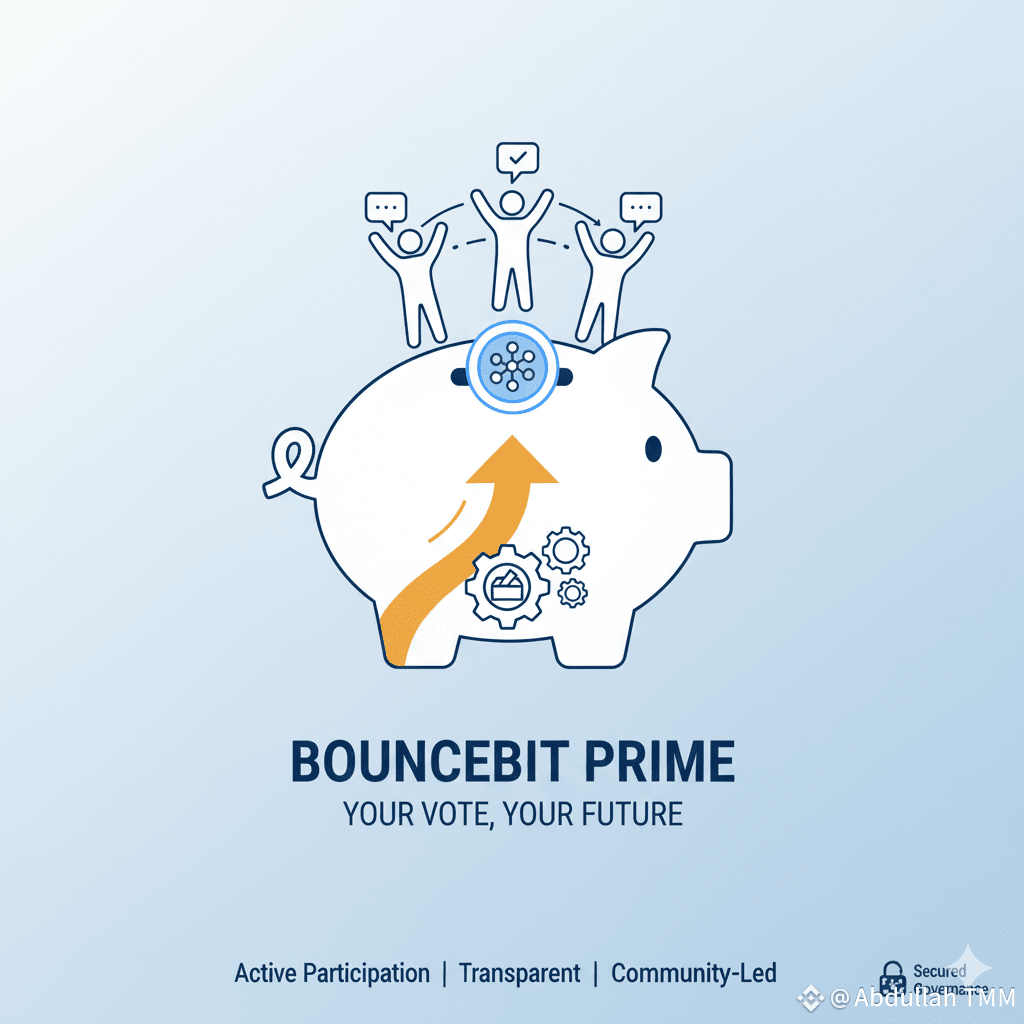
1
7
127

·
--
BOUNCEBIT in My Eyes: When CeDeFi "Wakes" BTC from Its Long SleepThe first time I came into contact with BounceBit, I admit, I did not immediately suspect it would become the epicenter of CeDeFi (Centralized-Decentralized Finance) narratives. My thought at the time was only one: how can I make my valuable BTC assets work harder? Because storing BTC traditionally feels like keeping "sleeping gold"—high value, but not generating any yield. BounceBit emerged offering a radical answer: not just a technical term, but a financial architecture that allows our BTC to "flow and grow."
BOUNCEBIT in My Eyes: When CeDeFi "Wakes" BTC from Its Long Sleep
The first time I came into contact with BounceBit, I admit, I did not immediately suspect it would become the epicenter of CeDeFi (Centralized-Decentralized Finance) narratives. My thought at the time was only one: how can I make my valuable BTC assets work harder? Because storing BTC traditionally feels like keeping "sleeping gold"—high value, but not generating any yield. BounceBit emerged offering a radical answer: not just a technical term, but a financial architecture that allows our BTC to "flow and grow."
4
3.8k

·
--
Still Waters Run Deep: How BounceBit Creates Value for Bitcoin in TranquilityIn the clamor of the crypto world, there is a project that is quietly changing the essence of the game. While other projects loudly proclaim revolution, BounceBit has chosen a different path—one of evolution, not disruption; one of effectiveness, not noise.
The Silent Revolution of Value
Imagine a deep underground river, calm on the surface but harboring immense energy within. Bitcoin is like this underground river, invaluable yet silent. What BounceBit does is not to change the direction of the river but to carve out new outlets for it, transforming still water into kinetic energy.
Still Waters Run Deep: How BounceBit Creates Value for Bitcoin in Tranquility
In the clamor of the crypto world, there is a project that is quietly changing the essence of the game. While other projects loudly proclaim revolution, BounceBit has chosen a different path—one of evolution, not disruption; one of effectiveness, not noise.
The Silent Revolution of Value
Imagine a deep underground river, calm on the surface but harboring immense energy within. Bitcoin is like this underground river, invaluable yet silent. What BounceBit does is not to change the direction of the river but to carve out new outlets for it, transforming still water into kinetic energy.
The Silent Revolution of Value
Imagine a deep underground river, calm on the surface but harboring immense energy within. Bitcoin is like this underground river, invaluable yet silent. What BounceBit does is not to change the direction of the river but to carve out new outlets for it, transforming still water into kinetic energy.
4
450

·
--
Bullish
💥 Big things happening with @bounce_bit ! #BounceBitPrime is bridging TradFi and DeFi by bringing institutional yield strategies on-chain. Built with top-tier partners like BlackRock and Franklin Templeton, it gives users direct access to tokenized RWA yield in a fully compliant way. The future of yield is here with $BB ! 🚀💼
💥 Big things happening with @BounceBit ! #BounceBitPrime is bridging TradFi and DeFi by bringing institutional yield strategies on-chain. Built with top-tier partners like BlackRock and Franklin Templeton, it gives users direct access to tokenized RWA yield in a fully compliant way. The future of yield is here with $BB ! 🚀💼
1
2

·
--
@bounce_bit is turning BTC into a yield-generating asset
#BounceBitPrime merges CeFi reliability with DeFi flexibility, giving access to tokenized real-world assets and institutional strategies.
$BB is building the future of restaking 🔥
@BounceBit is turning BTC into a yield-generating asset
#BounceBitPrime merges CeFi reliability with DeFi flexibility, giving access to tokenized real-world assets and institutional strategies.
$BB is building the future of restaking 🔥
#BounceBitPrime merges CeFi reliability with DeFi flexibility, giving access to tokenized real-world assets and institutional strategies.
$BB is building the future of restaking 🔥
6
1.1k

·
--

Article
What happens when DeFi meets TradFi? This project provides an answer.The world of encryption and traditional finance has always been two parallel lines: one side is decentralized, anonymous, and high-risk, high-reward crypto natives, while the other side is centralized, compliant, and stable traditional financial institutions. However, I recently discovered that these two lines are beginning to intersect, and they have sparked some interesting sparks. This intersection point is what is known as CeDeFi, or centralized-enabled decentralized finance.
To be honest, I was skeptical when the concept of CeDeFi first emerged. Isn't decentralization meant to escape centralized control? Now we want to combine the two, doesn't that contradict itself? But after further research, I found that this is actually a pragmatic evolutionary direction. What is the biggest problem with DeFi? Aside from smart contract risks, it's the lack of real-world assets and institutional-level liquidity. The biggest pain point for TradFi is inefficiency and slow innovation. If we can combine the technological advantages of DeFi with the funding scale and risk control systems of TradFi, theoretically, we can achieve a 1 plus 1 greater than 2 effect.
What happens when DeFi meets TradFi? This project provides an answer.
The world of encryption and traditional finance has always been two parallel lines: one side is decentralized, anonymous, and high-risk, high-reward crypto natives, while the other side is centralized, compliant, and stable traditional financial institutions. However, I recently discovered that these two lines are beginning to intersect, and they have sparked some interesting sparks. This intersection point is what is known as CeDeFi, or centralized-enabled decentralized finance.
To be honest, I was skeptical when the concept of CeDeFi first emerged. Isn't decentralization meant to escape centralized control? Now we want to combine the two, doesn't that contradict itself? But after further research, I found that this is actually a pragmatic evolutionary direction. What is the biggest problem with DeFi? Aside from smart contract risks, it's the lack of real-world assets and institutional-level liquidity. The biggest pain point for TradFi is inefficiency and slow innovation. If we can combine the technological advantages of DeFi with the funding scale and risk control systems of TradFi, theoretically, we can achieve a 1 plus 1 greater than 2 effect.
To be honest, I was skeptical when the concept of CeDeFi first emerged. Isn't decentralization meant to escape centralized control? Now we want to combine the two, doesn't that contradict itself? But after further research, I found that this is actually a pragmatic evolutionary direction. What is the biggest problem with DeFi? Aside from smart contract risks, it's the lack of real-world assets and institutional-level liquidity. The biggest pain point for TradFi is inefficiency and slow innovation. If we can combine the technological advantages of DeFi with the funding scale and risk control systems of TradFi, theoretically, we can achieve a 1 plus 1 greater than 2 effect.
1
1
465

·
--
Bitcoin 2.0: How BounceBit Is Transforming BTC Into a Yield-Bearing AssetFor over a decade, Bitcoin has been the world’s most trusted store of value — but not its most productive one. BounceBit is rewriting that story, merging Bitcoin’s unmatched security with DeFi’s yield innovation to create a new era of capital efficiency: Bitcoin 2.0.
The Problem: Idle Value in the World’s Most Valuable Asset
Despite its trillion-dollar market cap, Bitcoin remains largely static — locked in cold storage, sitting in centralized vaults, or waiting on-chain without generating yield. Traditional staking mechanisms don’t apply, and most DeFi protocols operate far from the Bitcoin ecosystem.
BounceBit’s mission is simple yet transformative: turn Bitcoin from passive value into active capital, without sacrificing compliance or custody security.
The BounceBit Vision: A Hybrid Settlement Layer for Institutional Yield
BounceBit merges the best of both financial worlds — CeFi reliability and DeFi composability — through a dual-layer architecture:
1. Regulated Custody Layer – Bitcoin is deposited into fully audited, regulated custodians like Franklin Templeton and Mainnet Digital. This ensures institutional-grade trust and legal compliance.
2. Programmable Settlement Layer – These assets are tokenized into compliant, yield-bearing equivalents usable across DeFi protocols. Every movement, from lending to validator restaking, is recorded transparently on-chain.
This design allows institutions, funds, and DAOs to earn yield on BTC without leaving the security of regulated custody.
The Innovation: Restaking Meets Real Yield
At the heart of BounceBit lies a powerful concept — restaked Bitcoin security.
By restaking BTC into BounceBit validators, holders contribute to network security and earn yield similar to ETH restakers on EigenLayer. These validators, in turn, secure DeFi applications, bridges, and Prime Vaults — enabling real, sustainable returns rather than speculative farming rewards.
It’s Bitcoin re-engineered to be both safe and productive.
Institutional-Grade DeFi: Prime Vaults and Composable Liquidity
BounceBit’s Prime Vaults transform Bitcoin into programmable yield instruments.
Here’s how:
Users deposit BTC or tokenized assets.Vaults deploy capital into diversified DeFi strategies — lending, restaking, or liquidity provision — governed by transparent smart contracts.Yields flow back to depositors, all while preserving custody assurance and auditability.
It’s the closest Bitcoin has ever come to earning like Ethereum — but with far greater regulatory clarity.
Why It Matters
BounceBit doesn’t just make Bitcoin yield-bearing — it redefines what institutional DeFi can look like.
For investors: Secure yield from a historically non-productive asset.For institutions: Compliance-ready exposure to DeFi returns.For DeFi protocols: Access to Bitcoin liquidity at scale.
This positions BounceBit as the financial bridge between traditional capital markets and on-chain economies — a system where the hardest money meets the smartest yield.
The Bottom Line
BounceBit’s Bitcoin 2.0 framework unlocks a future where BTC can finally do more than just sit idle.
It earns. It secures. It scales.
In that transformation lies a powerful truth — Bitcoin’s next chapter isn’t about speculation; it’s about participation.
@bounce_bit | #BounceBitPrime | $BB
Bitcoin 2.0: How BounceBit Is Transforming BTC Into a Yield-Bearing Asset
For over a decade, Bitcoin has been the world’s most trusted store of value — but not its most productive one. BounceBit is rewriting that story, merging Bitcoin’s unmatched security with DeFi’s yield innovation to create a new era of capital efficiency: Bitcoin 2.0.
The Problem: Idle Value in the World’s Most Valuable Asset
Despite its trillion-dollar market cap, Bitcoin remains largely static — locked in cold storage, sitting in centralized vaults, or waiting on-chain without generating yield. Traditional staking mechanisms don’t apply, and most DeFi protocols operate far from the Bitcoin ecosystem.
BounceBit’s mission is simple yet transformative: turn Bitcoin from passive value into active capital, without sacrificing compliance or custody security.
The BounceBit Vision: A Hybrid Settlement Layer for Institutional Yield
BounceBit merges the best of both financial worlds — CeFi reliability and DeFi composability — through a dual-layer architecture:
1. Regulated Custody Layer – Bitcoin is deposited into fully audited, regulated custodians like Franklin Templeton and Mainnet Digital. This ensures institutional-grade trust and legal compliance.
2. Programmable Settlement Layer – These assets are tokenized into compliant, yield-bearing equivalents usable across DeFi protocols. Every movement, from lending to validator restaking, is recorded transparently on-chain.
This design allows institutions, funds, and DAOs to earn yield on BTC without leaving the security of regulated custody.
The Innovation: Restaking Meets Real Yield
At the heart of BounceBit lies a powerful concept — restaked Bitcoin security.
By restaking BTC into BounceBit validators, holders contribute to network security and earn yield similar to ETH restakers on EigenLayer. These validators, in turn, secure DeFi applications, bridges, and Prime Vaults — enabling real, sustainable returns rather than speculative farming rewards.
It’s Bitcoin re-engineered to be both safe and productive.
Institutional-Grade DeFi: Prime Vaults and Composable Liquidity
BounceBit’s Prime Vaults transform Bitcoin into programmable yield instruments.
Here’s how:
Users deposit BTC or tokenized assets.Vaults deploy capital into diversified DeFi strategies — lending, restaking, or liquidity provision — governed by transparent smart contracts.Yields flow back to depositors, all while preserving custody assurance and auditability.
It’s the closest Bitcoin has ever come to earning like Ethereum — but with far greater regulatory clarity.
Why It Matters
BounceBit doesn’t just make Bitcoin yield-bearing — it redefines what institutional DeFi can look like.
For investors: Secure yield from a historically non-productive asset.For institutions: Compliance-ready exposure to DeFi returns.For DeFi protocols: Access to Bitcoin liquidity at scale.
This positions BounceBit as the financial bridge between traditional capital markets and on-chain economies — a system where the hardest money meets the smartest yield.
The Bottom Line
BounceBit’s Bitcoin 2.0 framework unlocks a future where BTC can finally do more than just sit idle.
It earns. It secures. It scales.
In that transformation lies a powerful truth — Bitcoin’s next chapter isn’t about speculation; it’s about participation.
@BounceBit | #BounceBitPrime | $BB
The Problem: Idle Value in the World’s Most Valuable Asset
Despite its trillion-dollar market cap, Bitcoin remains largely static — locked in cold storage, sitting in centralized vaults, or waiting on-chain without generating yield. Traditional staking mechanisms don’t apply, and most DeFi protocols operate far from the Bitcoin ecosystem.
BounceBit’s mission is simple yet transformative: turn Bitcoin from passive value into active capital, without sacrificing compliance or custody security.
The BounceBit Vision: A Hybrid Settlement Layer for Institutional Yield
BounceBit merges the best of both financial worlds — CeFi reliability and DeFi composability — through a dual-layer architecture:
1. Regulated Custody Layer – Bitcoin is deposited into fully audited, regulated custodians like Franklin Templeton and Mainnet Digital. This ensures institutional-grade trust and legal compliance.
2. Programmable Settlement Layer – These assets are tokenized into compliant, yield-bearing equivalents usable across DeFi protocols. Every movement, from lending to validator restaking, is recorded transparently on-chain.
This design allows institutions, funds, and DAOs to earn yield on BTC without leaving the security of regulated custody.
The Innovation: Restaking Meets Real Yield
At the heart of BounceBit lies a powerful concept — restaked Bitcoin security.
By restaking BTC into BounceBit validators, holders contribute to network security and earn yield similar to ETH restakers on EigenLayer. These validators, in turn, secure DeFi applications, bridges, and Prime Vaults — enabling real, sustainable returns rather than speculative farming rewards.
It’s Bitcoin re-engineered to be both safe and productive.
Institutional-Grade DeFi: Prime Vaults and Composable Liquidity
BounceBit’s Prime Vaults transform Bitcoin into programmable yield instruments.
Here’s how:
Users deposit BTC or tokenized assets.Vaults deploy capital into diversified DeFi strategies — lending, restaking, or liquidity provision — governed by transparent smart contracts.Yields flow back to depositors, all while preserving custody assurance and auditability.
It’s the closest Bitcoin has ever come to earning like Ethereum — but with far greater regulatory clarity.
Why It Matters
BounceBit doesn’t just make Bitcoin yield-bearing — it redefines what institutional DeFi can look like.
For investors: Secure yield from a historically non-productive asset.For institutions: Compliance-ready exposure to DeFi returns.For DeFi protocols: Access to Bitcoin liquidity at scale.
This positions BounceBit as the financial bridge between traditional capital markets and on-chain economies — a system where the hardest money meets the smartest yield.
The Bottom Line
BounceBit’s Bitcoin 2.0 framework unlocks a future where BTC can finally do more than just sit idle.
It earns. It secures. It scales.
In that transformation lies a powerful truth — Bitcoin’s next chapter isn’t about speculation; it’s about participation.
@BounceBit | #BounceBitPrime | $BB
3
464
Log in to explore more content
Join global crypto users on Binance Square
⚡️ Get latest and useful information about crypto.
💬 Trusted by the world’s largest crypto exchange.
👍 Discover real insights from verified creators.
Email / Phone number
Trending Topics
1
#QNTRises287%
4,229 views
171 Discussing
2
#HSBCNamesStablecoinRedCoinForPhasedLaunch
0 views
3 Discussing
3
#TrumpRejectsAIRulesForVoluntaryAudits
8,494 views
299 Discussing
4
#BitgetHotWalletBreachTiedToThirdPartySecurityFlaw
4,314 views
228 Discussing
5
#OpenAIUnveilsAlwaysOnAgentDots
4,638 views
258 Discussing
6
#ChainlinkLaunchesBankSWIFTLedgerFramework
5,849 views
222 Discussing
7
#EarningsSeason
479,726 views
3,587 Discussing
8
#SECChairWantsStockMarketsOnChain
10,018 views
220 Discussing
9
#MulticoinInvestsInGrass
6,249 views
147 Discussing
10
#CEARenamesToBNBStandardUnderBNC
6,674 views
152 Discussing