quantus

787 views
31 Discussing
kaymyg
·
--
Article
Quantus Network: Building a Blockchain for the Quantum Computing EraTechnology • Blockchain • Post-Quantum Cryptography • November 2026 The next major challenge facing blockchain technology may not come from competing networks, scalability limitations or transaction costs. It may come from a technology that is still developing but has the potential to undermine one of the fundamental security assumptions upon which much of the cryptocurrency industry was built: quantum computing. As quantum computers advance, existing cryptographic systems used to secure digital assets could eventually become vulnerable. This raises an important question: what happens to Bitcoin, Ethereum and other blockchain networks if sufficiently powerful quantum computers become capable of deriving private keys from publicly exposed cryptographic keys? Quantus Network is attempting to answer that question before it becomes an emergency. Launched on 9 September 2026, Quantus is a Proof-of-Work Layer-1 blockchain built specifically around post-quantum cryptography. Its native token is QTC. Rather than positioning itself as another general-purpose smart-contract platform, Quantus concentrates on secure peer-to-peer electronic money, privacy and long-term preservation of digital value. Its central proposition is straightforward: instead of waiting for quantum computers to threaten existing blockchains and then attempting complicated migrations, build a network around cryptographic standards designed to withstand quantum attacks from the beginning. 1. The Quantum Computing Problem Most established blockchain networks rely on elliptic-curve cryptography to authenticate transactions and protect digital assets. Bitcoin uses ECDSA and, in newer transaction formats, Schnorr signatures. Ethereum uses ECDSA, while other networks rely on cryptographic systems such as Ed25519. These systems are considered secure against conventional computers. However, a sufficiently powerful, fault-tolerant quantum computer could use Shor's algorithm to break the mathematical assumptions behind elliptic-curve cryptography. The implications would be significant. An attacker capable of deriving private keys from exposed public keys could potentially gain control of cryptocurrency wallets without knowing their original passwords or recovery phrases. The challenge is not simply replacing one cryptographic algorithm with another. Existing networks would need to coordinate upgrades, migrate users, protect dormant wallets and deal with assets whose owners are no longer active. Quantus approaches this problem differently. It seeks to eliminate the need for a future emergency migration by adopting post-quantum cryptographic standards at the protocol level. This is particularly relevant as the cryptocurrency industry holds trillions of dollars in assets secured by cryptographic systems that were not originally designed with powerful quantum computers in mind. 2. The Technology Behind Quantus #Quantus is built using Parity's Substrate framework, a modular blockchain development framework that supports custom blockchain architectures and forkless runtime upgrades. Its architecture combines four important technological components. A. Post-Quantum Digital Signatures: ML-DSA One of Quantus's most important design decisions is its adoption of ML-DSA, formerly known as CRYSTALS-Dilithium. ML-DSA is a lattice-based digital signature algorithm standardized by the US National Institute of Standards and Technology (NIST) under FIPS 204. Unlike traditional elliptic-curve signatures, ML-DSA is designed to resist attacks from both conventional and quantum computers. Quantus supports different security configurations, including ML-DSA-65, corresponding to NIST Security Level 3, and ML-DSA-87, corresponding to Level 5. There is, however, a trade-off. Traditional ECDSA signatures are approximately 65 bytes, whereas ML-DSA signatures are several kilobytes. Public keys are also considerably larger. This increases the amount of data that must be transmitted, stored and processed when validating transactions. Quantus therefore has to solve an additional problem: how to maintain an efficient payment network while using substantially larger cryptographic signatures. B. Secure Network Communications: ML-KEM Blockchain security is not limited to protecting wallet balances. Communications between network participants must also be protected. Quantus incorporates ML-KEM, formerly known as CRYSTALS-Kyber, standardized under NIST FIPS 203. ML-KEM is a post-quantum key encapsulation mechanism used to establish shared encryption keys between communicating parties. Combined with ML-DSA authentication, this provides a foundation for protecting peer-to-peer network communications against future quantum-enabled attacks. The distinction is important: ML-DSA protects digital signatures, while ML-KEM establishes encryption keys for secure communications. C. Proof-of-Work Consensus and Poseidon2 Quantus retains the Proof-of-Work model, making it philosophically closer to Bitcoin than to Proof-of-Stake networks such as Ethereum. Miners participate in securing the network and receive block rewards. The project does not impose a developer tax on mining rewards. One of its more unusual design decisions is the use of Poseidon2, an algebraic hash function designed to work efficiently within zero-knowledge proof systems. Poseidon2 operates over the Goldilocks finite field and is particularly useful for cryptographic operations involving mathematical circuits. This is important because Quantus relies heavily on zero-knowledge proofs for privacy and transaction aggregation. Its target block time is approximately 12 seconds, with continuous difficulty adjustment. However, Poseidon2 should not be confused with the post-quantum signature system. The security of the network depends on several distinct cryptographic components, each serving a different purpose. D. Wormhole: Privacy and Transaction Scaling Perhaps the most interesting component of Quantus is its Wormhole mechanism. Wormhole allows users to move funds between transparent and encrypted account structures using zero-knowledge proofs. Instead of recording a conventional transfer that publicly identifies both the sender and recipient, the mechanism allows funds to be deposited into a special address and subsequently reintroduced at another address using a cryptographic proof. The proof demonstrates that the transaction is valid without publicly revealing the relationship between the original and destination accounts. Quantus uses Plonky2-based zero-knowledge proofs and aggregation techniques to reduce the computational and data costs associated with these operations. This is particularly relevant because large post-quantum signatures create additional pressure on blockchain throughput. By aggregating multiple proofs, the network aims to process private transactions more efficiently than it would by handling every cryptographic operation independently. Its privacy model should nevertheless be understood correctly. Wormhole offers transaction-linking protection, but it should not automatically be equated with fully shielded privacy systems that conceal transaction amounts and other metadata. 3. What Makes Quantus Different? Quantus is not attempting to compete directly with every blockchain category. It is not primarily designed to host decentralised applications, complex smart contracts or large DeFi ecosystems. Its focus is closer to digital money: transferring value, maintaining ownership and protecting transactions against emerging cryptographic threats. Several features distinguish its approach. Dual account structures: Users can operate transparent accounts with publicly visible transactions and encrypted accounts using Wormhole. Both are accessible through the same recovery phrase, although they use different derivation paths.Reversible transfers: The network supports delayed transfers that can be cancelled within a designated period.Guardian protection: High-security accounts can designate guardians who may cancel suspicious transactions but cannot independently spend the account's funds.Multisignature: Accounts can require approval from multiple signatories, with support for configurations of up to approximately 100 participants.Recovery mechanisms: Time-locks and additional security arrangements provide alternatives for recovering or protecting accounts.Human-readable address verification: Check-phrases help users identify addresses and reduce the possibility of sending funds to an incorrectly copied destination.Mobile and cold wallets: Quantus provides mobile wallets and an open-source cold-wallet application that can turn a spare smartphone into an offline signing device. Transactions are transferred using QR codes, keeping the signing device disconnected from the internet. The cold-wallet approach is particularly interesting because it makes hardware-assisted offline signing more accessible without necessarily requiring users to purchase dedicated hardware wallets. 4. Scalability: Can Quantum Security Coexist With Performance? One of the biggest questions surrounding post-quantum blockchain architecture is whether additional cryptographic security comes at the expense of performance. Traditional blockchain signatures are relatively small. ML-DSA signatures are substantially larger, increasing the amount of information required to validate transactions and propagate them across the network. Quantus addresses this through its zero-knowledge architecture. Its transparent transactions are estimated to operate in the tens of transactions per second, while aggregated encrypted transactions are claimed to reach hundreds of transactions per second under favourable conditions. These figures should be treated as project-reported or architectural estimates rather than independently established sustained mainnet performance. The distinction matters because theoretical throughput and actual network performance are not necessarily the same. Real-world performance depends on network participation, hardware, proof-generation costs, verification requirements and transaction demand. Quantus is therefore making a different scalability proposition from networks such as Solana. Rather than maximising general-purpose transaction throughput, it seeks to make quantum-resistant value transfers practical through cryptographic efficiency and proof aggregation. 5. QTC: Supply, Mining and Tokenomics The native cryptocurrency of Quantus is QTC, with a maximum supply of 21 million tokens. This places its supply ceiling in the same numerical category as Bitcoin, although the two networks have different issuance mechanisms and economic structures. The distribution model has two principal components: Approximately 73% of the total supply is designated for mining.Approximately 27% was allocated at genesis to investors, founders, the team and the company. The majority of the genesis allocation is subject to a one-year lock followed by linear vesting over 36 months, with the vesting arrangements enforced on-chain. Quantus also uses a gradually declining emission model rather than Bitcoin's fixed four-year halving schedule. Its approximate reward formula is: \[ \text{Block Reward} = \frac{\text{Maximum Supply}-\text{Current Supply}}{50,000,000} \] This produces progressively declining rewards as the circulating supply approaches the maximum. Transaction fees may also be partially burned under applicable network rules. The economic argument is that mining incentives can gradually decline while the network maintains a predetermined supply ceiling. However, the genesis allocation deserves attention. Although vesting reduces the immediate availability of those tokens, future unlocks could influence market supply and price dynamics. 6. The Team, Funding and Governance Quantus was founded in 2024, with active development beginning towards the end of that year. Its key figures include co-founder and CEO Christopher Smith and co-founder Joseph Mattia. Christopher Smith has also been associated with Quantum Canary and the QDay podcast, alongside previous projects including BitMesh, Lunyr and FactoryDAO. Reported funding totals approximately $2.4 million, with participation and advisory involvement from individuals in the wider cryptocurrency and privacy ecosystem, including Balaji Srinivasan. Governance is structured around Quantus Improvement Proposals (QIPs), alongside Substrate-style governance mechanisms and a Technical Collective responsible for certain technical decisions. The stated ambition is progressive decentralisation, although the extent to which governance and development responsibilities are distributed will become clearer as the network matures. 7. Mainnet Progress and Market Position Reported project and market figures, late November 2026. These are not independently verified live measurements. Quantus launched its mainnet on 9 September 2026. By late November, it had accumulated approximately two and a half months of operating history. Project-reported network indicators include: 400,000+ Blocks produced 200+ Network nodes 10,000s Accounts created 12,000+ Monthly active wallet users, reported Market trackers have reported QTC trading around the $30 range, with a circulating market capitalisation of approximately $11 million and an all-time high approaching $186 shortly after its initial listings. These figures are particularly sensitive to the circulating supply because the network is still in its early mining and distribution stages. Liquidity remains relatively thin, with trading and cross-chain access involving platforms such as Raydium on Solana and NEAR Intents. The availability of wrapped QTC through these ecosystems is an important development because it creates access to liquidity and users beyond the native Quantus network. It is worth distinguishing between wrapped assets and native QTC. Wrapped tokens represent cross-chain versions of the underlying asset and introduce additional bridging and custody-related considerations. 8. How Quantus Relates to Bitcoin, Monero, Zcash and Other Blockchains Quantus is easier to understand when compared with networks that have different priorities. Bitcoin: Both use Proof-of-Work and have a fixed maximum supply of 21 million units. However, Bitcoin's existing signature infrastructure relies heavily on elliptic-curve cryptography. Quantus was designed around post-quantum signatures from its inception. Bitcoin has the advantage of a substantially longer operating history, greater liquidity and a more established monetary network. Monero: Monero prioritises financial privacy through confidential transactions and stealth addresses. Quantus also incorporates privacy, but adds a post-quantum security focus. Monero's privacy architecture and operating history are considerably more mature. Zcash: Zcash uses zero-knowledge proofs to enable shielded transactions. Quantus also uses zero-knowledge technology, particularly through Wormhole, but combines it with a different privacy model and post-quantum cryptographic architecture. Ethereum: Ethereum is a general-purpose smart-contract platform supporting decentralised applications, financial protocols and token ecosystems. Quantus has a narrower purpose, concentrating on secure digital money rather than competing directly in the smart-contract space. QRL (Quantum Resistant Ledger): QRL is another blockchain project specifically designed around quantum-resistant cryptography, using hash-based signature technology, particularly XMSS. Quantus takes a different approach through NIST-standardised lattice-based signatures and zero-knowledge proof aggregation. It is important not to confuse Quantus Network with Quant Network, whose QNT token is associated with enterprise interoperability and Overledger technology. They are separate projects. 9. Security Audits and Outstanding Risks Quantum resistance is a powerful proposition, but it does not automatically make a blockchain secure. Quantus has reported external security reviews covering several components of its architecture, including its ML-DSA implementation, hierarchical deterministic wallet, Proof-of-Work mechanisms, Poseidon2 and zero-knowledge circuits. Firms associated with these reviews include Neodyme, Equilibrium and Eiger. The project has also held an Immunefi audit competition. However, the existence of audits should not be interpreted as a guarantee that the entire network is free from vulnerabilities. The scope of each audit, findings, remediation and subsequent code changes matter. There are several risks worth watching. Cryptographic maturity: ML-DSA is a NIST-standardised algorithm, but the broader implementation and integration of post-quantum systems in a live blockchain remain relatively new.Performance: Large signatures and computationally demanding zero-knowledge proofs could create bottlenecks as network usage increases.Privacy limitations: Wormhole provides additional transaction privacy, but optional privacy and incomplete concealment of transaction metadata mean users should not assume absolute anonymity.Token distribution: The approximately 27% genesis allocation creates potential future selling pressure as vesting progresses.Liquidity: A relatively small market and limited trading venues can result in significant price volatility and difficulties executing large transactions.Adoption: A technically sophisticated blockchain still needs sustained demand. Its long-term success depends on whether users actually choose it for payments and long-term value preservation.Protocol resilience: The security of the complete system depends on the cryptographic algorithms, implementation quality, consensus, networking and economic incentives working together. Perhaps the most important consideration is that the quantum threat remains a developing technological risk. There is no certainty about when cryptographically relevant quantum computers will become practical. Quantus is making a long-term security bet, rather than responding to an already realised crisis. 10. The Bigger Question: Is Quantus Building for the Next Generation of Money? The cryptocurrency industry has spent much of its existence competing over transaction speeds, smart-contract capabilities, decentralised finance and ecosystem growth. Quantus is approaching the problem from another direction. Its proposition is that the next generation of blockchain infrastructure must consider not only what conventional computers can break today, but also what sufficiently advanced quantum computers might break tomorrow. That is a meaningful distinction. Bitcoin demonstrated that decentralised digital money could operate without a central authority. Ethereum expanded the possibilities of blockchain technology through programmable financial infrastructure. Monero and Zcash advanced the conversation around financial privacy. Quantus is attempting to combine some of these ideas with a different security foundation: post-quantum cryptography designed into the network from genesis. Its strongest argument is not that quantum computers will necessarily break existing blockchains tomorrow. It is that cryptographic migration is difficult, expensive and potentially disruptive, making early preparation a reasonable engineering decision. Nevertheless, being early is not the same as being successful. Quantus must demonstrate that its architecture can deliver reliable security, practical transaction speeds, meaningful privacy and sustainable decentralised participation. My assessment: Quantus is an interesting project because it is addressing a problem that most blockchain networks will eventually have to confront. Its combination of NIST-standardised post-quantum signatures, Proof-of-Work, zero-knowledge technology and a fixed monetary supply gives it a distinct identity. However, its short mainnet history means that its strongest claims still need to be demonstrated through sustained independent scrutiny and real-world adoption. If the quantum computing threat eventually becomes a defining issue for digital assets, networks that prepared their cryptographic foundations early could have an important advantage. Quantus is positioning itself to be one of them.

Quantus Network: Building a Blockchain for the Quantum Computing Era

Technology • Blockchain • Post-Quantum Cryptography • November 2026
The next major challenge facing blockchain technology may not come from competing networks, scalability limitations or transaction costs. It may come from a technology that is still developing but has the potential to undermine one of the fundamental security assumptions upon which much of the cryptocurrency industry was built: quantum computing.
As quantum computers advance, existing cryptographic systems used to secure digital assets could eventually become vulnerable. This raises an important question: what happens to Bitcoin, Ethereum and other blockchain networks if sufficiently powerful quantum computers become capable of deriving private keys from publicly exposed cryptographic keys?
Quantus Network is attempting to answer that question before it becomes an emergency.
Launched on 9 September 2026, Quantus is a Proof-of-Work Layer-1 blockchain built specifically around post-quantum cryptography. Its native token is QTC. Rather than positioning itself as another general-purpose smart-contract platform, Quantus concentrates on secure peer-to-peer electronic money, privacy and long-term preservation of digital value.
Its central proposition is straightforward: instead of waiting for quantum computers to threaten existing blockchains and then attempting complicated migrations, build a network around cryptographic standards designed to withstand quantum attacks from the beginning.
1. The Quantum Computing Problem
Most established blockchain networks rely on elliptic-curve cryptography to authenticate transactions and protect digital assets.
Bitcoin uses ECDSA and, in newer transaction formats, Schnorr signatures. Ethereum uses ECDSA, while other networks rely on cryptographic systems such as Ed25519.
These systems are considered secure against conventional computers. However, a sufficiently powerful, fault-tolerant quantum computer could use Shor's algorithm to break the mathematical assumptions behind elliptic-curve cryptography.
The implications would be significant. An attacker capable of deriving private keys from exposed public keys could potentially gain control of cryptocurrency wallets without knowing their original passwords or recovery phrases.
The challenge is not simply replacing one cryptographic algorithm with another. Existing networks would need to coordinate upgrades, migrate users, protect dormant wallets and deal with assets whose owners are no longer active.
Quantus approaches this problem differently. It seeks to eliminate the need for a future emergency migration by adopting post-quantum cryptographic standards at the protocol level.
This is particularly relevant as the cryptocurrency industry holds trillions of dollars in assets secured by cryptographic systems that were not originally designed with powerful quantum computers in mind.
2. The Technology Behind Quantus
#Quantus is built using Parity's Substrate framework, a modular blockchain development framework that supports custom blockchain architectures and forkless runtime upgrades.
Its architecture combines four important technological components.
A. Post-Quantum Digital Signatures: ML-DSA
One of Quantus's most important design decisions is its adoption of ML-DSA, formerly known as CRYSTALS-Dilithium.
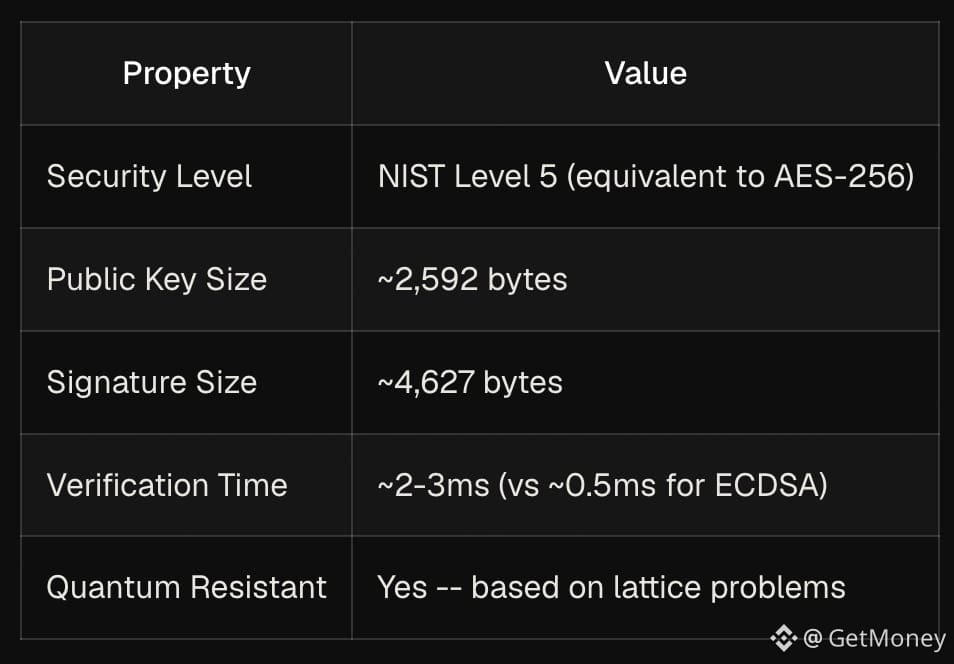
ML-DSA is a lattice-based digital signature algorithm standardized by the US National Institute of Standards and Technology (NIST) under FIPS 204.
Unlike traditional elliptic-curve signatures, ML-DSA is designed to resist attacks from both conventional and quantum computers.
Quantus supports different security configurations, including ML-DSA-65, corresponding to NIST Security Level 3, and ML-DSA-87, corresponding to Level 5.
There is, however, a trade-off. Traditional ECDSA signatures are approximately 65 bytes, whereas ML-DSA signatures are several kilobytes. Public keys are also considerably larger.
This increases the amount of data that must be transmitted, stored and processed when validating transactions.
Quantus therefore has to solve an additional problem: how to maintain an efficient payment network while using substantially larger cryptographic signatures.
B. Secure Network Communications: ML-KEM
Blockchain security is not limited to protecting wallet balances. Communications between network participants must also be protected.
Quantus incorporates ML-KEM, formerly known as CRYSTALS-Kyber, standardized under NIST FIPS 203.
ML-KEM is a post-quantum key encapsulation mechanism used to establish shared encryption keys between communicating parties.
Combined with ML-DSA authentication, this provides a foundation for protecting peer-to-peer network communications against future quantum-enabled attacks.
The distinction is important: ML-DSA protects digital signatures, while ML-KEM establishes encryption keys for secure communications.
C. Proof-of-Work Consensus and Poseidon2
Quantus retains the Proof-of-Work model, making it philosophically closer to Bitcoin than to Proof-of-Stake networks such as Ethereum.
Miners participate in securing the network and receive block rewards. The project does not impose a developer tax on mining rewards.
One of its more unusual design decisions is the use of Poseidon2, an algebraic hash function designed to work efficiently within zero-knowledge proof systems.
Poseidon2 operates over the Goldilocks finite field and is particularly useful for cryptographic operations involving mathematical circuits.
This is important because Quantus relies heavily on zero-knowledge proofs for privacy and transaction aggregation.
Its target block time is approximately 12 seconds, with continuous difficulty adjustment.
However, Poseidon2 should not be confused with the post-quantum signature system. The security of the network depends on several distinct cryptographic components, each serving a different purpose.
D. Wormhole: Privacy and Transaction Scaling
Perhaps the most interesting component of Quantus is its Wormhole mechanism.
Wormhole allows users to move funds between transparent and encrypted account structures using zero-knowledge proofs.
Instead of recording a conventional transfer that publicly identifies both the sender and recipient, the mechanism allows funds to be deposited into a special address and subsequently reintroduced at another address using a cryptographic proof.
The proof demonstrates that the transaction is valid without publicly revealing the relationship between the original and destination accounts.
Quantus uses Plonky2-based zero-knowledge proofs and aggregation techniques to reduce the computational and data costs associated with these operations.
This is particularly relevant because large post-quantum signatures create additional pressure on blockchain throughput.
By aggregating multiple proofs, the network aims to process private transactions more efficiently than it would by handling every cryptographic operation independently.
Its privacy model should nevertheless be understood correctly. Wormhole offers transaction-linking protection, but it should not automatically be equated with fully shielded privacy systems that conceal transaction amounts and other metadata.
3. What Makes Quantus Different?
Quantus is not attempting to compete directly with every blockchain category.
It is not primarily designed to host decentralised applications, complex smart contracts or large DeFi ecosystems.
Its focus is closer to digital money: transferring value, maintaining ownership and protecting transactions against emerging cryptographic threats.
Several features distinguish its approach.
Dual account structures: Users can operate transparent accounts with publicly visible transactions and encrypted accounts using Wormhole. Both are accessible through the same recovery phrase, although they use different derivation paths.Reversible transfers: The network supports delayed transfers that can be cancelled within a designated period.Guardian protection: High-security accounts can designate guardians who may cancel suspicious transactions but cannot independently spend the account's funds.Multisignature: Accounts can require approval from multiple signatories, with support for configurations of up to approximately 100 participants.Recovery mechanisms: Time-locks and additional security arrangements provide alternatives for recovering or protecting accounts.Human-readable address verification: Check-phrases help users identify addresses and reduce the possibility of sending funds to an incorrectly copied destination.Mobile and cold wallets: Quantus provides mobile wallets and an open-source cold-wallet application that can turn a spare smartphone into an offline signing device. Transactions are transferred using QR codes, keeping the signing device disconnected from the internet.
The cold-wallet approach is particularly interesting because it makes hardware-assisted offline signing more accessible without necessarily requiring users to purchase dedicated hardware wallets.
4. Scalability: Can Quantum Security Coexist With Performance?
One of the biggest questions surrounding post-quantum blockchain architecture is whether additional cryptographic security comes at the expense of performance.
Traditional blockchain signatures are relatively small. ML-DSA signatures are substantially larger, increasing the amount of information required to validate transactions and propagate them across the network.
Quantus addresses this through its zero-knowledge architecture.
Its transparent transactions are estimated to operate in the tens of transactions per second, while aggregated encrypted transactions are claimed to reach hundreds of transactions per second under favourable conditions.
These figures should be treated as project-reported or architectural estimates rather than independently established sustained mainnet performance.
The distinction matters because theoretical throughput and actual network performance are not necessarily the same.
Real-world performance depends on network participation, hardware, proof-generation costs, verification requirements and transaction demand.
Quantus is therefore making a different scalability proposition from networks such as Solana. Rather than maximising general-purpose transaction throughput, it seeks to make quantum-resistant value transfers practical through cryptographic efficiency and proof aggregation.
5. QTC: Supply, Mining and Tokenomics
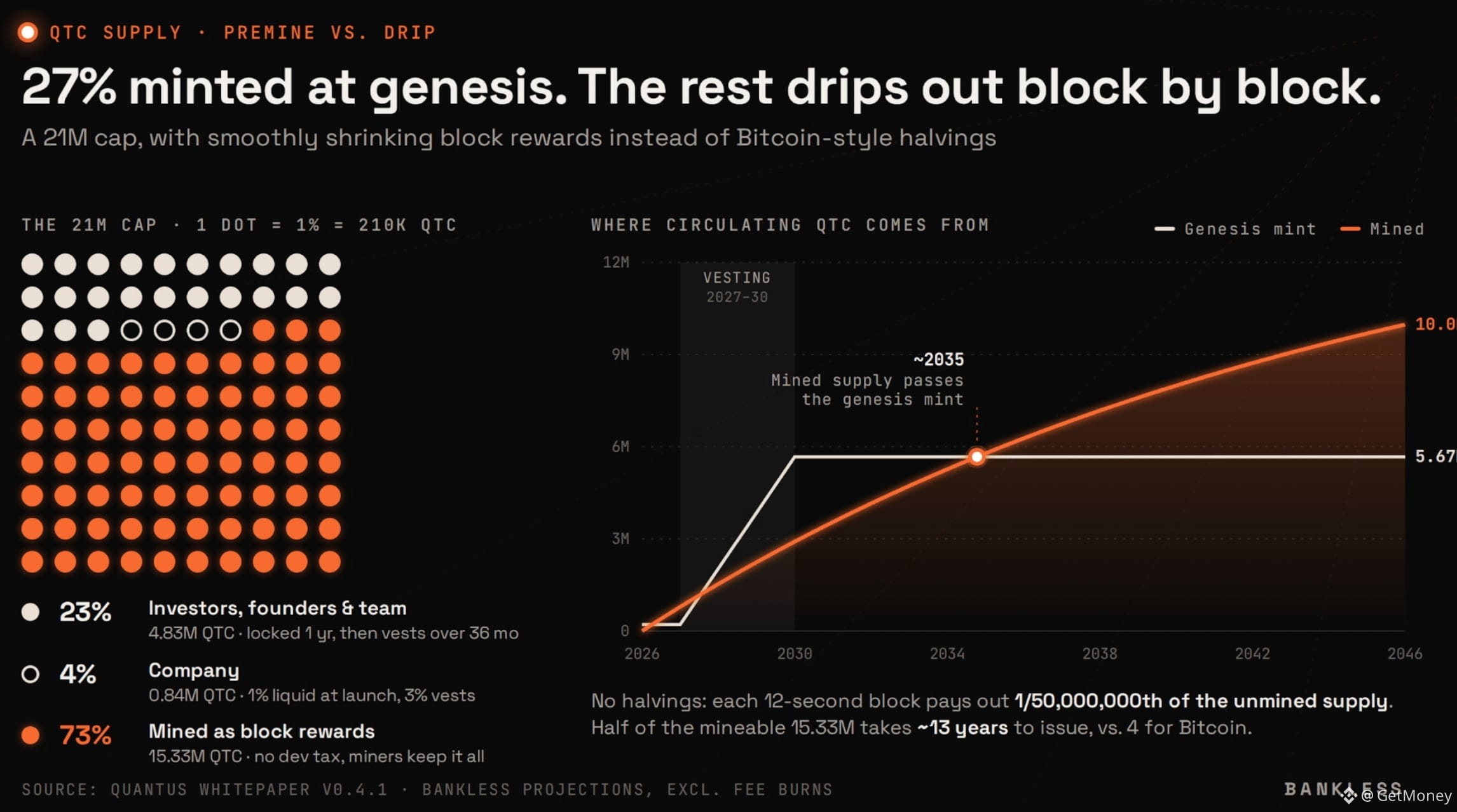
The native cryptocurrency of Quantus is QTC, with a maximum supply of 21 million tokens.
This places its supply ceiling in the same numerical category as Bitcoin, although the two networks have different issuance mechanisms and economic structures.
The distribution model has two principal components:
Approximately 73% of the total supply is designated for mining.Approximately 27% was allocated at genesis to investors, founders, the team and the company.
The majority of the genesis allocation is subject to a one-year lock followed by linear vesting over 36 months, with the vesting arrangements enforced on-chain.
Quantus also uses a gradually declining emission model rather than Bitcoin's fixed four-year halving schedule.
Its approximate reward formula is:
\[ \text{Block Reward} = \frac{\text{Maximum Supply}-\text{Current Supply}}{50,000,000} \]
This produces progressively declining rewards as the circulating supply approaches the maximum.
Transaction fees may also be partially burned under applicable network rules.
The economic argument is that mining incentives can gradually decline while the network maintains a predetermined supply ceiling.
However, the genesis allocation deserves attention. Although vesting reduces the immediate availability of those tokens, future unlocks could influence market supply and price dynamics.
6. The Team, Funding and Governance
Quantus was founded in 2024, with active development beginning towards the end of that year.
Its key figures include co-founder and CEO Christopher Smith and co-founder Joseph Mattia.
Christopher Smith has also been associated with Quantum Canary and the QDay podcast, alongside previous projects including BitMesh, Lunyr and FactoryDAO.
Reported funding totals approximately $2.4 million, with participation and advisory involvement from individuals in the wider cryptocurrency and privacy ecosystem, including Balaji Srinivasan.
Governance is structured around Quantus Improvement Proposals (QIPs), alongside Substrate-style governance mechanisms and a Technical Collective responsible for certain technical decisions.
The stated ambition is progressive decentralisation, although the extent to which governance and development responsibilities are distributed will become clearer as the network matures.
7. Mainnet Progress and Market Position
Reported project and market figures, late November 2026. These are not independently verified live measurements.
Quantus launched its mainnet on 9 September 2026. By late November, it had accumulated approximately two and a half months of operating history.
Project-reported network indicators include:
400,000+
Blocks produced
200+
Network nodes
10,000s
Accounts created
12,000+
Monthly active wallet users, reported
Market trackers have reported QTC trading around the $30 range, with a circulating market capitalisation of approximately $11 million and an all-time high approaching $186 shortly after its initial listings.
These figures are particularly sensitive to the circulating supply because the network is still in its early mining and distribution stages.
Liquidity remains relatively thin, with trading and cross-chain access involving platforms such as Raydium on Solana and NEAR Intents.
The availability of wrapped QTC through these ecosystems is an important development because it creates access to liquidity and users beyond the native Quantus network.
It is worth distinguishing between wrapped assets and native QTC. Wrapped tokens represent cross-chain versions of the underlying asset and introduce additional bridging and custody-related considerations.
8. How Quantus Relates to Bitcoin, Monero, Zcash and Other Blockchains
Quantus is easier to understand when compared with networks that have different priorities.
Bitcoin: Both use Proof-of-Work and have a fixed maximum supply of 21 million units. However, Bitcoin's existing signature infrastructure relies heavily on elliptic-curve cryptography. Quantus was designed around post-quantum signatures from its inception. Bitcoin has the advantage of a substantially longer operating history, greater liquidity and a more established monetary network.
Monero: Monero prioritises financial privacy through confidential transactions and stealth addresses. Quantus also incorporates privacy, but adds a post-quantum security focus. Monero's privacy architecture and operating history are considerably more mature.
Zcash: Zcash uses zero-knowledge proofs to enable shielded transactions. Quantus also uses zero-knowledge technology, particularly through Wormhole, but combines it with a different privacy model and post-quantum cryptographic architecture.
Ethereum: Ethereum is a general-purpose smart-contract platform supporting decentralised applications, financial protocols and token ecosystems. Quantus has a narrower purpose, concentrating on secure digital money rather than competing directly in the smart-contract space.
QRL (Quantum Resistant Ledger): QRL is another blockchain project specifically designed around quantum-resistant cryptography, using hash-based signature technology, particularly XMSS. Quantus takes a different approach through NIST-standardised lattice-based signatures and zero-knowledge proof aggregation.
It is important not to confuse Quantus Network with Quant Network, whose QNT token is associated with enterprise interoperability and Overledger technology. They are separate projects.
9. Security Audits and Outstanding Risks
Quantum resistance is a powerful proposition, but it does not automatically make a blockchain secure.
Quantus has reported external security reviews covering several components of its architecture, including its ML-DSA implementation, hierarchical deterministic wallet, Proof-of-Work mechanisms, Poseidon2 and zero-knowledge circuits.
Firms associated with these reviews include Neodyme, Equilibrium and Eiger. The project has also held an Immunefi audit competition.
However, the existence of audits should not be interpreted as a guarantee that the entire network is free from vulnerabilities. The scope of each audit, findings, remediation and subsequent code changes matter.
There are several risks worth watching.
Cryptographic maturity: ML-DSA is a NIST-standardised algorithm, but the broader implementation and integration of post-quantum systems in a live blockchain remain relatively new.Performance: Large signatures and computationally demanding zero-knowledge proofs could create bottlenecks as network usage increases.Privacy limitations: Wormhole provides additional transaction privacy, but optional privacy and incomplete concealment of transaction metadata mean users should not assume absolute anonymity.Token distribution: The approximately 27% genesis allocation creates potential future selling pressure as vesting progresses.Liquidity: A relatively small market and limited trading venues can result in significant price volatility and difficulties executing large transactions.Adoption: A technically sophisticated blockchain still needs sustained demand. Its long-term success depends on whether users actually choose it for payments and long-term value preservation.Protocol resilience: The security of the complete system depends on the cryptographic algorithms, implementation quality, consensus, networking and economic incentives working together.
Perhaps the most important consideration is that the quantum threat remains a developing technological risk. There is no certainty about when cryptographically relevant quantum computers will become practical. Quantus is making a long-term security bet, rather than responding to an already realised crisis.
10. The Bigger Question: Is Quantus Building for the Next Generation of Money?
The cryptocurrency industry has spent much of its existence competing over transaction speeds, smart-contract capabilities, decentralised finance and ecosystem growth.
Quantus is approaching the problem from another direction.
Its proposition is that the next generation of blockchain infrastructure must consider not only what conventional computers can break today, but also what sufficiently advanced quantum computers might break tomorrow.
That is a meaningful distinction.
Bitcoin demonstrated that decentralised digital money could operate without a central authority. Ethereum expanded the possibilities of blockchain technology through programmable financial infrastructure. Monero and Zcash advanced the conversation around financial privacy.
Quantus is attempting to combine some of these ideas with a different security foundation: post-quantum cryptography designed into the network from genesis.
Its strongest argument is not that quantum computers will necessarily break existing blockchains tomorrow. It is that cryptographic migration is difficult, expensive and potentially disruptive, making early preparation a reasonable engineering decision.
Nevertheless, being early is not the same as being successful. Quantus must demonstrate that its architecture can deliver reliable security, practical transaction speeds, meaningful privacy and sustainable decentralised participation.
My assessment: Quantus is an interesting project because it is addressing a problem that most blockchain networks will eventually have to confront. Its combination of NIST-standardised post-quantum signatures, Proof-of-Work, zero-knowledge technology and a fixed monetary supply gives it a distinct identity. However, its short mainnet history means that its strongest claims still need to be demonstrated through sustained independent scrutiny and real-world adoption.
If the quantum computing threat eventually becomes a defining issue for digital assets, networks that prepared their cryptographic foundations early could have an important advantage. Quantus is positioning itself to be one of them.
·
--
What makes the NEAR–Quantus connection particularly interesting is the difference in their technical focus. #Quantus is built around post-quantum cryptography, including ML-DSA signatures, while #NEAR focuses on cross-chain interoperability. One addresses the long-term security implications of quantum computing. The other helps connect blockchain ecosystems. Security and interoperability could become increasingly important complements. $QTC $NEAR {spot}(NEARUSDT)
What makes the NEAR–Quantus connection particularly interesting is the difference in their technical focus.
#Quantus is built around post-quantum cryptography, including ML-DSA signatures, while #NEAR focuses on cross-chain interoperability.
One addresses the long-term security implications of quantum computing. The other helps connect blockchain ecosystems.
Security and interoperability could become increasingly important complements.
$QTC $NEAR
kaymyg
·
--
The relationship between NEAR, Solana and Quantus
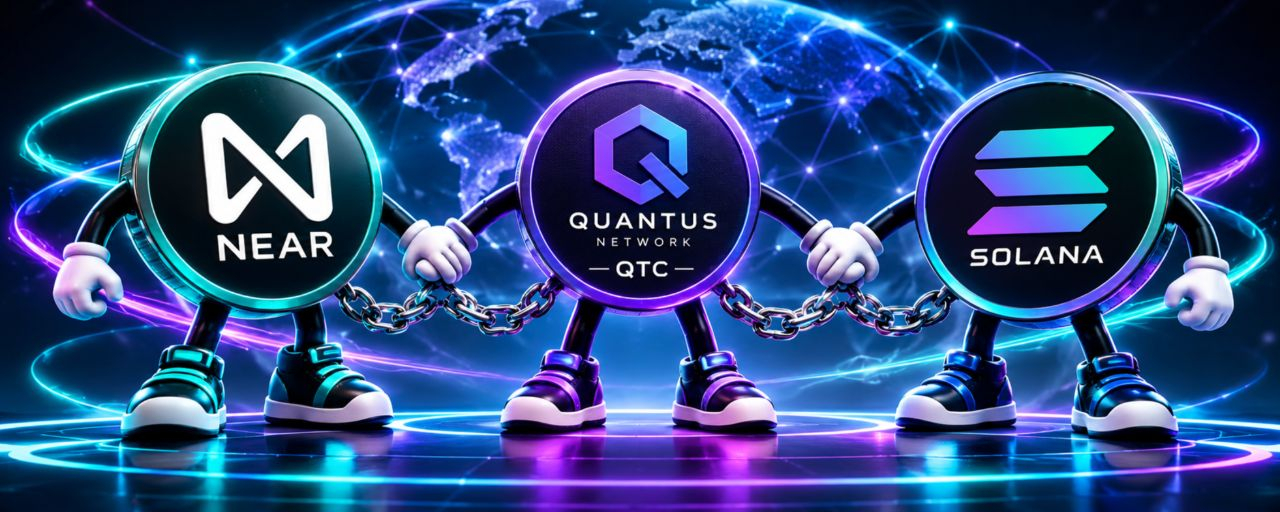
#Near Protocol has an emerging interoperability relationship with the #solana ecosystem, while #Quantus Network ($QTC) has a more direct technical and distribution connection to NEAR. The three projects are linked primarily through cross-chain asset transfers, liquidity access and ecosystem participation rather than a formal three-way partnership.
1. NEAR Protocol ↔ Solana
Technical relationship: NEAR Intents provides cross-chain transaction routing, allowing assets and liquidity to move between blockchain ecosystems, including Solana.Leadership connection: Mert Mumtaz, CEO of Helius, a major Solana infrastructure company, joined the NEAR Foundation Council on 15 October 2026.The Block+1Strategic distinction: Solana concentrates on high-performance applications and liquidity within its ecosystem, while NEAR focuses on connecting liquidity and markets across different chains.
Assessment: A genuine ecosystem and infrastructure relationship, but not evidence of a formal partnership between the Solana Foundation and NEAR Foundation.
2. NEAR Protocol ↔ Quantus Network (QTC)
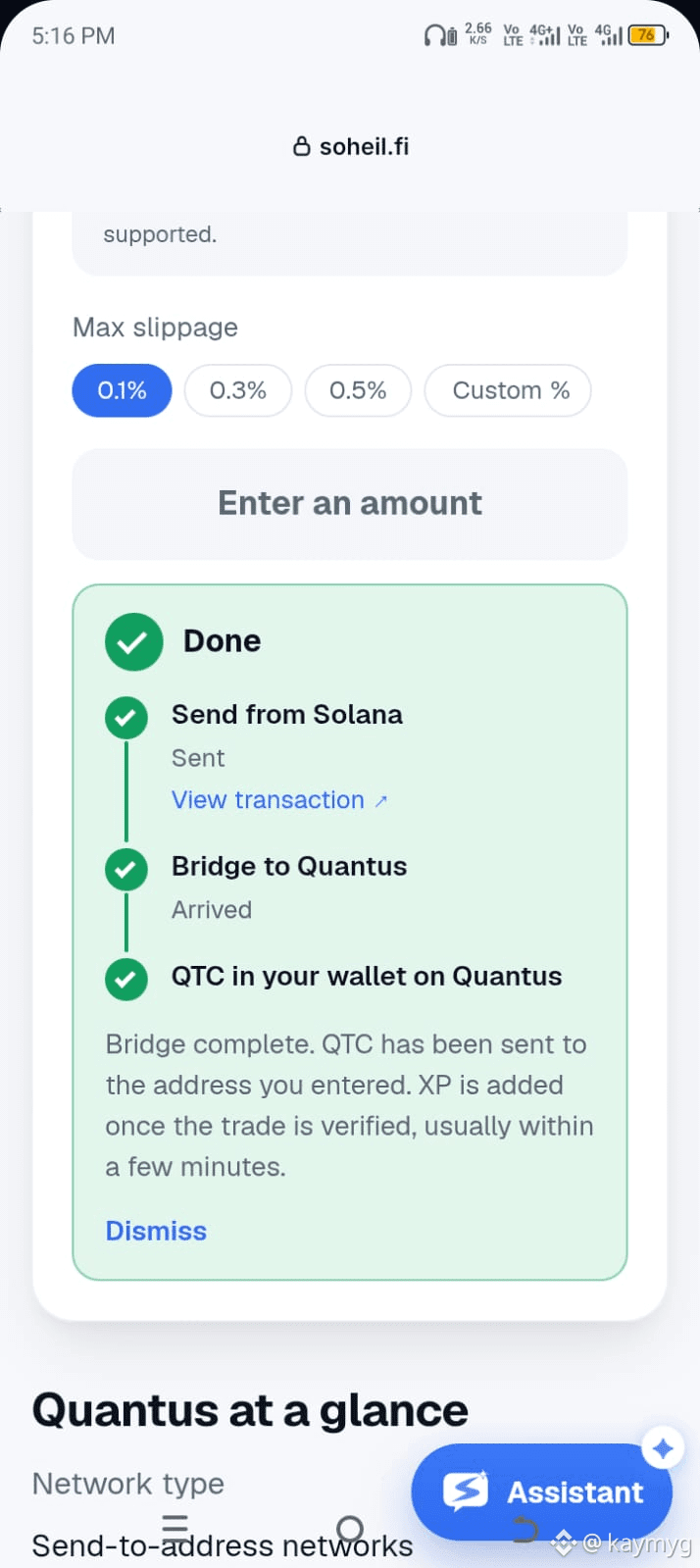
Technical integration: Quantus uses NEAR Intents to connect its native QTC asset with other blockchain ecosystems.Solana expansion: On 12 November 2026, QTC became available on Solana through Raydium, with NEAR Intents serving as the cross-chain connection.Strategic collaboration: NEAR and Quantus co-hosted Quantum & Privacy Day during TOKEN2049 Singapore in October 2026.Security alignment: Quantus is built around post-quantum cryptography, using ML-DSA signatures from its inception.prnewswire.com+2
Strongest documented relationship
Assessment: This is a concrete technical and ecosystem relationship. NEAR provides the interoperability infrastructure through which Quantus can reach markets beyond its native blockchain.
3. Quant Network (QNT) ↔ NEAR / Solana
Quant Network is a separate project from Quantus.
Quant Network: Develops Overledger, enterprise interoperability infrastructure connecting blockchain networks and traditional financial systems.Solana: Overledger supports multi-chain connectivity, but this does not establish a dedicated strategic partnership with Solana.NEAR: There is no sufficiently established public evidence of a significant direct partnership between Quant Network and NEAR Protocol.Overledger
Assessment: The relationship is much weaker than that of Quantus and NEAR. It is important not to confuse QNT with QTC.
Overall relationship assessment
Relationship
Assessment
NEAR – Solana
Ecosystem interoperability and leadership overlap
NEAR – Quantus
Direct technical integration and collaboration
Quantus – Solana
Live asset access through Raydium and NEAR Intents
Quant – Solana
General multi-chain connectivity
Quant – NEAR
No established special relationship
My conclusion: The most interesting connection is the NEAR–Quantus–Solana triangle. Quantus brings post-quantum security, NEAR provides cross-chain coordination and Solana provides access to its liquidity and application ecosystem.
One important qualification: interoperability does not mean the three networks share consensus, security infrastructure or governance. Nor does it mean Solana has adopted Quantus's post-quantum cryptography.
$NEAR $SOL $QTC
·
--
Article
The relationship between NEAR, Solana and Quantus#Near Protocol has an emerging interoperability relationship with the #solana ecosystem, while #Quantus Network ($QTC) has a more direct technical and distribution connection to NEAR. The three projects are linked primarily through cross-chain asset transfers, liquidity access and ecosystem participation rather than a formal three-way partnership. 1. NEAR Protocol ↔ Solana Technical relationship: NEAR Intents provides cross-chain transaction routing, allowing assets and liquidity to move between blockchain ecosystems, including Solana.Leadership connection: Mert Mumtaz, CEO of Helius, a major Solana infrastructure company, joined the NEAR Foundation Council on 15 October 2026.The Block+1Strategic distinction: Solana concentrates on high-performance applications and liquidity within its ecosystem, while NEAR focuses on connecting liquidity and markets across different chains. Assessment: A genuine ecosystem and infrastructure relationship, but not evidence of a formal partnership between the Solana Foundation and NEAR Foundation. 2. NEAR Protocol ↔ Quantus Network (QTC) Technical integration: Quantus uses NEAR Intents to connect its native QTC asset with other blockchain ecosystems.Solana expansion: On 12 November 2026, QTC became available on Solana through Raydium, with NEAR Intents serving as the cross-chain connection.Strategic collaboration: NEAR and Quantus co-hosted Quantum & Privacy Day during TOKEN2049 Singapore in October 2026.Security alignment: Quantus is built around post-quantum cryptography, using ML-DSA signatures from its inception.prnewswire.com+2 Strongest documented relationship Assessment: This is a concrete technical and ecosystem relationship. NEAR provides the interoperability infrastructure through which Quantus can reach markets beyond its native blockchain. 3. Quant Network (QNT) ↔ NEAR / Solana Quant Network is a separate project from Quantus. Quant Network: Develops Overledger, enterprise interoperability infrastructure connecting blockchain networks and traditional financial systems.Solana: Overledger supports multi-chain connectivity, but this does not establish a dedicated strategic partnership with Solana.NEAR: There is no sufficiently established public evidence of a significant direct partnership between Quant Network and NEAR Protocol.Overledger Assessment: The relationship is much weaker than that of Quantus and NEAR. It is important not to confuse QNT with QTC. Overall relationship assessment Relationship Assessment NEAR – Solana Ecosystem interoperability and leadership overlap NEAR – Quantus Direct technical integration and collaboration Quantus – Solana Live asset access through Raydium and NEAR Intents Quant – Solana General multi-chain connectivity Quant – NEAR No established special relationship My conclusion: The most interesting connection is the NEAR–Quantus–Solana triangle. Quantus brings post-quantum security, NEAR provides cross-chain coordination and Solana provides access to its liquidity and application ecosystem. One important qualification: interoperability does not mean the three networks share consensus, security infrastructure or governance. Nor does it mean Solana has adopted Quantus's post-quantum cryptography. $NEAR $SOL $QTC {future}(SOLUSDT) {future}(NEARUSDT)

The relationship between NEAR, Solana and Quantus

#Near Protocol has an emerging interoperability relationship with the #solana ecosystem, while #Quantus Network ($QTC) has a more direct technical and distribution connection to NEAR. The three projects are linked primarily through cross-chain asset transfers, liquidity access and ecosystem participation rather than a formal three-way partnership.
1. NEAR Protocol ↔ Solana
Technical relationship: NEAR Intents provides cross-chain transaction routing, allowing assets and liquidity to move between blockchain ecosystems, including Solana.Leadership connection: Mert Mumtaz, CEO of Helius, a major Solana infrastructure company, joined the NEAR Foundation Council on 15 October 2026.The Block+1Strategic distinction: Solana concentrates on high-performance applications and liquidity within its ecosystem, while NEAR focuses on connecting liquidity and markets across different chains.
Assessment: A genuine ecosystem and infrastructure relationship, but not evidence of a formal partnership between the Solana Foundation and NEAR Foundation.
2. NEAR Protocol ↔ Quantus Network (QTC)
Technical integration: Quantus uses NEAR Intents to connect its native QTC asset with other blockchain ecosystems.Solana expansion: On 12 November 2026, QTC became available on Solana through Raydium, with NEAR Intents serving as the cross-chain connection.Strategic collaboration: NEAR and Quantus co-hosted Quantum & Privacy Day during TOKEN2049 Singapore in October 2026.Security alignment: Quantus is built around post-quantum cryptography, using ML-DSA signatures from its inception.prnewswire.com+2
Strongest documented relationship
Assessment: This is a concrete technical and ecosystem relationship. NEAR provides the interoperability infrastructure through which Quantus can reach markets beyond its native blockchain.
3. Quant Network (QNT) ↔ NEAR / Solana
Quant Network is a separate project from Quantus.
Quant Network: Develops Overledger, enterprise interoperability infrastructure connecting blockchain networks and traditional financial systems.Solana: Overledger supports multi-chain connectivity, but this does not establish a dedicated strategic partnership with Solana.NEAR: There is no sufficiently established public evidence of a significant direct partnership between Quant Network and NEAR Protocol.Overledger
Assessment: The relationship is much weaker than that of Quantus and NEAR. It is important not to confuse QNT with QTC.
Overall relationship assessment
Relationship
Assessment
NEAR – Solana
Ecosystem interoperability and leadership overlap
NEAR – Quantus
Direct technical integration and collaboration
Quantus – Solana
Live asset access through Raydium and NEAR Intents
Quant – Solana
General multi-chain connectivity
Quant – NEAR
No established special relationship
My conclusion: The most interesting connection is the NEAR–Quantus–Solana triangle. Quantus brings post-quantum security, NEAR provides cross-chain coordination and Solana provides access to its liquidity and application ecosystem.
One important qualification: interoperability does not mean the three networks share consensus, security infrastructure or governance. Nor does it mean Solana has adopted Quantus's post-quantum cryptography.
$NEAR $SOL $QTC
·
--
One of the more interesting blockchain integrations is between NEAR Protocol and Quantus Network. #Quantus uses #Near Intents to connect its native QTC asset to external blockchain ecosystems. This gives Quantus access to broader liquidity and distribution without abandoning its own network. NEAR provides the interoperability. Quantus brings post-quantum security. $NEAR $QTC
One of the more interesting blockchain integrations is between NEAR Protocol and Quantus Network.
#Quantus uses #Near Intents to connect its native QTC asset to external blockchain ecosystems. This gives Quantus access to broader liquidity and distribution without abandoning its own network.
NEAR provides the interoperability. Quantus brings post-quantum security.
$NEAR $QTC
kaymyg
·
--
The relationship between NEAR, Solana and Quantus
#Near Protocol has an emerging interoperability relationship with the #solana ecosystem, while #Quantus Network ($QTC) has a more direct technical and distribution connection to NEAR. The three projects are linked primarily through cross-chain asset transfers, liquidity access and ecosystem participation rather than a formal three-way partnership.
1. NEAR Protocol ↔ Solana
Technical relationship: NEAR Intents provides cross-chain transaction routing, allowing assets and liquidity to move between blockchain ecosystems, including Solana.Leadership connection: Mert Mumtaz, CEO of Helius, a major Solana infrastructure company, joined the NEAR Foundation Council on 15 October 2026.The Block+1Strategic distinction: Solana concentrates on high-performance applications and liquidity within its ecosystem, while NEAR focuses on connecting liquidity and markets across different chains.
Assessment: A genuine ecosystem and infrastructure relationship, but not evidence of a formal partnership between the Solana Foundation and NEAR Foundation.
2. NEAR Protocol ↔ Quantus Network (QTC)
Technical integration: Quantus uses NEAR Intents to connect its native QTC asset with other blockchain ecosystems.Solana expansion: On 12 November 2026, QTC became available on Solana through Raydium, with NEAR Intents serving as the cross-chain connection.Strategic collaboration: NEAR and Quantus co-hosted Quantum & Privacy Day during TOKEN2049 Singapore in October 2026.Security alignment: Quantus is built around post-quantum cryptography, using ML-DSA signatures from its inception.prnewswire.com+2
Strongest documented relationship
Assessment: This is a concrete technical and ecosystem relationship. NEAR provides the interoperability infrastructure through which Quantus can reach markets beyond its native blockchain.
3. Quant Network (QNT) ↔ NEAR / Solana
Quant Network is a separate project from Quantus.
Quant Network: Develops Overledger, enterprise interoperability infrastructure connecting blockchain networks and traditional financial systems.Solana: Overledger supports multi-chain connectivity, but this does not establish a dedicated strategic partnership with Solana.NEAR: There is no sufficiently established public evidence of a significant direct partnership between Quant Network and NEAR Protocol.Overledger
Assessment: The relationship is much weaker than that of Quantus and NEAR. It is important not to confuse QNT with QTC.
Overall relationship assessment
Relationship
Assessment
NEAR – Solana
Ecosystem interoperability and leadership overlap
NEAR – Quantus
Direct technical integration and collaboration
Quantus – Solana
Live asset access through Raydium and NEAR Intents
Quant – Solana
General multi-chain connectivity
Quant – NEAR
No established special relationship
My conclusion: The most interesting connection is the NEAR–Quantus–Solana triangle. Quantus brings post-quantum security, NEAR provides cross-chain coordination and Solana provides access to its liquidity and application ecosystem.
One important qualification: interoperability does not mean the three networks share consensus, security infrastructure or governance. Nor does it mean Solana has adopted Quantus's post-quantum cryptography.
$NEAR $SOL $QTC

·
--
My overall opinion: I would currently put #QRL ahead as the more established and defensible choice, while keeping #Quantus under close observation. Quantus has interesting momentum, but its mining concentration is difficult to overlook. Abelian is also worth watching because of its privacy-oriented approach. Ultimately, quantum resistance alone does not make a blockchain secure. A genuinely competitive post-quantum blockchain must demonstrate three things: strong cryptography, decentralised consensus and sustainable transaction performance.
My overall opinion: I would currently put #QRL ahead as the more established and defensible choice, while keeping #Quantus under close observation.

Quantus has interesting momentum, but its mining concentration is difficult to overlook. Abelian is also worth watching because of its privacy-oriented approach.

Ultimately, quantum resistance alone does not make a blockchain secure. A genuinely competitive post-quantum blockchain must demonstrate three things: strong cryptography, decentralised consensus and sustainable transaction performance.
kaymyg
·
--
4. A major concern: Quantus and mining centralisation

Despite its growing visibility, Quantus has a notable consensus-security concern. Its miner leaderboard shows one address responsible for 51.6% of recorded blocks (245,700 out of 475,888). Earlier observations also indicated single-pool dominance in the 50–57% range.
If this reflects control of more than half of the active network hashpower, it creates a potential 51% attack risk, including recent block reorganisations, double-spending and temporary transaction censorship.
It does not allow the miner to break post-quantum signatures or simply steal existing coins. However, it raises legitimate questions about decentralisation. Historical snapshots suggest this concentration has been recurring rather than an isolated observation.
·
--
3. Popularity and public attention #QRL : Remains the most established reference point in discussions about native quantum-resistant blockchains, benefiting from its history since 2018. #Quantus (QTC): Is generating considerable recent attention among newer projects, following its September 2026 launch, CoinGecko trending visibility and significant price movements. Confusion involving fake QTC tokens on other networks has also contributed to discussion. Abelian (ABEL): Attracts interest around privacy and post-quantum cryptography, but remains less visible than QRL and Quantus. Mochimo (MCM): Has an established but relatively small community, with limited mainstream cryptocurrency visibility. Dilithion (DIL): Has a smaller following, with interest largely concentrated among people exploring post-quantum cryptocurrency alternatives. Tidecoin (TDC): Has relatively low public visibility and limited discussion compared with the better-known projects. Popularity takeaway: QRL leads in established recognition, while Quantus appears to be generating the most recent attention among newer entrants.
3. Popularity and public attention

#QRL : Remains the most established reference point in discussions about native quantum-resistant blockchains, benefiting from its history since 2018.

#Quantus (QTC): Is generating considerable recent attention among newer projects, following its September 2026 launch, CoinGecko trending visibility and significant price movements. Confusion involving fake QTC tokens on other networks has also contributed to discussion.

Abelian (ABEL): Attracts interest around privacy and post-quantum cryptography, but remains less visible than QRL and Quantus.

Mochimo (MCM): Has an established but relatively small community, with limited mainstream cryptocurrency visibility.

Dilithion (DIL): Has a smaller following, with interest largely concentrated among people exploring post-quantum cryptocurrency alternatives.

Tidecoin (TDC): Has relatively low public visibility and limited discussion compared with the better-known projects.

Popularity takeaway: QRL leads in established recognition, while Quantus appears to be generating the most recent attention among newer entrants.
kaymyg
·
--
2. Throughput and performance

None of these six is recognised as a high-TPS blockchain, and comparable independently verified throughput benchmarks are scarce.

#Quantus ($QTC): Has a publicly reported target block time of approximately 12 seconds, the shortest published target among this group, although this does not establish the highest TPS.

#QRL : Uses hash-based XMSS signatures, prioritising security over high transaction throughput.

Mochimo (MCM): Its proof-of-work architecture prioritises secure transactions rather than competing with high-speed blockchains.

Abelian (ABEL): Its privacy-oriented cryptographic design introduces additional complexity, and it is not known for high transaction throughput.

Dilithion (DIL): Uses RandomX, a CPU-oriented mining algorithm, and is not positioned as a high-throughput network.

Tidecoin (TDC): Publicly comparable TPS and block-time benchmarks are limited, making its speed difficult to rank reliably.

Performance takeaway: Quantus leads on reported block cadence, but there is insufficient comparable evidence to declare an overall TPS winner.
·
--
2. Throughput and performance None of these six is recognised as a high-TPS blockchain, and comparable independently verified throughput benchmarks are scarce. #Quantus ($QTC): Has a publicly reported target block time of approximately 12 seconds, the shortest published target among this group, although this does not establish the highest TPS. #QRL : Uses hash-based XMSS signatures, prioritising security over high transaction throughput. Mochimo (MCM): Its proof-of-work architecture prioritises secure transactions rather than competing with high-speed blockchains. Abelian (ABEL): Its privacy-oriented cryptographic design introduces additional complexity, and it is not known for high transaction throughput. Dilithion (DIL): Uses RandomX, a CPU-oriented mining algorithm, and is not positioned as a high-throughput network. Tidecoin (TDC): Publicly comparable TPS and block-time benchmarks are limited, making its speed difficult to rank reliably. Performance takeaway: Quantus leads on reported block cadence, but there is insufficient comparable evidence to declare an overall TPS winner.
2. Throughput and performance

None of these six is recognised as a high-TPS blockchain, and comparable independently verified throughput benchmarks are scarce.

#Quantus ($QTC): Has a publicly reported target block time of approximately 12 seconds, the shortest published target among this group, although this does not establish the highest TPS.

#QRL : Uses hash-based XMSS signatures, prioritising security over high transaction throughput.

Mochimo (MCM): Its proof-of-work architecture prioritises secure transactions rather than competing with high-speed blockchains.

Abelian (ABEL): Its privacy-oriented cryptographic design introduces additional complexity, and it is not known for high transaction throughput.

Dilithion (DIL): Uses RandomX, a CPU-oriented mining algorithm, and is not positioned as a high-throughput network.

Tidecoin (TDC): Publicly comparable TPS and block-time benchmarks are limited, making its speed difficult to rank reliably.

Performance takeaway: Quantus leads on reported block cadence, but there is insufficient comparable evidence to declare an overall TPS winner.
kaymyg
·
--
Post-Quantum Blockchains: Comparing Age, Speed, Popularity and Overall Strength

The post-quantum blockchain ecosystem is still developing, with several projects taking different approaches to protecting digital assets against future quantum-computing threats. Six notable native projects are QRL, Mochimo (MCM), Quantus (QTC), Dilithion (DIL), Tidecoin (TDC) and Abelian (ABEL).
None currently stands out as a high-throughput blockchain. Their primary focus is cryptographic security rather than transaction speed. But how do they compare across age, performance, popularity and overall potential?

1. Age and maturity

#QRL : Launched in 2018, making it one of the earliest dedicated quantum-resistant blockchain projects, with a relatively long operational history.

#Mochimo (MCM): Also emerged around 2018, positioning itself among the early pioneers of post-quantum proof-of-work cryptocurrencies.

Abelian (ABEL): A more recent project built around post-quantum cryptography and financial privacy.

#Tidecoin (TDC): A relatively less established project with a smaller public footprint and limited historical visibility.

#Dilithion (DIL): A newer Bitcoin-inspired project combining post-quantum signatures with CPU-oriented proof-of-work.

#Quantus (QTC): A newer entrant whose mainnet launched in September 2026, but which has rapidly attracted attention.
·
--
Bullish
Verified
#Quantus (QuantusNetwork) says its network has been secured by post-quantum ML-DSA cryptography since genesis, with over 33,400 accounts. QTC is now live on #Solana via #Raydium powered by $NEAR Intents. {future}(NEARUSDT)
#Quantus (QuantusNetwork) says its network has been secured by post-quantum ML-DSA cryptography since genesis, with over 33,400 accounts. QTC is now live on #Solana via #Raydium powered by $NEAR Intents.
·
--
Everyone's hunting for the one name holding up on a red day — and right now it's a quantum coin most people hadn't heard of a month ago. $QTC is the 8th most searched coin on CoinGecko today, trading near $70.79, down just 2.1% while $BTC slides 5.9% near $75,605 and $ETH drops 7.7% near $2,229. There's no fresh $QTC headline behind it, honestly — it's the quantum-safe narrative doing the work, plus a mainnet that only went live in September. The catch is real though: only about 324K of its 21M supply circulates, so the book is thin and any unlock pressure hits hard. I'm watching $75.50, today's high — reclaim it and the trending crowd has something to chase; lose $70 and the slide could get fast on that thin liquidity. Would you touch a coin with only 6% of supply out, or is that unlock overhang a hard pass no matter the story? #Quantus #CryptoMarket #BinanceSquare
Everyone's hunting for the one name holding up on a red day — and right now it's a quantum coin most people hadn't heard of a month ago.

$QTC is the 8th most searched coin on CoinGecko today, trading near $70.79, down just 2.1% while $BTC slides 5.9% near $75,605 and $ETH drops 7.7% near $2,229. There's no fresh $QTC headline behind it, honestly — it's the quantum-safe narrative doing the work, plus a mainnet that only went live in September.

The catch is real though: only about 324K of its 21M supply circulates, so the book is thin and any unlock pressure hits hard. I'm watching $75.50, today's high — reclaim it and the trending crowd has something to chase; lose $70 and the slide could get fast on that thin liquidity.

Would you touch a coin with only 6% of supply out, or is that unlock overhang a hard pass no matter the story?

#Quantus #CryptoMarket #BinanceSquare
·
--
$QTC is the odd one climbing the trending board this afternoon, up about 3.7% near $71.82 and sitting close to its daily high near $72.71, on light volume. It is a smaller name, so the attention stands out more than the move itself — trending lists do not usually surface a coin ranked in the 700s without traders actually looking. $BTC is steadier in the background, up about 1.8% near $77,989, so this feels like its own curiosity rather than the market lifting everything. I am watching whether $QTC holds above $70 — if it does, the trending buzz probably has a bit more legs to it. #Quantus
·
--
Verified
Quantus Luncurkan Token QTC Lewat NEAR IntentsJaringan blockchain tahan kuantum Quantus resmi meluncurkan token native QTC melalui platform near.com yang didukung NEAR Intents pada 6 Oktober 2026. Peluncuran ini menjadi salah satu pendorong kenaikan NEAR yang menembus 20 besar kapitalisasi pasar crypto. #NEAR #Quantus #QTC #PostQuantum #CryptoNew #BinanceSquare

Quantus Luncurkan Token QTC Lewat NEAR Intents

Jaringan blockchain tahan kuantum Quantus resmi meluncurkan token native QTC melalui platform near.com yang didukung NEAR Intents pada 6 Oktober 2026. Peluncuran ini menjadi salah satu pendorong kenaikan NEAR yang menembus 20 besar kapitalisasi pasar crypto.
#NEAR #Quantus #QTC #PostQuantum #CryptoNew #BinanceSquare
The volume on $QTC is starting to look identical to the early stages of the last major leg up. Most are sleeping on this momentum, but the smart money is already positioning. The window for this entry is closing fast. ?? #Quantus #BullRun #Altcoins #Crypto #Binance
The volume on $QTC is starting to look identical to the early stages of the last major leg up. Most are sleeping on this momentum, but the smart money is already positioning. The window for this entry is closing fast. ??

#Quantus #BullRun #Altcoins #Crypto #Binance
Notice how the volume is quietly shifting toward $QTC? A +57% surge in 24h isn't a fluke—it's institutional accumulation in plain sight. The window to entry before the retail crowd wakes up is closing fast. 🚀 #Quantus #Altcoins #BullRun #Trading #Binance
Notice how the volume is quietly shifting toward $QTC? A +57% surge in 24h isn't a fluke—it's institutional accumulation in plain sight. The window to entry before the retail crowd wakes up is closing fast. 🚀

#Quantus #Altcoins #BullRun #Trading #Binance
🚨 $QUANTUS PARTNERS WITH PROJECT ELEVEN FOR INSTITUTIONAL POST-QUANTUM CUSTODY ARCHITECTURE 🏦 Institutional smart money requires pristine risk management and crypto-agile custody before deploying size. Project Eleven and $QUANTUS are establishing a unified Strongpoint control layer, separating protocol-level ML-DSA post-quantum cryptography from governance and key management workflows. 🔍 This strategic integration tackles multi-chain cryptographic fragmentation head-on. By enabling institutional hardware and policy controls over a private-by-default, 21 million capped Layer 1, the groundwork for structural capital inflow ahead of 2027 is actively being laid. 📊 🛡️ 💬 Will post-quantum security become the primary structural requirement for institutional allocators next cycle? 👇 ⚠️ Not financial advice. Always manage your risk. 🛡️ 🏷️ #QUANTUS #Layer1 #Crypto #PostQuantum #Institutional 🏦 🛡️
🚨 $QUANTUS PARTNERS WITH PROJECT ELEVEN FOR INSTITUTIONAL POST-QUANTUM CUSTODY ARCHITECTURE 🏦

Institutional smart money requires pristine risk management and crypto-agile custody before deploying size. Project Eleven and $QUANTUS are establishing a unified Strongpoint control layer, separating protocol-level ML-DSA post-quantum cryptography from governance and key management workflows. 🔍

This strategic integration tackles multi-chain cryptographic fragmentation head-on. By enabling institutional hardware and policy controls over a private-by-default, 21 million capped Layer 1, the groundwork for structural capital inflow ahead of 2027 is actively being laid. 📊 🛡️

💬 Will post-quantum security become the primary structural requirement for institutional allocators next cycle? 👇

⚠️ Not financial advice. Always manage your risk. 🛡️

🏷️ #QUANTUS #Layer1 #Crypto #PostQuantum #Institutional

🏦 🛡️
Wait... did you guys see the volume spikes on $QTC? 🚀 Up 60% in 24h and the order books are thinning fast. This looks like the start of a massive breakout before the crowd wakes up. The window is closing—don't be the one chasing at the top. 📈 #Quantus #Crypto #BullRun #Altcoins #Binance
Wait... did you guys see the volume spikes on $QTC? 🚀 Up 60% in 24h and the order books are thinning fast. This looks like the start of a massive breakout before the crowd wakes up. The window is closing—don't be the one chasing at the top. 📈

#Quantus #Crypto #BullRun #Altcoins #Binance
📰 主网上线才一个月,Quantus 就因为“抗量子+隐私”这套定位迅速出圈,还被不少人拿来对比成“抗量子版 Zcash”。 这条公链采用 PoW,核心签名方案是 ML-DSA(Dilithium),并用 STARK、Plonky2 做证明聚合,试图把体积更大的后量子签名压缩下来。简单说,它想从一开始就把量子计算可能带来的安全问题写进架构里,而不是等以后再升级。 🔥 隐私部分也挺有意思。Quantus 通过 Wormhole 地址销毁并重新铸造资产,切断发送地址和最终接收地址之间的直接关联;Zcash 则主要依靠 zk-SNARKs 和屏蔽池来隐藏交易信息。方向相近,但做法并不一样。 项目主网于 2026 年 9 月 9 日上线,官网披露已有超过 8400 个活跃账户,累计交易超过 26 万笔,还接入了 NEAR Intents。融资方面,两轮合计约 242 万美元,Balaji、Babak Nivi、Mert 等人参与,背后和 Zcash 圈子的联系也让它更受讨论。 🤔 但争议同样很直接:QTC 总供应量的 27% 在创世阶段铸造,其中 23% 分给投资人、创始人和团队,锁定一年后再用 36 个月线性释放。抗量子技术还没真正面对大规模考验,代币分配已经先被社区拿出来审视了。你会因为技术方向关注 Quantus,还是会先把高比例创世分配放在第一位? #Quantus #QTC #Zcash #隐私赛道
📰 主网上线才一个月,Quantus 就因为“抗量子+隐私”这套定位迅速出圈,还被不少人拿来对比成“抗量子版 Zcash”。
这条公链采用 PoW,核心签名方案是 ML-DSA(Dilithium),并用 STARK、Plonky2 做证明聚合,试图把体积更大的后量子签名压缩下来。简单说,它想从一开始就把量子计算可能带来的安全问题写进架构里,而不是等以后再升级。

🔥 隐私部分也挺有意思。Quantus 通过 Wormhole 地址销毁并重新铸造资产,切断发送地址和最终接收地址之间的直接关联;Zcash 则主要依靠 zk-SNARKs 和屏蔽池来隐藏交易信息。方向相近,但做法并不一样。
项目主网于 2026 年 9 月 9 日上线,官网披露已有超过 8400 个活跃账户,累计交易超过 26 万笔,还接入了 NEAR Intents。融资方面,两轮合计约 242 万美元,Balaji、Babak Nivi、Mert 等人参与,背后和 Zcash 圈子的联系也让它更受讨论。

🤔 但争议同样很直接:QTC 总供应量的 27% 在创世阶段铸造,其中 23% 分给投资人、创始人和团队,锁定一年后再用 36 个月线性释放。抗量子技术还没真正面对大规模考验,代币分配已经先被社区拿出来审视了。你会因为技术方向关注 Quantus,还是会先把高比例创世分配放在第一位?
#Quantus #QTC #Zcash #隐私赛道
As quantum computing accelerates from theoretical science to practical reality, the foundational security of Web3 faces an inevitable challenge. Most modern blockchains rely on cryptographic algorithms like ECDSA, which advanced quantum processors could eventually compromise. Enter Quantus, an emerging project tackling this existential vulnerability head-on. Quantus is designed as a quantum-resistant Layer-1 network built to safeguard digital assets and smart contracts against future quantum computing capabilities. Rather than retrofitting legacy systems after quantum supremacy is achieved, Quantus integrates post-quantum cryptography directly into its core protocol architecture. Why does this matter to the market today? A major threat often highlighted by cybersecurity experts is the practice of harvesting encrypted data now to decrypt it later once quantum hardware matures. Quantus mitigates this risk by employing next-generation cryptographic standards, such as lattice-based algorithms recommended by global security frameworks, ensuring long-term privacy and asset integrity. Beyond raw security, Quantus aims to address the common trade-off associated with post-quantum algorithms: computational overhead. Quantum-safe signatures are significantly larger and more complex than traditional ones, which can slow down network performance. Quantus tackles this through optimized state execution and lightweight consensus design, maintaining high transaction throughput without compromising security. For the community on Binance Square, keeping an eye on projects like Quantus offers a valuable perspective on where infrastructure is heading. As institutional adoption grows and regulatory standards increasingly emphasize future-proof security, quantum-ready blockchains could set the baseline for Web3 safety. Paying attention to proactive security architecture today helps investors and builders navigate the technological shifts of tomorrow. Is your Web3 outlook ready for the quantum transition? #Quantus #CryptoSecurity #Web3
As quantum computing accelerates from theoretical science to practical reality, the foundational security of Web3 faces an inevitable challenge. Most modern blockchains rely on cryptographic algorithms like ECDSA, which advanced quantum processors could eventually compromise. Enter Quantus, an emerging project tackling this existential vulnerability head-on.

Quantus is designed as a quantum-resistant Layer-1 network built to safeguard digital assets and smart contracts against future quantum computing capabilities. Rather than retrofitting legacy systems after quantum supremacy is achieved, Quantus integrates post-quantum cryptography directly into its core protocol architecture.

Why does this matter to the market today? A major threat often highlighted by cybersecurity experts is the practice of harvesting encrypted data now to decrypt it later once quantum hardware matures. Quantus mitigates this risk by employing next-generation cryptographic standards, such as lattice-based algorithms recommended by global security frameworks, ensuring long-term privacy and asset integrity.

Beyond raw security, Quantus aims to address the common trade-off associated with post-quantum algorithms: computational overhead. Quantum-safe signatures are significantly larger and more complex than traditional ones, which can slow down network performance. Quantus tackles this through optimized state execution and lightweight consensus design, maintaining high transaction throughput without compromising security.

For the community on Binance Square, keeping an eye on projects like Quantus offers a valuable perspective on where infrastructure is heading. As institutional adoption grows and regulatory standards increasingly emphasize future-proof security, quantum-ready blockchains could set the baseline for Web3 safety. Paying attention to proactive security architecture today helps investors and builders navigate the technological shifts of tomorrow. Is your Web3 outlook ready for the quantum transition?

#Quantus #CryptoSecurity #Web3
Quantus (QTC) just took a sharp 11% dip in the last 24 hours, sliding to around $90 — a sudden move that has traders watching the $26M market cap project closely. For beginners, this kind of volatility is common in lower-cap altcoins ranked near #700, where lower liquidity means even moderate sell pressure can push prices down fast. The 24-hour volume sits at $3.3M, suggesting the drop wasn't driven by massive panic selling but rather a lack of buying support. Before jumping in, always check the project’s fundamentals: what problem does Quantus solve, who is the team, and is the tokenomics sustainable? A red candle isn't always a buy signal, and a green one isn't always safe. DYOR (Do Your Own Research) remains the golden rule, especially outside the top 100. #Quantus #CryptoVolatility What’s your rule of thumb when a small-cap asset drops double digits in a day — buy, wait, or avoid?
Quantus (QTC) just took a sharp 11% dip in the last 24 hours, sliding to around $90 — a sudden move that has traders watching the $26M market cap project closely. For beginners, this kind of volatility is common in lower-cap altcoins ranked near #700, where lower liquidity means even moderate sell pressure can push prices down fast. The 24-hour volume sits at $3.3M, suggesting the drop wasn't driven by massive panic selling but rather a lack of buying support. Before jumping in, always check the project’s fundamentals: what problem does Quantus solve, who is the team, and is the tokenomics sustainable? A red candle isn't always a buy signal, and a green one isn't always safe. DYOR (Do Your Own Research) remains the golden rule, especially outside the top 100.

#Quantus #CryptoVolatility

What’s your rule of thumb when a small-cap asset drops double digits in a day — buy, wait, or avoid?
🦈 INSTITUTIONAL MONEY IS PREPARING FOR POST-QUANTUM CRYPTO WITH $QUANTUS BREAKTHROUGH! ⚡ Smart capital isn't just looking at the next resistance flip, it's quietly front-running structural infrastructure shifts. 🏦 $QUANTUS just locked in a major institutional partnership with Project Eleven to bring quantum-secure custody and enterprise governance directly to its 21M hard-cap layer-1 network. When key management and post-quantum encryption align with true institutional architecture, long-term liquidity starts paying attention. 📊 As traditional finance demands future-proof security, seeing protocol-level zero-knowledge privacy and ML-DSA signatures build dedicated institutional rails is a massive fundamental trigger. 💡 Smart money accumulation always happens quietly in the infrastructure phase before retail catches the trend. 💬 Will post-quantum security become the dominant theme for institutional inflows in 2027? 👇 ⚠️ Not financial advice. Always manage your risk. 🛡️ 🏷️ #QUANTUS #Crypto #Layer1 #PostQuantum #SmartMoney 🔥 💎
🦈 INSTITUTIONAL MONEY IS PREPARING FOR POST-QUANTUM CRYPTO WITH $QUANTUS BREAKTHROUGH! ⚡

Smart capital isn't just looking at the next resistance flip, it's quietly front-running structural infrastructure shifts. 🏦 $QUANTUS just locked in a major institutional partnership with Project Eleven to bring quantum-secure custody and enterprise governance directly to its 21M hard-cap layer-1 network.

When key management and post-quantum encryption align with true institutional architecture, long-term liquidity starts paying attention. 📊 As traditional finance demands future-proof security, seeing protocol-level zero-knowledge privacy and ML-DSA signatures build dedicated institutional rails is a massive fundamental trigger.

💡 Smart money accumulation always happens quietly in the infrastructure phase before retail catches the trend. 💬 Will post-quantum security become the dominant theme for institutional inflows in 2027? 👇

⚠️ Not financial advice. Always manage your risk. 🛡️

🏷️ #QUANTUS #Crypto #Layer1 #PostQuantum #SmartMoney

🔥 💎
·
--
kaymyg
·
--
The relationship between NEAR, Solana and Quantus
#Near Protocol has an emerging interoperability relationship with the #solana ecosystem, while #Quantus Network ($QTC) has a more direct technical and distribution connection to NEAR. The three projects are linked primarily through cross-chain asset transfers, liquidity access and ecosystem participation rather than a formal three-way partnership.
1. NEAR Protocol ↔ Solana
Technical relationship: NEAR Intents provides cross-chain transaction routing, allowing assets and liquidity to move between blockchain ecosystems, including Solana.Leadership connection: Mert Mumtaz, CEO of Helius, a major Solana infrastructure company, joined the NEAR Foundation Council on 15 October 2026.The Block+1Strategic distinction: Solana concentrates on high-performance applications and liquidity within its ecosystem, while NEAR focuses on connecting liquidity and markets across different chains.
Assessment: A genuine ecosystem and infrastructure relationship, but not evidence of a formal partnership between the Solana Foundation and NEAR Foundation.
2. NEAR Protocol ↔ Quantus Network (QTC)
Technical integration: Quantus uses NEAR Intents to connect its native QTC asset with other blockchain ecosystems.Solana expansion: On 12 November 2026, QTC became available on Solana through Raydium, with NEAR Intents serving as the cross-chain connection.Strategic collaboration: NEAR and Quantus co-hosted Quantum & Privacy Day during TOKEN2049 Singapore in October 2026.Security alignment: Quantus is built around post-quantum cryptography, using ML-DSA signatures from its inception.prnewswire.com+2
Strongest documented relationship
Assessment: This is a concrete technical and ecosystem relationship. NEAR provides the interoperability infrastructure through which Quantus can reach markets beyond its native blockchain.
3. Quant Network (QNT) ↔ NEAR / Solana
Quant Network is a separate project from Quantus.
Quant Network: Develops Overledger, enterprise interoperability infrastructure connecting blockchain networks and traditional financial systems.Solana: Overledger supports multi-chain connectivity, but this does not establish a dedicated strategic partnership with Solana.NEAR: There is no sufficiently established public evidence of a significant direct partnership between Quant Network and NEAR Protocol.Overledger
Assessment: The relationship is much weaker than that of Quantus and NEAR. It is important not to confuse QNT with QTC.
Overall relationship assessment
Relationship
Assessment
NEAR – Solana
Ecosystem interoperability and leadership overlap
NEAR – Quantus
Direct technical integration and collaboration
Quantus – Solana
Live asset access through Raydium and NEAR Intents
Quant – Solana
General multi-chain connectivity
Quant – NEAR
No established special relationship
My conclusion: The most interesting connection is the NEAR–Quantus–Solana triangle. Quantus brings post-quantum security, NEAR provides cross-chain coordination and Solana provides access to its liquidity and application ecosystem.
One important qualification: interoperability does not mean the three networks share consensus, security infrastructure or governance. Nor does it mean Solana has adopted Quantus's post-quantum cryptography.
$NEAR $SOL $QTC

Log in to explore more content
Join global crypto users on Binance Square
⚡️ Get latest and useful information about crypto.
💬 Trusted by the world’s largest crypto exchange.
👍 Discover real insights from verified creators.
Email / Phone number