

陈小晖
133 Posts

陈小晖
Report
Block User
夫唯不争,一位略懂投机之道的混子。欧易实盘同名,且看2倍杠杆小资金能否做出来。
112 Following
67 Followers
49 Liked
Posts
·
--
November is here. First, wishing you guys a strong start and success!
I’m planning to trade less frequently. Even though I got the direction right last month, I still didn’t manage to make any good trades. My holding periods were too short, and I built my positions in batches too quickly. I need to get my mindset back on track and stop taking opportunities I shouldn’t.
This month, I’ll review more and trade less.
Two pre-market plans:
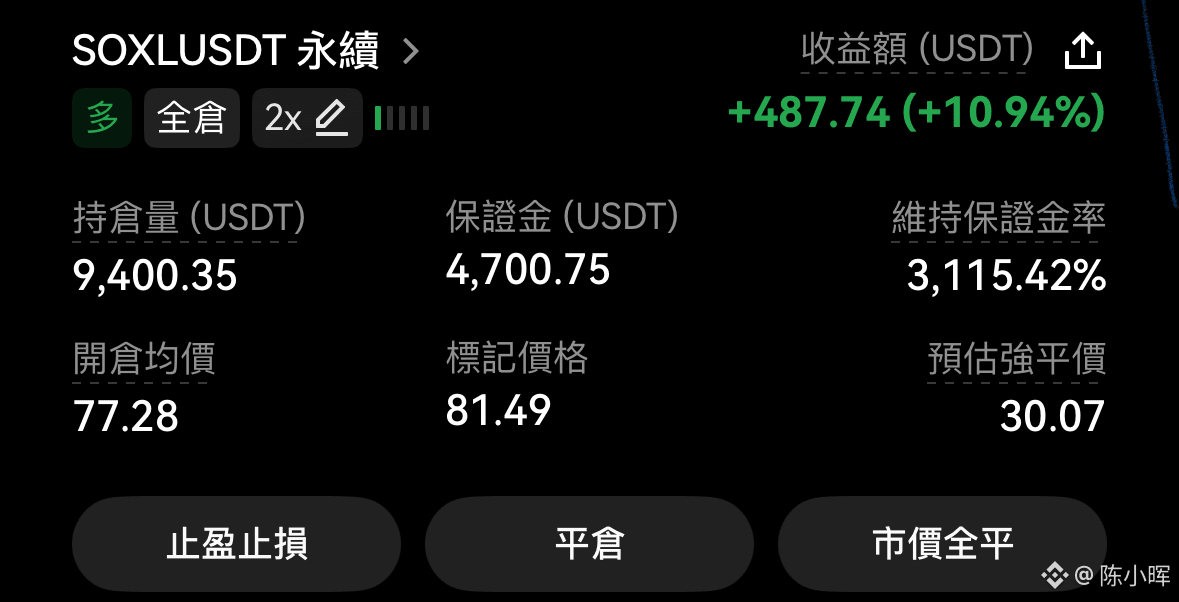
1: I think this move still needs to pull back toward the previous low. I’m not going to guess when it’ll pull back or when it’ll stabilize. I’ll add to my position when it gets there, then hold until the rally runs out of steam.
2: Once the election is over and the uncertainty is behind us, I’ll look at how much money flows back into oil and the AI sector. Then I’ll assess the strength of the rebound. Personally, I don’t think there’s any need to panic at this level.
A rebound after an irrational sell-off needs a pullback to confirm it. Only after that confirmation is there an opportunity to enter on the right side of the trend.
$SOXL
230
·
--
Bearish
Verified
SanDisk’s $SNDK 20 stock split, 1-for-8. Before that, they pushed the share price down, and the funds are also more focused on next quarter’s returns. After the split, it’ll be much easier to unload the shares. Selling at over 1,000 per share was possible when there was enough hype, but there isn’t enough hype now.
It’ll become 150 per share, then they’ll lure buyers in, push it above 200, and start steadily unloading shares as the price drifts down. Who knows—maybe we really will be able to buy SanDisk for around 50 later 😂.
#闪迪
{future}(SNDKUSDT)
SanDisk’s $SNDK 20 stock split, 1-for-8. Before that, they pushed the share price down, and the funds are also more focused on next quarter’s returns. After the split, it’ll be much easier to unload the shares. Selling at over 1,000 per share was possible when there was enough hype, but there isn’t enough hype now.
It’ll become 150 per share, then they’ll lure buyers in, push it above 200, and start steadily unloading shares as the price drifts down. Who knows—maybe we really will be able to buy SanDisk for around 50 later 😂.
#闪迪
It’ll become 150 per share, then they’ll lure buyers in, push it above 200, and start steadily unloading shares as the price drifts down. Who knows—maybe we really will be able to buy SanDisk for around 50 later 😂.
#闪迪
5
3.1k
·
--
Bearish
The second giant this year, Anthropic, is set to go public in the middle to latter part of next month, and is going to pull another $1.5–2 trillion out of the market. But right now, enthusiasm for the AI sector is cooling off way too quickly. Going public toward the tail end of the market hype is still pretty stressful. It’s hard to expect a very large gain.
Let’s run the numbers another way: even if the share price doesn’t rise, the company still gets the money it borrowed and can keep operating. The financing costs are close to 10% a year, and aren’t affected by market movements. It’s a win-win for Wall Street and Anthropic, plus there are orders tying all the big players together.
It’s like pumping up trading volume: after the IPO, if the stock goes up, you can use it as collateral; if it plunges right away, you collect the interest. Either way, the orders are still there, and the company has money.
For us, there’s still not much opportunity to get involved. The meat has long since been divided up among the capitalists.
Let’s just wait a little longer.
$ANTHROPIC #anthropic
{future}(ANTHROPICUSDT)
The second giant this year, Anthropic, is set to go public in the middle to latter part of next month, and is going to pull another $1.5–2 trillion out of the market. But right now, enthusiasm for the AI sector is cooling off way too quickly. Going public toward the tail end of the market hype is still pretty stressful. It’s hard to expect a very large gain.
Let’s run the numbers another way: even if the share price doesn’t rise, the company still gets the money it borrowed and can keep operating. The financing costs are close to 10% a year, and aren’t affected by market movements. It’s a win-win for Wall Street and Anthropic, plus there are orders tying all the big players together.
It’s like pumping up trading volume: after the IPO, if the stock goes up, you can use it as collateral; if it plunges right away, you collect the interest. Either way, the orders are still there, and the company has money.
For us, there’s still not much opportunity to get involved. The meat has long since been divided up among the capitalists.
Let’s just wait a little longer.
$ANTHROPIC #anthropic
189
·
--
Markets are like life—no one knows what will happen next. This wave of coin theft liquidated $1.5 billion in long positions. No technical support levels were any help. Market sentiment is spreading way too fast.
$BTC It plunged from 78,763 to 76,519. I wouldn’t say it’s time to buy the dip, but buying a little spot in batches is still a good option.
Market sentiment comes and goes quickly. Right now, sentiment in U.S. stocks is even worse than in crypto. Even with an unexpected incident, BTC hasn’t actually fallen that much. It’s still relatively stable, and there’s money coming in to buy it.
#币安披露黑客事件进展63亿美元损失已弥补八成
{future}(BTCUSDT)
Markets are like life—no one knows what will happen next. This wave of coin theft liquidated $1.5 billion in long positions. No technical support levels were any help. Market sentiment is spreading way too fast.
$BTC It plunged from 78,763 to 76,519. I wouldn’t say it’s time to buy the dip, but buying a little spot in batches is still a good option.
Market sentiment comes and goes quickly. Right now, sentiment in U.S. stocks is even worse than in crypto. Even with an unexpected incident, BTC hasn’t actually fallen that much. It’s still relatively stable, and there’s money coming in to buy it.
#币安披露黑客事件进展63亿美元损失已弥补八成
186
·
--
Bearish
Objectively speaking, based on market performance, the AI sector is accelerating toward a bottom, while pharmaceuticals and energy are accelerating toward a top. When all assets plunged, gold failed to serve as a safe haven either; only oil, U.S. Treasuries, and the like saw inflows.
This points to poor liquidity—even gold is being sold off. Are they trying to drive people into U.S. Treasuries?
All we can do is wait until oil starts to fall and see how much money flows back. If, after the decline, the recovery in assets is insufficient,
that would prove that this rebound is followed by the actual distribution phase.
#AI $CL
601
·
--
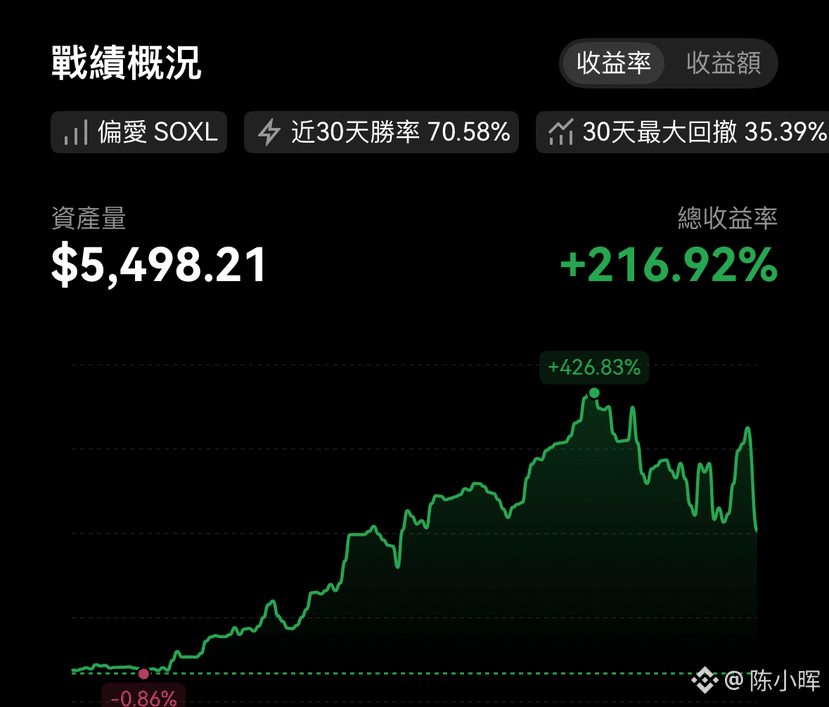
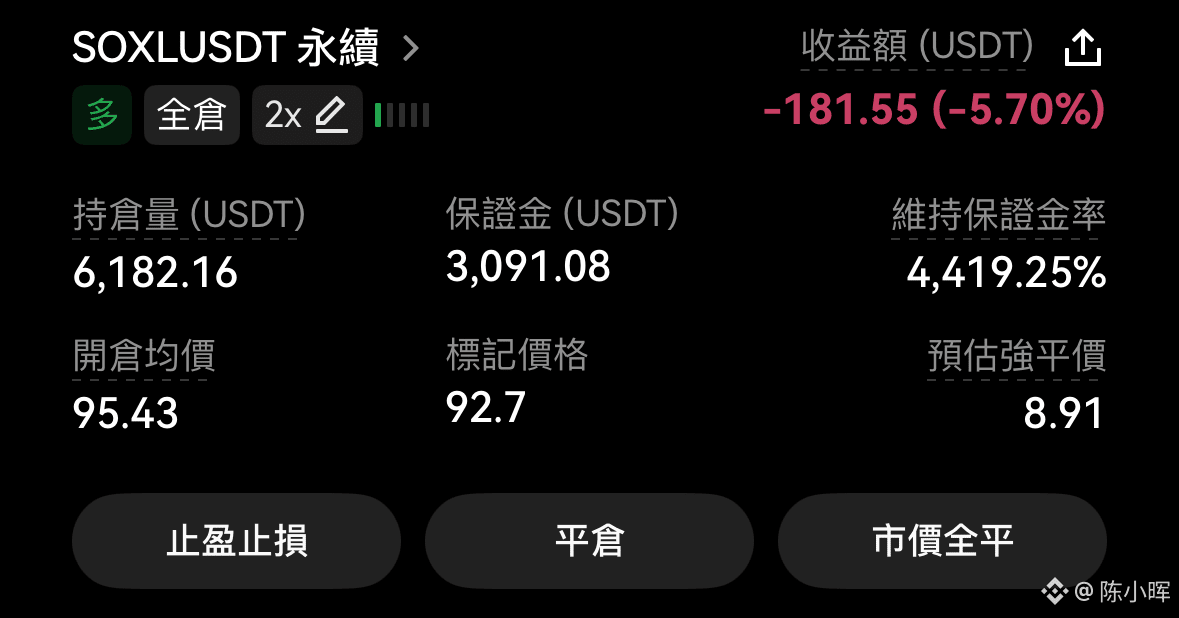
Another month is over. I was just about back to my previous high, but today’s sell-off wiped out all those gains. A month of work for nothing 😂. I’m resetting and starting to review what happened.
I was still too greedy this time. I got the direction right and knew a correction was coming, but I waited for a sharp drop to buy in. I just couldn’t resist, and I even left an overnight order. By the time I got up, three orders had been filled.
Lately, I’ve really just been playing oversold bounces. I started buying too early on the left side, and the move was too big. Apart from the $SOXL I picked, things were otherwise okay. It was a good reminder from the market: even if you get the direction right, you need to be patient. If an opportunity isn’t yours, it isn’t yours.
I’ve reduced my positions and am taking a break. Let’s see what Monday brings. If there’s another sharp sell-off on Monday, I’ll still finish this trade, but I’ll keep my position size under control. I’ll recover whatever I can. My view hasn’t changed: I still expect a rebound.
I’d also like to say: thanks, everyone, for trusting me. The ideas I share are my own, but when it comes to trading, just follow your own instincts.
I’m not telling anyone to trade the way I do. If you ask, I’ll share my views; whether you use them as a reference is up to you.
{future}(SOXLUSDT)
Another month is over. I was just about back to my previous high, but today’s sell-off wiped out all those gains. A month of work for nothing 😂. I’m resetting and starting to review what happened.
I was still too greedy this time. I got the direction right and knew a correction was coming, but I waited for a sharp drop to buy in. I just couldn’t resist, and I even left an overnight order. By the time I got up, three orders had been filled.
Lately, I’ve really just been playing oversold bounces. I started buying too early on the left side, and the move was too big. Apart from the $SOXL I picked, things were otherwise okay. It was a good reminder from the market: even if you get the direction right, you need to be patient. If an opportunity isn’t yours, it isn’t yours.
I’ve reduced my positions and am taking a break. Let’s see what Monday brings. If there’s another sharp sell-off on Monday, I’ll still finish this trade, but I’ll keep my position size under control. I’ll recover whatever I can. My view hasn’t changed: I still expect a rebound.
I’d also like to say: thanks, everyone, for trusting me. The ideas I share are my own, but when it comes to trading, just follow your own instincts.
I’m not telling anyone to trade the way I do. If you ask, I’ll share my views; whether you use them as a reference is up to you.
1.2k
·
--
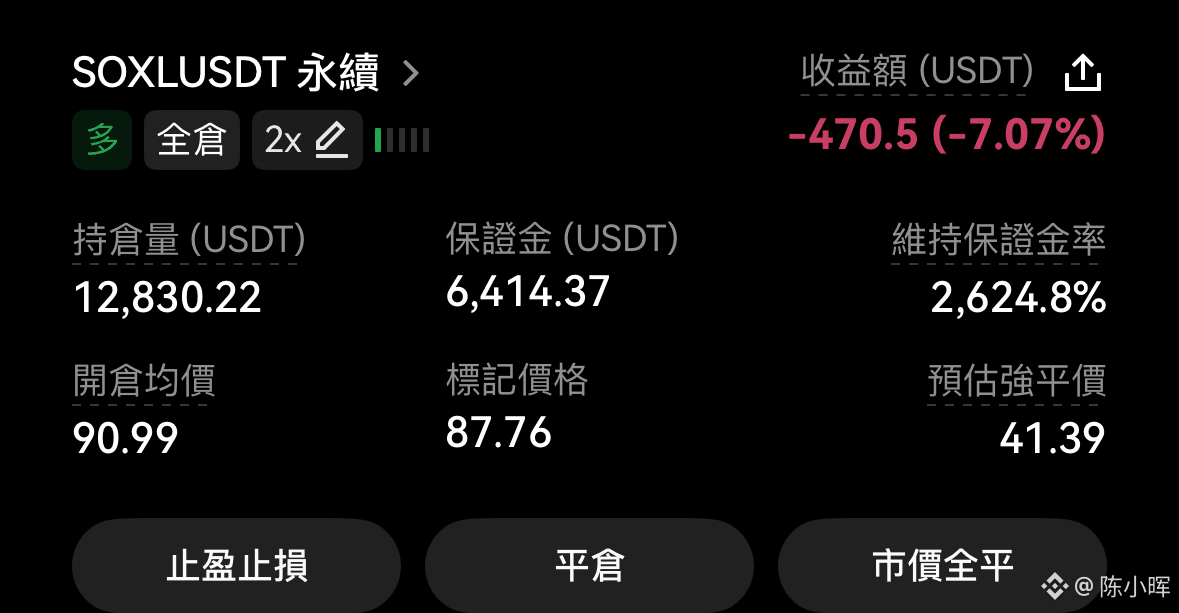
Intel's earnings report came out in the middle of the night, and the market took another big dive. At this level, it looks like a second bottom test for the AI sector. It's right not to make trades when things are uncertain. Since there's no way to predict the future, I closed out some of my positions.
We're still not near the previous low, and yesterday's drop was relatively large. If there are some bigger rebounds along the way, you can make a few intraday trades to lower your cost basis.
It's a sharp drop, and all the negative factors are now fully priced in. I expect a lot of people to turn bearish again. There's still a little distance to the previous low. Add in batches.
My view remains unchanged: once this pullback is over, I'm still expecting a rebound over the next 1–2 weeks.
Be patient for now and don't rush. Before the market stabilizes, just keep rolling your liquid positions within the day.
385
·
--
Bullish
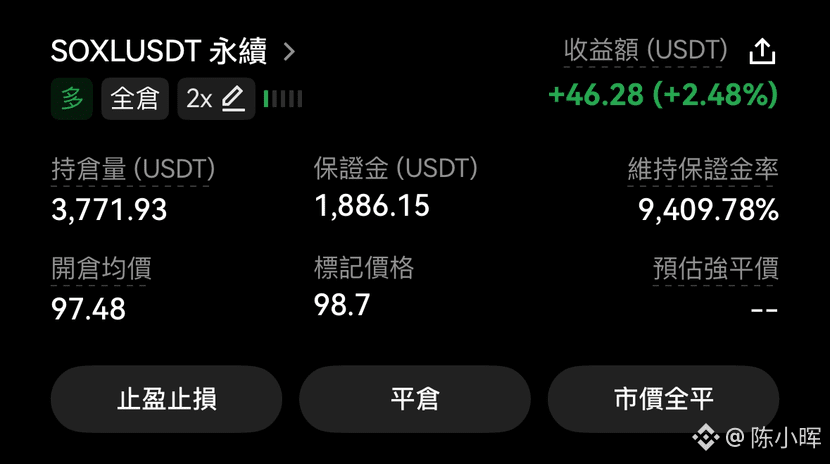
For now, there's no need to rush into a very large position. Once all the earnings reports are out tonight, if there's another sharp drop, then we can go in big.
Let's get past this period of uncertainty first. There's not much to worry about now. This time, Google has also brought down everyone's expectations for AI growth.
That could be a good thing. Over the next 1–2 weeks, on November 5, the Philadelphia Semiconductor Index will undergo a 3-for-1 split, which should increase buying demand.
And if oil prices pull back a bit during this period, along with some positive news to give things a boost, the rally could come quickly.
$SOXL still needs to churn around 100 for a while, shaking out profit-takers and rebuilding the uptrend.
#谷歌财报能否守住基本盘
{future}(SOXLUSDT)
For now, there's no need to rush into a very large position. Once all the earnings reports are out tonight, if there's another sharp drop, then we can go in big.
Let's get past this period of uncertainty first. There's not much to worry about now. This time, Google has also brought down everyone's expectations for AI growth.
That could be a good thing. Over the next 1–2 weeks, on November 5, the Philadelphia Semiconductor Index will undergo a 3-for-1 split, which should increase buying demand.
And if oil prices pull back a bit during this period, along with some positive news to give things a boost, the rally could come quickly.
$SOXL still needs to churn around 100 for a while, shaking out profit-takers and rebuilding the uptrend.
#谷歌财报能否守住基本盘
1
663
·
--
Bullish
Verified
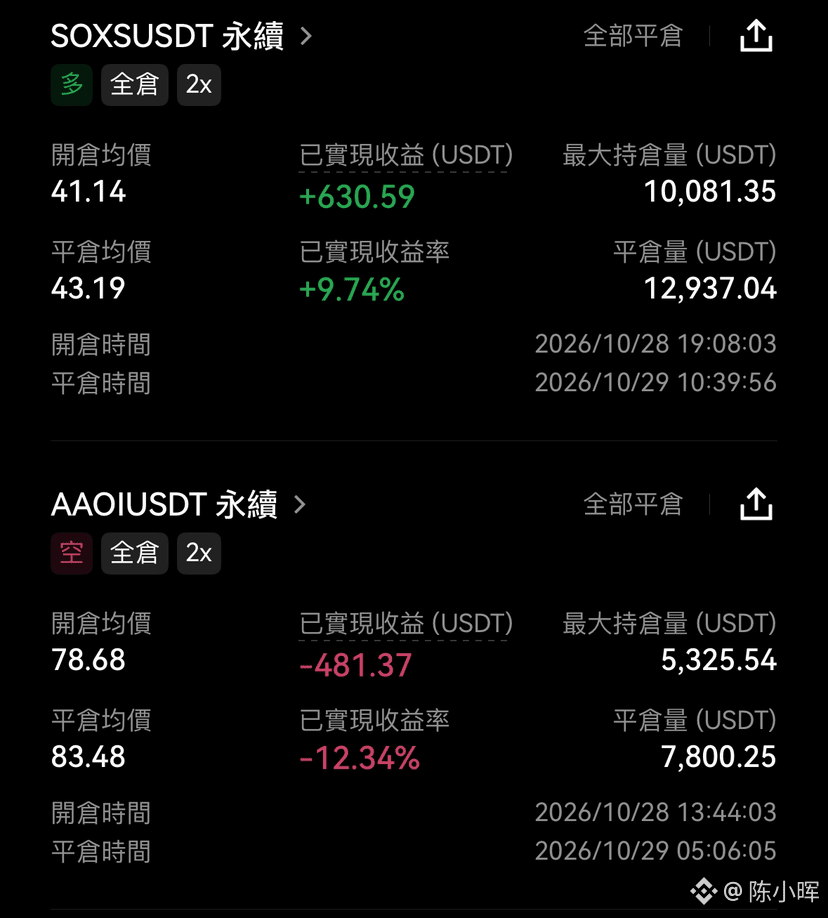
As expected yesterday, the rate decision came with no hike, and the market had already priced that in, so there wasn’t much reaction once it was announced. Earnings still had a bigger impact: Oracle beat expectations and immediately drove a rally across the AI sector. Then Google delivered another huge shock after hours. The risk-reward on this short-term short was indeed very attractive, but unfortunately AAOI stopped me out. Otherwise, I would’ve pocketed a 10-point gain on this short.
Amazon, SanDisk, and Intel still report earnings tonight. After that, most of the uncertainty should be behind us. If there’s another sharp selloff, I can close the short.
After a sharp drop, reopen the long position $SOXL . The long is a trial entry; don’t get in all at once. Still need to scale in.
#股票财报季
{future}(SOXLUSDT)
As expected yesterday, the rate decision came with no hike, and the market had already priced that in, so there wasn’t much reaction once it was announced. Earnings still had a bigger impact: Oracle beat expectations and immediately drove a rally across the AI sector. Then Google delivered another huge shock after hours. The risk-reward on this short-term short was indeed very attractive, but unfortunately AAOI stopped me out. Otherwise, I would’ve pocketed a 10-point gain on this short.
Amazon, SanDisk, and Intel still report earnings tonight. After that, most of the uncertainty should be behind us. If there’s another sharp selloff, I can close the short.
After a sharp drop, reopen the long position $SOXL . The long is a trial entry; don’t get in all at once. Still need to scale in.
#股票财报季
1
731
·
--
Bearish
Prices are rising again before the market opens, but my view hasn’t changed. There’s a need for a pullback at this level—to shake out the market and test support.
If there’s a sharp drop after the pullback, I’d still go long.
This rebound could continue for about two more weeks after the election.
Once all the uncertainty has been resolved, if prices are still rising, sell into strength.
For very short-term traders: I wouldn’t recommend going long at this level. Resistance needs to be tested, and the risk/reward isn’t favorable enough. If the test of resistance fails, a short position—combined with news catalysts (such as cloud providers’ capital spending growth falling short)—could offer a good risk/reward opportunity to profit from a sharp drop.
For swing traders: Wait for a pullback, then open another long position.
For medium-term traders: Wait until after the election to start building short positions.
So I’ve closed my long position and will first take a short trade, using my last add-on entry as the reference and setting a 5-point stop-loss.
1
687
·
--
Bearish
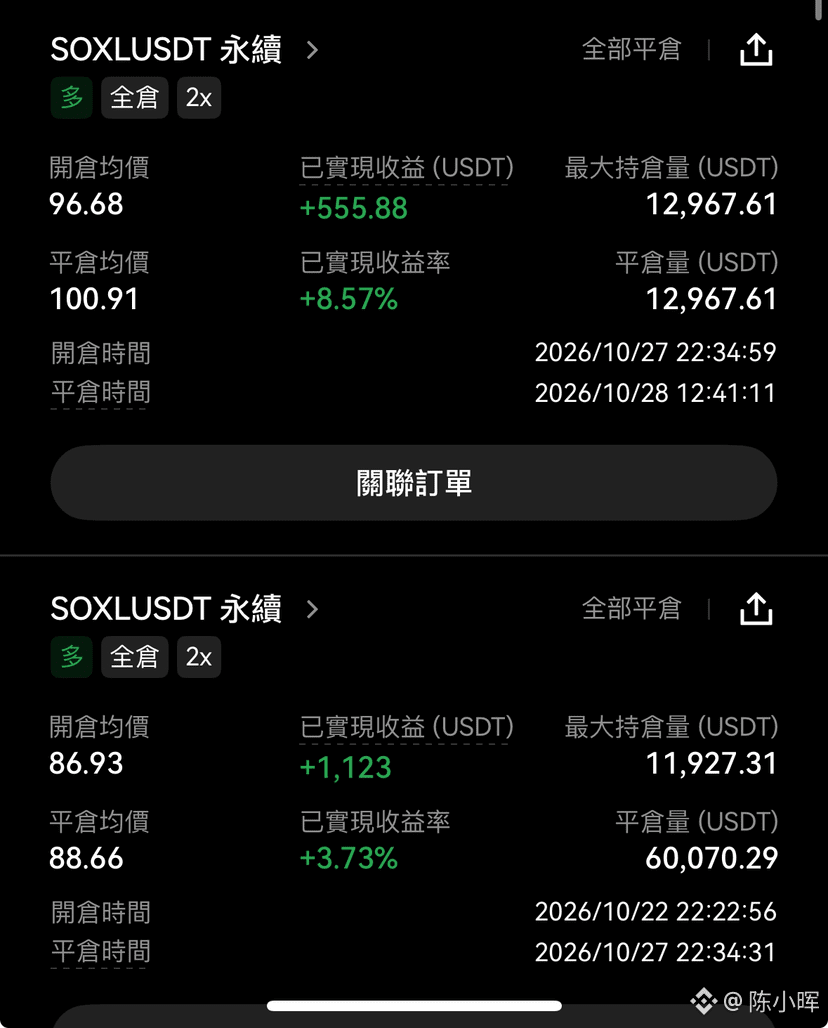
Opened a small short position $AAOI to hedge a bit. I’m not holding this one for long—just seeing how this pullback plays out.
Reduced my long position $SOXL . I’ll assess things tonight and decide whether to increase the position again.
SOXL has pulled back to around 100. It’d be better if it wicked back up. Short-term, the profit-takers need to be shaken out.
Once that’s done, it can challenge the resistance at 123.
I have two plans: if it rallies straight up before earnings, I’ll take profits. If it pulls back and shakes out weak hands, I’ll add to the position and set a stop-loss.
There’s uncertainty to be resolved tonight. If the big players use this to shake out weak hands, it’ll be twice as effective. Better to be cautious for now.
Stay in the game first, then adjust based on what the market does.
#FOMC会议
1
2
1.3k
·
--
Bullish
Verified
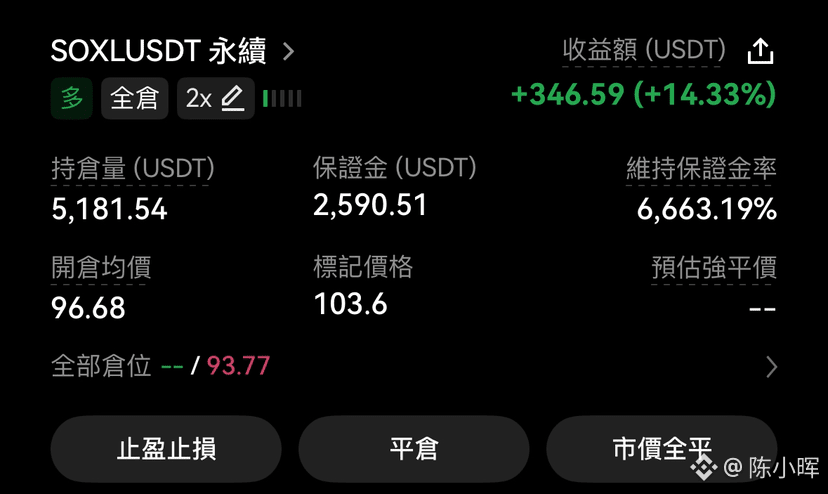
This time, $SKHYNIX ’s earnings came in, and instead we got a short squeeze.
Microsoft and Google earnings, along with the interest rate decision, are also coming tonight. If it pulls back from here and then continues higher, there’s still some room for a rebound.
Based on the price action over the past few days, expectations are already being priced in ahead of the election. The rebound could last until the election is over, after which the downtrend may resume following a period of consolidation.
There’s still one week to trade the rebound.
In the short term, wait for a pullback and a wick. $SOXL is consolidating around 100. If it pulls back but quickly recaptures 100, then 123 is the next level to watch.
1
2k
·
--
The 28th is going to be exciting: the Fed will announce its rate decision. But I don't think they'll raise rates this time, since the election is on November 4. There's no need for another hike before the election, and employment and the economy are holding up for now. Oil is driving inflation a bit higher, but you win some, you lose some—the growth in U.S. oil exports has been pretty incredible. Inflation is one thing, but they're making a fortune; even buyers in the Middle East and Europe now have to book oil years in advance.
There are a huge number of short sellers lately. And now we're heading into earnings reports from Microsoft, Google, and Amazon. Any sign of trouble, and tech stocks could tank right before your eyes. At these levels, if their capital growth meets expectations and their earnings are decent, it'll trigger a short squeeze.
I still think the real risk comes after the midterm elections. The big crash hasn't happened yet. For now, I'll keep watching to see when the last two uptrends start to weaken. That's when everything will collapse.
#谷歌 $GOOGLB $MSFTB
{spot}(MSFTBUSDT)
The 28th is going to be exciting: the Fed will announce its rate decision. But I don't think they'll raise rates this time, since the election is on November 4. There's no need for another hike before the election, and employment and the economy are holding up for now. Oil is driving inflation a bit higher, but you win some, you lose some—the growth in U.S. oil exports has been pretty incredible. Inflation is one thing, but they're making a fortune; even buyers in the Middle East and Europe now have to book oil years in advance.
There are a huge number of short sellers lately. And now we're heading into earnings reports from Microsoft, Google, and Amazon. Any sign of trouble, and tech stocks could tank right before your eyes. At these levels, if their capital growth meets expectations and their earnings are decent, it'll trigger a short squeeze.
I still think the real risk comes after the midterm elections. The big crash hasn't happened yet. For now, I'll keep watching to see when the last two uptrends start to weaken. That's when everything will collapse.
#谷歌 $GOOGLB $MSFTB
1
139
·
--
Bearish
Volatility is still likely to be high this week. Oil has pulled back a little, but it's still around 100. Right now, too much money is choosing to seek safety in U.S. Treasuries rather than gold. There's not quite enough liquidity in the pool.
On top of that, uncertainty surrounding the rate decision meeting in the early hours of the 29th has most people sitting on the sidelines and seeking safety.
If a rebound starts early this week, it means expectations are being priced in ahead of time—pull back after the rebound. If there's no rebound and prices continue to swing, we'll have to wait for the negative news to be priced in. We also need to test the short-term bottom.
I can't be sure this level will hold, so the only option is to build a position gradually on the left side. For very short-term trades, buy a little during an oversold dip and sell the same day.
#股票财报季
63
·
--
Bearish
Verified
$SKHYNIX Earnings reports are due out soon, and market expectations are already sky-high. Once the news is out, I’m afraid we’ll still have to test the short-term bottom.
Bull markets tend to see sharp drops, while bear markets tend to grind lower. What’s worrying now is that things could start to feel half-dead.
After this wave of selling, the rebound has been weak. Even if we get another decent bounce, I still think we’ve entered the first stage of a downtrend: a sharp drop followed by consolidation and a slow decline. There aren’t many right-side opportunities to take advantage of.
If you’re going long, the only play is an oversold rebound. In the short term, there’s no way to trade the trend.
For shorts, wait for each weak rebound before starting to build a position. The grind lower shouldn’t be too rapid—that’s when distribution is truly getting underway.
#SK海力士据报拟派特别股息
{future}(SKHYNIXUSDT)
$SKHYNIX Earnings reports are due out soon, and market expectations are already sky-high. Once the news is out, I’m afraid we’ll still have to test the short-term bottom.
Bull markets tend to see sharp drops, while bear markets tend to grind lower. What’s worrying now is that things could start to feel half-dead.
After this wave of selling, the rebound has been weak. Even if we get another decent bounce, I still think we’ve entered the first stage of a downtrend: a sharp drop followed by consolidation and a slow decline. There aren’t many right-side opportunities to take advantage of.
If you’re going long, the only play is an oversold rebound. In the short term, there’s no way to trade the trend.
For shorts, wait for each weak rebound before starting to build a position. The grind lower shouldn’t be too rapid—that’s when distribution is truly getting underway.
#SK海力士据报拟派特别股息
2
2
1.8k
·
--
$SNDK The AI chain needs more time to stabilize and rebound. Although time is on the bulls’ side, my view remains unchanged: we’re still within a downtrend. After the rebound, it’s probably best to exit or reduce your position as much as possible.
Now it’s just a matter of when the Magnificent Seven $NVDA really stop retesting their previous highs, and the uptrends in pharmaceutical and energy stocks come to a complete end. Only then will the real sell-off arrive. The current decline isn’t enough to truly put us into a bear market, but we’re getting close.
For this rebound, set your stop-loss at the new low. If that level breaks, stay on the sidelines for now, even if there’s another rebound afterward.
Start building short positions.
To everyone who got liquidated or took losses this time: I hope you can pick yourselves up again. One failure is nothing. Losses are the best gift on the path to becoming a better trader.
1
458
·
--
Bullish
Partly True
My trading this month has been pretty poor, starting with that Tem trade. I was a bit out of sync with the market and didn’t get a chance to open a short at the right level to ride the trend, so I just traded a short-term bounce instead. The second leg of the bounce had no real momentum. I did reduce my position, but the market proved I was wrong.
If the US AI stocks bounce tonight, it’ll still just be an oversold rebound—not a reversal. But after yesterday’s sell-off right into the close, the fact that prices started recovering after falling before the open is a pretty good sign.
Hopefully this rebound has more strength. The major uncertainties should be resolved soon: the rate decision on the 29th, along with the recent earnings reports. Given that the market has already sold off in advance, as long as earnings don’t bring any nasty surprises, there’s no need to read too much into them. From here, it’s all about oil and US Treasury yields. If either drops significantly, we could see a lot of short covering. Bulls and bears are two sides of the same coin in this market; once the risk-reward looks attractive, all it takes is a little push to get things moving.
So for now, I’ll just focus on managing this long trade and see how strong the rebound is. #股票财报季
297
·
--
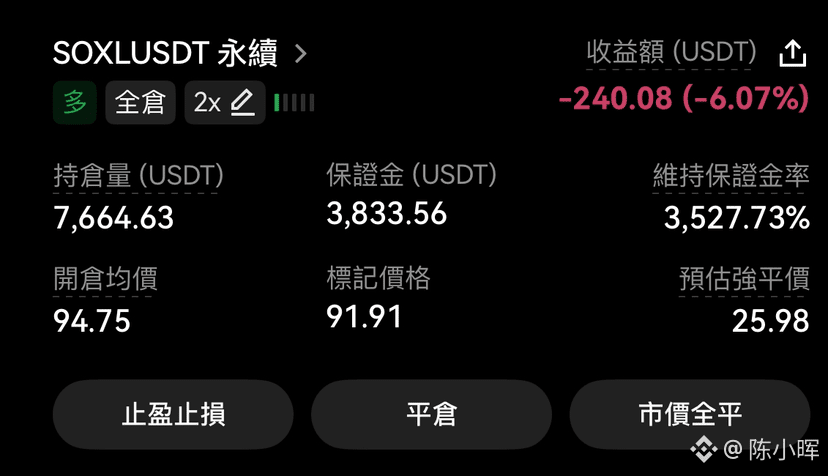
So far, the U.S. stock market has seen two rebound waves that fell short of expectations. Give it three chances, and if the third wave is still a weak rebound, then the strength of this rebound has to be questioned.
The market’s price action is right there in front of us. If it’s still this weak, it doesn’t really matter what explanation the market comes up with. Oil? AI falling short of expectations? Those are just explanations after the fact.
At least this proves one thing: for the major players, this level still isn’t a psychological price point.
Let’s wait for one last wave. If it’s time to get out, then get out—no looking back.
Might as well see tonight which stocks survive the sell-off and which get completely wiped out. We need to judge the flow of funds before placing our next trades.
#soxl
291
·
--
Oil prices have remained high, and with earnings season and the interest rate meeting at the end of the month, there are all these uncertainties. At this level, every rebound is followed by a pullback and weakness, and the market just can't stabilize. We still need to reduce our positions—we can't go all in recklessly.
Keep the position at around 50%, with the other 50% in cash. Set a 5-point stop loss on every trade. If you add to your position, exit when it hits the 5-point stop loss.
Until the situation becomes clearer, don't hold a full position overnight.
Wait for the direction to become clear first. Otherwise, the market will just keep swinging back and forth, leaving only opportunities for very short-term arbitrage.
The rebound is on a short-term timeframe; on the longer timeframe, the market is still in a downtrend.
At this level in the short term, there's not much point in being any more pessimistic—the bearish factors have reached an extreme. It's just a matter of when the rebound officially begins.
#股票财报季
273
·
--
Let me lay out the plan: after closing the 3x leveraged semiconductor long position on this rebound, I’ll start rotating into other positions.
For AI hardware companies that aren’t profitable and are doing contract manufacturing, I’ll wait for this rebound to lose steam before building short positions. $AAOI
As for the long position, $TEM , as long as it doesn’t break below the trend level, I’ll keep holding it.
Then I’ll add a few short positions in oil as a hedge and safety net. $CL
That’s the plan.
#StockEarningsSeason
1.2k
Log in to explore more content
Join global crypto users on Binance Square
⚡️ Get latest and useful information about crypto.
💬 Trusted by the world’s largest crypto exchange.
👍 Discover real insights from verified creators.
Email / Phone number
Trending Topics
BinanceProcesses$4.65BWithdrawals
38,337 views
149 Discussing
Binance Processes $4.65 Billion in Withdrawals After Reopening, Net Outflow of $3.64 Billion Equals 2.1% of Its $171 Billion in Assets
Binance News
·51 Likes
·15.9k views
WithdrawalsBack: 15 networks live
9,295 views
140 Discussing
BrazilVirtualAssetLicenseDeadlineDrawsAbout40Firms
537 views
50 Discussing