
KEVIN SPACEY BNB
16.4k Posts

KEVIN SPACEY BNB
 Square Verified+
Gentle with feelings. Dangerous with potential...
Open Trade
High-Frequency Trader
2 Years
543 Following
35.8K+ Followers
27.5K+ Liked
Posts
Portfolio
All
Quotes
Videos
Live
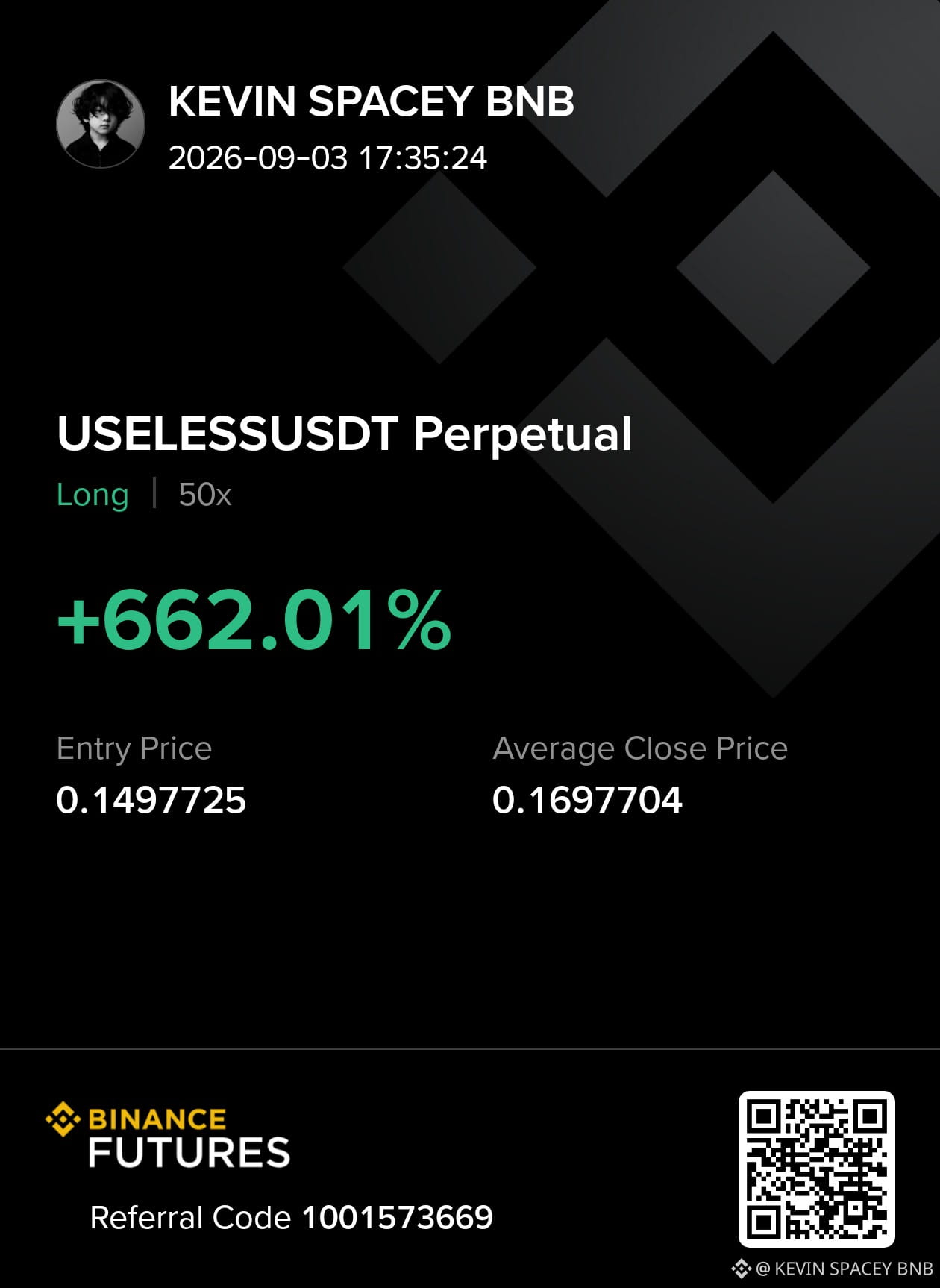
3 trades. 3 different setups. Real results.
I’m not here to make random calls or promise guaranteed profits. These are three trades I actually closed, with the entry and average close prices recorded on Binance Futures.
1️⃣ $USELESS — LONG 50x
Entry: 0.1497725
Close: 0.1697704
Result: +662.01%
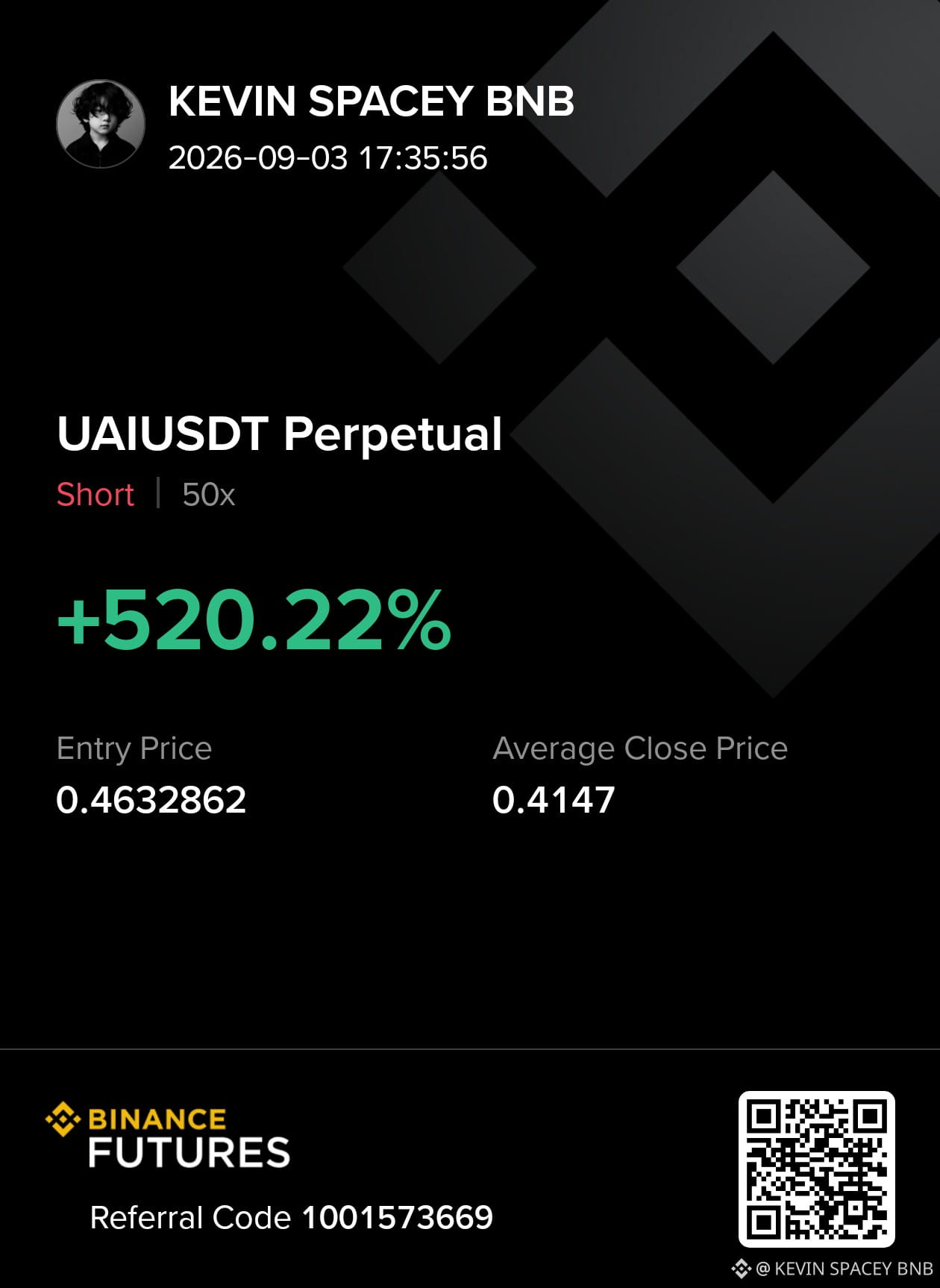
2️⃣ $UAI — SHORT 50x
Entry: 0.4632862
Close: 0.4147
Result: +520.22%
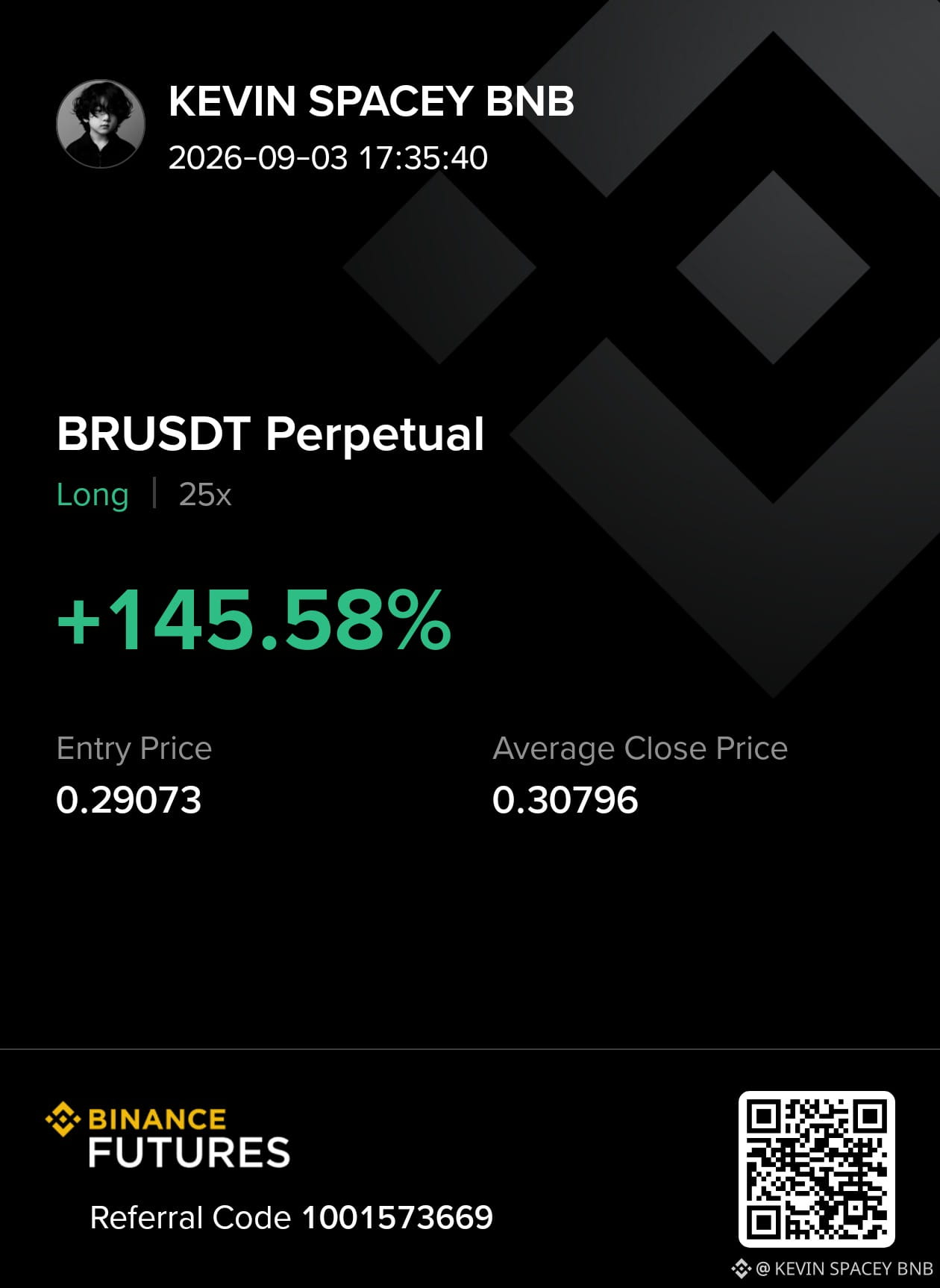
3️⃣ $BR — LONG 25x
Entry: 0.29073
Close: 0.30796
Result: +145.58%
What matters to me is not just the percentage shown on the screenshot it’s having a defined entry, knowing where the trade is invalidated, and managing the position instead of blindly chasing candles.
These results are past trades, not a guarantee of future performance. Always manage your own risk, especially when leverage is involved.
Trade Here 👇
I’m not here to make random calls or promise guaranteed profits. These are three trades I actually closed, with the entry and average close prices recorded on Binance Futures.
1️⃣ $USELESS — LONG 50x
Entry: 0.1497725
Close: 0.1697704
Result: +662.01%
2️⃣ $UAI — SHORT 50x
Entry: 0.4632862
Close: 0.4147
Result: +520.22%
3️⃣ $BR — LONG 25x
Entry: 0.29073
Close: 0.30796
Result: +145.58%
What matters to me is not just the percentage shown on the screenshot it’s having a defined entry, knowing where the trade is invalidated, and managing the position instead of blindly chasing candles.
These results are past trades, not a guarantee of future performance. Always manage your own risk, especially when leverage is involved.
Trade Here 👇
👀 The Futures Movers tab is getting interesting…
🥇 $CATI — 0.05459 | **+1.22%**
🥈 $NEIRO — 0.00008599 | **+0.62%**
🥉 $ICP — 2.517 | **+3.41%**
🔻 $PHA — 0.0243 | **-0.41%**
What caught my attention is $ICP sitting at the top in terms of percentage move, while CATI and NEIRO are also holding green.
And then there’s PHA, slightly in the red while the others are moving up. That contrast makes this list more interesting than just looking at the biggest gainers.
I’m not chasing any of these just because they’re green. A move is easy to notice the real question is whether the momentum can actually hold.
If you had to watch one of these four right now, which one would you pick? 👇
#SaudiSaysIranAttackedShipInHormuz #OpenAISaysAstraFindsFlawsAutonomously #HangSengCloses18PointsLower
🥇 $CATI — 0.05459 | **+1.22%**
🥈 $NEIRO — 0.00008599 | **+0.62%**
🥉 $ICP — 2.517 | **+3.41%**
🔻 $PHA — 0.0243 | **-0.41%**
What caught my attention is $ICP sitting at the top in terms of percentage move, while CATI and NEIRO are also holding green.
And then there’s PHA, slightly in the red while the others are moving up. That contrast makes this list more interesting than just looking at the biggest gainers.
I’m not chasing any of these just because they’re green. A move is easy to notice the real question is whether the momentum can actually hold.
If you had to watch one of these four right now, which one would you pick? 👇
#SaudiSaysIranAttackedShipInHormuz #OpenAISaysAstraFindsFlawsAutonomously #HangSengCloses18PointsLower
$CATI — 0.05459
33%
$NEIRO — 0.00008599
0%
$ICP — 2.517
67%
$PHA — 0.0243
0%
3 votes • Voting closed
i was mapping @Dusk 's block reward structure last night and found an economic trap i hadnt seen documented anywhere clearly.
the surface level split looks simple. 80% to the block generator, 10% to the voting committee, 10% to Dusk. straightforward enough.
but the 80% isnt guaranteed.
the generator's reward is split into two portions. 70% is fixed they get that regardless. the remaining 10% is variable and depends entirely on how many votes they include in the block certificate. include all known votes, earn the full 80%. deliberately exclude votes, your own reward shrinks.
i kept thinking about why this specific design exists.
on Dusk, block generators for all iterations within a round are predictable before the round ends. a generator scheduled for iteration 5 knows they're coming. the temptation is obvious let earlier iterations fail, win the block reward yourself. higher iteration generators have an incentive to sabotage earlier ones.
the variable reward flips that incentive. if you exclude votes to slow down earlier iterations, you're directly reducing your own payout. the protocol makes sabotage economically self-defeating.
then theres the penalty layer. minor faults trigger suspension excluded from selection for defined epochs. major faults like double voting trigger hard slashing a portion of stake gets burned permanently. not locked. burned.
$DUSK is the asset at stake in every one of these economic decisions.
is Dusk's incentive design sophisticated enough to prevent validator misbehavior at scale, or does the predictability of future generators create attack vectors the reward structure cant fully close??
@Dusk $DUSK #dusk
$CATI
What stops validators from misbehaving?
the surface level split looks simple. 80% to the block generator, 10% to the voting committee, 10% to Dusk. straightforward enough.
but the 80% isnt guaranteed.
the generator's reward is split into two portions. 70% is fixed they get that regardless. the remaining 10% is variable and depends entirely on how many votes they include in the block certificate. include all known votes, earn the full 80%. deliberately exclude votes, your own reward shrinks.
i kept thinking about why this specific design exists.
on Dusk, block generators for all iterations within a round are predictable before the round ends. a generator scheduled for iteration 5 knows they're coming. the temptation is obvious let earlier iterations fail, win the block reward yourself. higher iteration generators have an incentive to sabotage earlier ones.
the variable reward flips that incentive. if you exclude votes to slow down earlier iterations, you're directly reducing your own payout. the protocol makes sabotage economically self-defeating.
then theres the penalty layer. minor faults trigger suspension excluded from selection for defined epochs. major faults like double voting trigger hard slashing a portion of stake gets burned permanently. not locked. burned.
$DUSK is the asset at stake in every one of these economic decisions.
is Dusk's incentive design sophisticated enough to prevent validator misbehavior at scale, or does the predictability of future generators create attack vectors the reward structure cant fully close??
@Dusk $DUSK #dusk
$CATI
What stops validators from misbehaving?
💰 Economic rewards done right
67%
🔥 Stake slashing penalties
0%
👥 Committee oversight
0%
🔄 All three together
33%
6 votes • Voting closed
i saw "Chainlink partnership" and almost scrolled past it.
i'm glad i didnt.
most people hear oracle partnership and think price feed. one data point. one connection. done. the actual integration Dusk built is three separate infrastructure layers and each one solves a problem that regulated financial markets cant ignore.
first layer is cross-chain connectivity. regulated securities dont live on one chain forever. institutions need assets to move between networks without breaking compliance or settlement guarantees. CCIP handles that verified cross-chain messaging that maintains the integrity of the transaction as it moves.
second layer is verified data. DataLink brings institutional-grade data onto Dusk with cryptographic verification attached. for a regulated securities platform the data feeding into smart contracts cant be unverified. a stale price or corrupted input into a settlement contract doesnt just cause a bad trade it potentially triggers a compliance breach.
third layer stopped me completely. Data Streams delivers real-time market data at the speed financial applications actually need. deterministic settlement on Dusk means nothing if the market data driving the settlement decision is seconds behind.
i kept thinking about what breaks first if any one of these three layers fails. cross-chain connectivity fails assets get stranded. verified data fails contracts execute on corrupted inputs. real-time streams fail settlement happens on stale prices.
Dusk's financial infrastructure isnt just the blockchain layer. its everything feeding into it.
$DUSK settles every transaction that these three data layers make possible.
is Chainlink's three-layer integration what finally makes Dusk's regulated finance vision operationally complete, or does depending on external data infrastructure introduce a reliability risk the protocol itself cant control??
@Dusk $DUSK #dusk $TUT
Which data layer matters most for regulated onchain finance?
i'm glad i didnt.
most people hear oracle partnership and think price feed. one data point. one connection. done. the actual integration Dusk built is three separate infrastructure layers and each one solves a problem that regulated financial markets cant ignore.
first layer is cross-chain connectivity. regulated securities dont live on one chain forever. institutions need assets to move between networks without breaking compliance or settlement guarantees. CCIP handles that verified cross-chain messaging that maintains the integrity of the transaction as it moves.
second layer is verified data. DataLink brings institutional-grade data onto Dusk with cryptographic verification attached. for a regulated securities platform the data feeding into smart contracts cant be unverified. a stale price or corrupted input into a settlement contract doesnt just cause a bad trade it potentially triggers a compliance breach.
third layer stopped me completely. Data Streams delivers real-time market data at the speed financial applications actually need. deterministic settlement on Dusk means nothing if the market data driving the settlement decision is seconds behind.
i kept thinking about what breaks first if any one of these three layers fails. cross-chain connectivity fails assets get stranded. verified data fails contracts execute on corrupted inputs. real-time streams fail settlement happens on stale prices.
Dusk's financial infrastructure isnt just the blockchain layer. its everything feeding into it.
$DUSK settles every transaction that these three data layers make possible.
is Chainlink's three-layer integration what finally makes Dusk's regulated finance vision operationally complete, or does depending on external data infrastructure introduce a reliability risk the protocol itself cant control??
@Dusk $DUSK #dusk $TUT
Which data layer matters most for regulated onchain finance?
🌉 Cross-chain connectivity
100%
✅ Verified institutional data
0%
⚡ Real-time market streams
0%
🔄 All three or nothing
0%
1 votes • Voting closed
#TermMax
DeFi has kind of trained us to believe flexibility is always better.
Deposit whenever. Borrow whenever. Repay whenever.
Sounds ideal.
But I was looking at @TermMax and started wondering if all that flexibility comes with a cost we're just used to ignoring.
With floating-rate borrowing, you keep the freedom to move. The trade-off is that your financing cost keeps moving too.
You don't know what the rate will look like next week. Or next month.
Fixed-term borrowing flips that trade.
You give up some flexibility, but in return you know the terms upfront. The uncertainty doesn't disappear, it just changes shape.
That made me think the real choice isn't between a flexible product and a restrictive one.
It's between different types of uncertainty.
One lets you exit more freely but leaves your borrowing cost exposed to the market. The other gives you predictable financing but asks you to commit to time.
Maybe the hidden cost of flexibility is uncertainty.
And maybe the real value of fixed-term markets like @TermMax is simply knowing which uncertainty you're choosing.
$ACT still has my attention today.#USRefinersFaceLoomingCrudeSupplyDrop
$GALA
$BOME
What matters more when borrowing?
DeFi has kind of trained us to believe flexibility is always better.
Deposit whenever. Borrow whenever. Repay whenever.
Sounds ideal.
But I was looking at @TermMax and started wondering if all that flexibility comes with a cost we're just used to ignoring.
With floating-rate borrowing, you keep the freedom to move. The trade-off is that your financing cost keeps moving too.
You don't know what the rate will look like next week. Or next month.
Fixed-term borrowing flips that trade.
You give up some flexibility, but in return you know the terms upfront. The uncertainty doesn't disappear, it just changes shape.
That made me think the real choice isn't between a flexible product and a restrictive one.
It's between different types of uncertainty.
One lets you exit more freely but leaves your borrowing cost exposed to the market. The other gives you predictable financing but asks you to commit to time.
Maybe the hidden cost of flexibility is uncertainty.
And maybe the real value of fixed-term markets like @TermMax is simply knowing which uncertainty you're choosing.
$ACT still has my attention today.#USRefinersFaceLoomingCrudeSupplyDrop
$GALA
$BOME
What matters more when borrowing?
Flexibility
75%
Fixed Rates
0%
Predictability
0%
Liquidity
25%
4 votes • Voting closed
Verified
i was going through @Dusk 's environmental design documentation yesterday and realized the energy efficiency argument is actually three separate arguments stacked on top of each other.
most people stop at layer one.
layer one is consensus. Dusk runs proof of stake no energy-intensive puzzles, no mining hardware, no computational race. when Ethereum made this switch it cut energy consumption by more than 99.95%. Dusk was built PoS from day one so this overhead never existed in the first place.
but i kept reading and found layer two.
Kadcast @Dusk 's communication layer reduces bandwidth usage by roughly 25 to 50 percent compared to standard gossip protocols. every message travels through mathematically selected paths only. no redundant copies flooding the network. lower bandwidth means lower energy at every single node running the network simultaneously.
then layer three stopped me completely.
Dusk's virtual machine offloads heavy cryptographic operations ZK proof verification, signature validation, hashing to native host functions instead of running them inside WASM. research shows WASM runs 45 to 255 percent slower than native code for complex operations. slower execution means more energy per computation. Dusk avoids that overhead entirely by design.
i kept thinking about why three layers matters more than one. a chain that fixes consensus but runs inefficient networking and slow cryptography still wastes significant resources at scale. Dusk engineered the inefficiency out at every level simultaneously.
$DUSK is the asset moving through infrastructure that was built to be lean from the ground up.
is three-layer efficiency optimization enough to make Dusk genuinely sustainable at institutional transaction volumes, or does real financial market throughput expose energy costs that controlled design cant fully anticipate??
@Dusk #dusk
$TRUMP
$MVLLB
Where does blockchain energy waste hurt most?
most people stop at layer one.
layer one is consensus. Dusk runs proof of stake no energy-intensive puzzles, no mining hardware, no computational race. when Ethereum made this switch it cut energy consumption by more than 99.95%. Dusk was built PoS from day one so this overhead never existed in the first place.
but i kept reading and found layer two.
Kadcast @Dusk 's communication layer reduces bandwidth usage by roughly 25 to 50 percent compared to standard gossip protocols. every message travels through mathematically selected paths only. no redundant copies flooding the network. lower bandwidth means lower energy at every single node running the network simultaneously.
then layer three stopped me completely.
Dusk's virtual machine offloads heavy cryptographic operations ZK proof verification, signature validation, hashing to native host functions instead of running them inside WASM. research shows WASM runs 45 to 255 percent slower than native code for complex operations. slower execution means more energy per computation. Dusk avoids that overhead entirely by design.
i kept thinking about why three layers matters more than one. a chain that fixes consensus but runs inefficient networking and slow cryptography still wastes significant resources at scale. Dusk engineered the inefficiency out at every level simultaneously.
$DUSK is the asset moving through infrastructure that was built to be lean from the ground up.
is three-layer efficiency optimization enough to make Dusk genuinely sustainable at institutional transaction volumes, or does real financial market throughput expose energy costs that controlled design cant fully anticipate??
@Dusk #dusk
$TRUMP
$MVLLB
Where does blockchain energy waste hurt most?
⛏️ Consensus mechanism
100%
📡 Network communication
0%
🔐 Cryptographic operations
0%
📊 All three equally
0%
4 votes • Voting closed
#TermMax
I think we usually look at debt the wrong way.
Once you borrow, we treat that position like something that simply sits there until repayment.
But what if the terms of that debt become more valuable than the debt itself?
hmmm...That thought sent me deeper into @TermMax .
A fixed-rate position doesn't change its original terms just because the market moves. If new borrowing becomes more expensive, an older position with a better rate can suddenly look attractive to someone else.
That's an interesting shift.
The borrower isn't only holding debt anymore. They're holding a set of financing terms that can gain or lose relative value as the market changes.
Which makes me wonder:
Could fixed-rate lending eventually create a secondary market where the most valuable thing isn't the collateral, but the terms attached to the debt?
That's a much more interesting question to me than simply asking how much TVL @TermMax has.
$METAB
, $MOVR
and $HEMI
are still on my screen today.
#WalmartFalls7%
What makes fixed-rate debt valuable?
I think we usually look at debt the wrong way.
Once you borrow, we treat that position like something that simply sits there until repayment.
But what if the terms of that debt become more valuable than the debt itself?
hmmm...That thought sent me deeper into @TermMax .
A fixed-rate position doesn't change its original terms just because the market moves. If new borrowing becomes more expensive, an older position with a better rate can suddenly look attractive to someone else.
That's an interesting shift.
The borrower isn't only holding debt anymore. They're holding a set of financing terms that can gain or lose relative value as the market changes.
Which makes me wonder:
Could fixed-rate lending eventually create a secondary market where the most valuable thing isn't the collateral, but the terms attached to the debt?
That's a much more interesting question to me than simply asking how much TVL @TermMax has.
$METAB
, $MOVR
and $HEMI
are still on my screen today.
#WalmartFalls7%
What makes fixed-rate debt valuable?
Better Rates
43%
Liquidity
43%
Flexibility
14%
Duration
0%
7 votes • Voting closed
i was going through @Dusk 's contract architecture two days ago and stopped on something that reframes how KYC actually needs to work.
MosT compliance systems solve the eligibility problem by collecting everything. full identity, documents, ADdresses, financial history all stored, all visible to whoever runs the system.
@Dusk has a different model built into its core. its called Citadel.
heres how it actually works. a trusted provider checks a user offchain verifies whatever attributes matter, accreditation status, jurisdiction, eligibility. then instead of storing that data onchain, they issue a cryptographic license. the user later generates a zero knowledge proof showing they hold a valid license from a trusted provider without revealing their wallet, their identity, or which specific license produced the proof.
the contract verifies the proof. records a session. access granted.
i kept thinking about what that removes from the equation. a regulated service gets cryptographic evidence that an eligibility check happened without placing a single piece of personal data onchain. the compliance requirement is satisfied. the identity stays private.
the part that genuinely surprised me was where trust actually sits in this model. Dusk doesnt decide who is eligible. the service provider chooses which license providers it trusts and which attributes satisfy its rules. the protocol just verifies the proof.
$DUSK runs underneath every interaction this system governs.
"compliance without identity exposure isnt a privacy feature. its a completely different architecture."
does Citadel's license-based model make onchain compliance genuinely private, or does the trust placed in license providers simply move the identity risk offchain instead of removing it??
@Dusk #dusk #USJoblessClaimsFallTo206000
$ACE
$HEMI
Where should identity risk live in regulated finance?
MosT compliance systems solve the eligibility problem by collecting everything. full identity, documents, ADdresses, financial history all stored, all visible to whoever runs the system.
@Dusk has a different model built into its core. its called Citadel.
heres how it actually works. a trusted provider checks a user offchain verifies whatever attributes matter, accreditation status, jurisdiction, eligibility. then instead of storing that data onchain, they issue a cryptographic license. the user later generates a zero knowledge proof showing they hold a valid license from a trusted provider without revealing their wallet, their identity, or which specific license produced the proof.
the contract verifies the proof. records a session. access granted.
i kept thinking about what that removes from the equation. a regulated service gets cryptographic evidence that an eligibility check happened without placing a single piece of personal data onchain. the compliance requirement is satisfied. the identity stays private.
the part that genuinely surprised me was where trust actually sits in this model. Dusk doesnt decide who is eligible. the service provider chooses which license providers it trusts and which attributes satisfy its rules. the protocol just verifies the proof.
$DUSK runs underneath every interaction this system governs.
"compliance without identity exposure isnt a privacy feature. its a completely different architecture."
does Citadel's license-based model make onchain compliance genuinely private, or does the trust placed in license providers simply move the identity risk offchain instead of removing it??
@Dusk #dusk #USJoblessClaimsFallTo206000
$ACE
$HEMI
Where should identity risk live in regulated finance?
🔐 Onchain proof only
34%
🏛️ Trusted provider offchain
33%
🔄 Split between both
33%
❌ Nowhere — full anonymity
0%
3 votes • Voting closed
$BTC UPDATE 🚨
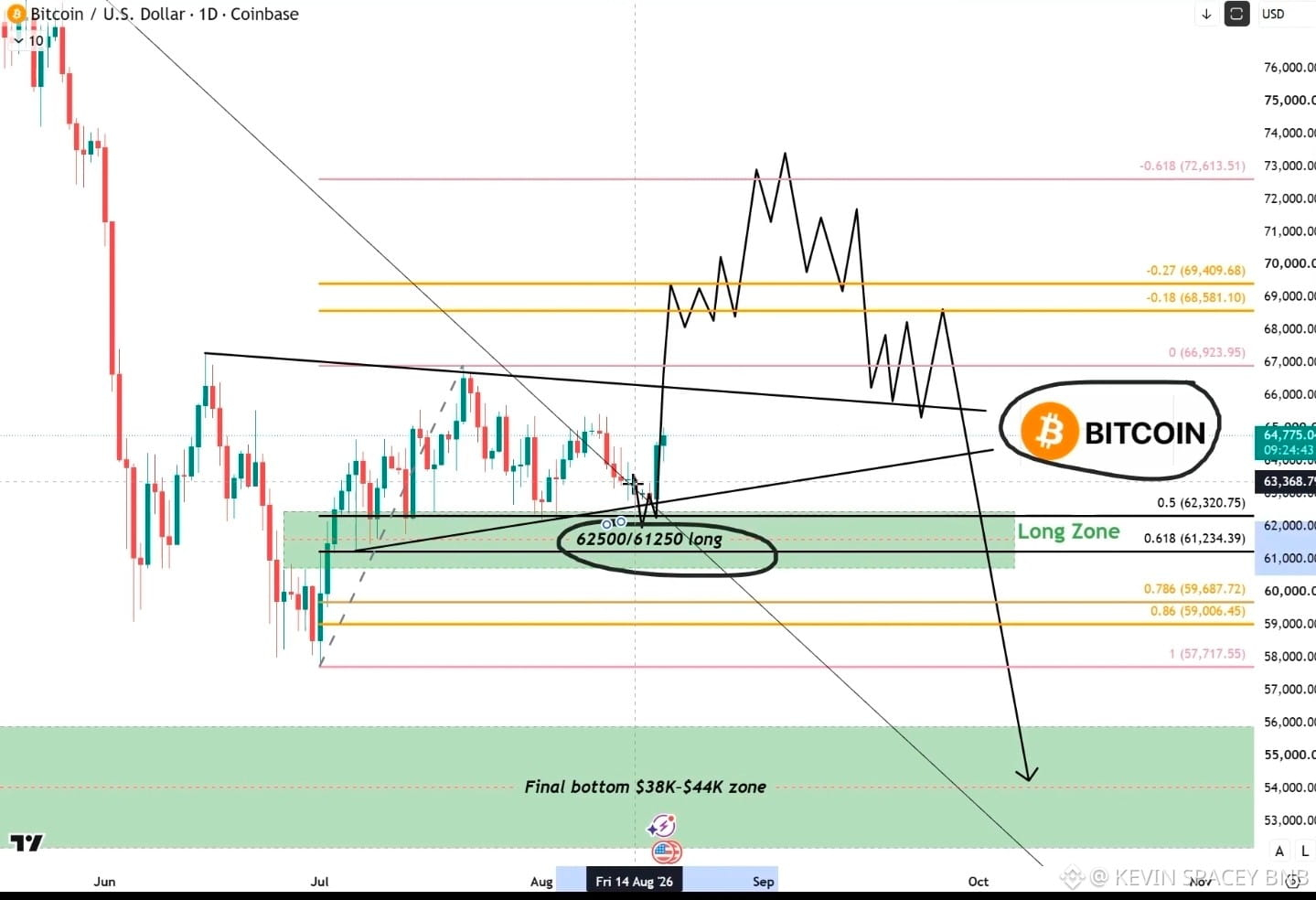
My BTC long is closed around $69K. All planned zones and targets have been hit: $64.7K → $62.5K/$61.2K → $68.5K/$69.4K → $72K → $76K.
BTC reached these targets within just two days, showing strong market momentum. The altcoin rally has already started, and my ETH long remains open.
I haven’t opened a BTC short yet—I’ll wait for clear bearish structure instead of catching a falling knife.
I still expect a major drop around August/September.
A bigger call may be coming. DYOR & stay tuned.
$BTC
#btc70k #CFTCSeeksInputOnComputeDerivatives
My BTC long is closed around $69K. All planned zones and targets have been hit: $64.7K → $62.5K/$61.2K → $68.5K/$69.4K → $72K → $76K.
BTC reached these targets within just two days, showing strong market momentum. The altcoin rally has already started, and my ETH long remains open.
I haven’t opened a BTC short yet—I’ll wait for clear bearish structure instead of catching a falling knife.
I still expect a major drop around August/September.
A bigger call may be coming. DYOR & stay tuned.
$BTC
#btc70k #CFTCSeeksInputOnComputeDerivatives
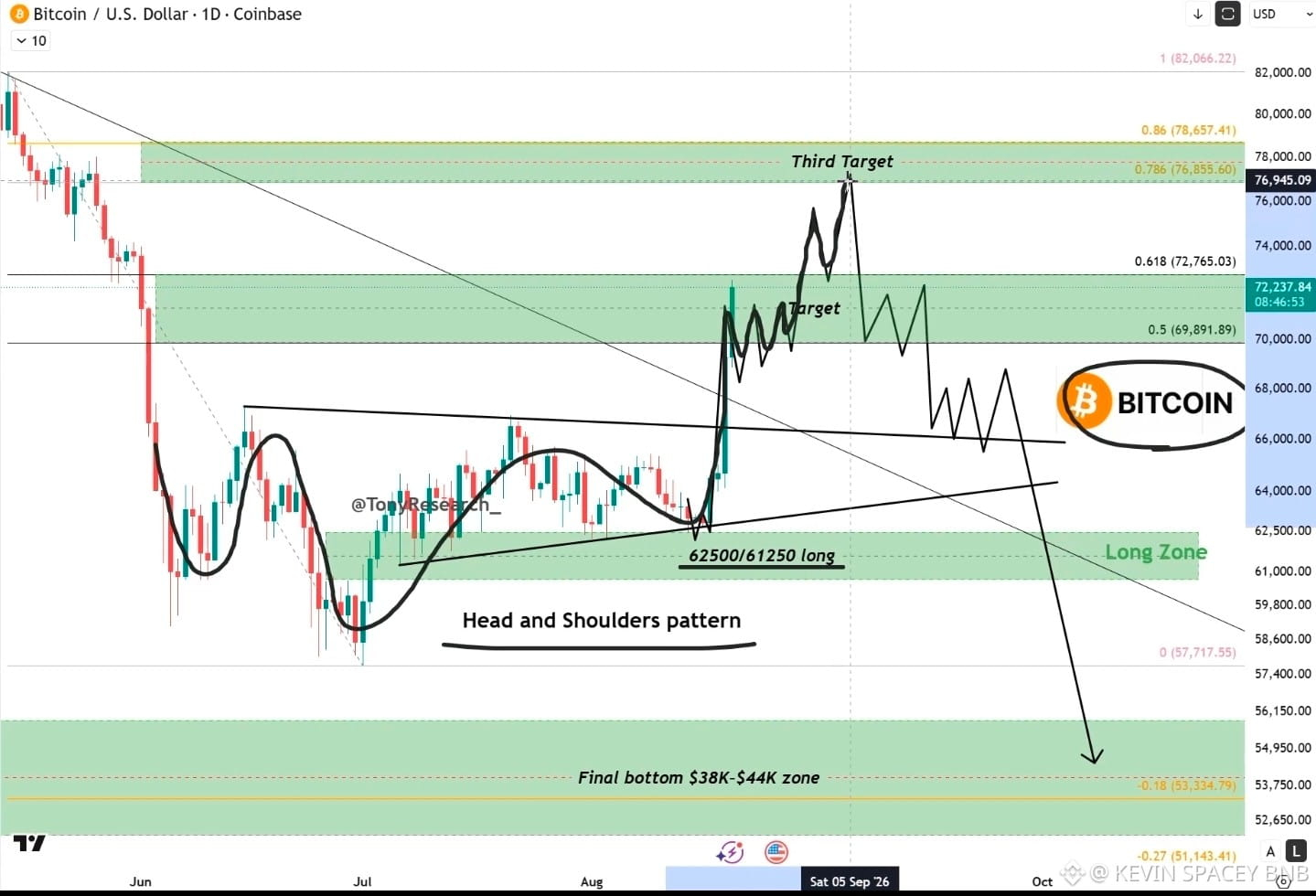
**DON'T SHORT $BTC RIGHT NOW**
First, $BTC will close the FVG at 70,000$.
Then we'll see the final drop.
Here's my plan:
1. First long position zone – 64,700$ (COMPLETED)
2. Second long position zone – 62,500$/61,200$ (COMPLETED)
3. There's a Head and Shoulders formation on the 1D chart (Loading)
4. First target - 68,500$/69,400$
5. Second target - 72,000$
6. After that, I'm expecting the final drop to start in August/September.
Also, just a reminder: When #BTC reaches the 68,000$-70,000$ zone, we'll see about a 40-100% jump in altcoins.
I'm expecting the final drop to start in August/September. Be cautious with long positions.
As I mentioned in my previous post, ETH is showing strength.
After this, there will be a drop, because this is also a bull trap.
Many people think the bottom has already been reached.
I think the final part hasn't started yet.
REMINDER: I had already warned about this even before BTC's bull trap at 82,000 dollars, the summer drop, and Space X's drop occurred.
MY NEXT PREDICTION WILL BE THE BIGGEST PREDICTION OF THIS CYCLE.
TURN ON NOTIFICATIONS. MOST PEOPLE WILL FOLLOW ME TOO LATE.
$BTC
#BTC
First, $BTC will close the FVG at 70,000$.
Then we'll see the final drop.
Here's my plan:
1. First long position zone – 64,700$ (COMPLETED)
2. Second long position zone – 62,500$/61,200$ (COMPLETED)
3. There's a Head and Shoulders formation on the 1D chart (Loading)
4. First target - 68,500$/69,400$
5. Second target - 72,000$
6. After that, I'm expecting the final drop to start in August/September.
Also, just a reminder: When #BTC reaches the 68,000$-70,000$ zone, we'll see about a 40-100% jump in altcoins.
I'm expecting the final drop to start in August/September. Be cautious with long positions.
As I mentioned in my previous post, ETH is showing strength.
After this, there will be a drop, because this is also a bull trap.
Many people think the bottom has already been reached.
I think the final part hasn't started yet.
REMINDER: I had already warned about this even before BTC's bull trap at 82,000 dollars, the summer drop, and Space X's drop occurred.
MY NEXT PREDICTION WILL BE THE BIGGEST PREDICTION OF THIS CYCLE.
TURN ON NOTIFICATIONS. MOST PEOPLE WILL FOLLOW ME TOO LATE.
$BTC
#BTC
🚨 BITCOIN PUMPED TO $70,000 FOR A REASON.
$BTC
This is the FINAL bull trap before new lows.
The plan is simple:
$69K → $72K → $57K → $48K
Don't chase the pump.
Reminder: I called the $16K Bitcoin bottom and the $126K top.
My next call will be the biggest one of this cycle.
Turn on notifications. Most people will follow me too late.
$BTC
#CryptoRally #FOMCWatch #FedMinutesShowNoSupportForRateCuts
$BTC
This is the FINAL bull trap before new lows.
The plan is simple:
$69K → $72K → $57K → $48K
Don't chase the pump.
Reminder: I called the $16K Bitcoin bottom and the $126K top.
My next call will be the biggest one of this cycle.
Turn on notifications. Most people will follow me too late.
$BTC
#CryptoRally #FOMCWatch #FedMinutesShowNoSupportForRateCuts
#TermMax
I keep coming back to one question when looking at @TermMax : what happens when the market starts caring more about maturity than just liquidity?
A lot of DeFi lending is built around flexibility. Deposit, borrow, repay whenever. But fixed-term markets create a different environment. You know the duration, the rate structure, and more of the conditions upfront.
That might not sound as exciting as chasing the biggest TVL number, but I think predictability has its own value.
Especially when larger capital starts looking for something beyond perpetual floating-rate exposure.
Maybe the real opportunity for TermMax isn't simply becoming another large lending protocol.
Maybe it's building a deeper market around time itself.
That's the angle I'm watching.
Meanwhile, $POL and $ACM are still on my radar, but $HEMI has my attention again.
Which matters most for TermMax as it scales?
I keep coming back to one question when looking at @TermMax : what happens when the market starts caring more about maturity than just liquidity?
A lot of DeFi lending is built around flexibility. Deposit, borrow, repay whenever. But fixed-term markets create a different environment. You know the duration, the rate structure, and more of the conditions upfront.
That might not sound as exciting as chasing the biggest TVL number, but I think predictability has its own value.
Especially when larger capital starts looking for something beyond perpetual floating-rate exposure.
Maybe the real opportunity for TermMax isn't simply becoming another large lending protocol.
Maybe it's building a deeper market around time itself.
That's the angle I'm watching.
Meanwhile, $POL and $ACM are still on my radar, but $HEMI has my attention again.
Which matters most for TermMax as it scales?
Maturity
43%
Revenue
29%
Utilization
14%
TVL
14%
7 votes • Voting closed
i spent yesterday reading through @Dusk 's finality mechanism and realized i had been using the word "final" wrong the entire time.
on most chains final means the block is done. confirmed. settled. move on.
on Dusk, final is a specific technical state that a block has to earn and the conditions are stricter than i expected.
here's what actually happens. every new block on Dusk enters one of four states. accepted means it has consensus but a lower-iteration block could still replace it. attested means all previous iterations failed so nothing can replace it at that level. confirmed means the block is unlikely to be replaced but still depends on what happens to its ancestors. final means the block is confirmed AND every single block before it is also final.
that last condition stopped me.
a block cant be final if its parent isnt final. which means true finality on Dusk doesnt just depend on one block it cascades backwards through the entire chain until every ancestor is settled.
i kept thinking about what this means for an institution settling a regulated securities transaction. they dont just need their block to be final. they need the entire chain of blocks leading to it to be final first.
that sounds complex. but it also means when Dusk says final it actually means nothing anywhere in the chain can unwind it.
$`DUSK powers every block that has to earn its way through these four states before settlement is real.
is Dusk's four-state finality model genuinely stronger than single-confirmation finality, or does the ancestor dependency quietly make true finality harder to reach than it looks??
@Dusk $DUSK #dusk #FOMCWatch
$RED
$ACE
POLL:
What matters more for institutional settlement?
on most chains final means the block is done. confirmed. settled. move on.
on Dusk, final is a specific technical state that a block has to earn and the conditions are stricter than i expected.
here's what actually happens. every new block on Dusk enters one of four states. accepted means it has consensus but a lower-iteration block could still replace it. attested means all previous iterations failed so nothing can replace it at that level. confirmed means the block is unlikely to be replaced but still depends on what happens to its ancestors. final means the block is confirmed AND every single block before it is also final.
that last condition stopped me.
a block cant be final if its parent isnt final. which means true finality on Dusk doesnt just depend on one block it cascades backwards through the entire chain until every ancestor is settled.
i kept thinking about what this means for an institution settling a regulated securities transaction. they dont just need their block to be final. they need the entire chain of blocks leading to it to be final first.
that sounds complex. but it also means when Dusk says final it actually means nothing anywhere in the chain can unwind it.
$`DUSK powers every block that has to earn its way through these four states before settlement is real.
is Dusk's four-state finality model genuinely stronger than single-confirmation finality, or does the ancestor dependency quietly make true finality harder to reach than it looks??
@Dusk $DUSK #dusk #FOMCWatch
$RED
$ACE
POLL:
What matters more for institutional settlement?
⚡ Fast finality
60%
🔒 Strict finality
40%
🔄 Both together
0%
📋 Regulator decides
0%
5 votes • Voting closed
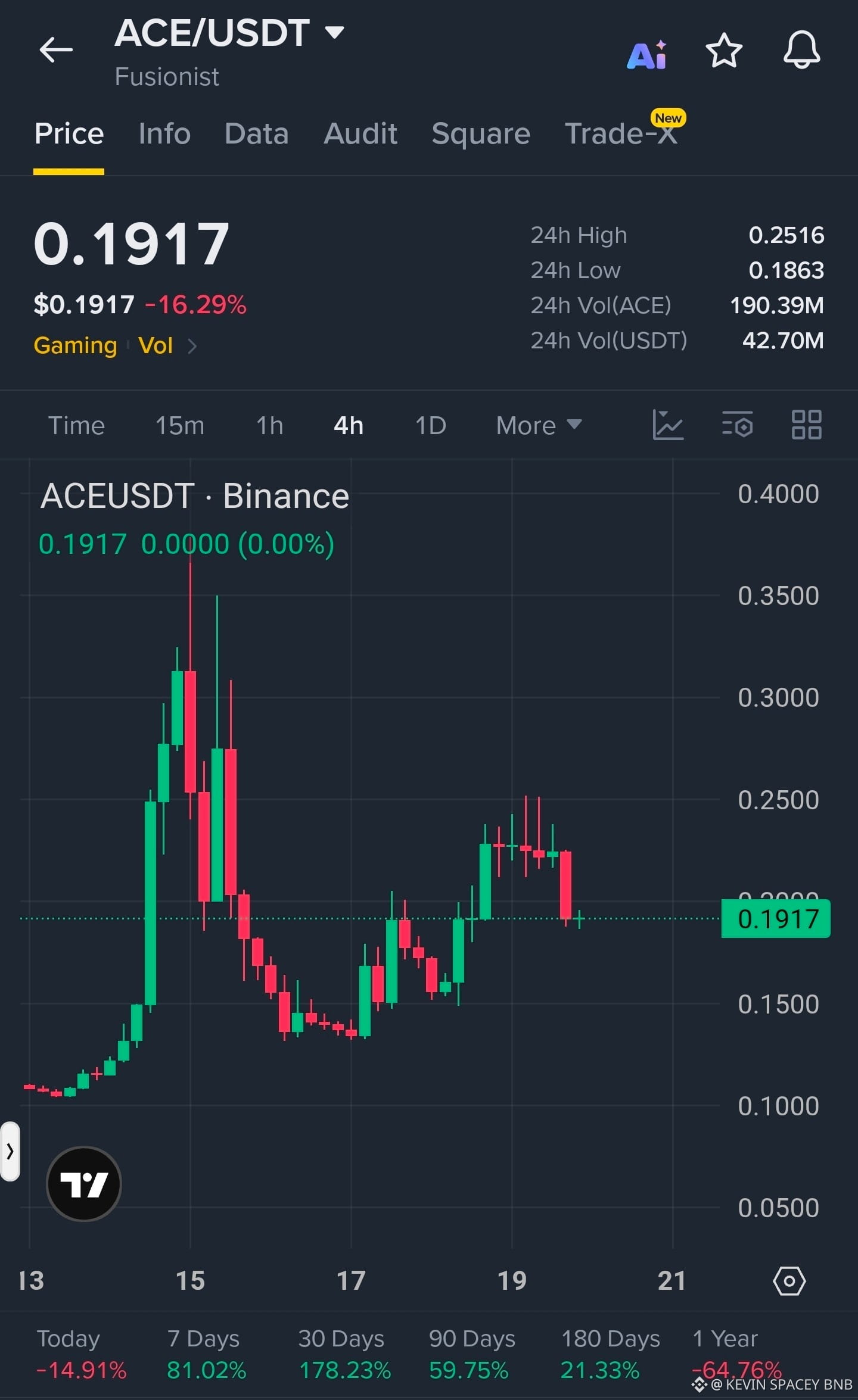
$ACE is sitting on a key 4H support after sellers erased the recent push, and I think another breakdown could open the door lower.
Trade Setup: SHORT
Entry Zone: $0.193 – $0.200
SL: $0.207
TP1: $0.185
TP2: $0.175
TP3: $0.162
I’m seeing repeated hesitation around $0.22–$0.23 followed by a large red candle back toward $0.19. If this area fails to hold and the rebound stays weak, I’d expect price to revisit the lower support zones.
Trade Here On $ACE 👇
#CryptoRally
Trade Setup: SHORT
Entry Zone: $0.193 – $0.200
SL: $0.207
TP1: $0.185
TP2: $0.175
TP3: $0.162
I’m seeing repeated hesitation around $0.22–$0.23 followed by a large red candle back toward $0.19. If this area fails to hold and the rebound stays weak, I’d expect price to revisit the lower support zones.
Trade Here On $ACE 👇
#CryptoRally
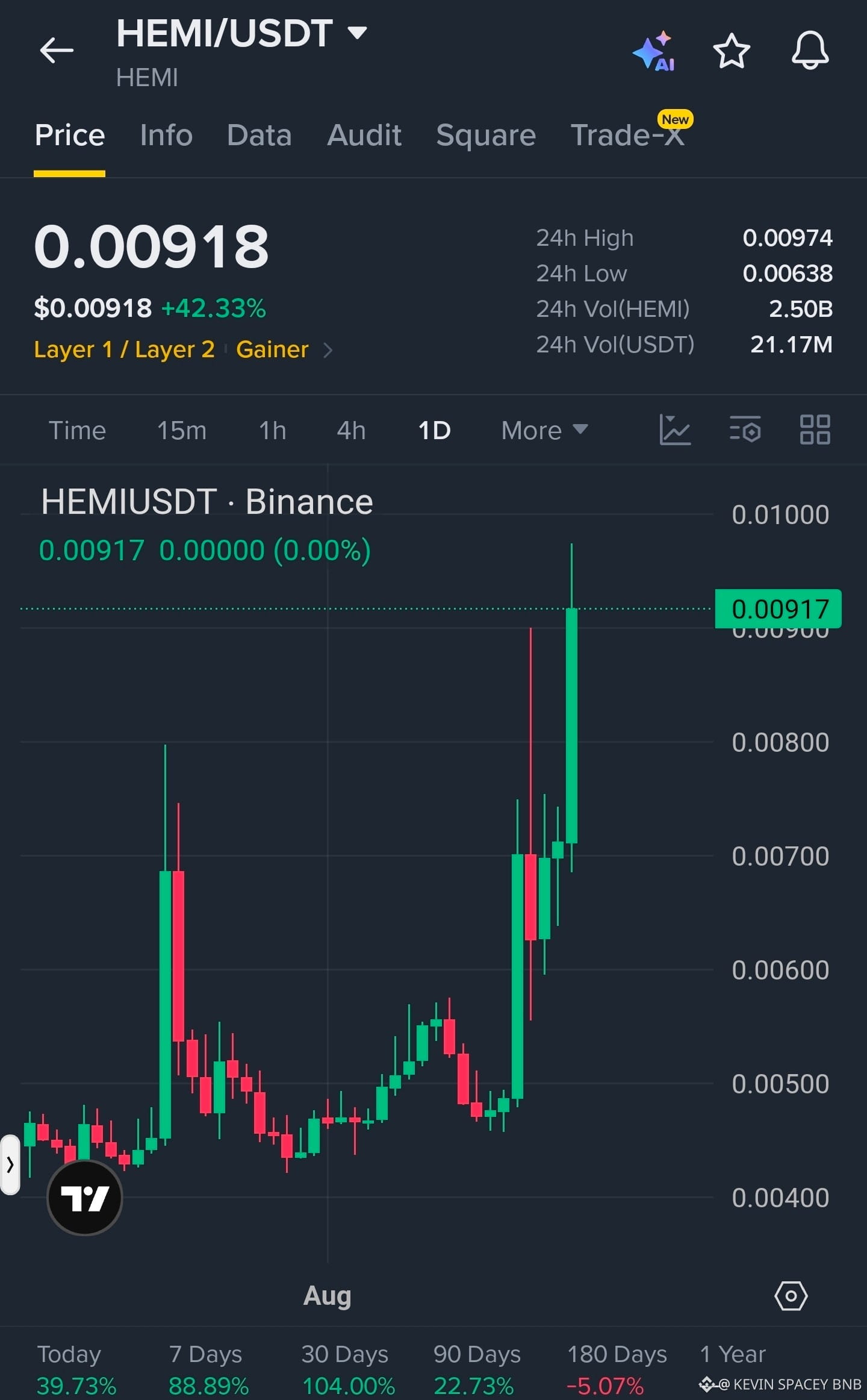
$HEMI has cleared its recent range with a huge daily candle, but after this vertical move I’d rather wait for a retest than chase the top.
Trade Setup: LONG
Entry Zone: $0.00840 – $0.00880
SL: $0.00785
TP1: $0.00970
TP2: $0.01050
TP3: $0.01130
I’m seeing buyers push straight through the previous $0.0070 area after several candles held above $0.0060. The current candle is stretched near $0.0092, so a pullback that holds above the breakout area would give me a cleaner long setup.
Trade Here On $HEMI 👇
#USStorageStocksExtendLosses
Trade Setup: LONG
Entry Zone: $0.00840 – $0.00880
SL: $0.00785
TP1: $0.00970
TP2: $0.01050
TP3: $0.01130
I’m seeing buyers push straight through the previous $0.0070 area after several candles held above $0.0060. The current candle is stretched near $0.0092, so a pullback that holds above the breakout area would give me a cleaner long setup.
Trade Here On $HEMI 👇
#USStorageStocksExtendLosses
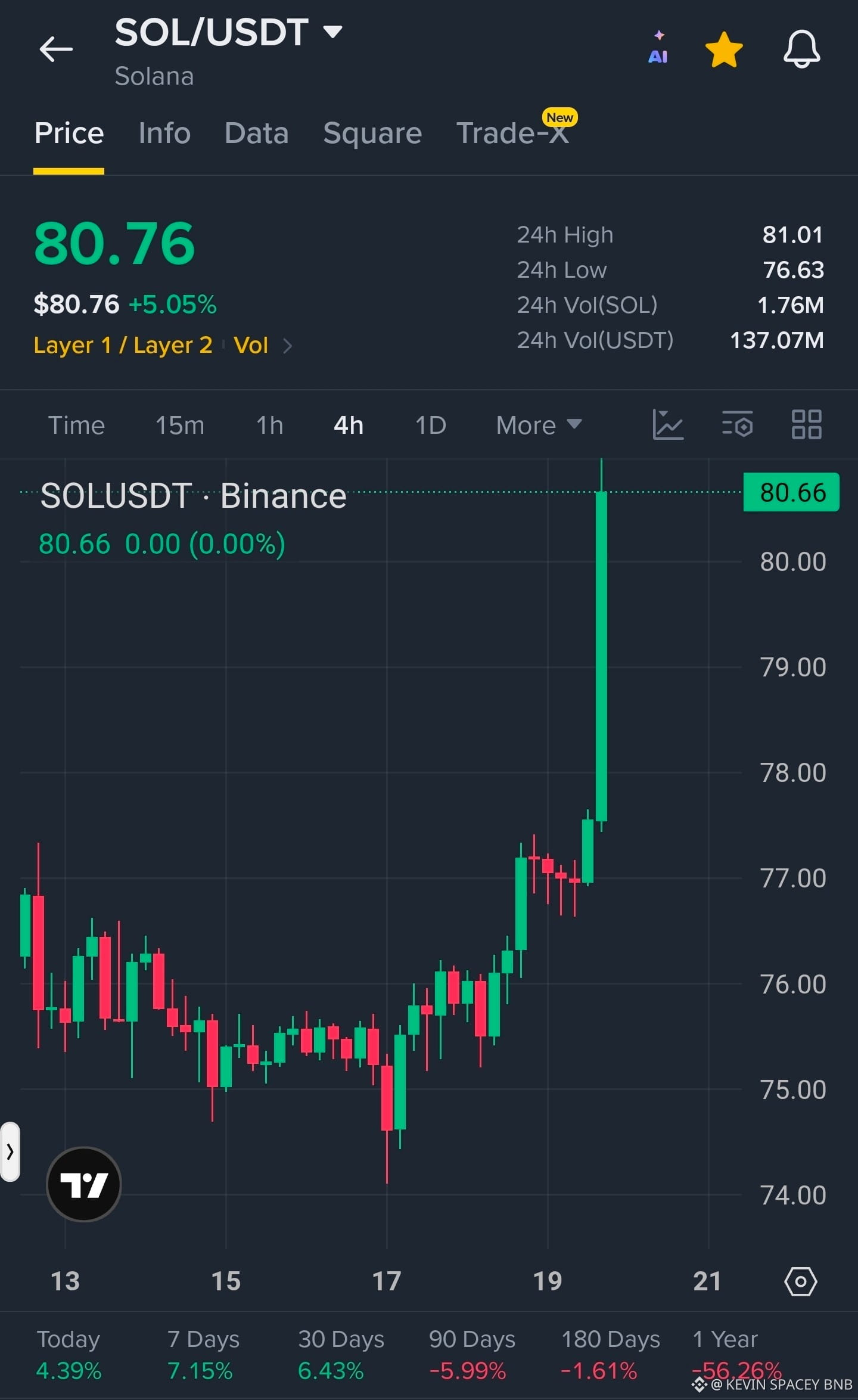
$SOL is pushing into fresh resistance after a sharp 4H expansion, and I’m watching for buyers to defend the breakout.
Trade Setup: LONG
Entry Zone: $79.90 – $80.40
SL: $79.20
TP1: $81.00
TP2: $81.80
TP3: $82.70
I see a clear shift from the $75 area into higher lows, followed by a fast move through the recent $77 resistance. The latest candle shows aggressive buying, so I’d prefer an entry on a controlled pullback rather than chasing near the 24H high.
Trade Here On $SOL 👇
#FOMCWatch
Trade Setup: LONG
Entry Zone: $79.90 – $80.40
SL: $79.20
TP1: $81.00
TP2: $81.80
TP3: $82.70
I see a clear shift from the $75 area into higher lows, followed by a fast move through the recent $77 resistance. The latest candle shows aggressive buying, so I’d prefer an entry on a controlled pullback rather than chasing near the 24H high.
Trade Here On $SOL 👇
#FOMCWatch
Borrowing in DeFi often comes with one uncomfortable question: **what will my cost actually be over time?** When rates fluctuate continuously, planning a position can become harder than opening it. This is one reason @TermMax caught my attention.
TermMax focuses on **fixed-rate borrowing and lending**, giving users a different approach to managing interest-rate uncertainty. Instead of relying entirely on variable borrowing costs, fixed terms can make the financial outcome easier to estimate before committing capital.
I think this becomes particularly interesting for users who manage DeFi positions with a defined strategy. Knowing the borrowing rate in advance can help with calculating expected costs, comparing opportunities, and deciding whether a trade still makes sense over a specific period.
But TermMax is not limited to lending markets. Its combination of fixed-rate infrastructure with **options trading** creates another layer of possibilities for users looking to manage exposure and build more structured on-chain strategies.
For me, this is the key idea behind TermMax: bringing financial tools with clearer parameters into DeFi rather than forcing every participant to depend on constantly changing conditions.
As decentralized markets mature, predictable borrowing costs and flexible risk-management tools could become increasingly valuable.
@TermMax #TermMax
$METAB
$ACE
$PORTAL
#USPressesSouthKoreaToPrioritizeMemoryChips #StrategySellsStockToRepurchasePreferred
Would fixed borrowing costs make you more confident when planning longer-term DeFi strategies with TermMax?
TermMax focuses on **fixed-rate borrowing and lending**, giving users a different approach to managing interest-rate uncertainty. Instead of relying entirely on variable borrowing costs, fixed terms can make the financial outcome easier to estimate before committing capital.
I think this becomes particularly interesting for users who manage DeFi positions with a defined strategy. Knowing the borrowing rate in advance can help with calculating expected costs, comparing opportunities, and deciding whether a trade still makes sense over a specific period.
But TermMax is not limited to lending markets. Its combination of fixed-rate infrastructure with **options trading** creates another layer of possibilities for users looking to manage exposure and build more structured on-chain strategies.
For me, this is the key idea behind TermMax: bringing financial tools with clearer parameters into DeFi rather than forcing every participant to depend on constantly changing conditions.
As decentralized markets mature, predictable borrowing costs and flexible risk-management tools could become increasingly valuable.
@TermMax #TermMax
$METAB
$ACE
$PORTAL
#USPressesSouthKoreaToPrioritizeMemoryChips #StrategySellsStockToRepurchasePreferred
Would fixed borrowing costs make you more confident when planning longer-term DeFi strategies with TermMax?
Fixed Rates
100%
Flexible Rates
0%
Both Matter
0%
1 votes • Voting closed
When blockchain meets real-world finance, transparency alone may not be enough. Financial markets routinely handle information that should be verifiable without necessarily being visible to everyone. This is where I think @Dusk is exploring an important design challenge.
What interests me about Dusk is the idea of creating an environment where financial assets and transactions can move on-chain while confidentiality remains part of the underlying experience. That direction could matter for businesses and institutions that cannot simply expose commercially sensitive information whenever they interact with blockchain technology.
Another interesting aspect is what this approach could mean for tokenized financial assets. Bringing traditional instruments on-chain requires more than issuing a token; the supporting infrastructure also needs to consider how financial participants actually operate, including their need for controlled information disclosure.
This gives me a different way to evaluate $DUSK . Rather than viewing it through the usual “another blockchain” lens, I see its real test in whether privacy-oriented infrastructure can make on-chain finance practical for use cases that public-by-default networks may find difficult to serve.
If tokenization continues expanding, networks designed around the realities of financial activity could become an increasingly important part of that transition.
@Dusk #dusk
#BTCPerpFundingRateHits20MonthHigh #USPressesSouthKoreaToPrioritizeMemoryChips #DollarHits3MonthLow #VIXFallsTo2026Low
$ALPINE
$TUT
If tokenized finance keeps growing, which Dusk feature could matter most for bringing real financial activity on-chain?
What interests me about Dusk is the idea of creating an environment where financial assets and transactions can move on-chain while confidentiality remains part of the underlying experience. That direction could matter for businesses and institutions that cannot simply expose commercially sensitive information whenever they interact with blockchain technology.
Another interesting aspect is what this approach could mean for tokenized financial assets. Bringing traditional instruments on-chain requires more than issuing a token; the supporting infrastructure also needs to consider how financial participants actually operate, including their need for controlled information disclosure.
This gives me a different way to evaluate $DUSK . Rather than viewing it through the usual “another blockchain” lens, I see its real test in whether privacy-oriented infrastructure can make on-chain finance practical for use cases that public-by-default networks may find difficult to serve.
If tokenization continues expanding, networks designed around the realities of financial activity could become an increasingly important part of that transition.
@Dusk #dusk
#BTCPerpFundingRateHits20MonthHigh #USPressesSouthKoreaToPrioritizeMemoryChips #DollarHits3MonthLow #VIXFallsTo2026Low
$ALPINE
$TUT
If tokenized finance keeps growing, which Dusk feature could matter most for bringing real financial activity on-chain?
Controlled Privacy
50%
Selective Disclosure
50%
Asset Tokenization
0%
Institutional Access
0%
2 votes • Voting closed
I used to think a fixed borrowing rate meant I had basically controlled the risk of my position.
But thats not really how I see it anymore.
With $TMX, the borrowing cost can stay predictable through the agreed period. I know what that side of the position may cost me instead of worrying about rates constantly changing.
For me, thats valuable.
But predictable borrowing cost and predictable collateral are two very different things.
My collateral can still move hard against me. If its value drops enough, a fixed rate doesnt suddenly protect my position from collateral risk.
I think this distinction gets missed alot.
What interests me about @TermMax is that fixed-rate borrowing can remove one uncertainty from the equation without pretending every other risk has disappeared.
$TMX doesn't make market volatility stop.
So when I look at $TMX, I don't read “fixed” as “safe.”
I read it as one variable is known.
That makes planning easier for me, but it also reminds me that collateral management is still my responsibility.
$TMX gives predictability on one side of the position while the other side can remain exposed to market movement.
And thats the part I wouldn't ignore just because my rate is fixed.
For me, the lesson from @TermMax is simple:
Fixed borrowing can make my cost predictable. It can never make collateral risk stand still.
$TMX #TermMax #ChinaJulyOutputRetailInvestmentAllMiss #CMESeptemberHikeOddsFallTo30.6% #IsraelStrikesLebanonKillsHezbollahCommander #SECReviewsSix3xLeveragedCommodityETFs
$GPS
$HEMI
$COTI
your borrowing cost stays fixed but collateral keeps moving, which risk would you personally watch more closely?
But thats not really how I see it anymore.
With $TMX, the borrowing cost can stay predictable through the agreed period. I know what that side of the position may cost me instead of worrying about rates constantly changing.
For me, thats valuable.
But predictable borrowing cost and predictable collateral are two very different things.
My collateral can still move hard against me. If its value drops enough, a fixed rate doesnt suddenly protect my position from collateral risk.
I think this distinction gets missed alot.
What interests me about @TermMax is that fixed-rate borrowing can remove one uncertainty from the equation without pretending every other risk has disappeared.
$TMX doesn't make market volatility stop.
So when I look at $TMX, I don't read “fixed” as “safe.”
I read it as one variable is known.
That makes planning easier for me, but it also reminds me that collateral management is still my responsibility.
$TMX gives predictability on one side of the position while the other side can remain exposed to market movement.
And thats the part I wouldn't ignore just because my rate is fixed.
For me, the lesson from @TermMax is simple:
Fixed borrowing can make my cost predictable. It can never make collateral risk stand still.
$TMX #TermMax #ChinaJulyOutputRetailInvestmentAllMiss #CMESeptemberHikeOddsFallTo30.6% #IsraelStrikesLebanonKillsHezbollahCommander #SECReviewsSix3xLeveragedCommodityETFs
$GPS
$HEMI
$COTI
your borrowing cost stays fixed but collateral keeps moving, which risk would you personally watch more closely?
🔘 Collateral Risk
78%
🔘 Borrowing Cost
22%
9 votes • Voting closed
Verified
i was reading through Hedger's documentation late last night and one line stopped me completely.
"computation on encrypted data."
i had to sit with that for a while....
most Privacy systems work after the fact. transaction happens, then it gets hidden. Hedger flips that. the computation itself happens while the data is still encrypted. the raw numbers never appear anywhere in the process not during calculation, not during verification, not during settlement.
i kept tRying to find where the exposure point was. i couldnt....
heres what that means practically. a regulated institution processes a securities transaction on @Dusk through DuskEVM.
Hedger handles it with homomorphic encryption the amounts, the counterparties, the positions stay encrypted throughout. then a ZK proof gets generated confirming the transaction followed every rule.
the regulator receives the proof. not the data. cryptographic evidence that compliance happened without ever seeing what was actually transacted.
i genuinely dont know how traditional compliance departments react to this. their entire workflow is built around reading raw data, cross-referencing it, filing it. Dusk is offering something technically superior but completely unfamiliar.
$DUSK runs underneath every DuskEVM transaction as the settlement layer.
"most systems hide data after processing it. Hedger never exposes it in the first place."
is computation on encrypted data the compliance breakthrough regulated finance actually needs, or does institutional trust require readable audit trails that cryptographic proofs cant replace??
@Dusk #dusk #ChinaJulyOutputRetailInvestmentAllMiss #CMESeptemberHikeOddsFallTo30.6% #CardanoSplitsDijkstraUpgradeIntoTwoPhases
$RED
$TUT
Can cryptographic proof replace traditional audit trails?
"computation on encrypted data."
i had to sit with that for a while....
most Privacy systems work after the fact. transaction happens, then it gets hidden. Hedger flips that. the computation itself happens while the data is still encrypted. the raw numbers never appear anywhere in the process not during calculation, not during verification, not during settlement.
i kept tRying to find where the exposure point was. i couldnt....
heres what that means practically. a regulated institution processes a securities transaction on @Dusk through DuskEVM.
Hedger handles it with homomorphic encryption the amounts, the counterparties, the positions stay encrypted throughout. then a ZK proof gets generated confirming the transaction followed every rule.
the regulator receives the proof. not the data. cryptographic evidence that compliance happened without ever seeing what was actually transacted.
i genuinely dont know how traditional compliance departments react to this. their entire workflow is built around reading raw data, cross-referencing it, filing it. Dusk is offering something technically superior but completely unfamiliar.
$DUSK runs underneath every DuskEVM transaction as the settlement layer.
"most systems hide data after processing it. Hedger never exposes it in the first place."
is computation on encrypted data the compliance breakthrough regulated finance actually needs, or does institutional trust require readable audit trails that cryptographic proofs cant replace??
@Dusk #dusk #ChinaJulyOutputRetailInvestmentAllMiss #CMESeptemberHikeOddsFallTo30.6% #CardanoSplitsDijkstraUpgradeIntoTwoPhases
$RED
$TUT
Can cryptographic proof replace traditional audit trails?
🔐 Yes — fully reliable
56%
📄 No — need readable data
22%
⚖️ Maybe depends on regulator
11%
🔄 Both together work best
11%
9 votes • Voting closed
Log in to explore more content