

Satoshi Pupil
574 Posts

Satoshi Pupil
Report
Block User
#binance
Frequent Trader
4 Years
24 Following
63 Followers
612 Liked
Posts
All
Quotes
Videos

Article
Nearly $150 million in liquidations in two hours: why Bitcoin risks falling even lowerBitcoin fell to around $79,600 and is trying to hold the psychological $80,000 mark. Cointelegraph reports that the crypto market is under pressure from concerns about future US Federal Reserve policy, sell-offs in stock markets, and the forced closure of traders’ positions.
Bitcoin entered the final week of the month under pressure from several factors at once: expectations surrounding the Fed’s decision, earnings reports from major technology companies, and new US macroeconomic data.
Nearly $150 million in liquidations in two hours: why Bitcoin risks falling even lower
Bitcoin fell to around $79,600 and is trying to hold the psychological $80,000 mark. Cointelegraph reports that the crypto market is under pressure from concerns about future US Federal Reserve policy, sell-offs in stock markets, and the forced closure of traders’ positions.
Bitcoin entered the final week of the month under pressure from several factors at once: expectations surrounding the Fed’s decision, earnings reports from major technology companies, and new US macroeconomic data.
Bitcoin entered the final week of the month under pressure from several factors at once: expectations surrounding the Fed’s decision, earnings reports from major technology companies, and new US macroeconomic data.
2

Article
A Step Toward Solving a Millennium Problem: OpenAI Announces Three New AI Scientific BreakthroughsLess than a month after releasing hundreds of solutions to long-standing mathematical problems, OpenAI has announced three new breakthroughs achieved by its artificial intelligence in the fields of mathematics, computer science, and physics. These include the proof of mathematical conjectures, the disproof of the exponential time hypothesis, and discoveries related to quantum field theory. The company has already engaged external experts to verify these results, interpret them, and assess their implications for science.
A distinct publication approach was adopted for each study. Some materials have already been made publicly available, while groups of scientists have been assembled to verify others.
Proving Conjectures Across All Dimensions
The first result concerns harmonic analysis—a branch of mathematics that, among other things, studies the behavior of waves. In 1991, mathematician Christopher Sogge formulated the "local smoothing conjecture," which describes patterns in wave focusing and predicts that the most extreme instances of such focusing must be short-lived.
The concept suggests that, in the worst-case scenario, a wave can focus much more intensely than it would at a typical moment in time. This conjecture carries broader implications for mathematical analysis; specifically, it is linked to the Kakeya conjecture and the Stein restriction conjecture. Prior to this, the local smoothing conjecture had been proven for two spatial dimensions in 2019, and the Kakeya conjecture for three dimensions in 2025. According to a statement from OpenAI, its models have proven the local smoothing conjecture, the Kakeya conjecture, and the Stein restriction conjecture for all dimensions. The new proof relies on an auxiliary partial differential equation.
The company achieved this result on October 18, 2026, and the following day formalized the proof using Lean—a system for verifying mathematical proofs. OpenAI has published a description of the result and the formalized proof in a public GitHub repository.
AI Refutes the Exponential Time Hypothesis
A second result concerns the Exponential Time Hypothesis (ETH), which describes the expected complexity of solving the Boolean satisfiability problem. This problem involves determining whether there exists an assignment of variable values that makes a given logical formula true.
ETH is widely used in theoretical computer science to evaluate the complexity of algorithms. It is also linked to the P versus NP question—one of the most famous unsolved problems in theoretical computer science, which concerns the relationship between problems whose solutions can be verified quickly and problems that can be solved quickly.
OpenAI claims that its system has refuted the ETH, and the result was subsequently verified using Lean. The hypothesis has been used in hundreds of scientific papers, including research in graph theory, computational biology, and database systems.
If the refutation is confirmed by independent researchers, it could reshape our understanding of the complexity of many computational problems and aid in the search for faster algorithms. At the same time, the practical application of this result will require further research. The verification process will be coordinated by experts in computational complexity theory: Russell Impagliazzo and Ramamohan Paturi from the University of California, San Diego, as well as Ryan Williams from the Massachusetts Institute of Technology.
At the request of this group, OpenAI has released raw data and proofs, allowing scientists to independently verify the claim. The company has also agreed to fund a conference dedicated to discussing the result and its potential implications.
Proofs for Quantum Field Theory
The third result concerns quantum field theory—the mathematical foundation of modern theoretical physics. OpenAI states that its models have generated proofs for the existence of certain interacting quantum field theories in four dimensions, specifically those related to quantum chromodynamics (QCD) and the Standard Model of particle physics.
Quantum chromodynamics describes the strong interaction that binds quarks and gluons together. The work also covers pure Yang-Mills theory, the existence of which is linked to one of the Clay Mathematics Institute’s Millennium Prize Problems—a challenge with a one-million-dollar reward for its solution.
The results will be verified by a group led by physicist David Gross, with the participation of Michael Douglas, Arthur Jaffe, Igor Klebanov, and Nikita Nekrasov. The team members have extensive research experience in mathematical physics and Yang-Mills theory.
You might be interested in: OpenAI claims to have solved a problem with a million-dollar prize attached.
OpenAI’s models generated a proof for the existence of Yang-Mills theory in natural language on September 9, 2026, followed by a proof for QCD on September 18. The company delayed the release of these findings to complete their formalization; the proof for the existence of Yang-Mills theory was verified using Lean on October 16.
Unlike the other two research tracks, the physics group decided not to release the AI-generated materials directly, opting instead to prepare their own presentation of the results. Their conclusions are expected to help assess whether these findings can contribute to making quantum field theory more mathematically rigorous.
OpenAI will fund further research
The company stated that it would support scientists who verify, explain, and build upon results generated by AI. This new collaboration program complements OpenAI’s previously announced $5 million contribution to the Simons Foundation.
You might be interested in: The price of a breakthrough is $2,000: a new model from OpenAI has solved 10 problems that had stumped scientists for decades.
The Simons Foundation will independently manage the funding, directing it toward seminars, conferences, and specialized programs for researchers. The goal is to provide scientists with the resources to independently examine, explain, and further develop these findings.
OpenAI notes that it will continue to gather feedback from the academic community regarding how AI-generated results are disclosed. The company also acknowledges that involving a limited number of initial curators could influence who gains early access to the research, potentially creating disparities in access to information.
Therefore, a key objective moving forward is to broaden the participation of scientists and find ways to make the process of verifying and interpreting results more open. The significance of these findings for mathematics, computer science, and physics will depend on the extent to which researchers can independently verify the claims.
Last month, OpenAI established a Mathematics and AI Advisory Group at the Institute for Advanced Study (IAS). A group of nine scientists operates autonomously and without funding from OpenAI to independently assess the academic significance of discoveries, develop recommendations for the safe release of findings, and determine the impact of AI systems on the development of fundamental mathematics.
A Step Toward Solving a Millennium Problem: OpenAI Announces Three New AI Scientific Breakthroughs
Less than a month after releasing hundreds of solutions to long-standing mathematical problems, OpenAI has announced three new breakthroughs achieved by its artificial intelligence in the fields of mathematics, computer science, and physics. These include the proof of mathematical conjectures, the disproof of the exponential time hypothesis, and discoveries related to quantum field theory. The company has already engaged external experts to verify these results, interpret them, and assess their implications for science.
A distinct publication approach was adopted for each study. Some materials have already been made publicly available, while groups of scientists have been assembled to verify others.
Proving Conjectures Across All Dimensions
The first result concerns harmonic analysis—a branch of mathematics that, among other things, studies the behavior of waves. In 1991, mathematician Christopher Sogge formulated the "local smoothing conjecture," which describes patterns in wave focusing and predicts that the most extreme instances of such focusing must be short-lived.
The concept suggests that, in the worst-case scenario, a wave can focus much more intensely than it would at a typical moment in time. This conjecture carries broader implications for mathematical analysis; specifically, it is linked to the Kakeya conjecture and the Stein restriction conjecture. Prior to this, the local smoothing conjecture had been proven for two spatial dimensions in 2019, and the Kakeya conjecture for three dimensions in 2025. According to a statement from OpenAI, its models have proven the local smoothing conjecture, the Kakeya conjecture, and the Stein restriction conjecture for all dimensions. The new proof relies on an auxiliary partial differential equation.
The company achieved this result on October 18, 2026, and the following day formalized the proof using Lean—a system for verifying mathematical proofs. OpenAI has published a description of the result and the formalized proof in a public GitHub repository.
AI Refutes the Exponential Time Hypothesis
A second result concerns the Exponential Time Hypothesis (ETH), which describes the expected complexity of solving the Boolean satisfiability problem. This problem involves determining whether there exists an assignment of variable values that makes a given logical formula true.
ETH is widely used in theoretical computer science to evaluate the complexity of algorithms. It is also linked to the P versus NP question—one of the most famous unsolved problems in theoretical computer science, which concerns the relationship between problems whose solutions can be verified quickly and problems that can be solved quickly.
OpenAI claims that its system has refuted the ETH, and the result was subsequently verified using Lean. The hypothesis has been used in hundreds of scientific papers, including research in graph theory, computational biology, and database systems.
If the refutation is confirmed by independent researchers, it could reshape our understanding of the complexity of many computational problems and aid in the search for faster algorithms. At the same time, the practical application of this result will require further research. The verification process will be coordinated by experts in computational complexity theory: Russell Impagliazzo and Ramamohan Paturi from the University of California, San Diego, as well as Ryan Williams from the Massachusetts Institute of Technology.
At the request of this group, OpenAI has released raw data and proofs, allowing scientists to independently verify the claim. The company has also agreed to fund a conference dedicated to discussing the result and its potential implications.
Proofs for Quantum Field Theory
The third result concerns quantum field theory—the mathematical foundation of modern theoretical physics. OpenAI states that its models have generated proofs for the existence of certain interacting quantum field theories in four dimensions, specifically those related to quantum chromodynamics (QCD) and the Standard Model of particle physics.
Quantum chromodynamics describes the strong interaction that binds quarks and gluons together. The work also covers pure Yang-Mills theory, the existence of which is linked to one of the Clay Mathematics Institute’s Millennium Prize Problems—a challenge with a one-million-dollar reward for its solution.
The results will be verified by a group led by physicist David Gross, with the participation of Michael Douglas, Arthur Jaffe, Igor Klebanov, and Nikita Nekrasov. The team members have extensive research experience in mathematical physics and Yang-Mills theory.
You might be interested in: OpenAI claims to have solved a problem with a million-dollar prize attached.
OpenAI’s models generated a proof for the existence of Yang-Mills theory in natural language on September 9, 2026, followed by a proof for QCD on September 18. The company delayed the release of these findings to complete their formalization; the proof for the existence of Yang-Mills theory was verified using Lean on October 16.
Unlike the other two research tracks, the physics group decided not to release the AI-generated materials directly, opting instead to prepare their own presentation of the results. Their conclusions are expected to help assess whether these findings can contribute to making quantum field theory more mathematically rigorous.
OpenAI will fund further research
The company stated that it would support scientists who verify, explain, and build upon results generated by AI. This new collaboration program complements OpenAI’s previously announced $5 million contribution to the Simons Foundation.
You might be interested in: The price of a breakthrough is $2,000: a new model from OpenAI has solved 10 problems that had stumped scientists for decades.
The Simons Foundation will independently manage the funding, directing it toward seminars, conferences, and specialized programs for researchers. The goal is to provide scientists with the resources to independently examine, explain, and further develop these findings.
OpenAI notes that it will continue to gather feedback from the academic community regarding how AI-generated results are disclosed. The company also acknowledges that involving a limited number of initial curators could influence who gains early access to the research, potentially creating disparities in access to information.
Therefore, a key objective moving forward is to broaden the participation of scientists and find ways to make the process of verifying and interpreting results more open. The significance of these findings for mathematics, computer science, and physics will depend on the extent to which researchers can independently verify the claims.
Last month, OpenAI established a Mathematics and AI Advisory Group at the Institute for Advanced Study (IAS). A group of nine scientists operates autonomously and without funding from OpenAI to independently assess the academic significance of discoveries, develop recommendations for the safe release of findings, and determine the impact of AI systems on the development of fundamental mathematics.
3
Bitcoin mining and AI compute infrastructure company Luxor Technology has raised $16 million in a strategic funding round led by CMT Digital.
Canaan, MicroBT, Halo, Steelhead, and undisclosed angel investors also participated. The round included primary and secondary capital. Luxor said it will use the funding for its AI cloud platform, hardware business, and compute derivatives products.
Canaan, MicroBT, Halo, Steelhead, and undisclosed angel investors also participated. The round included primary and secondary capital. Luxor said it will use the funding for its AI cloud platform, hardware business, and compute derivatives products.

2
2
Did Justin Sun Just Make a Massive Bet on PEPE?
According to data fromи Arkham Intelligence, Justin Sun owns about 2.82% of all available $PEPE tokens, totaling about 11.85 trillion tokens worth about $51.25 million.
Most of that came in over the past ten days, when two large withdrawals from Poloniex occurred on October 17 and October 26.
His previous PEPE holdings were valued at around $267,000 until mid-October.
Only #Binance , #Robinhood , and #Coinbace
own more than him. No other wallet cluster comes close.
However, there's a caveat: Poloniex is connected to Sun's wallet, so some of these transactions might have been internal rather than new market acquisitions.
Regardless, Sun definitely has a stake in PEPE now.
1
27
If you think it’s too late to learn about Bitcoin and buy it, here are 4 points that might change your mind:
• Many large institutions still restrict access
• Legislation for regulatory clarity has not yet been enacted
• A strategic reserve has not yet made any purchases
• Most corporations and nations are still on the sidelines
• Many large institutions still restrict access
• Legislation for regulatory clarity has not yet been enacted
• A strategic reserve has not yet made any purchases
• Most corporations and nations are still on the sidelines
1
If you think it’s too late to learn about Bitcoin and buy it, here are 4 points that will change your mind:
• Many major institutions still restrict access
• The Clarity Act still isn’t law
• The Strategic Reserve hasn’t bought anything yet
• Most corporations and nations are still on the sidelines
If you think it’s too late to learn about Bitcoin and buy it, here are 4 points that will change your mind:
• Many major institutions still restrict access
• The Clarity Act still isn’t law
• The Strategic Reserve hasn’t bought anything yet
• Most corporations and nations are still on the sidelines
• Many major institutions still restrict access
• The Clarity Act still isn’t law
• The Strategic Reserve hasn’t bought anything yet
• Most corporations and nations are still on the sidelines
1
14
The cryptocurrency exchange Binance has officially applied for a Virtual Asset Service Provider (VASP) license in Brazil. The application was submitted to the Central Bank of Brazil on October 23, 2026, through a local legal entity, BBrasil.
This move is driven by a strict regulatory deadline set for October 30, 2026. Under the new regulations, companies already operating in the market that fail to submit an application by this date will be required to cease all operations in the country within 90 days. Submitting the documentation allows Binance to continue its operations during the transition period while the regulator reviews the request.
As part of its adaptation to the Central Bank's new requirements, Binance has implemented significant restrictions for local users:
• Service limitations: Effective October 27, 2026, the exchange has suspended or restricted eight key services, including crypto lending, margin trading, mining pools, and cloud mining.
• Asset delisting: 22 cryptocurrencies (including USDE, USTC, DCR, and XVG) have been removed from the local platform.
• Account migration: By October 29, the company plans to complete the migration of Brazilian users to a local payment account structure to ensure compliance with domestic financial regulations. Binance’s General Manager in Brazil, Thiago Sarandi, stated that the company fully supports market regulation and hopes that continued dialogue with the Central Bank will allow for the return of some of the discontinued products in the future.
1
1
Ripple receives OCC approval to launch Ripple National Trust Bank (RNTB), making it a federally chartered trust institution in the U.S.
Ripple receives OCC approval to launch Ripple National Trust Bank (RNTB), making it a federally chartered trust institution in the U.S.
1
27
BlackRock, with $15 trillion in assets, is partnering with Japan’s SBI and Startale to connect tokenized investment funds with a Japanese yen stablecoin.
BlackRock, with $15 trillion in assets, is partnering with Japan’s SBI and Startale to connect tokenized investment funds with a Japanese yen stablecoin.
1
10
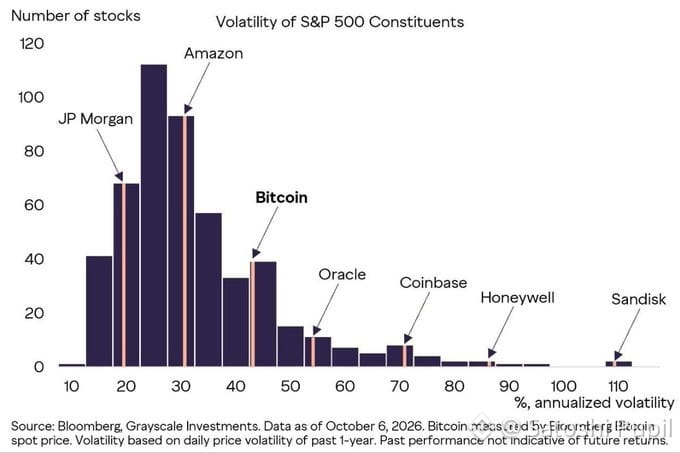
Bitcoin is LESS VOLATILE than Oracle, Coinbase, Honeywell, and Sandisk, according to Grayscale.
Bitcoin’s annualized realized volatility was 43%, below its average of 64% over the past decade and the 81% recorded five years ago.
By this measure, Grayscale ranks bitcoin as less volatile than approximately 19% of S&P 500 stocks—a quiet reminder that some familiar stocks have experienced larger price swings than BTC.
1
5
Bitcoin is LESS VOLATILE than Oracle, Coinbase, Honeywell, and Sandisk, according to Grayscale.
Bitcoin’s annualized realized volatility was 43%, below its average of 64% over the past decade and the 81% recorded five years ago.
By this measure, Grayscale ranks bitcoin as less volatile than approximately 19% of S&P 500 stocks—a quiet reminder that some familiar stocks have experienced larger price swings than BTC.
1
4
General Market Sentiment
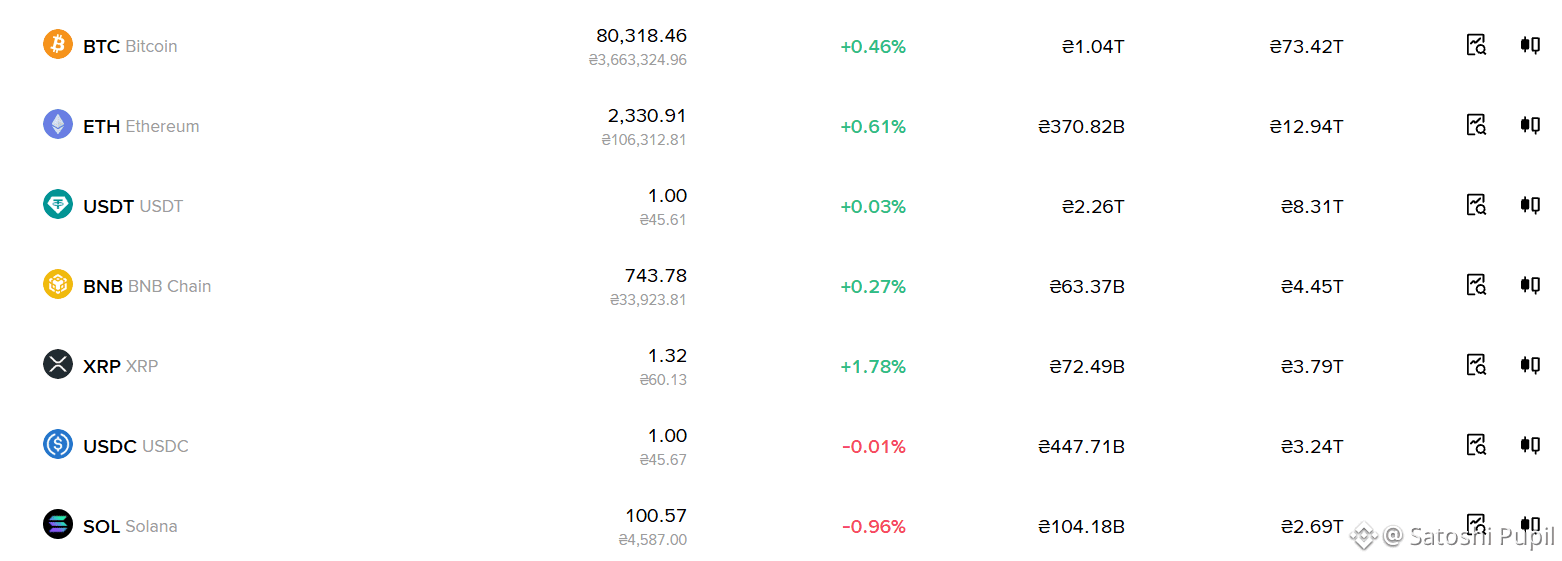
The market is experiencing a moderate positive consolidation with low volatility. Most key assets are showing slight growth ranging from +0.27% to +1.78%, indicating an accumulation phase or market anticipation of new drivers (macroeconomic news or network updates).
Bitcoin: The asset has consolidated above the psychological mark of $80,000. Capitalization stands at $1.04T, and high trading volume confirms steady dominant demand in the market.
XRP: The growth leader among top altcoins (+1.78%), the token is demonstrating the strongest positive momentum among the presented assets, holding its price at $1.32.
Ethereum and BNB: Showing stable dynamics (+0.61% and +0.27% respectively). BNB is at a high level of $743.78.
Solana (-0.96%): The session's lagger and the only major altcoin in the list showing a slight local correction, balancing near the support level of $100.00 ($100.57).
2
43
Overall Market Sentiment
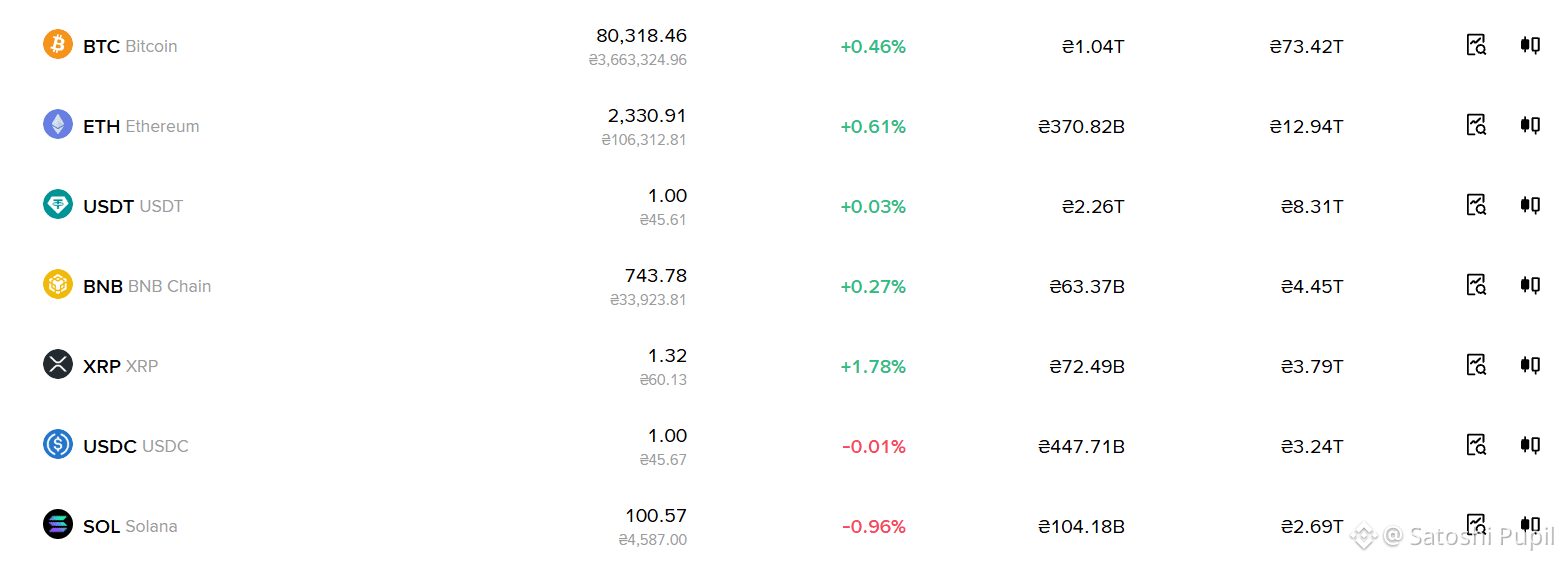
The market is seeing moderate positive consolidation with low volatility. Most key assets are posting slight gains ranging from +0.27% to +1.78%, indicating an accumulation phase or that the market is waiting for new catalysts (macroeconomic news or network updates).
Bitcoin: The asset has established itself above the psychological $80,000 mark. Its market capitalization stands at $1.04T, while high trading volume confirms steady, dominant demand in the market.
The top gainer among major altcoins is XRP (+1.78%), which is showing the strongest positive momentum among the assets listed, holding at $1.32.
Ethereum and BNB: Both are showing stable performance (+0.61% and +0.27%, respectively). BNB is trading at a high level of $743.78.
The session’s underperformer is Solana (-0.96%): the only major altcoin on the list showing a slight local correction, hovering near the $100.00 support level ($100.57).
2
48

$BNB $SOL also fall, damn it
{spot}(SOLUSDT)
{spot}(BNBUSDT)
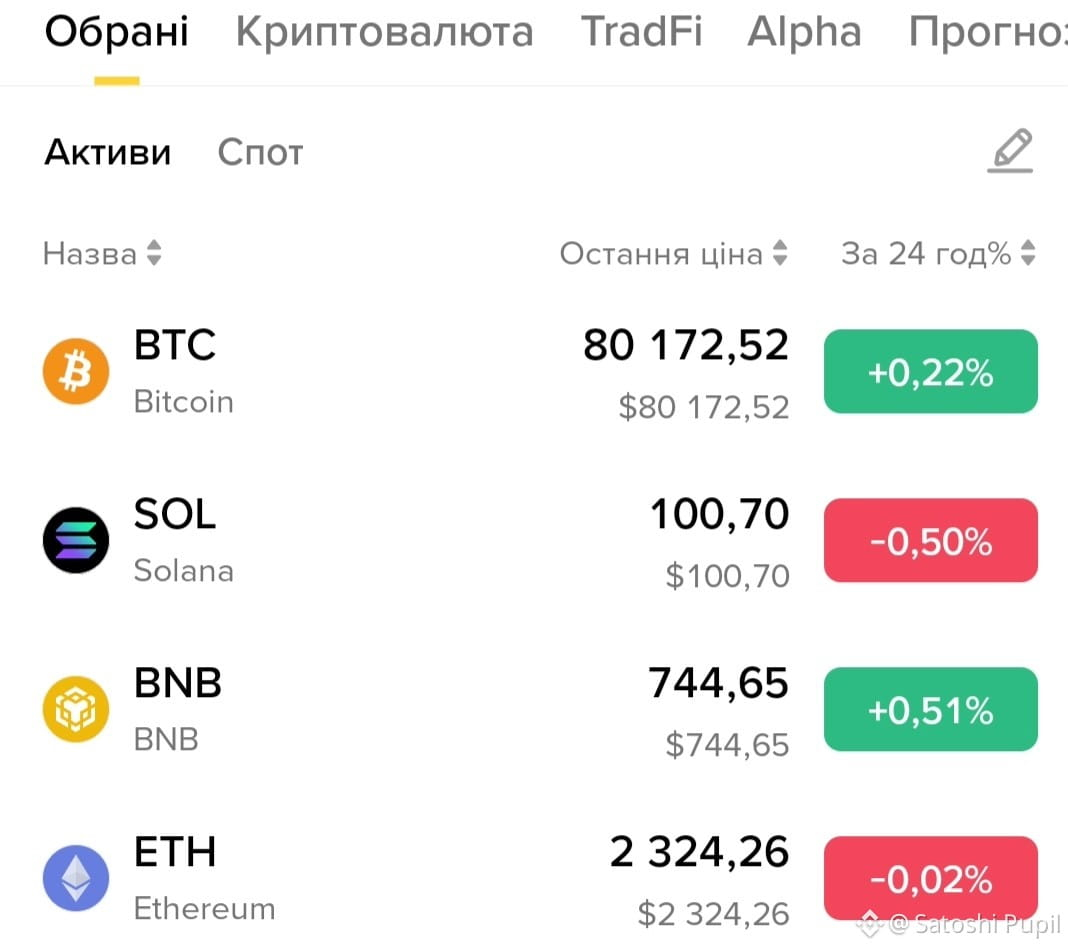
$BNB $SOL also fall, damn it

4
414
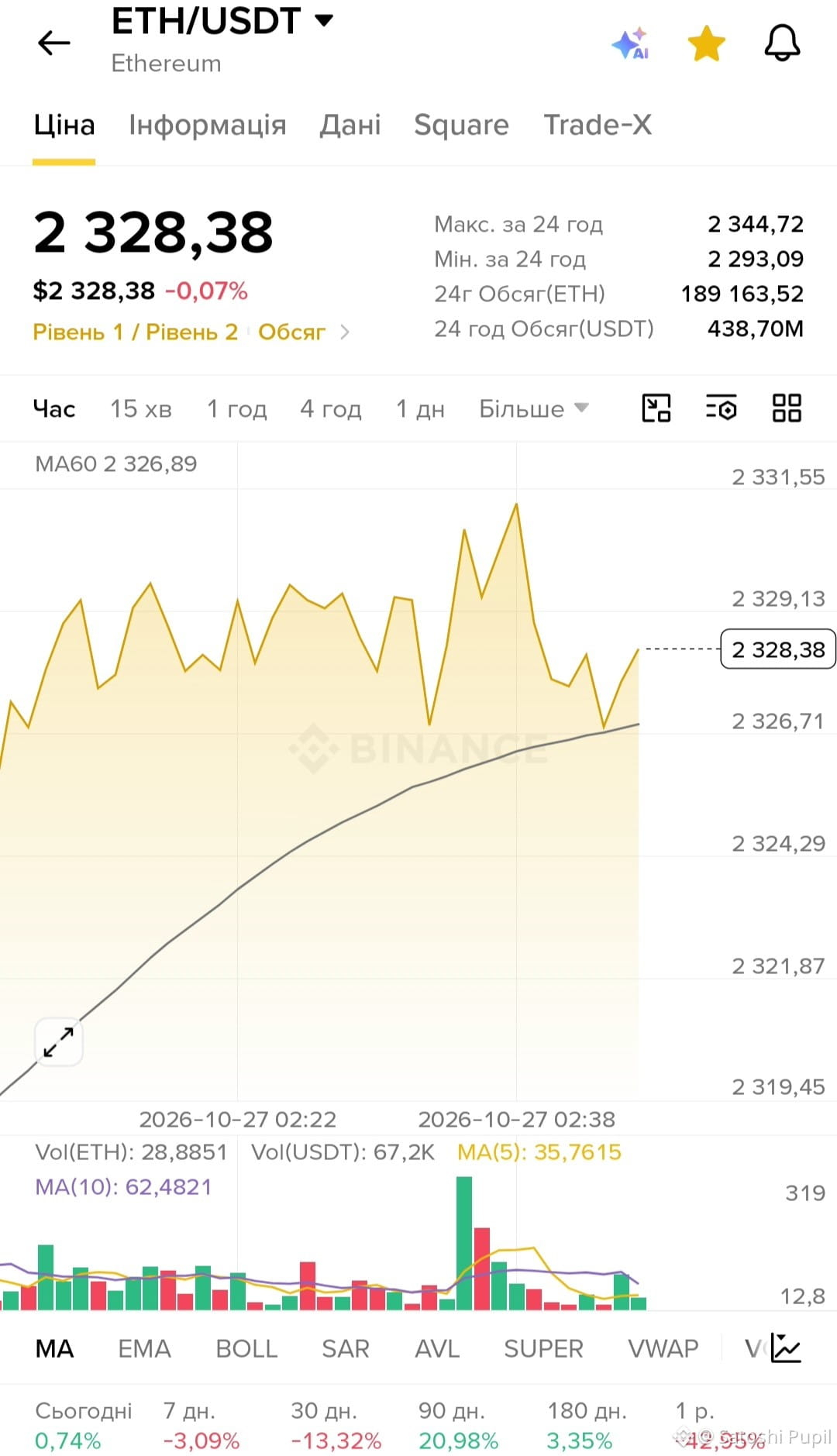
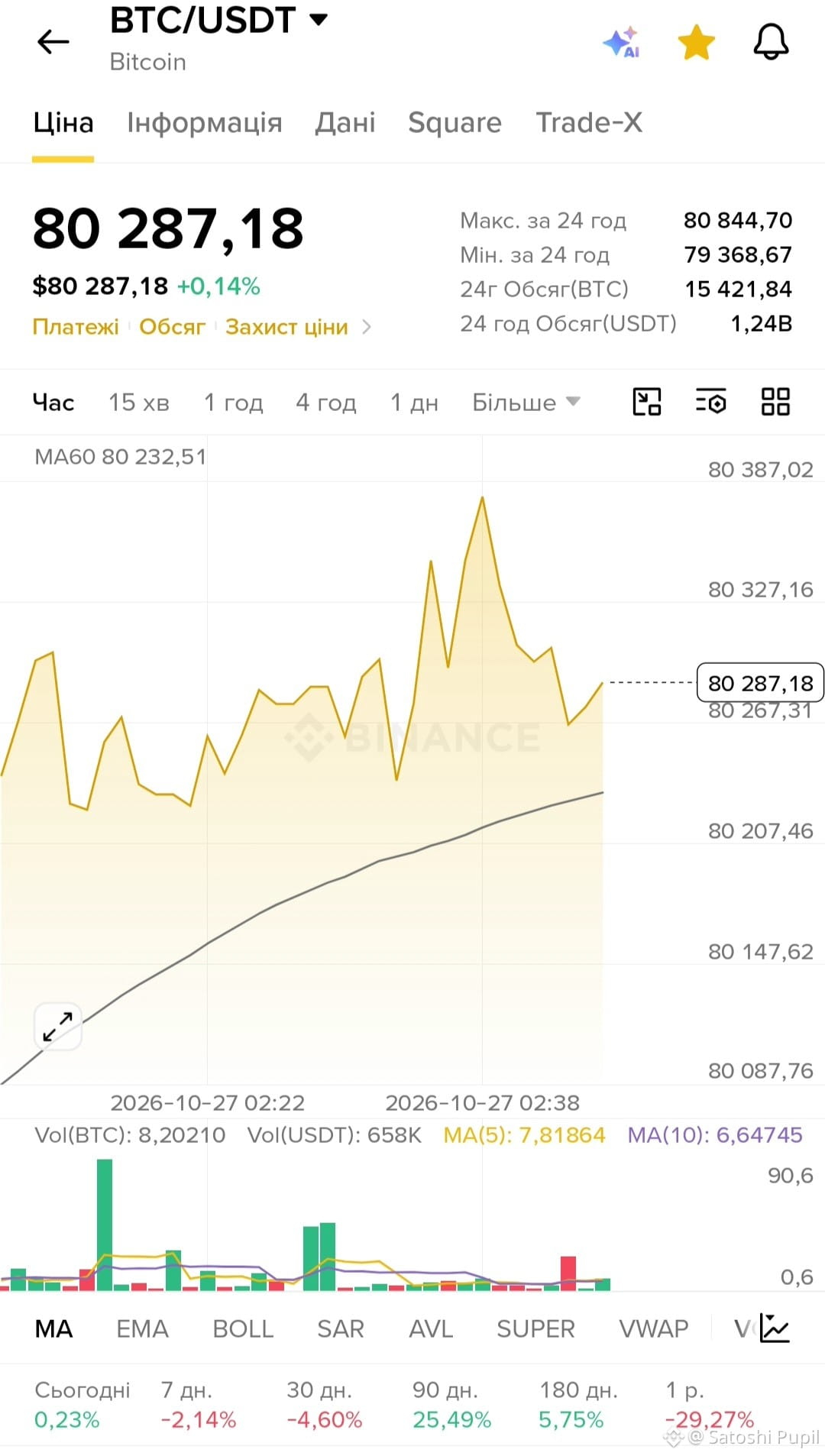
Bitcoin drops back below $80,000, while Ethereum falls below $2,300 as US and Israeli strikes on Iran increasingly appears to be a matter of “when,” NOT “if.”
Bitcoin drops back below $80,000, while Ethereum falls below $2,300 as US and Israeli strikes on Iran increasingly appears to be a matter of “when,” NOT “if.”
1
1
78
$550 BILLION has been added to the U.S. stock market in just ONE HOUR as Trump put attacks on Iran on hold.
The TACO trade is playing out perfectly AGAIN.
$550 BILLION has been added to the U.S. stock market in just ONE HOUR as Trump put attacks on Iran on hold.
The TACO trade is playing out perfectly AGAIN.
The TACO trade is playing out perfectly AGAIN.

4
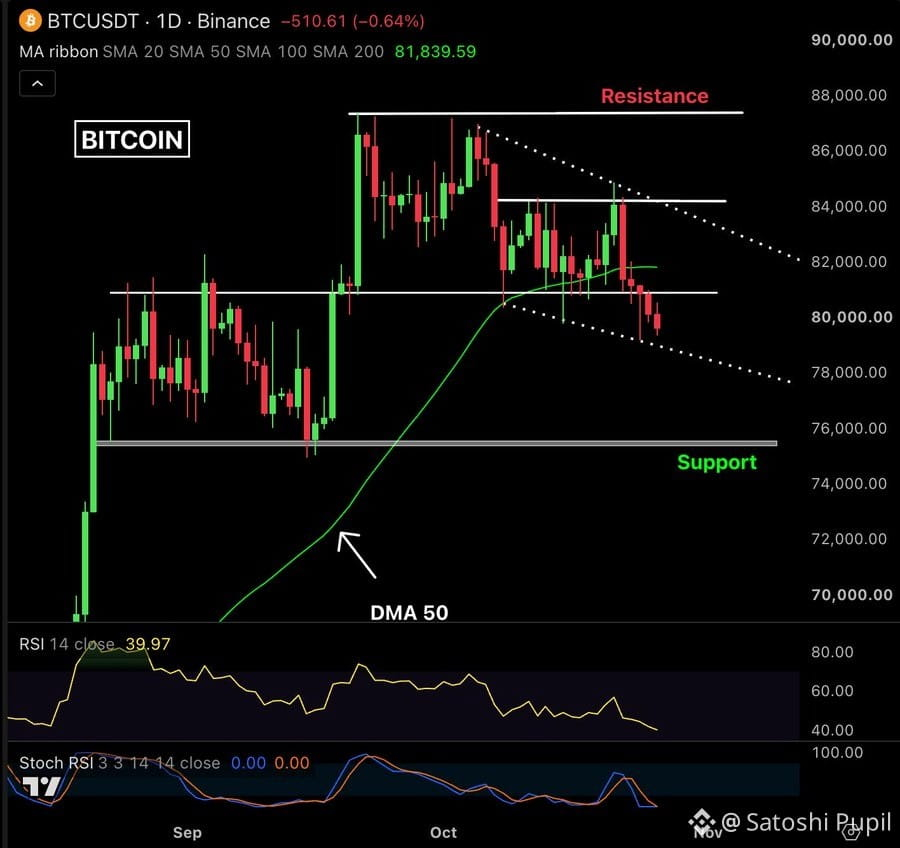
Bitcoin has been falling for the last five days, and the daily chart is looking weak. Price has dropped below the daily MA 50 near $81,800, and it needs to reclaim that level to keep the bullish case strong.
For now, $84,800 and $87,500 are the resistance levels to watch, and the support is around $75,000.
This week’s Israel election, FOMC decision, big tech earnings, U.S. PCE, GDP and midterm elections could all drive volatility.
If $BTCgets back above the daily MA 50, things could start looking better. A move above $85,000 would be another positive sign.
5
The NBA partners with Kalshi and Polymarket as preferred prediction market exchanges, while entering into a data-sharing agreement with the CFTC to guard against insider trading.
#NBA #Polymarket
The NBA partners with Kalshi and Polymarket as preferred prediction market exchanges, while entering into a data-sharing agreement with the CFTC to guard against insider trading.
#NBA #Polymarket
#NBA #Polymarket
2
Log in to explore more content
Join global crypto users on Binance Square
⚡️ Get latest and useful information about crypto.
💬 Trusted by the world’s largest crypto exchange.
👍 Discover real insights from verified creators.
Email / Phone number