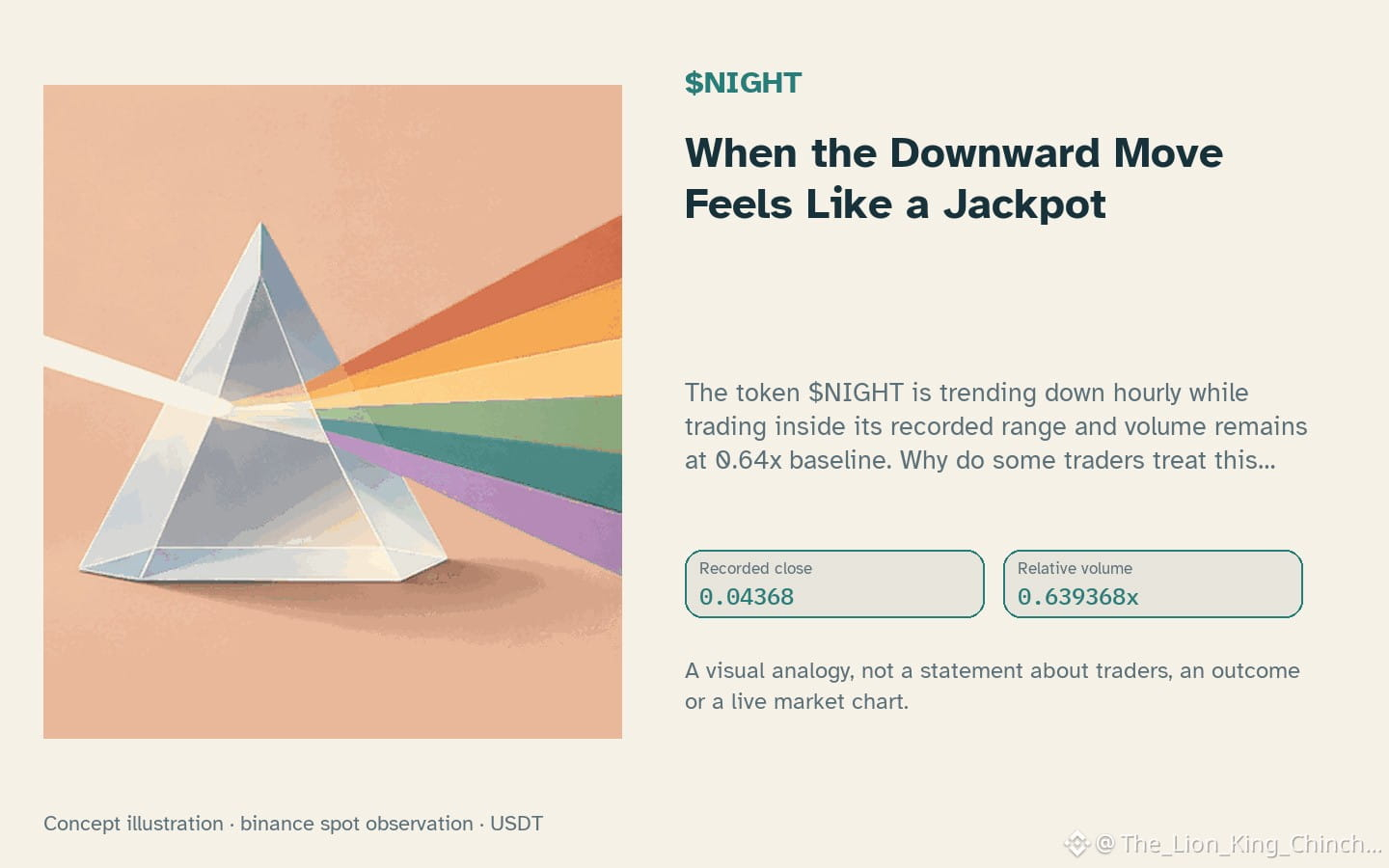
$NIGHT : When the Downward Move Feels Like a Jackpot
The token $NIGHT is trending down hourly while trading inside its recorded range and volume remains at 0.64x baseline. Why do some traders treat this slip as a lottery ticket, hoping for a sudden rally that would deliver outsized profit? The bias at play is "lottery‑ticket thinking," a form of over‑optimism that inflates the perceived payoff while ignoring the low probability of a breakout.
In this scenario the market shows a modest hourly change -0.636943% and RSI 47.2 in a neutral zone. The price is squeezed between local support and resistance, yet the narrative of a hidden upside can capture attention. Traders may anchor on the recent high, recall past rapid recoveries, and feel regret if they miss a hypothetical surge. This creates a feedback loop where the size of a potential gain outweighs the realistic odds.
A contrasting case would be a coin that drops sharply with volume three times baseline and an RSI deep in oversold territory; the same bias would be less persuasive because the risk appears larger. To guard against lottery‑ticket thinking, run a simple self‑check: ask whether the expected reward exceeds the probable move by a factor greater than the inverse of the win probability. If the answer is yes, pause and seek additional evidence such as a confirming breakout candle or a shift in volume. Only then should the interpretation be revised.
Probabilistic market research, not a recommendation or guaranteed return.
#NIGHT #TradingPsychology