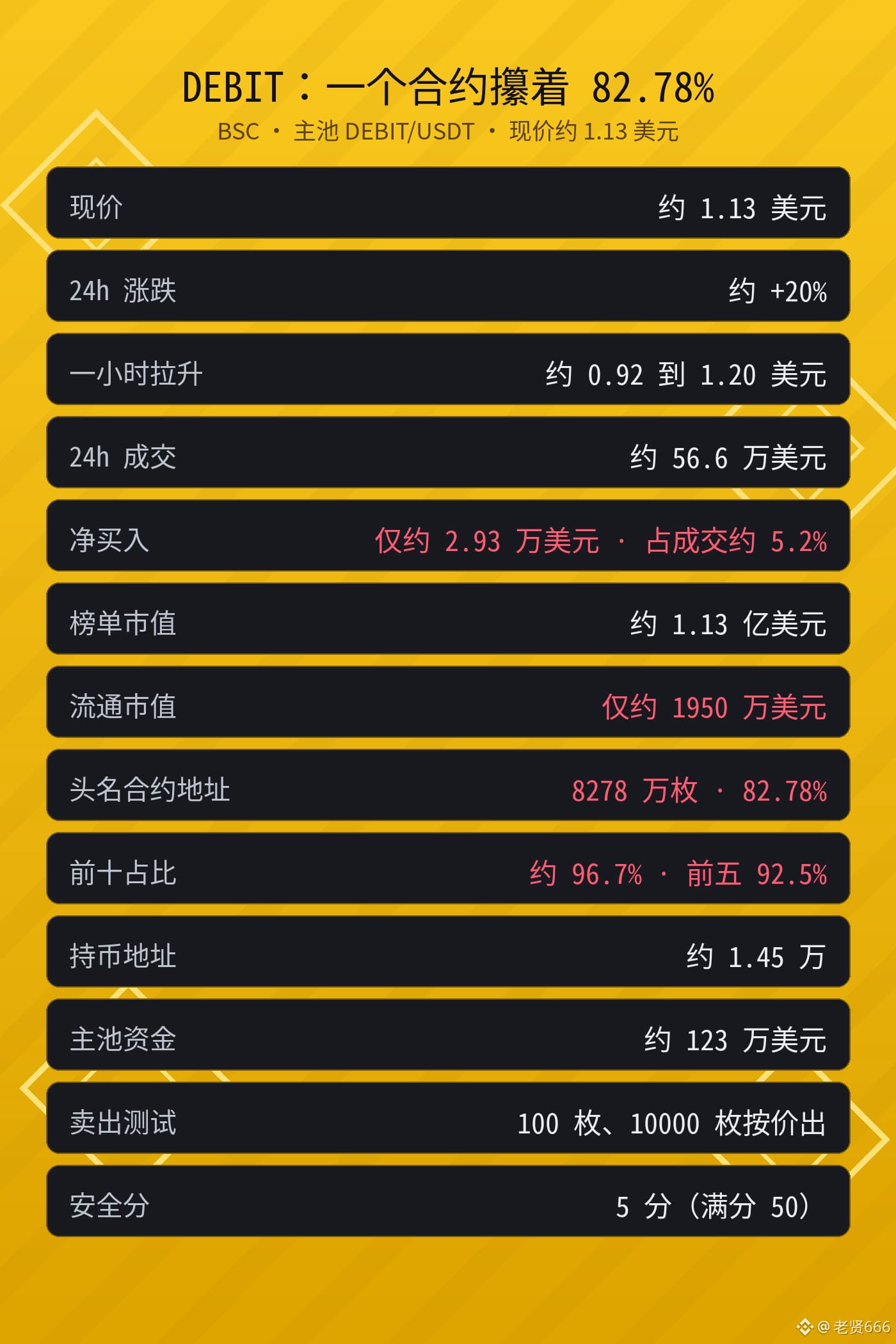
$DEBIT One contract holds 82.78%; last night, the price jumped 30% in an hour.
First, the most striking figure: the total supply of DEBIT is 100 million tokens, and 82.78 million of them—82.78%—sit in a single contract address. That’s the figure you can verify on-chain right now. Only 17.22 million tokens remain in circulation. At the current price of about $1.13, that puts the circulating market cap at around $19.5 million. The $113 million listed on ranking sites is calculated by multiplying the total supply of 100 million by the price, overstating it by 5.8 times.
The top 10 holders own about 96.7% combined, and the top five about 92.5%. Retail investors hold just over 3% at most. There are about 14,500 holder addresses.
Now, about last night’s surge: throughout November 7, the price hovered around $0.91. Then, in the hour around midnight, it shot straight up to $1.20—a rise of about 30%. The current price is around $1.13, up about 20% in 24 hours. But total trading volume for the day was only about $566,000: 2,140 buy orders worth about $298,000, and 2,500 sell orders worth about $268,000. Net buying came to about $29,300, less than 6% of trading volume. A few tens of thousands of dollars in net buying are pushing up a token with a $113 million market cap—that’s what happens when the available float is thin.
Is this contract address for locked tokens, a treasury, or something else? The team has yet to publish a distribution table or unlock schedule. On-chain, it appears to be a proxy contract with no publicly listed name. In the records visible on its page, tokens only come in, never go out; all 82.78 million sit neatly inside. Teller itself offers unsecured lending and tells a story about AI-powered credit. It launched on Alpha on August 26, where 240 points could be redeemed for 50 tokens. The team says October saw its largest volume of AI loan pre-approvals this year, but it gave no figures, so that claim can’t be verified.
The main pool is DEBIT against $USDT, with about $1.23 million in liquidity. Test sells of 100 and 10,000 tokens both went through at the current price without getting stuck. Its security score is just 5 out of 50. The top 100 holders have an average cost basis of $1.72, over 30% above the current price, so even the whales are underwater.
If you’re holding, keep an eye on two things: whether that address holding 82.78 million tokens moves its funds—if it does, the circulating supply could multiply several times over—and whether net buying can rise above the $30,000 range. If the address stays still and net buying doesn’t pick up, any further price rise is being driven by the thin float. Whether it can hold is anyone’s guess.
One contract controls 83% of the supply, and the team hasn’t said when those tokens might move. Would you dare to hold?
This is not investment advice. Alpha projects are high-risk and could go to zero.
#BinanceAlpha #DEBIT #TokenHolderWatch