


In a nutshell, an exchange deserves trust when its claims can be checked against evidence of reserves, security, withdrawals, and accountability. To assess its reliability, examine the scope of each document and the company’s obligations, without treating transparency as a guarantee.
Reserves: what does the proof show?
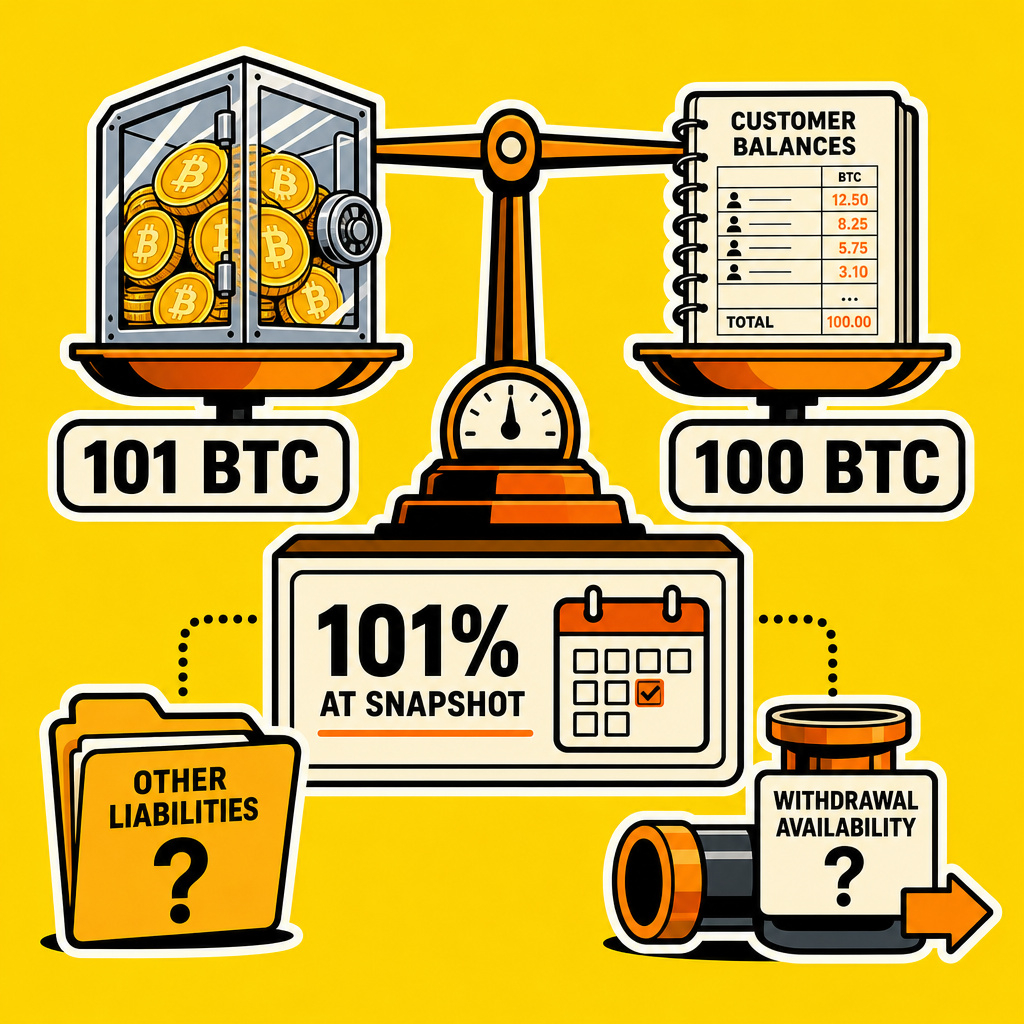
A proof of reserves should make it possible to identify the reference date, the assets considered, the balances owed to customers, and the methodology. Also note who produced the analysis and what limitations they disclosed.
Hypothetical example: 102 BTC in reserves for 100 BTC owed represents 102% coverage at that snapshot. This does not prove that there are no other liabilities or that funds are continuously available for withdrawals.
This guide presents general evaluation criteria, not an analysis of a specific platform. The numerical examples are hypothetical.
Individual balance: was your account included in the calculation?
When evaluating proof of reserves, distinguish the reported total from the inclusion of your balance. An aggregate figure alone does not show that a specific account was included in the calculation.
Look for official instructions linking individual verification to the selected report. Compare the balance recorded on the reference date, not the current balance. Also identify which assets were covered.
Balance inclusion answers a limited question. It does not turn proof of reserves into a full audit of the company or guarantee security.
Security: who assessed the controls, and what was the scope?
Distinguish account protection from infrastructure security. Additional authentication makes unauthorized access more difficult, but does not prove the protection of wallets, internal systems, or exchange processes.
For each independent assessment, record the assessor, the entity examined, the date, the scope, and any qualifications. A seal without a verifiable report does not show what was actually assessed.
The date you read a certification does not renew it. Distinguish the document's issue date, the period examined, and its stated validity.
Withdrawals: clear rules do not replace an operational track record
Check the exact asset and network combination: minimums, fees, restrictions, and maintenance notices. The presence of a coin on the platform does not prove that it can be withdrawn over any network.
Hypothetical example: a withdrawal of 200 units with a fee of 2 delivers 198 to the destination if the fee is deducted from the amount. To assess continuity, look for dated records of interruptions and resumptions.
Before concentrating funds, consider making a small transaction, taking expected costs into account. A completed withdrawal verifies that particular transaction, not future reliability.
Loss protection: criteria for assessing funds and reimbursement
If the exchange announces a protection fund, look for documents defining its purpose, covered events, exclusions, and who decides on payouts. Do not assume universal coverage just because the fund exists.
Distinguish three questions: available funds, a contractual right to reimbursement, and support for recovery. A protection announcement does not automatically answer all three.
Identify who assumes responsibility for each type of loss and which channel handles disputes. Assistance in trying to recover assets is not equivalent to a commitment to return them.

Incidents: does the communication allow the facts to be reconstructed?
Transparent communication makes it possible to establish the order of the initial notice, affected services, confirmed facts, and restoration. Compare the time of the incident with the time of the communication to assess how quickly it was reported.
Distinguish preliminary information from later conclusions. A resumption notice confirms what was stated on that date; by itself, it does not demonstrate that the cause was eliminated.
Also look for information on how losses were handled and evidence of improvements implemented. Promising reinforcements is different from documenting their implementation. Cross-check official statements against independent analyses.
Decision: who is responsible, and what evidence remains incomplete?
Identify the contracting entity in the terms and consult the relevant official register for the service and your place of residence. A foreign authorization does not prove local authorization or cover every activity.
Classify each point as documented, partial, or unverified. Record the date and scope of the evidence, as well as the contracting party and complaint channel. Avoid a single score that hides gaps.
Hypothetical example: verifiable reserves and undefined loss coverage support different conclusions. There is evidence for the reserves; reimbursement remains unproven.
Conclusion
Assessing an exchange's reliability requires connecting statements, documents, and contractual responsibility. Start with the entity that will provide the service and gather dated evidence about reserves, security, withdrawals, and losses. Before transferring funds, record what is documented and which protections you cannot assume.
Disclaimer: Purely educational/informational content, not investment advice.