

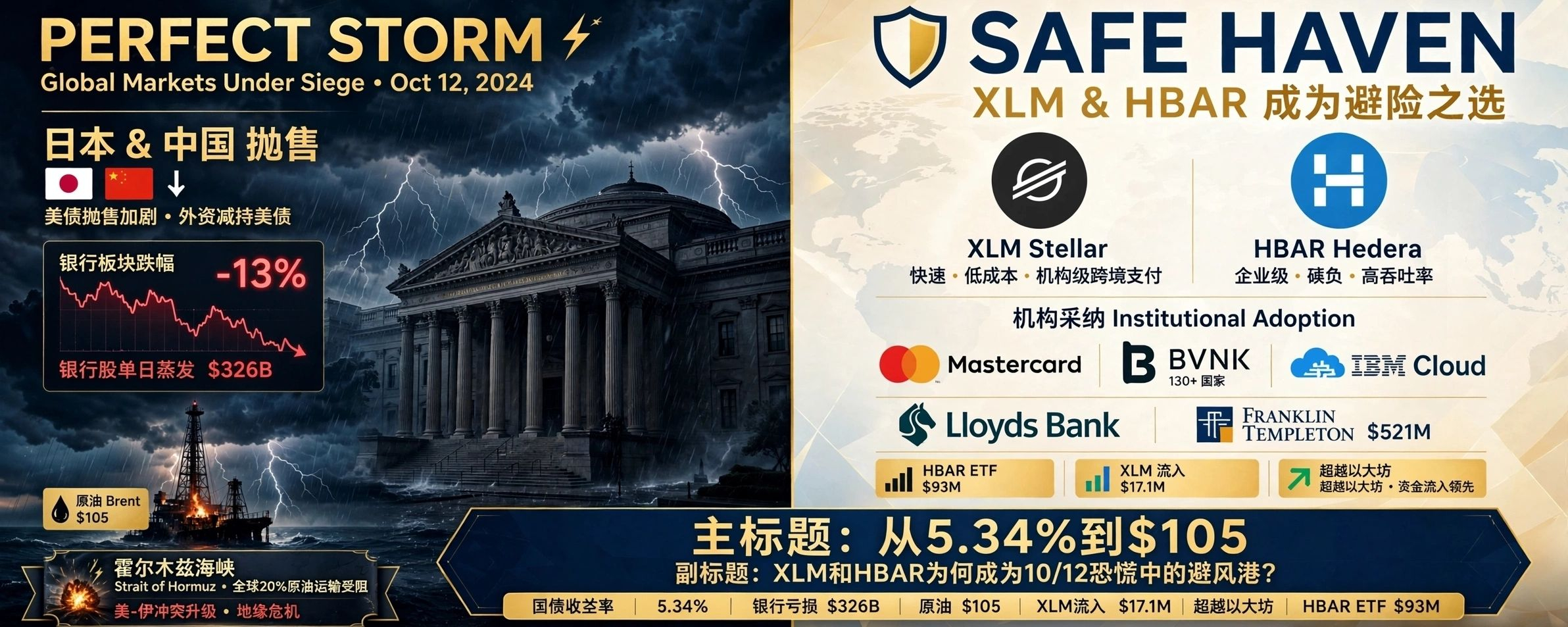

Everyone is watching Bitcoin, but changes in U.S. Treasury bonds, oil markets, and global credit could also affect the cryptocurrency market.
With October 12 approaching, the question worth considering isn’t which token will survive tomorrow, but rather: Which projects have real-world use cases? And how will changing market conditions affect their tokens?
1. U.S. Treasury yields face pressure
The yield on 10-year U.S. Treasury bonds briefly rose to around 5.36%, its highest level since 2002.
According to U.S. Treasury data, as of July 2026, Japan held approximately $1.104 trillion in U.S. Treasury bonds, while China held approximately $618 billion.
However, declining holdings do not necessarily mean that investors are broadly pulling out of the U.S. dollar. The data may be affected by portfolio adjustments and changes in asset prices, and July data showed that foreign investors were still net buyers of long-term U.S. securities.
Source: U.S. Treasury — Foreign Portfolio Holdings Data
Rising Treasury yields may make fixed-income assets more attractive and put pressure on riskier assets such as cryptocurrencies. But that does not mean all digital assets will fall by the same amount.
II. Oil Markets and Geopolitical Tensions
During recent geopolitical tensions, Brent crude prices briefly topped $105 per barrel. Meanwhile, shipping through the Strait of Hormuz was disrupted, and some oil production in the Gulf of Mexico was halted by a hurricane.
Source: Reuters — International Oil Price Developments, October 8, 2026
If energy prices continue to rise, inflationary pressures may intensify and rate cuts could be delayed. This environment may increase market volatility, but these factors alone are not enough to determine the direction of Bitcoin or other cryptocurrencies.
III. Why Pay Attention to $XLM?
The Stellar network has seen some notable developments in the tokenization of real-world assets (RWAs).
According to reports published on October 9, 2026, tokenized investment products on the Stellar network recorded $17.1 million in net inflows over 24 hours, exceeding the roughly $16 million in comparable inflows for Ethereum over the same period. The reports also noted that the value of tokenized assets on Stellar had grown to approximately $3.5 billion to $4 billion.
Source: Report on Inflows into Stellar Tokenized Investment Products
In addition, BVNK announced that it had integrated Stellar into its multichain stablecoin payments infrastructure, enabling customers to use the network for cross-border transfers, merchant payments, treasury management, and other activities.
Source: Stellar announcement on the BVNK integration
What do these developments mean for XLM holders?
They reflect increased activity and usage in some Stellar use cases, but do not prove that all institutional inflows are being used to buy XLM or guarantee that its price will rise.
Investors still need to monitor actual network usage, genuine demand for XLM, and whether network growth can translate into economic value for the token.
IV. Why Pay Attention to $HBAR?
There have also been some notable institutional partnerships and application developments in the Hedera ecosystem:
IBM Cloud: IDTrust, a Hedera-based platform developed by The Hashgraph Group, was listed in the IBM Cloud Catalog in September 2026.
UK financial markets: Lloyds Banking Group, Aberdeen, and Archax partnered to use tokenized assets as collateral in foreign exchange trading.
Regulatory status: A joint interpretation issued by the U.S. Securities and Exchange Commission (SEC) and the Commodity Futures Trading Commission (CFTC) in March 2026 included HBAR in the category of digital commodities defined by the interpretation. However, regulatory interpretations should be distinguished from binding legal rules.
Source: Announcements from IBM and The Hashgraph Group | UK financial applications on Hedera | SEC regulatory filings
These developments show that Hedera is exploring real institutional applications, but they do not prove that every business activity on the network will directly increase demand for HBAR, nor do they mean its price is certain to rise.
V. How Should Traders Respond?
Rather than trying to predict which token will survive a market fluctuation on any given day, focus on these three areas:
1. Risk Management
Avoid using leverage that could magnify losses, and do not invest money you will need soon for living expenses or other payments coming due.
2. Liquidity Management
Keeping some highly liquid assets may help improve flexibility in responding to market changes. However, stablecoins also carry risks related to issuers, trading platforms, liquidity, and other factors.
3. Distinguish Network Success from Token Value
Adoption of a technology by banks or institutions does not necessarily mean that the associated token will appreciate in value. Focus on the token’s demand mechanisms, actual fees, real-world usage, and regulatory risks.
Conclusion
Rising Treasury yields and geopolitical tensions may increase volatility in cryptocurrency markets, but they cannot by themselves determine the ultimate winners and losers.
Stellar and Hedera have shown some developments worth examining in payments, real-world asset tokenization, and institutional applications. These factors provide a reasonable basis for continuing to monitor $XLM and $HBAR, but they do not guarantee that either will outperform the market in the short term.
The real opportunity is not to chase tokens touted as certain to survive tomorrow, but to study which projects are seeing growth in real-world applications and assess whether that growth can generate genuine, sustainable economic demand for their tokens.
#XLM #HBAR #RWA #Bitcoin #Crypto