

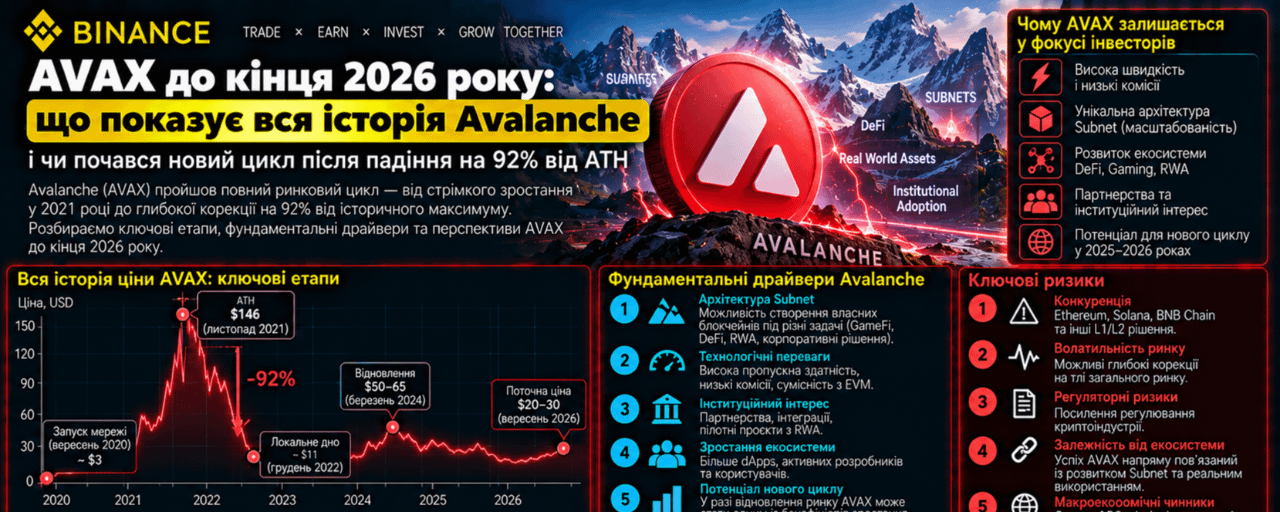

AVAX by the end of 2026: what the entire history of Avalanche shows and whether a new cycle has started after a 92% drop from its ATH
Avalanche enters the final stretch of 2026 after a very strong September recovery.
As of September 30, AVAX is trading at approximately:
$11–11.5.
As of the end of August, the price was around:
$7,2.
That is, in September alone, AVAX added approximately:
+60%.
At the same time, the historical maximum, formed on November 21, 2021, is approximately at:
$145.
So AVAX is still trading at approximately:
92% below ATH.
At first glance, this may seem like a huge underestimate.
But this is where you need to be careful.
The 2026 Avalanche is a completely different asset than the 2021 Avalanche.
Changed:
circulating supply;
network structure;
Avalanche L1 model;
validator economics;
institutional adoption;
RWA;
stablecoins;
competition between L1.
Therefore, the main question now is not:
"AVAX was once $145 — will it go back there?"
A:
"Is Avalanche's economic value growing fast enough to trigger a new AVAX revaluation cycle?"
To answer, you need to go through the entire history of the asset since 2020.
2020: Avalanche launches
Avalanche mainnet was launched in September 2020.
The first available AVAX stock quotes appeared around:
$3.
2020 was actually a price discovery phase.
For the available part of the year, AVAX gave approximately:
+23%.
But within the first months, volatility was already very high.
August:
+93%
September:
-27%
October:
-16%
December:
-15%.
That is, it became clear from the very beginning:
AVAX — high-beta L1.
2021: one of the strongest years in the history of the crypto market
2021 has been an absolute blast.
AVAX started the year at approximately:
$3,7
and finished around:
$109.
Annual result:
about +2,900%.
This is one of the strongest annual movements among the large L1s.
January 2021: +327%
In one month, AVAX grew by approximately:
four times.
February:
+80%.
March:
+20%.
April:
+14%.
And then came the first big stress test.
May–June 2021: almost -65%
May:
-45%
June:
-35%.
AVAX fell from about $33 to $12.
And even then, a pattern emerged that still works today:
AVAX could lose 40–60% within a structural bull market and then set a new ATH.
August 2021: +193%
After the summer low:
July:
+14%
August:
+193%
September:
+69%.
And in November:
+87%.
On November 21, AVAX reached approximately:
$145.
This was the peak of the first major Avalanche cycle.
Why AVAX rose so much in 2021
The main narrative then sounded like this:
"Ethereum is too expensive - faster L1s are needed."
The market simultaneously overestimated:
Solana;
Earth;
Phantom;
Avalanche.
Avalanche has a very strong DeFi ecosystem:
Ghost;
Curve;
Trader Joe;
Benqi;
GMX;
Pangolin.
And Avalanche Rush incentives accelerated the arrival of liquidity.
At its peak, Avalanche was no longer perceived as an experiment, but as:
one of Ethereum's main competitors.
But valuation went too far
An ATH of around $145 meant a huge premium for future growth.
And when the macro regime changed, AVAX turned out to be one of the most vulnerable large assets.
2022: -90%
2022 was an almost complete destruction of the previous valuation.
AVAX started the year higher:
$110.
And finished approximately at:
$10,9.
Result:
-90,5%.
The worst period is the second quarter
April:
-40%
May:
-54%
June:
-36%.
Q2 in summary:
approximately -83%.
This is almost a complete surrender.
Why was the fall so severe?
Several factors came together:
The Fed has been aggressively raising rates;
liquidity was disappearing;
Terra/LUNA collapsed;
DeFi TVL was falling;
FTX added another systemic shock.
But there was another problem for AVAX:
There have become too many alternative L1s.
In 2021, investors paid a huge premium for the thesis:
"The future will be multichain."
In 2022, the market began to ask:
Which L1 is really needed?
2023: AVAX resurrects
The year 2023 began approximately around:
$10,9.
And ended near:
$38,5.
Result:
+254%.
But almost the entire result was formed at the end of the year.
January 2023: +82%
After surrender:
strong relief rally.
Then, for seven consecutive months, the structure was almost constantly weak.
May:
-18%
June:
-8%
August:
-22%
September:
-7%.
AVAX returned approximately to:
$9.
And then came Q4
October:
+23%
November:
+89%
December:
+80%.
Q4 overall:
approximately +317%.
This is one of the most extreme quarterly recoveries in the history of large L1s.
What changed in 2023
Avalanche began to move more and more strongly from the concept:
"one blockchain for all"
to:
"a network of specialized blockchains."
Back then they were also called:
Subnets.
And it was this idea that would later become the basis of Avalanche9000.
2024: the foundation is developing, but the token is almost not growing
The year 2024 is very important.
AVAX started it around:
$42
and finished about:
$36.
Result:
approximately -14%.
That is, against the backdrop of a strong crypto market, AVAX actually did not create an annual profit.
But there were huge movements during the year
February:
+23%
March:
+32%
April:
-39%
June:
-19%
July:
-13%
August:
-11%
September:
+22%
November:
+79%
December:
-20%.
This is an almost perfect definition of a high-beta asset.
December 2024: Avalanche9000 changes the network
On December 16, 2024, the following was activated:
Etna Upgrade.
It became the core of Avalanche9000 — the biggest architectural change to Avalanche since launch.
Subnets have effectively become Avalanche L1
Before Etna, running a Subnet was expensive.
Validator had:
validate the Primary Network;
to deposit 2,000 AVAX;
support additional infrastructure.
Etna changed this model.
Now Avalanche L1 validator:
should not stake 2,000 AVAX.
Instead, he pays a dynamic continuous fee.
Beginner level:
approximately 1.33 AVAX per month.
L1 launch cost dropped by more than 99.9%
This is a huge change.
Previously, creating your own network on Avalanche required a very large AVAX commitment.
After Etna, the barrier to entry dropped dramatically.
For developers, this is clearly bullish.
But there is a very interesting nuance for AVAX tokenomics.
Avalanche9000 simultaneously strengthened and weakened the AVAX thesis
Positive:
more L1s can be launched;
every L1 validator pays AVAX fee;
fee is burned;
The ecosystem becomes more scalable.
Negative:
L1 validators should no longer block:
2 000 AVAX.
That is, the large mandatory structural staking demand has disappeared.
This is an important point.
Avalanche9000:
made the network better,
but did not necessarily automatically make AVAX more scarce.
2025: another big bear year
2025 turned out to be very weak again.
AVAX started it around:
$36
and finished approximately:
$12,6.
Result:
about -65%.
Particularly weak were
February:
-35%
March:
-16%
October:
-40%
November:
-25%
December:
-10%.
This is a very important lesson.
The network has already received Avalanche9000.
The institutional narrative was strengthened.
And the token still fell by almost two-thirds.
Why?
Because:
network success ≠ token success.
This rule doesn't just work for Polygon, Sui, or NEAR.
It is just as important for Avalanche.
Avalanche can be a great infrastructure for:
RWA;
institutional finance;
gaming;
payments;
custom blockchains.
But you need to answer separately:
How much of this economic activity creates demand for AVAX?
And now it's 2026
The first six months looked almost catastrophic.
January:
approximately -12–18%
February:
-10–11%
March:
-3%
April:
almost unchanged
May:
-2%
June:
-27%.
In June, AVAX fell to approximately:
$5,9.
This was a drop of about 96% from the ATH
From:
$145
to:
less than $6.
This is effectively a complete destruction of the 2021 valuation cycle.
But then the structure changed dramatically.
July–September 2026
July:
approximately -3%
August:
+13%
September:
about +60%.
AVAX rose:
from about $7.27
to:
$11,5+.
The quarterly growth is already about:
+60%.
This is very reminiscent of 2023
In 2023, AVAX was also almost without demand for a long time.
Then:
October +23%;
November +89%;
December +80%.
In 2026 we have:
summer bottom;
August stabilization;
September breakout.
That's why Q4 is becoming especially interesting now.
But there is also a big difference.
Avalanche 2026 is much more institutional
In 2021, Avalanche's main narrative was:
DeFi.
In 2026, one of the main stories:
tokenization and RWA.
According to DefiLlama, Avalanche currently has approximately:
DeFi TVL:
$630–650 million
Stablecoin market cap:
about $1.39 billion
active RWA AUM:
about $1.0–1.05 billion
DEX volume:
approximately $1 billion in 7 days.
In RWA, Avalanche already looks much stronger than in regular DeFi
Avalanche's official institutional page, which uses a slightly broader asset accounting methodology, as of September 28 showed:
$1.79 billion RWA TVL
and:
$950 million stablecoins.
The numbers differ from DefiLlama due to Avalanche L1's methodology and coverage.
But the general conclusion is the same:
Tokenized finance has become a big segment of Avalanche.
Who already uses Avalanche?
The list is much more interesting than it was a few years ago.
The official ecosystem documentation includes:
BlackRock
BUDDL
Franklin Templeton
BENJI
VanEck
VBILL
KKR
tokenized private-equity products
Janus Henderson
JAAA and JTRSY
Galaxy
tokenized CLO
WisdomTree
and other institutional products.
This is a completely different class of adoption than the 2021 farming incentives.
BlackRock BUIDL is particularly important
According to current DefiLlama data, BUIDL generates approximately:
35% Avalanche RWA AUM.
That is, Avalanche already has a real presence in:
tokenized institutional capital.
This is one of the strongest fundamental arguments for AVAX.
But there's also FIFA
In May 2025, FIFA selected Avalanche to create:
FIFA's own Blockchain.
This is a separate Avalanche L1.
During the 2026 World Cup, this infrastructure was already used for ticketing and fan products.
Avalanche reports:
over 100,000 right-to-ticket issues
and more than:
$25 million volume
у World Cup ticketing experiment.
This is one of the best examples of what the Avalanche L1 architecture was designed for.
Not every company needs a public C-Chain
The bank may need:
permissioned validator set;
KYC;
own governance rules;
own privacy;
separate execution environment.
A sports organization may need:
own ticketing chain.
Gaming company:
own high-throughput economy.
This is where Avalanche has a strong architectural thesis:
"not everyone should live on the same blockchain."
This distinguishes Avalanche from the Ethereum L2 model
Ethereum primarily scales vertically through:
L2 rollups.
Avalanche offers:
sovereign L1.
Each network can have:
own validators;
own gas token;
own compliance rules;
own VM;
own economics.
And Interchain Messaging allows these networks to interact.
But here again the problem of AVAX arises.
Avalanche L1 can:
use your own gas token.
That is, every successful Avalanche ecosystem network does not necessarily create huge transactional demand for AVAX.
AVAX is still needed for:
Primary Network;
staking;
L1 validator fees;
certain ecosystem operations;
gas на C-Chain;
interchain infrastructure.
But value accrual is not as straightforward as:
HYPE buyback.
This is what you need to remember.
Tokenomics AVAX
Maximum supply:
720 million AVAX.
On genesis, the following was created:
360 million
The rest is issued mainly as staking rewards.
And at the same time, all transaction fees are burned
Fees of:
X-Chain;
C-Chain;
P-Chain;
Avalanche L1, which use AVAX,
can burn.
That is, the supply model has two opposing forces:
staking issuance
against:
fee burn.
Is AVAX deflationary?
So far:
no.
The official documentation directly states that AVAX is still far from the hard cap and staking rewards usually exceed the burn.
Therefore, the asset mostly remains:
inflationary.
This is an important difference from the popular thesis:
"AVAX is constantly being burned, so the supply is only decreasing."
No.
Burn is.
But at the same time there is issuance.
The more you use it, the more interesting the model becomes.
If the ecosystem grows:
more transactions →
more validator fees →
more AVAX burn.
In the long term, strong network usage can significantly improve:
net issuance.
But today this is not the main driver of valuation.
Current supply is much larger than in 2021
This is very important when comparing with ATH.
According to historical aggregators, average/available supply:
2021:
approximately 127 million AVAX
2022:
249 million
2023:
326 million
2024:
382 million
2025:
416 million
2026:
over 420 million
That is, the old ATH:
$145
cannot simply be transferred to a modern supply.
AVAX at $145 today would mean a completely different market cap
With a circulating supply of over 420 million:
$145 × 420 million ≈ $61 billion.
This is a much higher valuation than Avalanche had in the early stages of 2021.
Therefore the argument:
"AVAX is 92% below ATH, so 12x potential"
too simplistic.
Current valuation
With AVAX close to:
$11–11,5
market cap is approximately:
$5 billion
This is a much more interesting ratio than:
RWA;
stablecoins;
DeFi;
institutional adoption,
than the 2021 valuation.
What does AVAX mean at $15?
With approximately 430–450 million circulating supply:
market cap would be around:
$6.5–6.8 billion
From $11.3:
about:
+33%.
This is a completely normal move for AVAX.
AVAX at $20
Market cap:
about:
$9 billion
From the current level:
+75–80%.
This already requires a continuation of a strong Q4.
But it doesn't look extreme in the context of AVAX's historical volatility.
$30
Market cap:
about:
$13–14 billion
This would mean a serious ecosystem re-rating.
For such a movement you need:
strong BTC;
institutional inflows;
further RWA growth;
expansion L1 activity;
general altcoin risk-on.
$50
This is already a valuation of more than:
$20 billion
By the end of 2026, this is not my base case scenario.
This requires a virtually new major L1 bull cycle.
What does the monthly history of AVAX show?
Avalanche has a very interesting feature:
Q4 is not stable at all.
Q4 2021
+64%.
Bull market.
Q4 2022
-37%.
Bear market.
Q4 2023
+317%.
Huge recovery.
Q4 2024
+29%.
Moderately positive.
Q4 2025
-59%.
Disastrous.
That is, seasonality itself:
almost useless.
AVAX trades:
market regime.
But November is historically very interesting.
Available statistics:
2020:
+1%
2021:
+87%
2022:
-32%
2023:
+89%
2024:
+79%
2025:
-25%.
This doesn't show that "November is always bullish."
And another:
If AVAX enters Q4 with positive momentum, November has historically been able to expand the movement very strongly.
And that's why the September +60% breakout is important now.
What historical period is the fall of 2026 most similar to?
The most interesting analogue:
fall 2023.
Then:
The SUI-like L1 sector was weak;
AVAX stood near lows for a long time;
then a sudden re-rating began.
October:
+23%.
November:
+89%.
December:
+80%.
But 2026 has one fundamental advantage
In 2023, the institutional thesis was mainly:
future.
In 2026 there already exist:
BlackRock;
Franklin Templeton;
VanEck;
KKR;
Galaxy;
FIFA;
other tokenized funds and institutional products.
This is a much more mature foundation.
And one fundamental problem
The AVAX ecosystem today competes with a much larger number of strong platforms:
Ethereum/L2;
Solana;
BNB Chain;
On;
Apartments;
Polygon;
Stellar;
new institutional chains.
That is, Avalanche is no longer enough to be:
"fast EVM blockchain".
He needs to have:
specialization.
And such specialization is increasingly becoming:
sovereign L1 + institutional finance + tokenization.
Current fundamental picture
As of the end of September 2026:
DeFi TVL:
≈ $630–650 million
Stablecoins:
≈ $1.39 billion
Active RWA AUM:
≈ $1.0 billion
DEX volume in 7 days:
≈ $1 billion
Active addresses:
tens of thousands per day
Transactions:
hundreds of thousands a day.
This is real economic activity.
But compared to Ethereum or Solana, it's still not huge.
Therefore, AVAX today is more like a valuation turnaround trade.
The investor is actually buying the thesis:
Avalanche has already gone through a phase of inflated expectations, survived a -95% drawdown, rebuilt its architecture, and is now getting a second chance through institutional adoption.
This is an interesting thesis.
But it still needs to be confirmed:
stable growth in usage.
Technical structure of AVAX
Current zone:
$11–11,5.
September maximum:
approximately $11.9–12.
$12 is now the first big limit.
First breakout
$12.
If AVAX consolidates above:
next area:
$13–14.
Main resistance in 2026
The annual maximum is approximately at:
$14,7–15.
That is why:
$15
For me, it is the main level that separates:
recovery
from:
new expansion cycle.
If $15 is broken
Next zone:
$17–18.
Then:
$20.
It is $20 that is the main psychological target for a strong Q4.
After $20
Next big area:
$24–25.
And then:
$28–30.
This will require a full-fledged altcoin risk-on.
First support
$10–10,3.
After +60% in a month, a retest of $10 would be completely normal.
Mainstay
$8,8–9,2.
This is where an important zone of previous months of trading takes place.
While she is holding:
The September breakout remains structurally strong.
Next support
$7–7,5.
This is actually the start of the September impulse.
Return below:
$7
will be a very bad signal.
Structural bottom
$5,8–6,2.
This is the area of summer lows.
Returning there would mean the complete abolition of the current recovery thesis.
What can continue the rally?
1. AVAX passes $12 and $15
This is the main technical confirmation.
2. RWAs continue to grow
Today, Avalanche already has about:
$1 billion+ active institutional RWA.
If the indicator moves to:
$1.5–2 billion,
The fundamental narrative is significantly strengthened.
3. Stablecoin supply
Current level:
about $1.39 billion.
This is one of the best indicators of the network's real financial activity.
4. New Avalanche L1
Etna lowered the launch barrier by more than:
99,9%.
If the number of actually active L1s increases, and not just the number of announcements, this is a strong signal.
5. Institutional products
BlackRock;
Franklin Templeton;
VanEck;
KKR;
Galaxy;
FIFA.
For Avalanche, it is important that these projects:
generated activity,
rather than simply existing on a list of partnerships.
6. General crypto market
AVAX remains a high-beta asset.
Strong BTC and ETH significantly increase the chances of a move to $15–20.
What can break recovery
1. BTC goes risk-off
AVAX historically falls much more than Bitcoin.
2022:
-90%.
2025:
-65%.
This is not an asset for low volatility.
2. AVAX cannot pass $12–15
After +60% in September, a rejection from this area could trigger a strong mean reversion.
3. RWA is growing, but AVAX demand is not
This, in my opinion, is the main fundamental risk.
Avalanche can become a successful institutional infrastructure.
And a native token can only receive a small portion of the value created.
4. Low fees
Etna has reduced the minimum C-Chain base fee by approximately:
96%.
For the user, this is great.
But cheaper transactions mean:
smaller burn per operation.
For burn to grow, a much larger transaction volume is needed.
5. L1 no longer blocks 2,000 AVAX
This is another paradox of Avalanche9000.
It has become much cheaper to scale the network.
But the structural demand from the need to stake 2,000 AVAX for each validator disappeared.
Now you need to:
number of L1 validators × continuous fees
compensated for this change in the long run.
AVAX forecast until the end of 2026
After almost +60% in September, we should expect very wide volatility.
AVAX history shows:
20–40% correction
inside the bullish phase - absolutely normal.
I see three main scenarios.
🟡 Baseline scenario — 50%
The September rally is turning into consolidation.
AVAX holds:
$9–10.
RWA and stablecoin metrics are gradually increasing.
Bitcoin remains stable.
AVAX passes $12 and tests:
$14–15.
With a good Q4:
$16–18.
Baseline range by year end:
$9–18.
The most likely zone on December 31:
$13–16.
This is my basic scenario.
🟢 Bullish scenario — 30%
Required:
BTC goes to $90–100K+;
ETH passes $3K;
AVAX consolidates above $15;
RWAs continue to grow rapidly;
stablecoin supply is expanding;
new L1s launch real activity;
The institutional narrative is strengthened;
altcoins are going full risk-on.
Then:
$15
becomes support.
Next zone:
$18–20.
Then:
$24–25.
In a very strong Q4:
$28–30.
Bullish year-end zone:
$20–28.
A move to $30 is possible as an extended bullish scenario.
🔴 Bearish scenario — 20%
Triggers:
BTC loses key supports;
Treasury yields are rising sharply again;
altcoins are moving into deleveraging;
AVAX cannot pass $12;
institutional narrative does not translate into AVAX demand;
stablecoin/RWA growth is stalling.
Then:
$9
becomes the first target.
Breakdown:
$7–7,5.
Further:
$5,8–6,2.
In a strong liquidation event:
$5.
Bearish year-end zone:
$6–9.
Why I'm not putting $50–100 into the forecast by the end of the year
Because the old price does not equal the old valuation.
In 2021, the circulating supply of AVAX was much smaller.
Today, there are already over:
420 million AVAX.
Ago:
$30
already means a market cap of about $13 billion.
$50
over $20 billion.
$100
over $40 billion.
And $145 would mean a valuation of about:
$60 billion+.
One strong quarter is not enough for such a re-rating.
Avalanche needs to become one of the world's dominant rails for:
tokenized finance.
The most interesting comparison — 2023
In 2023, AVAX was also almost forgotten.
By September, the token had fallen below $10.
Then:
October +23%;
November +89%;
December +80%.
In three months, the price has increased by more than:
four times.
Today, the starting structure is partly similar:
summer capitulation;
August stabilization;
strong September.
But there is a fundamental difference.
In 2023, the rally was ahead of the foundation.
In 2026, the foundation already has:
$1 billion+ RWA,
$1.39 billion stablecoins,
BlackRock BUIDL,
Franklin Templeton,
VanEck,
FIFA Blockchain
and cheap Avalanche L1 architecture.
Therefore, the current recovery thesis looks stronger.
But we also need to remember 2025
In September 2025, AVAX also increased by approximately:
+28%.
And now:
October:
-39%
November:
-25%
December:
-10%.
Therefore:
A strong September guarantees nothing.
If the macro regime changes, AVAX can easily reverse all the movement.
What I will track by the end of the year
$12
First confirmation of breakout.
$15
The main boundary between recovery and expansion.
$20
A level after which we can talk about a much stronger L1 re-rating.
From fundamental metrics
RWA AUM
Now it's close:
$1.0–1.05 billion
за DefiLlama.
Stablecoin market cap
≈ $1.39 billion
DeFi TVL
≈ $630–650 million
DEX volume
Close:
$1 billion per week.
Avalanche L1
You need to look at more than just the number of networks.
And on:
active validators + transactions + assets + real users.
AVAX burn
The more real usage, the more important the balance becomes:
issuance vs burn.
My AVAX forecast until December 31, 2026
Current zone:
$11–11,5
First support:
$10–10,3
Mainstay:
$8,8–9,2
Structural support:
$7–7,5
Critical:
$5,8–6,2
First breakout:
$12
Main breakout:
$14,7–15
Next goal:
$17–18
Psychological level:
$20
Bullish extension:
$24–25
Very strong Q4:
$28–30.
Result
The Avalanche are currently in one of the most interesting positions in their history.
In terms of price:
AVAX is almost destroyed relative to ATH.
From approximately:
$145
to:
$11.
But from an infrastructure perspective, Avalanche is much stronger today than it was in 2021.
Then the main argument was:
DeFi incentives.
Today:
BlackRock;
Franklin Templeton;
VanEck;
KKR;
Galaxy;
FIFA;
tokenized funds;
stablecoins;
sovereign Avalanche L1.
Etna/Avalanche9000 has radically lowered the barrier to launching its own L1: instead of having to block 2,000 AVAX, a validator can operate for a continuous fee, initially close to 1.33 AVAX per month.
This makes Avalanche much more competitive as:
blockchain infrastructure.
But for AVAX, a new question arises:
Will cheap network scaling create enough AVAX demand and burn to offset the loss of the old 2,000 AVAX staking requirement and the current issuance?
This, in my opinion, is the main fundamental issue of the token.
Therefore, my baseline forecast until the end of 2026:
$13–16.
Beachboy:
$20–28.
Bear:
$6–9.
Key limit:
$15.
If AVAX passes $15 after almost +60% in September and at the same time continues to rise:
RWA;
stablecoins;
Avalanche L1 usage;
DEX volume;
fee burn,
This will be a strong signal that the market is starting to appreciate the no longer old narrative of 2021:
"another Ethereum killer",
and a completely different thesis:
Avalanche as infrastructure for proprietary blockchains, tokenized assets, and regulated finance.
If the price cannot pass $12–15, and institutional adoption is hardly reflected in AVAX demand, the current movement may turn out to be just another high-beta recovery rally.
And the main conclusion from the entire AVAX story is this:
Avalanche has already proven that it can create technological infrastructure. Now AVAX must prove that the economic value of this infrastructure is returned to the native token.
It is the struggle between:
institutional adoption
and
token value accrual
will, in my opinion, define the next big AVAX cycle.
Not a financial recommendation. The forecast is a scenario analysis of historical monthly quotes of AVAX, Avalanche L1, RWA, stablecoin activity, tokenomics, fee burn and the current state of the crypto market. After the strong September movement, AVAX volatility may remain very high.
#Avalanche #AVAXAnalysis #BlackRock #CryptoAnalysis #BinanceSquare