

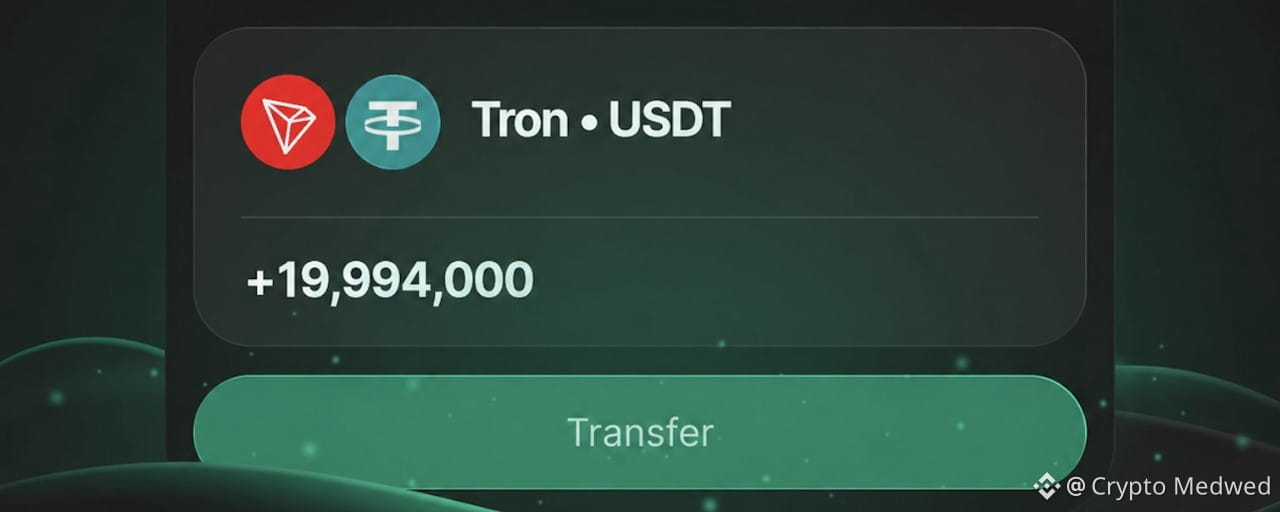

Now large volumes of USDT can be moved between two networks via the USDT0 interface in just a few actions. For TRON, this is especially interesting amid the ongoing growth of stablecoin liquidity and the network’s role in global transfers of digital dollars.
Up to $20 million per transfer
The key change is a substantial increase in available liquidity between Ethereum and TRON. USDT0 said that the infrastructure is now designed for a targeted maximum transaction size of $20 million.
The published example shows a transfer of 20 million USDT from Ethereum to TRON. The interface demonstrates receiving about 19.994 million USDT on the TRON side.
Important! This is an illustration of the USDT0 interface, not a promise of a fixed cost for any transfer. The actual terms of a specific operation must be checked right before confirming it.
Why move USDT between Ethereum and TRON?
Ethereum and TRON are two of the most important networks for circulating USDT, but they are used in somewhat different scenarios.
Ethereum has massive DeFi infrastructure and is used by institutional participants, protocols, exchanges, and other large digital-asset holders.
TRON, in turn, has become widely adopted precisely as a network for moving USDT. In September 2026, the amount of USDT on TRON exceeded $94 billion, and the daily transfer volume was in the tens of billions of dollars.
Therefore, the ability to move large liquidity between these ecosystems is practically important. Capital can be on Ethereum when it’s needed to work with the corresponding infrastructure, and then move to TRON for further transfers and settlement—or vice versa.
Why does the $20 million limit matter?
For the average user, the difference between being able to transfer $1 million or $20 million in a single operation is practically irrelevant. But for large holders, market makers, exchanges, and other professional participants, the situation is completely different.
If you need to move $20 million, limited liquidity may force you to split the operation into many separate transactions. That means extra actions and potentially more complex liquidity management.
Increasing available capacity to $20 million per transaction makes the Ethereum ↔ TRON route far more practical for large transfers.
That’s why this update should be viewed primarily as infrastructure, not something aimed at end users.
What is USDT0?
USDT0 is infrastructure designed to move dollar liquidity between supported blockchains.
The main idea is to reduce fragmentation of USDT across different networks and give users the ability to move value from one ecosystem to another through a single mechanism. For the stablecoin market, this is an important task.
USDT exists across multiple blockchains, but having the same ticker doesn’t mean the tokens can move between networks on their own. For that, corresponding cross-chain infrastructure is required. USDT0 effectively creates such an interaction layer between the supported networks.
Why is this especially interesting for TRON?
The update appeared at a time when the supply of stablecoins on TRON continues to grow.
According to CryptoRank, as of September 25, 2026, since the beginning of the year the stablecoin supply on the network has grown by roughly $8.35 billion— the largest absolute increase among the blockchains included in the published comparison.
At the same time, TRON DAO recently reported exceeding $30 trillion in cumulative transfer volume across the network’s entire history.
These figures can’t be mixed: the growth in stablecoin supply, historical transaction volume, and cross-chain transfers measure different aspects of activity. But together they show just how large TRON’s stablecoin infrastructure has become.
Now it also adds the ability to move up to $20 million in USDT between TRON and Ethereum in a single operation via USDT0.
Cross-chain liquidity is becoming increasingly important
The stablecoin market is gradually turning into a multichain system. A user may need Ethereum for one application, TRON for an international transfer, and another network for trading or DeFi.
The issue is that liquidity ends up distributed among separate blockchains. The easier it is to move it between networks, the less important it becomes where exactly the USDT was originally located.
This is especially important for large participants. If tens of millions of dollars can be moved across networks without needing to run a large number of separate operations, capital becomes more mobile.
In this sense, raising the USDT0 limit is another step toward a situation where different blockchains start operating as parts of a broader stablecoin infrastructure.
Conclusion
Between Ethereum and TRON, infrastructure is emerging that is designed for truly large USDT movements.
TRON already has more than $94 billion worth of USDT and is used for an enormous number of transfers of digital dollars. Ethereum, meanwhile, remains one of the largest ecosystems for DeFi and institutional blockchain infrastructure.
The ability to move up to $20 million between them in a single transaction makes the boundary between two major USDT hubs less noticeable.
If cross-chain infrastructure continues to develop, over time it will matter less and less to a user which network their digital dollars were originally on.
Liquidity becomes multichain, and TRON gets another major channel for interacting with the rest of the USDT market.