

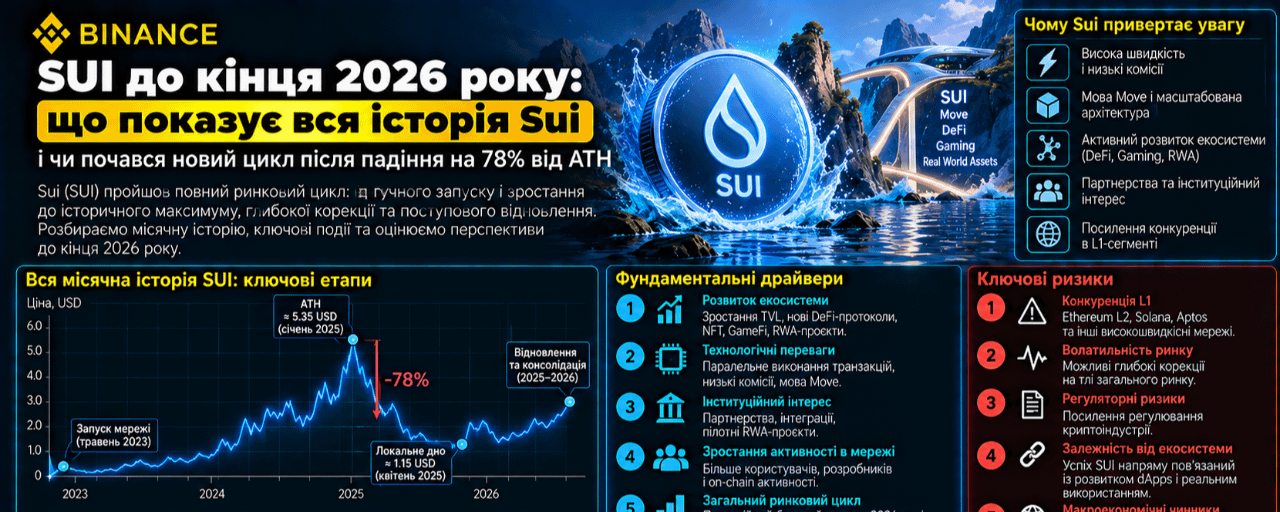

SUI enters the final part of 2026 in a very interesting position.
As of September 29, the token is trading at approximately:
$1.15–1.20.
And that looks fairly modest when you recall the historical all-time high:
$5.35.
That is, SUI is still approximately at:
78% below ATH.
But September 2026 already gave about:
+59%.
As of the end of August, SUI was trading at about $0.73, and in September it rose above $1.28.
So the main question right now is:
is it just a strong rebound after a multi-month drop, or the start of a new Sui revaluation cycle?
To answer that, you need to look at the entire history of SUI since the mainnet launch in 2023.
Sui is one of the youngest large L1s
Sui Mainnet officially launched:
May 3, 2023.
The network is built around Move and an object-centric data model, which allows parallel execution of independent transactions instead of sequentially processing all operations.
SUI fulfills multiple functions at once:
gas;
staking;
network security;
liquidity asset;
governance.
Max supply is limited by:
10B SUI.
At mainnet launch, only about was in circulation:
5%.
The rest of the supply had to gradually come onto the market over the following years.
And it’s precisely the last point that is critically important for the entire SUI price story.
2023: launch and the first capitulation
SUI debuted at around:
$1.
After the initial excitement, the market started selling the token fairly quickly.
Based on available monthly data:
July:
-8%
August:
-21%
September:
-6%
October:
-6%.
On October 19, 2023, SUI set an all-time low at approximately:
$0.365.
That is, less than half a year after mainnet, the token lost about two-thirds of its initial valuation.
and then everything changed very quickly
November 2023:
+35%.
December:
+28%.
SUI ended the year at approximately:
$0.78.
In the incomplete 2023 year, the result was still negative, but the bottom had already formed.
This is the first SUI regularity:
after a prolonged capitulation, it can shift extremely quickly from full apathy to aggressive momentum.
We’ll see this a few more times.
2024: a real Sui breakout
2024 became the strongest year in SUI history.
The year started at around:
$0.84
and it ended around:
$4.12.
Result:
approximately +389–395%.
But the year was not vertical at all.
January 2024: +96%
Only in the first month, SUI nearly doubled:
+96%.
February:
+9%.
March:
+14%.
By spring, the token was already approaching:
$2.
And then a very deep correction started.
April–July: the market wiped out almost all momentum
April:
-40%
May:
-10%
June:
-20%
July:
-14%.
The price returned to approximately:
$0.70.
So SUI lost more than half of its value from the spring highs.
And this is exactly where it’s important to understand the nature of SUI.
This is:
high-beta L1.
When the narrative is strong, it can significantly outpace BTC and ETH.
But when capital exits altcoins, the drop is also much stronger.
September 2024: the start of the second wave
August:
+13%.
And September:
+123%.
This is one of the strongest months in all of SUI history.
Then:
October:
+11%
November:
+76%
December:
+19%.
By the end of the year, SUI was already trading above:
$4.
Why was 2024 so strong?
The market started perceiving Sui not just as:
«one more new L1».
A real DeFi ecosystem started forming.
DeepBook became a native liquidity layer.
DEX activity was growing.
Cetus, Navi, Suilend, Scallop, and other protocols developed.
On top of that, the narrative added:
Solana competitor.
Sui had:
Move;
parallel execution;
low fees;
fast settlement;
consumer-friendly primitives.
And capital started pricing it as one of the potential major L1s of the next cycle.
January 2025: all-time high
On January 6, 2025, SUI set an ATH at approximately:
$5.35.
And practically immediately after that, a completely different cycle began.
2025: -65–67%
SUI opened the year around $4.1–$4.3.
And it ended with:
around $1.40.
Yearly result:
approximately -65–67%.
This is a very important year for understanding SUI.
The technology hasn’t disappeared.
DeFi kept working.
But valuation has become too high relative to the new demand.
The first blow of 2025
January:
almost neutral
February:
-31%
March:
-20%.
Then in April:
+55%.
SUI returned to the $3.5 area.
At first glance, it seemed that the bull market had returned.
But no.
July 2025: another strong rebound
After the next correction:
July:
+30%.
But then:
August:
-10%
October:
-27%
November:
-37%
December:
-5%.
By the end of the year, SUI was again close to:
$1.4.
The main lesson from 2025
Even a good blockchain can be:
bad token trading due to incorrect valuation.
This is one of the most important things in SUI.
Because the network can get better, while the token simultaneously falls due to:
unlocks;
dilution;
weaker altcoin market;
compression valuation multiples;
competition.
And now it’s 2026
The first months were extremely weak.
January:
about -9–18%
February:
around -22%
March:
-3%
April:
+3%
May:
-2–3%
June:
around -22%
July:
about -1%
August:
+6%
September:
approximately +59% at the current moment.
SUI declined in 2026 to approximately:
$0.64.
and now it has returned again to:
$1.15–1.20.
But even after +59% in September 2026, the year is still negative
This is an important detail.
SUI started the year at around:
$1.40.
Current price:
around $1.17.
So YTD is still about:
-15–20%.
That’s why the current move is still better described as:
recovery,
not a new bull market.
But Sui’s fundamentals in 2026 are much stronger than the price
This is where things get interesting.
Today Sui has approximately:
$536M DeFi TVL.
Stablecoin market cap:
around $480M.
24-hour DEX volume:
around $85M.
7-day DEX volume:
above $550M.
Active addresses:
around 128,000 per day.
And the network processes tens of millions of transactions per day.
So this is already not an empty L1.
But there’s a very important nuance here
In September, you could find TVL numbers above:
$1B.
Different dashboards can calculate ecosystem liquidity differently — for example, using bridged/native assets.
Current net DeFi TVL per DefiLlama is approximately:
$536M,
then bridged TVL is approaching:
$1B.
That’s why for valuation analysis, it’s important not to mix these metrics.
DeepBook becomes one of the main assets of Sui
On September 24, 2026, a separate was launched:
DeepBook App.
And DeepBook itself has already processed:
more than $20B in trading volume.
More than 15 applications use it as a shared liquidity layer.
And before the launch of the new app, there was a waitlist with more than:
150,000 traders.
This is a very strong fundamental argument.
Why DeepBook is important
Most blockchains allow third-party DEXs to build liquidity.
Sui went further.
DeepBook is actually:
native on-chain central limit order book infrastructure.
In 2026, the product already includes:
Spot;
Margin;
Predict.
Margin supports native leverage up to:
5x.
Predict uses options-like mechanics.
So Sui is gradually trying to become not just a smart-contract network, but:
on-chain financial execution layer.
The second important story — stablecoins
In March 2026, on Sui, it launched:
Sui Dollar — USDsui.
It is issued by Bridge:
company Stripe.
USDsui is built on Bridge Open Issuance and integrated with the main Sui wallets and DeFi protocols.
This is a very important signal.
Sui gets not just another stablecoin.
It gets:
institutional payment infrastructure connected with the Stripe ecosystem.
And Sui makes stablecoin transfers gasless
In September, Sui reported that transfers of several stablecoins can already work:
without gas for the user.
This is a very interesting model for payments.
A person can send a stablecoin and not even know that they need SUI for gas.
For adoption, this is great.
But there’s a paradox for the token here.
The better the UX, the weaker the direct gas-demand might be
If a user doesn’t need to buy SUI in order to:
to transfer USDC;
transfer USDsui;
to make a payment,
so network usage could grow faster than direct demand for the native token.
This is the same problem we’ve already seen in other cheap networks:
a successful blockchain doesn’t always mean the same growth for the native token.
That’s why for SUI you need to look not only at transactions.
Sui is already moving into real payments
On September 17, Daya integrated Sui as settlement infrastructure for:
cross-border payments;
treasury management;
remittances;
developer APIs.
The launch started in Nigeria, with plans to expand to:
South Africa;
Ghana;
Kenya.
The system uses gasless stablecoin transfers.
So the payments narrative is already going beyond crypto-native DeFi.
Another big direction — Bitcoin
Sui is building Hashi.
Idea:
allow BTC holders to use Bitcoin in DeFi without moving the underlying BTC into a standard custodial wrapped structure.
Sui reports that more than have joined the project:
20 institutional partners,
among which:
BitGo;
Ledger;
Cumberland;
FalconX.
But it’s important:
Hashi hasn’t launched yet.
So it’s a catalyst, but so far:
future catalyst.
The AI narrative has also come to Sui
In 2026, Sui actively promotes:
agentic commerce.
The main idea is that the AI agent should be able to:
receive limited spending authority;
to carry out several actions;
atomically execute a payment;
without getting unlimited access to the user’s wallet.
Sui uses Payment Intents and Programmable Transaction Blocks for this.
This is starting to put Sui in competition not only with:
Solana;
Aptos;
Ethereum,
and partly with:
NEAR.
But the strongest institutional catalyst in 2026 — CME
On May 5, 2026, CME introduced:
SUI Futures
and revenue;
Micro SUI Futures.
CME continues to publish settlements, volume, and open interest for these contracts.
This is a very important change.
An institutional investor can now:
hedge SUI;
short SUI;
trade basis;
to obtain regulated derivatives exposure
without needing to work through a crypto exchange.
But CME is not automatically bullish
This matters.
Regulated futures open up:
long access.
But they are also opening:
short access.
So CME is increasing:
liquidity;
institutional legitimacy;
price discovery.
But doesn’t guarantee growth.
In the US, SUI-based ETF products are already available
In May, SEC filings recorded a prospectus for:
2x Sui ETF.
And in June–July, documents were registered for:
21Shares 2x Long Sui ETF — TXXS.
These products use regulated SUI futures to obtain leveraged exposure.
This is another proof that SUI is moving into:
institutional derivatives universe.
But leveraged ETFs should not be confused with a regular spot ETF.
And here is the main problem with SUI: supply
Max supply:
10B SUI.
In circulation, now approximately:
4.1B.
So:
around 41% of the maximum supply.
Current market cap is approximately:
$4.8B.
And a fully diluted valuation:
around $11.5–$12B.
That’s a very big difference.
That’s why SUI at $1.17 is not necessarily «cheap»
On the chart it looks like:
ATH:
$5.35.
Now:
$1.17.
So:
«the token fell 78%, so it’s cheap».
But calculating it this way is incorrect.
Today, circulation has significantly more SUI than in 2023 or in the early stages of 2024.
That’s why it’s more important to look at:
market cap.
A return to $5.35 today implies a completely different valuation
With the current circulating supply around:
4.1B SUI
price:
$5.35
would have meant a market cap around:
$22B.
And by the time of such a move, circulating supply is most likely to be even larger.
So the old ATH:
is not a free target.
Unlocks — the main structural risk
From the start, Sui was built with a gradual token release schedule.
In 2023, circulation had a little over 5%.
Now:
around 41%.
And going forward, new tokens will continue to come onto the market according to the schedule.
This means that SUI must constantly create:
new demand,
to compensate for the new supply.
This is what distinguishes SUI from BTC
In Bitcoin, new supply is:
predictable;
gradually shrinking due to halving.
In SUI, a significant part of max supply is still:
doesn’t circulate.
Therefore, for holders, dilution matters much more.
There’s also a second major risk — reliability
At the end of May 2026, Sui experienced:
three mainnet outages over roughly 48 hours.
The first two incidents were related to bugs in gas charging logic after release 1.72.
Third — with a separate error saving randomness state during restart validators on epoch transition.
After that, the Sui Core Team released a major fix and a public post-mortem.
For a financial blockchain, this is a serious risk.
Why outages are especially important for Sui
If a blockchain wants to serve:
payments;
leveraged trading;
stablecoins;
institutional assets;
AI agents,
availability should be:
almost flawless.
Speed in millions of TPS doesn’t help if the network sometimes fully stops.
That’s why reliability is one of the key metrics that must be monitored through the end of 2026.
At the same time, the activity is indeed large
According to DefiLlama, Sui is currently processing approximately:
30+ million transactions per day
and has more than:
120,000 active addresses per day.
This is a serious network.
But there’s the next question:
How much economic value do these transactions create for SUI itself?
Fees are still small
With a market cap around:
$4.8B
network revenue remains relatively small.
DefiLlama records only a few thousand dollars of chain revenue per day, even though application-layer fees are much higher.
This is very important.
Sui may have:
huge throughput;
many transactions;
very low fees.
But low fees at the same time mean:
weaker direct cash-flow-like value accrual to the native token.
So SUI is a bet on the network’s future economy
Current valuation is based not so much on today’s revenue.
It is based on the expectation that Sui will become big:
DeFi layer;
payments network;
stablecoin rail;
trading infrastructure;
consumer blockchain;
AI-agent settlement layer.
This makes SUI:
growth asset.
And that’s why it is very sensitive to changes in expectations.
Which historical period is September 2026 most similar to?
The most interesting analogy:
August–September 2024.
Then SUI also went through a deep correction before this.
July ended at around:
$0.82.
August started the recovery.
And September gave:
+123%.
Then Q4 continued the rally, and in January 2025 SUI set an ATH.
In 2026, we see a similar structure:
June:
a strong drop;
July:
stabilization;
August:
+6%;
September:
+59%.
This is a very interesting coincidence.
But there is one huge difference
In 2024, supply pressure was lower.
Today the circulating supply is already:
around 4.1B.
So to repeat the 2024 rally, you need:
a much larger absolute inflow of capital.
That’s why I wouldn’t mechanically carry over the +123% from September 2024 to Q4 2026.
SUI technical structure
Current zone:
$1.15–1.20.
September high:
around $1.28–1.29.
This area is precisely the first serious test right now.
First resistance
$1.28–1.33.
If SUI holds above:
next zone:
$1.45–1.50.
Main breakout
In my view:
$1.50.
Why?
Because returning above an important portion of the distribution from late 2025 matters again.
After $1.50, the recovery structure becomes much more convincing.
Next
Next zone:
$1.75–1.90.
And then:
$2.00.
Exactly $2 is the psychological boundary between:
strong recovery
and:
with a new revaluation phase.
Above $2
Next areas:
$2.30–2.50
and:
$2.80–3.00.
But this requires a very strong Q4.
First support
$1.05–1.10.
After +59% in a month, a return here would be a normal pullback.
Main support
$0.88–0.95.
This is where an important zone of prior consolidation is.
As long as it holds:
the recovery structure remains alive.
Most important structural support
$0.68–0.73.
That’s where the September breakout started.
A return below:
$0.68
would mean the actual cancellation of the entire current recovery.
What could continue the rally
1. SUI passes $1.30 and $1.50
This is the first technical confirmation.
2. DeFi TVL rises again
Current level:
around $536M.
If TVL is consistently returning to $750M–$1B:
this will be a strong fundamental signal.
3. Stablecoin supply grows
Right now in the network there are about:
$480M stablecoins.
For the payments ecosystem, this figure is more important than the number of memecoins.
4. DeepBook continues scaling
More than:
$20B historical volume
is already showing real product-market fit.
If trading activity grows, Sui will get a stronger financial-chain narrative.
5. Institutional access
CME futures already exist.
Leveraged ETF products are already here.
This creates a new liquidity channel.
6. Payments
USDsui;
gasless stablecoin transfers;
Daya;
Bridge/Stripe infrastructure
could become one of the most important catalysts of 2027, which the market will price in earlier.
What could break the rally
1. Unlocks
This is the main fundamental risk.
Only about:
41% max supply
is in circulation.
Even a strong network must constantly find new buyers to absorb supply.
2. Another serious outage
After three halts in May, the market will pay extra attention to reliability.
3. DeFi activity does not return to old highs
The network narrative must be validated by capital.
4. BTC moves into risk-off
SUI — a high-beta asset.
A -10% in Bitcoin could easily mean:
SUI -20–30%.
The 2025 story shows this well.
5. Market cap grows faster than the economy
If the price returns to $2–3, and:
TVL;
stablecoins;
revenue;
DEX volume
don’t grow along with it; valuation becomes vulnerable again.
What different SUI prices will mean
With current circulating supply of about 4.1B — just for rough illustration, since supply keeps changing:
SUI = $1.50
Market cap is approximately:
$6.1B.
SUI = $2
Market cap approximately:
$8.2B.
SUI = $3
Market cap approximately:
$12.3B.
SUI = $5
Market cap approximately:
$20.5B.
And the actual market cap will be even higher if, by then, circulation increases.
That’s why the old ATH must be assessed very carefully.
SUI forecast through the end of 2026
After +59% in September, I don’t expect the token to repeat that result every month.
But the current breakout is already strong enough to indicate a change in the short-term regime.
I see three scenarios.
🟡 Base scenario — 50%
September rally transitions into consolidation.
SUI doesn’t lose:
$0.90–1.00.
DeFi activity remains stable.
The stablecoin ecosystem is gradually growing.
BTC remains above key supports.
SUI passes:
$1.30
and by year-end it’s testing:
$1.50–1.80.
Base range:
$0.95–1.80.
Most likely zone for December 31:
$1.35–1.65.
This is my main scenario.
🟢 Bullish scenario — 30%
For this, you need:
BTC moves into a strong Q4;
ETH breaks $3,000;
SUI holds above $1.50;
TVL returns toward $750M–$1B;
stablecoin supply grows;
DeepBook volume accelerates;
the institutional narrative around CME/ETF strengthens;
unlocks are absorbed without significant sell pressure.
Then:
$1.50
becomes support.
Next zone:
$1.80–2.00.
Then:
$2.30–2.50.
In a very strong Q4:
$2.80–3.00.
Bullish year-end zone:
$2.00–2.80.
A move toward $3 is possible as an expanded bullish scenario.
🔴 Bearish scenario — 20%
Triggers:
BTC sharply corrects;
macro risk-off;
unlock pressure increases;
DeFi liquidity leaves Sui;
stablecoin growth stops;
new reliability problems;
SUI loses $0.90.
Then:
$0.70–0.75
becomes the first big target.
Break through this area:
$0.60–0.65.
In strong altcoin deleveraging:
$0.45–0.55.
Bearish year-end zone:
$0.55–0.85.
Why I didn’t put $5.35 in the base forecast
Because ATH is not a magnet.
From $1.17 to $5.35 requires:
about +357%.
And at the same time, circulating supply continues to increase.
That’s why returning to ATH today requires a much higher absolute valuation than at the beginning of 2025.
This isn’t enough:
«Sui is a good blockchain».
A large new cycle is needed, in which Sui really captures a significant portion:
DeFi;
trading;
payments;
stablecoins;
consumer apps
for competitors.
Which historical scenario would you look at the most?
2024.
But not through the numbers themselves.
The structure is very similar:
a deep drawdown →
summer capitulation →
stabilization →
a strong September breakout.
In 2024, after this there were:
October +11%;
November +76%;
December +19%.
If such a model repeated literally, SUI could end the year much higher than $2.
But there is a fundamental difference:
today supply is significantly higher.
So repeating the same percentage path requires much more capital.
The second historical scenario you can’t forget — 2025
In April 2025, SUI also suddenly surged:
+55%.
In July:
+30%.
And every time it seemed that the trend reversal had already happened.
And the year still ended:
approximately -65%.
So one strong month:
is not yet a new cycle.
It will be October–November that will show whether the September breakout is truly structural.
What I will be tracking through the end of the year
$1.30
First confirmation of breakout.
$1.50
The main boundary between recovery and a new expansion phase.
$2
Main psychological level.
$0.90
The level below which the bullish thesis starts to weaken.
$0.70
The actual cancellation of the September breakout.
And from fundamental metrics
TVL
Now:
around $536M.
Stablecoin market cap
Around:
$480M.
DEX volume
Around:
$550M over the last 7 days.
DeepBook volume
More than:
$20B cumulative.
Circulating supply
Around:
$4.1B out of $10B SUI.
CME Open Interest
The mere appearance of regulated derivatives is important, but now you need to watch:
whether real institutional participation is growing.
Reliability
After the May outages, this is one of the most important technical metrics.
My SUI forecast through December 31, 2026
Current zone:
$1.15–1.20
First support:
$1.05–1.10
Main support:
$0.88–0.95
Structural support:
$0.68–0.73
Bearish breakdown:
below $0.68
First resistance:
$1.28–1.33
Main breakout:
$1.50
Next target:
$1.75–1.90
Psychological level:
$2.00
Bullish extension:
$2.30–2.50
A very strong Q4:
$2.80–3.00.
Summary
In 2026, SUI is in a very interesting contradiction.
On one side, the token:
approximately 78% below ATH.
In 2025, it provided about:
-65%.
And in 2026, even after +59% in September, it’s still roughly negative YTD.
On the other hand:
the network itself is much more mature today than during previous price highs.
There are:
more than $500M DeFi TVL;
around:
$480M stablecoins;
DeepBook with:
$20B+ cumulative volume;
native USDsui from Bridge/Stripe;
gasless stablecoin payments;
regulated CME futures;
SUI-based leveraged ETF products;
new payment integrations;
Bitcoin DeFi roadmap;
AI-agent infrastructure.
So fundamental development:
real.
But there are two serious problems.
First:
supply.
In circulation, only about:
41% of the maximum 10 billion SUI.
So future demand must constantly absorb new supply.
Second:
value accrual.
Extremely cheap, and even gasless, transactions are great for users.
But the network revenue itself is still small compared to the token’s valuation.
So the main SUI question through the end of 2026 is not:
«Is the Sui blockchain good?»
For many technological and product metrics, the answer is already quite strong.
The question is different:
«Is Sui’s economy growing fast enough to absorb future unlocks and justify a new SUI valuation?»
That’s why my base scenario through the end of the year is:
$1.35–1.65.
Bullish:
$2.00–2.80.
Bearish:
$0.55–0.85.
And the most important level:
$1.50.
If after +59% in September, SUI passes $1.50 and at the same time we see further growth:
TVL;
stablecoins;
DeepBook volume;
institutional participation,
it will no longer just be a technical bounce.
This will be an argument that the market is starting to:
reassess the entire Sui economy.
If SUI doesn’t pass $1.30–1.50 and once again loses $0.90, September may turn out to be another strong high-beta rally inside a much longer revaluation phase.
And the main takeaway from all of the SUI story is this:
Sui doesn’t need to prove anymore that it can build a fast blockchain. Now it must prove that a fast network can create an economy that grows faster than the circulating SUI supply increases.
It’s the battle between:
adoption
and
dilution
in my opinion, will determine the price of SUI not only through the end of 2026, but also during the next big cycle.
Not financial advice. The forecast is scenario-based analysis of SUI’s entire history, network activity, DeFi and stablecoin metrics, token unlocks, institutional products, and the current crypto market structure. Historical moves do not guarantee repetition of results.
#SUI #SuiNetwork #SUIPrediction #CryptoAnalysis #BinanceSquare