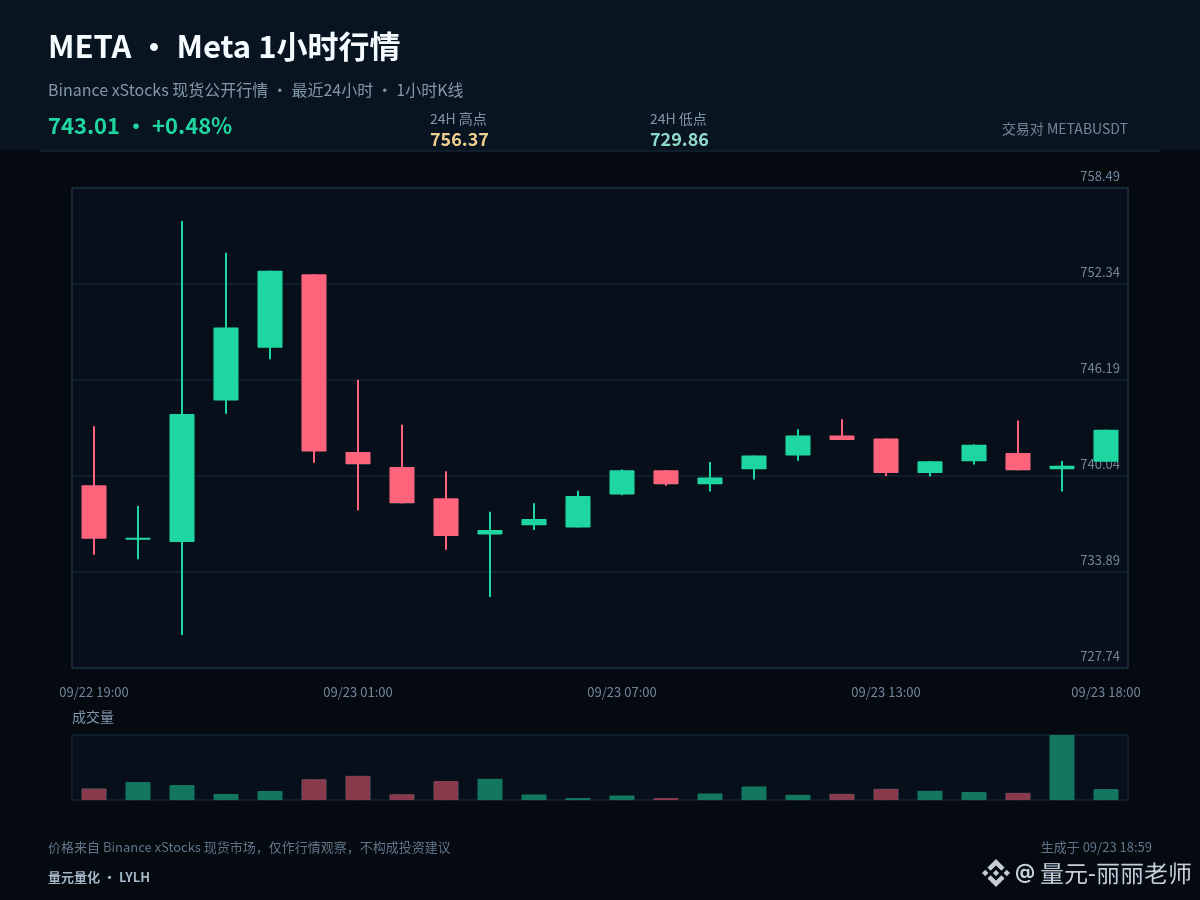
$METAB #META Once momentum picks up, entry should only be considered; more importantly, you need to evaluate the position first. Currently, in the last 1 hour: +0.31%, and in 24 hours: +0.48%. The space that has already been covered cannot simply be treated as the next segment that can be replicated.
$METAB #META A clear one-sided trend has not formed yet; the 1-hour and 24-hour rhythm is still tug-of-war. At this stage, attention should be focused on the boundaries of the range, not on the color of every single candlestick.
The timing more favorable to the bulls is to return to around 743.115, where selling pressure weakens, and then try again at 756.37. If it accelerates without a pullback, the risk-reward of chasing price will decline.
For execution, set clear conditions: after breaking above 756.37, you need confirmation—not chase just because of a momentary surge. If it dips to 729.86, check whether it can quickly reclaim—don’t jump in just because you see a drop. In the middle zone, when the odds are not sufficient, waiting itself is also part of the strategy.
Existing positions can be handled in stages around key levels to avoid making all judgments at once. For those on the sidelines, wait for breakout confirmation or for pullback stabilization. For US stock underlyings, also watch volatility caused by trading session transitions. Your plan should be based on price conditions; do not let emotions replace execution.
Missing a segment of the行情 doesn’t directly cause loss—the problem comes from chasing at the end of volatility without a plan, which forces positions into passivity. Risk control should still come before the conclusion: execute only when conditions are met, and if the price action becomes invalid, reassess promptly. The larger the volatility, the more restrained each individual position should be. The above is a scenario walkthrough based on the current 1-hour and 24-hour data; it does not constitute a promise of returns.
#21SharesLaunchesEuropesFirstZcashETP
$METAB #META A clear one-sided trend has not formed yet; the 1-hour and 24-hour rhythm is still tug-of-war. At this stage, attention should be focused on the boundaries of the range, not on the color of every single candlestick.
The timing more favorable to the bulls is to return to around 743.115, where selling pressure weakens, and then try again at 756.37. If it accelerates without a pullback, the risk-reward of chasing price will decline.
For execution, set clear conditions: after breaking above 756.37, you need confirmation—not chase just because of a momentary surge. If it dips to 729.86, check whether it can quickly reclaim—don’t jump in just because you see a drop. In the middle zone, when the odds are not sufficient, waiting itself is also part of the strategy.
Existing positions can be handled in stages around key levels to avoid making all judgments at once. For those on the sidelines, wait for breakout confirmation or for pullback stabilization. For US stock underlyings, also watch volatility caused by trading session transitions. Your plan should be based on price conditions; do not let emotions replace execution.
Missing a segment of the行情 doesn’t directly cause loss—the problem comes from chasing at the end of volatility without a plan, which forces positions into passivity. Risk control should still come before the conclusion: execute only when conditions are met, and if the price action becomes invalid, reassess promptly. The larger the volatility, the more restrained each individual position should be. The above is a scenario walkthrough based on the current 1-hour and 24-hour data; it does not constitute a promise of returns.
#21SharesLaunchesEuropesFirstZcashETP