
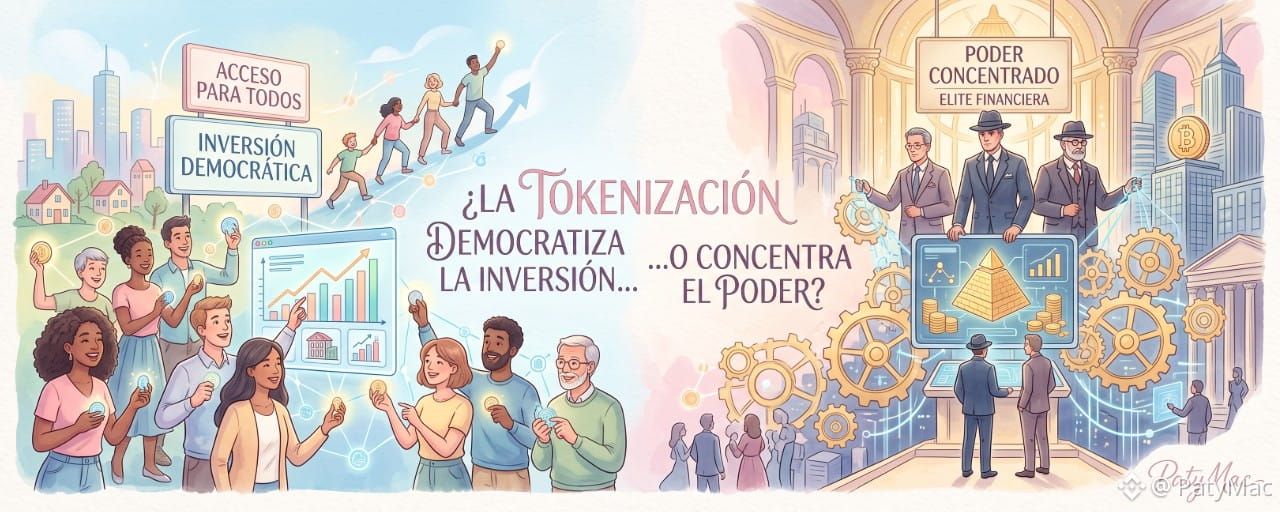

After explaining what tokenization is, a much more uncomfortable question arises: who controls everything that exists behind that token?
Not long ago, I published content explaining how tokenization can transform certain real-world assets or economic rights into digital representations.
And the community’s response was interesting: questions, comments, saves, and conversations that continued even long after the publication.
But the more we talk about tokenization, the more a question appears that I consider even more important:
If now more people can access an investment… does that also mean they have more power?
Because one thing is democratizing access.
And another very different one is democratizing ownership, information, and the capacity to make decisions.
That’s where a much deeper discussion begins.
🧩 FIRST: WHAT CHANGES WHEN WE TOKENIZE AN ASSET?
Let’s imagine a property valued at USD 1,000,000.
In the traditional model, economically accessing that asset may require a significant amount of capital.
Now let’s imagine that the legal structure allows certain rights linked to that project to be represented through 100,000 tokens.
The investment could be split into much smaller units.
A person who previously needed to gather a considerable amount of money could, depending on the structure and applicable rules, access an economic fraction of the project.
This is one of the big promises of tokenization:
fractionalize assets and reduce certain entry barriers.
The World Bank specifically identifies fractionalization as one of tokenization’s potential benefits, because it can reduce the initial outlay required to participate in certain investments.
But here we have to pause.
Because a fundamental distinction appears:
BUYING A FRACTION DOESN’T NECESSARILY MEAN CONTROLLING THE ASSET.
⚖️ TOKENIZING DOESN’T AUTOMATICALLY MEAN TRANSFERRING OWNERSHIP
This is probably one of the most important points in the entire debate.
When someone hears:
“This property was tokenized.”
you can immediately imagine:
“So if I buy a token, I own part of the property.”
Not necessarily.
It depends on what that token represents legally.
It could represent, depending on the structure:
an interest;
an economic right;
a debt instrument;
a contractual right;
an interest in a company that owns the asset;
or certain rights directly linked to the asset.
That’s why, before asking:
“How much is the token worth?”
we should ask:
“WHAT RIGHT DOES IT REPRESENT?”
The difference can be huge.
🏢 A VERY SIMPLE EXAMPLE
Let’s assume a company owns a building.
We have:
BUILDING
↓
PROPRIETARY COMPANY
↓
TOKEN ISSUANCE
↓
INVESTORS
A person buys 100 tokens.
Is it automatically co-registered ownership of the building?
Not necessarily.
It could be acquiring certain rights against the company or against the vehicle used to structure the investment.
That’s why there are two different questions:
Who has the asset?
and
Who has the token?
They may be different people or entities.
And that’s where one of tokenization’s major legal challenges appears:
Correctly connecting the digital right with the right that exists outside the blockchain.
🌎 AND HERE APPEARS THE BIG PROMISE: DEMOCRATIZE
Tokenization can enable something that was previously difficult:
economically split a large investment into smaller units.
That can open the door to:
small investors;
new participants;
business projects;
certain SMEs;
assets that traditionally had little liquidity;
new financing models.
The World Bank also identifies possible benefits of tokenization for financing small and medium-sized enterprises, including the use of certain assets as collateral and reducing certain information asymmetries.
And this can be especially interesting for emerging markets.
But there’s one thing:
lowering the economic barrier to entry doesn’t eliminate all other barriers.
🧠 BECAUSE AN INVESTMENT CAN BE ACCESSIBLE… AND STILL BE HARD TO UNDERSTAND
Let’s imagine that tomorrow I can invest USD 50 in a tokenized asset.
That’s far more accessible than needing USD 50,000.
But:
Do I know exactly what I bought?
Do I know the issuer?
Can I verify the asset?
Do I know what rights I have?
Can I sell whenever I want?
Is there a secondary market?
Who holds custody?
Who manages?
Who is responsible if something goes wrong?
The entry price can go down.
But legal and financial complexity can remain.
And that matters a lot.
🔥 NOW COMES THE UNCOMFORTABLE QUESTION
Let’s assume we have:
100,000 investors
and each one holds a small amount of tokens.
At first glance, it looks like an extremely distributed system.
But behind those 100,000 investors could be:
a platform
an issuer
a custodian
an operator
a developer
a technological infrastructure
that concentrate a large part of operational power.
So we can have:
fractionalized ownership
but
concentrated power.
And this does not automatically mean that there is an irregularity.
It’s simply a question of market structure and governance that deserves to be analyzed.
⛓️ BLOCKCHAIN IS NOT SYNONYMOUS WITH DECENTRALIZATION
This is one of the most frequent confusions.
Just because an operation uses blockchain or DLT doesn’t mean the entire system is decentralized.
We can have a public blockchain and, at the same time:
a single issuer;
a single platform;
a single custodian;
a limited secondary market;
a smart contract administered by a small group;
or an infrastructure controlled by a company.
The register technology and the business’s economic structure are different things.
And the IMF has precisely pointed out that tokenization can reduce some costs and intermediaries, but that the market infrastructure may end up more concentrated due to network externalities.
🔗 THE POWER OF NETWORK EFFECTS
Let’s imagine a platform that starts by tokenizing assets.
At the beginning, there is:
1,000 users.
After that:
10,000.
After that:
100,000.
As the number of participants increases, the platform can become more attractive because there already exist:
more investors;
more assets;
more transactions;
more liquidity;
more information.
And that can create a loop:
more users
↓
more liquidity
↓
more assets
↓
more users
↓
more liquidity
The problem appears when an infrastructure becomes so dominant that it’s hard for other competitors to enter.
The IMF analyzes exactly this phenomenon: network effects can increase the value of broadly used infrastructure, and if there is a dominant provider, they can also increase its market power.
🏦 WILL INTERMEDIARIES DISAPPEAR?
This is another promise that frequently appears:
“With blockchain we won’t need intermediaries anymore.”
Reality can be much more complex.
Tokenization can reduce certain intermediary costs or functions.
But that doesn’t necessarily mean all intermediaries disappear.
In fact, the IMF notes that it’s more likely that tokenization will reduce the cost of certain intermediary processes rather than eliminate them completely. How much of that savings ultimately reaches the investor will depend, among other things, on the level of competition.
And new players appear:
platforms;
custodians;
technology providers;
issuers;
operators;
infrastructure providers;
compliance services;
smart contract developers.
So maybe the right question isn’t:
“Does blockchain eliminate intermediaries?”
or rather:
“WHICH INTERMEDIARIES DISAPPEAR AND WHICH GAIN NEW POWER?”
🇵🇾 AND WHAT IS HAPPENING IN PARAGUAY?
Here the issue stops being only theoretical.
Paraguay already has a new framework for the Securities and Commodities Market through Law No. 7572/2025.
The rule has the objectives of protecting investors and promoting an equitable, sound, efficient, and transparent market.
And there is a particularly interesting point for our topic.
Article 73 considers securities those that represent, among other things, credit rights, ownership, an interest, or cash-settlement obligations that can be the subject of negotiation or transfer.
And it also expressly includes those:
“issued, recorded, transferred, or stored using distributed ledger technologies or similar ones.”
This is important because it shows that the Paraguayan legislator already legally contemplates instruments linked to DLT technologies within the concept of securities, when they meet the characteristics provided for by law.
But pay attention:
that doesn’t mean that every existing token is automatically a security, nor that every tokenization is automatically under the same regime.
Legal classification depends on the specific nature of the instrument and the transaction.
🏛️ PARAGUAY IS IN A STAGE OF REGULATORY DEVELOPMENT
In November 2025, the Central Bank of Paraguay explained that, after the new Securities and Commodities Market Law, during 2026 regulations related to innovation would be advanced, including crowdfunding, tokenization, and DLT. It also noted that one of the challenges will be correctly defining the regulatory perimeter when public resources are being collected, there is an expectation of returns, and there is information asymmetry.
This is particularly relevant.
Because one thing is:
create a technological token.
And another is:
use that instrument to raise funds from the public with an expectation of returns.
The second situation can trigger much more important regulatory issues.
🏠 LET’S IMAGINE NOW A TOKENIZED PROPERTY IN PARAGUAY
Let’s assume a company owns a building.
It legally structures it.
Creates a token issuance.
They offer them to investors.
A person buys.
And you receive your tokens in a wallet.
The question shouldn’t end there.
We should keep asking:
Who owns the property?
What document links the token to the property?
What rights does the investor receive?
Who manages the income?
How are they distributed?
Can they sell their tokens?
Where?
Who controls the secondary market?
What happens if the company goes insolvent?
What happens if the property has a mortgage?
What happens if there is a seizure?
What jurisdiction applies?
What authority supervises the operation?
That’s where tokenization stops being just a technological issue.
It becomes:
Law + Finance + Technology.
⚠️ THE TOKEN CAN BE ON BLOCKCHAIN. THE ASSET REMAINS IN THE REAL WORLD.
This point deserves special attention.
Let’s imagine:
Wallet X
↓
owns
Token #4587
Meanwhile:
Company Y
↓
appears as the owner of the property.
We have two realities:
DIGITAL REALITY
Wallet X → Token
LEGAL REALITY
Company Y → Property
The fundamental question is:
WHAT LEGAL RELATIONSHIP EXISTS BETWEEN BOTH?
Because the blockchain can prove certain movements or records within its own infrastructure.
But it doesn’t automatically replace all external legal records.
🔐 AND IF THE SMART CONTRACT FAILS?
Another aspect we can’t ignore.
Tokenization introduces software into processes that may have economic consequences.
And the software can contain:
errors;
vulnerabilities;
program failures;
integration problems;
external dependencies.
The IMF warns that programs used in tokenized structures can introduce risks stemming from defective code and contingent contract chains.
Then a very interesting legal question appears:
If a technological error causes an economic loss, who is responsible?
The issuer?
The developer?
The platform?
The custodian?
The technology provider?
The answer can’t be given simply by looking at the blockchain.
You need to analyze:
contracts + applicable legislation + corporate structure + regulation + specific circumstances.
💧 AND TOKENIZING DOESN’T GUARANTEE LIQUIDITY
Another common mistake is thinking:
“If it’s tokenized, I can sell it easily.”
Not necessarily.
Tokenization can facilitate certain transfer mechanisms.
But to sell, you need:
a buyer.
You can have:
100,000 tokens
and practically no market.
Liquidity depends on the existence of participants, infrastructure, rules, trust, and market conditions.
Moreover, the BIS has noted that choosing the technological architecture creates a trade-off: a shared network can reduce fragmentation, while multiple interoperable networks can increase competition in infrastructure but also fragment liquidity and assets. That’s why it considers common standards and interoperability to be important.
👥 SO WHO REALLY HAS POWER?
We can analyze a tokenized system at six levels:
1. THE OWNER OF THE ASSET
Who legally owns the property, company, or asset?
2. THE ISSUER
Who creates and offers the tokens?
3. INFRASTRUCTURE
Who controls the technology on which tokens are issued or traded?
4. THE CUSTODIAN
Who keeps the assets, keys, or elements needed to execute the structure?
5. THE MARKET
Where can tokens be bought and sold?
6. THE INVESTOR
What rights do they actually have?
This last question often gets less attention than it deserves.
💰 HOW MUCH DOES IT COST TO GET IN… AND HOW MUCH DOES IT COST TO GET OUT?
Democratization is usually measured by the first number:
“Now you can get in with USD 50.”
But we should also look at the second one:
“Can you get out?”
Because an investment can have an extremely accessible entry and a very complicated exit.
That’s why, before investing, you need to analyze:
price;
fees;
liquidity;
transfer restrictions;
secondary market;
rights;
risks;
jurisdiction;
custody.
An accessible investment is not necessarily a liquid investment.
🌱 CAN TOKENIZATION BENEFIT SMEs?
Yes, potentially.
A small company may have valuable assets but face difficulties obtaining financing.
Tokenization could make it possible to structure certain rights over assets or projects in a fractional way and potentially accessible to more investors.
The World Bank considers that tokenization can open financing possibilities for SMEs and facilitate certain uses of assets as collateral.
But again:
technology doesn’t replace the legal structure.
If the asset is:
mortgaged;
seized;
subject to restrictions;
badly valued;
or legally disconnected from the token,
the problem continues to exist.
⚖️ TOKENIZING DOESN’T ELIMINATE THE RIGHT
And this is perhaps the part I’m most interested in as a lawyer.
Because many times tokenization is discussed as if blockchain could build a world completely separate from traditional rules.
It doesn’t work like that.
When a token represents or is linked to a real-world asset, issues like the following still matter:
Civil law;
Corporate law;
Contract law;
Register law;
Tax law;
Inheritance law;
Procedural law;
anti-money laundering prevention;
investor protection;
securities market regulation.
Technology can change how a digital representation is registered or transferred.
But we still need to determine:
WHAT RIGHT EXISTS?
WHO DOES IT BELONG TO?
HOW IS IT EXERCISED?
AND AGAINST WHOM CAN IT BE ENFORCED?
🌎 THE CHALLENGE FOR LATIN AMERICA
For countries like Paraguay and other Latin American economies, tokenization can represent an interesting opportunity.
But the discussion shouldn’t be limited to:
“Can we tokenize?”
The question should be:
“Can we tokenize in a legally secure way?”
That requires thinking about:
financial education;
digital education;
investor protection;
transparency;
interoperability;
custody;
fraud prevention;
asset identification;
traceability;
liquidity;
claim/recovery mechanisms;
regulation.
Because if the technology advances faster than the investor’s understanding, we can end up with a technically sophisticated market that is hard to understand for the person putting in their money.
🔥 THE BIG PARADOX
And here we reach the heart of this article.
Tokenization can make it possible for a person who would never have been able to participate economically in a given project to access a fraction.
That can indeed expand access.
But at the same time, the infrastructure required to create, manage, custody, and trade those tokens may end up concentrated among a few players.
So we can have:
more people with access
but
not necessarily more people with power.
And this difference is fundamental.
🧠 ACCESS ≠ POWER
We can summarize the whole debate in four sentences:
Fractionalizing an asset ≠ fractionalizing power.
Lower the entry price ≠ eliminate risk.
Blockchain ≠ automatic decentralization.
Token ≠ necessarily direct ownership of the underlying asset.
These four differences should accompany anyone interested in tokenization.
🏛️ ARE WE CHANGING INTERMEDIARIES?
For decades, much of the financial system has been organized around:
banks
exchanges
funds
custodians
intermediaries
Tokenization can modify some of those functions.
But it can also create new centers of power:
platforms
issuers
technology providers
digital custodians
operators
DLT infrastructures
tokenized markets
That’s why one of the most interesting questions for the coming years will be:
Does tokenization eliminate intermediaries… or does it change who intermediates?
🇵🇾 WHAT SHOULD A PARAGUAYAN INVESTOR ASK?
Before buying any token that supposedly represents real estate, a company, a project, or an asset, I would have this checklist:
1️⃣ What exactly am I buying?
2️⃣ What right does the token represent?
3️⃣ Who is the owner of the underlying asset?
4️⃣ What document legally connects the token to that asset?
5️⃣ Who issued the tokens?
6️⃣ Who manages the platform?
7️⃣ Who holds custody?
8️⃣ Is there a real secondary market?
9️⃣ Can I sell whenever I want?
🔟 What happens if the issuer goes bankrupt?
1️⃣1️⃣ What happens if the asset has a debt, mortgage, or seizure?
1️⃣2️⃣ What legislation applies?
1️⃣3️⃣ Where can I file a claim?
1️⃣4️⃣ What authority supervises the operation?
1️⃣5️⃣ What are all the fees?
And one last question that should be in big letters:
WHO CONTROLS THE INFRASTRUCTURE?
🔥 THEN… DOES TOKENIZATION DEMOCRATIZE OR DOES IT CONCENTRATE?
The most honest answer is:
IT CAN DO BOTH.
It can democratize:
✔ access;
✔ fractionalization;
✔ certain investment opportunities;
✔ some transfer processes;
✔ potentially certain financing mechanisms.
But it can also concentrate:
⚠️ infrastructure;
⚠️ data;
⚠️ custody;
⚠️ liquidity;
⚠️ issuance;
⚠️ technology;
⚠️ capacity to make decisions.
The IMF itself points out this duality: tokenization can reduce frictions, costs, and certain needs for intermediaries, but it can also create new forms of infrastructure concentration and market power.
And the BIS points out that the decisions made now about the architecture of these markets can influence whether the benefits of tokenization end up being widely distributed or are instead conditioned by fragmented or dominant structures.
💭 MAYBE THE QUESTION IS MISFRAMED
Maybe we shouldn’t ask only:
“Does tokenization democratize investing?”
We should ask:
Who can enter?
Who can leave?
Who decides?
Who controls?
Who has the information?
Who holds custody?
Who is responsible?
Because real financial democratization isn’t only about letting more people buy.
It also implies that those people know what they are buying and what their rights are.
🌐 THE FUTURE OF TOKENIZATION WON’T BE ONLY TECHNOLOGICAL
The discussion that follows won’t be simply:
“Does blockchain work?”
Technology already allows experimentation with these models.
The discussion will be much more complex:
What rules do we need so that a digital infrastructure can expand access without creating new monopolies, new information asymmetries, or new risks for those who invest?
And in countries like Paraguay, where the securities market framework is expressly incorporating instruments based on DLT and where the BCP has announced regulatory progress on tokenization, this debate is no longer purely futuristic.
🔥 AND HERE IS MY CONCLUSION
The real tokenization revolution isn’t simply about turning real estate, a company, or an asset into thousands of tokens.
That’s only the technological part.
The real transformation will be determining what rights these thousands of people now able to participate in actually have.
Because we can have:
100,000 investors
100,000 wallets
100,000 tokens
and yet…
very few actors making the fundamental decisions.
That’s why:
TOKENIZATION CAN FRACTIONALIZE AN INVESTMENT WITHOUT NECESSARILY FRACTIONALIZING POWER.
And that’s one of the most important questions—legal, economic, and technological—of this new stage.
💬 I’LL LEAVE YOU A QUESTION
If tomorrow you could invest USD 100 in a tokenized fraction of a USD 10 million building…
Would you feel like you truly own part of the building?
Or would you consider that first you need to know exactly what right that token represents?
Because in the end…
THE TOKEN CAN BE DIGITAL.
BUT THE RIGHT IT REPRESENTS STILL NEEDS A FOUNDATION IN THE REAL WORLD.
And that’s where Blockchain, Finance, and Law start speaking the same language.



#Tokenizacion #Blockchain #ActivosDigitales #CryptoLaw #FinanzasDigitales