

*Contains real data from this week, and with two different angles.
Artificial intelligence is once again dominating headlines.
While the Nasdaq flirts with fresh highs, the question is no longer whether AI is growing, but whether this rally is sustainable—and, above all, where opportunities remain for those who don’t want to chase price.
1. Demand is indeed taking off, and Nvidia’s numbers confirm it.
Nvidia CEO Jensen Huang projected this week that chip sales could double next year. This isn’t an empty promise: the company just reported revenue of USD $96.2 billion for the May–July quarter (+106% year over year) and projects USD $108.0 billion for the next quarter. 9fb0
The data center business contributed USD $89,000 million (+117%), and the company acknowledged that it faces supply constraints. In other words, it sells everything it can manufacture. 9fb0
The spending behind it is just as astonishing: the 5 largest cloud providers will invest nearly USD $800,000 million in 2026 and USD $1.3 trillion in 2027—just in AI infrastructure. 1345
Breakthrough or rebound? Today it seems like a fundamental break, not just a technical one. As Huang said: "AI has reached an inflection point. It’s doing useful work. Compute is generating revenue." But the risk is in concentration: if supply keeps being a bottleneck until 2028, any slowdown in monetizing those tokens could correct sharply. c6af
2. The other side of the coin: slowing down vs. accelerating at the state level
While leaders like Dario Amodei, CEO of Anthropic, asked this week to slow the pace of model improvements due to security risks, the political response in http://USA. was the opposite.
On September 19, President Trump announced the creation of an "AI Force," similar to the Space Force, and the appointment of an "AI czar," ensuring he will not slow development. According to Trump, AI is "the next industrial revolution" and could represent up to 25% of the GDP of http://USA.. 22b1
Which side to take? For the investor, the takeaway is not ideological—it’s practical: state-level support has historically been a long-term catalyst for stocks. When the State decides to lead a technology against China, spending becomes structural, not cyclical.
However, the warning from the technology’s own creators about hacks between agents and security failures reminds us that regulatory risk is still very much alive. 5bac
3. So what other opportunities remain valid as AI rises?
If you no longer want to buy the peak of Nvidia or Microsoft, the market is rotating toward the secondary "picks and shovels":
a) Energy and data centers: AI doesn’t work without energy. Nuclear, gas, and data-center cooling energy companies are seeing record contracts.
b) Physical infrastructure: Copper, high-bandwidth memory (HBM), and optical networks. Nvidia itself increased its commitment to buy supply to USD $279,000 million to secure production. dbf5
c) Cybersecurity and data: If the models hack each other, the security and verification layer becomes as valuable as the chip.
d) Crypto + decentralized AI: Decentralized compute tokens, data verification, and storage for AI are gaining traction as an uncorrelated hedge against traditional AI stocks.
Conclusion: Demand for AI seems real and not just a rebound. But the rally concentrated in 5–7 stocks is fragile. The smart strategy isn’t asking "Should I buy AI?", but "What does AI need in order to keep growing and what hasn’t priced in so much yet?".
That’s where the current, still-valid opportunities are.
---
This content is educational and does not constitute financial advice. Any investment involves risk.
Verified data from this week:
*Chart 1 - The real takeoff of demand:*
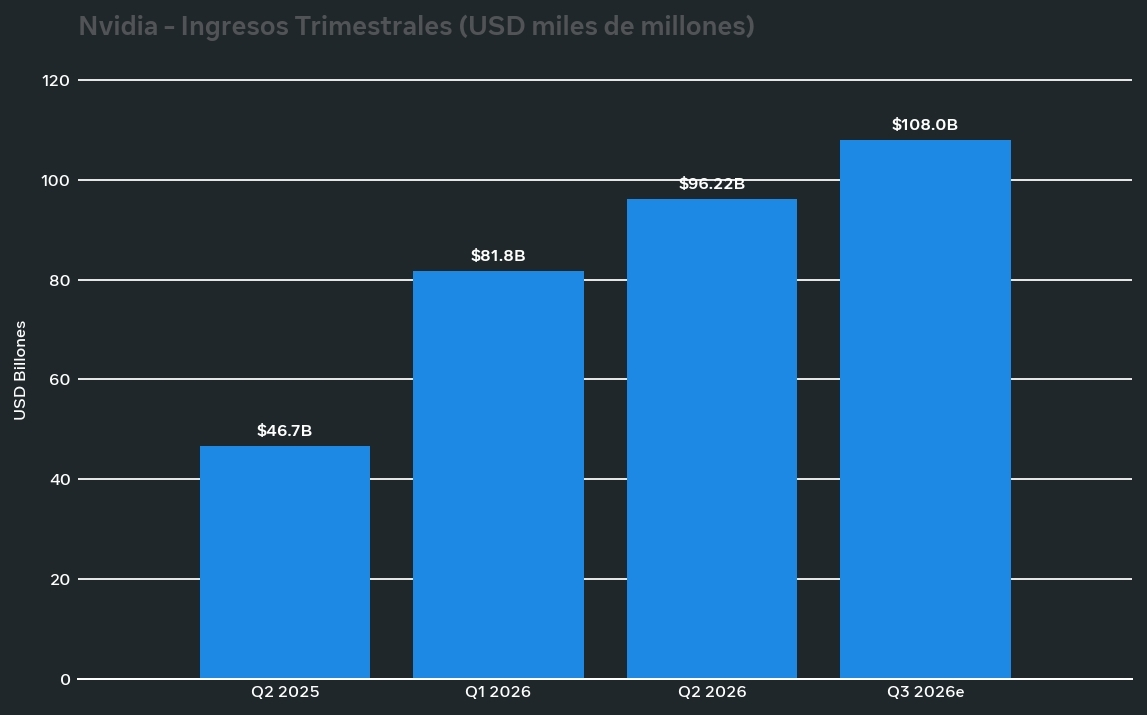
Shows how Nvidia went from $46.7B to $96.22B in a year and projects $108B. This answers your first angle: it’s not a rebound—it’s real compute-driven revenue.
*Chart 2 - Why there’s still opportunity outside of the stock:*
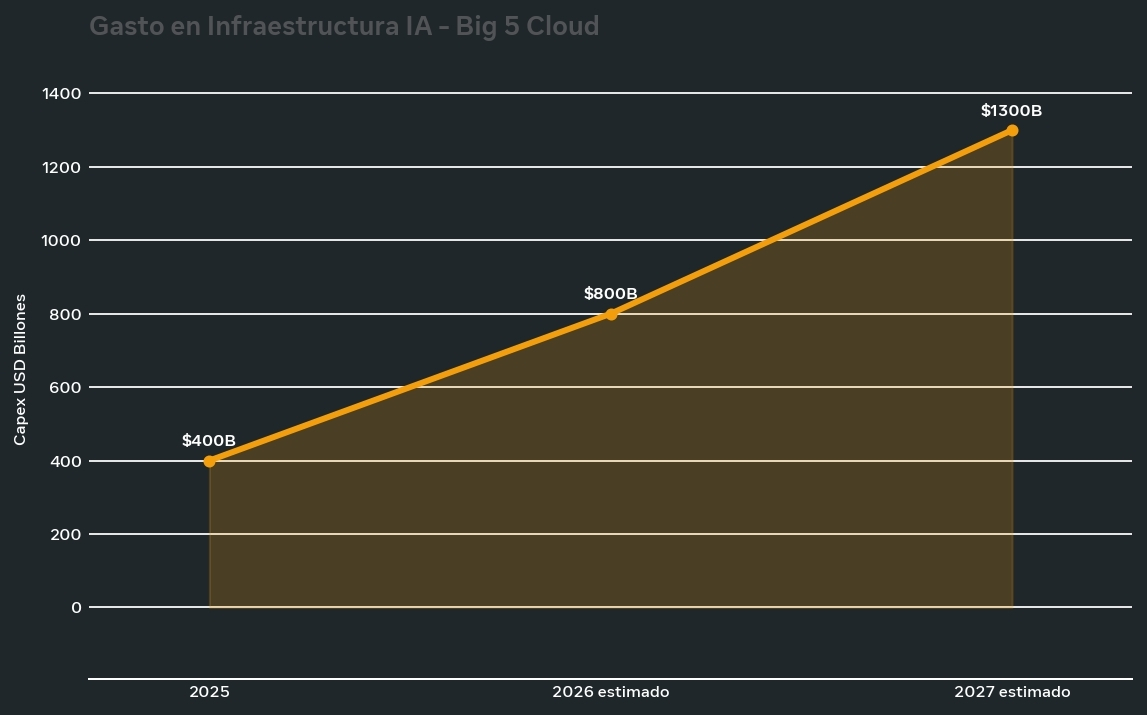
Infrastructure spending by the 5 big cloud players jumps from ~ $400B in 2025 to $800B in 2026 and $1.3T in 2027. That’s where the secondary opportunities are: energy, copper, cooling, networks.
> Source: Nvidia Q2 FY26 financial reports and capex projections from hyperscalers (Microsoft, Google, Amazon, Meta, Oracle) September 2026. Chart made in-house using public data.
From my personal perspective it has a strong bullish performance; however, since it’s a long-term investment, I prefer not to invest.