
光明社区-阿波罗
518 Posts

光明社区-阿波罗
 Square Verified+
LUCiC·超级共识者‖光明社区·文化传播者‖利他主义·坚定奉行者 LUCiC·Super Consensus Holder‖Guangming Community·Cultural Communicator‖Steadfast Practitioner of Altruism.

SOL Holder
Frequent Trader
7.4 Years
644 Following
35.9K+ Followers
33.1K+ Liked
Posts
All
Quotes
Live
PINNED

PINNED


Baoluo币商资本
·
--
#比特币四周内第三次单块重组
Is it a trend-driven advantage or a news-driven advantage? What are the differences and connections between them?
$BTC $AAPL.US
Is it a trend-driven advantage or a news-driven advantage? What are the differences and connections between them?
$BTC $AAPL.US


慢就是快Mike
·
--
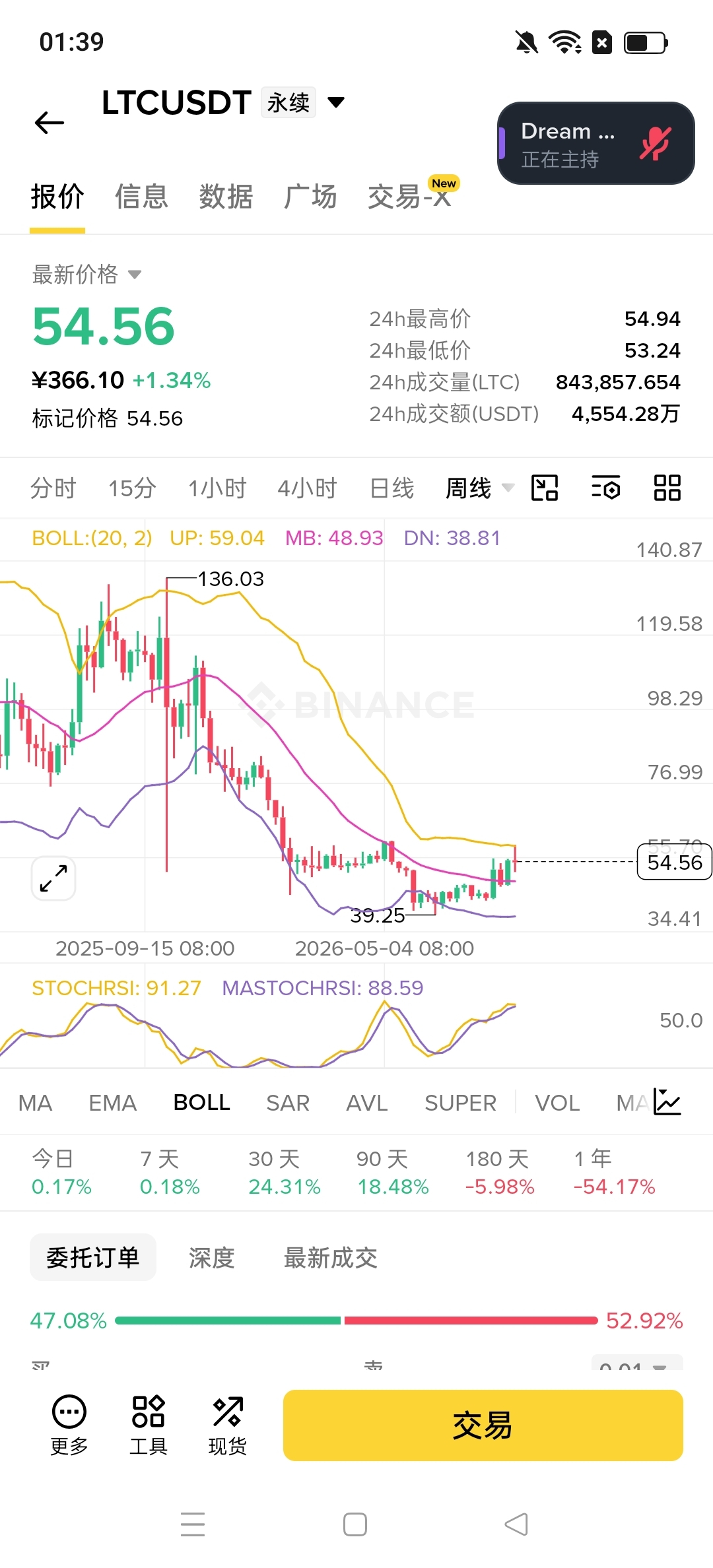
$LTC Grayscale makes another move—will LTC become the next ZEC?
On September 11, Grayscale filed an S-3/A amendment with the SEC. The plan is to convert the Litecoin trust into a Grayscale Litecoin Trust ETF, with the code unchanged—still LTCN. The listing venue will move from the OTC to NYSE Arca.
When the news came out, I checked the LTC price action—there was no reaction. That’s normal. For something like this, people who understand it already knew. People who don’t just glance at the headline and scroll past.
On September 11, Grayscale filed an S-3/A amendment with the SEC. The plan is to convert the Litecoin trust into a Grayscale Litecoin Trust ETF, with the code unchanged—still LTCN. The listing venue will move from the OTC to NYSE Arca.
When the news came out, I checked the LTC price action—there was no reaction. That’s normal. For something like this, people who understand it already knew. People who don’t just glance at the headline and scroll past.

听澜321
·
--
🤐 Is the crypto market turning red again today? Everyone, don’t panic first~
With this market move, do you feel like your heart is freezing, one after another?
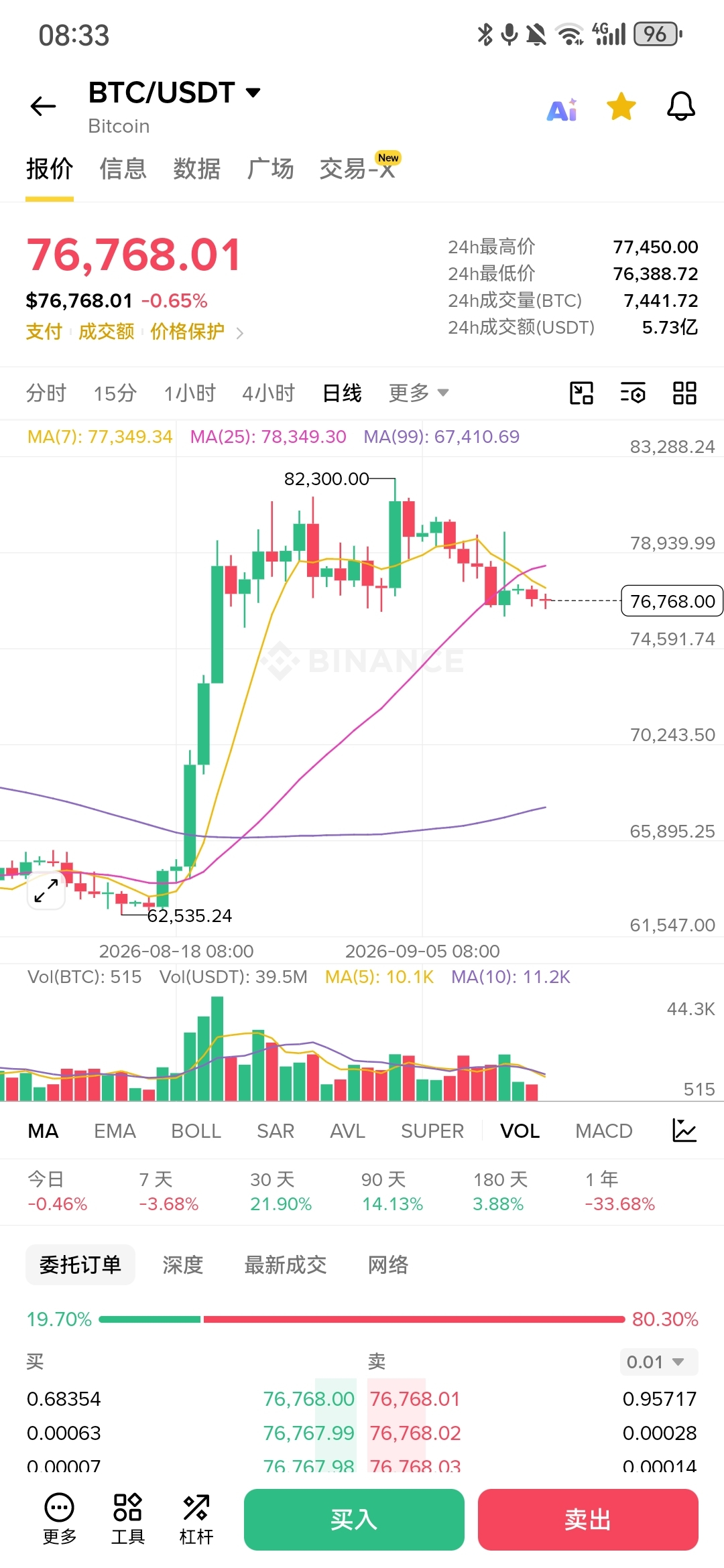
$BTC has fallen back below 77,000 again, and in the past 24 hours, more than 120,000 people were liquidated.
Why is it dropping? To put it simply: “waiting for the meeting.”
1️⃣ The Fed is “making moves”
The day after tomorrow (the 16th), the Federal Reserve will release its interest rate decision. According to the latest data, the probability of a rate hike in September has jumped straight to 86.5%! Even Goldman Sachs has changed its tune, saying this time they’ll hike. Big money is scared and has started running; institutions have continuously withdrawn funds from Bitcoin ETFs for 4 straight days.
2️⃣ Oil prices are still rising
Brent crude oil has broken past $107. When oil prices rise, inflation doesn’t come down, and the Fed is even less willing to loosen policy. This logic is something even old leeks understand.
3️⃣ ETF funds are “moving”
The most wild part is that while Bitcoin ETFs are bleeding, Ethereum ETFs have quietly gone in by more than $200 million. Big money isn’t leaving—it's just rotating positions.
👉 One-sentence summary: It’s not that crypto is done for—it’s that the money is waiting for the Fed to blow the whistle 😂
Right now, everyone on the internet is betting: is this rate hike the last one, or the start of a nightmare?
Do you think the Fed is a dove or a hawk this time?
Drop a comment—liquidated brothers, let’s huddle together for warmth 😂😂😂
#Clarity法案9月15日程序性投票 #全网爆仓6.74亿美元
With this market move, do you feel like your heart is freezing, one after another?
$BTC has fallen back below 77,000 again, and in the past 24 hours, more than 120,000 people were liquidated.
Why is it dropping? To put it simply: “waiting for the meeting.”
1️⃣ The Fed is “making moves”
The day after tomorrow (the 16th), the Federal Reserve will release its interest rate decision. According to the latest data, the probability of a rate hike in September has jumped straight to 86.5%! Even Goldman Sachs has changed its tune, saying this time they’ll hike. Big money is scared and has started running; institutions have continuously withdrawn funds from Bitcoin ETFs for 4 straight days.
2️⃣ Oil prices are still rising
Brent crude oil has broken past $107. When oil prices rise, inflation doesn’t come down, and the Fed is even less willing to loosen policy. This logic is something even old leeks understand.
3️⃣ ETF funds are “moving”
The most wild part is that while Bitcoin ETFs are bleeding, Ethereum ETFs have quietly gone in by more than $200 million. Big money isn’t leaving—it's just rotating positions.
👉 One-sentence summary: It’s not that crypto is done for—it’s that the money is waiting for the Fed to blow the whistle 😂
Right now, everyone on the internet is betting: is this rate hike the last one, or the start of a nightmare?
Do you think the Fed is a dove or a hawk this time?
Drop a comment—liquidated brothers, let’s huddle together for warmth 😂😂😂
#Clarity法案9月15日程序性投票 #全网爆仓6.74亿美元
@听澜321
is speaking[LIVE] 🎙️ Building Binance Square, holding BNB|On a new Monday, BTC is back to 77,000—could this be related to whether the Clear Act’s final vote can actually be carried out? Let’s talk~
6.1k listens

Noor221
·
--
Bullish$DEBIT is putting on a massive performance today, printing a massive green god candle and breaking past major resistance levels! 📈🔥
Key Metrics Breakdown:
Current Price: $3.16 (+61.41%)
Market Cap: $54.35M
Fully Diluted Valuation (FDV): $315.25M
Liquidity: $2.53M
Holders: 14,008
Technical Highlights:
Massive Volume Spike: Trading volume has exploded past 1.07B, easily surpassing both the MA(5) and MA(10) averages.
Breakout Momentum: The 1D chart shows a strong expansion following weeks of consolidation around the $1.55 – $2.17 range, pushing directly toward test levels above $3.41.
Holder Growth: On-chain holders have crossed 14K, reflecting solid retail and smart money interest.
Volatile moves like this bring high reward but require tight risk management. Are you taking profits here or holding for higher targets? Let us know your trading plan below! 👇$DEBIT
#DEBIT #CryptoUpdate #Altcoins #TechnicalAnalysis
Do you think it's HITS 5$ OR 10$
Key Metrics Breakdown:
Current Price: $3.16 (+61.41%)
Market Cap: $54.35M
Fully Diluted Valuation (FDV): $315.25M
Liquidity: $2.53M
Holders: 14,008
Technical Highlights:
Massive Volume Spike: Trading volume has exploded past 1.07B, easily surpassing both the MA(5) and MA(10) averages.
Breakout Momentum: The 1D chart shows a strong expansion following weeks of consolidation around the $1.55 – $2.17 range, pushing directly toward test levels above $3.41.
Holder Growth: On-chain holders have crossed 14K, reflecting solid retail and smart money interest.
Volatile moves like this bring high reward but require tight risk management. Are you taking profits here or holding for higher targets? Let us know your trading plan below! 👇$DEBIT
#DEBIT #CryptoUpdate #Altcoins #TechnicalAnalysis
Do you think it's HITS 5$ OR 10$
白鲨观点
·
--
On Sunday evening, let’s just chat.
A lot of friends who are new to the scene ask me: what’s most important in trading? Is it technical analysis? Is it information channels? Or is it money management?
I say none of those. The most important thing in trading is admitting that you’re not good enough.
This sounds a bit bleak, but it’s really something I figured out after losing a lot of money. In the first few years after I got into the industry, I always felt I was smarter than others. If other people lost money, it was because they were stupid—I was definitely different. I studied all kinds of technical indicators, read dozens of trading books, and reviewed my trades late into the night every day. I thought I was prepared enough.
So what happened? The market slapped me in the face the way it wanted to—no mercy at all.
Later, I slowly realized that in front of the market, your little bit of “smartness” is really nothing. You think you understand the trend, but actually you just got lucky and happened to be right a few times. You think you’ve found a pattern, but actually it’s just the market drawing you a carrot.
Admitting you’re not good enough isn’t surrender—it’s getting your position right. You know there are many things you don’t understand, so you won’t go all-in with your whole account balance, you won’t pile on leverage a hundredfold, and you won’t go all-in just because you heard a piece of news. You’ll respect the market, leave room for error, cut losses, and wait patiently.
In the end, trading isn’t about who’s smarter—it’s about who can better recognize themselves.
People who know they’re not good enough can actually go farther.
In the end, trading isn’t about who’s more clever—it’s about who can better recognize themselves.
People who know they’re not good enough can actually go farther.
At 9 p.m., I’ll open the mic in the chat room and talk about the pitfalls I’ve stepped into over the years and the lessons I’ve learned. This isn’t shilling trades—just pure chatting. If you want to drop by and sit in, go to my profile and enter the chat room.
A lot of friends who are new to the scene ask me: what’s most important in trading? Is it technical analysis? Is it information channels? Or is it money management?
I say none of those. The most important thing in trading is admitting that you’re not good enough.
This sounds a bit bleak, but it’s really something I figured out after losing a lot of money. In the first few years after I got into the industry, I always felt I was smarter than others. If other people lost money, it was because they were stupid—I was definitely different. I studied all kinds of technical indicators, read dozens of trading books, and reviewed my trades late into the night every day. I thought I was prepared enough.
So what happened? The market slapped me in the face the way it wanted to—no mercy at all.
Later, I slowly realized that in front of the market, your little bit of “smartness” is really nothing. You think you understand the trend, but actually you just got lucky and happened to be right a few times. You think you’ve found a pattern, but actually it’s just the market drawing you a carrot.
Admitting you’re not good enough isn’t surrender—it’s getting your position right. You know there are many things you don’t understand, so you won’t go all-in with your whole account balance, you won’t pile on leverage a hundredfold, and you won’t go all-in just because you heard a piece of news. You’ll respect the market, leave room for error, cut losses, and wait patiently.
In the end, trading isn’t about who’s smarter—it’s about who can better recognize themselves.
People who know they’re not good enough can actually go farther.
In the end, trading isn’t about who’s more clever—it’s about who can better recognize themselves.
People who know they’re not good enough can actually go farther.
At 9 p.m., I’ll open the mic in the chat room and talk about the pitfalls I’ve stepped into over the years and the lessons I’ve learned. This isn’t shilling trades—just pure chatting. If you want to drop by and sit in, go to my profile and enter the chat room.


光明社区-亮总
·
--
2025 is a turning point, 2026 is results-driven. For some, things take a nosedive; for others, they rise with the wind. Why run around in all directions? Brightness Community has everything you need.



奕澤YiiiiiZze
·
--
🧧🧧🧧Spotting trends is what makes for steady, long-term progress. Hold LUCiC, and, through the ups and downs of the market, find clarity and act with conviction. Every choice you make is a fearless rush toward the future.
Follow, like, and share
Follow, like, and share

乘风Sunshine
·
--
I made money—earned 48 US dollars. Now playing event contracts is getting harder and harder. Getting some real “meat” is really not easy. My daily living expenses are in hand.
(ps: I’m recovering; when I’m back, I’ll stream steadily again. The preliminary plan is still the same old schedule: event contract at 7:00 AM, and perpetual contract at 10:00 PM)
(ps: I’m recovering; when I’m back, I’ll stream steadily again. The preliminary plan is still the same old schedule: event contract at 7:00 AM, and perpetual contract at 10:00 PM)



Ahmed Ali Nizamani
·
--
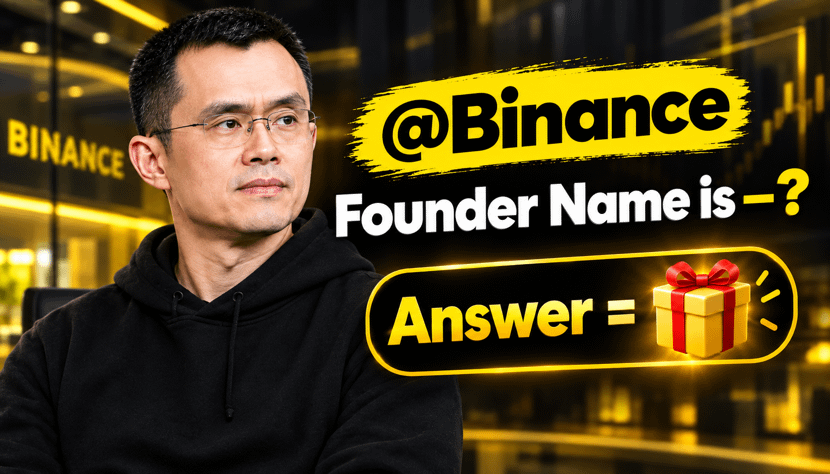
What is name of Binance Founder ?
Answer = 🎁🎁🎁
Answer = 🎁🎁🎁

逐浪字母哥
·
--
📢📢📢Comment➕Forward $BTC
Understand candlestick charts, avoid pitfalls—daily review shares my thinking. Follow to discuss the market together and unite to fully grasp it 📈$SOL
Understand candlestick charts, avoid pitfalls—daily review shares my thinking. Follow to discuss the market together and unite to fully grasp it 📈$SOL


白鲨观点马来西亚
·
--
a16z buys HYPE like crazy—what are institutions betting on?
a16z has added to its HYPE position again. It now holds 5.2 million tokens, at an average cost of $67, with an unrealized profit of about $95 million. A week ago, it just bought more than 800,000 tokens—so this is another add.
Institutional crypto buying is different from retail—retail looks at the K-line and chases pumps and sells dumps, while institutions look at roadmap and positioning, betting on the right track.
On this Hyperliquid track, the core bet is essentially: "can decentralized derivatives eat into the share of centralized exchanges?"
It’s like when e-commerce first took off—some people thought it was just small-scale play, while others had already gone heavy on logistics infrastructure.
But here’s the question: a correct track doesn’t necessarily mean the right asset. a16z’s unrealized profit is nearly $100 million. Its cost is $67; now the price is $85. Just because it’s making money doesn’t mean you who enter now can make money too. It can hold for three years until the industry realizes. You might not even survive a drawdown within three days.
Institutional crypto buying is allocation; retail crypto buying is gambling. The same asset, different buyers—the logic is completely different. Don’t assume things are safe just because institutions move in. They’re here to build a position; you’re here to be the exit liquidity. Between those two is multiple bull-bear cycles.
What other tracks are worth watching that institutions are heavily backing? I’ve put together an observation checklist. We’ll discuss it slowly in the chat so you can understand the large capital’s positioning logic.
a16z has added to its HYPE position again. It now holds 5.2 million tokens, at an average cost of $67, with an unrealized profit of about $95 million. A week ago, it just bought more than 800,000 tokens—so this is another add.
Institutional crypto buying is different from retail—retail looks at the K-line and chases pumps and sells dumps, while institutions look at roadmap and positioning, betting on the right track.
On this Hyperliquid track, the core bet is essentially: "can decentralized derivatives eat into the share of centralized exchanges?"
It’s like when e-commerce first took off—some people thought it was just small-scale play, while others had already gone heavy on logistics infrastructure.
But here’s the question: a correct track doesn’t necessarily mean the right asset. a16z’s unrealized profit is nearly $100 million. Its cost is $67; now the price is $85. Just because it’s making money doesn’t mean you who enter now can make money too. It can hold for three years until the industry realizes. You might not even survive a drawdown within three days.
Institutional crypto buying is allocation; retail crypto buying is gambling. The same asset, different buyers—the logic is completely different. Don’t assume things are safe just because institutions move in. They’re here to build a position; you’re here to be the exit liquidity. Between those two is multiple bull-bear cycles.
What other tracks are worth watching that institutions are heavily backing? I’ve put together an observation checklist. We’ll discuss it slowly in the chat so you can understand the large capital’s positioning logic.


龙虾量化带单
·
--
BullishFollow me to get your bonus. 3 reposters will win $5 each.
Follow me to get your bonus. 3 reposters will win $5 each.
Follow me for your bonus. 3 share participants will win 5 dollars each.
Follow me for your bonus. 3 sharers will win 5 dollars each.
Follow me for your bonus. 3 resharers will win 5 US dollars each.
Follow me to get your bonus. 3 share participants will win 5 dollars each.
تابعني لمكافأتك. 3 من المشاركين سيفوزون بـ 5 دولارات لكل واحد.
Follow me for a bonus. 3 reposters will each receive $5.
Follow me to get your bonus. 3 reposters will win $5 each.
Follow me for your bonus. 3 share participants will win 5 dollars each.
Follow me for your bonus. 3 sharers will win 5 dollars each.
Follow me for your bonus. 3 resharers will win 5 US dollars each.
Follow me to get your bonus. 3 share participants will win 5 dollars each.
تابعني لمكافأتك. 3 من المشاركين سيفوزون بـ 5 دولارات لكل واحد.
Follow me for a bonus. 3 reposters will each receive $5.


全球零撸达人
·
--
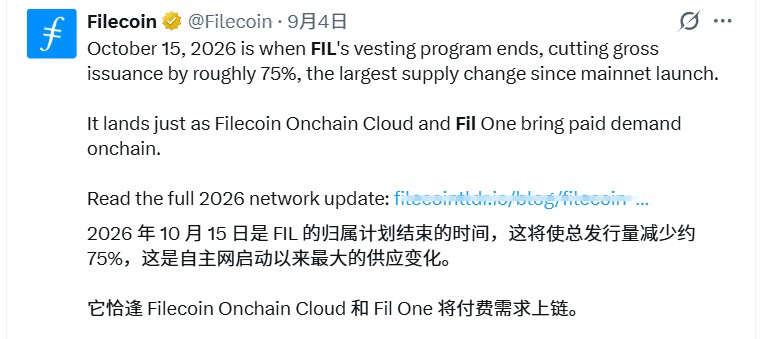
$FIL fil2026 October mid-month, Protocol Labs and the Foundation’s batch of linear unlocks lasting up to 6 years will come to an end.
The official line is: new issuance will be cut by about 75%, and afterward the main source will be block rewards.
The crypto community loves to tell stories like “they’re issuing less.” For FIL, these past years have been weighed down by unlocks. This milestone is clear-cut, not an empty concept.
Couple that with the network pushing paid storage, S3 compatibility (Fil One), and on-chain cloud storage: the direction shifts from “build capacity by piling on compute power” to “real people pay to store data.”
Whether it works or not remains to be seen, but at least the narrative changes—from purely unlocking to dump pressure—to “a bit less supply plus a desire for real demand.”
FIL has fallen from its all-time high by more than 99%—a year ago it was around two dollars; now it’s around eight or nine tenths of a dollar.
The characteristic of these old coins is: once market sentiment turns and capital is willing to rotate into old storage/infrastructure, the upside elasticity can be huge; but in the meantime it’s just a painful grind downward.$FIL
The official line is: new issuance will be cut by about 75%, and afterward the main source will be block rewards.
The crypto community loves to tell stories like “they’re issuing less.” For FIL, these past years have been weighed down by unlocks. This milestone is clear-cut, not an empty concept.
Couple that with the network pushing paid storage, S3 compatibility (Fil One), and on-chain cloud storage: the direction shifts from “build capacity by piling on compute power” to “real people pay to store data.”
Whether it works or not remains to be seen, but at least the narrative changes—from purely unlocking to dump pressure—to “a bit less supply plus a desire for real demand.”
FIL has fallen from its all-time high by more than 99%—a year ago it was around two dollars; now it’s around eight or nine tenths of a dollar.
The characteristic of these old coins is: once market sentiment turns and capital is willing to rotate into old storage/infrastructure, the upside elasticity can be huge; but in the meantime it’s just a painful grind downward.$FIL

静心1688
·
--
💥Misfortune lies in what gives rise to fortune; fortune also lies in what hides misfortune.
💥Explanation: Good fortune is concealed within calamity, and hidden within good fortune are lurking dangers. Misfortune and fortune transform into each other; there is no need for excessive joy or grief over gains and losses.
#代币化股票持有者增长619.1% #美国合众银行完成Stellar跨境支付试点
💥Explanation: Good fortune is concealed within calamity, and hidden within good fortune are lurking dangers. Misfortune and fortune transform into each other; there is no need for excessive joy or grief over gains and losses.
#代币化股票持有者增长619.1% #美国合众银行完成Stellar跨境支付试点


橙子Joyce
·
--
BullishApple’s new CEO John Ternus first publicly outlines his product philosophy, sketching an “Apple in the Ternus era” for the outside world.
Engineers take the helm; the roadmap leaves him “immensely excited”
Ternus officially assumed the role of Apple CEO last week, becoming the highest-ranking leader in Apple’s history with an engineering background. In an exclusive interview, he admitted that for someone steering “one of the world’s most important companies,” the feeling inside him is “excitement that makes the hair stand on end.”
Asked about expectations that his engineering background would “rekindle innovation” at Apple, Ternus did not directly accept that premise. Instead, he stressed that Apple’s innovation has never stopped, and that the new opportunities brought by AI are the biggest driving force right now.
Apple chose to enter the foldable-screen race only after the market matured, reflecting Ternus’s engineering philosophy—prefer to endure the criticism of being “late,” but wait until the durability of the hinge, slimmer design, and system-level interactions are polished to an industrial-grade level before launching into the market.
iPhone’s position is unshaken; Apple reiterates its “personal hub” strategy
Against the backdrop of intensifying competition in AI wearable devices, Ternus clearly rejected the market interpretation that “Apple is shifting its strategic focus from phones to wearables.”
Apple Watch and AirPods are excellent AI devices, but their positioning is as an auxiliary ecosystem built around the iPhone—not a replacement.
Privacy built into the chip, targeting controversy in the wearable market
When asked about the privacy concerns sparked by Meta AI glasses, Ternus pointed to the latest audio-intelligence features released on Apple Watch to explain how Apple’s privacy protections are implemented at the hardware-architecture level.
According to Apple, the feature generates no audio recordings, does not retain text transcriptions, and not even the user themselves can retrieve the data. To achieve this, Apple designed a brand-new chip for the new Apple Watch, embedding an independent secure enclave (exclave). Audio data exists only at the instant it is processed, and is then destroyed.
Jazz, Apple’s senior vice president of hardware engineering, added:
“If we don’t generate a recording, then no one will have a recording. It can’t be attacked by hackers, and it can’t be forcibly retrieved.”
This design logic directly addresses public concerns that AI-driven voice recording-type features may infringe on users’ privacy.
$AAPL.US
Long-term investment in Apple stock
Engineers take the helm; the roadmap leaves him “immensely excited”
Ternus officially assumed the role of Apple CEO last week, becoming the highest-ranking leader in Apple’s history with an engineering background. In an exclusive interview, he admitted that for someone steering “one of the world’s most important companies,” the feeling inside him is “excitement that makes the hair stand on end.”
Asked about expectations that his engineering background would “rekindle innovation” at Apple, Ternus did not directly accept that premise. Instead, he stressed that Apple’s innovation has never stopped, and that the new opportunities brought by AI are the biggest driving force right now.
Apple chose to enter the foldable-screen race only after the market matured, reflecting Ternus’s engineering philosophy—prefer to endure the criticism of being “late,” but wait until the durability of the hinge, slimmer design, and system-level interactions are polished to an industrial-grade level before launching into the market.
iPhone’s position is unshaken; Apple reiterates its “personal hub” strategy
Against the backdrop of intensifying competition in AI wearable devices, Ternus clearly rejected the market interpretation that “Apple is shifting its strategic focus from phones to wearables.”
Apple Watch and AirPods are excellent AI devices, but their positioning is as an auxiliary ecosystem built around the iPhone—not a replacement.
Privacy built into the chip, targeting controversy in the wearable market
When asked about the privacy concerns sparked by Meta AI glasses, Ternus pointed to the latest audio-intelligence features released on Apple Watch to explain how Apple’s privacy protections are implemented at the hardware-architecture level.
According to Apple, the feature generates no audio recordings, does not retain text transcriptions, and not even the user themselves can retrieve the data. To achieve this, Apple designed a brand-new chip for the new Apple Watch, embedding an independent secure enclave (exclave). Audio data exists only at the instant it is processed, and is then destroyed.
Jazz, Apple’s senior vice president of hardware engineering, added:
“If we don’t generate a recording, then no one will have a recording. It can’t be attacked by hackers, and it can’t be forcibly retrieved.”
This design logic directly addresses public concerns that AI-driven voice recording-type features may infringe on users’ privacy.
$AAPL.US
Long-term investment in Apple stock

橙子Joyce
·
--
BullishHow many investment institutions globally allocate BTC?
When you add together global asset management firms, hedge funds, pension funds, insurance companies, family offices, RIAs, and the like, the total is at least tens of thousands to over a hundred thousand.
The approximate situation for institutions that have already allocated BTC is as follows:
• Publicly traceable entities (listed companies, ETFs/funds, governments, etc.) are on the order of a few hundred. In total, they hold about 18% of the BTC supply, and ownership is highly concentrated.
• Among the top 30 RIA firms in the U.S., 29 have already held Bitcoin.
• Survey of financial advisors: In 2025, about 32% of advisors said they allocate crypto assets for clients (22% in 2024). The RIA channel is somewhat higher. Average allocation is still very small.
• Overall, the advisory industry’s allocation to BTC is only about 0.008% of assets under management.
Most are not allocated
• There are about 16,500 U.S. SEC-registered investment advisers (and when including state-registered ones, the number of related firms can reach tens of thousands).
• There are about 149,000 globally regulated open-end funds.
• Hedge funds number roughly 8,000–12,000.
• The number of global asset management firms is even larger (tens of thousands are already captured by only some databases).
• In Bank of America’s 2025 global fund manager survey: about 97% of surveyed fund managers said they have no Bitcoin/crypto exposure.
• An informal survey of about 400 wealth management managers in 2026: 67% of customer portfolios still have no crypto allocation.
If you interpret “investment institutions” as including asset managers, funds, advisory firms, pension funds, insurance companies, etc., then the vast majority have not allocated BTC (by number of firms, very likely over 90%, and under many definitions close to 95%–99%). The institutions that do allocate are mainly concentrated in large U.S. asset managers, some hedge funds, listed company treasuries, and advisors that indirectly buy through spot ETFs.
Allocation adoption is still at an early stage: for institutions that do allocate, typical portfolio weights are commonly only on the order of 1%–2%. The industry-wide share of AUM is even lower. Future growth is mainly expected to come from the advisor channel and from traditional institutions that have not entered yet.
I’ve believed for the past seven or eight years that BTC’s development potential will become broader and more diversified! Invest in BTC, ETH, and BNB regularly!
$BTC
When you add together global asset management firms, hedge funds, pension funds, insurance companies, family offices, RIAs, and the like, the total is at least tens of thousands to over a hundred thousand.
The approximate situation for institutions that have already allocated BTC is as follows:
• Publicly traceable entities (listed companies, ETFs/funds, governments, etc.) are on the order of a few hundred. In total, they hold about 18% of the BTC supply, and ownership is highly concentrated.
• Among the top 30 RIA firms in the U.S., 29 have already held Bitcoin.
• Survey of financial advisors: In 2025, about 32% of advisors said they allocate crypto assets for clients (22% in 2024). The RIA channel is somewhat higher. Average allocation is still very small.
• Overall, the advisory industry’s allocation to BTC is only about 0.008% of assets under management.
Most are not allocated
• There are about 16,500 U.S. SEC-registered investment advisers (and when including state-registered ones, the number of related firms can reach tens of thousands).
• There are about 149,000 globally regulated open-end funds.
• Hedge funds number roughly 8,000–12,000.
• The number of global asset management firms is even larger (tens of thousands are already captured by only some databases).
• In Bank of America’s 2025 global fund manager survey: about 97% of surveyed fund managers said they have no Bitcoin/crypto exposure.
• An informal survey of about 400 wealth management managers in 2026: 67% of customer portfolios still have no crypto allocation.
If you interpret “investment institutions” as including asset managers, funds, advisory firms, pension funds, insurance companies, etc., then the vast majority have not allocated BTC (by number of firms, very likely over 90%, and under many definitions close to 95%–99%). The institutions that do allocate are mainly concentrated in large U.S. asset managers, some hedge funds, listed company treasuries, and advisors that indirectly buy through spot ETFs.
Allocation adoption is still at an early stage: for institutions that do allocate, typical portfolio weights are commonly only on the order of 1%–2%. The industry-wide share of AUM is even lower. Future growth is mainly expected to come from the advisor channel and from traditional institutions that have not entered yet.
I’ve believed for the past seven or eight years that BTC’s development potential will become broader and more diversified! Invest in BTC, ETH, and BNB regularly!
$BTC

自由1688
·
--
Anthropic’s CEO Says the “China Factor” Is the Biggest Challenge in Slowing the AI Race
Debate in the artificial intelligence industry over whether development speed should be slowed is heating up rapidly, and China has been pushed to the center of this discussion. Recently, Dario Amodei, CEO of Anthropic, publicly stated that if the world attempts to set speed limits on AI development, the biggest practical challenge would not lie in the technology itself, but in how to deal with the possibility that competitive players such as China may continue to accelerate their efforts.
Debate in the artificial intelligence industry over whether development speed should be slowed is heating up rapidly, and China has been pushed to the center of this discussion. Recently, Dario Amodei, CEO of Anthropic, publicly stated that if the world attempts to set speed limits on AI development, the biggest practical challenge would not lie in the technology itself, but in how to deal with the possibility that competitive players such as China may continue to accelerate their efforts.

Log in to explore more content