
Gm, #学堂日报 9.10 Market Overview
1️⃣ Market Snapshot
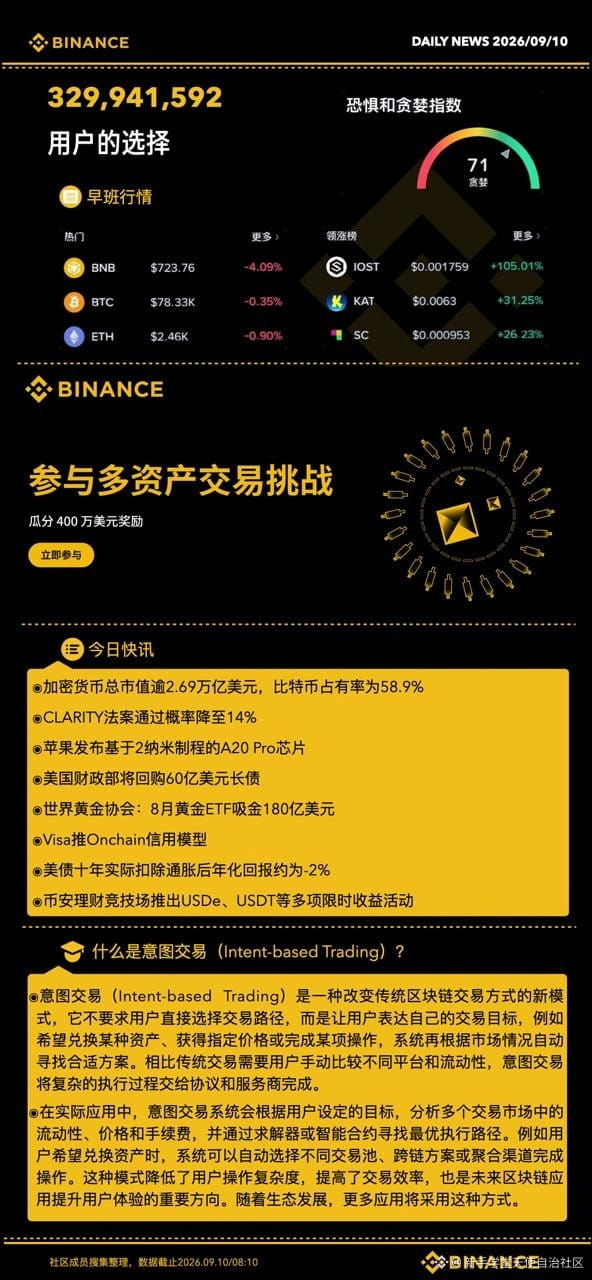
▪ Total crypto market cap is about $2.69 trillion, with Bitcoin’s dominance at 58.9%.
▪ The Fear & Greed Index is 71 (Greed); market sentiment remains in a relatively strong range.
2️⃣ Binance Updates
▪ Binance has launched a multi-asset trading challenge; users can participate to split a $4 million reward pool.
▪ The Binance Savings Arena has introduced multiple time-limited yield activities for USDe, USDT, and more, continuing to enrich stablecoin and yield product choices.
▪ Binance keeps expanding multi-asset trading and savings scenarios, further catering to users with different risk preferences.
3️⃣ Industry Highlights
▪ Market forecasts suggest the CLARITY Act has about a 14% chance of passing within the year; U.S. crypto regulatory progress still carries significant uncertainty.
▪ Apple unveiled the A20 Pro chip based on a 2nm process; advanced-process and AI hardware remain in focus.
▪ The U.S. Department of the Treasury plans to repurchase about $6 billion in long-term bonds; the market is watching its impact on liquidity and the bond market.
▪ Data from the World Gold Council shows that in August, gold ETFs attracted about $18 billion; demand for safe-haven assets remains strong.
▪ Visa launched an onchain credit model; traditional payments giants continue exploring onchain credit and financial services.
▪ The annualized return for U.S. 10-year real inflation-adjusted data is about -2%; pressure on long-term real yields remains a concern.
4️⃣ Today’s Quick Lesson: What Is Intent-Based Trading?
🔸 What is intent-based trading?
▪ Intent-based trading doesn’t require users to specify step by step things like “which platform,” “how to swap,” and “which chain route.” Instead, it lets users express the final goal directly.
▪ For example: “I want to swap 1 ETH for as much USDC as possible,” and the system will automatically look for a better execution strategy.
🔸 How does it work?
▪ The system compares different DEXs, liquidity pools, cross-chain routes, fees, and prices.
▪ Then a solver or smart agent finds the more optimal execution path to help users complete the trade.
🔸 How is it different from traditional trading?
▪ Traditional onchain trading often requires users to do their own price checks and select the network and route.
▪ Intent-based trading hands those complex steps to the system, so users only need to focus on “what result I want to achieve.”
Follow @新手学堂天使自治社区 for more updates 🚀
1️⃣ Market Snapshot
▪ Total crypto market cap is about $2.69 trillion, with Bitcoin’s dominance at 58.9%.
▪ The Fear & Greed Index is 71 (Greed); market sentiment remains in a relatively strong range.
2️⃣ Binance Updates
▪ Binance has launched a multi-asset trading challenge; users can participate to split a $4 million reward pool.
▪ The Binance Savings Arena has introduced multiple time-limited yield activities for USDe, USDT, and more, continuing to enrich stablecoin and yield product choices.
▪ Binance keeps expanding multi-asset trading and savings scenarios, further catering to users with different risk preferences.
3️⃣ Industry Highlights
▪ Market forecasts suggest the CLARITY Act has about a 14% chance of passing within the year; U.S. crypto regulatory progress still carries significant uncertainty.
▪ Apple unveiled the A20 Pro chip based on a 2nm process; advanced-process and AI hardware remain in focus.
▪ The U.S. Department of the Treasury plans to repurchase about $6 billion in long-term bonds; the market is watching its impact on liquidity and the bond market.
▪ Data from the World Gold Council shows that in August, gold ETFs attracted about $18 billion; demand for safe-haven assets remains strong.
▪ Visa launched an onchain credit model; traditional payments giants continue exploring onchain credit and financial services.
▪ The annualized return for U.S. 10-year real inflation-adjusted data is about -2%; pressure on long-term real yields remains a concern.
4️⃣ Today’s Quick Lesson: What Is Intent-Based Trading?
🔸 What is intent-based trading?
▪ Intent-based trading doesn’t require users to specify step by step things like “which platform,” “how to swap,” and “which chain route.” Instead, it lets users express the final goal directly.
▪ For example: “I want to swap 1 ETH for as much USDC as possible,” and the system will automatically look for a better execution strategy.
🔸 How does it work?
▪ The system compares different DEXs, liquidity pools, cross-chain routes, fees, and prices.
▪ Then a solver or smart agent finds the more optimal execution path to help users complete the trade.
🔸 How is it different from traditional trading?
▪ Traditional onchain trading often requires users to do their own price checks and select the network and route.
▪ Intent-based trading hands those complex steps to the system, so users only need to focus on “what result I want to achieve.”
Follow @新手学堂天使自治社区 for more updates 🚀