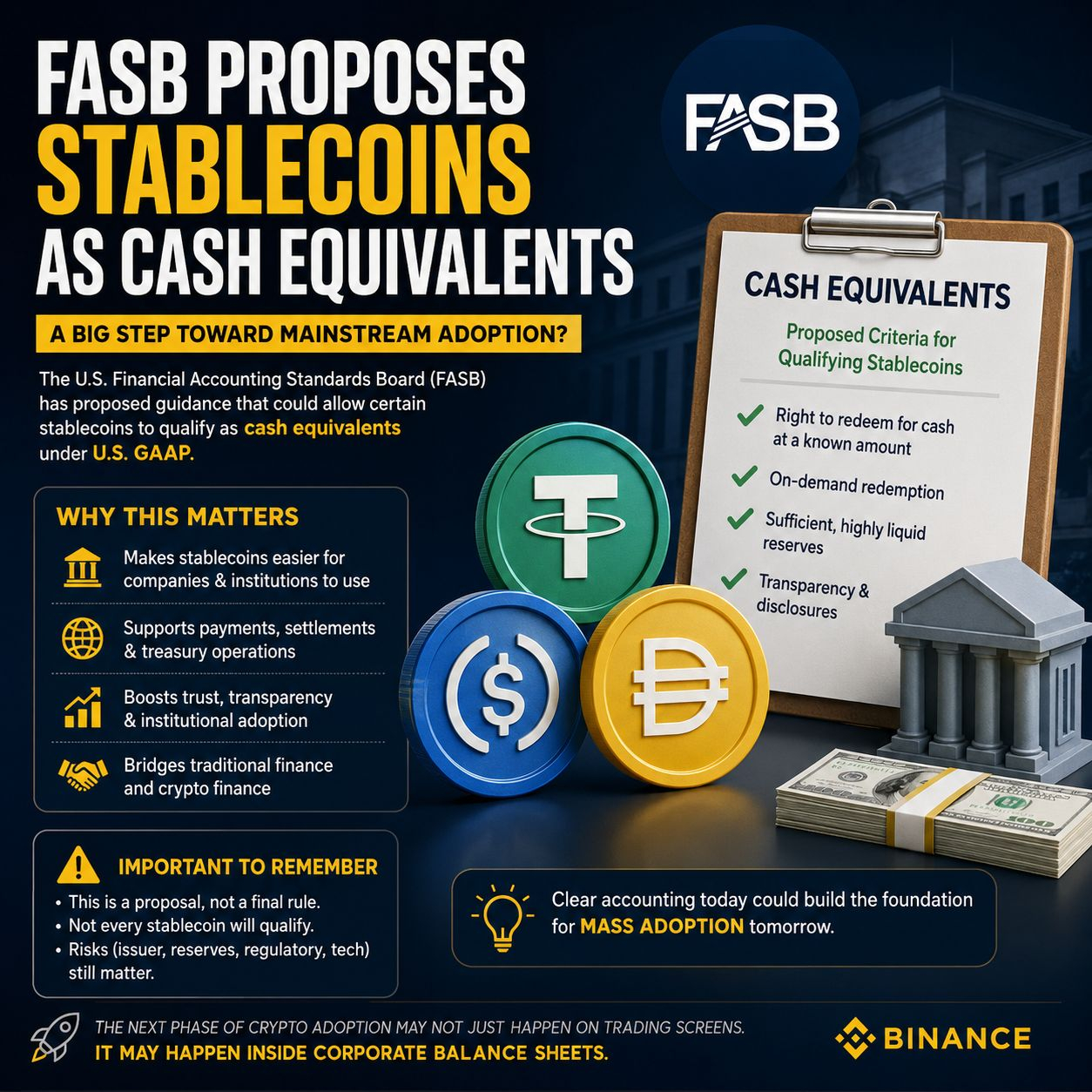

FASB Proposes Stablecoins as Cash Equivalents — Why This Matters for Crypto 👀
There’s an interesting development happening in the U.S. accounting world that crypto investors should pay attention to.
The Financial Accounting Standards Board (FASB) has proposed guidance that could allow certain stablecoins to qualify as cash equivalents under U.S. GAAP.
Now, this does NOT mean that every stablecoin is officially “cash.”
But it could be an important step toward making stablecoins easier for companies and institutions to use and account for.
So, what is FASB actually proposing?
The idea is that some stablecoins could potentially meet the existing definition of a cash equivalent if they have the right characteristics.
For example, a qualifying stablecoin would generally need:
🔹 A clear right to redeem the token for a known amount of cash
🔹 On-demand redemption
🔹 Sufficient liquid reserves backing the tokens
🔹 Reserves that are highly liquid and properly maintained
🔹 Clear information and disclosures for users and investors
In simple words:
If a stablecoin behaves more like a highly liquid digital dollar than a speculative crypto asset, it may have a stronger case for cash-equivalent treatment.
Why should crypto investors care?
This is bigger than accounting.
Think about how businesses look at money.
Companies want assets that are:
✅ Liquid
✅ Easy to redeem
✅ Low in price volatility
✅ Easy to understand
✅ Easy to report on their financial statements
If certain stablecoins receive clearer accounting treatment, it could remove one more obstacle for businesses and institutions considering their use.
And that could support wider adoption of stablecoins for:
💵 Corporate treasury
🌍 Cross-border payments
⚡ Faster settlement
🏦 Institutional liquidity
🔄 Digital payments
📊 On-chain financial operations
But there is an important catch ⚠️
Don't read this headline as:
“FASB says stablecoins are cash.”
That's not what is happening.
This is a proposal, and only stablecoins that satisfy specific conditions could potentially qualify.
Also, accounting classification does not automatically mean that a stablecoin is risk-free.
You still have to think about:
• Issuer risk
• Reserve quality
• Redemption risk
• Regulatory risk
• Smart-contract and technology risk
• Counterparty risk
My take 👇
I think this is one of those developments that may look boring at first but could become important over time.
Crypto adoption isn't only about Bitcoin prices going up.
Sometimes the bigger story is what happens behind the scenes — accounting rules, regulation, payments, custody and institutional infrastructure.
If stablecoins become easier for companies to hold and report, that could make them more useful as a bridge between traditional finance and blockchain-based finance.
And that's something worth watching.
The next phase of crypto adoption may not just happen on trading screens. It may happen inside corporate balance sheets.
What do you think?
Could clearer accounting treatment accelerate institutional stablecoin adoption? 👇
Follow https://zenvestai.com