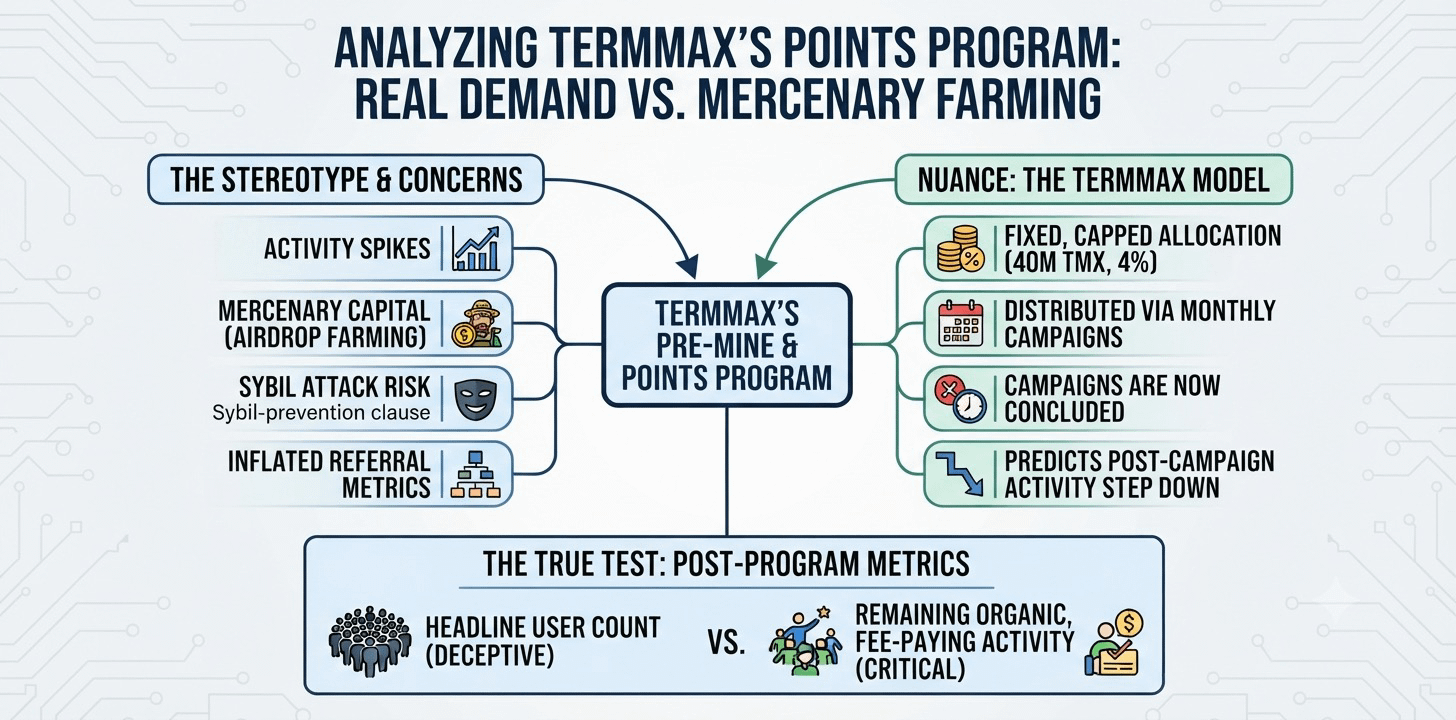
Every DeFi protocol running a points program eventually has to answer the same uncomfortable question: how much of this activity is real demand, and how much is mercenary capital farming a future token. TermMax's own numbers, over 1 million users, 837,000 registered wallets, a reported peak of 170,000 daily active users across more than 100 markets, invite exactly that scrutiny, because they were substantially built during a pre-mine phase explicitly designed to reward participation before TMX existed as a tradable token.
The stereotype is well earned across the category. Points programs reliably produce activity spikes that collapse the moment rewards stop, because a meaningful share of that volume was never about the product, it was about positioning for an airdrop. TermMax's own leaderboard documentation even includes a Sybil-prevention clause reserving the right to retroactively revoke rewards from detected Sybil activity, which is itself an admission that farmed, non-organic participation was a live concern worth building defenses against from the start. A tiered referral system stacked on top, rewarding users for bringing in active referees, adds another lever that can inflate headline numbers without necessarily reflecting deeper organic conviction in the product.
Here is where I think the picture gets more nuanced than the stereotype allows. Unlike a protocol paying out inflationary emissions indefinitely, TermMax's pre-mine was a fixed, capped allocation, 40 million TMX, 4% of total supply, distributed once through monthly campaigns and then finished for good. Activity generated purely to farm a program that has already concluded should, in theory, show up as a step down in usage now rather than a permanent floor propped up by ongoing rewards. Whether that step down actually happened, and how much real fee-paying activity remains underneath it, is the number worth checking directly rather than assuming from the headline user count alone.
@TermMax #TermMax