



Jupiter (JUP) is the leading decentralized exchange aggregator on Solana, helping users find the best prices in liquidity pools. After announcing partnerships with Securitize and Jump Trading Group to bring regulated tokenized stocks to the Solana (SOL) blockchain, the stock surged by 34%.
After a prolonged cooldown from usage and token market activity, this protocol has been given a stronger institutional narrative than the memecoin trading cycles that supported the Solana decentralized finance (DeFi) ecosystem over the past year. The harder question is whether this marks the beginning of a structural shift or just a timely relief rebound.
From a meme-coin generator to regulated finance
Jupiter has long been one of Solana’s most important applications. It started as a swap aggregator that helped users route trades through Solana’s liquidity channels to achieve better pricing and efficiency, but it gradually expanded into a broader DeFi platform covering swaps, perpetual futures, liquidity provision, lending, and other on-chain financial tools. During Solana’s memecoin boom, Jupiter became an important trading gateway. This cemented its position as one of the core distribution layers in the chain, but it also made the protocol exposed to the speculative cycles that drive its growth.
This new partnership is designed to go beyond that framework. Under the structure that has been announced, Securitize—an established platform for originating and managing tokenized real-world assets (RWA)—and fully compliant with regulatory requirements, will provide regulated securities infrastructure. Jump Trading Group, a well-known proprietary trading and market-making firm, will provide liquidity through its PropAMM technology. Jupiter will serve as the user-facing access point. In simple terms, the goal is to let users trade tokenized versions of real stocks on Solana through familiar DeFi interfaces while operating within a regulated market structure.
Tokenized stocks are not new, but many earlier attempts produced thin, hard-to-validate products—such as synthetic wrapping, offshore experiments, or structures with unclear regulation. This partnership feels more serious because Securitize brings robust compliance and institutional influence. The company works with major asset managers and regulated entities, including broker-dealers, transfer agents, and alternative trading system infrastructure. Timing also matters: shortly before the Jupiter partnership was announced, Securitize announced an expanded approval from FINRA (the U.S. securities self-regulatory organization). This enables its subsidiaries to custody tokenized securities, support atomic settlement, and integrate with on-chain stablecoin settlement trades.
For Jupiter, the strategic logic is clear. If tokenized stocks gain traction, the protocol could surpass Solana’s dominant swap-routing router. It could become a gateway between traditional financial assets and on-chain users. That would give Jupiter a more durable growth path and reduce reliance on meme-coin cycles and retail trading frenzy. For Solana, this partnership strengthens the institutional narrative: high-throughput settlement, low fees, and real assets flowing through public blockchain rails. For JUP holders, the bull case is that new trading flows will ultimately translate into higher revenue, stronger fee capture, and more meaningful value accumulation.
The metrics still show a cooling of the protocol
The current data doesn’t yet support a clean, convincing transformation story. Since the memecoin peak in early 2025, Jupiter’s activity metrics have dropped sharply. In January 2025, weekly active addresses were around 3.4 million, but the latest data shows roughly 540,000 at the beginning of May 2026—a decline of 84%. Trading volume shows a similar pattern: from about 222 million weekly trades at the January 2025 high down to roughly 36 million by the end of April 2026—also down about 84%. Taken together, these numbers make it hard to say Jupiter’s core usage has recovered, even though it remains Solana’s dominant DEX aggregator platform compared with peers like Raydium and Orca.
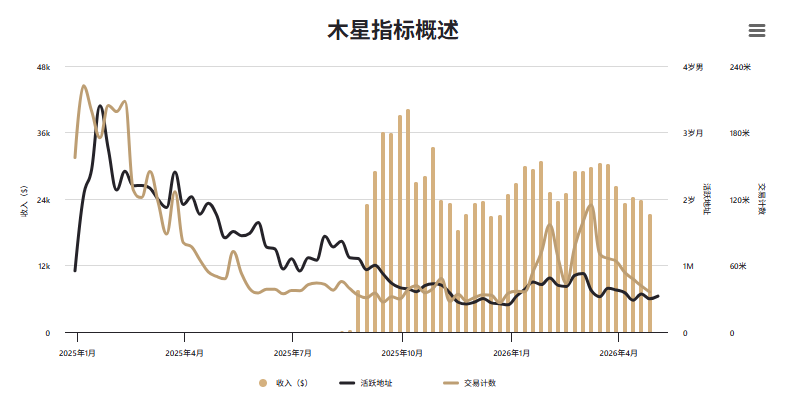
Revenue data adds yet another layer of caution. In early October 2025, weekly revenue peaked at roughly $40,300, while the latest figures show about $21,300 at the end of April 2026. This doesn’t mean Jupiter is structurally broken, but it does show that the protocol hasn’t regained its earlier momentum.
That’s why tokenized-stock partnerships matter—but they shouldn’t be overhyped. They give Jupiter a credible new direction, at a time when the old ecosystem engine has cooled. If regulated stocks can bring Jupiter new users, sustained trading volumes, and higher-quality trading activity, this partnership could mark the start of a broader repositioning. Jupiter would be seen less as a Solana meme-trading platform and more as a distribution layer for regulated on-chain finance.
However, risks remain. Regulated stocks require compliance, know-your-customer (KYC) checks, and whitelisted wallets. This makes the product more credible, but also less naturally spreadable than ordinary DeFi trading. In 2026, cross-border tokenized securities traded on public blockchains may face regulatory hurdles that could increase friction. Meme coins spread because they’re frictionless; tokenized securities won’t behave the same way. Fee economics is also still an open question. Even if trading volume grows, it’s unclear how much value Jupiter will capture relative to Securitize, Jump, issuers, liquidity providers, or other intermediaries. Tokenized securities are also harder to compose than typical DeFi assets, because regulated transfer restrictions limit their free movement across protocols.
Credible transformation, but not a turnaround yet
So the conclusion is nuanced. Jupiter’s rebound isn’t baseless: the partnership has strategic significance, and Securitize gives this announcement more credibility than a typical crypto-RWA headline. But the data suggests the protocol is rolling back from a major speculative peak—active users, transaction volume, and revenue are all far below historical highs. The market is now assessing whether Jupiter could evolve into something bigger than just a meme-coin trading gateway. The protocol now has to prove it.
This development aligns with Solana’s overall RWA trend for 2026: strong growth in the value of tokenized assets amid rising institutional interest in on-chain stocks and settlement. The key metrics are simple to watch: which stocks are listed, how much capital is committed to the fund, how tight the spreads are, how much settlement volume flows through Jupiter, and whether these activities contribute meaningfully to protocol revenue. Until these data points appear, Securitize’s partnership should be viewed as a credible bullish option for regulated on-chain finance—not evidence of a fundamental turnaround yet.